
Brazil Rail Freight Transport Market Size and Share
| Study Period | 2019 - 2030 |
| Forecast Data Period | 2025 - 2030 |
| Historical Data Period | 2019 - 2023 |
| Market Size (2025) | USD 7.39 Billion |
| Market Size (2030) | USD 9.11 Billion |
| CAGR (2025 - 2030) | 4.34% |
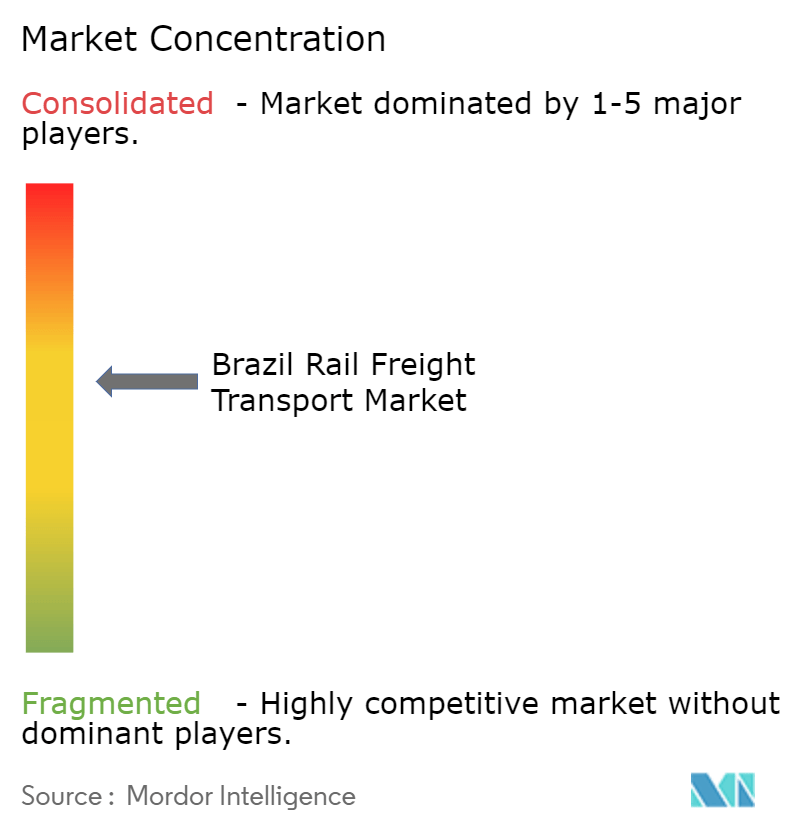
| Market Concentration | Medium |
Major Players *Disclaimer: Major Players sorted in no particular order |
Brazil Rail Freight Transport Market Analysis by Mordor Intelligence
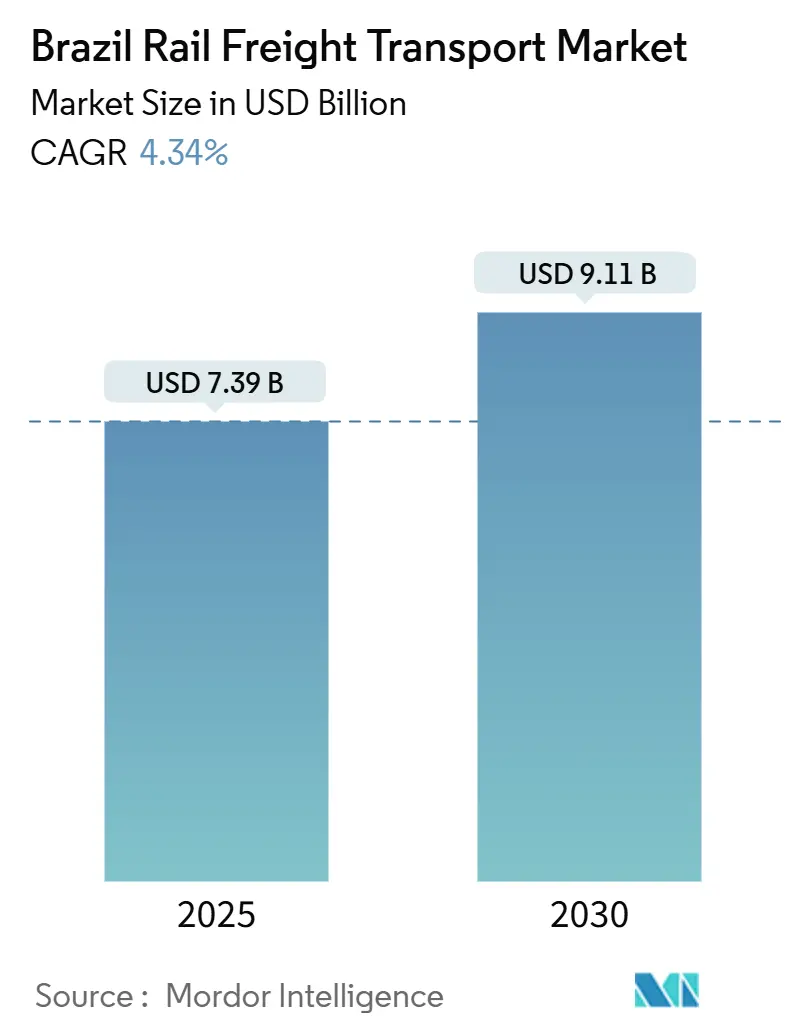
The Brazil Rail Freight Transport Market size is estimated at USD 7.39 billion in 2025, and is expected to reach USD 9.11 billion by 2030, at a CAGR of 4.34% during the forecast period (2025-2030).
Brazil's rail freight transport market is undergoing a transformation, driven by substantial investments in infrastructure, fleet upgrades, and sustainability efforts. These initiatives aim to boost operational efficiency and cater to the nation's expanding logistics needs. Recent investments in new port terminals are enhancing Brazil's integrated transport infrastructure.
In April 2024, Rumo, Brazil's leading private freight railroad operator, partnered with DP World to build a new port terminal at the Port of Santos. The BRL 2.5 billion (USD 500 million) project will increase the port’s capacity by 12.5 million tonnes annually, including 9 million tonnes of grains and 3.5 million tonnes of fertilizers. Located on DP World’s private terminal, the project awaits regulatory approval and is expected to be completed in 30 months. The agreement includes a 30-year operational period with potential extensions. It also aligns with Rumo’s strategy to expand its rail network in the Midwest through the State Railway of Mato Grosso project.
Brazilian rail freight operators are modernizing fleets with advanced wagons and locomotives to boost efficiency and sustainability. In March 2024, MRS Logistics invested BRL 1 billion (USD 203 million) in rolling stock, ordering 560 gondola wagons from Greenbrier Maxion (GBMX) and 30 locomotives from Wabtec. These upgrades align with MRS’s strategy to enhance productivity and sustainability. Operating a 1,643 km rail network across Minas Gerais, Rio de Janeiro, and São Paulo, MRS handles 20% of Brazil’s exports and one-third of its rail freight.
Brazil is undertaking initiatives to reactivate dormant railroads, aiming to improve the sustainability and competitiveness of its rail freight sector, which plays a critical role in the country's logistics and supply chain efficiency. In December 2024, the Inter-American Development Bank (IDB) and Infra S.A., linked to Brazil’s Transportation Ministry, began studies to revitalize 10,000 km of inactive rail sections. Using data from the National Logistics Plan, these studies will assess the feasibility of redeveloping critical corridors, including São Luís to Fortaleza. The project aims to increase rail transport's share in Brazil’s logistics matrix and reduce carbon emissions through targeted concessions. Pre-feasibility studies will conclude in six months, followed by technical, economic, and environmental feasibility studies within 12 months.
Hence, the Brazil's rail freight market is undergoing significant transformation, driven by investments in infrastructure, fleet upgrades, and sustainability initiatives. With key developments including the establishment of new port terminals, fleet modernization efforts, and the reactivation of dormant railroads. These measures aim to improve operational efficiency, expand the rail network, and minimize environmental impact, aligning with Brazil's increasing logistics and transportation requirements.
Brazil Rail Freight Transport Market Trends and Insights
Growth in Containerized Cargo Transport in Brazil
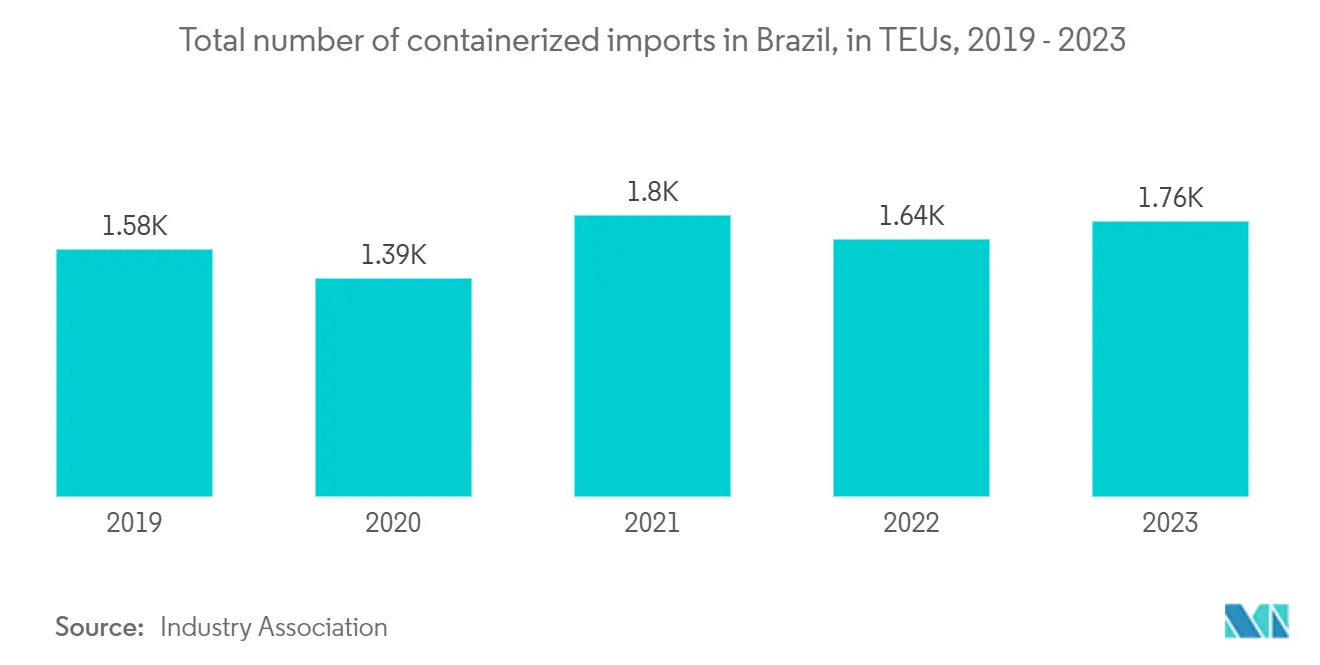
Brazil's containerized cargo transport sector demonstrates significant growth, emphasizing the increasing importance of containerized shipping in the nation's logistics operations. By December 2024, Brazil's containerized cargo throughput for October reached 12.1 million tons, equivalent to 1.1 million TEUs (twenty-foot equivalent units), reflecting a 9.66% increase. Long-haul trade contributed substantially, handling 0.8 million TEUs. This growth highlights the rising demand for containerized cargo and improved operational efficiency at Brazilian ports. The National Waterway Transportation Agency (ANTAQ) reported a 3.32% decline in total cargo volumes across Brazil’s port sector; however, containerized shipping recorded notable gains, reinforcing its critical role in Brazil’s trade infrastructure.
The freight forwarding market in Brazil is experiencing significant expansion, marked by the establishment of new offices across the country. In October 2024, DP World, a global logistics leader, inaugurated a new freight forwarding office in Itajaí, Brazil. This strategic move aims to strengthen its market presence and enhance connectivity in the Latin American region. The office offers services such as sea freight for both full container load (FCL) and less container load (LCL), highlighting DP World's commitment to meeting the increasing demand for containerized cargo transport.This expansion emphasizes the critical role of containerized transport in enhancing regional connectivity and supporting Brazil’s trade growth.
Brazil's port sector has experienced several noteworthy acquisitions in recent times, reflecting increased business activity in the market. In September 2024, CMA CGM, the world’s third-largest container shipping company, announced plans to acquire Santos Brasil, operator of South America’s largest container terminal at the Port of Santos. The BRL 12.49 billion (USD 2 billion) deal strengthens CMA CGM’s position in Brazil and highlights its focus on expanding containerized shipping in the region. The acquisition is expected to reduce vessel wait times, enhance capacity, and improve efficiencies at Brazil’s busiest container terminal.


Expansion of Integrated Logistics Services in Brazil
In 2024, Brazil's rail freight sector achieved significant advancements to enhance integrated logistics services. The country has been actively collaborating with international partners to improve its practices. In October 2024, the U.S. Trade and Development Agency (USTDA) hosted a reverse trade mission in the U.S. for leaders of Brazil's rail sector. This initiative aimed to establish partnerships with U.S. industries and expedite the modernization and decarbonization of Brazil’s freight rail network. The delegation's interactions with U.S. companies and trade associations, along with demonstrations of advanced technologies, underscore Brazil's focus on integrating innovative solutions into its rail logistics.
Simultaneously, the Brazilian government has taken strategic measures to improve logistics services within the rail freight sector. In November 2024, the government established a permanent interdisciplinary commission to oversee railway projects managed by freight concessionaires. This commission, comprising representatives from various governmental bodies, is responsible for monitoring studies, defining guidelines, and supporting decision-making related to rail transport. Such oversight is critical for ensuring the effective integration of logistics services in the rail freight sector.
Private companies have also been actively pursuing contracts to enhance the efficiency and quality of railway infrastructure. In January 2024, Vale S.A. renegotiated key railway concession contracts for the Carajás Railway (EFC) and the Vitória a Minas Railway (EFVM) with local authorities. The company committed approximately BRL11 billion (USD 1.78 billion) to improve the infrastructure and operational efficiency of these railways. This investment is expected to strengthen logistics service integration, enabling more efficient freight transport across Brazil.

Competitive Landscape
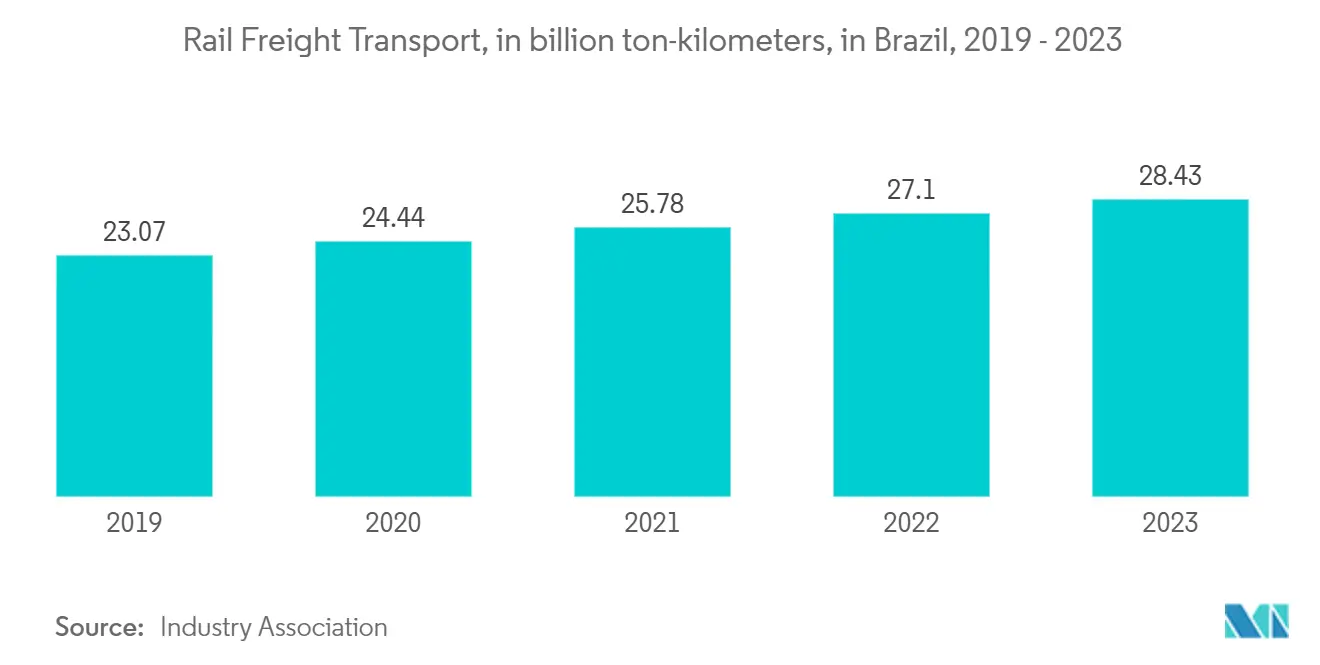
Brazil's rail freight transport market is driven by the nation's strong agricultural and mineral exports. Major players are modernizing rail infrastructure, increasing capacity, and improving operational efficiency to address the growing demand. Investments in digital technologies, such as real-time tracking and multimodal solutions, are being adopted to streamline operations and enhance service quality. The competitive landscape is shaped by efforts to reduce logistics costs and tackle challenges like labor strikes and infrastructure limitations. As the market evolves, companies are focusing on innovation and digitalization to maintain a competitive edge in this dynamic environment.
Brazil Rail Freight Transport Industry Leaders
Rumo Logística
MRS Logística
DP World
Iridium Communications
U.S. Trade and Development Agency (USTDA)
- *Disclaimer: Major Players sorted in no particular order

Recent Industry Developments
- October 2024: Iridium Communications partnered with Satcom Direct Brasil and MRS Logística to deploy Iridium Certus satellite connectivity on MRS’s railway network, a key development for Brazil’s rail freight sector. The service enables real-time communication between train operators and control centers, enhancing safety, efficiency, and traffic management. This solution strengthens MRS’s cargo logistics capabilities, critical for Brazil’s export and freight operations. Iridium’s satellite network ensures reliable communication with better coverage and resilience in adverse weather.
- March 2024: VLI Logistics in Brazil contracted Progress Rail to supply eight EMD SD70ACe-BB diesel-electric locomotives for BRL 170 million (USD 34 million). Designed for Brazilian railways, these 4300-horsepower locomotives with a top speed of 110 km/h will boost freight transport efficiency. This deal continues VLI’s fleet modernization efforts, following a prior agreement with Wabtec. The investment aligns with Brazil’s goal to enhance railway infrastructure and drive economic growth through efficient cargo transport.


Brazil Rail Freight Transport Market Report Scope
The Brazil rail freight market is critical for transporting goods, particularly bulk commodities such as agricultural products and minerals. This rail freight system is a key component of the logistics industry, delivering a cost-effective and efficient solution for moving large cargo volumes, especially to ports for export.
The report provides a comprehensive background analysis of the Brazil Rail Freight Transport market, covering the current market trends, restraints, technological updates, and detailed information on various segments and the industry's competitive landscape. Additionally, the impact of geopolitics and the pandemic has been incorporated and considered during the study. The Brazil Rail Freight Transport market is segmented By Cargo Type (Containerized, Non-Containerized and Liquid Bulk), By Service Type (Transportation and Services Allied to Transportation). The report offers the Brazil Rail Freight Transport market size and forecasts in values (USD) for all the above segments.
| Containerized |
| Non-Containerized |
| Liquid Bulk |
| Transportation |
| Services Allied to Transportation |
| By Type of Cargo | Containerized |
| Non-Containerized | |
| Liquid Bulk | |
| By Service Type | Transportation |
| Services Allied to Transportation |


Key Questions Answered in the Report
How big is the Brazil Rail Freight Transport Market?
The Brazil Rail Freight Transport Market size is expected to reach USD 7.39 billion in 2025 and grow at a CAGR of 4.34% to reach USD 9.11 billion by 2030.
What is the current Brazil Rail Freight Transport Market size?
In 2025, the Brazil Rail Freight Transport Market size is expected to reach USD 7.39 billion.
Who are the key players in Brazil Rail Freight Transport Market?
Rumo Logística, MRS Logística, DP World, Iridium Communications and U.S. Trade and Development Agency (USTDA) are the major companies operating in the Brazil Rail Freight Transport Market.
What years does this Brazil Rail Freight Transport Market cover, and what was the market size in 2024?
In 2024, the Brazil Rail Freight Transport Market size was estimated at USD 7.07 billion. The report covers the Brazil Rail Freight Transport Market historical market size for years: 2019, 2020, 2021, 2022, 2023 and 2024. The report also forecasts the Brazil Rail Freight Transport Market size for years: 2025, 2026, 2027, 2028, 2029 and 2030.
Page last updated on:
Brazil Rail Freight Transport Market Report
Statistics for the 2025 Brazil Rail Freight Transport market share, size and revenue growth rate, created by Mordor Intelligence™ Industry Reports. Brazil Rail Freight Transport analysis includes a market forecast outlook for 2025 to 2030 and historical overview. Get a sample of this industry analysis as a free report PDF download.


 Your data is secure and never sold or shared.


