
Market Overview
| Study Period | 2020 - 2031 |
|---|---|
| Forecast Data Period | 2026 - 2031 |
| Historical Data Period | 2020 - 2024 |
| Market Size (2026) | USD 11.59 Billion |
| Market Size (2031) | USD 15.44 Billion |
| Growth Rate (2026 - 2031) | 5.90 % |
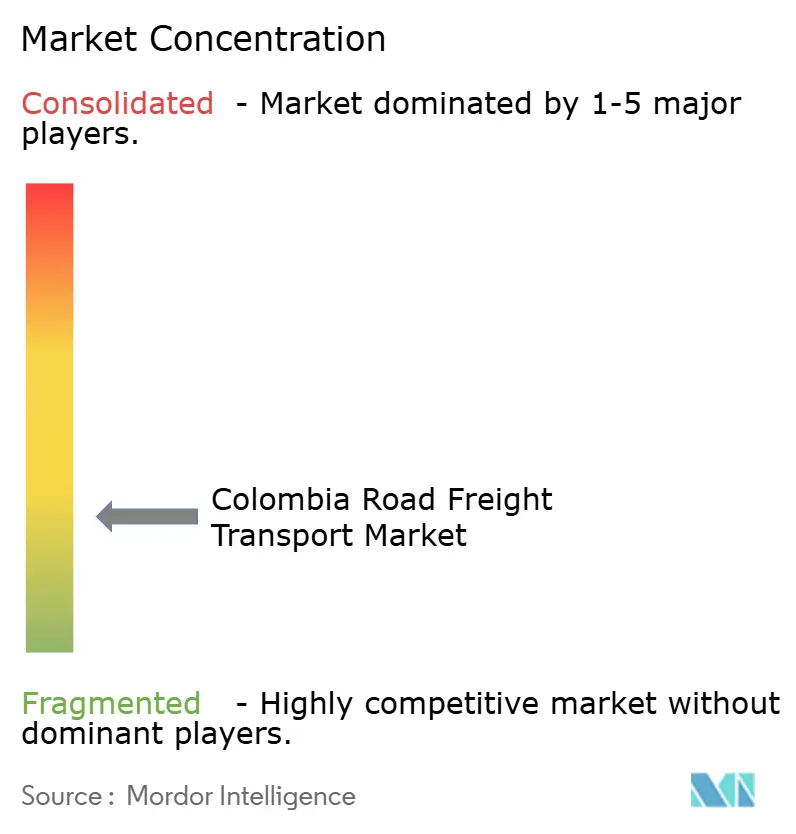
| Market Concentration | Low |
Major Players *Disclaimer: Major Players sorted in no particular order Image © Mordor Intelligence. Reuse requires attribution under CC BY 4.0. | |
Colombia Road Freight Transport Market Analysis by Mordor Intelligence
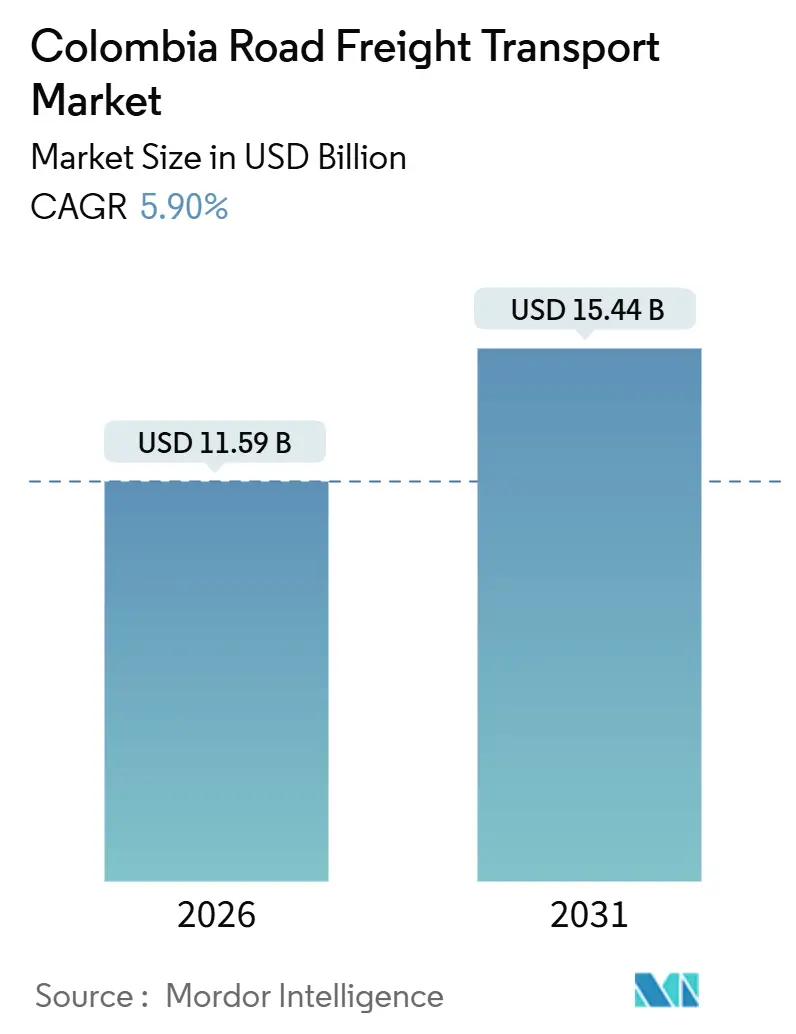
The Colombia Road Freight Transport Market size is estimated at USD 11.59 billion in 2026, and is expected to reach USD 15.44 billion by 2031, at a CAGR of 5.90% during the forecast period (2026-2031).
The trajectory captures Colombia’s role as a logistics bridge between Pacific and Caribbean trade lanes, while chronic cost friction, 18% of shipment value versus the 8% OECD benchmark, continues to erode margins. Capacity upgrades under the 4G highway program have trimmed trunk-route travel times, yet unpaved rural roads, high diesel prices, and an aging truck fleet keep operating costs elevated. Growth catalysts include nearshoring-led manufacturing relocation, a more than 10-fold rise in parcel volumes since 2010, which is reshaping the less-than-truckload (LTL) arena, and a wave of foreign direct investment in free-trade-zone (FTZ) warehousing. Competitive differentiation now hinges on digital control towers, electric-truck pilots, and bonded storage footprints, even as policy uncertainty and cargo theft constrain short-term confidence. Despite these headwinds, sustained export demand for coal, crude, and perishables keeps long-haul lanes busy, underpinning the revenue outlook of the Colombia road freight transport market.
Key Report Takeaways
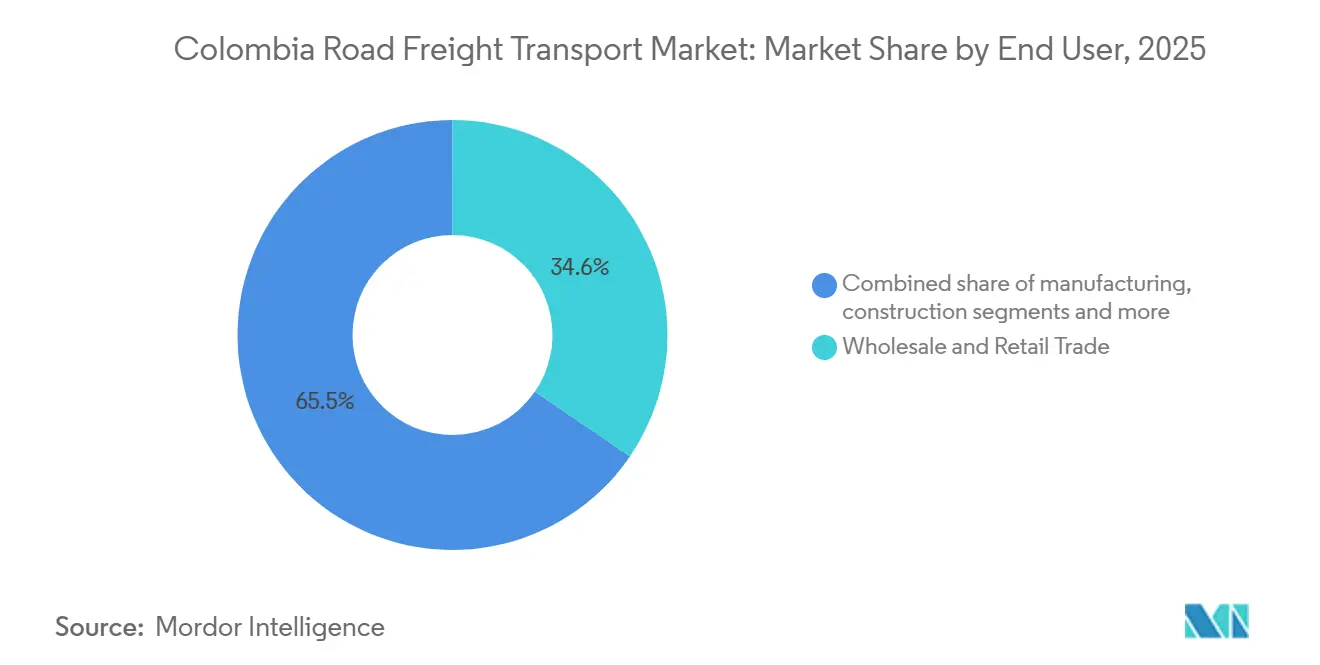
- By end user, wholesale & retail trade led with a 34.55% share of Colombia's road freight transport market in 2025, while also delivering the fastest growth of 6.34% CAGR through 2031.
- By destination, domestic freight controlled 63.57% of tonnage in 2025; international flows are on track for the highest 6.87% CAGR to 2031.
- By truckload specification, full truckload captured 77.65% of Colombia road freight transport market share in 2025, whereas less-than-truckload is forecast to expand at a 6.65% CAGR to 2031.
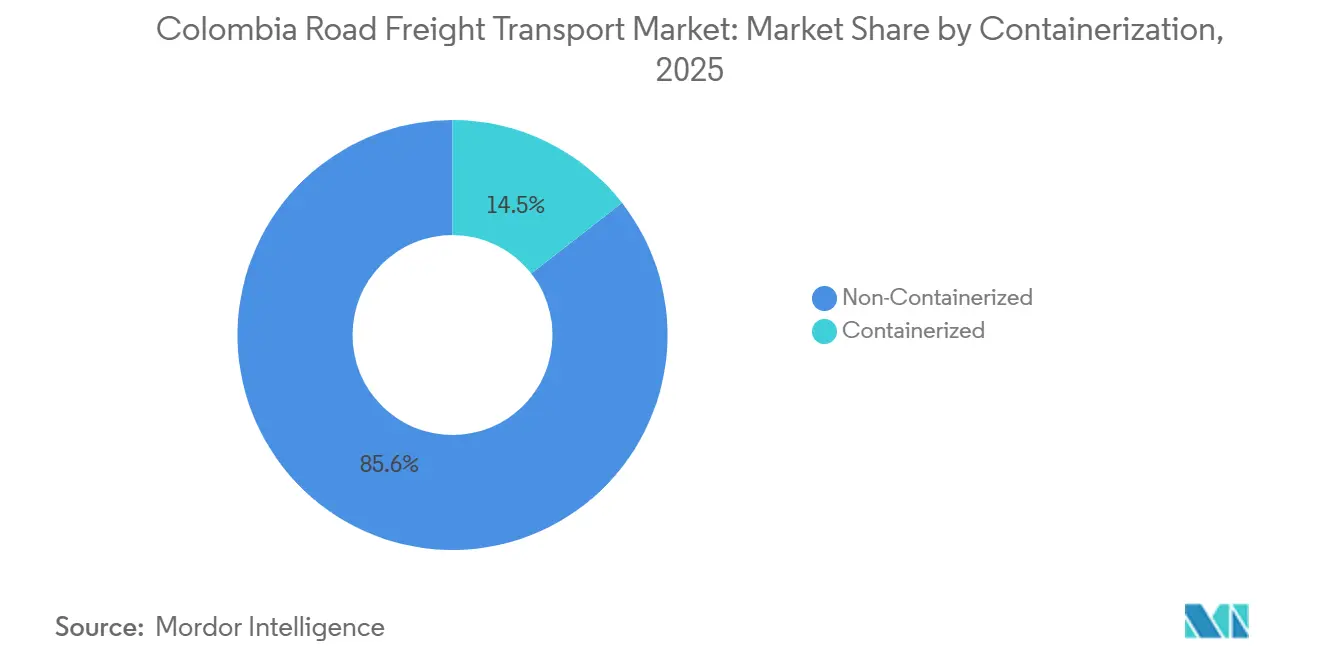
- By containerization, non-containerized cargo dominated with 85.55% of 2025 volume, while Colombia road freight transport market size for containerized freight is projected to grow at 6.03% CAGR between 2026 and 2031.
- By distance, long-haul moves held 74.62% of tonne-kilometers and are set to post a 6.21% CAGR, outpacing short-haul expansion.
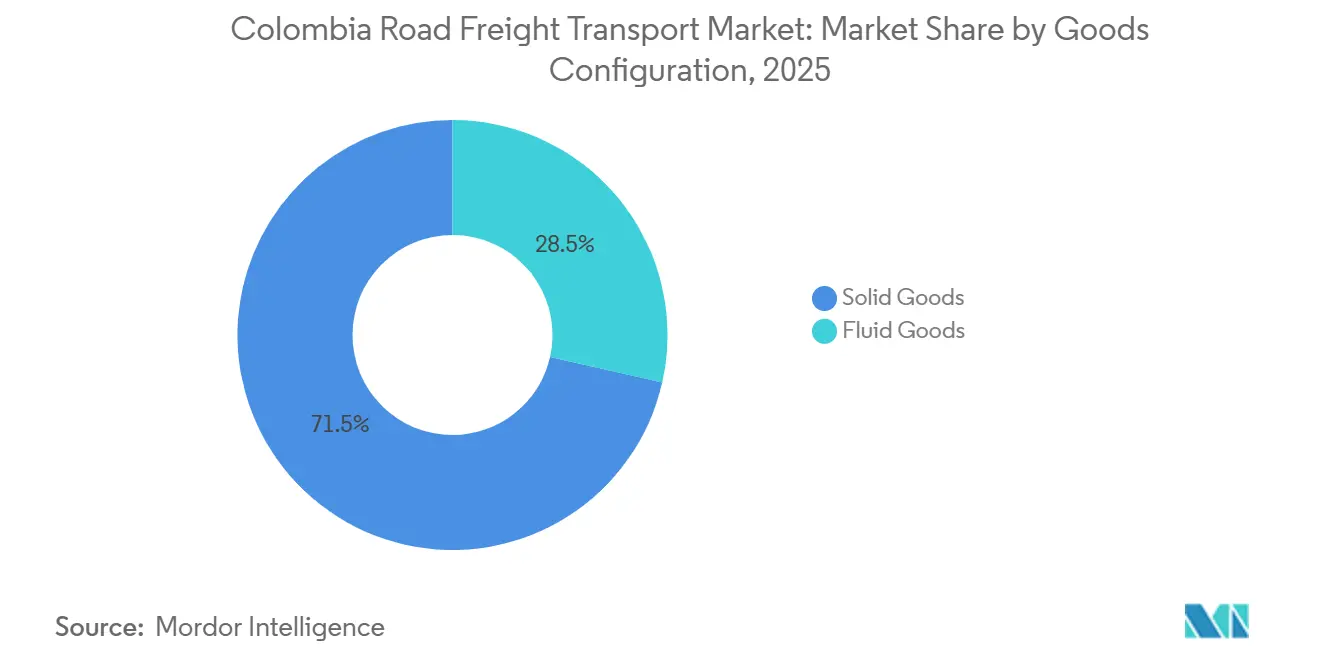
- By goods configuration, solid goods accounted for 71.46% of freight in 2025, but fluid-goods volumes will grow at a 6.37% pace as domestic refinery output climbs.
- By temperature control, non-temperature freight made up 94.55% of loads in 2025; temperature-controlled logistics is projected to advance at a 6.52% CAGR, led by pharmaceuticals and floriculture.
Note: Market size and forecast figures in this report are generated using Mordor Intelligence’s proprietary estimation framework, updated with the latest available data and insights as of January 2026.
Colombia Road Freight Transport Market Trends and Insights
Drivers Impact Analysis*
| Driver | (~) % Impact on CAGR Forecast | Geographic Relevance | Impact Timeline |
|---|---|---|---|
| Accelerated 4G/5G Highway Programme | +1.2% | National, with early gains in Bogotá-Buenaventura, Magdalena corridors | Medium term (2-4 years) |
| E-commerce Boom Raises LTL Demand | +1.4% | Urban centers - Bogotá, Medellín, Cali, Barranquilla | Short term (≤ 2 years) |
| Manufacturing-sector Output Expansion | +0.9% | Andean industrial belt, Caribbean coastal zones | Medium term (2-4 years) |
| Truck-fleet Modernisation Incentives | +0.8% | National, prioritizing Bogotá, Antioquia fleets | Long term (≥ 4 years) |
| Automatic Axle-load Enforcement (e-scales) | +0.6% | Toll plazas on 4G corridors, gradual rural rollout | Medium term (2-4 years) |
| Free-trade-zone Warehousing Surge | +1.1% | Bogotá (30 FTZs), Cartagena, Barranquilla, Cali | Short term (≤ 2 years) |
| Source: Mordor Intelligence | |||
Accelerated 4G/5G Highway Programme
Nearly 90% completion of 4G concessions in 2025 delivered more than 5,000 km of dual-carriageways that halved transit times on Bogotá–Buenaventura and Magdalena routes[1]. The USD 2 billion Magdalena Trunk project, now funded and due by 2027, will open direct export pathways for Tolima and Huila growers. Progress toward next-generation 5G concessions has stalled because land-acquisition disputes have frozen USD 4.6 billion in works, delaying critical feeder links. A 2023 toll freeze also left operators with a USD 203 million revenue gap, forcing contract renegotiations that push completion into 2028-2029. The outcome is a bifurcated network where modern highways funnel trucks into a handful of corridors, intensifying congestion at Buenaventura port during peak coffee season.
E-commerce Boom Raises LTL Demand
Online sales reached 18% of national retail turnover in 2024, multiplying parcel flows and dropping average parcel weight below 5 kg[2]. Domestic leaders Coordinadora Mercantil and Servientrega invested in automated sortation hubs that enable same-day delivery inside major cities, while digital freight platforms reduce empty runs by up to 20%. Amazon’s 2024 entry into Medellín and Cali signals rising competition, yet service gaps persist in rural zones where unpaved roads raise last-mile costs by 40%. Urban consolidation centers, therefore, remain the backbone of LTL growth within the Colombia road freight transport market.
Manufacturing-Sector Output Expansion
Colombia’s PMI stayed above the 50-point threshold through late 2025 despite industrial volatility; forward orders for chemicals and plastics remain firm as firms reshore from Asia. FTZs offering a 15% corporate tax rate attract assemblers that cluster warehousing with production, shrinking drayage-to-port distances. Nevertheless, the 2026 fuel-tax plan could lift logistics costs by 8-10%, pressuring producers to lock in full-truckload contracts. Commitments by Bavaria to cut emissions 25% by 2030 also require expanded electric fleets and temperature-controlled capacity, spurring equipment upgrades across the Colombia road freight transport market.
Truck-Fleet Modernization Incentives
An average heavy-duty vehicle age of 18 years undermines fuel efficiency, yet Resolution 5304 and the NAMA program offer subsidies for Euro VI trucks[3]. Only 4,200 units were scrapped in 2024 versus a 10,000-unit target, highlighting financing barriers for small carriers. Bogotá pilots with 22 electric rigs proved 35% cheaper per kilometer than diesel units, but scarce charging outside cities limits wider deployment. Large shippers increasingly reward compliant fleets with premium contracts, nudging market consolidation.
Restraints Impact Analysis*
| Restraint | (~) % Impact on CAGR Forecast | Geographic Relevance | Impact Timeline |
|---|---|---|---|
| 94% Rural Roads Unpaved | -1.30% | Rural municipalities, Orinoquía, Amazonía, Pacific coast | Long term (≥ 4 years) |
| Ageing Heavy-duty Vehicle Fleet | -0.90% | National, concentrated in small-operator fleets | Medium term (2-4 years) |
| High Cargo-theft Incidence on Trunk Roads | -0.70% | Cauca, Nariño, Norte de Santander, Arauca corridors | Short term (≤ 2 years) |
| PPP Build-out Delays (permits/land) | -1.00% | Meta, Casanare, Chocó, secondary-road networks | Long term (≥ 4 years) |
| Source: Mordor Intelligence | |||
94% Rural Roads Unpaved
Just 21% of Colombia’s 204,855 km network is paved, leaving producers in coffee-growing Caldas and Quindío to rely on small all-terrain trucks that carry 40% less payload and double per-kilometer costs. The logistics performance index ranks Colombia 86th worldwide, in part because rainy-season closures isolate farms for days. Although USD 1.2 billion is earmarked for rural upgrades, land-tenure disputes have postponed 60% of projects, perpetuating two-tier freight service inside the Colombia road freight transport market.
Ageing Heavy-Duty Vehicle Fleet
More than one-third of trucks predate 2005 emissions rules, burning 25% more fuel than Euro VI models. Mandatory scrappage by 2028 faces funding gaps for owner-operators, who already endure 12-15% downtime. Diesel subsidy removal slated for 2026 will widen cost disparities, accelerating the shift of premium cargo to better-capitalized carriers and reshaping competition in the Colombia road freight transport market.
*Our forecasts treat driver/restraint impacts as directional, not additive. The impact forecasts reflect baseline growth, mix effects, and variable interactions.
Segment Analysis
By End User: Retail Drives Parcel Density
Wholesale & Retail Trade generated the largest 34.55% slice of the Colombia road freight transport market share in 2025, and this segment is forecast to grow at a 6.34% CAGR to 2031 as online retail prompts network densification. The Colombia road freight transport market size attributed to retail freight is poised to surpass USD 5 billion by 2031. Automation at city hubs has streamlined same-day delivery, though rural service still encounters infrastructure limits.
Agriculture, Fishing & Forestry remains critical, anchored by coffee that represented 7.3% of 2024 exports. Manufacturing volumes are volatile but gain support from FTZ incentives, while Oil & Gas logistics relies on heavy tanker fleets to move crude and refined products. Construction freight should rebound once PPP road sites restart, lifting cement and steel demand across the Colombia road freight transport market.

By Destination: Cross-Border Gains Outpace Domestic
Domestic lanes retained 63.57% of 2025 tonnage, yet international flows will advance at a 6.87% CAGR through 2031 as nearshoring accelerates north-bound supply chains. The Colombia road freight transport market size linked to cross-border moves is expected to approach USD 6 billion by 2031.
4G corridor upgrades slash Bogotá–Medellín transit to under five hours, but Pacific-coast congestion drives exporters toward Caribbean ports 400 km farther away. Diesel tax hikes could raise border-crossing costs 8-10%, pushing shippers to bundle volumes in full-truck contracts.
By Truckload Specification: LTL Gains from Digital Aggregation
Full Truckload operations accounted for 77.65% of Colombia road freight transport market share in 2025, fueled by bulk coal and oil traffic[4]. Less-than-Truckload, however, will grow fastest at 6.65% as platforms match fragmented parcels with available deck space.
Telematics systems cut empty kilometers by up to 20%, while electric vans ensure zero-emission compliance inside Bogotá’s low-emission zones. FTL operators face margin pressure once diesel subsidies vanish, although fleet digitalization can offset part of the impact.
By Containerization: Bulk Dominates, FTZ Boosts Boxes
Non-containerized cargo made up 85.55% of 2025 tonnage, reflecting robust flows of coal, coffee, and crude. Containerized freight, steered by FTZ value-added activities, is forecast to grow 6.03%, adding roughly USD 1 billion to the Colombia road freight transport market size by 2031.
FTZ operators enjoy duty deferment and a 15% corporate tax rate, attracting electronics and pharma firms that demand bonded storage and stable cold-chain links. Land scarcity near Bogotá is driving warehouse expansion toward outer municipalities with lower rents but longer drayage legs.
By Distance: Long Haul Anchored by Export Corridors
Long-haul routes held 74.62% of tonne-kilometers in 2025, buoyed by 500-km-plus hauls from inland mines to Caribbean ports. Coal and crude flows ensure a 6.21% CAGR, while short-haul growth hinges on e-commerce density inside megacities.
Electric-truck pilots remain city-bound owing to limited rapid chargers outside major hubs, yet consumer demand is compelling carriers to hybridize fleets, especially for cold-chain beverages and perishables in the Colombia road freight transport market.
By Goods Configuration: Solid Goods Lead, Fluids Accelerate
Solid goods such as coffee, cement, and steel captured 71.46% of the 2025 volume. Fluid goods, including petroleum derivatives, are set for a 6.37% CAGR on the back of refinery expansions at Cartagena and Barrancabermeja.
Energy shippers deploy Euro VI tanker units with spill-containment technology, but looming diesel price hikes could compress margins. Solid-goods carriers shoulder rural-road deficits that double unit costs versus paved arteries, sustaining the competitive gap within the Colombia road freight transport industry.
By Temperature Control: Cold Chain Expands for Pharma & Produce
Non-temperature freight dominated at 94.55% in 2025, yet temperature-controlled loads will grow 6.52%, powered by USD 1.5 billion in flower exports and stringent pharmaceutical GDP rules. Colombia road freight transport market size for cold chain is projected to top USD 1 billion by 2031.
DHL’s 39-facility network now offers GDP-compliant storage, while Bavaria’s carbon roadmap is driving uptake of electric reefers. Only 15% of rural areas have nearby cold stores, requiring mobile chill units that lift costs 10-15%.
Geography Analysis
Colombia’s Andean axis, Bogotá, Medellín, Cali, handled roughly 65% of domestic tonnage in 2025, leveraging dual-carriageway gains that trimmed trunk travel times. FTZ clusters in Bogotá and Cartagena processed 1.2 million TEUs in 2024, feeding electronics and pharma flows bound for North America.
The Caribbean coast hosts export-heavy lanes for coal and crude that generated 48.5% of 2024 export earnings. Buenaventura on the Pacific manages 60% of container imports, but week-long dwell times push shippers northward, adding cost and distance.
Orinoquía and Amazonía together account for under 10% of freight activity because 94% of roads there remain unpaved, forcing multimodal river or air solutions that inflate rates up to 300%. Rising security provisions along border corridors further complicate operations, yet nearshoring gains in the Andean interior keep the Colombia road freight transport market on an upward trajectory.
Regulatory Landscape
Colombia road freight transport is governed under the Ministry of Transport framework (including Decree 1079 of 2015 and subsequent updates), with oversight and enforcement supported by the Superintendencia de Transporte. A central operational compliance anchor is the official Sistema de Informacion de Costos Eficientes para el Transporte Automotor de Carga (SICE-TAC), used as the reference for efficient freight cost calculation. Authorities have continued updating the tool to reflect labor-time components (including overtime) and cargo-specific requirements, including liquids and container movements.
Cost and documentation controls tightened further through recent measures: Decree 1017 of 2025 set parameters that feed into 2026 toll and operating-cost dynamics, while the Superintendencia de Transporte reinforced reporting obligations tied to cost transparency for cargo generators and market participants. In early 2026, the Ministry of Transport reported operating cost increases driven by adjustments such as tolls, wages, and fuel variables, and the SICE-TAC scope expanded to include cost publications applicable to light cargo vehicles (3,500 to 7,500 kg). This extended the reference-cost regime deeper into urban and regional distribution.
Value Chain Analysis
The Colombia road freight transport value chain begins with demand from wholesale and retail trade, manufacturing, agriculture, and oil and gas shippers, then moves through freight forwarders/3PLs, dispatch and brokerage functions, and a fragmented carrier base dominated by small owner-operators. Shipments then reach consignee delivery and reverse logistics. Sector formalization and transaction traceability increasingly rely on compulsory digital reporting layers such as the RNDC and reference-cost tooling via SICE-TAC, which affect how shippers contract capacity and how carriers evidence compliance, waiting times, and route economics.
On the physical side, the chain is conditioned by corridor performance to ports and industrial centers. Network upgrades improve trunk productivity, while rural access remains a bottleneck. Government statistics pointed to the scale of road cargo movement, including 73.7 million tons of solid cargo moved by road in 1H 2025, up 3.8% year-on-year. Infrastructure delivery continues to rely on PPP structures, such as the Buga-Loboguerrero-Buenaventura (5G) corridor reaching financial closure in 2024. Parallel intermodal initiatives, including the La Dorada-Chiriguana rail PPP award window referenced by ANI in 2024, keep drayage, terminal handling, and long-haul trucking central, but also create pressure to integrate with rail and port-facing logistics to reduce end-to-end cost.
Competitive Landscape
Small owner-drivers control 60-65% of the truck fleet, while global integrators secure premium contracts. DHL Supply Chain operates 296,000 m² of GDP-grade cold stores and plans USD 1.3 million in solar and fleet upgrades for 2025[5].
Local champion Coordinadora Mercantil leverages automated hubs for same-day delivery, and TCC introduced battery-electric trucks serving micro-fulfillment centers. Organización Corona’s SAP control tower raised filled round trips by 20% and cut demurrage 40%, demonstrating that data-driven routing can boost productivity even in aging fleets.
Security tech and ESG credentials now tip contract awards. Carriers offering GPS geofencing command a 10-15% rate premium on high-risk corridors, while shippers with Scope-3 emissions targets seek partners deploying Euro VI or electric trucks, reshaping the Colombia road freight transport market.
Colombia Road Freight Transport Industry Leaders
-
Operadores Logisticos De Carga S OPL Carga S.A.S.
-
Coordinadora Mercantil S.A.
-
TCC S.A.S.
-
Transportes Vigia Sociedad Por Acciones Simplificada S.A.S.
-
Transportes Sanchez Polo S.A.
- *Disclaimer: Major Players sorted in no particular order
Market Opportunities and Future Outlook
A clear opportunity lies in monetizing corridor upgrades and reliability improvements on difficult geographies, where road conditions and security constraints create service gaps and a premium for compliant, tech-enabled operators. In 2026, the government advanced major road interventions, including the Ministry of Transport awarding the COP 8.8 trillion El Estanquillo-Popayan project (101 km of interventions, including 62.3 km of dual carriageway and 14 tunnels). Invias also advanced adjudication for COP 363.254 billion in works on the Quibdo-Medellin (182 km) and Quibdo-Pereira (210 km) corridors for 2026-2029. These actions create contracting whitespace for carriers and logistics providers tied to construction supply chains, with scope to convert improved access into denser regional distribution.
Energy transition and digitization are also changing service designs across line-haul and urban freight. The Ministry of Transport announced Ruta-E in May 2026, a 1,200 km electric freight corridor between Bogota and Cartagena with charging points every 100 km. Named participants include DHL, BYD, Auteco Blue, TCC, and Voltrelli, supporting investment cases for electric tractors, electric reefers, and corridor-based charging services. In parallel, visibility and matching for the long tail of owner-operators remains an identifiable gap. Platforms such as VePAI launched a WhatsApp-integrated AI approach to structure visibility for a large independent driver base, reinforcing opportunities for LTL aggregation, control-tower services, and shipper-grade compliance layers that reduce empty kilometers and improve serviceability beyond major cities.
Recent Industry Developments
- July 2026: Coordinadora Mercantil opened a new regional branch in Quibdo (Choco) to extend direct coverage into a historically underserved corridor. The move supports last-mile and regional line-haul options in areas where road quality and security constraints have limited consistent service, enabling higher service frequency and tighter delivery windows.
- August 2025: DHL Supply Chain committed USD 1.3 million to upgrade point-of-sale infrastructure and add solar installations across its 39 warehouses in Colombia. The investment supports operating-cost reduction and more resilient facility operations, reinforcing competitiveness for contract logistics and road freight-linked distribution networks.
- October 2024: TCC S.A.S. secured a COP 11.272 billion credit facility from Banco de Bogota to modernize its fleet with 51 new 100% electric vehicles targeted for major cities including Bogota, Medellin, and Cali. The financing supports broader fleet electrification in urban distribution, where emissions compliance and operating-cost control increasingly influence shipper tender decisions.
Research Methodology Framework and Report Scope
Market Definition and Coverage
For this methodology, the market covers paid services that move goods by truck on Colombian roads, including domestic moves and cross-border legs handled by road carriers. The value is measured as the revenue generated by road freight transport activity within Colombia during the year.
Scope exclusions: We exclude passenger transport, pure warehousing and forwarding fees not tied to trucking, and ocean or air freight charges that sit outside the road leg.
Segmentation Overview
- By End User
- Agriculture, Fishing & Forestry
- Construction
- Manufacturing
- Oil & Gas, Mining & Quarrying
- Wholesale & Retail Trade
- Others
- By Destination
- Domestic
- International
- By Truckload Specification
- Full Truckload (FTL)
- Less-than-Truckload (LTL)
- By Containerization
- Containerized
- Non-Containerized
- By Distance
- Long Haul
- Short Haul
- By Goods Configuration
- Fluid Goods
- Solid Goods
- By Temperature Control
- Non-Temperature Controlled
- Temperature Controlled
Data Sources, Market Sizing, and Validation
Desk Research
Desk work starts with building a clear demand and supply picture for trucking in Colombia, then tying it to a usable set of public data series. We reviewed official statistics and policy releases such as those from DANE (national statistics), the Ministry of Transport and related road agencies, and DIAN trade and customs publications for import and export direction. We also used the World Bank and UN Comtrade to cross-check macro trade signals.
To keep pricing and activity assumptions realistic, we used additional sources such as company filings and investor presentations of transport and logistics operators, public tender and contract notices, and reputable press coverage on fuel, tolls, and infrastructure work. Select paid subscriptions were used only where they helped with standardized company financials, shipment and trade movement context, and patent lookups when technology adoption claims needed a check. These examples are not exhaustive, and many other public and paid sources were also referenced to collect data, validate it, and clarify unclear points.
Primary Interviews and Surveys
Primary work was used to pressure-test the model and fill gaps that public data does not spell out, especially around yield per ton-km, empty running, typical route mix, and how pricing resets flow through contracts. We spoke with a mix of carriers, fleet operators, shippers, and logistics coordinators across key Colombian corridors, then triangulated what we heard with commodity flow patterns and trade-linked road legs.
Distribution of primary research fieldwork respondents
| Company type | Respondent position |
|---|---|
| Top tier: 33% | CXOs: 17% |
| Mid tier: 48% | Functional/Unit leaders: 36% |
| Smaller Players: 19% | Managers: 47% |
Market-Sizing & Forecasting
The core sizing is built top-down by reconstructing the freight activity pool and translating it into revenue using practical price and utilization assumptions. For Colombia, this starts from a structured view of domestic versus international road legs, then it is refined using checks on truckload mix (FTL versus LTL), containerized versus non-containerized movements, distance split (short haul versus long haul), and the share of temperature-controlled and fluid goods traffic.
To keep the totals grounded, we corroborate results with selective bottom-up approximations, like rolling up a sample of carrier revenues where available. We then check implied revenue per trip, per ton, or per km against what operators report. When data is missing for smaller fleets or informal capacity, the gap is handled using penetration-style assumptions (for example, how much of a corridor is served by organized fleets) and then rechecked through interviews.
For forecasts, scenario analysis is used so the growth path stays consistent with measurable drivers such as industrial output, agriculture and mining shipment intensity, trade volumes, fuel and toll cost pass-through behavior, and changes in corridor capacity from road upgrades. Assumptions are adjusted only after they are reviewed with industry respondents, and one short sentence check is applied each time to ensure the implied pricing and volume do not move in opposite directions without a clear reason.
Data Validation & Update Cycle
Validation is done through a set of practical cross-checks, then through analyst review. We compare model outputs with independent signals such as trade-linked road activity, corridor throughput direction, and whether the implied average revenue levels match what carriers and shippers describe for similar lanes.
Outliers are flagged, and the assumptions behind them are revisited before sign-off. This can also trigger a quick re-contact with respondents when a mismatch stays unexplained. Reports are refreshed annually, with interim updates when material events occur, such as sharp cost shocks or policy changes that alter freight rates. Before delivery, a final pass is completed so the numbers reflect the latest available updates.
Mordor Intelligence's Colombia Road Freight Transport Market Size Compared Against Other Published Estimates
It is common to see different market sizes for Colombia road freight transport because publishers do not always draw the same boundary around what counts as road freight revenue. Differences usually come from whether international legs are counted, whether forwarding and warehousing fees are blended into the total, and how price and volume are projected during periods of cost volatility.
By tracking corridor-level activity and pricing resets, then refreshing assumptions with interview checks, Mordor Intelligence keeps the estimate tied to truck-based freight revenue within Colombia rather than bundling adjacent logistics services into the same number.
Benchmark comparison
| Source | Market Size | Gaps in Research Methodology |
|---|---|---|
| Mordor Intelligence | USD 11.59 B (2026) | |
| Global Consultancy A | USD 13.40 B (2026) | This estimate appears to blend broader logistics revenue with trucking, which can pull in forwarding, warehousing, and value-added handling that sit outside the road leg. |
| Trade Journal B | USD 9.90 B (2026) | This figure is typically derived from narrower formal-carrier reporting and can undercount smaller fleets and non-containerized, short-haul flows where disclosure is weaker. |
The spread in the table is mainly explained by scope choices and by how the informal and small-fleet portion is treated. When the boundary is held to trucking revenue and the activity mix is checked across destination, distance, and load type, the resulting market size stays easier to trace back to real operating conditions and repeatable inputs.
Key Questions Answered in the Report
How large will Colombia’s road freight sector be by 2031?
The Colombia road freight transport market size is forecast to reach USD 15.44 billion by 2031, expanding at a 5.9% CAGR.
Which customer group ships the most freight?
Wholesale & Retail Trade led with 34.55% of 2025 volumes and is also the fastest-growing end-user segment.
What share of traffic is less-than-truckload?
LTL held 22.35% of 2025 revenues and is projected to grow 6.65% annually through 2031 thanks to e-commerce parcelization.
Why are containerized loads growing faster than bulk?
FTZ warehouse incentives and value-added assembly drive a 6.03% CAGR for containerized freight, despite bulk cargo dominance.
How will diesel subsidy removal affect carriers?
Pump prices are expected to rise 8-10%, squeezing margins and accelerating adoption of Euro VI and electric trucks for efficiency.