
Market Overview
| Study Period | 2020 - 2031 |
|---|---|
| Forecast Data Period | 2026 - 2031 |
| Base Year Market Size (2025) | USD 1.19 Billion |
| Market Size (2026) | USD 1.25 Billion |
| Market Size (2031) | USD 1.62 Billion |
| Growth Rate (2026 - 2031) | 5.35 % |
| Market Concentration | Medium |
Major Players *Disclaimer: Major Players sorted in no particular order Image © Mordor Intelligence. Reuse requires attribution under CC BY 4.0. | |
Brazil Ophthalmic Devices Market Analysis by Mordor Intelligence
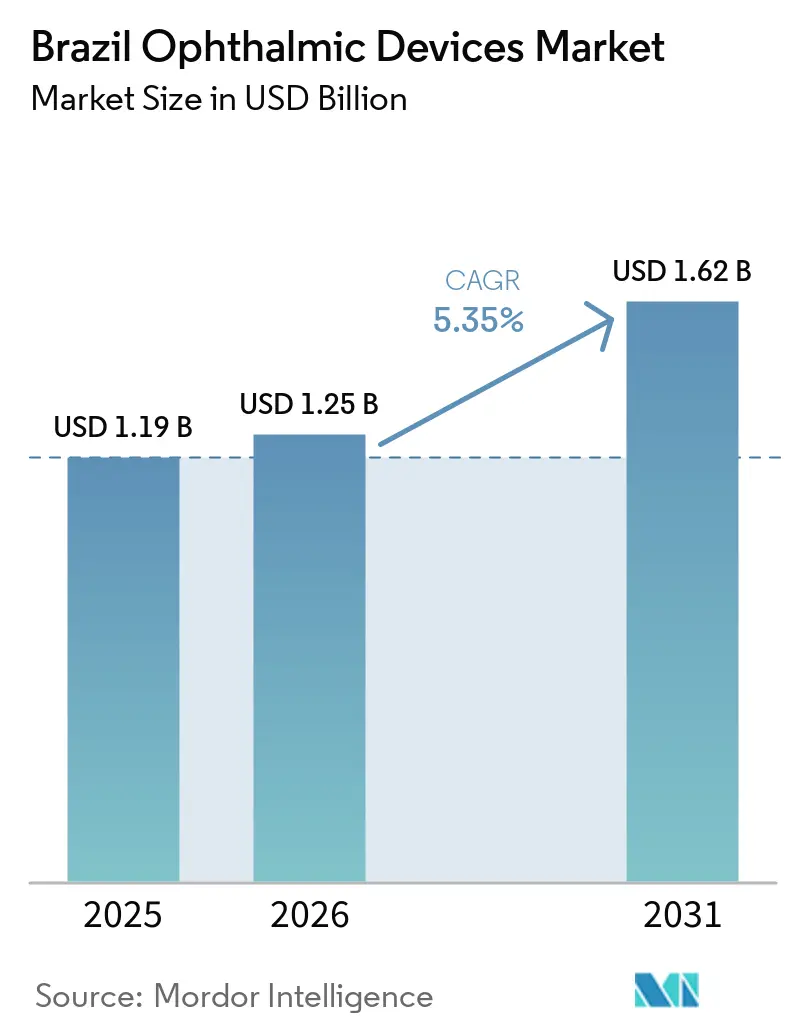
The Brazil Ophthalmic Devices Market size was valued at USD 1.19 billion in 2025 and is estimated to grow from USD 1.25 billion in 2026 to reach USD 1.62 billion by 2031, at a CAGR of 5.35% during the forecast period (2026-2031).
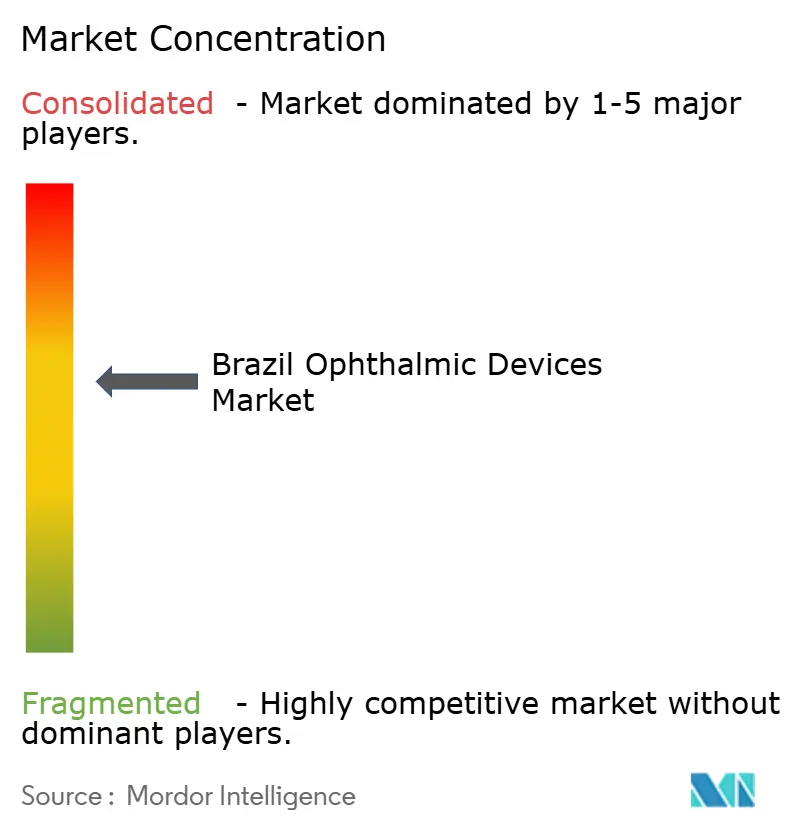
An aging population, rising diabetes prevalence, and fast-track regulatory pathways are expanding procedure volumes and shortening device-launch lags, while currency volatility continues to inflate import costs. Vision-care products dominate revenue today, yet diagnostic platforms for diabetic retinopathy screening and swept-source OCT are expanding faster as public tele-ophthalmology pilots scale and private clinics modernize their imaging fleets. Competitive intensity is moderate; five multinational suppliers account for about 58% of sales, whereas dozens of domestic distributors still win public tenders in secondary cities. Private equity capital is accelerating the migration of cataract and refractive surgeries from hospitals to ambulatory surgery centers, improving equipment utilization and boosting premium-IOL uptake.
Key Report Takeaways
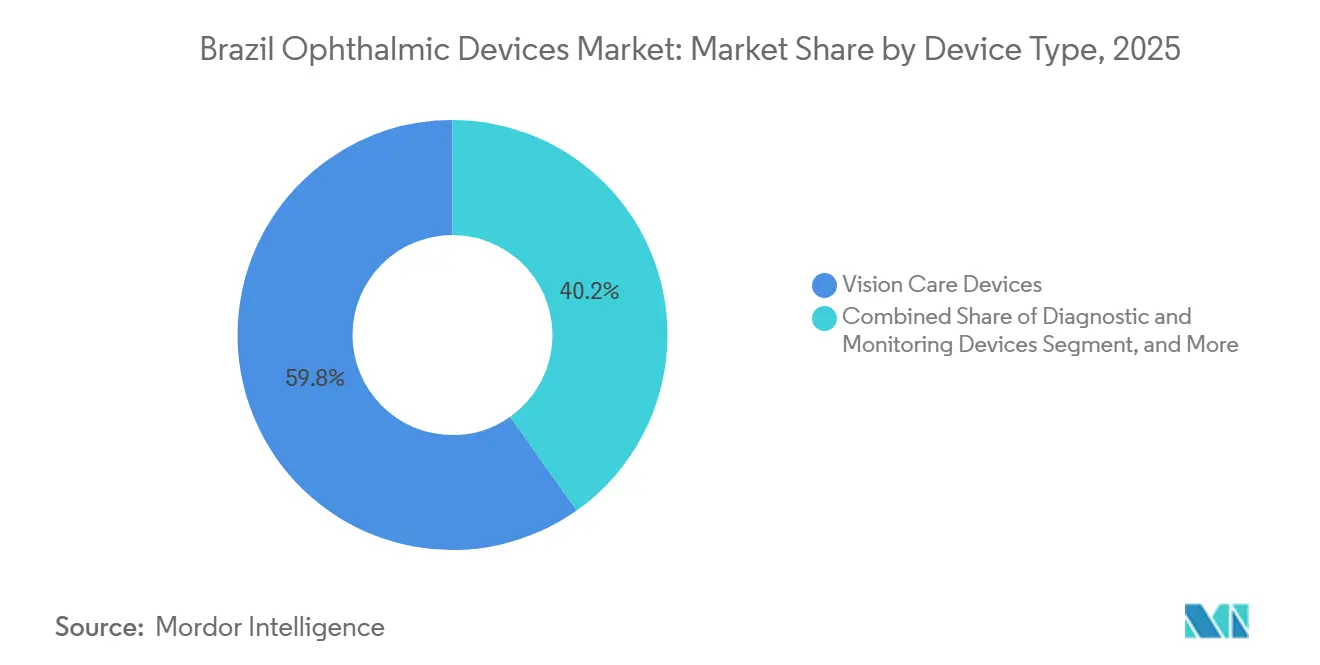
- By device type, vision care devices captured 59.77% of Brazil ophthalmic devices market share in 2025, while diagnostic and monitoring devices are projected to post the highest 8.52% CAGR through 2031.
- By disease indication, cataract devices accounted for 37.16% of 2025 revenue; diabetic retinopathy platforms are forecast to expand fastest at a 7.78% CAGR, driven by mandatory screening mandates.
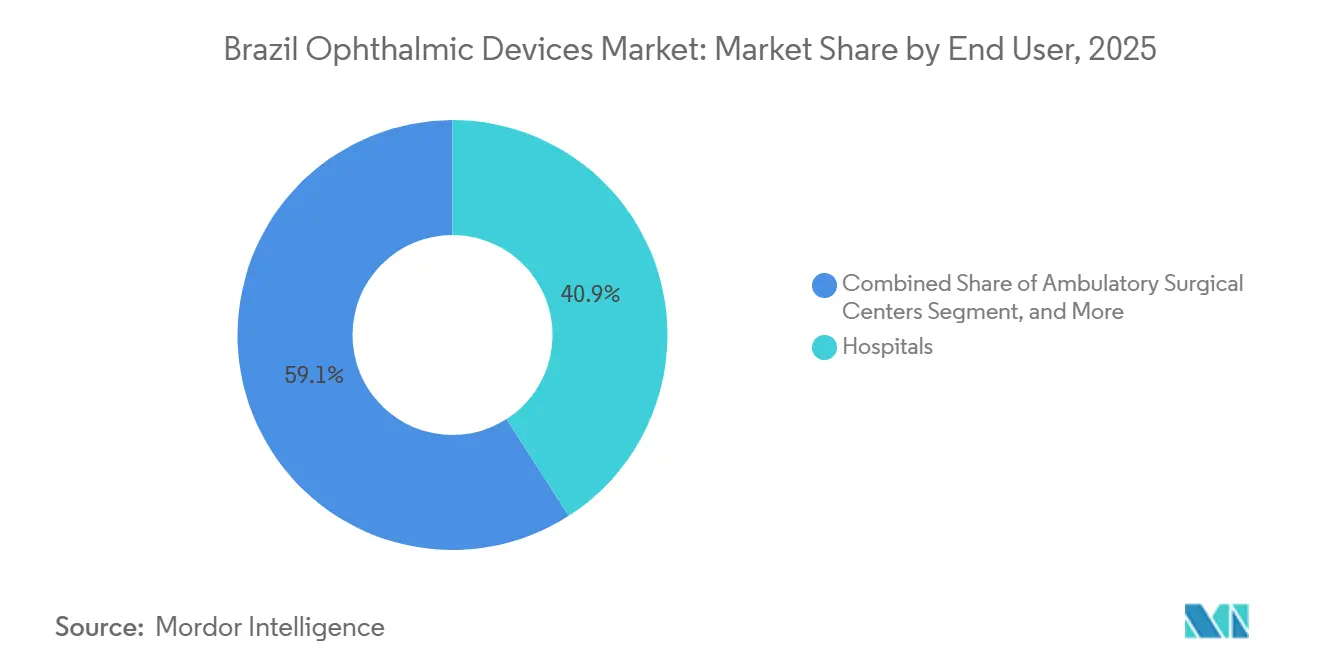
- By end user, hospitals accounted for 40.89% of end-user spending in 2025, yet ambulatory surgery centers are set to grow at a 10.49% CAGR as private insurers reimburse outpatient cataract and refractive procedures.
Note: Market size and forecast figures in this report are generated using Mordor Intelligence’s proprietary estimation framework, updated with the latest available data and insights as of January 2026.
Brazil Ophthalmic Devices Market Trends and Insights
Drivers Impact Analysis*
| Driver | (~) % Impact on CAGR Forecast | Geographic Relevance | Impact Timeline |
|---|---|---|---|
| Diabetic-retinopathy prevalence and demand for OCT | +0.9% | Nationwide; strongest in southeast | Medium term (2-4 years) |
| Femtosecond-laser adoption in private cataract suites | +0.7% | São Paulo, Rio de Janeiro, Brasília | Long term (≥ 4 years) |
| “Saúde Visual” mobile-screening expansion | +0.5% | North and Northeast | Short term (≤ 2 years) |
| Rising private-insurance coverage for premium IOLs | +0.6% | Southeast economic corridor | Medium term (2-4 years) |
| Expansion of tele-ophthalmology networks in remote & Amazon regions | +0.4% | Amazon basin and remote interior states | Short term (≤ 2 years) |
| Rising screen time in youth fueling myopia & demand for vision correction | +0.3% | Urban centers nationwide | Long term (≥ 4 years) |
| Source: Mordor Intelligence | |||
Aging Population Fuelling Cataract and AMD Procedure Volumes
More than 31 million Brazilians were aged 60 or older in 2021, and this cohort is projected to top 40 million by 2030.[1] Cataract surgeries climbed to 1.18 million in 2024 after a Ministry of Health backlog-reduction fund injected R$1.2 billion, yet volumes remain below the 3,000-per-million rate the WHO recommends. Premium IOLs already account for 35% of private implants, and femtosecond laser–assisted cataract surgery accounts for 25% of São Paulo ASC cases, signaling strong upside for premium platforms. Anti-VEGF injections for AMD exceeded 1.8 million in 2025, though public facilities still rely on off-label bevacizumab due to cost differentials of up to 90%. ANVISA’s 2024 post-market-surveillance rule now covers toric and EDOF lenses, raising compliance costs but improving safety tracking.
Rising Diabetes Prevalence Driving Retinal Diagnostics and Laser Therapy
Diabetes affects 10.2% of Brazilian adults, equating to 16.6 million people, and 36.3% carry some level of diabetic retinopathy.[2] Only 21% of diabetics were screened in 2019, leaving nearly 4.5 million undiagnosed cases that now enter AI-enabled triage streams. Phelcom’s smartphone fundus camera, cleared by ANVISA in 2023, processes images in 60 seconds and reaches 94% sensitivity, slashing referral backlogs in 120 municipalities. Private diagnostic chains installed 18% more swept-source OCT units in 2024, detecting macular edema 6 months earlier than time-domain systems and spurring demand for anti-VEGF treatment. Regulatory updates for software-as-medical-device tools require AI vendors to demonstrate AUC scores above 0.92 on Brazilian datasets, yet fast-track filings still finalize in under 180 days.
Technological Advances Accelerating Adoption
Device-registration lags have dropped from a year to roughly six months as ANVISA prioritizes digital and AI submissions.[3] Alcon’s 2025 acquisition of LENSAR introduced the ALLY femtosecond platform with real-time wavefront guidance, immediately challenging Carl Zeiss’s VisuMax 800 in premium cataract suites. Small-incision lenticule extraction now represents 18% of Brazil’s refractive surgeries, up from 9% in 2023, and offers faster visual recovery than LASIK. Swept-source OCT and ultra-widefield cameras extend diagnostic accuracy into the choroid and the retinal periphery, enabling earlier intervention for AMD and DR. Local assembly in the Manaus Free-Trade Zone trims landed costs up to 20% for select lasers and OCT units, cushioning BRL depreciation.
SUS-Backed Tele-Ophthalmology Pilots Boosting Portable Device Uptake
The Ministry of Health funded 2,500 TeleOftalmo sites with R$47 million in 2024, targeting municipalities where ophthalmologist density sits below 1 per 50,000 residents. Portable cameras weighing less than 2 kg allow health workers to screen 40 patients per day and sync images to cloud databases that retinal specialists review within 48 hours. Screening coverage in pilot states jumped from 12% in 2018 to 35% in 2024, cutting late-stage referrals by 28%. Mobile surgical buses performed 12,400 cataract procedures in rural Bahia and Ceará last year, demonstrating demand elasticity when access barriers are removed. ANVISA now mandates AES-256 encryption for imaging and domestic data storage, raising infrastructure spending but protecting patient privacy.
Restraints Impact Analysis*
| Restraints Impact Analysis | (~) % Impact on CAGR Forecast | Geographic Relevance | Impact Timeline |
|---|---|---|---|
| Shortage of fellowship-trained ophthalmic surgeons | –0.8% | North and Northeast public hospitals | Long term (≥ 4 years) |
| High import tariffs and BRL volatility | –0.7% | Nationwide | Short term (≤ 2 years) |
| Supply-chain delays for high-end diagnostic capital equipment | –0.5% | Ports of Santos, Rio, and inland routes | Medium term (2-4 years) |
| Low SUS reimbursement rates for new surgical technologies | –0.6% | Nationwide public facilities | Medium term (2-4 years) |
| Source: Mordor Intelligence | |||
BRL Currency Volatility Inflating Import Prices
The real lost 14% against the dollar between 2023 and 2024, lifting landed prices for OCT scanners, lasers, and microscopes 12-18%. SUS cataract reimbursements have stayed flat at R$580 since 2019, squeezing hospital margins and delaying equipment replacements by up to nine months. Private ASCs increasingly opt for five-year leasing in local currency, while wholesalers without hedging saw gross-margin erosion of 300 basis points in 2024. Manaus tax exemptions offset only a small slice of exposure, as just 15% of ophthalmic SKUs are locally assembled. Retail chains passed price hikes selectively, pushing premium progressive lenses up 8-10% while keeping entry-level SKUs flat to protect volume.
Ophthalmologist Shortage Outside Southeast Limits Device Utilization
Only 8.96 ophthalmologists serve every 100,000 Brazilians, but 60% practice in São Paulo, Rio de Janeiro, and Minas Gerais. Amazonas reports just 3.6 specialists per 100,000, leaving OCT scanners idle 60% of clinic hours. Residency slots expanded 12% between 2020 and 2024, yet 70% of graduates remain in the wealthier Southeast. Tele-ophthalmology solves screening gaps but cannot replace slit-lamp or surgical expertise, so advanced devices still cluster in urban hubs. The national council now proposes linking future SUS equipment tenders to minimum ophthalmologist-density thresholds, a policy that could slow procurement in underserved states.
*Our forecasts treat driver/restraint impacts as directional, not additive. The impact forecasts reflect baseline growth, mix effects, and variable interactions.
Segment Analysis
By Device Type: Diagnostic Platforms Outpace Vision Care Growth
Diagnostic and monitoring devices accounted for a modest base in 2025 but are projected to outpace every other category at an 8.52% CAGR, propelled by nationwide diabetic retinopathy mandates and AI-ready OCT systems. Vision-care goods nevertheless retained 59.77% of 2025 revenue, reflecting the country’s 71,226 optical outlets and a consumer tilt toward monthly silicone-hydrogel lenses. Contact-lens leaders Johnson & Johnson Vision and CooperVision exploit pharmacy networks to cover urban and peri-urban zones, while EssilorLuxottica leverages two domestic factories to buffer exchange-rate shocks on frames and Rx lenses.
Swept-source OCT scanners from Heidelberg Engineering and Nidek captured 60% of new premium installs last year, offering non-dye angiography that trims imaging sessions from 45 minutes to 12. Portable fundus cameras priced below USD 5,000 now feature in SUS bids across 120 municipalities, supporting 340,000 retinal images annually. Surgical devices are set to post a solid 7.9% CAGR as femtosecond laser–assisted cataract surgery penetration climbs beyond 10% nationally by 2031. The Brazil ophthalmic devices market share held by surgical consoles is likely to rise by two points by the end of the decade as private insurers reimburse outpatient cataract bundles that include premium IOLs.

By Disease Indication: Retinopathy Narrows Cataract’s Lead
Cataract systems accounted for 37.16% of revenue in 2025, driven by 1.18 million SUS procedures and 664,000 private surgeries. Still, diabetic retinopathy solutions will log the quickest 7.78% CAGR through 2031 as screening coverage broadens under federal mandates. Glaucoma devices hold a mid-teens slice, buoyed by 12% MIGS penetration in private ASCs, whereas AMD therapeutics lean heavily on bevacizumab in public hospitals but showcase growing uptake of port-delivery implants in affluent metros.
Cataract dominance stems from demographic pressure; Brazil adds 650,000 seniors annually, and premium IOL penetration in private centers already surpasses 35%. Conversely, one in three diabetics has retinal disease, yet fewer than a quarter receive annual imaging. AI-triage platforms flagging referable cases at 94% sensitivity shorten waitlists but also expose capacity gaps in laser therapy and anti-VEGF supply. As reimbursement codes for OCT angiography and portable ultrasound devices mature, retinopathy could overtake glaucoma spending by 2029.
By End-User: ASCs Capture Surgical Volume Shift
Hospitals handled 40.89% of the 2025 spend due to SUS cataract subsidies, but Brazil's ophthalmic devices market growth among ambulatory surgery centers is forecast at 10.49% CAGR, the fastest of any channel. Consolidators such as TecLASER For Eyes and Pátria-backed Oftalmax aggregate high-volume cataract and refractive caseloads, lifting equipment utilization above 90%. Specialty ophthalmic clinics held roughly one-third of the market share, leveraging retina and refractive niches to justify ultra-widefield cameras and SMILE lasers.
ASC economics are compelling: outpatient cataract bundles cost 30-40% less than hospital tariffs and allow same-day discharge, a feature prized by private insurers seeking cost containment. Public hospitals, by contrast, defer device upgrades amid frozen reimbursements and BRL headwinds, granting ASCs a technology lead in premium IOLs and femtosecond lasers. Optical retail chains remain important for vision-care turnover, and their 8% outlet expansion in 2024 underscores latent consumer demand even in a tight economy.
Geography Analysis
The Southeast mirrors its concentration of 60% of all ophthalmologists and 70% of private ASCs. São Paulo alone hosts more femtosecond lasers than the entire North and Northeast combined, a reality that speeds adoption curves for premium IOLs and SMILE surgery. High private-insurance penetration, 44% of residents, also bolsters early uptake of AI diagnostics.
The Center-West is driven by Brasília’s affluent insurance base and Goiás clinics acquiring swept-source OCT units in 2024. The North mobile surgical buses and battery-powered imaging devices bridge Amazonian river networks to reach remote populations. Strict data-localization rules compel cloud-service investments in regional hubs such as Manaus and Belém, raising overhead but safeguarding privacy.
Regulatory Landscape
Ophthalmic devices in Brazil are regulated by ANVISA under a risk-based framework (Classes I to IV). Higher-risk products require formal marketing authorization (registro), rather than simple notification. RDC 751/2022 sets the Essential Safety and Performance Requirements and the technical-dossier expectations used during product regularization and GMP assessments. It is particularly relevant for device-drug combinations, where applicants must document the incorporated medicinal substance (identity, source, justification for inclusion, and primary mode of action) as part of the submission package.
Traceability and post-market controls are tightening. ANVISA has expanded requirements through newer rules such as RDC 848/2024, and in February 2026 published Normative Instruction No. 426/2026, which sets requirements for transmitting and managing Unique Device Identification (UDI) data in the national SIUD database, effective from March 1, 2026. These changes raise the operational bar for manufacturers and local registration holders, especially for connected imaging devices and higher-risk ophthalmic products that already sit within more stringent Class III/IV compliance pathways.
Competitive Landscape
The Brazilian ophthalmic devices market has a moderate concentration score. Alcon’s USD 356 million purchase of LENSAR added the ALLY adaptive femtosecond platform, expected to command 40% of FLACS procedures by 2027. Carl Zeiss Meditec leverages its VisuMax 800 and AI IOL Calculator to lock in refractive and cataract surgeons, while Bausch + Lomb promotes the Stellaris Elite phaco system in SUS tenders. Johnson & Johnson Vision launched the TECNIS Odyssey in 2025, raising the premium-IOL stakes, and EssilorLuxottica integrates frames through 1,450 franchises and two factories that blunt currency swings.
Domestic disrupter Phelcom undercuts tabletop fundus units by 80%, placing 150 Eyer cameras in public clinics and courting export markets across Latin America. Glaukos and Alcon jostle for MIGS leadership, yet adoption outside private ASCs is thin until SUS updates its reimbursement list. Private equity fuels consolidation: Pátria Investimentos bought a 40% stake in Oftalmax in 2024 and targets 25% EBITDA by maximizing theatre throughput. Overall, the competitive field balances scale advantages with nimble regional distributors that supply 3,800 municipalities lacking major-brand service coverage.
Brazil Ophthalmic Devices Industry Leaders
-
Alcon Inc.
-
Johnson & Johnson Vision Care, Inc.
-
Carl Zeiss Meditec AG
-
Bausch + Lomb Corp.a SA
-
EssilorLuxottica SA
- *Disclaimer: Major Players sorted in no particular order
Market Opportunities and Future Outlook
Screening-scale gaps and care-delivery redesign are creating white space for lower-cost diagnostics and workflow-enabling platforms across Brazil. Federal SUS tele-ophthalmology expansion offers a practical route for portable fundus cameras and cloud-connected imaging kits in underserved regions, while private chains and ambulatory surgery centers continue upgrading into swept-source OCT systems and premium cataract suites to improve throughput and premium-IOL conversion.
Local and regional manufacturing, along with compliance-ready portfolios, are emerging as differentiation levers amid import-cost volatility and tighter ANVISA requirements. A specific example is Grupo Mais Visao, which in April 2026 acquired ophthalmic lens manufacturer Stock Lux in Sao Paulo and announced transferring operations to Feira de Santana, Bahia, with initial capacity of 50,000 lens pairs per month, reflecting continued vertical integration in vision-care supply. On the regulated-products side, RDC 751/2022 and related ANVISA guidance for device-drug combinations (including products incorporating medicinal substances as an integral part) supports demand for suppliers that can provide complete technical dossiers, validated quality systems, and, where applicable, domestically hosted data and cybersecurity-aligned imaging workflows.
Recent Industry Developments
- April 2026: Grupo Mais Visao acquired ophthalmic lens manufacturer Stock Lux in Sao Paulo and announced the transfer of operations to Feira de Santana, Bahia. The move includes an initial production capacity of 50,000 lens pairs per month, supporting local supply of prescription lenses and improving lead times for optical retail and lab partners.
- September 2025: Alcon made its UNITY Vitreoretinal Cataract System (VCS) commercially available in Brazil following local approval activities. The platform strengthens Alcon's position in premium cataract and vitreoretinal surgery workflows where ASCs and high-volume private centers prioritize efficiency and standardization.
- February 2024: The Brazilian Ministry of Health funded the expansion of SUS-backed TeleOftalmo pilots, supporting a larger network of tele-ophthalmology screening points. This accelerated procurement of portable imaging devices and reinforced demand for secure, cloud-enabled image transfer and review workflows across municipalities with limited specialist access.
Research Methodology Framework and Report Scope
Market Definition and Coverage
For this study, the market covers the value of ophthalmic devices sold and used in Brazil for eye diagnosis, eye surgery, and vision correction, spanning hospitals, specialty eye clinics, ambulatory surgery centers, and retail channels.
Scope exclusions: we exclude refurbished units and unregulated cosmetic lenses that are not part of regulated vision care use.
Segmentation Overview
- By Device Type
- Diagnostic & Monitoring Devices
- OCT Scanners
- Fundus & Retinal Cameras
- Autorefractors & Keratometers
- Corneal Topography Systems
- Ultrasound Imaging Systems
- Perimeters & Tonometers
- Other Diagnostic & Monitoring Devices
- Surgical Devices
- Cataract Surgical Devices
- Vitreoretinal Surgical Devices
- Refreactive Surgical Devices
- Glaucoma Surgical Devices
- Other Surgical Devices
- Vision Care Devices
- Spectacles Frames & Lenses
- Contact Lenses
- Diagnostic & Monitoring Devices
- By Disease Indication
- Cataract
- Glaucoma
- Diabetic Retinopathy
- Other Disease Indications
- By End-user
- Hospitals
- Specialty Ophthalmic Clinics
- Ambulatory Surgery Centers (ASCs)
- Other End-users
Data Sources, Market Sizing, and Validation
Desk Research
Desk research was used to set the fact base for demand and supply signals in Brazil eye care, and then to tighten the product boundary around regulated ophthalmic devices. We reviewed public sources including Brazil health system publications and procedure statistics, ANVISA product registration and recall notices, IBGE population and aging tables, and Ministry of Health datasets to understand where device use is concentrated.
To keep assumptions grounded, we also checked trade and pricing signals using customs and trade statistics, peer-reviewed ophthalmology journals, and association publications that discuss cataract and glaucoma treatment volumes. Company annual reports, investor presentations, and credible press were used to understand portfolio mix and how devices move through local channels, where revenue disclosure is uneven. A paid subscription focused on company financials and news helped standardize revenue references when public disclosures were limited. These desk research sources are illustrative only, and other references were used for data collection, validation, and clarification during the analysis.
Primary Interviews and Surveys
Primary work focused on interviews and structured surveys with distributors, hospital procurement teams, specialty eye clinics, ambulatory surgery centers, and practicing clinicians who use diagnostic and surgical systems as part of routine care in Brazil. Inputs were used to confirm what is typically purchased as new equipment, how replacement cycles behave, and how demand shifts between public and private care.
To avoid over-relying on one viewpoint, we balanced responses across different company sizes and job roles, and then re-contacted a subset of experts when large gaps appeared between desk indicators and modeled outputs.
Distribution of primary research fieldwork respondents
| Company type | Respondent position |
|---|---|
| Top tier: 37% | CXOs: 13% |
| Mid tier: 47% | Functional/Unit leaders: 27% |
| Smaller Players: 16% | Managers: 60% |
Market-Sizing & Forecasting
The core model starts with a top-down demand pool that links Brazil procedure and patient volumes to typical device usage in care delivery, then translates that activity into annual equipment and consumable value. After building the demand pool, we ran selective bottom-up checks using supplier and channel roll ups (sampled revenue splits, ASP-by-volume logic, and distributor sell-through sense checks) so totals could be corrected when the first pass looked too high or too low.
Key inputs that guided the sizing included cataract surgery volume, refractive error correction demand, installed base replacement cycles for diagnostic systems, import dependence for higher-value platforms, and price movement of lenses and capital equipment under local currency conditions. Forecasting used scenario analysis tied to expert expectations on procedure growth, public access expansion, and replacement timing, with short-term smoothing where year-to-year procurement is lumpy. Where bottom-up references were missing for smaller categories, gaps were handled using conservative adoption and replacement assumptions that were validated in interviews.
Data Validation & Update Cycle
Model outputs are checked against independent signals, including procedure growth rates, registration activity for key product groups, and observed pricing trends from trade and channel discussions. When the model produces unusual jumps, we review assumptions step by step, and we trigger follow-up calls to confirm whether the change reflects real procurement shifts or timing, currency effects, or one-off tenders.
Before sign-off, the work goes through multiple analyst reviews that compare totals with segment sums and with external demand indicators, and then align the narrative to the final numbers. Reports are refreshed annually, and interim updates are made when material events change procurement or access trends. Right before delivery, a final review pass is completed so clients receive the latest updated view.
Mordor Intelligence's Brazil Ophthalmic Devices Market Estimate Compared With Other Published Estimates
Published market sizes for Brazil ophthalmic devices can vary a lot, even when the topic name is the same, because the underlying product list, year selection, and pricing logic are not aligned. Differences also show up when one estimate uses an older base year, or when growth is projected using one headline driver instead of a set of demand signals.
The table points to a wide spread versus our 2025 number, and the biggest drivers typically come from what is counted as vision care revenue, how capital equipment replacement is treated, and whether totals are kept to regulated, new products only. Currency timing also matters, since annual averages and point-in-time rates can move the USD value in either direction.
Benchmark comparison
| Source | Market Size | Gaps in Research Methodology |
|---|---|---|
| Mordor Intelligence | USD 1.19 B (2025) | |
| Industry Publisher A | USD 0.51 B (2025) | The lower value is consistent with a narrower product basket where parts of spectacles and contact lenses revenue can be excluded, and where premium surgical platforms are counted selectively or priced using limited channel inputs. |
| Research Group B | USD 1.25 B (2019) | The older base year makes comparisons sensitive to replacement timing, inflation, and exchange-rate choice, and some category mapping may differ between diagnostic systems, surgical equipment, and vision care products. |
The spread is easier to explain once scope and timing are made explicit, and the table also shows why 2025-to-2025 comparisons are the cleanest way to read differences. In Mordor Intelligence's model, the 2025 total includes new, ANVISA-aligned diagnostic, surgical, and vision care devices sold in Brazil (including OCT and phaco systems, intraocular lenses, spectacles, and contact lenses) while excluding refurbished units and unregulated cosmetic lenses, which shifts the result versus narrower baskets or older-year builds. With these inclusions applied consistently, the number stays traceable to procedure activity, replacement behavior, and interview-checked price progression that can be repeated on each refresh.
Key Questions Answered in the Report
What is the projected value of the Brazil ophthalmic devices market in 2031?
The Brazil ophthalmic devices market size is projected to reach USD 1.62 billion by 2031.
W hich device category will grow fastest through 2031?
Diagnostic and monitoring devices are expected to post the highest CAGR of 8.52% in diabetic retinopathy screening.
Why are ambulatory surgery centers gaining share?
Private insurers reimburse outpatient cataract and refractive procedures at lower cost, and ASCs deliver shorter wait times plus access to premium IOLs.
How is tele-ophthalmology influencing regional demand?
TeleOftalmo hubs and portable fundus cameras raised screening coverage to 35% in pilot states, spurring purchases of low-cost diagnostic kits in underserved areas.
What major regulatory change speeds device launches?
ANVISA’s 2025 fast-track pathway cut approval timelines to 180 days, allowing AI diagnostics and premium IOLs to reach surgeons six months after global release.