
Brazil Home Loan Market Size and Share
Market Overview
| Study Period | 2020 - 2031 |
|---|---|
| Forecast Data Period | 2026 - 2031 |
| Historical Data Period | 2020 - 2024 |
| Market Size (2026) | USD 62.99 Billion |
| Market Size (2031) | USD 104.81 Billion |
| Growth Rate (2026 - 2031) | 10.72 % |
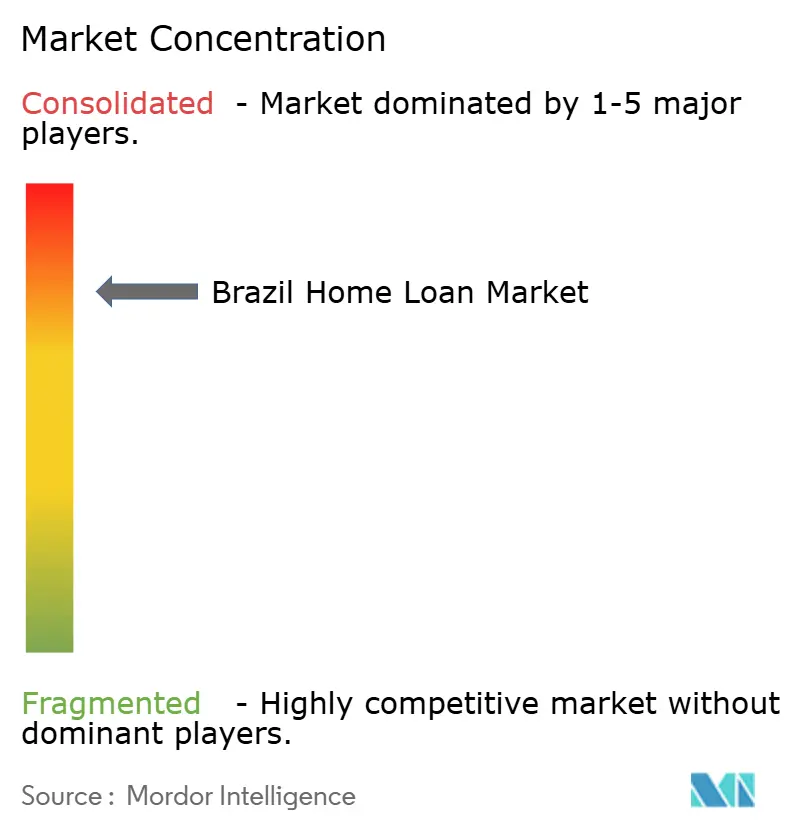
| Market Concentration | High |
Major Players *Disclaimer: Major Players sorted in no particular order Image © Mordor Intelligence. Reuse requires attribution under CC BY 4.0. | |

Brazil Home Loan Market Analysis by Mordor Intelligence
The Brazil home loan market size is USD 62.99 billion in 2026, and it is projected to reach USD 104.81 billion by 2031 at a 10.72% CAGR during the forecast period (2026-2031). Demand is reinforced by urbanization and middle-income expansion, with 87% of residents living in cities and household formation continuing to add new buyers. Policy support through Minha Casa, Minha Vida, and updated SBPE rules expands eligibility and keeps originations resilient across rate cycles. Open Finance and Pix adoption compress underwriting timelines by enabling cash-flow-based credit assessment and instant data sharing[1]IBGE, “2022 Census, 87% of the Brazilian population lives in urban areas,” IBGE News Agency, ibge.gov.br. Competitive strategies concentrate on digital onboarding, AI-driven decisioning, and bank–fintech partnerships that link origination speed with stable funding.
Key Report Takeaways
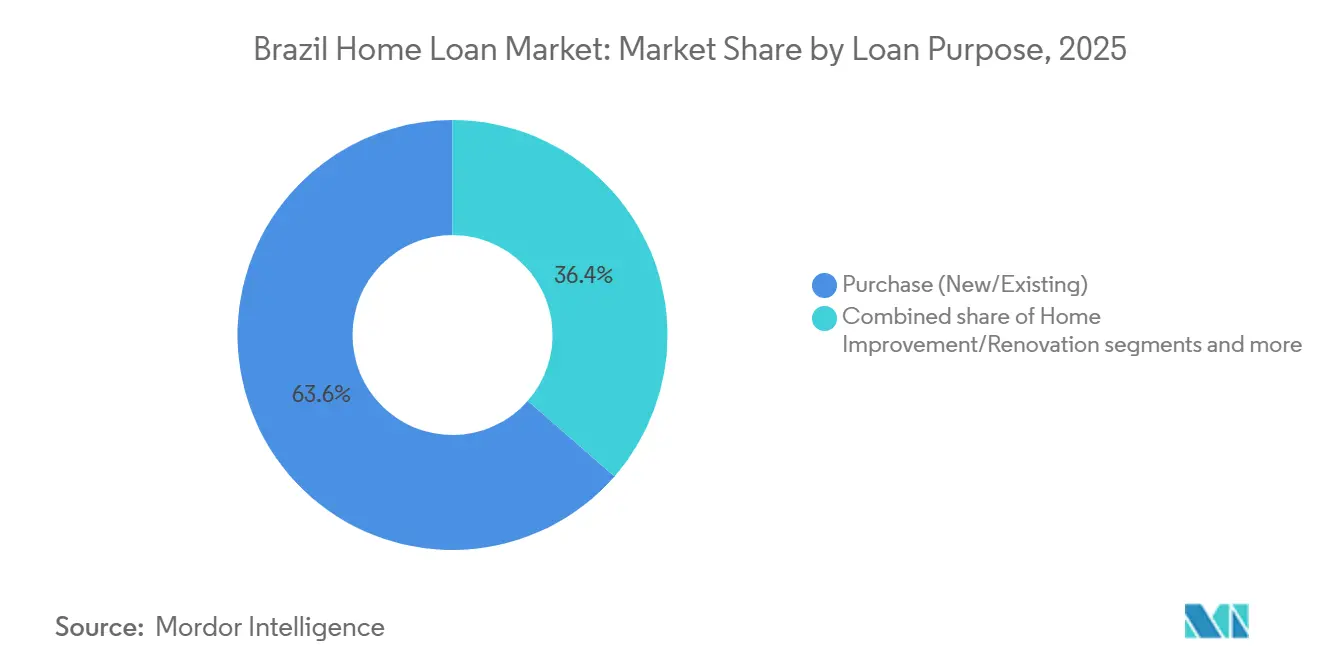
- By loan purpose, Purchase (New or Existing) led the Brazil home loan market with a 63.57% share in 2025, while Home Improvement and Renovation is projected to grow at a 10.04% CAGR through 2031.
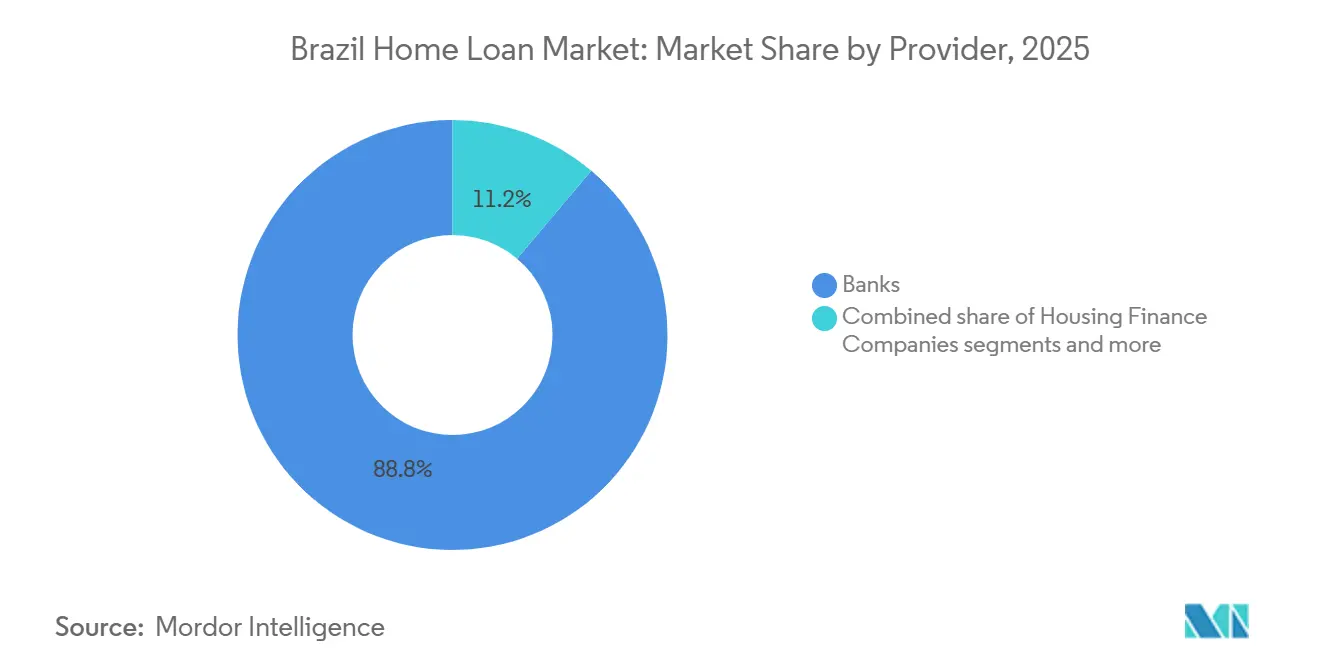
- By provider, Banks dominated the Brazil home loan market with an 88.83% share in 2025, while Others are forecast to expand at a 12.82% CAGR during 2026 - 2031.
- By interest rates, Floating Interest Rates accounted for 93.25% of the Brazil home loan market in 2025, while Fixed Interest Rates are expected to advance at a 14.57% CAGR through 2031.
- By loan tenure, terms greater than 20 Years held a 50.04% share of the Brazil home loan market in 2025, while 11 to 20 Years are set to grow at a 13.67% CAGR through 2031.
Note: Market size and forecast figures in this report are generated using Mordor Intelligence’s proprietary estimation framework, updated with the latest available data and insights as of January 2026.
Proportional positioning is established by comparing country level and regional contributions against the global total, including that of Brazil. The home loan market share in our global report expresses these relative weights.
Brazil Home Loan Market Trends and Insights
Drivers Impact Analysis*
| Driver | (~) % Impact on CAGR Forecast | Geographic Relevance | Impact Timeline |
|---|---|---|---|
| Government Housing Support Programs | +1.8% | National, with enhanced subsidies in the North and Northeast regions | Short term (≤ 2 years) |
| Urbanization and Middle-Class Expansion | +2.1% | National core, fastest growth in medium-sized cities | Medium term (2-4 years) |
| Macroeconomic Growth and Rising Disposable Income | +1.4% | National, concentrated in Southeast | Medium term (2-4 years) |
| Fintech-Led Credit Accessibility | +1.6% | National urban centers, strongest in São Paulo, Rio, and Brasília | Short term (≤ 2 years) |
| Interest Rate Environment and Mortgage Uptake | +2.3% | National | Long term (≥ 4 years) |
| Technological Advancements in Mortgage Lending | +1.5% | National urban, digital-first platforms in metros | Medium term (2-4 years) |
| Source: Mordor Intelligence | |||
Government Housing Support Programs
Minha Casa, Minha Vida expansions increase affordability through income-calibrated subsidies and subsidized coupon bands, which stabilize purchase decisions for eligible families across income brackets. The program’s 2025 adjustments add a new income tier and update value ceilings, which bring middle-income borrowers into regulated pricing without removing priority from lower-income cohorts. Location criteria that prioritize transit proximity and service access reduce hidden costs for households and improve the livability of financed units. FGTS-backed flows and Caixa’s execution capacity shorten the time from project launch to origination, which supports steady disbursement during tight monetary conditions[2]CAIXA, “CAIXA News and Releases,” CAIXA, caixa.gov.br. As program visibility improves, developers align pipelines with the updated thresholds, reinforcing purchase-led volumes within the Brazil home loan market. These adjustments contribute a measurable positive effect on the long-run adoption of formal housing credit among first-time and returning buyers.
Urbanization and Middle-Class Expansion
Urbanization stands at 87% of the population and supports deeper mortgage penetration through higher formal employment shares and service sector concentration. Household formation rises through the mid-2020s and creates sustained demand for purchases and targeted renovations in both core and secondary cities. Income levels vary across regions, which yields larger average loan sizes in the Southeast and volume-led growth in regions with higher subsidy intensity. Labor market improvements in 2025 align with higher formal earnings and help more borrowers qualify under SBPE and FGTS criteria. Growing digital adoption makes mid-tenure and renovation products accessible to younger cohorts who favor predictable budgeting. These dynamics collectively expand the addressable base for the Brazil home loan market as migration shifts support sustained urban absorption.
Macroeconomic Growth and Rising Disposable Income
Macroeconomic growth in 2026 remains steady while fiscal consolidation aims to improve risk premia and reduce funding spreads across banking channels[3]OECD, “Economic Outlook, Brazil Chapter,” OECD, oecd.org. Real wages and formal employment gains in 2025 improved household cash flows, which support incremental credit capacity within underwriting criteria. Regional income dispersion channels higher-ticket financing to large metros while program support keeps momentum in other areas. Banks and non-banks use cash-flow analytics and collateral-backed structures to serve borrowers without traditional paycheck documentation. As policy anchors take hold, lenders scale originations through SBPE and FGTS frameworks with measured risk controls. These conditions reinforce a gradual and broad-based expansion path for the Brazil home loan market through the forecast period.
Fintech-Led Credit Accessibility
Open Finance and Pix deliver consented, real-time data that lenders use to score applicants on observed cash flows, which increases approval rates for self-employed and gig-economy workers. Instant payment transactions supply high-frequency signals on bill payment and income variability that complement traditional bureau files. Leading private institutions integrate these datasets into their superapps to produce pre-approved offers that reduce friction and accelerate decisions. Regulatory updates define roles for payment initiation and API standards, which enable fintechs to operate adjacent to banks in origination while relying on bank funding[4]Itaú Unibanco, “Institutional Presentation,” Itaú Unibanco, itau.com.br. Caixa’s Banking-as-a-Service model illustrates this division of labor as partners handle front-end experiences and Caixa provides balance sheet and compliance infrastructure. These capabilities widen access and shorten time to cash, which is supportive for the Brazil home loan market in dense urban corridors.
Restraints Impact Analysis*
| Restraint | (~) % Impact on CAGR Forecast | Geographic Relevance | Impact Timeline |
|---|---|---|---|
| Elevated and Volatile Interest Rate Environment | -2.0% | National | Short term (≤ 2 years) |
| Macroeconomic Uncertainty and Consumer Confidence Risks | -0.9% | National, acute pressure in the Northeast states | Medium term (2-4 years) |
| Regulatory Constraints and Bureaucratic Bottlenecks | -0.7% | National, pronounced in smaller municipalities | Long term (≥ 4 years) |
| High Household Indebtedness Limiting Borrowing Capacity | -1.2% | National, the highest debt-service in urban Southeast | Medium term (2-4 years) |
| Source: Mordor Intelligence | |||
Elevated and Volatile Interest Rate Environment
The policy rate plateaued at a restrictive level in late 2025 and filtered into higher lending coupons for non-subsidized mortgages, which lifted monthly installments and reduced affordability. Banks transmitted rate changes to SBPE loans while FGTS-linked lines remained partially insulated by subsidized pricing rules. Higher coupons led developers to delay some greenfield projects, which shifted borrower focus toward ready inventory and renovation upgrades. As inflation indicators move closer to the target band, lenders anticipate scope for coupon moderation that would reactivate deferred demand. Borrowers respond to volatility by favoring predictable installment structures in the mid-tenure and fixed-rate segments where available. This restraint is most pronounced in the short term and gradually fades with policy normalization and improved price dynamics.
Macroeconomic Uncertainty and Consumer Confidence Risks
Economic uncertainty dampens housing intent when households prioritize liquidity buffers over long-duration obligations. Confidence-sensitive cohorts slow large-ticket decisions until they see sustained stabilization in employment, inflation, and borrowing costs. In regions with lower average incomes, the same uncertainty generates larger swings in intent and approval, which yield uneven origination patterns. Lenders adjust risk appetite and pricing to keep portfolios resilient without closing the credit window for qualified applicants. Policy signals that clarify program funding and capital rules improve visibility for developers and banks, which helps stabilize forward pipelines. The net effect moderates over the medium term as macro indicators align with targets and underwriting precision improves.
*Our forecasts treat driver/restraint impacts as directional, not additive. The impact forecasts reflect baseline growth, mix effects, and variable interactions.
Segment Analysis
By Loan Purpose: Renovation Demand Propels Niche Growth
"Purchase, New or Existing" leads the Brazil home loan market with a 63.57% share in 2025, driven by household formations and improved affordability under updated program thresholds. Acquisition volumes rose as buyers secured inventory, leveraging clear policy guidance and financing. SBPE reforms increased the SFH property value ceiling to BRL 2.25 million (USD 401,786), expanding access for middle-income families to regulated rates and predictable amortization. Major metros and regional centers remain purchase-driven, supported by program and SBPE channels. Digital origination growth has prompted lenders to focus on pre-approvals and cash-flow-verified offers, sustaining purchase momentum into 2026.
Home Improvement and Renovation is the fastest-growing segment, with a 10.04% CAGR from 2026 to 2031. Shorter tenures, smaller ticket sizes, and simplified registration support growth. Public credit lines for renovations and efficiency upgrades meet urban borrowers’ needs for targeted improvements without long-term exposure. Policies allowing collateral reuse enable owners to extract equity for upgrades while retaining core financing. The "Others" category, including construction and refinancing, remains cyclical, influenced by funding costs and developer pipelines. Digital verification and quick decision-making drive the expansion of renovation-aligned products, catering to smaller projects requiring rapid execution.



By Provider: Fintech Platforms Disrupt Bank Hegemony
Banks hold an 88.83% market share in 2025, driven by deposit funding, SBPE mandates, and operational scale in SBPE and FGTS segments. The leading public bank executes nationwide subsidy-linked housing finance programs. Private leaders invest in AI-enabled origination and superapps with pre-approvals and debt-service calculators to streamline decisions. Other players are projected to grow at a 12.82% CAGR as fintech originators and specialized finance firms scale Open Finance data and securitization, enhancing participation through Banking-as-a-Service and structured partnerships in Brazil's home loan market.
Regulatory modernization clarifies Open Finance roles and expands licensed finance companies' scope in the credit ecosystem. Bradesco and peers report higher digital disbursement shares, highlighting the durability of end-to-end digital origination in retail credit. Banks maintain a funding cost advantage by pairing SBPE deposits with TR-linked liabilities for stable pricing. Non-banks scale by standardizing analytics and investor reporting for receivables issuance, improving execution for portfolios above economic thresholds. These developments ensure Brazil's home loan market remains competitive and inclusive while adhering to prudential standards.
By Interest Rates: Fixed Gains Traction Amid Volatility
Floating Interest Rates account for 93.25% of balances in 2025 and reflect TR-linked portfolios that moderate nominal installment variability for eligible borrowers. Savings deposit mechanics tie funding costs to TR, which supports asset-liability alignment and reduces duration risk in the bank channel. FGTS-backed loans frequently default to floating arrangements, which sustains the segment’s dominance across cycles and income tiers. Borrowers prioritize approval and monthly affordability under program rules, which reinforces floating-rate selection under current frameworks. Floating prevalence remains a structural feature of the Brazil home loan market, given funding design and program mandates.
Fixed Interest Rates are projected to grow at a 14.57% CAGR through 2031, supported by updated amortization guidance that stabilizes nominal installments and improves predictability. Regulators outlined how amortization components can offset inflation-related updates to protect monthly budgets while managing price dynamics. Middle-income buyers in the new SFH ceiling band show early interest in fixed structures to improve household budgeting under tighter conditions. Lenders diversify into fixed exposures to improve risk metrics and portfolio resilience within ISO-aligned frameworks. The Brazil home loan market gains product diversity as fixed offerings complement floating staples during and after policy normalization.
By Loan Tenure: Mid-Tenures Optimize Affordability
Terms greater than 20 Years held a 50.04% share in 2025, driven by subsidy-linked structures extending repayments up to 35 years to match income-constrained budgets. The SFH framework supports longer tenures, reducing monthly obligations compared to 20-year terms and improving loan-to-income ratios at approval. Households with stronger cash positions prefer shorter tenures to minimize total interest while preserving liquidity. Digital platforms use consented account data to tailor tenures based on verified cash flows, reinforcing tenure stratification by income band in Brazil's home loan market.
The 11 to 20 Years segment is the fastest-growing tenure, with a 13.67% CAGR from 2026 to 2031, as borrowers balance affordability and total interest costs under the updated SFH ceiling. Approval systems optimize tenure and monthly obligations to align with borrower cash flows and property prices. Shorter tenures dominate premium and investor segments, where liquidity and asset strategies favor faster amortization. The rising share of mid-tenures reflects improved applicant qualification under predictable installment structures and enhanced digital screening. This shift supports healthier borrower profiles and steadier servicing across economic cycles.
Geography Analysis
Regional distribution in 2025 aligns with population and income patterns, with the Southeast estimated at 43.1% of origination value, reflecting larger average ticket sizes and dense employment hubs. The Brazil home loan market share for the Southeast tracks its higher per capita income and infrastructure depth, which sustains purchase-led flows in metropolitan areas and peripheries. Urbanization and transit investments support absorption, with new corridors improving access to employment and services that underpin demand. The Brazil home loan market benefits from this concentration of value while policy changes expand the eligible base for regulated financing.
The Northeast is the fastest-growing region as program intensity, lifestyle migration, and services expansion bring more qualified households into formal mortgage channels. Differentiated subsidy rates and eligibility criteria reflect local income profiles and support originations in key capitals and growth corridors. Lenders focus on urban centers with stronger employment and stable collateral values to ensure portfolio performance. The Brazil home loan market expands through this regional rotation while maintaining exposure to core metropolitan volumes. Diversification by city size and sector mix improves resilience during monetary transitions.
The South contributes steady volumes with diversified economies and high urbanization that support consistent demand for mid-tenure and fixed options. The Central-West shows strong population growth and government-linked employment that raises eligibility for SBPE and FGTS-backed loans. The North remains smaller in value terms due to income and infrastructure gaps, yet industrial hubs with formal employment increase FGTS-linked participation. As Open Finance widens underwriting precision, regional access improves and supports broader inclusion within the Brazil home loan market.
Mordor Intelligence examines the home loan market across diverse other regional markets as well, offering granular country-level perspectives for United States, China, and India and more.
Regulatory Landscape
Brazilian home lending operates primarily under the Sistema Financeiro da Habitação (SFH) and the Sistema de Financiamento Imobiliario (SFI). Regulation and supervision are led by Banco Central do Brasil (BCB), with policy guidelines issued by the Conselho Monetario Nacional (CMN). A key structural rule in the Sistema Brasileiro de Poupanca e Emprestimo (SBPE) requires financial institutions to allocate at least 65% of savings-deposit resources to real estate credit, which anchors bank funding and pricing behavior across interest-rate cycles.
In 2026, policy and prudential refinements continued to shape collateral, guarantee, and eligibility mechanics. Instrução Normativa BCB no 707 (January 2026) set conditions for real estate credit operations that share the same property as collateral, which affects refinancing, second-lien-like structures, and product design around collateral re-use. Medida Provisoria no 1.350 (April 15, 2026) introduced improvements to the Fundo Garantidor da Habitacao Popular, reinforcing guarantee architecture for lower-income housing finance linked to federal programs such as Minha Casa, Minha Vida.
Value Chain Analysis
The value chain starts with borrower sourcing and pre-qualification, through branches, correspondent networks, developers, and increasingly digital channels using Open Finance data. It then moves to underwriting, collateral appraisal, and contract formalization via property registry and notary steps required under SFH/SFI. Funding is matched to product types, with SBPE savings resources and FGTS-linked lines supporting SFH lending, while SFI origination relies more on market-based liabilities and capital markets instruments.
Origination and servicing remain concentrated in large banks. Caixa Economica Federal acts as the primary federal housing-policy executor and is also a dominant servicer in subsidized segments, including a portfolio mix materially tied to Minha Casa, Minha Vida. Private banks, including Itaú Unibanco, Bradesco, and Banco Santander, have operated more selectively in early 2026 amid macro and rate conditions, focusing on risk-adjusted segments and tighter credit filters. Non-bank participation comes through housing finance companies authorized by the BCB that originate or warehouse loans and distribute risk through instruments such as LCI, debentures, and fund structures. This creates a secondary channel outside SFH constraints while still depending on standardized collateral, documentation, and investor reporting.
Competitive Landscape
Brazil's home loan market is highly concentrated, with a few major institutions dominating origination and servicing. Leading banks control most volumes and funding access. State-backed channels focus on subsidy-linked loans, while private banks use AI-driven origination within mobile platforms to reduce decision times. Open Finance consent flows and real-time debt-service calculators enable pre-approved offers and higher conversion rates. Public sector leaders expand housing disbursements via SBPE and FGTS, maintaining low non-performing ratios. Banco do Brasil strengthens regional lending through ESG-linked international partnerships, addressing housing and infrastructure needs.
Digital transactions are rising as Bradesco and peers increase online disbursements using automated KYC and app-based support. Bank-fintech collaborations grow through Banking-as-a-Service, where fintechs handle origination, and banks provide balance sheets and compliance. Open Finance and Pix streamline underwriting, reducing manual documentation and improving access for cash-flow-rich but thin-file borrowers. SBPE deposits anchor bank funding, while securitization supports non-bank scaling. Program reforms, set for 2026, raise ceilings and refine amortization rules, expanding the borrower base.
Strategic efforts focus on speed, predictability, and inclusion. Itaú integrates real-time pre-approvals into its superapp, tailoring offers via Open Finance. Bradesco accelerates digital origination with automated KYC workflows. Banco do Brasil deepens ESG-linked financing for resilient construction and infrastructure. Caixa's BaaS initiative extends white-label channels to fintechs, enhancing reach with incumbent-grade funding and compliance.
Brazil Home Loan Industry Leaders
Banco do Brasil S.A.
Caixa Econômica Federal (CEF)
Banco Bradesco S.A.
Itaú Unibanco Holding S.A.
Banco Santander Brasil S.A.
- *Disclaimer: Major Players sorted in no particular order

Market Opportunities and Future Outlook
A near-term opportunity lies in expanding capacity for program-linked and middle-income lending as program parameters move up-market while keeping regulated structures intact. In April 2026, updated Minha Casa, Minha Vida operating rules raised the financed property value ceiling to BRL 600,000 for families earning up to BRL 13,000 per month. That widens the regulated credit addressable band, and it is already pushing lenders to refresh product grids, developer partnerships, and pre-approval funnels around the new thresholds.
Digital distribution and alternative underwriting also create another opening, particularly for banks and fintech-originators that can combine fast onboarding with compliant SBPE/SFH execution. Caixa reported its mortgage credit portfolio reached BRL 1 trillion by June 2026, which highlights the scale of balance-sheet capacity in the public channel and the importance of operational throughput, servicing, and funding access. At the same time, product adjustments in private banking, such as Santander Brasil increasing maximum financing to 90% of property value for selected client profiles in May 2026, point to room for differentiated offers. LTV-based, profile-based, and SFI-oriented structuring can benefit where data-sharing supports tighter risk segmentation.
Recent Industry Developments
- July 2026: Caixa Econômica Federal mortgage credit portfolio reaches R$1 trillion, up more than 14% year over year. The expansion signals public sector dominance in housing finance and supports Minha Casa Minha Vida spillovers into bancassurance and funding salience.
- May 2026: Santander Brasil increases maximum financing percentage for housing loans from 80% to 90% for targeted client profiles. The move reflects Open Finance driven underwriting expansion and improves conversion in a high-rate environment.
- April 2026: Caixa Econômica Federal updates Minha Casa Minha Vida program rules with financing ceiling raised to R$600,000 for families earning up to R$13,000 per month. The reform reinforces public housing financing channel and broadens borrower base for regulated credit.


Research Methodology Framework and Report Scope
Market Definition and Coverage
For this study, the Brazil home loan market is defined as the total value of residential lending issued and held for housing related purposes, tracked across major provider types operating in Brazil and measured in USD terms.
Scope exclusions: this sizing excludes unsecured personal credit that is not tied to housing, and it also excludes commercial real estate lending.
Segmentation Overview
- By Loan Purpose
- Purchase (New/Existing)
- Home Improvement/Renovation
- Others (Construction, Refinance, etc.)
- By Provider
- Banks
- Housing Finance Companies
- Others
- By Interest Rates
- Fixed Interest Rates
- Floating Interest Rates
- By Loan Tenure
- ≤ 10 Years
- 11 – 20 Years
- Greater than 20 years
Data Sources, Market Sizing, and Validation
Desk Research
Desk research sets the guardrails for the model by fixing Brazil-specific context on housing demand, lending conditions, and the main funding channels used for mortgages. Public sources were used to understand the direction of housing credit and to cross-check whether the modeled trend fits with interest rate cycles.
We relied on non paywalled sources such as Banco Central do Brasil statistical releases, IBGE housing and household indicators, ABECIP updates on housing credit and SBPE performance, and FGTS housing allocation and program documentation published through official government channels. We also reviewed lender disclosures such as annual reports, investor presentations, and financial statements, supported by reputed press reporting on policy changes and origination trends. Where needed, paid subscriptions for company financials and intelligence, news and financials, and an import-export shipment-level database were used selectively to validate institution-level activity and macro conditions linked to construction demand. The examples listed here are not exhaustive, and many other sources were reviewed to collect data, validate assumptions, and clarify open questions.
Primary Interviews and Surveys
Primary work was used to pressure test the market math and to convert broad indicators into usable assumptions, especially when public series cover only one funding bucket or one definition of housing credit. We spoke with a mix of lenders, housing finance specialists, and ecosystem participants to confirm drivers such as rate sensitivity, approval timelines, average ticket size movement, and shifts between SBPE, FGTS, and market funding, with views gathered across Brazil's major lending centers and regional demand pockets.
Distribution of primary research fieldwork respondents
| Company type | Respondent position |
|---|---|
| Top tier: 28% | CXOs: 17% |
| Mid tier: 54% | Functional/Unit leaders: 33% |
| Smaller Players: 18% | Managers: 50% |
Market-Sizing & Forecasting
The model starts with a top-down reconstruction where housing credit is built from observed lending activity and key funding pools, then translated into market value in USD using consistent timing assumptions. After that, we corroborate it with selective bottom-up approximations using sampled lender roll-ups, channel checks, and average loan size times estimated financed units, which are then used to adjust totals where disclosure is uneven.
Inputs that meaningfully move the Brazil outcome include the Selic rate path and mortgage rate pass-through, SBPE and FGTS funding availability, financed housing unit volumes, average loan size progression, property price direction, and program rule changes that shift eligibility and borrower mix. For forecasting, scenario analysis is used to reflect different interest rate and funding conditions, followed by light time series smoothing so one-off spikes do not overstate the trend. When a bottom-up check is missing for a smaller pocket of lending, gaps are handled through conservative interpolation anchored to the closest observable funding and origination indicators.
Data Validation & Update Cycle
Outputs are checked against independent signals, including public housing credit updates, funding channel movements, and direction of originations reported by industry bodies, and then variances are investigated before final numbers are accepted. When a large mismatch is seen, we recheck definitions, rerun currency conversion timing, and then reconnect with selected interviewees to confirm whether it is a true market shift or a data timing issue.
A multi-step internal review is followed so assumptions, calculations, and narrative stay consistent across sections. Reports refresh annually, and interim updates are made when material events occur such as major policy changes or sharp rate moves. Before delivery, a final analyst pass is done so clients receive the latest updated view available at that time.
Mordor Intelligence's Brazil Home Loan Market Sizing Compared With Other Published Estimates
Published market values for Brazil home loans can vary because the underlying definition is not always the same, and the funding buckets included can shift the total by a lot. Differences also show up when one publisher uses annual originations flow, while another leans on outstanding balances, and when exchange rate timing is handled in different months.
By checking SBPE and FGTS funding movements alongside financed unit counts and then refreshing FX conversion timing, Mordor Intelligence keeps the market total tied to a broad housing lending pool instead of a single channel series.
Benchmark comparison
| Source | Market Size | Gaps in Research Methodology |
|---|---|---|
| Mordor Intelligence | USD 62.99 B (2026) | |
| Industry Association Bulletin A | USD 34.00 B (2024) | This number reflects SBPE funded housing finance originations for the year, which excludes FGTS backed lending and also tracks annual flow rather than a wider home loan value pool. |
| Financial News Desk B | USD 58.00 B (2025) | This estimate is presented as total real estate financing originations for the year, which can mix categories within real estate credit and does not always separate home purchase, improvement, and other housing loan purposes consistently. |
The spread is mainly explained by whether the underlying series is SBPE only, a total annual origination headline, or a broader home loan value view that stays consistent across loan purpose and provider coverage. Using clear inputs that can be rechecked each year also makes the final number easier to trace back to funding and demand indicators.


Key Questions Answered in the Report
What is the size and growth outlook for the Brazil home loan market from 2026 to 2031?
The Brazil home loan market size is USD 62.99 billion in 2026, and it is projected to reach USD 104.81 billion by 2031 at a 10.72% CAGR.
Which loan purpose category leads, and which is growing fastest in Brazil?
Purchase, New or Existing, leads with a 63.57% share in 2025, and Home Improvement and Renovation is the fastest-growing at a 10.04% CAGR from 2026 to 2031.
How is the provider mix changing in Brazil’s housing finance?
Banks hold 88.83% of originations in 2025, while Others are projected to grow at a 12.82% CAGR as fintechs scale Open Finance-driven origination and securitization partnerships.
What rate structures do borrowers prefer in Brazil, and how is that shifting?
Floating Interest Rates hold a 93.25% share in 2025 due to TR-linked structures and program design, and fixed offerings are gaining traction at a 14.57% CAGR under updated amortization guidance.
Which regions lead value and which show the fastest expansion in Brazil?
The Southeast leads by value with an estimated 43.1% share in 2025, and the Northeast shows the fastest trajectory under enhanced subsidies and urban migration.
What policy changes are most relevant for product and tenure choices in Brazil?
The SFH ceiling increase to BRL 2.25 million and amortization refinements support mid-tenure and fixed-structure adoption while preserving affordability in subsidy-linked segments.
Page last updated on:


 Your data is secure and never sold or shared.


