
Market Overview
| Study Period | 2021 - 2031 |
|---|---|
| Forecast Data Period | 2026 - 2031 |
| Historical Data Period | 2021 - 2024 |
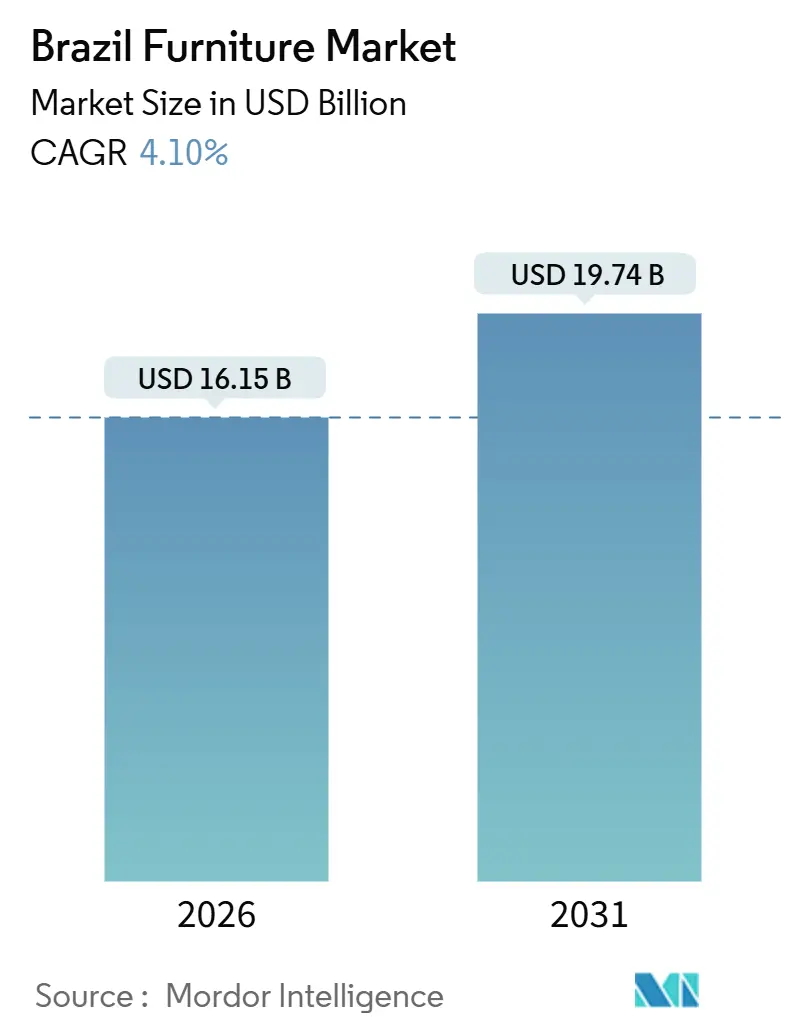
| Market Size (2026) | USD 16.15 Billion |
| Market Size (2031) | USD 19.74 Billion |
| Growth Rate (2026 - 2031) | 4.10 % |
| Market Concentration | Low |
Major Players *Disclaimer: Major Players sorted in no particular order Image © Mordor Intelligence. Reuse requires attribution under CC BY 4.0. | |
Brazil Furniture Market Analysis by Mordor Intelligence
The Brazil furniture market size reached USD 16.15 billion in 2026 and is projected to reach USD 19.74 billion by 2031, expanding at a 4.10% CAGR. The Brazil furniture market is experiencing steady growth, driven by a combination of strategic shifts and evolving consumer demand. Companies are increasingly focusing on value-chain efficiency and optimizing their product mix, reflecting a shift from competing on volume to competing on price realization, margin protection, and selective promotional strategies. The sector is also adapting to changes in pricing, certification, and fulfillment models following a period of market volatility, which is helping businesses strengthen operational resilience. Export opportunities are expanding, particularly toward Europe and within Mercosur countries, as Brazilian manufacturers prepare to take advantage of anticipated tariff-free access under the Europe-Mercosur trade framework. This is placing greater emphasis on traceability, quality standards, and alignment with international market requirements, boosting the competitiveness of Brazilian furniture abroad. On the domestic front, demand is supported by government housing programs that create consistent orders for entry-level cabinetry, modular kitchens, and bedroom furnishings targeted at lower to middle-income consumers. As financing conditions improve, there is potential for households to resume deferred purchases of higher-value furniture items, further supporting market expansion.
Key Report Takeaways
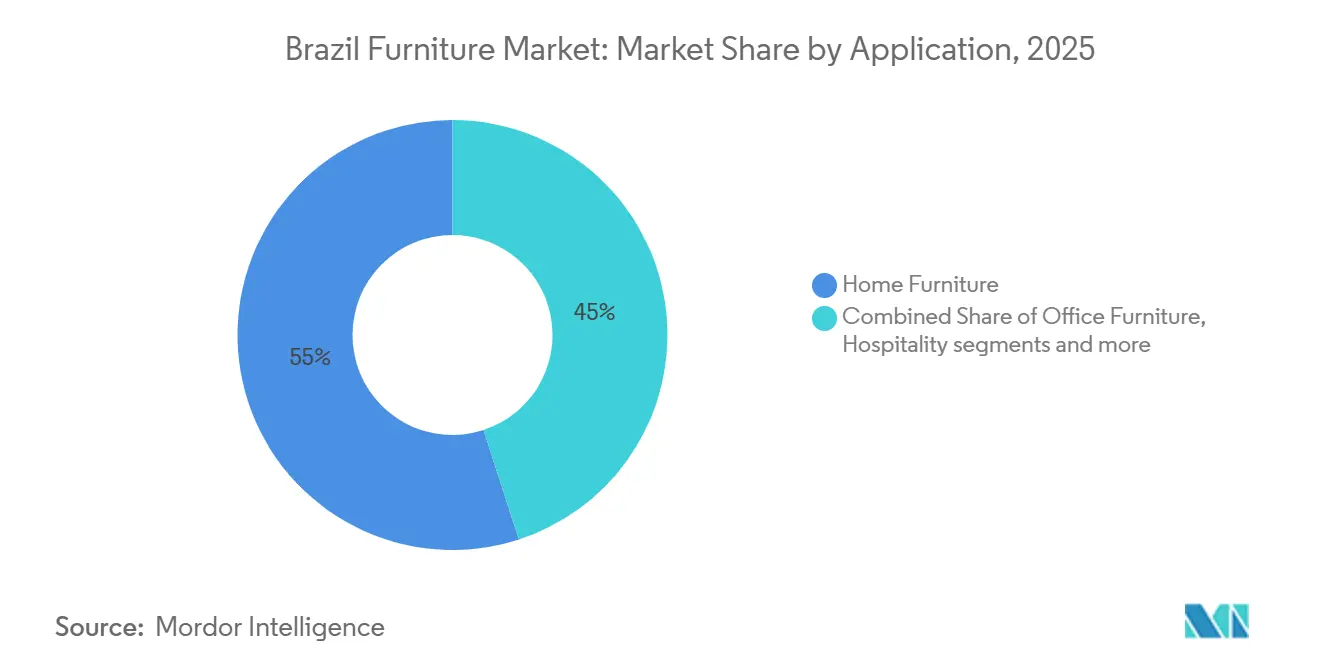
- By application, home furniture led with 55.0% of the Brazil furniture market share in 2025. Healthcare furniture is projected to expand at a 5.66% CAGR through 2031.
- By material, wood retained 62.0% of the Brazil furniture market share in 2025. Plastic and polymer are projected to grow at a 4.94% CAGR through 2031.
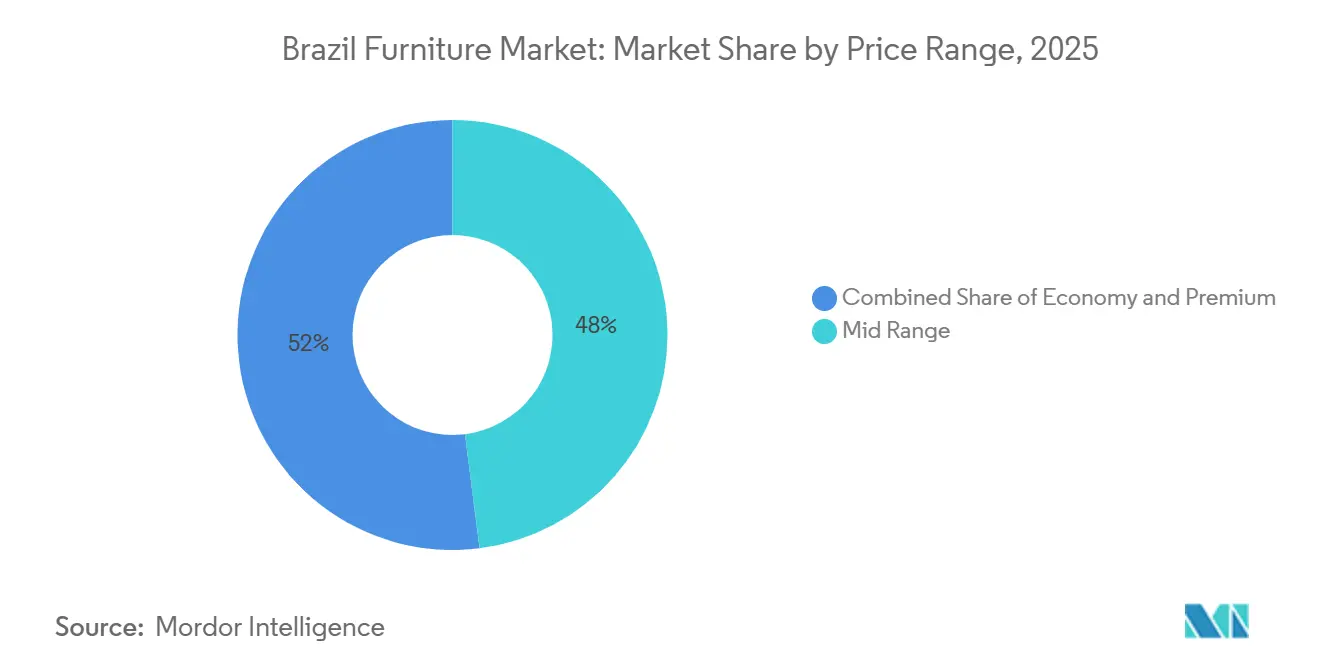
- By price range, mid-range held 48.0% of the Brazil furniture market share in 2025. The premium tier is projected to advance at a 4.61% CAGR through 2031.
- By distribution channel, B2C or retail accounted for 75.0% of the Brazil furniture market share in 2025. Online channels within B2C are projected to grow at a 7.36% CAGR through 2031.
- By geography, Southeast Brazil captured 47.0% of the Brazil furniture market share in 2025. The North is projected to be the fastest-growing region at a 4.82% CAGR through 2031.
Note: Market size and forecast figures in this report are generated using Mordor Intelligence’s proprietary estimation framework, updated with the latest available data and insights as of January 2026.
Brazil Furniture Market Trends and Insights
Drivers Impact Analysis*
| Driver | (~) % Impact on CAGR Forecast | Geographic Relevance | Impact Timeline |
|---|---|---|---|
| E-commerce penetration beyond Tier-1 cities | +0.9% | National, with early gains in São Paulo, Paraná, and Northeast capitals | Medium term (2-4 years) |
| Growing middle-class credit access | +0.7% | Concentrated in Southeast/South; spillover to the Midwest | Short term (≤ 2 years) |
| Government-backed housing stimulus (Minha Casa Minha Vida) | +0.5% | National, highest impact in Southeast/Northeast Faixa 1-3 zones | Medium term (2-4 years) |
| ESG-driven certified-wood demand (FSC, PEFC) | +0.3% | Export-oriented and domestic premium clusters in large metros | Long term (≥ 4 years) |
| Furniture-subscription and leasing platforms | +0.2% | Primarily Southeast metros; pilot expansion in the South | Long term (≥ 4 years) |
| Digital-twin enabled mass-customization | +0.1% | High-income urban centers; limited SME adoption | Long term (≥ 4 years) |
| Source: Mordor Intelligence | |||
E-commerce Penetration Beyond Tier-1 Cities Unlocks Latent Rural Demand
Online expansion in the Brazil furniture market is widening beyond major metros as marketplaces and sellers build assortments for interior municipalities and reduce delivery friction for bulky goods. Platforms are standardizing catalogs, tightening delivery windows in high-density corridors, and aligning inventory with regional preferences to improve conversion and repeat rates. As channel strategies mature, physical showrooms provide touchpoints for high-consideration categories while digital funnels capture traffic and close sales. Retail calendar effects remain material, with national statistics showing peaks and troughs around promotional moments that pull demand across months. Industry updates confirm that production volumes did not keep pace with nominal revenue in late 2025, which signals continued optimization of pricing, logistics, and assortment as e-commerce deepens into underserved locations in the Brazil furniture market.
Growing Middle-Class Credit Access Fuels Installment-Driven Consumption
The Brazil furniture market is increasingly shaped by household access to consumer credit. Brazil’s official data show that household credit has risen steadily and reached record levels by late 2025, totaling over USD 688 billion at the end of 2024. This expansion enables middle-income consumers to use multi-month installment plans for higher ticket items such as kitchens, wardrobes, and bundled furniture packages.[1] Elevated borrowing costs and household delinquency constrained purchases in late 2025, prompting consumers to prioritize essential replacements over full-room sets. As financing conditions ease in 2026, affordability for installment purchases is expected to improve, supporting a gradual rebound in average ticket sizes. Production and sales data highlight the cyclical nature of demand, with early-year gains giving way to slower activity aligned with tighter credit. Retailers are balancing accessible price points with margin discipline to capture demand as deferred purchases are released.
Government-Backed Housing Stimulus Drives Entry-Tier Furniture Demand
The Minha Casa Minha Vida housing program has been a key driver of baseline demand for entry-level cabinetry, modular kitchens, and bedroom furniture by supporting household formation among lower-income and emerging middle-class families. By the end of 2024, the program had contracted over 1.26 million housing units, exceeded its original targets, and highlighted strong participation from its intended beneficiaries. The program prioritizes ready-to-occupy housing, which encourages the purchase of essential furniture items rather than luxury or custom pieces, shaping the product mix toward modular, space-efficient solutions.[2] Flexible financing and subsidies embedded in the program increase affordability for lower-income buyers, enabling them to gradually furnish their new homes using installment-based purchases, which aligns with the broader trend of credit-driven consumption in Brazil. Beneficiaries typically sequence furniture purchases over time, first acquiring essential items at move-in and later upgrading or replacing pieces as household budgets allow, supporting repeat sales and aftermarket demand.
ESG-Driven Certified-Wood Demand Repositions Brazil in Premium Export Tiers
Rising regulatory and buyer expectations in Europe are increasing the value of certified and traceable timber, reshaping both export strategies and premium domestic furniture lines. Brazil has recently updated and strengthened national forestry standards to support sustainable forest management and certified timber production, which underpins traceability and environmental credibility in global supply chains. The Forest Stewardship Council’s new national standard for natural forests, developed through public consultation and field testing, came into effect in October 2025, promoting responsible forest practices, biodiversity conservation, and stronger rights protections for local communities. [3] Updated standards strengthen low-impact logging practices and community protections, raising the bar for verified supply chains and sustainable sourcing. Anticipated trade frameworks, such as the EU-Mercosur agreement, further emphasize sustainability by prioritizing deforestation-free materials and reliable audit trails, which can reduce barriers for compliant Brazilian exporters. Industry programs have equipped manufacturers with ESG diagnostics, carbon accounting aligned with global protocols, and certification checklists to accelerate compliance, enabling faster market access and improving competitiveness.
Restraints Impact Analysis*
| Restraint | (~) % Impact on CAGR Forecast | Geographic Relevance | Impact Timeline |
|---|---|---|---|
| High logistics costs in the North and the Center-West | -0.6% | North and Center-West states; limited infrastructure corridors | Short term (≤ 2 years) |
| Exchange-rate volatility on imported inputs | -0.5% | National exposure for machinery and hardware imports; export competitiveness | Short term (≤ 2 years) |
| Skilled labor shortage in customized joinery | -0.3% | Hubs in Paraná, Santa Catarina, Rio Grande do Sul | Medium term (2-4 years) |
| Tighter formaldehyde-emission regulations | -0.2% | National production; compliance costs for MDF and particleboard | Medium term (2-4 years) |
| Source: Mordor Intelligence | |||
High Logistics Costs in North and Central-West Erode Retailer Margins
Delivery costs for bulky furniture remain structurally high in regions with sparse warehousing and long transportation routes, particularly in the North and the Center-West. Retailers targeting price-sensitive households face margin pressure when freight expenses consume a significant portion of transaction value, limiting the adoption of higher-ticket items. Late 2025 production data and industry reporting highlight how rising distribution costs and logistical constraints impacted inventory planning and throughput. In response, the Brazil furniture market is implementing micro-fulfillment centers, route optimization, and tighter product assortments to protect service levels and reduce return costs. Sellers are also experimenting with hybrid operating models that combine marketplace exposure with localized pickup or scheduled delivery to maintain customer experience while controlling expenses. These strategies are increasingly critical as redirected export capacity intensifies competition in domestic channels and emphasizes the need for precise, efficient supply chain management.
Exchange-Rate Volatility on Imported Inputs Compresses Manufacturer Profitability
Manufacturers dependent on imported machinery, hardware, and chemical inputs face planning and cost challenges when currency fluctuations alter landed costs and complicate pricing. While higher export receipts in 2024 partially offset these pressures, they were insufficient to fully support investment in automation and capacity upgrades. Companies that diversify sourcing within Mercosur can mitigate long lead times, hedge some currency risk, and align with emerging Europe-Mercosur trade opportunities. Larger multinational players leverage steady execution in contract channels to buffer consumer-facing segments from foreign exchange volatility. Improved visibility on policy rates and FX bands is expected to enhance planning certainty, allowing manufacturers to unlock deferred capital expenditures for productivity and certification initiatives. These investments in efficiency and compliance expand the addressable market for Brazilian furniture, particularly in export-oriented and higher-value segments.
*Our forecasts treat driver/restraint impacts as directional, not additive. The impact forecasts reflect baseline growth, mix effects, and variable interactions.
Segment Analysis
By Application: Planned Furniture Pivots from Premium to Functional Necessity
Home furniture accounted for 55.0% in 2025, anchoring the Brazil furniture market share at the application level with planned and modular solutions moving beyond upper-income niches. Momentum in fitted cabinetry and compact storage reflects a growing focus on functional, space-optimized designs that enhance everyday utility. Healthcare furniture is emerging as a rapidly expanding application, driven by demand for durable, certified materials in hospitals and clinics. Contract segments, including office and hospitality, show mixed growth, with corporate projects progressing gradually while small businesses adopt modular workstations for hybrid work setups.
The market is aligning product assortments with these trends by prioritizing configurable systems that meet safety and durability standards while ensuring reliable delivery. Aftermarket dynamics complement new-home purchases, as subsidized housing beneficiaries gradually complete rooms and upgrade key pieces as finances allow. Retailers are optimizing product ladders for standardized layouts in affordable housing and emphasizing installation simplicity to control service costs. Overall, improving consumer credit conditions are expected to support steadier demand for planned kitchens, storage-heavy furniture, and installment-friendly categories, strengthening both domestic consumption and structured delivery models.

By Material: Wood Retains Dominance as Low-Emission MDF Gains Premium Traction
Wood remained the largest material category with a 62.0% share in 2025, supported by robust panel capacity and deep forestry resources that underpin the Brazil furniture market. Engineered panels such as MDF and particleboard continue to serve as the backbone for configurable and flat-pack formats that improve logistics efficiency for nationwide distribution. Industry programs emphasize sustainability and certification readiness, which guide resin selection, finishing, and sourcing aligned to global buyer requirements. Plastic and polymer are projected to be the fastest-growing materials at a 4.94% CAGR through 2031, especially in categories that value durability, cleanability, and weight advantages. Export-facing producers are also reinforcing certified wood chains to comply with European sustainability rules while protecting access to premium channels in the Brazil furniture market.
Evolving expectations for verified sourcing and environmental performance continue to favor FSC and other recognized certification labels, which simplify compliance audits and retailer onboarding. Industry initiatives provide manufacturers with diagnostics, carbon accounting tools, and structured checklists to accelerate the certification process recognized by international buyers. As these capabilities extend from larger exporters to mid-sized suppliers, the Brazil furniture market is positioned to broaden its reach in regulated export destinations and increase the share of eco-labeled assortments in the domestic market. Advances in panel chemistry and finishing systems support this transition while maintaining cost competitiveness. Together, material innovation and rigorous chain-of-custody practices are becoming central to long-term strategic positioning in both export markets and premium local segments.
By Price Range: Mid-Range Compression Drives Polarization Toward Budget and Premium
Mid-range accounted for 48.0% in 2025, and it remains the largest price band even as households adjusted purchases under tighter credit in late 2025 in the Brazil furniture market. The premium tier is projected to grow at a 4.61% CAGR through 2031 as higher-income cohorts continue to prioritize quality, durability, and certified materials. Promotional cycles in the national retail calendar shift demand across months more than they expand the total wallet, which points to the importance of timing and disciplined inventory planning. Industry reporting shows unit softness in late 2025 despite nominal revenue growth, which indicates ticket values were supported by pricing actions and targeted discounts rather than broad volume gains. As financing costs decline in 2026, retailers expect an improved backdrop for mid-range recovery in planned kitchens, bedroom sets, and living room anchors in the Brazil furniture market.
Premium assortments rely on eco-labeled woods, enhanced ergonomics, and modularity that fit compact urban spaces with minimal waste, thereby sustaining differentiation and resale value. Certification roadmaps from industry programs help brands substantiate claims that resonate with higher-income buyers in large metros. Budget ranges remain sensitive to freight and last-mile costs, which require lean packaging and standardized SKUs to control delivery expenses without reducing perceived value. Retailers are trimming long-tail assortments and improving vendor-managed inventory to stabilize stock turns across price bands. As conditions improve, the Brazil furniture market should display steadier distribution of spend across budget, mid-range, and premium tiers while maintaining a stronger link between financing, fulfillment, and value perception.
By Distribution Channel: Marketplace Aggregation Reshapes B2C Competitive Dynamics
B2C or retail channels accounted for 75.0% in 2025, and online subchannels within B2C are projected to grow at a 7.36% CAGR through 2031 as convenience and assortment deepen in the Brazil furniture market. Sellers continue to integrate online discovery with showroom validation for high-consideration purchases while streamlining pickup and scheduled delivery to manage bulky items at scale. National retail patterns show how promotions can reallocate demand between months, which supports calendar-driven strategies for major categories. Project channels in office, hospitality, and healthcare maintain longer cycles and different margin structures, and multinational filings indicate stable service to Latin America clients that include Brazil. These attributes make B2C the principal arena for share battles while projects supply a predictable base of orders in contract-grade segments.
Compliance capabilities remain a differentiator in safety-critical categories, since reliable testing and certification reduce the risk of delays and returns for multi-seller marketplaces. Association programs that codify ESG and quality requirements are helping smaller firms document processes that satisfy buyer due diligence. Retailers are also improving packaging, routing, and delivery coordination to reduce damage in transit and to preserve NPS at scale. As these operating disciplines spread, the Brazil furniture market will maintain a hybrid model with online-led growth, targeted showroom support, and a steady project pipeline that absorbs specialized capacity. Inventory visibility and fulfillment speed will be critical to margin integrity in this environment.
Geography Analysis
Southeast Brazil accounted for 47.0% of furniture consumption in 2025, reinforcing its position as the country’s main market and production base. Large urban centers, mature distribution networks, and strong retail density continue to drive demand across categories. Production clusters in the South complement this demand by supplying the national market through well-established wood-furniture hubs. These clusters benefit from skilled labor and dense supplier ecosystems built over decades. Together, scale, logistics, and access to certified inputs support premium and export-oriented furniture lines.
In late 2025, furniture unit sales declined even as nominal revenues increased, reflecting inflation effects, cautious discounting, and uneven regional demand. Manufacturers responded by adjusting production schedules, demonstrating flexibility amid tighter credit and softer consumption. As financing conditions normalize in 2026, demand in the Southeast is expected to stabilize. More predictable order cycles should emerge across residential and contract categories. This environment favors disciplined inventory management and value-driven pricing strategies.
The South remains a strategic export platform as manufacturers diversify shipments toward Europe and neighboring regional markets. In the Northeast, housing programs such as Minha Casa Minha Vida sustain demand for essential, standardized furniture focused on durability and ease of installation. Retailers in the region emphasize compact, value-oriented products to manage logistics and affordability. The North is projected to be the fastest-growing region at a 4.82% CAGR through 2031, supported by logistics improvements and digital marketplace expansion. Meanwhile, Center-West demand is shaped by institutional and public-sector purchases, reinforcing a more balanced and export-ready Brazilian furniture market.
Regulatory Landscape
Brazil’s furniture industry operates under a mix of tax, product-safety, and technical-standard requirements that increasingly influence sourcing and go-to-market choices. On the tax side, the shift to the new consumption tax model (IBS/CBS) under LC 214/2025 is becoming a practical compliance topic for both domestic supply and importation, with CGIBS Resolution No. 6 dated April 30, 2026 regulating key aspects of IBS application for supplies and imports. At the same time, Siscomex and Receita Federal guidance effective January 1, 2026 reflects a tightening of import tax incentive treatment linked to Complementary Law updates, raising the bar for import declaration accuracy for furniture, components, and production inputs.
On the technical and conformity side, standards and compulsory certification shape product design and tender eligibility in specific categories. ABNT published ABNT NBR 17192 in August 2024, setting safety and durability requirements for domestic wardrobes and storage furniture, while INMETRO maintains mandatory certification coverage for selected furniture used in institutional settings such as school furniture (individual student tables and chairs) under Portaria No. 401/2020. These frameworks reinforce documented quality control, testing, and traceability as procurement and retail onboarding requirements tighten, particularly for manufacturers serving public channels and export-oriented buyers.
Value Chain Analysis
The Brazil furniture value chain runs from timber and panel supply (solid wood, MDF, particleboard) to metal and polymer inputs, hardware and chemical systems (adhesives, coatings), then manufacturing in clustered hubs, and finally downstream distribution through B2C retail (including online marketplaces) and B2B project channels. The industry remains predominantly domestic-demand driven, with trade exposure often cited at only 6 to 8% of total market size, which makes local demand cycles, promotional calendars, and credit conditions central to production planning and inventory turns. At the component level, external sourcing risk shows up clearly, with China accounting for 72.1% of furniture import volume from January to November 2025, affecting landed-cost volatility and lead-time planning for import-reliant SKUs and fittings.
Coordination from upstream to downstream is shaped by regional production and export corridors. For exports, the South is a key shipment base, with Santa Catarina (33.3%) and Rio Grande do Sul (31.4%) leading furniture and mattress exports from January to November 2025, and with destination concentration managed alongside these volumes, as the United States represented 23.5% of Brazilian furniture exports in 2025. This pattern pushes manufacturers to strengthen certification and traceability for premium channels, while distributors and retailers prioritize packaging efficiency, delivery reliability for bulky goods, and localized fulfillment to manage high logistics costs, particularly in the North and Center-West.
Competitive Landscape
The Brazil furniture market remains highly fragmented, with numerous manufacturers and retailers competing across diverse price points and channels. Recent industry trends show that while unit volumes moderated, revenue gains suggest companies relied on disciplined pricing and targeted promotions to protect margins. National retail data reflect month-to-month variability, particularly around promotion-driven periods that influence purchase timing in categories requiring longer consideration. Export-oriented firms are preparing for Europe-Mercosur access by investing in certification, traceability, and chain-of-custody processes aligned with European standards. Industry initiatives are helping close capability gaps, equipping more companies to compete effectively in premium export channels.
Two strategic moves highlight how scale and compliance shape competitive advantage in the Brazil furniture market. Structured buyer programs connecting vetted manufacturers with international purchasers have strengthened export relationships and improved order visibility. Multinational companies with diversified product portfolios maintain steady activity in Latin America, especially in contract segments that demand certified materials and robust service networks. These developments underscore the importance of integrating compliance, logistics, and financing to deliver a cohesive value proposition. Companies that can combine these capabilities across price tiers are best positioned to capture market share.
Association and government agendas continue to reinforce quality, safety, and sustainability standards, which favor producers with reliable testing infrastructure and documented processes. Firms are leveraging the Europe-Mercosur roadmap to prioritize investments that facilitate entry into regulated markets while maintaining balanced domestic B2C operations sensitive to promotions and delivery experience. Omnichannel execution and export readiness are becoming central to strategic differentiation, ensuring consistent service levels and market responsiveness. The operating pattern for the coming years emphasizes capital discipline, regulatory compliance, and supply chain precision. Together, these measures support a steadier growth trajectory for the Brazil furniture market.
Brazil Furniture Industry Leaders
-
IKEA
-
Ashley Furniture Industries, Inc.
-
MillerKnoll Inc.
-
Natuzzi S.p.A.
-
La-Z-Boy Incorporated
- *Disclaimer: Major Players sorted in no particular order

Market Opportunities and Future Outlook
A concrete opportunity area centers on export-ready, sustainability-led assortments that can withstand higher scrutiny around traceability and verified sourcing. FSC’s updated national standard for natural forests in Brazil took effect in October 2025, giving manufacturers a clearer pathway to formalize chain-of-custody practices and bring certified product lines into premium domestic and international channels. Export promotion infrastructure also supports near-term commercialization, with the Brazilian Furniture Project run with ApexBrasil supporting around 175 companies and helping organize buyer access and market positioning in target geographies.
A second opportunity is productivity and service-level upgrades tied to automation, digitalization, and more predictable order fulfillment across omnichannel retail and contract segments. The industry shows modernization activity, with 2024 machinery and modernization investment reported up 12.1%, and ForMóbile 2026 (June 30 to July 3, 2026) focusing its agenda on automation and Industry 4.0 adoption. With 22,843 active furniture and mattress companies in Brazil as of 2025, the gap is in scaling these capabilities beyond larger firms to SMEs, especially in modular kitchens, wardrobes, and entry-tier housing-linked categories, where standardized designs, faster lead times, and lower returns improve economics for online-led growth and national distribution.
Recent Industry Developments
- July 2026: Grupo Toky, owner of Tok&Stok and Mobly, obtained court approval for its judicial restructuring from the Sao Paulo Court of Justice. The restructuring targets financial stabilization while keeping operations running under court supervision, which can reshape supplier terms and inventory strategies across one of the country’s major furniture retail ecosystems.
- June 2026: ABIMOVEL and ForMóbile ran an international buyer program in Sao Paulo (June 30 to July 2, 2026), connecting about 60 Brazilian companies with international importers. The program strengthens export commercialization for manufacturers that have invested in compliance, design, and delivery capabilities and helps diversify demand away from domestic retail volatility.
- May 2026: NKBA Global Connect partnered with ABIMOVEL to support Brazilian manufacturers and suppliers in the North American kitchen and bath market. The tie-up formalizes a channel for standards alignment and business development in a higher-spec segment, reinforcing the role of associations in accelerating internationalization for Brazilian furniture brands.
Research Methodology Framework and Report Scope
Market Definition and Coverage
For this study, the Brazil furniture market is defined as the value of furniture sold for residential and non-residential use across Brazil through offline and online channels, counted at the point of sale in current USD.
Scope exclusions: We exclude home decor items that are not furniture, along with used furniture resales and informal secondhand transactions.
Segmentation Overview
- By Application
- Home Furniture
- Chairs
- Tables (side tables, coffee tables, dressing tables, etc.)
- Beds
- Wardrobes
- Sofas
- Dining Tables / Dining Sets
- Kitchen Cabinets
- Other Home Furniture (bathroom, outdoor, etc.)
- Office Furniture
- Office Chairs
- Tables
- Storage Cabinets
- Desks
- Sofas & Other Soft Seating
- Other Office Furniture
- Hospitality Furniture
- Educational Furniture
- Healthcare Furniture
- Other Applications (public places, retail malls, government offices, etc.)
- Home Furniture
- By Material
- Wood
- Metal
- Plastic & Polymer
- Other Materials
- By Price Range
- Economy
- Mid-Range
- Premium
- By Distribution Channel
- B2C / Retail
- Home Centers
- Specialty Furniture Stores
- Online
- Local Workshops (unorganized market)
- Other Distribution Channels
- B2B / Project
- B2C / Retail
- By Region
- Southeast
- South
- Northeast
- North
- Central-West
Data Sources, Market Sizing, and Validation
Desk Research
Desk research sets the fact base for demand conditions, price direction, and trade exposure before any market model is finalized. We referred to public sources such as IBGE for household, income, and population indicators, BACEN for interest-rate and credit series, MDIC and Brazil customs trade statistics for furniture-related import and export flows, and housing and construction indicators published by official government agencies.
To connect these signals to market value, we also reviewed listed company filings, investor presentations, association websites, and reputed press coverage that discusses category pricing, channel shifts, and consumer sentiment. Where useful, paid subscriptions for company financials and intelligence, news and financials, and a shipment-level import/export database were used to cross-check inflection points and validate trade-linked categories. The sources noted above are not exhaustive, and we also used additional references for data collection, validation, and research clarification.
Primary Interviews and Surveys
Primary inputs were used to confirm what desk sources cannot show clearly, especially how promotional intensity, mix changes, and price pass-through affect reported value in a given year. We spoke with a mix of manufacturers, importers, distributors, retailers, and sector experts to validate channel splits, typical price bands, and how quickly costs move into average selling prices across Brazil.
These conversations also helped us reconcile regional demand patterns, align assumptions on housing turnover and renovation activity, and sanity-check how e-commerce affects unit volumes and average ticket sizes.
Distribution of primary research fieldwork respondents
| Company type | Respondent position |
|---|---|
| Top tier: 39% | CXOs: 14% |
| Mid tier: 47% | Functional/Unit leaders: 37% |
| Smaller Players: 14% | Managers: 49% |
Market-Sizing & Forecasting
The core sizing uses a top-down build where household formation, housing completions, renovation activity, and non-residential fit-out demand are translated into a furniture demand pool, which is then priced using category-level average selling prices. The totals are corroborated with selective bottom-up approximations, such as sampled category ASP times estimated unit volumes by channel, followed by reasonableness checks against trade direction for import-exposed categories.
Inputs that were tracked include new housing deliveries, consumer credit availability and interest-rate direction, inflation and cost pass-through into furniture pricing, online share movement, and the shift between ready-to-assemble and fully assembled products (which changes average ticket). Where coverage is thinner for smaller formats or sub-regional players, gaps are handled using channel benchmarks and conservative mix assumptions, and then rechecked through primary feedback.
Forecasting is run using scenario analysis supported by exponential smoothing for key demand drivers, so changes in housing, income, and credit conditions can be reflected without forcing a straight-line path. Price growth is modeled separately from volume and then combined, which reduces the risk of overstating value when unit demand softens but nominal pricing rises.
Data Validation & Update Cycle
Outputs are validated through multi-step checks that compare modeled totals with independent signals like trade movement, reported retail commentary, and macro indicators tied to discretionary spending. If a category shows an unusual jump, assumptions on ASP progression, channel mix, and demand proxies are reopened, and experts are re-contacted when variance cannot be explained with available evidence.
Before sign-off, the model and key assumptions go through analyst review so the calculations remain consistent and the logic can be followed from inputs to totals. Reports refresh annually, with interim updates when material events occur that can change pricing, supply, or consumer demand. Right before delivery, a final pass is completed so clients receive the latest updated view.
Mordor Intelligence's Brazil Furniture Market Sizing Compared With Other Published Estimates
Published market values for Brazil furniture can diverge because each study locks in a different year, pricing path, and currency conversion timing, and those choices matter when inflation and FX are moving quickly. Differences also show up when some estimates blend in adjacent home goods, or when they assume a faster price climb than what retailers and distributors report in practice.
A refresh-led factor is the timing used for USD conversion and the way average selling prices are rechecked during the year, since promo depth and mix shifts can move value even when unit demand is steady, and this is managed through mid-year price validation and variance follow-ups in Mordor Intelligence.
Benchmark comparison
| Source | Market Size | Gaps in Research Methodology |
|---|---|---|
| Mordor Intelligence | USD 16.15 B (2026) | |
| Industry Publisher A | USD 19.43 B (2025) | Uses a different base year and can apply a wider product umbrella that includes adjacent furnishings, which lifts the reported value even before forecasting assumptions are applied. |
| Global Consultancy B | USD 19.55 B (2024) | Starts from an earlier valuation year and may carry forward stronger price growth with fewer channel-level checks on promotional intensity, which can inflate USD value in high-inflation periods. |
Overall, the spread is best explained by year selection, how price growth is translated into ASPs, and how currency timing is handled in the conversion to USD. By keeping key inputs tied to housing, credit, and channel pricing checks, we can give users a number that is easier to trace and update when conditions shift.
Key Questions Answered in the Report
What is the current size and projected growth of the Brazil furniture market?
The Brazil furniture market size reached USD 16.15 billion in 2026 and is projected to reach USD 19.74 billion by 2031 at a 4.10% CAGR.
Which application segment leads and which grows fastest in the Brazil furniture market?
Home furniture led with a 55.0% share in 2025, while healthcare furniture is projected to grow at a 5.66% CAGR through 2031.
Which materials dominate the Brazil furniture market and where is growth strongest?
Wood retained a 62.0% share in 2025, and plastic and polymer are projected to be the fastest-growing materials at a 4.94% CAGR through 2031.
What channels are expanding fastest in the Brazil furniture market?
B2C accounted for 75.0% in 2025, and online subchannels within B2C are projected to grow at a 7.36% CAGR to 2031.
Which regions lead, and where is growth strongest across Brazil?
Southeast Brazil held 47.0% of consumption in 2025, and the North is forecast to grow fastest at a 4.82% CAGR through 2031.