
Market Overview
| Study Period | 2020 - 2031 |
|---|---|
| Forecast Data Period | 2026 - 2031 |
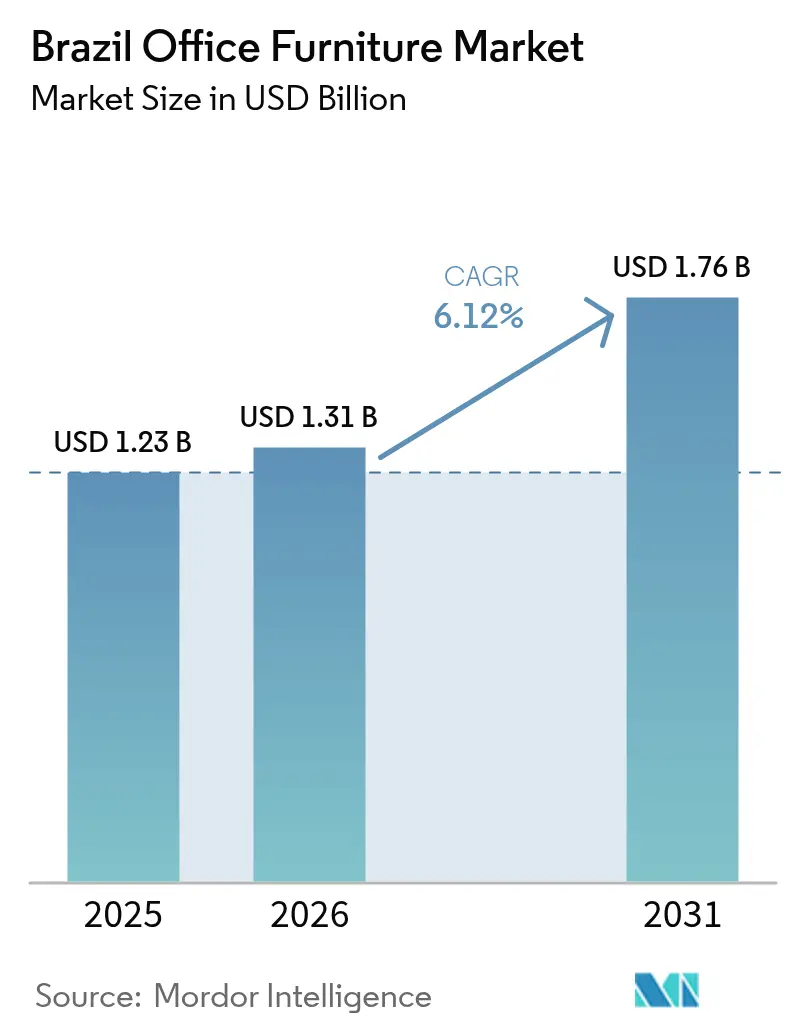
| Base Year Market Size (2025) | USD 1.23 Billion |
| Market Size (2026) | USD 1.31 Billion |
| Market Size (2031) | USD 1.76 Billion |
| Growth Rate (2026 - 2031) | 6.12 % |
| Market Concentration | Medium |
Major Players *Disclaimer: Major Players sorted in no particular order Image © Mordor Intelligence. Reuse requires attribution under CC BY 4.0. | |
Brazil Office Furniture Market Analysis by Mordor Intelligence
The Brazil office furniture market size is expected to grow from USD 1.23 billion in 2025 to USD 1.31 billion in 2026 and is forecast to reach USD 1.76 billion by 2031 at 6.12% CAGR over 2026-2031. Demand accelerates as hybrid-work policies, flexible occupancy contracts, and rising corporate wellness budgets converge to reshape workspace planning. Employers now treat ergonomic compliance as a productivity lever, fueling orders for height-adjustable desks and certified seating that meet NR17 requirements. Co-working operators are scaling beyond first-tier metros, and virtual-office subscriptions remain three times higher than pre-pandemic levels. Regional vacancy compression in São Paulo underscores the move from expansionary leasing to retrofit activity that favors modular, reconfigurable furniture. Meanwhile, federal tax incentives for FSC-certified timber and falling steel prices encourage domestic manufacturers to modernize plants and compete on sustainability credentials[1].
Key Report Takeaways
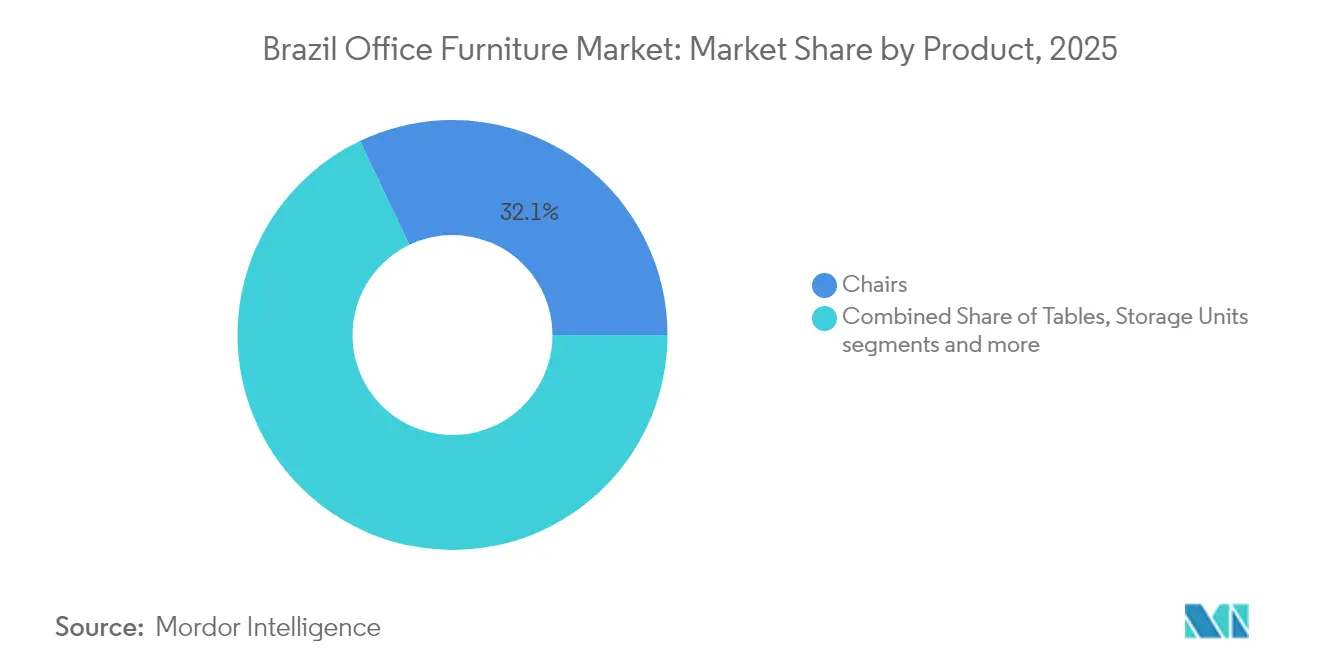
- By product category, chairs led with 32.10% Brazil office furniture market share in 2025, while tables are projected to expand at a 6.45% CAGR through 2031.
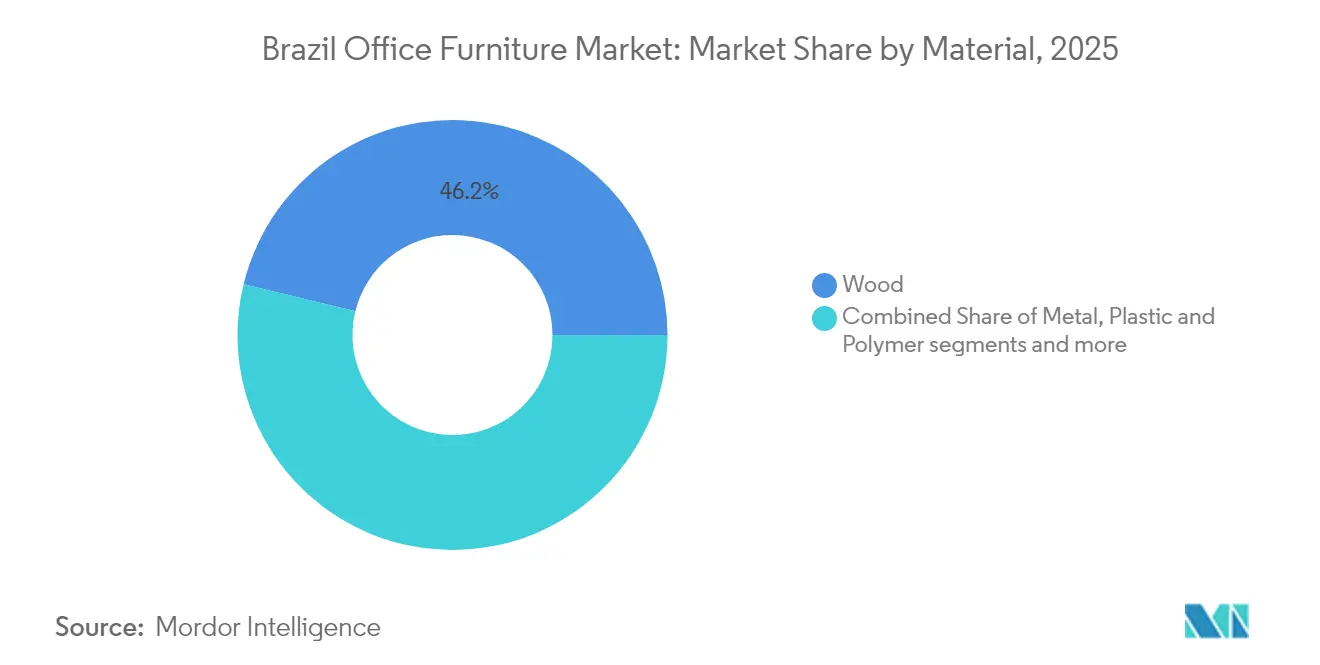
- By material, wood accounted for 46.20% of the Brazil office furniture market size in 2025; plastic & polymer is set to post the fastest 6.55% CAGR over 2026-2031.
- By price range, the economy segment captured 52.80% revenue in 2025, yet mid-range products are on track for a 6.33% CAGR to 2031.
- By end-user, corporate offices commanded 50.90% of the Brazil office furniture market size in 2025, whereas healthcare offices are forecast to grow at a 6.92% CAGR.
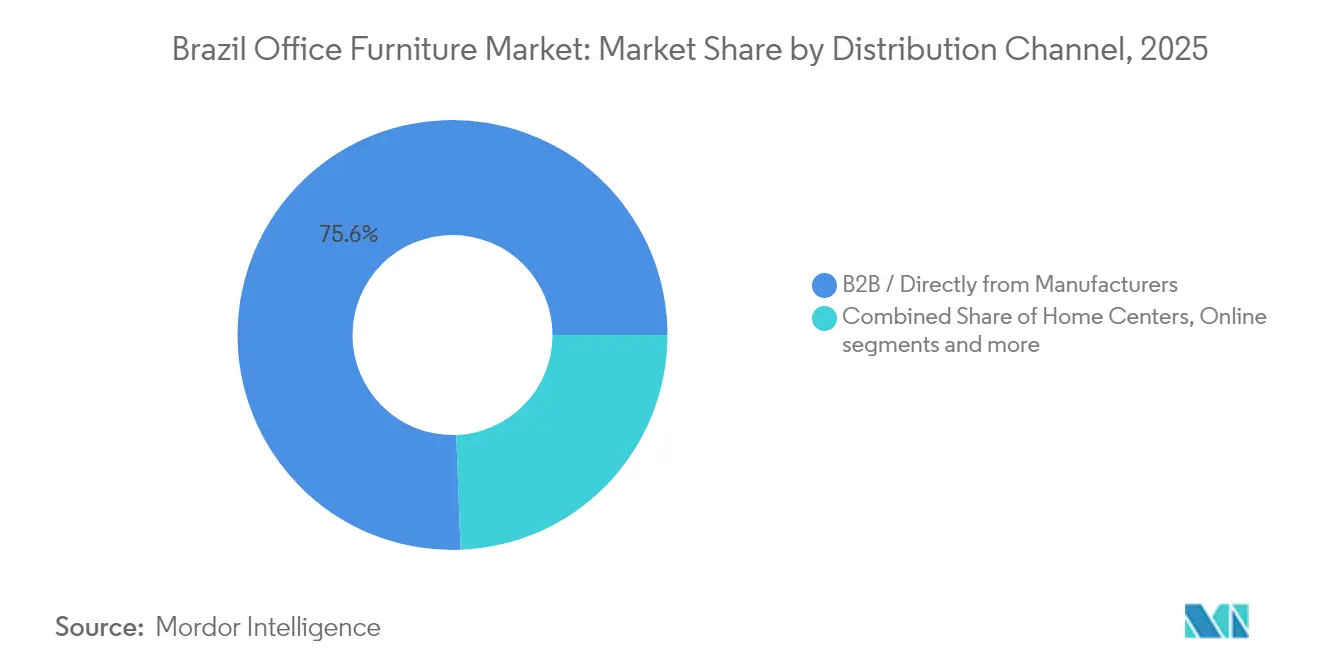
- By distribution channel, B2B direct sales held 75.60% of the Brazil office furniture market share in 2025 and will maintain a 6.52% CAGR through 2031.
- By geography, the Southeast led with 50.70% revenue in 2025; the North region is projected to log the fastest 6.66% CAGR between 2026-2031.
Note: Market size and forecast figures in this report are generated using Mordor Intelligence’s proprietary estimation framework, updated with the latest available data and insights as of 2026.
Brazil Office Furniture Market Trends and Insights
Drivers Impact Analysis*
| Driver | (~) % Impact on CAGR Forecast | Geographic Relevance | Impact Timeline |
|---|---|---|---|
| Hybrid-work adoption is fueling ergonomic demand | +1.8% | National; São Paulo, Rio de Janeiro, Belo Horizonte | Medium term (2-4 years) |
| Corporate investment in employee well-being & productivity | +1.5% | Southeast & South; tier-2 expansion | Long term (≥ 4 years) |
| Expansion of co-working & flex-office footprints | +1.2% | Metros extending to Campinas, Florianópolis, Curitiba | Short term (≤ 2 years) |
| Tax-credit incentives for FSC-certified wood sourcing | +0.8% | Nationwide, Santa Catarina, Paraná producers | Long term (≥ 4 years) |
| Near-shore BPO growth in tier-2 Brazilian cities | +0.7% | Interior São Paulo, Minas Gerais, Rio Grande do Sul | Medium term (2-4 years) |
| Digital procurement platforms easing SMB access | +0.4% | National; higher in Southeast & South | Short term (≤ 2 years) |
| Source: Mordor Intelligence | |||
Hybrid-work adoption is fueling ergonomic demand
Hybrid work has altered the logic of space allocation, pushing companies to retrofit existing floors rather than lease new ones. Office layouts now include hot-desking hubs, quiet booths, and collaboration corners that share adjustable furniture in constant rotation. Because each station may host multiple users, NR17-compliant chairs with intuitive levers have become a procurement staple, and vendors highlight certification to pre-empt labor-inspection penalties. Facility managers specify sit-stand desks to encourage movement and reduce sedentary fatigue, aligning with wellness dashboards tracking musculoskeletal claims[2]. Audio-visual integration shapes table demand because conference surfaces must conceal cabling and position cameras at eye level for hybrid meetings. Foam suppliers report higher density-grade orders, while fastener makers see uptake in quick-lock mechanisms that enable daily reconfiguration. Collectively, ergonomic furniture has shifted from discretionary spend to baseline infrastructure across the Brazil office furniture market.
Corporate investment in employee well-being & productivity
Brazilian employers frame workspace quality as a talent-retention tool, bundling furniture upgrades with mental-health initiatives and ESG scorecards. Procurement teams move from price-per-unit to whole-life-cost analyses that consider warranty length and recyclability. Vendors offering take-back programs gain preference because they help companies meet waste-reduction targets. Biophilic design enters the mainstream brief as projects request timber accents and natural fabrics to moderate cognitive fatigue. On-site physio consultations audit chair settings, reinforcing links between ergonomic adherence and lower absenteeism. As wellness targets enter quarterly KPIs, furniture budgets shift from capex to multi-year operational envelopes tied to health metrics.
Expansion of co-working & flex-office footprints
Virtual-office clientele has tripled versus pre-pandemic benchmarks, underscoring demand for flex-space solutions. Operators demand furniture with universal aesthetics, durable laminates, and tool-free assembly that accelerates tenant turnover. As the model penetrates tier-2 cities, local installers partner with national manufacturers to meet 48-hour fit-out timelines embedded in leases. Fabric mills develop easy-clean textiles that pass stringent rub tests, responding to hospitality-inspired interior palettes. Co-working chains influence retail perception; freelancers who frequent these spaces later purchase familiar brands for home offices, creating a halo effect.
Tax-credit incentives for FSC-certified wood sourcing
Law 14,789/23 reduces import duties on woodworking machinery and accelerates depreciation for domestically produced equipment, driving manufacturers to enhance production capabilities[3]. FSC-certified sawmills are utilizing these incentives to install CNC routers, which optimize material usage and enable the production of complex geometries. Export-driven brands are emphasizing certified material provenance on their specification sheets to ensure compliance with the EUDR[4]. The inclusion of deforestation-free clauses in tenders by large corporate buyers has made FSC certification a critical factor for securing national contracts. These developments are expected to strengthen the adoption of sustainable practices across the woodworking industry. Additionally, the policy changes are likely to boost investments in advanced machinery, further improving operational efficiency and competitiveness in the market.
Restraints Impact Analysis*
| Restraint | (~) % Impact on CAGR Forecast | Geographic Relevance | Impact Timeline |
|---|---|---|---|
| Volatile steel & lumber prices | -1.4% | National, acute on metal-furniture makers | Short term (≤ 2 years) |
| Cyclical corporate CAPEX cuts | -0.9% | Southeast & South | Medium term (2-4 years) |
| Port-side logistics bottlenecks | -0.6% | Santos and Rio de Janeiro ports | Short term (≤ 2 years) |
| BYO-furniture trend among gig workers | -0.3% | Metros with high freelancer density | Long term (≥ 4 years) |
| Source: Mordor Intelligence | |||
Volatile steel & lumber prices
Global steel prices have declined; however, the anticipated cost savings are limited due to currency volatility and freight surcharges. Engineered-wood producers are encountering similar challenges, as imported veneers are invoiced in U.S. dollars, exposing them to exchange rate risks. To mitigate cost fluctuations, manufacturers are adopting dual-sourcing strategies and entering into quarterly supply contracts. These measures aim to stabilize procurement expenses and ensure supply chain reliability. Additionally, designers are exploring hybrid construction methods to reduce dependency on individual commodities. Such approaches are becoming critical in navigating the volatile pricing environment across global markets.
Cyclical corporate CAPEX cuts
Economic slowdowns have led CFOs to impose freezes on furniture upgrades, extending replacement cycles beyond typical depreciation schedules. Facility management teams are prioritizing cost-effective solutions, such as repair kits, over complete furniture replacements. Refurbishment services are experiencing increased demand, ensuring production lines remain operational. Sales teams are adapting their strategies by targeting pilot zones, where upgrades are positioned as critical investments in productivity rather than optional expenditures. This approach aims to align with budget constraints while emphasizing long-term value. The shift in strategy reflects a broader trend of prioritizing efficiency and cost management in response to market conditions.
*Our forecasts treat driver/restraint impacts as directional, not additive. The impact forecasts reflect baseline growth, mix effects, and variable interactions.
Segment Analysis
By Product: Tables Drive Workspace Reconfiguration
Chairs retained 32.10% of the Brazil office furniture market share in 2025, underscoring their role as the baseline purchase for every workstation. The segment’s momentum stems from mandatory NR17 compliance, which obliges buyers to specify height-adjustable seats with lumbar support and high-density foam. Even so, tables are poised for faster expansion; they are forecast to register a 6.45% CAGR between 2026 and 2031 as companies redesign floorplates for hybrid collaboration zones and technology-integrated conference rooms. Demand spikes for flip-top training tables, mobile conference slabs with embedded power ports, and sit-stand desks that accommodate different employee height profiles, pushing vendors to standardize modular leg systems and quick-lock casters.
As hybrid scheduling reshapes utilization patterns, ancillary surfaces-side tables, laptop carts, credenzas-also gain prominence because they allow workers to switch tasks without relocating. The surge in table orders catalyzes follow-on demand for cable-management kits and under-desk storage accessories that maximize legroom in shared stations. Chairs, meanwhile, evolve toward auto-tension mechanisms and breathable mesh backs to cope with multiple daily users. Together, these dynamics position tables as the structural backbone of activity-based layouts, while chairs continue to serve as the ergonomic cornerstone of the overall Brazil office furniture market size.

By Material: Plastic Innovation Challenges Wood Dominance
Wood commanded 46.20% of revenue in 2025, holding its status as the preferred finish for executive suites and reception counters that rely on warm aesthetics to convey brand gravitas. Manufacturers leverage FSC-certified supplies to satisfy ESG clauses, ensuring the segment’s endurance even as buyers diversify their material palettes. The competitive edge for wood also lies in machining versatility, which enables intricate veneer inlays and curved forms now popular in biophilic interiors.
Plastic and polymer lines are set to outpace every other material group, advancing at a 6.55% CAGR through 2031 as designers embrace glass-fiber shells and post-consumer resins that provide lightweight durability without sacrificing premium finishes. The growth of this category is reinforced by rising freight costs that favor lighter freight classes and by heightened demand for bold pastel colorways that polymers can achieve without secondary painting. Metal frames continue to feature inside desk skeletons and chair bases, but their share fluctuates with commodity-price swings, encouraging hybrid constructions that marry wood accents with polymer edges. These trends reveal a maturing buyer mindset that balances sustainability targets with long-term durability expectations, reallocating spend within the overall Brazil office furniture market share rather than cannibalizing it.
By Price Range: Mid-Range Segment Captures Quality Migration
Economy products captured 52.80% of 2025 demand, illustrating that cost efficiency remains central for small and mid-sized enterprises operating on tight budgets. Buyers in this tier gravitate toward locally fabricated desks and stackable chairs that promise fast delivery and easy replacement. However, mid-range furniture is forecast to expand at a 6.33% CAGR over 2026-2031 as procurement teams shift focus from upfront sticker price to lifecycle economics that factor in warranty length, repairability, and resale value.
Mid-tier vendors are responding by importing high-function mechanisms-synchronous tilts, memory-height presets-then marrying them with locally sourced frames to moderate cost. Premium offerings, often imported from U.S. and European brands, keep influencing design language across the spectrum, but their uptake is constrained to marquee headquarters and design studios. Refurbished premium chairs trading on secondary platforms at discounted rates blur traditional tier lines, enabling budget-conscious firms to access high-end ergonomics. This tier interplay suggests a gradual quality migration that will shrink the absolute gap between economy and mid-range specifications while preserving clear segmentation within the Brazil office furniture market.
By End-User: Healthcare Offices Lead Growth Acceleration
Corporate offices held 50.90% of revenue in 2025, fueled by hybrid-work retrofits that roll out hot-desking and collaboration nooks across headquarters campuses. These projects prioritize adjustable desks, acoustic dividers, and power-ready tables that can be re-plotted overnight, keeping contract flows steady for full-line vendors. Healthcare facilities, on the other hand, are projected to record the highest 6.92% CAGR by 2031 as public and private hospital networks launch expansion phases to meet aging-population needs.
Ergonomic stools, antimicrobial vinyl-covered task chairs, and height-variable nurse-station desks top the healthcare shopping list, widening the product mix that manufacturers must stock. Educational institutions supply a reliable but slower-moving pipeline, constrained by government budget cycles yet gradually pivoting toward collaborative library layouts that echo corporate agile zones. Government and municipal offices remain price-conscious, though NR17 enforcement ensures baseline quality standards. The diversified customer spread cushions suppliers against cyclical shocks, creating a multi-sector shield for sustaining the Brazil office furniture market share.
By Distribution Channel: Direct Sales Dominate Corporate Relationships
B2B direct sales from manufacturers accounted for 75.60% of 2025 turnover and are forecast to climb at a 6.52% CAGR because large enterprises value end-to-end accountability in design, delivery, and maintenance. These contracts often embed space-planning services, asset-tagging, and periodic ergonomic audits, creating recurring revenue beyond the initial furniture drop. Project-management portals allow facility managers to track milestones, installation crews, and punch-list resolutions in real time, a level of transparency seldom matched by third-party dealers.
Retail and e-commerce channels split the remaining share, catering to freelancers, startups, and branch locations that place small-batch orders requiring immediate dispatch. Marketplace listings of certified refurbished chairs deliver brand-name ergonomics at accessible prices, strengthening the circular economy narrative. Home-center chains showcase office vignettes that double as educational displays on seat-height norms and monitor placement, subtly upselling accessories like footrests and anti-fatigue mats. Collectively, this channel blend ensures comprehensive market reach, anchoring the overall Brazil office furniture market size while empowering different buyer archetypes to procure on their own terms.
Geography Analysis
The Southeast region remains the gravitational center of the Brazil office furniture market, capturing 50.70% of revenue in 2025, thanks to the dense concentration of corporate headquarters and design studios clustered around São Paulo and Rio de Janeiro. Retrofit activity is brisk: Grade-A towers in São Paulo now prioritize lounge-style collaboration zones over traditional cubicles, and vacancy in the city dropped to its lowest post-pandemic level of 18.3% in Q1 2025, signaling that tenants are refreshing interiors rather than expanding footprints. Local upholstery mills benefit from short-run orders that demand custom colorways and rapid turnaround, reinforcing the region’s reputation for design agility.
Momentum is shifting northward as well. The North region is forecast to log the fastest 6.66% CAGR through 2031, powered by near-shore BPO operators setting up large call-center hubs in Manaus and Belém that require dense layouts of ergonomic chairs and compact desks. Federal free-zone incentives trim import duties on IT hardware, prompting multinationals to co-locate furniture purchases in the same logistics corridors to shorten lead times. Suppliers respond by establishing micro-warehouses near river ports and tapping indigenous design cues-such as woven-fiber backrests-to distinguish product lines while honoring local culture.
Elsewhere, growth unfolds along multiple, more measured paths. The Northeast benefits from tourism-linked refurbishments in Salvador and Fortaleza, where hotels convert back-office spaces into co-working lounges for digital nomads. Central-West demand tracks agribusiness diversification: new regional headquarters in Goiânia and Cuiabá commission mid-range fit-outs that balance cost control with brand presentation. In the South, vertically integrated manufacturers leverage Santa Catarina’s forestry ecosystem to prototype certified-wood desks with minimal transport emissions, then export surplus production to Mercosur neighbors via well-developed road networks. Together, these regional narratives create a geographically diversified revenue base that buffers the national market against localized economic shocks.
Regulatory Landscape
Brazil office furniture demand is shaped by workplace ergonomics and product standardization. NR17 remains a key compliance anchor for employers and furniture specifiers, reinforcing demand for adjustable seating and workstation setups aligned to ergonomic requirements. On the product side, conformity and metrology oversight sits with INMETRO, while ABNT issues the technical standards commonly referenced in specifications and quality control. These include ABNT NBR standards covering core office categories, such as chairs (NBR 13962), desks and tables (NBR 13966), and office panel partitions (NBR 13964).
Trade and tax administration also affects sourcing decisions for components and finished goods. Furniture imports face Brazil's import and customs procedures administered through federal systems such as Siscomex, and import duties under furniture classifications can be a material cost line for buyers and distributors. In parallel, Brazil's tax reform transition toward a dual VAT model (CBS and IBS) runs through a multi-year implementation window (2026 to 2033), with 2026 functioning as a pilot year focused on fiscal documentation adaptation, keeping operational compliance and invoicing readiness in focus for manufacturers and B2B sellers.
Value Chain Analysis
The Brazil office furniture value chain starts with raw materials and inputs, primarily wood-based panels and timber, metals, plastics and polymers, fabrics, foams, coatings, and mechanisms (tilt, casters, gas lifts), plus packaging and hardware. These feed into manufacturing clusters that combine cutting, CNC machining, upholstery, assembly, and finishing, with design and specification support from architects and workplace consultants. Industry bodies also play an enabling role, as ABIMOVEL, together with ApexBrasil, supports internationalization and supplier development initiatives spanning finished furniture as well as components and machinery, reflecting the breadth of the ecosystem.
Downstream, distribution is dominated by B2B direct sales and project delivery, supported by installation, maintenance, refurbishment, and take-back services. Road transport is the backbone connecting plants, regional warehouses, and commercial customers, while ports matter for imported components and selected finished products, making port-side logistics bottlenecks a practical constraint during tight capacity periods. International market engagement also influences the chain, with ABIMOVEL and ApexBrasil-led participation at global fairs such as Salone del Mobile.Milano 2026 highlighting the linkage between domestic production capabilities and export-facing marketing, and raising requirements for consistent quality, traceability, and certified sourcing across suppliers.
Competitive Landscape
The Brazil office furniture market exhibits moderate fragmentation with domestic manufacturers competing alongside international brands through authorized distributors and direct operations. Domestic stalwarts such as Flexform anchor their market presence by fusing Italian-inspired styling with local manufacturing, a blend that insulates clients from currency volatility while preserving design cachet. Showrooms serve as collaborative labs where architects and facility managers co-create prototypes, allowing rapid iteration and reinforcing deep, consultative relationships. Regional competitors like Marelli and Cavaletti sustain relevance through flexible production cells that can shift quickly from large corporate orders to bespoke color runs for boutique projects, illustrating how operational agility competes head-to-head with brand heritage.
International labels—among them Herman Miller and Haworth—maintain premium positioning by enforcing rigorous showroom standards, ensuring that Brazilian clients experience identical acoustics, ergonomics, and material palettes to those found in New York or Milan. Haworth’s recent consolidation of luxury subsidiaries under the Haworth Lifestyle banner broadens its reach into lounge and hospitality categories, signaling a strategy to embed the brand across the full spectrum of workspace touchpoints. These global players lean on local distributors for after-sales service, blending international design language with domestic customer-support networks.
A newer cohort of digital-native challengers is reshaping go-to-market dynamics. Some focus on direct-to-consumer flat-pack desks promoted through social-media storytelling, capitalizing on the growing BYO-furniture trend among freelancers. Others integrate algorithmic configurators into procurement platforms like Mercado Eletrônico, enabling architects to drag-and-drop certified components into virtual floor plans in minutes. Many of these newcomers outsource fabrication to established factories during off-peak shifts, creating collaborative rather than adversarial supply-chain relationships. As sustainability audits become standard in RFPs, both incumbents and disruptors highlight circular-economy credentials—from take-back programs to recycled-plastic seating—illustrating that competitive advantage now rests as much on narrative coherence as on product engineering.
Brazil Office Furniture Industry Leaders
-
Interstuhl Brasil
-
Flexform
-
Marelli
-
Herman Miller Brazil
-
Haworth Brazil
- *Disclaimer: Major Players sorted in no particular order

Market Opportunities and Future Outlook
Hybrid retrofit projects and flex-space operations continue to translate ergonomic compliance into procurement needs, particularly for NR17-aligned seating and height-adjustable or reconfigurable workstations that can serve multiple users. That creates room for suppliers that bundle furniture with services already valued in Brazil's B2B channel mix, such as workplace planning, fast installation, asset tagging, and ergonomic audit support, especially in high-density metros and expanding tier-2 locations.
Two opportunity lanes are forming around premiumization and export diversification. On premium and specification-led demand, industry programs such as ABIMAD Export (with dozens of associated companies) and events like ABIMAD's 42nd edition scheduled for August 3 to 6, 2026 at Sao Paulo Expo provide a platform for high-end design, customization, and sustainability credentials to reach both Brazilian buyers and international visitors. On the trade side, softer export performance in early 2026 increases the emphasis on differentiated products (design-led, certified materials, and standards-compliant ergonomics) and on broadening routes to market, including components and machinery supply development supported by ABIMOVEL and ApexBrasil initiatives.
Recent Industry Developments
- July 2026: Marelli inaugurated a new 2,000 square meter administrative headquarters to support its operations and corporate workspace activities. The facility strengthens internal coordination across design, sales, and project execution, improving responsiveness for large fit-outs and retrofit-heavy demand. It also signals ongoing commitment to domestic infrastructure even as buyers shift toward modular, reconfigurable office layouts.
- March 2026: Flexform formalized a strategic partnership with Vivo Keyd Stars, becoming the official supplier of Alpha 2 Pro chairs across the e-sports organization. The partnership expands Flexform's reach into performance-driven seating demand and broadens brand touchpoints beyond traditional corporate procurement. It also leverages sponsorship-style distribution to drive chair volumes through new customer communities.
- April 2025: Haworth restructured its design division under the Haworth Lifestyle banner, unifying Poltrona Frau, Cassina, and Zanotta. The consolidation simplifies cross-brand specification and sourcing for Brazilian projects that combine task seating with lounge and hospitality-style areas. It supports more integrated bidding for full-scope workplace and amenity fit-outs, aligning with hybrid-office retrofit patterns.
Research Methodology Framework and Report Scope
Market Definition and Coverage
This market is defined as revenue generated from office-use furniture sold and delivered within Brazil, covering items used to equip workplaces and work areas in commercial buildings and institutional offices.
Scope exclusions: Residential household furniture, mattresses, and non-furniture fit-out items (such as flooring, lighting, and decor) are excluded.
Segmentation Overview
- By Product
- Chairs
- Employee Chairs
- Meeting Chairs
- Guest Chairs
- Tables
- Conference Tables
- Desks
- Other Tables
- Storage Units
- Filing Cabinets
- Bookcases & Shelving
- Sofas/Soft Seating
- Booths & Office Dividers
- Other Office Furniture (Stools, Reception, Accessories)
- Chairs
- By Material
- Wood
- Metal
- Plastic & Polymer
- Other Materials
- By Price Range
- Economy
- Mid-range
- Premium
- By End-user
- Corporate Offices
- Healthcare Offices
- Educational Institutions
- Government & Public Offices
- Hospitality & Retail Back-office
- Others
- By Distribution Channel
- B2C / Retail
- Home Centers
- Specialty Furniture Stores
- Online
- Other Distribution Channels
- B2B / Direct from Manufacturers
- B2C / Retail
- By Geography
- North Region
- Northeast Region
- Central-West Region
- Southeast Region
- South Region
Data Sources, Market Sizing, and Validation
Desk Research
Desk research starts by mapping Brazil demand signals that are visible in public data, and then converting them into sizing inputs we can test in the model. We relied on sources such as IBGE for macro indicators, Brazil customs trade statistics for import and export direction, and Banco Central do Brasil for currency context that impacts USD reporting.
To make the furniture link real, we also reviewed sources such as the Ministry of Labor and Employment for ergonomics guidance (NR17 context), sector publications from Brazilian furniture export and industry bodies, and audited company filings and investor presentations where product mix and channel exposure is discussed. When needed, paid subscriptions for company financials, news and financials, and shipment level trade data were used to fill gaps and cross-check outliers. These examples are not exhaustive, and many other sources were referred to for data collection, validation, and research clarification.
Primary Interviews and Surveys
Primary work focused on validating what drives buying in Brazil, and where spend is shifting between new offices and retrofit activity. We spoke with manufacturers, distributors, corporate and facility buyers, and workspace planners across major business centers, and then used these inputs to confirm price bands, replacement cycles, and channel splits before finalizing the model.
Distribution of primary research fieldwork respondents
| Company type | Respondent position |
|---|---|
| Top tier: 39% | CXOs: 14% |
| Mid tier: 40% | Functional/Unit leaders: 28% |
| Smaller Players: 21% | Managers: 58% |
Market-Sizing & Forecasting
Sizing is built from a top-down demand reconstruction where commercial office activity in Brazil is translated into furniture spending pools, and then filtered through replacement demand and fit-out intensity by office type. To keep the totals grounded, we also run selective bottom-up checks using sampled supplier revenues, channel checks from distributors, and an ASP times volume build for a few high-velocity categories, and then the differences are investigated before the final number is set.
Key inputs used in the model include office leasing and occupancy trends that affect new fit-outs, refurbishment frequency in mature office stock, ergonomic compliance adoption (NR17 awareness that pushes seating and height-adjustable desks), import reliance for select categories based on customs patterns, and raw material price direction that influences realized selling prices. Forecasts are developed using scenario analysis, where the base case is anchored to consensus views from interviews on corporate capex appetite, hybrid-work space redesign pace, and expected pricing progression in BRL before conversion to USD.
Data Validation & Update Cycle
Validation is handled through triangulation across three layers, model outputs, independent signals (trade flows, office activity indicators, and public macro series), and the primary feedback loop. Outliers are flagged early, and assumptions are reopened when the variance cannot be explained by known factors such as one-off projects, sharp price moves, or temporary import swings.
Before sign-off, the model and write-up are reviewed in multiple steps so calculation logic, units, and currency conversions are consistent across sections. Reports are refreshed annually, with interim updates when material events occur, and a final pre-delivery check is completed so clients receive the latest view.
Mordor Intelligence's Brazil Office Furniture Market Size Compared With Other Published Estimates
Published market values for Brazil office furniture can look far apart because each publisher mixes product boundaries, demand settings, and price logic in its own way. Differences often show up when one estimate leans heavily on broad furniture spending, while another tries to isolate office-use demand tied to workplace activity.
Home office furniture sold as a consumer purchase sits outside Mordor Intelligence's scope, and that exclusion alone can move the total because many sources blend household and commercial channels during hybrid-work years. Gaps also come from how prices are treated, where some estimates apply aggressive ASP uplift without checking local BRL inflation timing, and from how quickly numbers are refreshed after swings in imports and corporate fit-out budgets.
Benchmark comparison
| Source | Market Size | Gaps in Research Methodology |
|---|---|---|
| Mordor Intelligence | USD 1.23 B (2025) | |
| Trade Journal A | USD 2.97 B (2025) | Uses a wider definition that appears to blend home office and broader contract furniture demand, and the uplift path is presented without clear linkage to Brazil office activity or replacement cycles. |
| Industry Research Portal B | USD 3.41 B (2025) | Tracks a contract furniture market where office is only one end-use, so adjacent categories like education and hospitality are likely included, which inflates the office-only reading. |
Taken together, the spread mainly reflects category overlap and how demand is tied to real office furniture purchase triggers. By keeping the definition centered on office-use furniture in Brazil and then stress-testing pricing and volume assumptions with interviews and cross-check signals, the resulting size stays traceable to repeatable inputs rather than broad spending proxies.
Key Questions Answered in the Report
What is the current valuation of the Brazil office furniture market?
The market is valued at USD 1.31 billion in 2026.
How quickly is revenue expected to increase?
Sales are forecast to climb at a 6.12% CAGR, reaching USD 1.76 billion by 2031.
Why are tables gaining importance in workplace design?
Firms emphasize collaborative layouts and hybrid-meeting technology, driving a 6.45% CAGR for tables.
Which region is experiencing the fastest demand growth?
The North region leads with a projected 6.66% CAGR thanks to BPO expansion and infrastructure builds.
How do direct manufacturer channels benefit corporate buyers?
Direct channels bundle design, installation, and maintenance, delivering single-source accountability.
What is sparking furniture demand in healthcare facilities?
Hospital expansions and hygiene standards push healthcare offices to the highest 6.92% CAGR.