
Market Overview
| Study Period | 2021 - 2031 |
|---|---|
| Forecast Data Period | 2026 - 2031 |
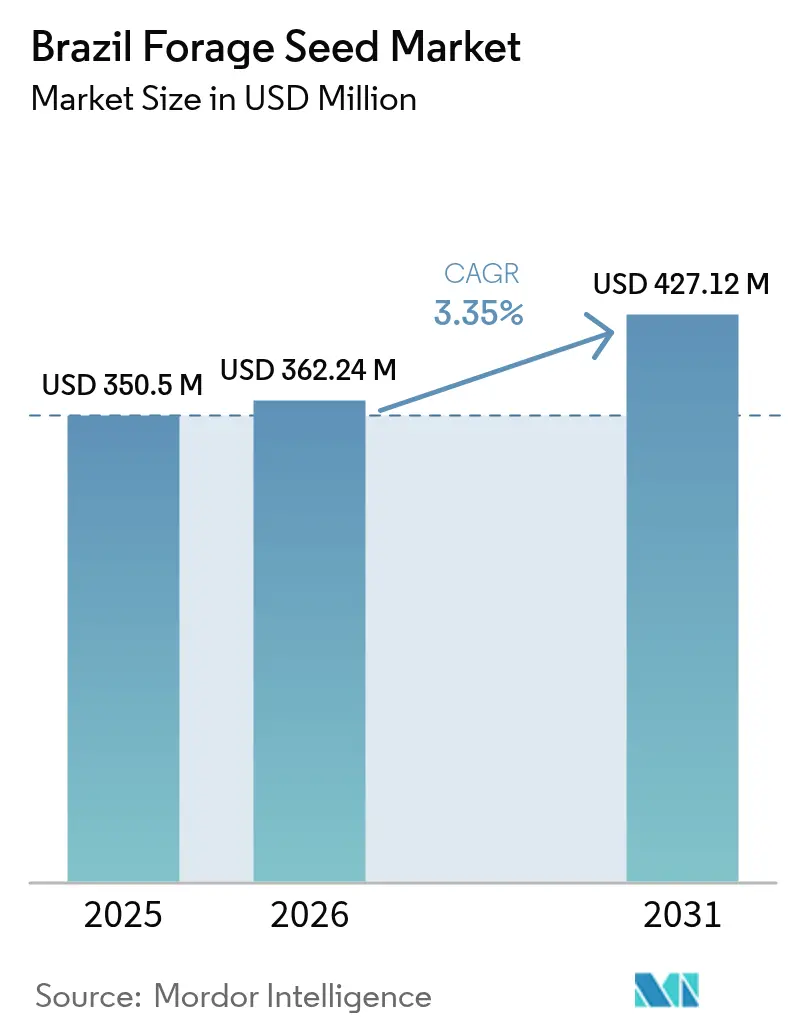
| Base Year Market Size (2025) | USD 350.50 Million |
| Market Size (2026) | USD 362.24 Million |
| Market Size (2031) | USD 427.12 Million |
| Growth Rate (2026 - 2031) | 3.35 % |
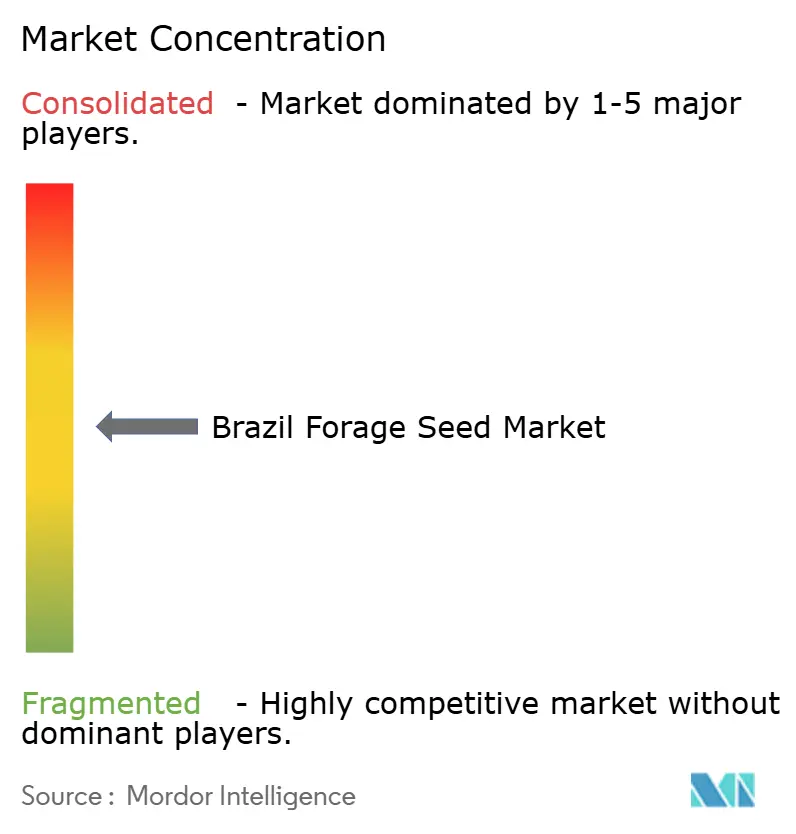
| Market Concentration | Medium |
Major Players *Disclaimer: Major Players sorted in no particular order Image © Mordor Intelligence. Reuse requires attribution under CC BY 4.0. | |
Brazil Forage Seed Market Analysis by Mordor Intelligence
Brazil forage seed market size in 2026 is estimated at USD 362.24 million, growing from 2025 value of USD 350.50 million with 2031 projections showing USD 427.12 million, growing at 3.35% CAGR over 2026-2031. Livestock intensification, the shift toward hybrid genetics, and the 2024 Bio-inputs Law together reshape technology priorities as producers pursue higher stocking rates, stress-tolerant cultivars, and certified seed that complies with emerging sustainability metrics.[1] Over 170 million head of cattle graze more than 100 million hectares of managed pasture, anchoring steady year-round demand for the Brazil forage seed market across the Center-West, Southeast, South, and expanding frontier zones.[2] Hybrid cultivars dominate the genetic mix, while forage corn and sorghum programs receive increasing budget share in corporate research pipelines that emphasize yield stability under erratic weather. Although counterfeit seed and logistics congestion remain headwinds, precision-agriculture platforms, digital seed-credit apps, and state-backed pasture-recovery loans collectively shorten the payback period on premium genetics, reinforcing adoption momentum across the Brazil forage seed market landscape.
Key Report Takeaways
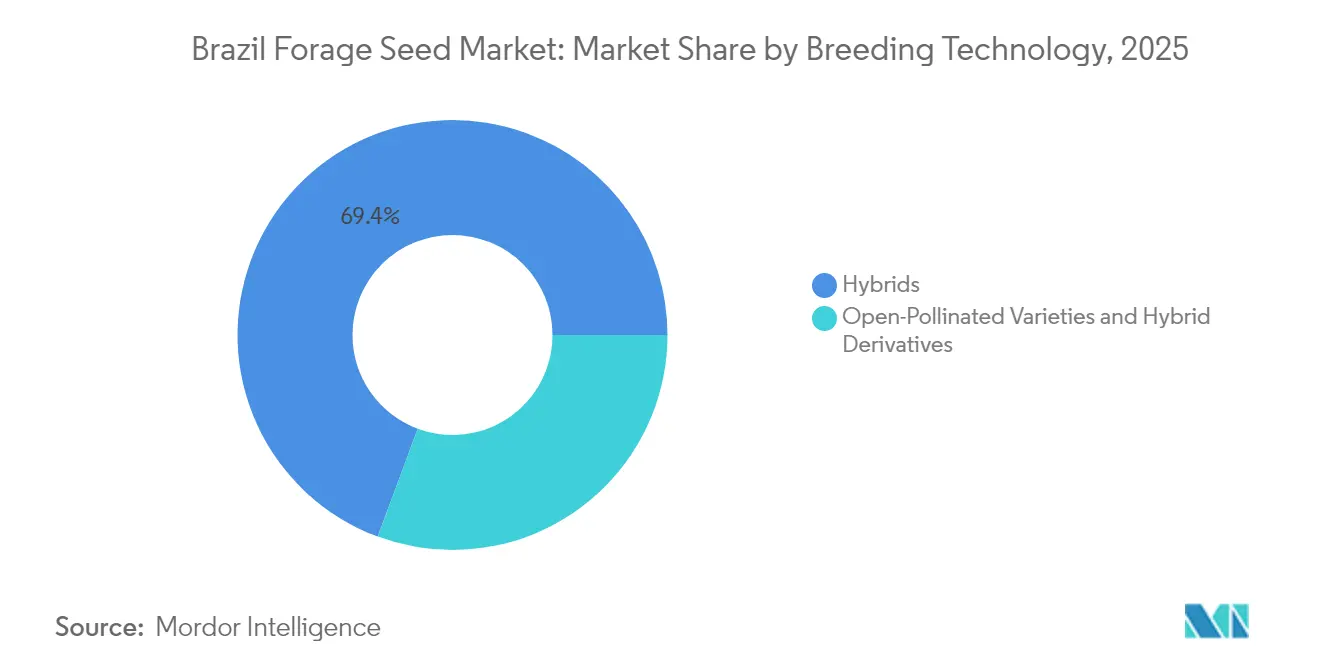
- By breeding technology, hybrid varieties accounted for 69.35% of the Brazil forage seed market share in 2025, while Transgenic Hybrids are anticipated to grow at a 9.84% CAGR.
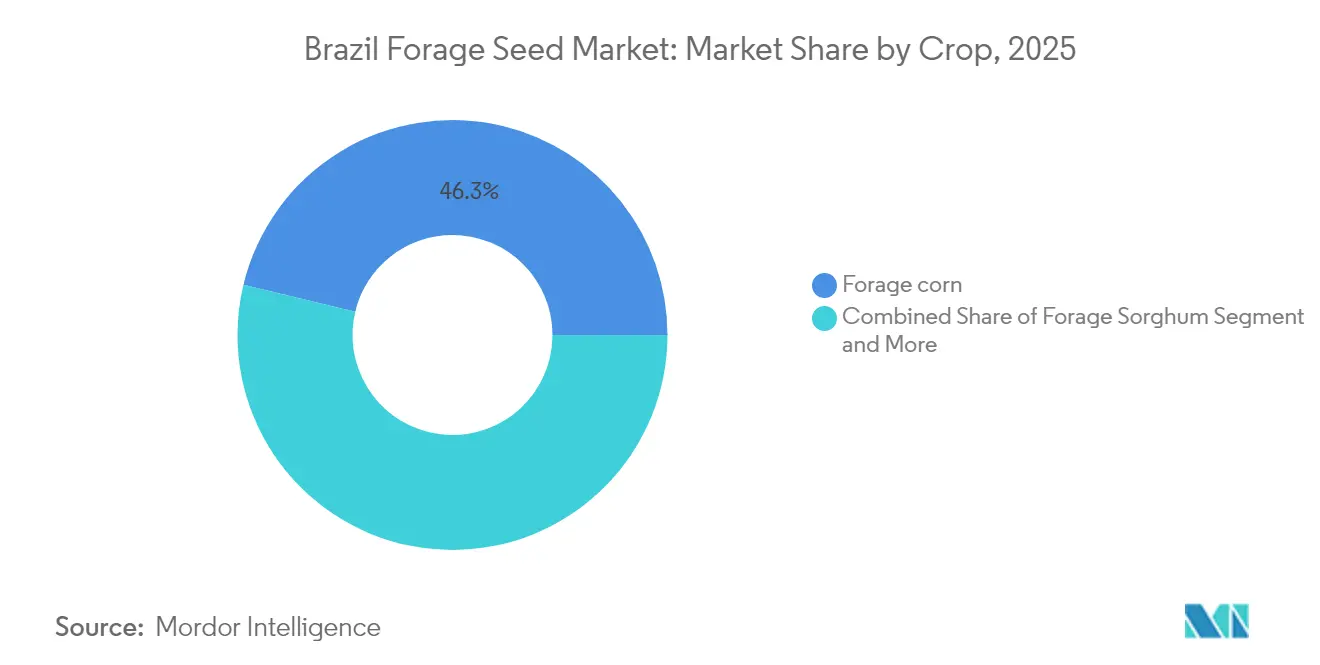
- By crop, forage corn held a 46.25% share of the Brazil forage seed market size in 2025, while forage sorghum recorded the fastest crop-specific CAGR at 8.95% between 2026 and 2031.
Note: Market size and forecast figures in this report are generated using Mordor Intelligence’s proprietary estimation framework, updated with the latest available data and insights as of 2026.
Brazil Forage Seed Market Trends and Insights
Drivers Impact Analysis*
| Driver | (~) % Impact on CAGR Forecast | Geographic Relevance | Impact Timeline |
|---|---|---|---|
| Livestock expansion and intensification | +0.8% | Center-West, Southeast, and South | Medium term (2-4 years) |
| Adoption of improved tropical grass cultivars | +0.6% | National, with focus on Cerrado and Amazon transition | Long term (≥ 4 years) |
| Government ILPF and ABC-Carbon programs | +0.5% | Center-West, Northeast, and Amazon transition | Long term (≥ 4 years) |
| Growing corn-silage demand from dairy and feedlots | +0.4% | South, Southeast, selected Center-West micro-regions | Medium term (2-4 years) |
| Digital seed-credit and e-commerce platforms | +0.3% | National, early adoption in South and Southeast | Short term (≤ 2 years) |
| Seed-coating innovations for tropical climates | +0.2% | National, emphasis on semi-arid Northeast | Medium term (2-4 years) |
| Source: Mordor Intelligence | |||
Livestock expansion and intensification
Rising stocking-rate targets from the present 0.97 animal units per hectare toward 3.60 units create a structural pull for high-germination, nutrient-dense seed lots. Commercial ranches redesign grazing rotations around grass-legume mixtures that stabilize protein intake and lower urea costs, stimulating premium-segment growth. Export-oriented packers increasingly require traceability documentation that starts at seed purchase, adding compliance value to branded products. Intensification also prompts demand for coated seed that shortens pasture establishment times and delivers uniform stands under variable rainfall.
Adoption of improved tropical grass cultivars
Successive cultivar releases such as BRS Capiaçu elephant grass (33% higher dry-matter yield) and BRS 661 forage sorghum (70 metric tons per hectare potential) underscore a pipeline of genetics tailored to regional moisture and pest profiles. Early-adopting corporate ranches in Mato Grosso and Pará pay premium prices to capture the feed-conversion advantage, while smallholders lag due to credit constraints. Public–private multiplication agreements shorten the seed-to-market cycle, yet early-cycle shortages surface during launch seasons, keeping price realizations firm.
Government ILPF and ABC-Carbon programs
The ABC+ plan allocated BRL 7.05 billion (USD 1.4 billion) in concessional rural credit for sustainable practices in 2024, with a significant tranche earmarked for pasture restoration and diversified forage stands. Participating farms install tree-shaded paddocks that require shade-tolerant grasses and deep-rooted legumes, nudging breeders toward niche selections with documented carbon-sequestration attributes. Mandatory technical-assistance packages embedded in the loans improve correct seeding rates and establishment, reducing wastage and bolstering repeat purchases.
Growing corn-silage demand from dairy and feedlots
The number of confinement feedlots rose 11% in 2024, and dairy processors added 4.5 million liters per day of new capacity, both trends translating into surging silage demand.[3] Seed developers respond with ultra-early and medium-maturity hybrids that allow staggered harvesting, meeting year-round bunker-fill schedules. Precision harvesters require uniform plant height and moisture, favoring purpose-bred silage types over conventional grain cultivars.
Restraints Impact Analysis*
| Restraint | (~) % Impact on CAGR Forecast | Geographic Relevance | Impact Timeline |
|---|---|---|---|
| Prevalence of low-quality “pirate” seed | -0.4% | National, highest in Northeast and North | Short term (≤ 2 years) |
| Climate-driven droughts and floods | -0.3% | Northeast (drought), South (floods), Amazon transition | Medium term (2-4 years) |
| Port/logistics bottlenecks in peak season | -0.2% | National, critical in North and Northeast corridors | Short term (≤ 2 years) |
| Rising seed-borne fungal contamination | -0.2% | Humid tropical zones nationwide | Medium term (2-4 years) |
| Source: Mordor Intelligence | |||
Prevalence of low-quality “pirate” seed
Informal roadside vendors flood local markets with unlabeled seed that often contains less than 60% pure live seed, undermining confidence in certified offerings and compressing price premiums. Enforcement sweeps confiscated 1,800 metric tons of illegal stock in 2024, yet remote areas remain difficult to monitor. Legitimate suppliers counter by embossing lot numbers on coated seed and offering field-germination warranties to safeguard brand reputation.
Climate-driven droughts and floods
Brazil's increasing climate variability disrupts both seed production and end-user planting schedules, creating supply-demand imbalances that constrain market growth. The 2024 drought in Rio Grande do Sul reduced seed multiplication areas while flooding damaged storage facilities and distribution infrastructure. Extreme weather events force producers to delay or abandon planting, reducing annual seed consumption and creating inventory management challenges for distributors. Climate impacts particularly affect rain-fed seed production areas where irrigation infrastructure remains limited.
*Our forecasts treat driver/restraint impacts as directional, not additive. The impact forecasts reflect baseline growth, mix effects, and variable interactions.
Segment Analysis
By Breeding Technology: Hybrids Command a Premium Position
Hybrid lines captured 69.35% of revenue in the Brazil forage seed market share during 2025, underscoring widespread acceptance of predictable yield, uniform maturity, and multi-trait disease shields. In large Center-West ranches, hybrids consistently out-yield open-pollinated varieties by 18% in dry-matter and deliver 2 points higher crude protein, metrics the finance teams track within feed-cost dashboards. Non-transgenic hybrids still dominate volume, serving buyers who seek performance gains without genetically modified organism regulatory overhead. Transgenic hybrids are advancing at a 9.84% CAGR, buoyed by herbicide-tolerance traits that cut manual weeding and align with conservation tillage mandates.
Open-pollinated varieties persist among smallholders and organic dairies where lower seed costs and certification rules discourage biotech use. Hybrid derivatives seed blends that capture partial heterosis offer a mid-priced bridge for growers upgrading from traditional lines. The Brazil forage seed market size for hybrid derivatives remains modest yet shows consistent renewal demand in marginal rainfall belts. As CTNBio (National Technical Commission on Biosafety) streamlines dossier review, breeders allocate greater capital to gene-edited traits such as brown midrib lignin reductions that can lift in-rumen digestibility by up to 5 percentage points.

By Crop: Forage Corn Retains the Energy Crown
Forage corn accounted for 46.25% of the forage seed market size in 2025, due to its exceptional starch density and well-developed silage logistics. Elite silage hybrids now hit 22 metric tons of dry-matter per hectare under drip irrigation in São Paulo clusters and maintain digestibility above 68% neutral-detergent fiber, a performance that underpins milk-yield gains in total mixed ration operations. Dual-purpose corn hybrids give feedlot managers flexibility to pivot between grain and silage harvest, buffering commodity-price swings.
Forage sorghum, expanding at a 8.95% CAGR, appeals to regions with 500 millimeters or less annual rainfall. BRS 661 underscores the genetic acceleration, blending drought resilience with 70 metric tons of biomass ceilings. Dairy outreach programs in semi-arid Bahia showcase sorghum-corn rotation models that distribute risk and flatten seasonal feed costs. Alfalfa retains loyal acreage in temperate southern micro-climates due to its 20% crude-protein benchmark, while millet, ryegrass, and oat mixes fill window crops that bridge rainy-season transition gaps. The diverse crop palette ensures the Brazil forage seed market meets discrete nutritional and climatic specs across latitude and altitude gradients.
Geography Analysis
The Center-West dominates the Brazil forage seed market, fueled by expansive ranches in Mato Grosso, Mato Grosso do Sul, and Goiás that each re-seed thousands of hectares annually to sustain higher stocking densities. Corporate growers possess capital for hybrid germplasm bundles, precision sowing machinery, and telemetry-guided variable-rate fertilization, raising per-hectare seed budgets well above the national average. Distribution hubs in Rondonópolis and Sorriso link directly to certified seed farms, shortening lead times and curbing viability losses.
The Southeast ranks second, spearheaded by Minas Gerais dairy basins and feedlots around São Paulo that favor silage-focused corn and sorghum hybrids with contractually specified starch and fiber parameters. Fintech-enabled input loans proliferate, enabling medium operations to lock in hybrid seed early and secure volume rebates. Southeastern growers also pilot drone-based stand-counts, feeding real-time data to seed suppliers that fine-tune plant-population recommendations by cultivar. The South presents a distinct crop mix where temperate pasture and winter cereals maintain rotation diversity. Rio Grande do Sul remains a key hybrid-seed multiplication zone, but the 2024 drought exposed water-stress vulnerability, prompting a pivot to supplementary irrigation and insurance hedges. Santa Catarina poultry integrators now stipulate forage cover on free-range plots, widening the scope for low-height ryegrass seed. The Northeast and North together represent high-growth frontiers. Semi-arid zones in Piauí and Maranhão adopt drought-tolerant forage sorghum hybrids funded by ABC credits, while Pará’s humid frontier trials shade-tolerant grass-legume mixes under emerging agroforestry corridors. Logistics remain challenging, so e-commerce and mobile wallet payments play a critical role in expanding certified-seed reach. Overall, regional heterogeneity mandates a broad cultivar portfolio, reinforcing the Brazil forage seed market resilience across climatic extremes.
Regulatory Landscape
Brazil forage seed production and marketing are handled under the National Seed and Seedling System (SNSM), established by Law No. 10.711/2003 and regulated by Decree No. 5.153/2004, with the Ministry of Agriculture and Livestock (MAPA) acting as the primary federal authority. Companies involved in producing, processing, packaging, storing, testing, trading, importing, or exporting seeds must register in RENASEM (National Registry of Seeds and Seedlings), and cultivars must be listed in the RNC (National Registry of Cultivars) to qualify for legal multiplication and commercialization.
Compliance is enforced through species-specific rules on identity and quality, including standards for purity and germination, with formal certification routes administered by MAPA, including for international trade. In October 2025, MAPA issued Normative Instruction No. 31 to update production norms and identity and quality standards for temperate-climate forage seed species, which reinforces the need for suppliers to track revisions and keep labeling, lot traceability, and quality-control processes aligned with current requirements.
Competitive Landscape
The competitive landscape is concentrated, with the top five breeders controlling more than 50% of revenue, and is characterized by research pipelines, proprietary traits, and digital delivery models. Multinationals leverage global germplasm libraries and molecular labs to stack traits quickly, while domestic players capitalize on local agronomy know-how and rural-extension networks. Vertical integration from breeding plots to retail channels compresses time-to-market, especially for transgenic launches that navigate CTNBio clearance.
Strategic mergers and acquisitions reshape asset footprints. KWS divested its South American corn franchise to GDM, freeing capital for vegetable and sugar beet programs, yet retaining forage-hybrid research and development via a new Uberlândia hub. Barenbrug purchased Corteva's Brachiaria portfolio to deepen tropical-grass dominance, while regional operator Boa Safra merged with SememBras, consolidating storage and coating capacity. Trait stacks now incorporate CRISPR-induced brown-midrib lignin cuts, insecticidal proteins, and drought-responsive gene promoters, although commercial rollouts hinge on consumer perception and European Union import rules.
Digital platforms become differentiators. Market leaders embed satellite biomass indices and smartphone scouting logs directly into seed invoices, allowing ranch managers to benchmark cultivar performance against neighbor averages. Biological seed treatments emerge as the next battleground following the Bio-inputs Law, with Syngenta and local start-ups racing to patent microbial consortia that boost phosphorus solubilization. These innovations elevate switching costs, bolstering customer stickiness in the Brazil forage seed market.
Brazil Forage Seed Industry Leaders
-
Barenbrug do Brasil Ltda (Royal Barenbrug Group)
-
Corteva Inc.
-
DLF Seeds and Science (DLF A/S)
-
UPL Ltd.
-
Bayer AG
- *Disclaimer: Major Players sorted in no particular order
Market Opportunities and Future Outlook
Pasture renewal and recovery are a direct driver of certified forage seed demand, with about 8 million hectares of pasture renewed or recovered annually in Brazil under programs such as ABC (Low Carbon Agriculture). This supports room for packaged offerings that pair improved tropical grasses with under-penetrated forage legumes, particularly where farm plans are aligned with integrated crop-livestock-forestry (ILPF) and carbon-focused objectives that require documented establishment and performance.
Near-term momentum is tied to institutional financing and ongoing R&D and coordination. In July 2026, the Federal Government launched the 2026/2027 Crop Plan with BRL 525.1 billion for the agricultural sector, including BRL 140.2 billion for investments linked to modernization, storage, and technological innovation, which can support on-farm establishment spending and seed supply-chain upgrades such as cleaning, coating, storage, and testing. On the innovation and commercialization side, organizations like Unipasto (a network representing 31+ seed-producing companies working with Embrapa) provide a scaling path for new cultivars and production technologies, while MAPA consultation processes on tropical forage rules point to continuing tightening of identity and quality compliance that favors traceable, branded seed lots over informal supply.
Recent Industry Developments
- June 2026: Corteva Agriscience announced expanded forage seed and crop protection technologies at Bahia Farm Show in Luis Eduardo Magalhaes, reinforcing its bundled approach across genetics, seed treatments, and biological inputs. The announcement highlights Corteva's focus on integrated solutions across forage seed-adjacent systems, where producers manage rotations that include silage crops and pasture renewal.
- October 2025: MAPA published Normative Instruction No. 31 updating production norms and identity and quality standards for temperate-climate forage seed species, revising earlier requirements and increasing attention on testing and labeling. The update raises the importance of quality assurance and traceability for suppliers serving Brazil's South and other temperate-seed channels.
- March 2024: KWS completed the sale of its South American corn business to GDM, changing the competitive environment for corn germplasm and related seed infrastructure in the region. The transaction reshaped asset footprints and R&D priorities, with implications for how forage-oriented corn programs and distribution partnerships are organized in Brazil.
Research Methodology Framework and Report Scope
Market Definition and Coverage
In this study, the Brazil forage seed market is defined as the value of seeds sold for establishing or renewing forage crops that are grown mainly to feed livestock, including grasses, legumes, and forage cereals, across the country.
Scope exclusions: The sizing excludes on-farm saved seed, feed additives, pasture fertilizers, and livestock feed or forage biomass trade that does not represent seed sales.
Segmentation Overview
- By Breeding Technology
- Hybrids
- Non-Transgenic Hybrids
- Transgenic Hybrids
- Herbicide-Tolerant Hybrids
- Other Traits
- Open-Pollinated Varieties and Hybrid Derivatives
- Hybrids
- By Crop
- Alfalfa
- Forage Corn
- Forage Sorghum
- Other Forage Crops (Millet, Oats)
Data Sources, Market Sizing, and Validation
Desk Research
Desk work started with a simple fact base linking pasture area, livestock herd trends, and seed regulation to seed demand in Brazil. Public sources such as Brazil's agriculture and statistics agencies, MAPA rules on seed registration and certification, FAOSTAT, and foreign-trade statistics were used to set model inputs on consistent definitions.
We also reviewed seed association publications and agronomy research (including peer-reviewed studies on pasture renovation and forage productivity) to understand replacement cycles and common species mixes by region. Company filings, investor presentations, and reputable agriculture press were used to sense-check pricing direction and channel structure. In a few cases, paid subscriptions for company financials and patent databases helped confirm which suppliers are active and how product portfolios are changing. The sources listed here are illustrative, and many other public references were also used for data collection, cross-checking, and clarification.
Primary Interviews and Surveys
Primary work was used to pressure test the desk assumptions around seeded pasture renewal rates, the share of certified seed, and how pricing moves between seasons. We spoke with a mix of seed producers, distributors, and large farm buyers across Brazil's key cattle and dairy belts, and then reconciled the findings with desk indicators so the model remained realistic for normal weather and demand years.
Distribution of primary research fieldwork respondents
| Company type | Respondent position |
|---|---|
| Top tier: 37% | CXOs: 13% |
| Mid tier: 49% | Functional/Unit leaders: 31% |
| Smaller Players: 14% | Managers: 56% |
Market-Sizing & Forecasting
Sizing was built using a top-down demand pool reconstruction, where pasture area and renovation cycles are translated into seed demand, and then priced into value using realistic farmgate and channel pricing. To keep the totals practical, we corroborated the outcome with selective bottom-up checks such as sampled supplier revenue direction, distributor throughput, and ASP multiplied by indicative volumes for key forage seed types.
Inputs that mattered most included seeded pasture renewal frequency, cattle herd and dairy activity by region, certified versus informal seed share, typical seeding rates by crop type, and seasonal price movement linked to planting windows and logistics. When a variable was weak in one region, conservative ranges were applied and then narrowed using interview feedback and observed trade and planting signals. Forecasts used scenario analysis anchored on a central case, with upside and downside cases tied to pasture recovery programs, credit availability, and weather-driven replanting needs highlighted by local experts.
Data Validation & Update Cycle
Outputs were validated through several checks so unusual jumps could be explained before sign-off. We compared implied seed volumes and average prices against independent signals such as planted area direction, regulation driven certification trends, and reported supply tightness in main producing and consuming regions.
If the model disagreed with multiple external signals, the assumptions were revisited and targeted re-contacts were triggered to clarify what changed in the market. Each report is refreshed annually, and interim adjustments are made when material events occur, such as policy changes or sharp input-cost swings. Before delivery, an analyst completes a final update pass so clients receive the most current view that can be supported by documented inputs.
Mordor Intelligence's Brazil Forage Seed Market Size Versus Other Published Estimates
Published market values for Brazil forage seed can differ even when the topic name looks the same, because the underlying scope and the pricing basis are not consistent across sources. In our checks, the biggest drivers were what gets counted as forage seed versus adjacent farm inputs, whether informal seed circulation is imputed, and how fast price growth is assumed over the forecast window.
Some published figures appear to include a wider set of pasture and forage related spending, and they also apply more aggressive growth over longer horizons. For Mordor Intelligence, the value is counted only when it is a seed sale for forage establishment or renewal within Brazil, with certification dynamics and realistic seeding rates used to constrain volumes before pricing is applied.
Benchmark comparison
| Source | Market Size | Gaps in Research Methodology |
|---|---|---|
| Mordor Intelligence | USD 350.50 M (2025) | |
| Industry Publisher A | USD 428.10 M (2025) | Uses a broader segmentation lens (by animal type and product form) that can pull in adjacent forage and farm spend, and it applies a longer forecast window with faster price and adoption progression assumptions. |
| Market Publisher B | USD 1.25 B (2024) | Reported value is substantially higher, which suggests a wider basket beyond forage seed (for example, additional pasture inputs or expanded species coverage) and a base year definition that is not aligned with seed-only sales. |
The spread in the table is largely explained by scope expansion and different pricing and adoption trajectories. By tying demand to pasture renewal behavior, seeding rates, and certification signals, the estimate stays traceable to clear levers and can be repeated and updated without relying on opaque add-ons.
Key Questions Answered in the Report
How large is the Brazil forage seed market in 2026?
The Brazil forage seed market size stands at USD 362.24 million in 2026, with a forecast value of USD 427.12 million by 2031.
How fast is the Brazil forage seed market growing?
The market is advancing at a 3.35% CAGR from 2026 to 2031.
Which breeding technology dominates sales?
Hybrid genetics lead with 69.35% of 2025 revenue.
Why is forage sorghum gaining popularity?
Its drought tolerance and 70 metric ton yield potential drive a 8.95% CAGR through 2031.