
Market Overview
| Study Period | 2021 - 2031 |
|---|---|
| Forecast Data Period | 2026 - 2031 |
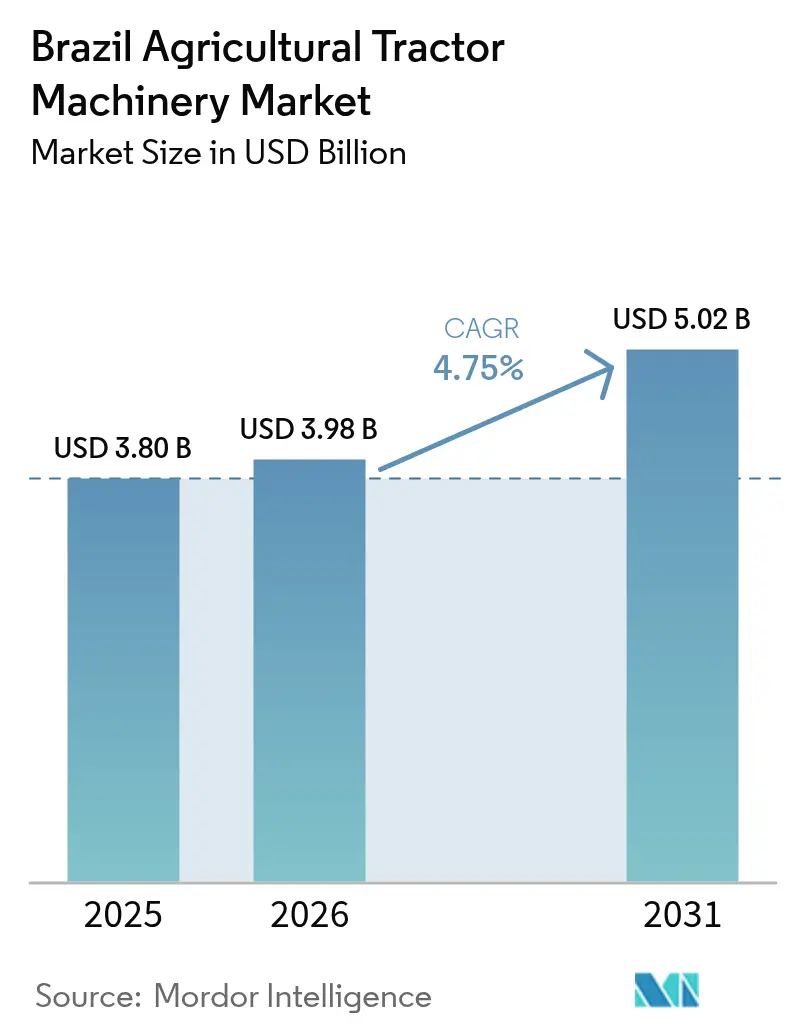
| Base Year Market Size (2025) | USD 3.80 Billion |
| Market Size (2026) | USD 3.98 Billion |
| Market Size (2031) | USD 5.02 Billion |
| Growth Rate (2026 - 2031) | 4.75 % |
| Market Concentration | High |
Major Players *Disclaimer: Major Players sorted in no particular order Image © Mordor Intelligence. Reuse requires attribution under CC BY 4.0. | |
Brazil Agricultural Tractor Machinery Market Analysis by Mordor Intelligence
The Brazil agricultural tractor machinery market size is expected to grow from USD 3.80 billion in 2025 to USD 3.98 billion in 2026 and is forecast to reach USD 5.02 billion by 2031 at 4.75% CAGR over 2026-2031. Robust rural credit subsidies, a rebound in commodity prices, and greater adoption of precision-ready implements are anticipated to keep the Brazil agricultural tractor machinery market on a steady expansion path. Producer demand is recovering after a slide in 2024 unit sales that stemmed from high interest rates and weak soybean prices. Government programs such as Moderfrota and the National Development Bank’s (BNDES) equalized credit lines continue to anchor equipment financing at rates 200–300 basis points below commercial benchmarks, allowing dealers to stretch payment terms and smooth seasonal spikes[1]. Original equipment manufacturer (OEM) strategies now center on autonomous-ready platforms, quick-attach retrofit kits, and satellite connectivity, all of which align with Brazil’s large, geographically dispersed farm operations. Competitive intensity remains high as multinationals invest in domestic production while local implement specialists undercut imports through shorter supply chains and subsidized dealer financing.
Key Report Takeaways
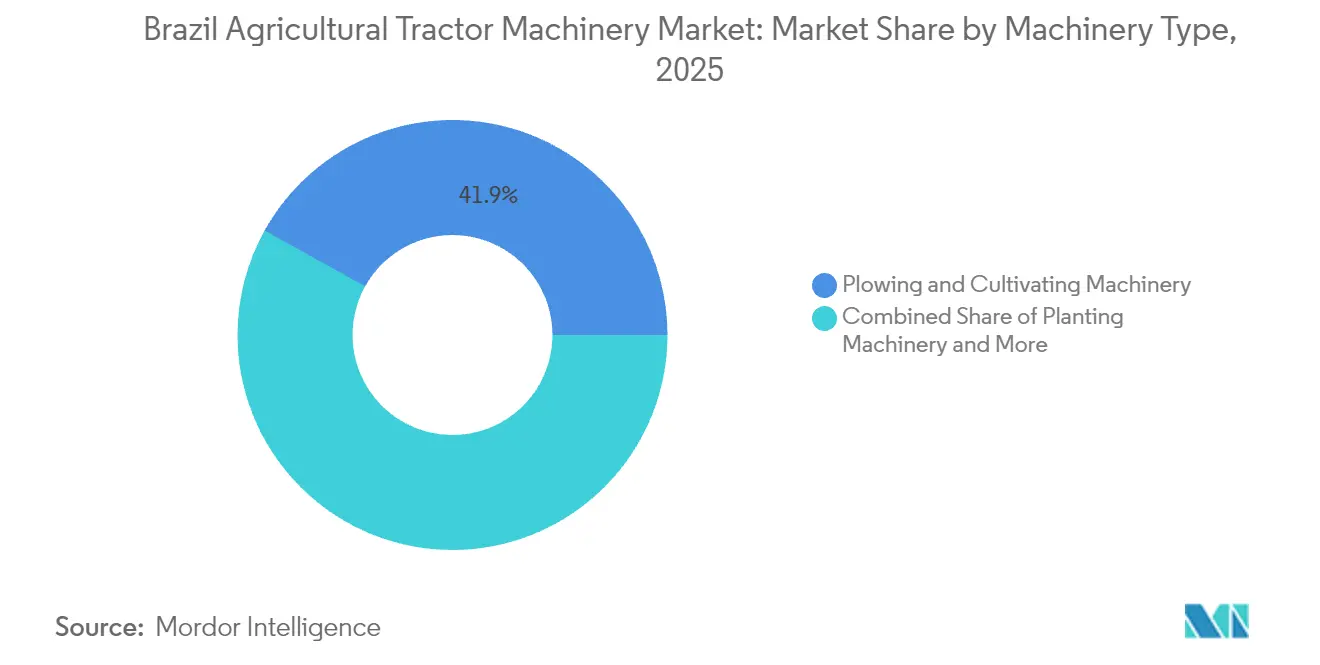
- By machinery type, plowing and cultivating machinery led the Brazil agricultural tractor machinery market with a 41.92% revenue share in 2025. In contrast, planting machinery is forecast to expand at a 8.83% CAGR through 2031.
Note: Market size and forecast figures in this report are generated using Mordor Intelligence’s proprietary estimation framework, updated with the latest available data and insights as of 2026.
Brazil Agricultural Tractor Machinery Market Trends and Insights
Drivers Impact Analysis*
| Driver | (~) % Impact on CAGR Forecast | Geographic Relevance | Impact Timeline |
|---|---|---|---|
| Mainstream Credit-Financed Mechanization Boom | +1.2% | National, strongest in Mato Grosso, Paraná, and Goiás | Medium term (2–4 years) |
| Commodity-price-linked Capex Cycles | +0.8% | Soybean and corn belts | Short term (≤2 years) |
| Domestic OEM Remanufacturing Push | +0.6% | São Paulo, Paraná, and Rio Grande do Sul | Long term (≥4 years) |
| Government Moderfrota Subsidy Extension | +1.0% | Nationwide small and medium farms | Medium term (2–4 years) |
| Precision-ready Quick-Attach Retrofit Upsurge | +0.7% | Large estates in Mato Grosso, Goiás | Short term (≤2 years) |
| Emergence of Carbon-Smart Tillage Practices | +0.5% | Cerrado and Amazon transition zones | Long term (≥4 years) |
| Source: Mordor Intelligence | |||
Mainstream Credit-Financed Mechanization Boom
BNDES disbursed funds for machinery in 2024, reflecting a notable increase that allowed dealers to extend payment terms significantly. Moderfrota contributed to the addition of a substantial number of tractors to the national fleet over a decade, highlighting the important role of subsidized loans. The February 2025 tranche of funding supports lending activities during critical planting months. These initiatives collectively reduce growers’ cost of capital compared to commercial rates and encourage consistent equipment replacement.
Commodity-price-linked Capex Cycles
Soybean futures experienced significant declines, reducing farm margins and delaying tractor purchases for several months. Historically, an increase in soybean prices has been linked to a notable rise in equipment orders within a short period, highlighting the strong connection between revenue and spending. Coffee provided some stability as Arabica prices supported ongoing mechanization efforts in key agricultural regions. These price fluctuations create immediate impacts that either encourage or hinder capital investments.
Domestic OEM Remanufacturing Push
Jacto and Stara now refurbish key driveline parts locally, reducing overall ownership costs compared with imports. AGCO’s Canoas remanufacturing plant extends tractor life significantly, appealing to a large portion of Brazil’s aging fleet. Shorter supply chains also mitigate currency fluctuations and improve parts delivery times. These benefits are gradually shifting buyer preferences toward domestically produced or remanufactured components.
Government Moderfrota Subsidy Extension
Moderfrota rates remain well below the national benchmark interest rate, making it an attractive option for financing. The program allocates a significant portion of its packages to small and medium growers, expanding mechanization beyond traditional agricultural hubs. Equalized credit ensures predictable monthly payments despite increasing interest burdens. Its continuation remains crucial for maintaining stability in equipment sales.
Restraints Impact Analysis*
| Restraint | (~) % Impact on CAGR Forecast | Geographic Relevance | Impact Timeline |
|---|---|---|---|
| High Import Tariffs on Precision Components | −0.9% | Nationwide import-dependent users | Medium term (2–4 years) |
| Double-digit Interest Rates on Working Capital | −1.3% | Dealers and small farms | Short term (≤2 years) |
| Seasonal Logistics Bottlenecks | −0.6% | Mato Grosso and southern ports | Short term (≤2 years) |
| Fragmented Rural Financing Access | −0.7% | Semi-arid Northeast, Amazon fringes | Long term (≥4 years) |
| Source: Mordor Intelligence | |||
High Import Tariffs on Precision Components
Capital-goods duties are significant and increase further when local service taxes are included, making advanced sensors and controllers expensive for growers. The expiration of the ex-tarifário waiver creates uncertainty and leads to forward-buying activity[2]. Importers also face extended approval timelines due to recent regulatory changes. High costs hinder the adoption of precision-agriculture technologies, particularly for smaller operations.
Seasonal Logistics Bottlenecks
Brazil faces a significant storage shortfall, forcing immediate grain sales at harvest discounts[3]. Port queues at Arco Norte can experience lengthy delays, impacting the timely arrival of machinery during peak demand. Road congestion on key routes further extends transit times for tractors shipped from southern factories. Limited cash flow and delayed deliveries together hinder timely equipment upgrades.
*Our forecasts treat driver/restraint impacts as directional, not additive. The impact forecasts reflect baseline growth, mix effects, and variable interactions.
Segment Analysis
By Machinery Type: Plowing and Cultivating Machinery Dominates While Planting Machinery Accelerates
Plowing and cultivating machinery accounted for 41.92% of 2025 revenue, reflecting the extensive use of no-till practices that necessitate investments in specialized double-disc openers and shanks. Planting machinery gear is the fastest-growing segment of the Brazilian agricultural tractors market, advancing 8.83% per year as cotton, corn, and specialty-grain growers adopt zero-damage seed placement. The Brazil agricultural tractor machinery market size for sowing solutions is forecast to rise from USD 0.85 billion in 2025 to USD 1.42 billion in 2031. Domestic players such as Stara and Jacto offer pneumatic meters and variable-rate controllers that cut seed waste by 4% and reduce overlaps by up to 8%. Harvesting implements grow moderately because sugarcane mechanization already exceeds 90%. Fertilizer and pest-control sprayers gain momentum from precision-agriculture retrofits that trim input costs 10–15%.
Precision-ready implements feed a broader ecosystem shift. Jacto’s Lumina planter integrates cloud-based telemetry, allowing agronomists to adjust seeding depth in real-time. Kuhn’s VBP 3260 baler supports integrated crop-livestock systems that store higher-protein feed. Such innovations raise implement prices by 15–20% yet shorten payback through reduced inputs and higher yields, supporting the long-term growth of the Brazilian agricultural tractors machinery market.

Geography Analysis
Dealer and service networks remain concentrated in Brazil’s South and Southeast, even as production shifts northward. São Paulo hosts a significant number of dealerships, reflecting its OEM manufacturing base. Minas Gerais and Paraná follow closely, benefiting from coffee and grain demand. Rio Grande do Sul is emerging as a production node thanks to Mahindra’s assembly plant.
Mato Grosso accounts for a substantial portion of soybean production yet has a limited number of dealerships, creating after-sales gaps that lengthen downtime and restrict credit. Goiás gains from significant investments in ethanol that raise demand for sugarcane harvesters. The frontier Matopiba region produces a large share of combined soybean and corn output but commands a small percentage of dealerships, spotlighting white-space for distributors.
The Arco Norte corridor, ports of Itaqui, Barcarena, and Santarém, has seen considerable growth, shortening machinery transit times to northern states. John Deere’s Starlink roll-out, starting in Horizontina and Catalão factories, addresses connectivity gaps across a majority of farm areas, enabling remote diagnostics that reduce service trips significantly.
Regulatory Landscape
Brazil's agricultural tractor and self-propelled machinery market follows a multi-agency compliance framework that covers road transit registration, safety, emissions licensing, and trade administration. MAPA manages the National Register of Tractors and Agricultural Machinery (RENAGRO), and tractors manufactured from January 1, 2016 for agricultural work must be registered in RENAGRO to circulate on public roads. For operational safety, manufacturers and employers are required to align equipment design and use with the Ministry of Labor requirements under NR-12 (including Annex XI for agricultural machinery), which affects guarding, operator protection, and retrofit requirements during commercialization and on-farm use.
Environmental and import requirements also shape product scope. Engine commercialization requires IBAMA licensing via LCVM and aligns with CONAMA Resolution 433/2011, which influences OEM engine and aftertreatment offerings. Importers and distributors operate under customs and tariff processes administered through Siscomex and CAMEX/GECEX trade measures, including periodic changes to ex-tarifario eligibility and capital-goods duties. In 2026, updates tied to LC 224 and Receita Federal normative guidance increased diligence needs around import benefit applicability and documentation in the Duimp/Siscomex workflow.
Competitive Landscape
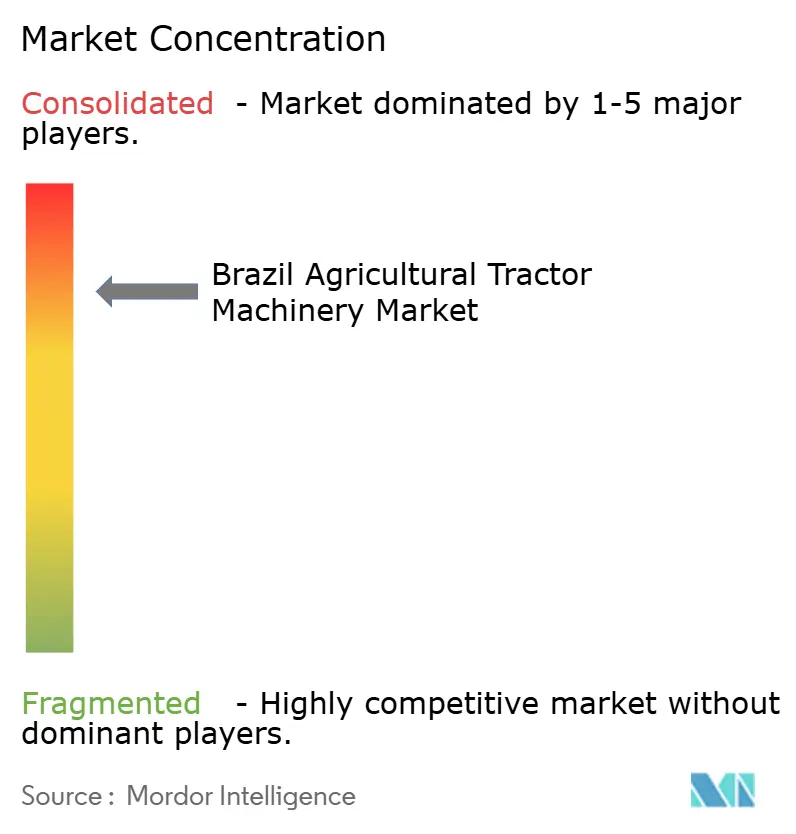
The Brazil agricultural tractor machinery market is highly concentrated, Deere and Company, CNH Industrial, AGCO Corporation, Bucher Industries, and Stara together control maximum percentage of the 2025 revenue. Multinationals channel capital into autonomy, connectivity, and local production. John Deere invested BRL 3 billion (USD 600 million) in three factories plus a BRL 180 million (USD 36 million) tropical-agriculture technology center. CNH launched a fully Brazilian-built Axial-Flow 160 combine after a BRL 100 million (USD 20 million) upgrade to its Sorocaba plant.
Domestic champions leverage home-field advantages. Jacto’s partnership with DJI extends to agricultural drones, while Stara’s Zero Crop Damage planter claims 4% seed savings. Financing remains a key differentiator: Jacto and Stara offer annual rates of 6.99–9.99%, undercutting dealer financing tied to the Selic rate. Mahindra and Yanmar pursue the aged-fleet replacement cycle by adding 18 dealerships in 2024 alone and scaling local assembly capacity.
Importers face headwinds. Bucher Industries reported a significant drop in revenue in Brazil for 2024, as interest-rate spikes forced inventory write-downs. The ex-tarifário duty holiday, in effect through December 2025, provides temporary relief, domestic content rules and longer approval timelines weigh on new entrants.
Brazil Agricultural Tractor Machinery Industry Leaders
-
Deere & Company
-
AGCO Corporation
-
CNH Industrial N.V.
-
Bucher Industries AG
-
Stara S/A
- *Disclaimer: Major Players sorted in no particular order
Market Opportunities and Future Outlook
Local manufacturing and localization programs are creating whitespace in compact and mid-horsepower tractors, implements, and attached precision-ready packages as OEMs expand Brazilian capacity and increase engineering content. Yanmar moved from an announced plan to execution by starting construction of its BRL 280 million Indaiatuba factory (aimed at 7,000 units per year), and John Deere opened a new industrial facility in Canoas, Rio Grande do Sul after a BRL 42 million investment to manufacture the 1025E sprayer. These additions support shorter lead times, improved parts availability, and more localized portfolios that fit Brazil's dispersed farm geography and service constraints.
Public development finance and OEM innovation pipelines are also pulling through product modernization. CNH Industrial Brazil secured BRL 129 million from BNDES under BNDES Mais Inovacao for eight projects spanning tractors, planters, and harvesters, reinforcing demand for nationalized components, retrofit kits, and connectivity-enabled implements that reduce operating costs for growers who delay full fleet replacement. With credit costs elevated in 2026, OEM and dealer offerings that bundle financing, remanufactured parts, and precision upgrades (including variable-rate controllers and telemetry-ready implements) provide a clearer commercialization path beyond replacement-only purchase cycles.
Recent Industry Developments
- July 2026: AGCO announced BRL 340 million in investments in Brazil for new technologies and assembly lines, including an expansion of the Mogi das Cruzes facility footprint. The announcement supports local capacity expansion and faster rollout of updated tractor and implement configurations aligned with Brazilian farm practices and parts availability needs.
- May 2026: Yanmar began construction of its BRL 280 million factory in Indaiatuba, Sao Paulo, targeting a production capacity of about 7,000 compact tractors per year. The project expands domestic supply for smaller horsepower segments and increases competitive pressure on incumbent brands that rely on imported compact units.
- February 2025: AGCO opened a Reman Transmissions Center of Excellence in Jundiai, Sao Paulo, focused on remanufacturing transmission components for agricultural equipment. Expanded reman capability lowers lifecycle ownership costs and improves parts turnaround times for operators managing older fleets under tighter financing conditions.
Research Methodology Framework and Report Scope
Market Definition and Coverage
For this study, the market covers the value of tractor-led agricultural machinery used on farms in Brazil, focused on implements and equipment that are pulled by, mounted on, or otherwise used with agricultural tractors.
Scope exclusions: Industrial and construction tractors, and non-agricultural tractor use cases, are excluded from this market sizing.
Segmentation Overview
- By Machinery Type
- Plowing and Cultivating Machinery
- Plows
- Harrows
- Rotovators and Cultivators
- Other Plowing and Cultivating Machinery
- Planting Machinery
- Seed Drills
- Planters
- Spreaders
- Other Planting Machinery
- Haying and Forage Machinery
- Mowers and Conditioners
- Balers
- Other Haying and Forage Machinery
- Sprayers
- Other Types
- Plowing and Cultivating Machinery
Data Sources, Market Sizing, and Validation
Desk Research
Desk research starts by building a clean picture of Brazil farm activity and mechanization needs, then mapping that to implement categories used with tractors. We relied on public references such as Brazil government agriculture statistics, trade customs data, and rural credit program releases (including equipment financing trends), since these provide steady time-series anchors.
To cross-check demand direction, we also review trade association publications for machinery shipment indications and dealer commentary, plus company annual reports, investor presentations, and reputable press coverage on planting seasons and fleet replacement. Patent databases are used to spot where implement design and precision-ready features are trending, which supports adoption assumptions during modeling. In a few cases, paid subscriptions for company financials and an import-export shipment-level database are used to sanity check pricing and trade flows. The sources listed above are illustrative only, and many other public and internal references are also consulted for data collection, validation, and clarification.
Primary Interviews and Surveys
Primary work is used to confirm what the model cannot reliably read from public data, especially how implement demand shifts across crop cycle timing, farm size, and the practical availability of credit. We speak with stakeholders across the value chain, including dealers, distributors, farm operators, service networks, and local manufacturing and assembly teams, and we balance inputs across Brazil's main farming belts and secondary producing areas.
These conversations help validate price bands, mix shifts across implement types, and the timing of replacement purchases. After that, the inputs are reconciled back to the desk view so the final totals remain explainable.
Distribution of primary research fieldwork respondents
| Company type | Respondent position |
|---|---|
| Top tier: 26% | CXOs: 12% |
| Mid tier: 58% | Functional/Unit leaders: 35% |
| Smaller Players: 16% | Managers: 53% |
Market-Sizing & Forecasting
Sizing is built using a top-down and bottom-up approach. In the top-down build, tractor population, annual sales direction, and crop area and planting intensity are used to reconstruct the demand pool for tractor-linked implements, which is then allocated into major implement groups and applications. To keep the model usable, we rely on a small set of clear inputs, such as equipment financing conditions, replacement cycle behavior, average price progression by implement class, and the timing of planting and harvesting seasons.
Selective bottom-up checks are then used to pressure-test the totals, such as sampled dealer sell-through by implement type and ASP, and supplier-side channel checks where reliable. Where bottom-up coverage is incomplete in remote regions or within small dealer networks, gaps are handled through proportional allocation based on cultivated area, crop mix, and observed dealer density, then rechecked during interviews.
For forecasting, scenario analysis is applied around credit availability and commodity-driven expectations for farm income, then a light regression-style check is used on historical linkages between mechanization spend and macro and ag indicators. The final forecast stays consistent with what interviewees describe as realistic order pipelines and seasonality, so the output remains usable for planning.
Data Validation & Update Cycle
Outputs are validated through multiple checks that look for breaks between value, units, and known market signals, and then the drivers are revisited if the variance falls outside a reasonable band. Our team compares final market totals against independent indicators like tractor sales direction, rural credit disbursement signals, and import patterns, then reviews anomalies in a second pass before sign-off.
If a major shock occurs, such as a sharp change in credit policy or a sudden price spike linked to currency movement, we re-contact selected respondents to confirm what is changing and what is not. Reports are refreshed annually, with interim updates for material events, and before delivery an analyst runs a final pass so clients receive the latest updated view.
Mordor Intelligence's Brazil Agricultural Tractor Machinery Market Estimate Compared With Other Published Estimates
It is normal to see different market values for Brazil agricultural tractor machinery because publishers do not always apply the same equipment boundary, year, or pricing logic. Some sources size a wider agriculture equipment basket, while a few focus only on tractors, which can push values up or down even before forecasting assumptions come into play.
By tracking implement-level price bands, credit-driven purchase timing, and seasonality checks, Mordor Intelligence keeps the estimate tied to tractor-used machinery categories rather than folding in broader farm equipment lines or adjacent on-farm systems. Differences can also come from currency conversion timing, whether a base year is 2024 or 2025, and whether replacement demand is assumed to normalize quickly after a weak unit year.
Benchmark comparison
| Source | Market Size | Gaps in Research Methodology |
|---|---|---|
| Mordor Intelligence | USD 3.80 B (2025) | |
| Global Research Publisher A | USD 4.06 B (2025) | Uses a broader interpretation of tractor machinery that can include tractors and related equipment in one bucket, which typically lifts the total versus an implements-focused scope. |
| Industry Research Desk B | USD 6.23 B (2024) | Sizes a wider Brazil agriculture equipment market that spans multiple equipment categories beyond tractor-linked implements, and it also uses a different base year and product mix. |
The spread in the table is mainly explained by what is counted and when it is counted, and those two choices influence pricing, mix, and growth math. When scope is kept tight to tractor-used implements and the assumptions are repeatedly checked against credit and seasonality signals, the resulting number is easier to trace and repeat year to year for decision-making.
Key Questions Answered in the Report
What is the current size of the Brazil agricultural tractor machinery market?
The Brazil agricultural tractor machinery market size stands at USD 3.98 billion in 2026.
How fast is the market anticipated to grow?
It is forecast to post a 4.75% CAGR and reach USD 5.02 billion by 2031.
Which implement type is growing the quickest?
Planting machinery are projected to grow at a 8.83% CAGR through 2031.
Why are high-horsepower tractors gaining traction?
Large estates are adopting above-130 horsepower autonomous-ready platforms to cover 5,000 to 10,000 hectares efficiently.