
Boron Market Size and Share
Market Overview
| Study Period | 2021 - 2031 |
|---|---|
| Market Volume (2026) | 5.54 Million tons |
| Market Volume (2031) | 6.78 Million tons |
| Growth Rate (2026 - 2031) | 4.12 % |
| Fastest Growing Market | Asia Pacific |
| Largest Market | Asia Pacific |
| Market Concentration | Medium |
Major Players *Disclaimer: Major Players sorted in no particular order Image © Mordor Intelligence. Reuse requires attribution under CC BY 4.0. | |
Boron Market Analysis by Mordor Intelligence
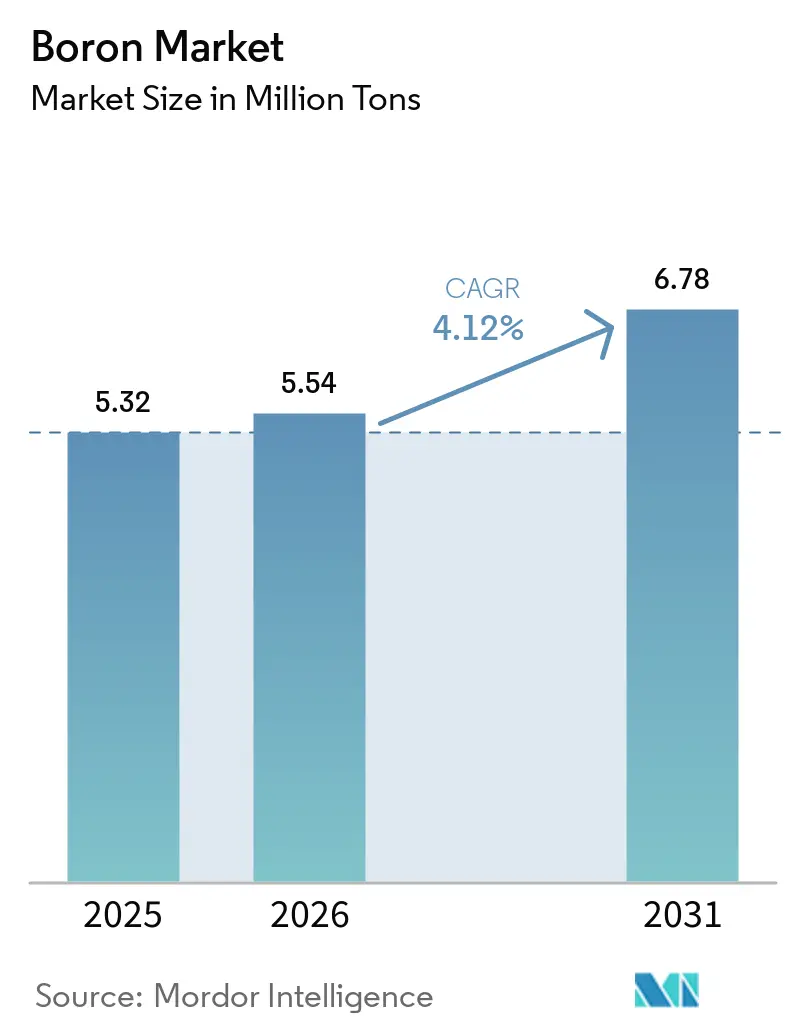
The Boron Market size is expected to increase from 5.32 million tons in 2025 to 5.54 million tons in 2026 and reach 6.78 million tons by 2031, growing at a CAGR of 4.12% over 2026-2031. In November 2025, the U.S. designated boron as a federal critical mineral, spurring incentives for onshore projects and intensified supply-chain audits. Turkey, seizing the moment, ramped up its production year-on-year through August 2024. In September 2024, it inaugurated a granular facility, further solidifying its grip on deposits that account for a significant portion of the world's reserves. Meanwhile, on February 6, 2026, Searles Valley Minerals issued a WARN notice, revealing permanent layoffs. This move underscored the mounting pressure on unintegrated North American producers, who find themselves at a disadvantage against Turkey's subsidized capacity. Developments like Ioneer’s Rhyolite Ridge, which capitalize on both lithium and boron, are now seen as strategic moves, positioning them competitively against state-backed suppliers.
Key Report Takeaways
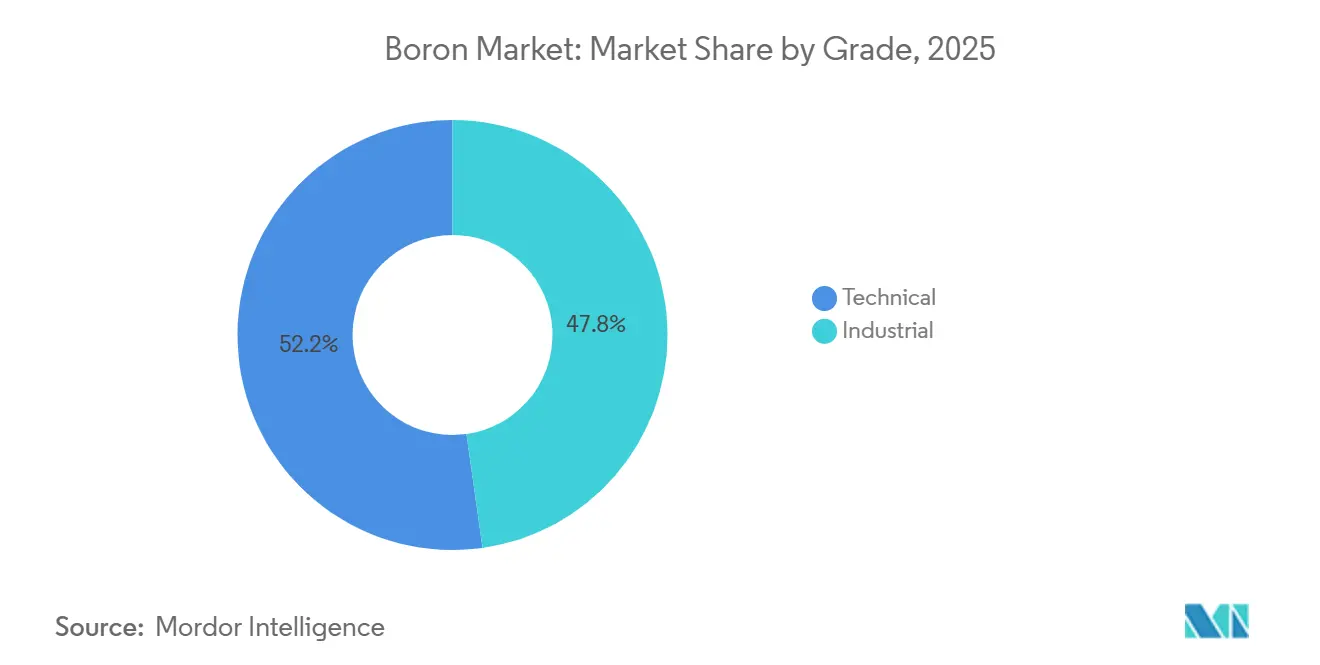
- By grade, technical grade captured 52.23% of the boron market share in 2025, and the segment is forecast to post a 4.16% CAGR through 2031.
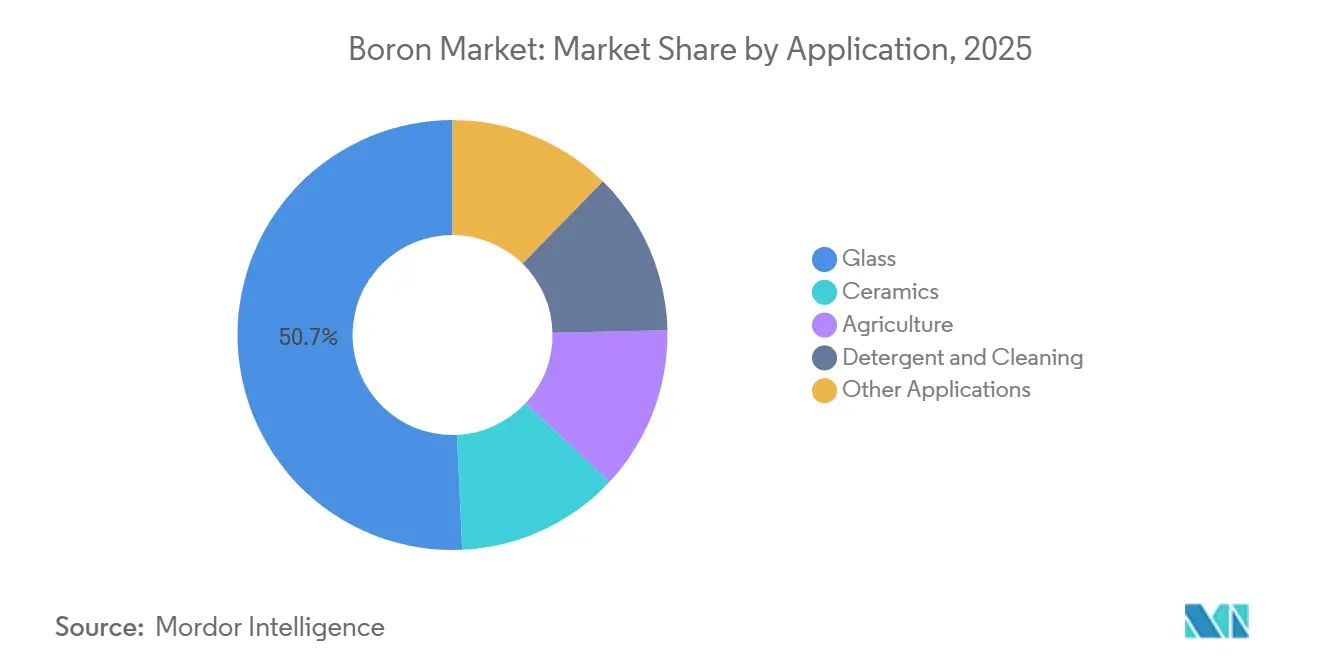
- By application, glass led with 50.71% revenue share in 2025 and is poised for the quickest 4.23% CAGR to 2031.
- By geography, Asia-Pacific accounted for 52.34% of 2025 sales; the region is projected to record the fastest 4.20% CAGR through 2031.
Note: Market size and forecast figures in this report are generated using Mordor Intelligence’s proprietary estimation framework, updated with the latest available data and insights as of 2026.
Market Trends and Insights
Drivers Impact Analysis of Boron Market*
| Drivers | (~) % Impact on CAGR Forecast | Geographic Relevance | Impact Timeline |
|---|---|---|---|
| Construction-grade glass demand surge (borosilicate, glass-ceramics) | +1.2% | Global, with APAC core and North America secondary | Medium term (2-4 years) |
| Electrification-induced semiconductor boron dopants | +0.9% | APAC (Taiwan, South Korea, Japan), North America (US) | Long term (≥ 4 years) |
| Micronutrient-driven agritech adoption | +0.8% | APAC (India, China), South America (Brazil, Argentina) | Short term (≤ 2 years) |
| Hydrogen storage via solid borohydrides | +0.4% | Europe, North America, Japan | Long term (≥ 4 years) |
| Ultra-high-temperature ceramics for hypersonics | +0.5% | North America, Europe (defense contractors) | Medium term (2-4 years) |
| Source: Mordor Intelligence | |||
Construction-Grade Glass Demand Surge
Borosilicate glass has transitioned from specialized laboratory use to becoming a staple in mainstream infrastructure. Producers of pharmaceutical vials turn to Type I borosilicate to sidestep leachables in biologics. Manufacturers in the solar industry opt for low-iron borosilicate cover sheets, as these sheets not only transmit more light but also endure hail impacts. Notably, installations in the Asia-Pacific region represented a significant portion of photovoltaic glass consumption. Developers of solid-oxide fuel cells are choosing calcium-borosilicate substrates, which can operate at 800 °C while retaining ionic conductivity. While flat-panel display lines in South Korea and Taiwan continue to utilize aluminoborosilicate, the shift towards OLEDs has tempered volume growth. Collectively, these dynamics ensure a consistent demand for borosilicate glass, providing a buffer for the boron market against fluctuations seen in other sectors.
Electrification-Induced Semiconductor Boron Dopants
Ion implantation depends on ultra-high-purity boron trifluoride. Gate-all-around transistors at sub-3 nm nodes tolerate no metallic contamination, reinforcing demand for 99.999% gas. Research during 2024 demonstrated boron-doped diamond MOSFET mobility above 100 cm²/V·s, suggesting future displacement of silicon carbide in electric-vehicle inverters[1]. Due to the defense-critical nature of neutron-absorbing control rods, the U.S. Department of Defense has allocated funds to boost domestic boron carbide production. Foundry majors in Taiwan and South Korea import all boron feedstock, so geopolitical shifts in Turkish export policy present a latent supply risk that further incentivizes diversification of the boron market.
Micronutrient-Driven Agritech Adoption
In January 2026, India revised its Nutrient-Based Subsidy, adding boron-fortified fertilizers to the same policy tier as zinc and manganese. Agronomic trials indicate that a deficiency in boron can lead to a significant yield drop in cotton and rapeseed. However, a tissue-specific application can effectively restore these yields. China is implementing similar measures in regions with high-pH soils. Meanwhile, Brazil and Argentina incorporate boron into NPK blends specifically for soy. Given that crop cycles are annual, the consistent agricultural offtake creates a demand floor, helping to stabilize the boron market even during construction downturns.
Hydrogen Storage via Solid Borohydrides
While metal borohydrides like LiBH₄ can store hydrogen, their high desorption temperatures pose challenges for commercialization. Alloying LiBH₄ with magnesium hydride cut release thresholds to below 300 °C in 2024 experiments, a range compatible with proton-exchange-membrane waste heat. Horizon Europe and Japan’s NEDO have since funded pilot synthesis lines, aiming to support long-haul transport that batteries cannot serve. Sodium borohydride, already used in pulp bleaching, may provide a circular loop because spent sodium borate can be regenerated electrolytically. While no automaker has yet committed, the work keeps a technology option alive and widens the strategic envelope of the boron market.
Restraints Impact Analysis of Boron Market*
| Restraints | (~) % Impact on CAGR Forecast | Geographic Relevance | Impact Timeline |
|---|---|---|---|
| Energy-intensive refining cost swings | -0.6% | Global, acute in Europe and North America | Short term (≤ 2 years) |
| Open-pit mining environmental curbs | -0.4% | Turkey, South America (Chile, Argentina) | Medium term (2-4 years) |
| Silicon-based glass modifiers substitution risk | -0.3% | Global, concentrated in low-cost glass segments | Long term (≥ 4 years) |
| Source: Mordor Intelligence | |||
Energy-Intensive Refining Cost Swings
In boron refining, energy costs dominate, especially with multi-stage calcination processes exceeding 900 °C. European gas prices surged in early 2024, only to plummet by late 2025. However, this volatility has made investors wary of committing to new kilns. In 2024, Rio Tinto transitioned its California mobile equipment to renewable diesel. This move reduced its Scope 1 carbon emissions but simultaneously increased its fuel costs. Meanwhile, Eti Maden capitalizes on subsidized electricity rates in Turkey, creating a pronounced cost disparity that ultimately influences transaction prices in the boron market.
Open-Pit Mining Environmental Curbs
Turkey’s Kırka and Bigadiç pits now face tougher dust-suppression and water-recycling audits introduced in 2024; compliance requires electrostatic precipitators and covered conveyors that raise capital intensity. Chile’s January 30, 2026, critical minerals strategy placed stricter tailings standards on Salar de Surire and Salar de Atacama, where boric acid is a coproduct with lithium. Europe’s draft Critical Raw Materials Act will require ISO 14001 verification for importers. Higher compliance costs do not remove supply but elevate the global cost floor for the boron market.
*Our forecasts treat driver/restraint impacts as directional, not additive. The impact forecasts reflect baseline growth, mix effects, and variable interactions.
Boron Market Segment Analysis
By Grade:
Technical Purity Lifts Premium ApplicationsTechnical Grade held 52.23% of the 2025 volume, and its dominance is set to expand at a 4.16% CAGR. This is driven by heightened demands for ppm-level purity from sectors like microelectronics and defense. For instance, sub-3 nm nodes necessitate ion-implant boron trifluoride with a high level of purity. Similarly, to ensure reactor safety margins, neutron-absorbing boron carbide mandates boron-10 enrichment exceeding specific thresholds. Notably, funding directed specifically at this grade hints at a predictable multi-year demand surge. On the other hand, Industrial Grade caters to sectors like glass, detergents, and fertilizers. However, its growth is tempered. Mature applications impose limits, and there's an ongoing substitution trend in household cleaners.
Premium spreads for boron widened significantly in 2025. This shift occurred as refiners in Turkey and Chile opted for higher-margin lithium brines, sidelining boron purification and thereby capping the incremental supply of Technical Grade. Major aerospace players are increasingly turning to single-sourcing high-purity powders. This strategy not only sidesteps qualification delays but also results in long-term contracts, bolstering price stability in the boron market. In contrast, prices for Industrial Grade are influenced by fluctuations in freight rates and energy surcharges. Such volatility has a ripple effect, impacting agricultural retailers who navigate seasonal inventory challenges.
By Application:
Glass Anchors Structural GrowthGlass captured 50.71% of 2025 volume and remains the fastest expanding application at 4.23% CAGR through 2031, securing over half of projected incremental tonnage and reinforcing its place at the center of the boron market. Pharmaceutical vials, solar cover sheets, and laboratory equipment account for the bulk, each leveraging borosilicate’s coefficient of thermal expansion, which is one-third that of soda-lime alternatives. Solar adoption in Asia-Pacific, coupled with U.S. factory-build announcements, sustains baseline momentum even if construction sentiment wavers elsewhere.
Ceramics also hold significant shares, driven by hypersonic hardware and thermal-management substrates in high-density power electronics. India’s new subsidy has bolstered agriculture's share of boron-fortified micronutrients. In North America and Europe, sodium percarbonate and enzyme cocktails are replacing sodium perborate, leading to a decline in detergent sales. However, borax maintains a price edge in ASEAN markets. Meanwhile, flame retardants and neutron-capture therapy, though minor players, are expanding in tandem with the broader boron market.

Geography Analysis
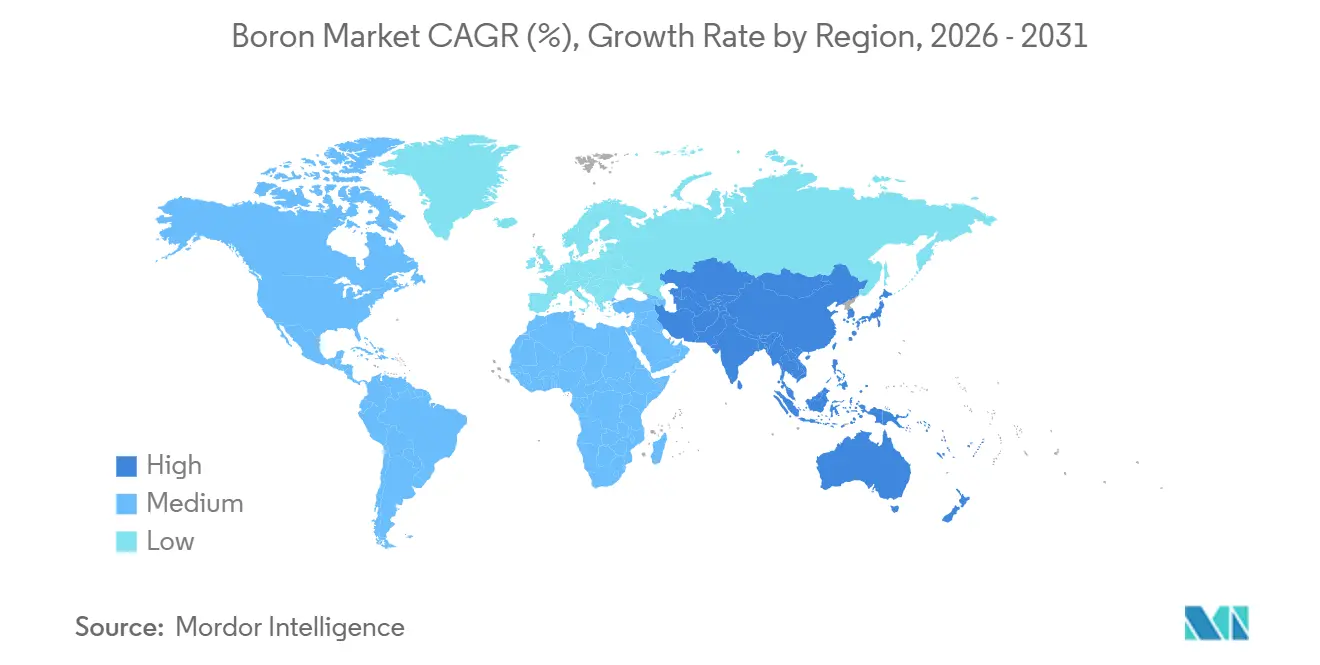
APAC Boron Market
Asia-Pacific accounted for 52.34% of global volume in 2025 and will expand at a 4.20% CAGR, reflecting the region’s dominance in flat-panel glass, fertilizer consumption, and precision ceramics. China heavily relied on imports from Turkey and Chile due to the limited scale of local ores. Thanks to a subsidy, India's farm demand is set to rise annually. Meanwhile, Japan is making strides by exporting Hexagonal boron nitride parts, crucial for semiconductor packaging. Additionally, emerging glass clusters in Vietnam and Thailand are not only expanding supply chains but also integrating the boron market into the region's manufacturing landscape.
North America Boron Market
North America accounted for a significant share of the global volume in 2025. Rio Tinto's California complex contributes substantially to the global refined output, yet has not announced any expansions post-2024. A federal designation as a critical mineral in the U.S. from November 2025 paves the way for tax incentives, bolstering domestic ventures. Ioneer's Rhyolite Ridge, which received clearance in October 2024, is set to commence operations in 2028, producing boric acid annually. Meanwhile, Canada and Mexico play a minor role, primarily importing from U.S. distributors.
EMEA and South America Boron Market
Europe accounted for a notable portion of the global boron consumption in 2025. Key players like Germany, France, and Italy, while central to fiberglass insulation and ceramics, depend on Turkey for a significant share of their boron imports[2]. This reliance is further emphasized by the draft EU legislation classifying boron as a strategic raw material, highlighting the region's supply vulnerabilities. South America, with a considerable share, is spearheaded by Chile's Salar de Surire plant and SQM's unit at Salar de Atacama. In the Middle East and Africa, accounting for a smaller share, Saudi Arabia and South Africa emerge as the main importers.
Value Chain Analysis
The boron value chain begins with upstream extraction of borate ores and brines, concentrated in a limited set of producing basins led by Turkey (Eti Maden) and the United States (notably Rio Tinto operations in California), with additional supply from South America (Chile) and Russia. Ore is processed into refined borates (borax, boric acid) through crushing, dissolution, purification, and energy-intensive dehydration and calcination steps, then converted into higher-purity chemicals (for example, technical-grade boric acid powders, boron trifluoride for ion implantation, and boron carbide or boron nitride ceramics) before reaching end-use manufacturers in glass, agriculture, detergents, and advanced materials.
Midstream logistics and packaging are material cost drivers because borates typically move as bulk solids and bagged products through ports, rail, and regional warehouses, with distribution hubs in Europe and Asia supporting import-reliant consumers. Key friction points include energy-price volatility for high-temperature refining, route and port disruptions that affect bulk and container availability, and mine-side outages that can tighten availability quickly given the concentrated supply base. On the supplier side, capacity moves such as Eti Maden opening the Bigadiç granular boron facility in September 2024 (serving fertilizer-oriented products) show how producers tune product form to downstream needs, while downstream buyers manage risk through qualification, multi-sourcing, and longer-term supply arrangements for higher-purity grades.
Competitive Landscape
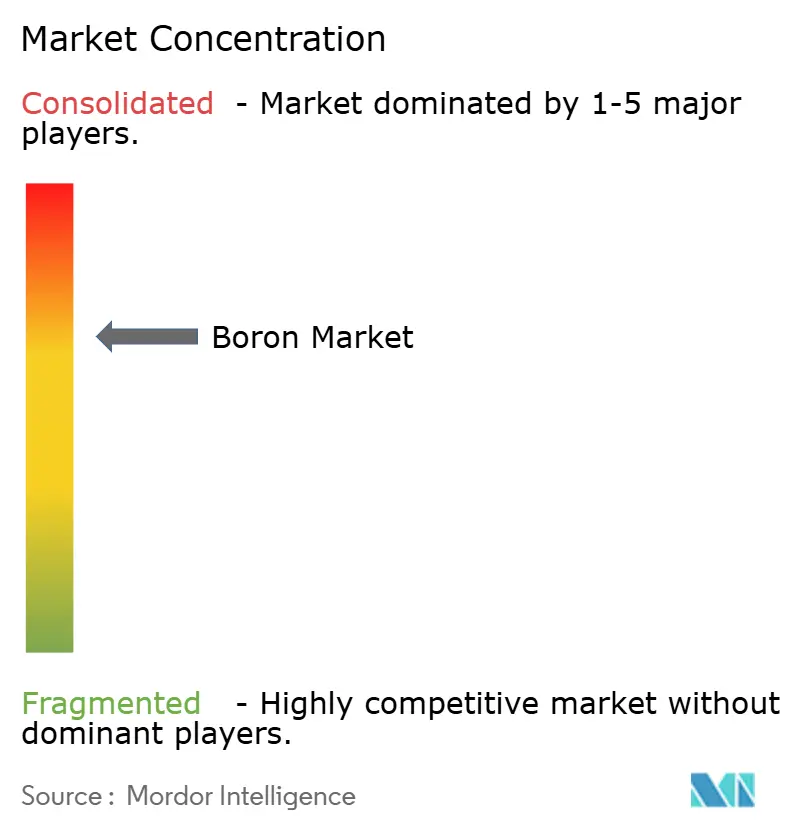
The boron market is moderately consolidated. Emergent solution-mining ventures in California began pilot extraction in January 2024. These entrants fragment a region long shared by two incumbents and test whether modular plants can remain viable against Turkish low-cost exports. Patent filings jumped in 2024 from 2023, signaling a pivot of innovation toward downstream chemistry, especially borohydride synthesis and ultra-high-temperature composites. Technical Grade suppliers are investing in ion-exchange purification and isotopic enrichment, while Industrial Grade players chase freight synergies and just-in-time warehousing.
Boron Industry Leaders
-
Eti Maden
-
Rio Tinto
-
Quiborax
-
Searles Valley Minerals
-
Minera Santa Rita (MSR)
- *Disclaimer: Major Players sorted in no particular order
Boron Market Companies Covered in this Report
- 3M
- Air Liquide
- American Elements
- Boron Molecular
- Boron One Holdings
- Eti Maden
- Gujarat Boron Derivatives Pvt., Ltd.
- Ioneer
- Minera Santa Rita (MSR)
- Momentive Technologies
- Quiborax
- Resonac Holdings Corporation
- Rio Tinto
- Saint-Gobain
- SB Boron Corporation
- Searles Valley Minerals
- Stella Chemifa Corporation
Market Opportunities and Future Outlook
Domestic and diversified supply of higher-purity boron chemicals and intermediates offers an actionable opportunity to reduce dependence on a small number of exporting regions, particularly for technical-grade uses in semiconductors and defense. In April 2026, U.S. Borax initiated production upgrades at its Coudekerque facility, including a new boric acid line for battery-quality (Optibor BQ+) and technical-grade (Optibor TP+) powders, pointing to investment focused on tighter-specification borates rather than commodity-only volumes.
North American refining and conversion capacity tied to secured offtake is another area where project-level momentum is visible. 5E Advanced Materials has publicized a Fort Cady focus on ferroboron (for specialty steel and NdFeB magnet supply chains) and, in July 2026, signed an offtake heads of agreement with a domestic cellulose insulation company for boric acid and calcium sulphate, reflecting end-market pull for borates beyond traditional glass and fertilizers. Co-product development models that link boron to lithium projects also continue to attract counterparties, as shown by Ioneer entering strategic non-binding letters of intent in June 2026 with KIND and Hyundai Engineering to advance the Rhyolite Ridge lithium-boron project, supporting a pipeline for integrated processing and broader financing pathways.
Recent Industry Developments in Boron Market
- July 2026: 5E Advanced Materials signed an offtake heads of agreement with a domestic cellulose insulation company covering boric acid and calcium sulphate from its Fort Cady facility. The agreement ties boron chemicals directly to an identifiable end market and helps underpin project bankability through demand-linked commercialization steps.
- May 2026: Chile's Ministry of Mining published the decree setting conditions for a Special Lithium Operation Contract (CEOL) linked to Quiborax's El Aguila plant initiative to recover lithium from mining tailings. The move broadens Quiborax's strategic footprint around boron-linked brine and tailings chemistry, and it supports circular-economy processing routes in a country where boric acid can be produced as a co-product with lithium.
- September 2024: Eti Maden inaugurated the Bigadic Granular Boron Production Facility in Turkey with 35,000 tons per year capacity aimed at fertilizer applications. The investment strengthens downstream product-form capabilities and reinforces Turkey's role in shaping global supply availability and product mix for bulk borate consumption.
Boron Market Report Scope and Research Methodology
Market Definition and Coverage
This market covers the demand and supply of boron materials that are used as inputs across industries, measured as the physical volume consumed and produced across major regions.
Scope exclusions: Finished end products that only contain small boron additives are not counted unless they are reported and traded as boron materials.
Segments Covered in This Report
- By Grade
- Technical
- Industrial
- By Application
- Glass
- Ceramics
- Agriculture
- Detergent and Cleaning
- Other Applications
- By Geography
- Asia-Pacific
- China
- India
- Japan
- South Korea
- ASEAN Countries
- Rest of Asia-Pacific
- North America
- United States
- Canada
- Mexico
- Europe
- Germany
- United Kingdom
- France
- Italy
- Russia
- Nordic Countries
- Rest of Europe
- South America
- Brazil
- Argentina
- Rest of South America
- Middle-East and Africa
- Saudi Arabia
- South Africa
- Rest of Middle-East and Africa
- Asia-Pacific
Data Sources, Market Sizing, and Validation
Desk Research
Desk work was used to set the outer boundaries of the boron supply chain and to build the first set of demand and trade signals that can be checked later. We mainly rely on public sources such as USGS minerals statistics, UN Comtrade trade data, national geological survey publications, customs and tariff schedules, and peer-reviewed papers on borates use in glass and agriculture.
Along with these, we cross-check company filings, investor presentations, trade association pages, and reputed press coverage to understand capacity additions, operating rates, and product mix shifts over time. Select paid subscriptions for company financials and intelligence, patent databases, and shipment-level import-export data are used to fill gaps where public reporting is thin. These examples are not exhaustive, and many other sources were also referred to for data collection, validation, and clarification.
Primary Interviews and Surveys
Primary discussions were run with suppliers, distributors, and large buyers across glass, ceramics, and agriculture so the model reflects how boron is actually contracted and consumed. We also checked assumptions with technical experts who track borates grades and with regional contacts across APAC, EMEA, and the Americas to confirm trade flows, typical pricing ranges, and near-term demand shifts.
Distribution of primary research fieldwork respondents
| Company type | Respondent position | Region |
|---|---|---|
| Top tier: 27% | CXOs: 13% | APAC: 41% |
| Mid tier: 55% | Functional/Unit leaders: 41% | EMEA: 36% |
| Smaller Players: 18% | Managers: 46% | Americas: 23% |
Market-Sizing & Forecasting
Sizing is built using top-down market reconstruction, where production and trade data are used to arrive at apparent consumption of boron by region and then aligned to end-use pull. That total is then corroborated through selective bottom-up checks, like sampled supplier and channel volumes, and a volume times average price view for key borates, which helps us adjust for reporting gaps.
Inputs that matter in this market include boron minerals and borates output trends, import-export balances by major producing and consuming countries, glass and ceramics production indicators, agricultural micronutrient application intensity, and short-term price movements for borates. When pricing is noisy, the model uses blended average selling prices across common grades so one-off spot spikes do not distort totals.
For forecasting, scenario analysis is used to reflect how construction-linked glass demand and farm input affordability can move differently by region. Assumptions on capacity additions, utilization, and trade diversion are refined through expert feedback, and missing country splits are handled by proportioning to the most stable trade and consumption signals available.
Data Validation & Update Cycle
Outputs are checked against independent signals like trade balances, production growth, and end-use activity so large jumps get explained before numbers are finalized. If a variance is detected, the drivers are re-tested, the conversion factors are reviewed, and follow-up calls are triggered with relevant contacts.
A multi-step internal review is followed so the model logic, units, and math are consistent across regions and years. Reports are refreshed annually, and interim updates are made when material events occur, such as major capacity changes, policy shifts affecting mining, or sustained price dislocations. Before delivery, a final analyst pass is completed to ensure clients receive the latest updated view.
Mordor Intelligence's Boron Market Size Versus Other Published Estimates
Published boron market figures often do not match because the unit of measurement and the counted product boundary can be different even when the topic name looks the same. Some sources focus on value, some focus on volume, and the difference becomes larger when price assumptions and grade coverage are not stated clearly.
Trade balances, production series, and end-use activity checks are the evidence that keep Mordor Intelligence aligned to a volume-defined boron demand pool, which reduces the risk of mixing in downstream finished goods or double-counting blended products. Differences also come from how each publisher treats average price progression, the conversion timing used for currencies, and how recently the base-year inputs were refreshed after capacity or trade shifts.
Benchmark comparison
| Source | Market Size | Gaps in Research Methodology |
|---|---|---|
| Mordor Intelligence | USD 5.54 M (2026) | |
| Industry Publisher A | USD 3.75 B (2026) | Reported in value terms, which can embed broader boron-containing product baskets and price assumptions that are not directly traceable back to mined and refined boron volumes. |
| Industry Publisher B | USD 2.67 B (2024) | Uses a different base year and a revenue framing that may apply a single price curve across types, which can shift totals when product mix and regional price spreads change. |
Looking across the three figures, the spread is mainly explained by unit choice and where the inclusion boundary is drawn around boron versus boron-containing products. By keeping the core model tied to repeatable supply, trade, and end-use signals, the study gives a practical total that can be revisited each year with the same steps and updated inputs.
Key Questions Answered in the Report
How fast will the Asia-Pacific demand for boron grow through 2031?
Asia-Pacific demand is projected to rise at a 4.20% CAGR, supported by solar cover glass, fertilizer subsidies, and electronics glass.
Why is Technical Grade pricing rising faster than Industrial Grade?
Semiconductor and defense specifications require ppm-level purity, creating tight supply and pushing Technical Grade premiums within one year.
Which applications are most exposed to substitution risk?
Commodity flat glass can swap part of its boron content for alumina or zirconia, trimming demand growth in low-end segments.
What is the current demand for the boron market and its expected growth by 2031?
The global consumption is 5.54 million tons in 2026 and is projected to reach 6.78 million tons by 2031, reflecting a 4.12% CAGR.