
Bonded Abrasives Market Size and Share
Market Overview
| Study Period | 2021 - 2031 |
|---|---|
| Market Size (2026) | USD 25.23 Billion |
| Market Size (2031) | USD 32.39 Billion |
| Growth Rate (2026 - 2031) | 5.12 % |
| Fastest Growing Market | Asia Pacific |
| Largest Market | Asia Pacific |
| Market Concentration | Medium |
Major Players *Disclaimer: Major Players sorted in no particular order Image © Mordor Intelligence. Reuse requires attribution under CC BY 4.0. | |
Bonded Abrasives Market Analysis by Mordor Intelligence
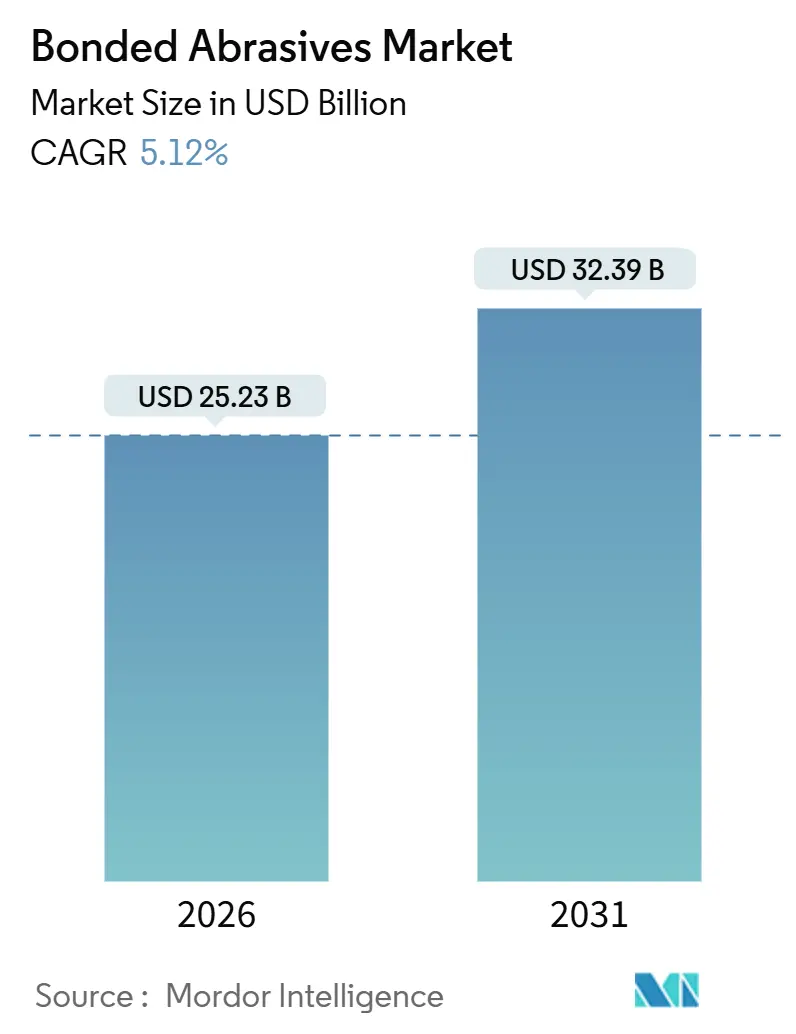
The Bonded Abrasives Market size is estimated at USD 25.23 billion in 2026, and is expected to reach USD 32.39 billion by 2031, at a CAGR of 5.12% during the forecast period (2026-2031). Continued electrification in vehicle powertrains, aerospace reshoring across North America and Europe, and infrastructure-driven metal-working expansions in Asia-Pacific collectively sustain demand for precision grinding wheels. Vitrified bond products dominate heavy-duty cylindrical and surface grinding lines, while resin bonds penetrate high-speed setups that exceed 25 m/s peripheral speed. Tighter geometric tolerances in electric motors and battery housings widen the application base for cubic boron nitride (CBN) and ceramic grains, and AI-enabled tool-room automation improves productivity by shortening dressing cycles. Regional players are scaling capacity in thin cutting wheels and high-purity silicon carbide, intensifying competition with incumbents that still control 40-45% of global revenue.
Key Report Takeaways
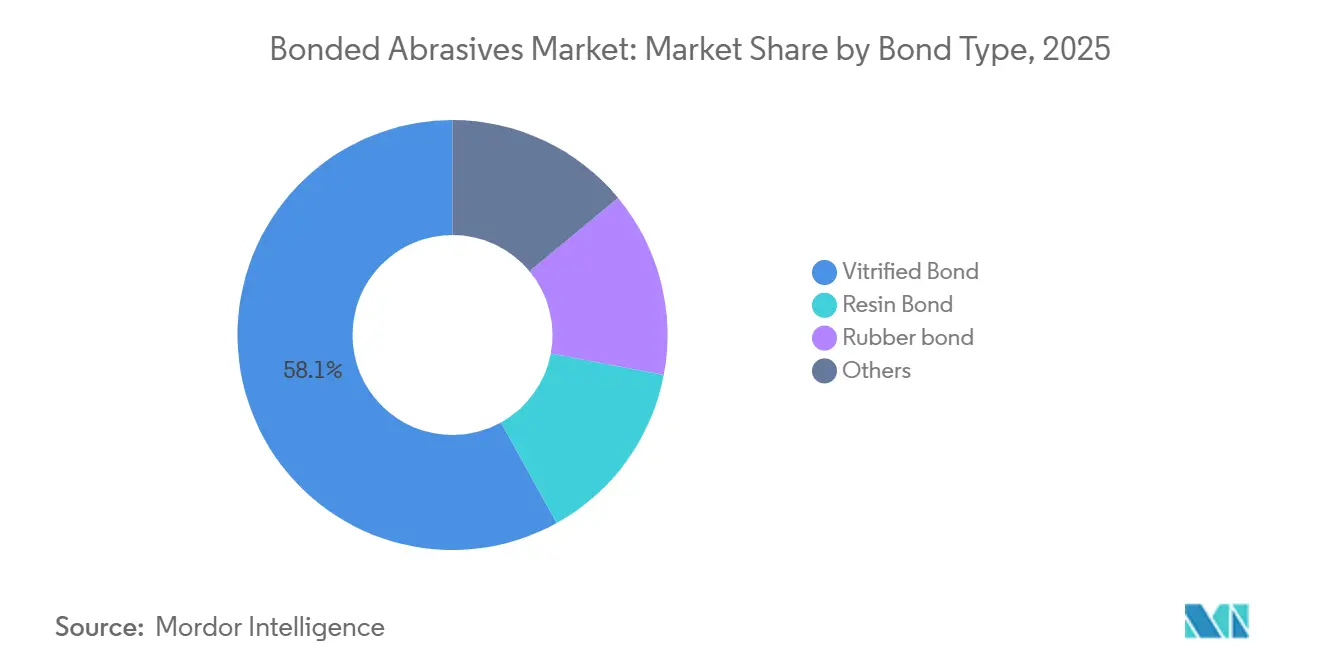
- By bond type, vitrified bond led with 58.06% bonded abrasives market share in 2025 and is projected to register a 5.49% CAGR through 2031.
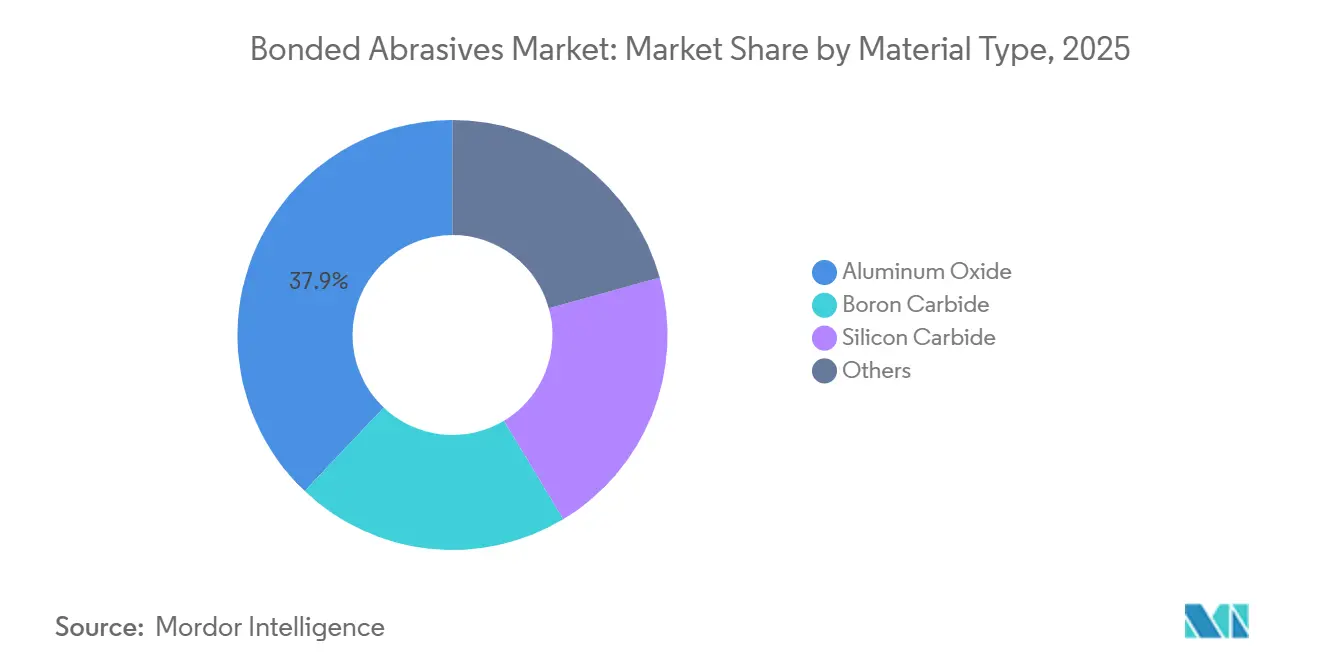
- By material type, aluminum oxide accounted for 37.93% of the bonded abrasives market size in 2025 and is advancing at a 5.46% CAGR through 2031.
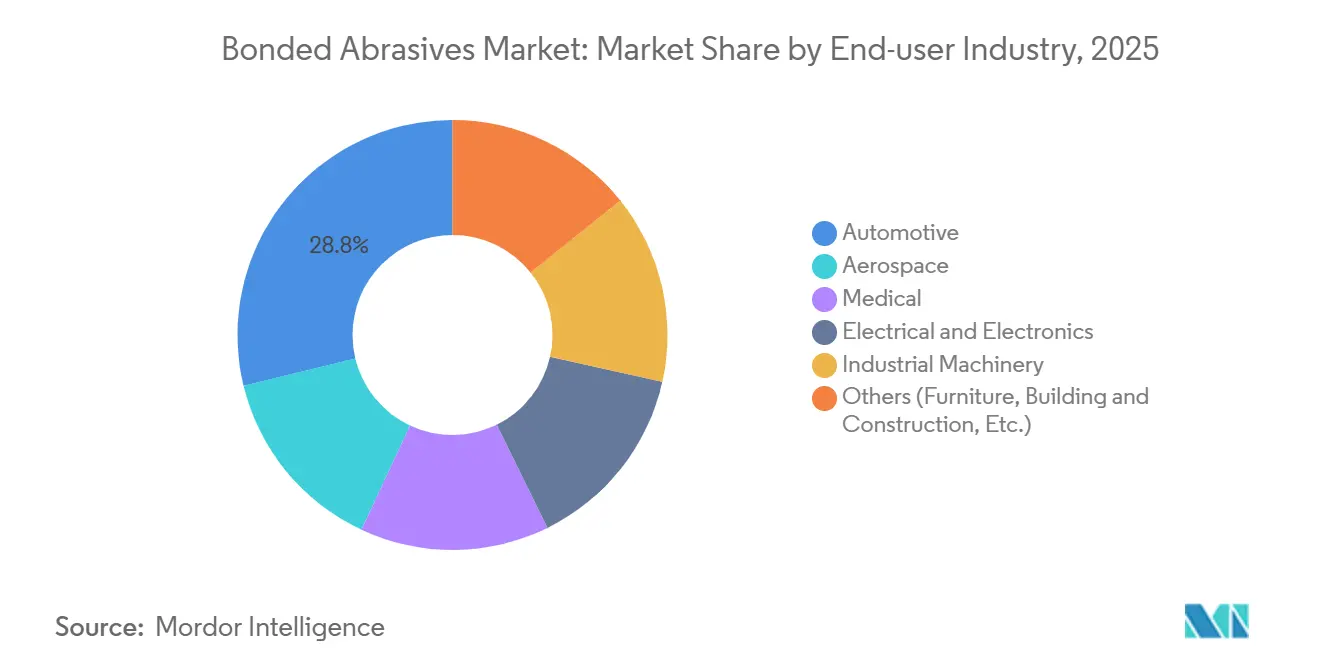
- By end-user industry, automotive held 28.79% revenue in 2025 and is projected to expand at a 5.56% CAGR during 2026-2031.
- By geography, Asia-Pacific captured 56.48% revenue in 2025; the region is forecast to post a 5.71% CAGR to 2031.
Note: Market size and forecast figures in this report are generated using Mordor Intelligence’s proprietary estimation framework, updated with the latest available data and insights as of January 2026.
Global Bonded Abrasives Market Trends and Insights
Drivers Impact Analysis*
| Driver | (~) % Impact on CAGR Forecast | Geographic Relevance | Impact Timeline |
|---|---|---|---|
| Infrastructure-Led Metal-Working Boom in Asia | +1.5% | Asia-Pacific core, spillover to Middle East and Africa | Long term (≥ 4 years) |
| Resinoid Wheels Enabling Greater Than 25 m/s High-Speed Grinding Lines | +1.0% | Global, concentrated in North America and Europe aerospace hubs | Medium term (2-4 years) |
| Shift To Precision Ceramics and CBN Grains in EV Power-Trains | +1.3% | Global, led by China, Europe, North America EV manufacturing clusters | Medium term (2-4 years) |
| AI-Driven Tool-Room Automation (Self-Sharpening Set-Ups) | +0.8% | North America and Europe advanced manufacturing, emerging in Asia-Pacific | Short term (≤ 2 years) |
| Re-Shoring of US/EU Aerospace Machining Capacity | +0.9% | North America and Europe, focused on Midwest, South, Mountain West regions | Medium term (2-4 years) |
| Source: Mordor Intelligence | |||
Infrastructure-Led Metal-Working Boom in Asia
Regional steel output is rising as India produced 144.3 million t in fiscal 2024, up 13.4% year on year, while new capacity in Vietnam and Indonesia adds flat-rolled output for construction projects[1]Ministry of Steel, “Annual Report 2023-24,” steel.gov.in . More steel means more billet grinding, structural-beam finishing, and rebar cutting, which directly lifts bonded abrasives market demand. Chinese mill utilization is softening, yet Wood Mackenzie expects India, Thailand, and the Philippines to absorb volume through 2031, shifting wheel consumption southward. Japan and South Korea remain buyers of CBN and diamond wheels for semiconductor wafer and micro-finishing work, underscoring a stable premium niche. Governments channel infrastructure budgets into metro rail, port dredging, and bridge expansion, locking in multi-year orders for aluminum-oxide wheels. The result is predictable long-cycle revenue visibility for both global and local producers.
Resinoid Wheels Supporting greater than 25 m/s Grinding Lines
Automotive crankshaft and aerospace turbine machining increasingly runs at peripheral speeds that vitrified wheels cannot safely withstand, so resin bonds with elastic phenolic matrices are preferred. Peer-reviewed trials show resin-bond diamond wheels sustain 125 m/s in production, slashing cycle time by 30% and reducing heat-affected zones on nickel superalloys. Aerospace OEMs therefore cut finishing passes while maintaining Ra ≤ 0.4 µm surface finishes. Electric-vehicle motor shafts require roundness within 5 µm, a tolerance easier to hit with shock-resistant resin wheels. Automotive tier-1 suppliers deploy these wheels to hit takt times below 60 s per shaft, protecting throughput. With peripheral speeds still climbing, demand elasticity favors suppliers able to certify wheels under ISO 21940 burst-test criteria.
Precision Ceramics and CBN for EV Powertrains
CBN generates lower grinding forces and up to 15% finer surface finishes on induction-hardened steel shafts than aluminum oxide, eliminating secondary polish steps. Electric motors that spin beyond 15,000 rpm need such finishes to avoid vibration, and EV makers now specify CBN wheels in purchasing tenders. Ceramic grains that micro-fracture under load create a self-sharpening action on aluminum housings, preventing built-up edge. Battery pack machining for thin-wall aluminum castings benefits from this self-sharpening, extending wheel life by nearly 20% versus conventional abrasives. The bonded abrasives market therefore pivots toward higher-margin super-abrasive formats, boosting average selling price even if volume growth moderates.
AI-Driven Tool-Room Automation
Fraunhofer IEM’s RoboGrinder uses vibration and acoustic sensors to adjust feed and speed in real time, trimming cycle time by 40% and cutting dressing frequency 15% in pilot runs. Chalmers University’s Grinding 4.0 digital twin predicts wheel wear with 98.1% accuracy, guiding optimal dressing-infeed depth and length. Shops achieve lights-out production during night shifts, trimming labor expense and improving spindle utilization. Suppliers able to embed RFID chips that communicate wheel ID and wear history position themselves for service-based revenue streams. Early adopters report scrap reductions of 7 pp, reinforcing a data-driven pull for high-precision wheels.
Restraints Impact Analysis*
| Restraint | (~) % Impact on CAGR Forecast | Geographic Relevance | Impact Timeline |
|---|---|---|---|
| Energy-Intensive Firing Furnaces Facing Carbon Taxes | -0.6% | Europe and North America, emerging in China | Medium term (2-4 years) |
| Ti-Oxide And Phenolic-Resin Price Volatility greater than 18% YoY | -0.4% | Global, acute in North America and Europe due to import reliance | Short term (≤ 2 years) |
| Stricter PM2.5 Limits in India and China Grinding Shops | -0.5% | Asia-Pacific, concentrated in India and China manufacturing hubs | Medium term (2-4 years) |
| Source: Mordor Intelligence | |||
Energy-Intensive Firing Furnaces and Carbon Taxes
Vitrified wheels fire above 1,200 °C, consuming 3-5 MWh per tonne and emitting significant CO2. The European Commission requires 55% emissions cuts by 2030, obliging ceramic plants to retrofit electric or hydrogen kilns that each cost more than EUR 10 million[2]European Commission, “Industrial Carbon Management Strategy COM 2024/62,” ec.europa.eu . U.S. industrial policy offers tax credits for electrified furnaces, yet smaller producers still face USD 8-12 million up-front capital. Chinese dual-control caps have already forced Henan and Shandong operations to curtail peak-season output, lengthening wheel lead times to eight weeks. Higher energy surcharges narrow operating margins and could delay capacity additions, moderating bonded abrasives market expansion where vitrified products dominate.
Ti-Oxide and Phenolic-Resin Price Volatility greater than 18% YoY
Titanium dioxide and phenolic resin spot prices swung more than 18% year on year in 2024-2025, squeezing resin-bond wheel makers that lack hedging cover. U.S. fused alumina output hovers near 22,000 t, leaving import dependence above 95%, with China supplying 91% of crude tonnage. Freight spikes and tariffs amplify cost uncertainty. BASF is boosting MDI capacity in Louisiana by 58% to stabilize resin feedstock, but the new train will not commission until 2026. Producers increasingly trial bio-based resins, yet scale remains limited, so pricing risk remains a near-term headwind.
*Our forecasts treat driver/restraint impacts as directional, not additive. The impact forecasts reflect baseline growth, mix effects, and variable interactions.
Segment Analysis
By Bond Type: Vitrified Bond Hold Precision Edge
Vitrified bond secured 58.06% bonded abrasives market share in 2025 and is projected to register a 5.49% CAGR to 2031. Its rigid, porous structure resists burn and preserves geometry on crankshafts, camshafts, and turbine blades even under heavy normal forces. Vitrified variants also enable in-process conditioning that keeps surface integrity consistent during long production runs. Research partnerships such as Chalmers Grinding 4.0 lower tool cost per part by predicting dressing intervals, improving wheel utilization by 15 pp.
Resin bonds, cured below 200 °C, are capturing high-speed applications where elastic matrices absorb shock and limit catastrophic bursts. Automotive EV lines value that resilience for motor shaft grinding at peripheral speeds above 80 m/s. Rubber bonds, while niche at single-digit share, remain essential for thin cutting disks and centerless grinding where vibration damping improves finish. Metal and shellac bonds fill ultra-precision optics roles, rounding out a diverse bonded abrasives market.


By Material Type: Aluminum Oxide Anchors Ferrous Grinding
Aluminum oxide captured 37.93% of bonded abrasives market size in 2025 and is forecast at a 5.46% CAGR through 2031, driven by cost-effective grinding of carbon and alloy steel. Import concentration exposes users to tariff shocks, yet volume remains sticky because no other conventional grain balances cost and toughness as effectively. Silicon carbide targets non-ferrous metals, ceramics, and composites where friable edges slice cleanly. CUMI’s high-purity plant now under construction addresses semiconductor wafer lapping where 99.5% purity matters.
CBN and engineered ceramic grains penetrate EV, aerospace, and medical implants where lower grinding forces and self-sharpening improve part integrity. B4C satisfies sapphire wafer and armor applications but stays limited due to brittleness and price. Regulatory pressure on dust and VOC emissions pushes producers to incorporate cool-cutting engineered pores that lower grinding temperature and improve environmental compliance.
By End-User Industry: Automotive Leads, Medical Precision Rises
Automotive absorbed 28.79% bonded abrasives market revenue in 2025, the largest slice, and is expanding at 5.56% CAGR on the back of tighter EV tolerances and higher rotating speeds. EV assembly requires CBN wheels to hit sub-5 µm concentricity on drive shafts, while aluminum housings shift toward ceramic grains for smear-free cuts. Aerospace follows, consuming resin-bond CBN wheels for superalloy turbine blades as global shop visits rise with fleet age.
Medical device makers increasingly demand ultra-smooth titanium and cobalt-chrome implant surfaces, opening upscale niches for cotton-fiber and resin unitized wheels that run cool. Electronics manufacturers specify diamond and CBN disks to finish silicon carbide wafers to Ra less than 0.1 µm. Industrial machinery, construction fabrication, and general engineering round out demand, prioritizing wheel life and cost per cut over extreme precision.
Geography Analysis
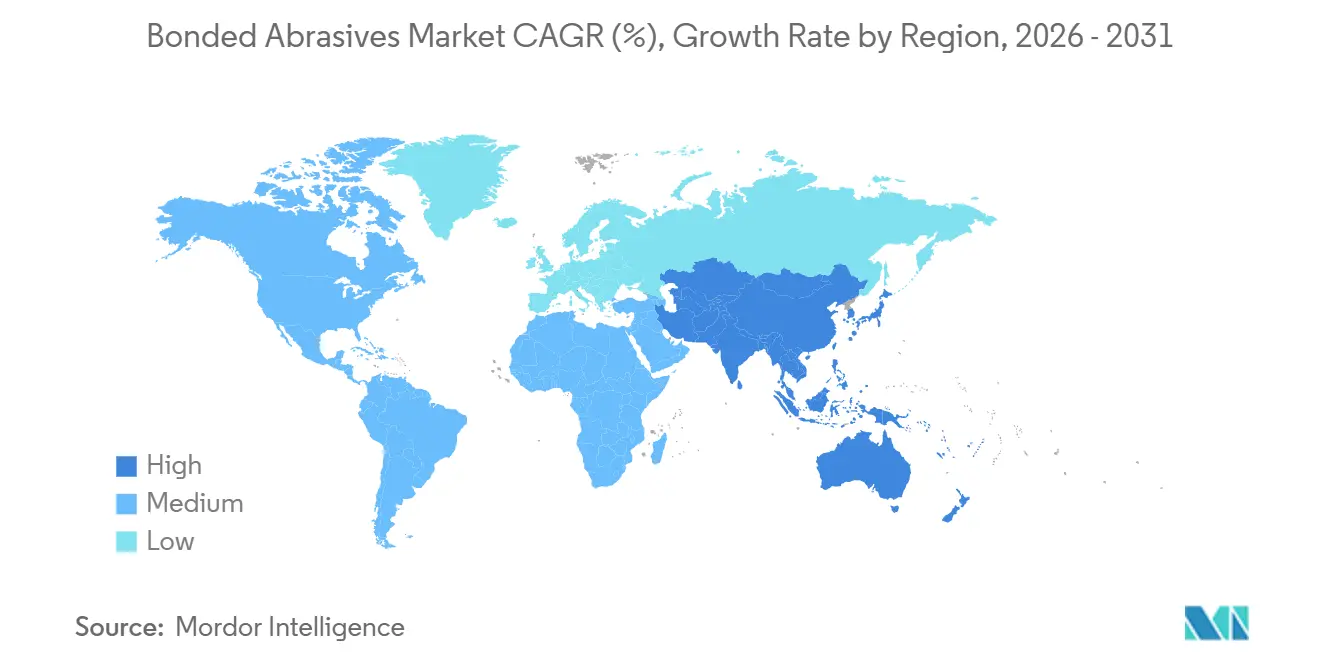
Asia-Pacific commanded 56.48% bonded abrasives market revenue in 2025 and is forecast for a 5.71% CAGR to 2031, the quickest global pace. India is the swing consumer as crude steel output rose 13.4% to 144.3 million t in 2024, and capital spending on thin-wheel and silicon-carbide lines underscores local appetite. Tyrolit’s new Pune plant strengthens regional access to CBN and diamond wheels, shrinking freight time from Europe to two weeks. Southeast Asia funnels public funds into bridges and rail corridors, pulling demand for cost-effective aluminum-oxide wheels on structural steel. Japan and South Korea hold premium niches in semiconductor wafer grinding, reliant on CBN and diamond grains.
In North America, aerospace reshoring stimulates CBN demand, yet carbon taxes and high electricity tariffs raise vitrified production costs. DOE tax credits encourage kiln electrification, but only large plants achieve the scale to invest. Tariff exposure remains acute because 91% of fused alumina imports originate in China, motivating alternative supply chains from Australia and Guyana.
Europe mirrors North American challenges. The EU Industrial Carbon Management strategy compels 55% CO2 reductions by 2030, so Saint-Gobain pilots hydrogen kilns in France while midsized Italian manufacturers weigh LNG-to-electric transitions. Germany, Italy, and France together sustain automotive and aerospace grinding volumes, but cost pressures shift some downstream machining to Eastern Europe.
South America and Middle East and Africa together represent low bonded abrasives market revenue. Brazil’s vehicle assembly plants still grind crankshafts with vitrified aluminum-oxide wheels, while Saudi Arabian infrastructure projects buy cutting disks for pipeline fabrication. South African mining operations use resin-bond wheels for drill-bit sharpening where wheel life outweighs finish requirements.

Value Chain Analysis
The bonded abrasives value chain begins with upstream minerals and intermediates used to produce abrasive grains and bond systems, including bauxite-derived alumina and fused alumina, silica and carbon inputs for silicon carbide, and chemical inputs such as phenolic resins and ceramic raw materials for vitrified bonds. Grain production and vitrified-wheel firing are energy-intensive steps, and the report context highlights how kiln energy exposure and trade measures affect landed costs and lead times, particularly for vitrified products that require high-temperature firing.
In the midstream, wheel manufacturers combine grains, bonds, fillers, and reinforcements into vitrified, resin, rubber, and specialty bonded products. They then qualify wheels for specific speed and safety requirements before supplying industrial distributors and OEM channels serving automotive, aerospace, industrial machinery, and electronics. Distribution increasingly depends on application engineering and automation readiness, reflected in the June 2025 Saint-Gobain Surface Solutions and AV&R partnership that links abrasive products with robotic surface finishing systems and joint testing at Saint-Gobain’s European Grinding Technology Centre in Germany. Portfolio consolidation also plays a role, such as Mirka’s 2025 acquisition of Hermes bonded wheel assets, which broadened its bonded wheel offering.
Competitive Landscape
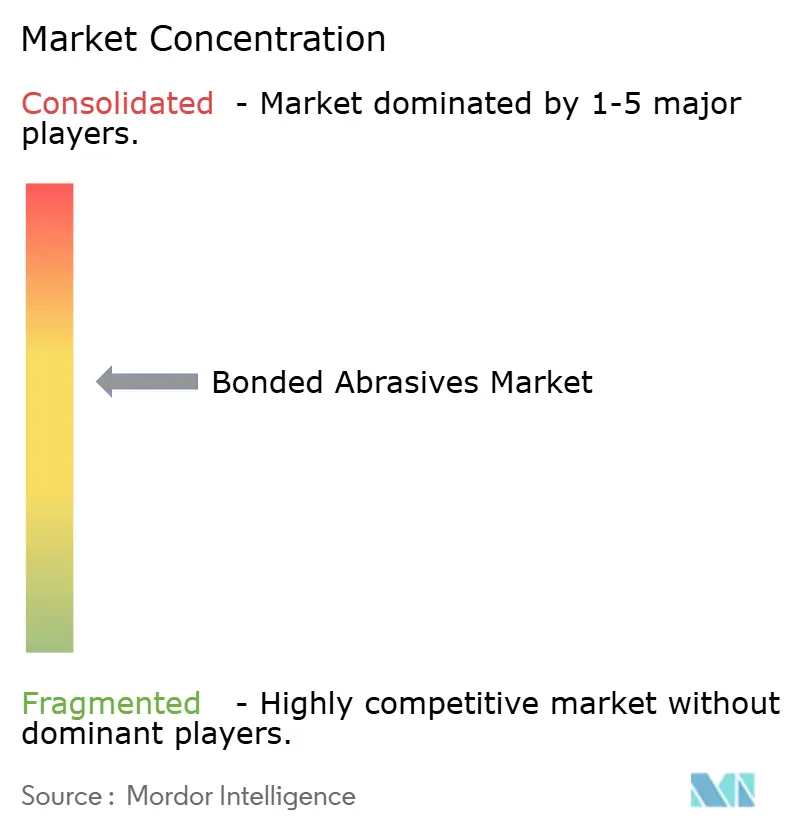
Global bonded abrasives competition is moderately concentrated. 3M, Saint-Gobain, Bosch, Tyrolit, and CUMI together captured about 42% of 2025 sales. 3M released 169 new abrasive products in 2024, including Cubitron 3 belts for robotic cells that enable higher removal rates at lower pressure. Saint-Gobain invests in hydrogen-ready tunnel kilns to trim Scope 1 emissions by 30% in French plants, meeting EU targets. Bosch runs a 20-site carbide recycling loop, delivering 50% carbon reduction and cost savings for end users who offset raw-material volatility.
CUMI acquired Germany-based Rhodius for EUR 55 million in 2022, gaining the world’s thinnest cutting wheel technology and expanding European distribution. The company follows with INR 350 crore in fiscal 2025 capex for a 50 million-wheel plant and a 6 t/month high-purity SiC furnace. Tyrolit’s Pune facility, operational by 2026, targets double-digit Asia share within five years through localized CBN and diamond production.
Emerging challengers, especially in India and China, scale thin-wheel lines and exploit lower energy costs, pressuring incumbents on price. Technology differentiation shifts toward sensor-embedded wheels and cloud analytics that predict wear. Suppliers offering AI-enabled process control win contracts in aerospace blade refurbishment lines seeking to minimize scrap. Raw-material backward integration, particularly in fused alumina and SiC, becomes a hedge against geopolitical trade risk.
Bonded Abrasives Industry Leaders
3M
Saint-Gobain
Tyrolit AG
CUMI
Robert Bosch Power Tools GmbH
- *Disclaimer: Major Players sorted in no particular order

Market Opportunities and Future Outlook
Compliance-driven requalification and localization create whitespace for suppliers that can substantiate chemical and product safety performance while sustaining throughput in high-speed and precision grinding. In Europe, REACH-linked developments in 2026, including a new nickel release restriction for metal-based abrasive products effective June 1, 2026 and additional compliance screening for imported resin-bonded abrasive tools from China effective July 1, 2026, increase the need for testing, traceability, and documentation. This aligns with the report’s demand themes around EV powertrains and aerospace machining, where tighter tolerances and high peripheral speeds support adoption of CBN and engineered ceramic grains.
Supply chain recalibration is also creating openings for regional competence centers and capacity additions that can reduce lead times and lessen exposure to imported grain and finished-wheel cost volatility. China’s removal of export tax rebates for grinding wheels and bonded abrasive materials effective April 1, 2026 adds a further landed-cost consideration for standardized products, which strengthens the case for localized production footprints and diversified sourcing. Evidence of repositioning includes Mirka’s January 2026 completion of the Hermes bonded abrasives asset acquisition (including the Uetersen, Germany facility positioned as a competence center) and CUMI’s ongoing expansion program in India (bonded/coated abrasives and electrominerals), which targets additional capacity in line with Asia-Pacific’s large consumption base highlighted in this report.
Recent Industry Developments
- April 2026: 3M announced the divestiture of its Precision Grinding and Finishing business to Nimbus, with the unit positioned to operate as Winterthur Technology Group. The change shifts ownership and operating focus for a specialized grinding and finishing portfolio, affecting customer sourcing options and competitive behavior in higher-performance grinding applications.
- September 2025: Mirka Ltd completed the acquisition of Hermes Schleifmittel GmbH’s bonded conventional abrasive wheel assets. The deal broadened Mirka’s bonded wheel portfolio and strengthened its manufacturing and engineering base in Germany for conventional bonded wheels alongside diamond and CBN offerings.
- June 2025: Tyrolit AG commenced construction of its first Indian manufacturing facility in Pune to produce CBN and diamond grinding wheels. The project supports faster regional supply for superabrasive wheels used in precision grinding, and it brings production closer to Asia-Pacific demand centers.


Research Methodology Framework and Report Scope
Market Definition and Coverage
For this study, the bonded abrasives market covers revenue generated from abrasive products where grains are held together with a bonding material, and used for material removal, cutting, grinding, or finishing across industrial and fabrication settings.
Scope exclusions: coated abrasives (such as sandpaper rolls and sheets) and loose abrasive grains sold without a bond are excluded from this market sizing.
Segmentation Overview
- By Bond Type
- Vitrified Bond
- Resin Bond
- Rubber bond
- Others
- By Material Type
- Aluminum Oxide
- Boron Carbide
- Silicon Carbide
- Others
- By End-user Industry
- Automotive
- Aerospace
- Medical
- Electrical and Electronics
- Industrial Machinery
- Others (Furniture, Building and Construction, Etc.)
- By Geography
- Asia-Pacific
- China
- India
- Japan
- South Korea
- ASEAN Countries
- Rest of Asia-Pacific
- North America
- United States
- Canada
- Mexico
- Europe
- Germany
- United Kingdom
- Italy
- France
- Spain
- NORDIC Countries
- Rest of Europe
- South America
- Brazil
- Argentina
- Rest of South America
- Middle-East and Africa
- Saudi Arabia
- South Africa
- Rest of Middle-East and Africa
- Asia-Pacific
Data Sources, Market Sizing, and Validation
Desk Research
Desk work starts by mapping the demand drivers that typically pull bonded abrasives volume, and then matching them with publicly visible supply signals. For context building, we refer to sources such as the US Geological Survey for abrasive minerals, the International Trade Centre trade map for import and export direction, and national statistics portals such as the US Census Bureau for manufacturing activity and relevant output series.
To ground assumptions on end-use momentum, we also review information from bodies such as the International Organization of Motor Vehicle Manufacturers for vehicle production, the International Energy Agency for industrial and investment indicators, and safety and product compliance cues from OSHA and NIOSH pages where relevant to grinding dust exposure. Company annual reports, investor decks, and press releases are used to understand product mix and capacity moves, and paid subscriptions are used selectively for company financials and for shipment-level trade checks. These examples are not exhaustive, and other public sources were also consulted to collect, validate, and clarify data points.
Primary Interviews and Surveys
Primary conversations are used to pressure test what desk sources cannot show clearly, especially bond type mix shifts, typical pricing movement, and how abrasive consumption changes with utilization rates. We speak with a mix of manufacturers, distributors, and large end users focused on metalworking and automotive, and we keep coverage balanced across APAC, EMEA, and the Americas so regional differences in standards and process choices are reflected in the final model.
Distribution of primary research fieldwork respondents
| Company type | Respondent position | Region |
|---|---|---|
| Top tier: 29% | CXOs: 13% | APAC: 43% |
| Mid tier: 52% | Functional/Unit leaders: 33% | EMEA: 32% |
| Smaller Players: 19% | Managers: 54% | Americas: 25% |
Market-Sizing & Forecasting
Sizing is built using a top-down and bottom-up approach. The top-down view starts from country level manufacturing and metalworking activity, and then reconstructs the bonded abrasives demand pool using penetration and usage intensity. Once that demand pool is formed, it is converted into value by applying realistic price bands by bond type and by common product forms used in grinding and cutting.
In the model, industrial production and fabrication output trends, automotive and machinery build rates, abrasive minerals availability signals, average replacement cycles for wheels in high duty operations, and mix changes between vitrified, resin, and rubber bonds drive most of the variance. Forecasts are shaped using scenario analysis supported by expert feedback, since end-use utilization and capital spending can shift faster than long-run averages. Where a clean bottom-up build is not possible for smaller countries, ratios are borrowed from similar industrial structures and adjusted through distributor checks and trade flow directionality, so totals remain consistent.
Data Validation & Update Cycle
Outputs are validated through multiple checks that look for logical alignment with independent signals, such as import and export movement, reported capacity expansions, and shifts in metalworking activity. When a country result looks out of line, assumptions on penetration, usage rates, or price bands are revisited, and the relevant interview pool is re-contacted for a quick confirmation.
Before sign-off, the file is reviewed in steps by another analyst to catch formula breaks, unit errors, and regional double counting. The report is refreshed annually, and interim updates are made when material events occur, such as major plant additions, trade disruptions, or sharp changes in industrial production. Right before delivery, a final review pass is done so clients receive the latest updated view.
Mordor Intelligence's Bonded Abrasives Market Size Versus Other Published Estimates
It is normal to see different market values published for bonded abrasives, even when the topic sounds identical. The spread usually comes from what is counted as bonded products, which end uses are emphasized, and how price and currency timing are handled across years.
The biggest gap drivers here are scope and how demand is reconstructed, since some estimates fold in adjacent abrasive categories or treat certain cutting and finishing products differently. By tracking end-use output indicators and refreshing bond type price bands quarterly, Mordor Intelligence keeps the 2026 value tied to a defined bonded-only demand pool and avoids inflation from coated abrasives or loose grains that are traded in parallel.
Benchmark comparison
| Source | Market Size | Gaps in Research Methodology |
|---|---|---|
| Mordor Intelligence | USD 25.23 B (2026) | |
| Global Consultancy A | USD 18.62 B (2026) | Uses a narrower counted scope that leans toward grinding wheels for metalworking, with lighter coverage of electrical and electronics and smaller industrial users, which compresses the demand pool and the implied average pricing. |
| Industry Publisher B | USD 28.30 B (2025) | Anchors on an earlier base year and applies a higher value per unit assumption, and the product boundary appears to include some bonded cutting and finishing items that overlap with non-bonded abrasives, which can lift the total. |
Overall, the range in the table is explained mostly by what each publisher includes, plus the year chosen and the way prices are carried forward. Our approach stays repeatable because the market total is built from visible activity drivers, checked against trade and supply signals, and then corrected when interview feedback shows a mismatch in mix or replacement behavior.


Key Questions Answered in the Report
What is the current bonded abrasives market size?
The bonded abrasives market size totaled USD 25.23 billion in 2026 and is projected at USD 32.39 billion by 2031.
Which segment leads by bond type?
Vitrified bond dominates with 58.06% bonded abrasives market share in 2025.
Which region is growing fastest?
Asia-Pacific shows the quickest growth, forecast at a 5.71% CAGR during 2026-2031.
How are carbon taxes affecting producers?
European and North American plants must retrofit kilns, raising capital needs by USD 8-12 million per facility and pressuring margins.
Page last updated on:





