
Body Contouring Devices Market Size and Share
Market Overview
| Study Period | 2020 - 2031 |
|---|---|
| Market Size (2026) | USD 1.82 Billion |
| Market Size (2031) | USD 3.45 Billion |
| Growth Rate (2026 - 2031) | 13.68 % |
| Fastest Growing Market | Asia-Pacific |
| Largest Market | North America |
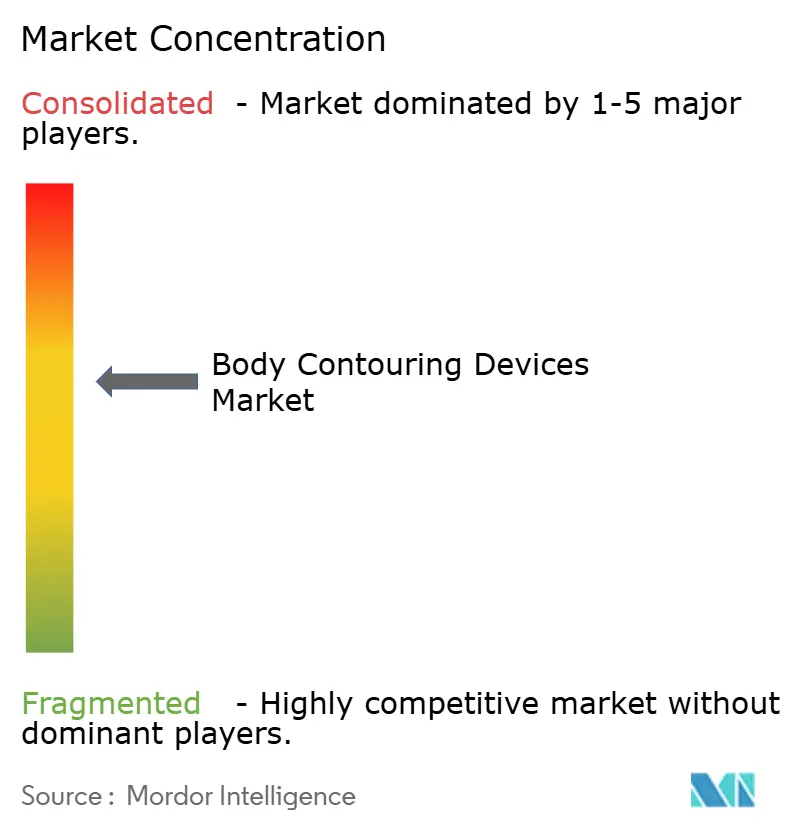
| Market Concentration | Medium |
Major Players *Disclaimer: Major Players sorted in no particular order Image © Mordor Intelligence. Reuse requires attribution under CC BY 4.0. | |
Body Contouring Devices Market Analysis by Mordor Intelligence
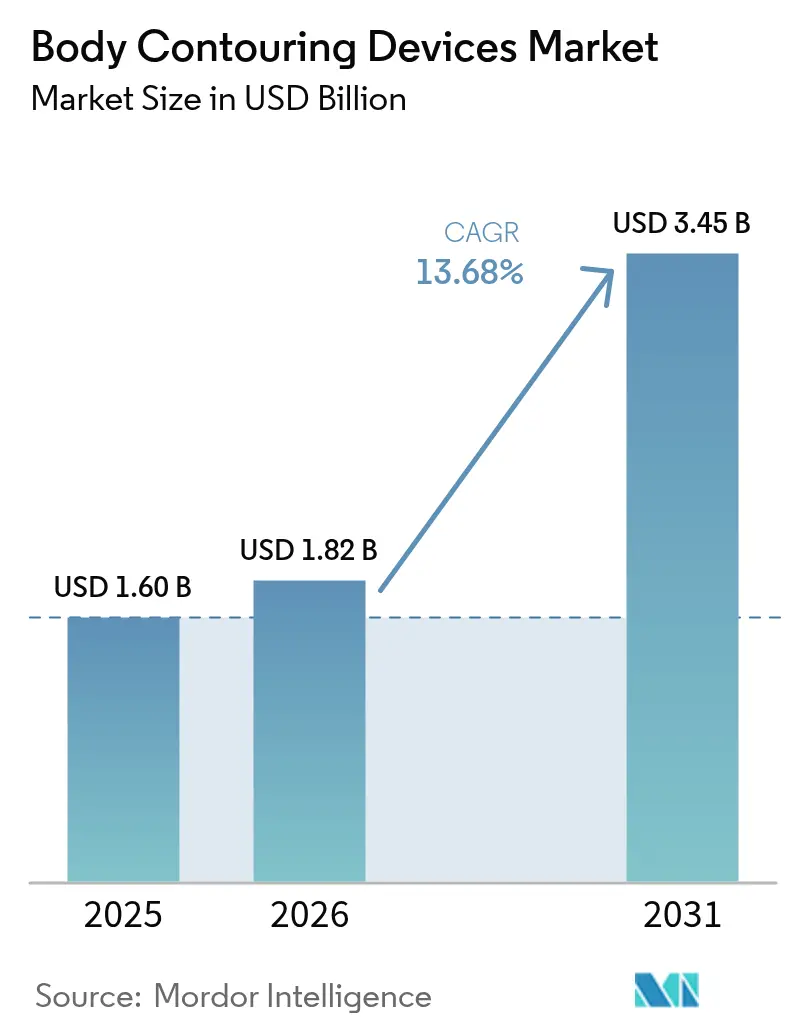
The body contouring devices market size was valued at USD 1.60 billion in 2025 and estimated to grow from USD 1.82 billion in 2026 to reach USD 3.45 billion by 2031, at a CAGR of 13.68% during the forecast period (2026-2031). Rapid uptake of non-invasive technologies, rising aesthetic awareness among younger adults and converging radiofrequency, cryolipolysis and high-intensity focused electromagnetic (HIFEM) capabilities are energising growth. Providers now bundle fat reduction, muscle toning and skin tightening into single sessions, shortening recovery times and widening the consumer base. Medical spas are formalising subscription programmes that lower per-visit fees while locking in recurring revenue. Meanwhile, hospitals invest in multi-application platforms to protect market share, and vendors integrate artificial-intelligence-driven dose settings that improve procedural consistency. Persistent supply-chain pressures and evolving regulatory demands temper momentum but do not alter the structural shift toward convenience-led, technology-enhanced body shaping solutions.
Key Report Takeaways
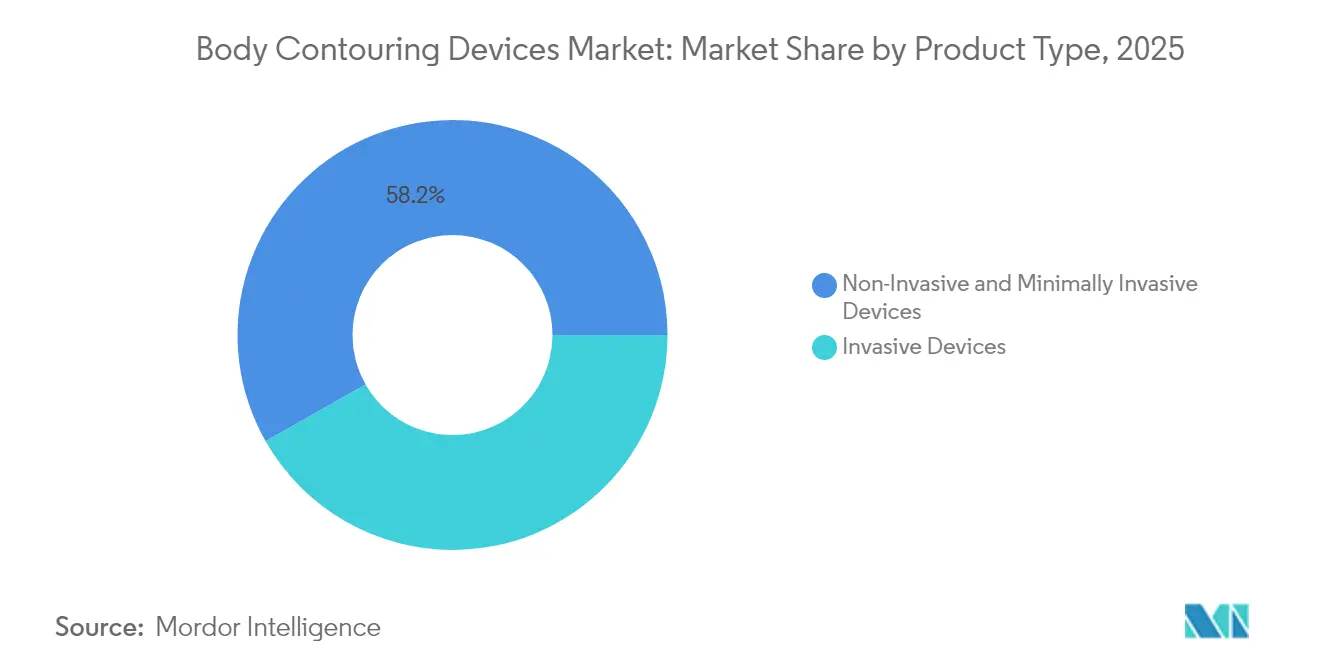
- By product type, non-invasive and minimally invasive systems captured 58.23% body contouring devices market share in 2025, and their 17.95% CAGR up to 2031 is the fastest among all categories.
- By application, skin tightening and cellulite reduction held 41.93% of the body contouring devices market size in 2025; muscle toning and definition is projected to accelerate at 18.33% CAGR through 2031.
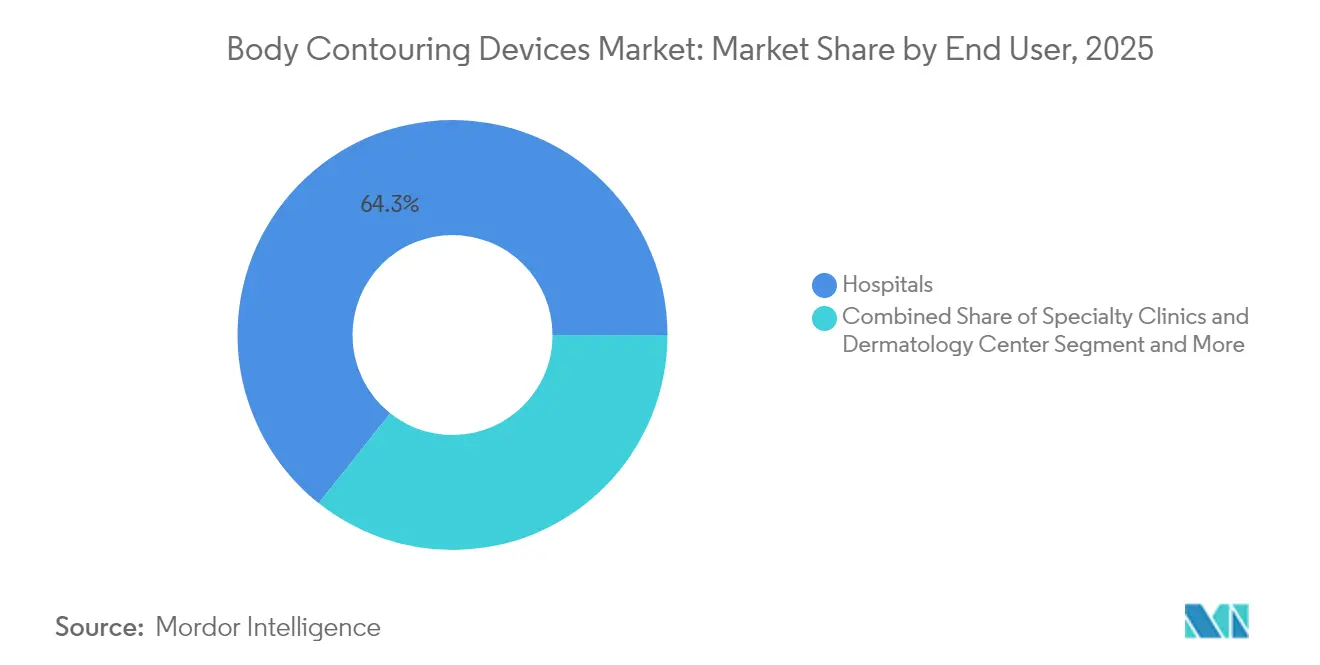
- By end user, hospitals retained 64.31% revenue in 2025, whereas medical spas record the strongest expansion at 16.9% CAGR to 2031.
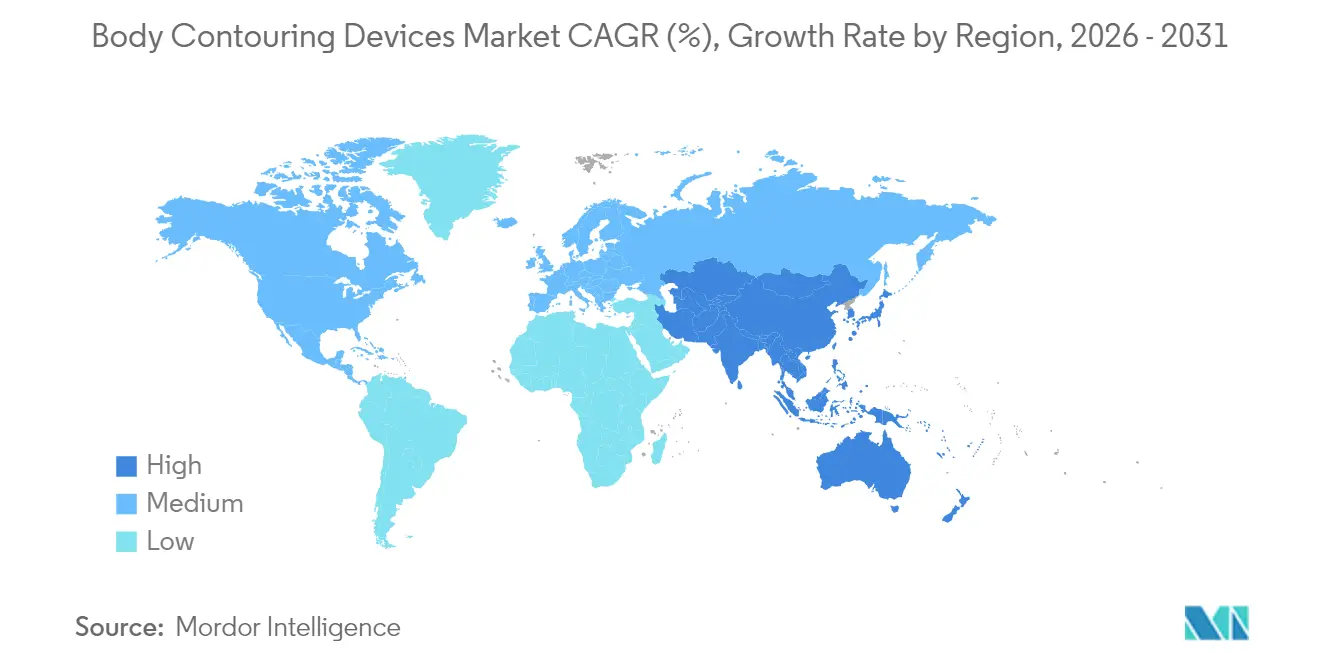
- By geography, North America dominated with 39.42% revenue in 2025, yet Asia-Pacific is forecast to rise at 17.05% CAGR, the highest among all regions.
Note: Market size and forecast figures in this report are generated using Mordor Intelligence’s proprietary estimation framework, updated with the latest available data and insights as of 2026.
Market Trends and Insights
Drivers Impact Analysis of Body Contouring Devices Market*
| Driver | (~) % Impact on CAGR Forecast | Geographic Relevance | Impact Timeline |
|---|---|---|---|
| Growing Adoption of Minimally Invasive & Non-Invasive Procedures | +3.2% | Global, with North America & Europe leading | Medium term (2-4 years) |
| Technological Advancements in RF, Cryolipolysis & HIFEM | +2.8% | Global, concentrated in developed markets | Long term (≥ 4 years) |
| Rising Prevalence of Obesity & Aesthetic Consciousness | +2.1% | Global, particularly Asia-Pacific & North America | Long term (≥ 4 years) |
| Expanding Medical Tourism in Emerging Economies | +1.9% | Asia-Pacific core, spill-over to MEA | Medium term (2-4 years) |
| AI-Enabled Personalised Treatment Protocols | +1.5% | North America & EU, expanding to Asia-Pacific | Long term (≥ 4 years) |
| Subscription-Based Med-Spa Business Models | +1.3% | North America & Europe primarily | Short term (≤ 2 years) |
| Source: Mordor Intelligence | |||
Growing Adoption of Minimally Invasive & Non-Invasive Procedures
Patient preference has pivoted firmly toward less disruptive approaches that reduce downtime and visible bruising. Cryolipolysis devices, for example, can trim 20–25% of subcutaneous fat after a single session, while patient-reported pain scores remain low[1]Allergan Aesthetics, “CoolSculpting | Fat Freezing Technology,” Allergan Aesthetics, allerganaesthetics.com. Post-pandemic self-scrutiny amplified demand, and a 2024 survey showed that 63% of facial-aesthetic clients were first-time entrants to medical aesthetics. Multi-modality workstations now fuse HIFEM with radiofrequency, letting clinicians offer simultaneous muscle toning and fat lysis in under 30 minutes. Medical spas scale these offerings through loyalty memberships, and early trials of at-home suction-RF-EMS gadgets demonstrate measurable circumference loss, suggesting a future omnichannel ecosystem.
Technological Advancements in RF, Cryolipolysis & HIFEM
Engineering improvements focus on deeper, more uniform energy delivery and broader patient suitability. A next-generation HIFEM platform recently secured two additional FDA clearances covering darker Fitzpatrick skin types and lateral-thigh lipolysis, with MRI studies confirming 1.4 cm average fat-layer reduction. Fractionated RF handpieces now penetrate variable tissue depths, enabling precise collagen remodelling. Laboratory work on cerium-doped calcium carbonate particles paired with low-intensity ultrasound hints at a non-thermal pathway for adipocyte apoptosis[2]Jhih-Ni Lin et al., “Cerium-Doped Calcium Carbonate Microparticles Combined with Low-Intensity Ultrasound for Efficient Sonodynamic Therapy,” Journal of Biological Engineering, springeropen.com. These breakthroughs underpin the body contouring devices market as manufacturers race to patent differentiated heat, cold or electromagnetic algorithms that promise consistent outcomes.
Rising Prevalence of Obesity & Aesthetic Consciousness
Obesity affects more than 1 billion adults worldwide, generating a large pool of individuals seeking adjunct procedures after pharmacological or surgical weight loss. Up to 96% of bariatric-surgery recipients experience redundant skin folds that impact mobility and hygiene, fuelling demand for tightening technologies. Concurrently, adoption of GLP-1 agonists such as semaglutide often reveals residual contour irregularities, motivating clients to pursue non-invasive sculpting to refine body lines. Demographically, 54% of female med-spa visitors fall between 35-54 years, indicating a prolonged consumer runway.
Expanding Medical Tourism in Emerging Economies
Affordable pricing, reputable surgeons and favourable visa policies make several Asia-Pacific nations popular for elective aesthetic care. India now ranks among the top three countries for liposuction volume. Thailand bundles hospital stays with recovery-hotel packages to capture high-spending travellers, while regional governments actively market medical hubs at international trade shows. Although post-procedure follow-up complexity persists, cross-border patient flows enlarge the addressable customer base for equipment vendors and service providers.
Restraints Impact Analysis of Body Contouring Devices Market*
| Restraint | (~) % Impact on CAGR Forecast | Geographic Relevance | Impact Timeline |
|---|---|---|---|
| High Capital Cost of Advanced Devices & Procedures | -2.1% | Global, particularly emerging markets | Medium term (2-4 years) |
| Stringent Regulatory & Safety Compliance Requirements | -1.8% | North America & EU primarily | Long term (≥ 4 years) |
| Shortage of Qualified Aesthetic Practitioners | -1.5% | Global, acute in emerging markets | Long term (≥ 4 years) |
| Semiconductor Supply-Chain Volatility | -1.2% | Global, concentrated in Asia-Pacific manufacturing | Short term (≤ 2 years) |
| Source: Mordor Intelligence | |||
High Capital Cost of Advanced Devices & Procedures
Premium multi-modality systems can exceed USD 100,000, a figure that rises once training, disposables and annual maintenance contracts are included. Public filings from a leading manufacturer revealed that supply-chain expenses now equate to 20% of revenue, forcing aggressive cost-optimisation programmes. Smaller clinics in emerging economies struggle to attain payback within the typical 18-month horizon, hindering penetration into price-sensitive segments.
Stringent Regulatory & Safety Compliance Requirements
The FDA’s 2024 draft guidance on thermal-effect evaluation introduced additional pre-market testing layers for devices that heat or cool tissue[3]U.S. Food and Drug Administration, “Medical Device Supply Chain and Shortages,” FDA, fda.gov. In parallel, the European Union Medical Device Regulation mandates continuous post-market clinical follow-up, extending certification cycles and lifting compliance budgets. Cyber-security risk assessments have also become compulsory, adding documentation overhead that disproportionately burdens start-ups.
*Our forecasts treat driver/restraint impacts as directional, not additive. The impact forecasts reflect baseline growth, mix effects, and variable interactions.
Body Contouring Devices Market Segment Analysis
By Product Type:
Non-Invasive Technologies Drive Market EvolutionNon-invasive platforms owned 58.23% of 2025 revenue, and this share is forecast to widen as the category propels an 17.95% CAGR through 2031 in the body contouring devices market. Cryolipolysis heads the field, with real-world studies confirming 20–25% single-session fat volume reduction. HIFEM-RF hybrids further expand use-cases by delivering concurrent adipocyte apoptosis and myofibril hypertrophy. Invasive devices such as power-assisted liposuction remain vital for substantial debulking but grow at a slower clip as patients increasingly favour lunchtime procedures.
The competitive edge within non-invasive systems now lies in applicator ergonomics, cooling efficiency and electromagnetic field homogeneity. Vendors file rapid-fire patents around sensor-based temperature cut-offs and closed-loop impedance monitoring. Meanwhile, ultrasound-assisted lipoplasty evolves to address dense fibrous fat with lower ecchymosis, keeping an important albeit niche foothold in the body contouring devices industry.



By Application:
Muscle Toning Emerges as Growth DriverSkin tightening and cellulite reduction retained 41.93% of 2025 revenue, yet muscle-toning treatments will accelerate fastest at 18.33% CAGR, mirroring consumer interest in athletic aesthetics. MRI assessments document up to 25% muscle growth after a standard four-session HIFEM protocol, which lifts repeat-purchase intent. Fat-reduction applications sustain demand thanks to continual improvements in selective adipolysis and post-lipolysis lymphatic mobilisation.
Integration with pharmacological weight-management regimens enlarges total market opportunity. Practitioners pair GLP-1 treatments with non-invasive tightening to tackle lax skin, creating combined packages that command premium pricing. Post-bariatric patients, numbering more than 350,000 annually worldwide, often undergo staged contouring, underscoring long-tail demand inside the body contouring devices market.
By End User:
Medical Spas Challenge Hospital DominanceHospitals generated 64.31% of 2025 sales due to broad service portfolios and established referral channels. Yet medical spas will outpace all other settings at 16.9% CAGR to 2031, reflecting consumer appetite for boutique experiences and membership discounts. Repeat-visit ratios exceed 70%, and the subscription model boosts utilisation of high-capital devices.
Specialty dermatology clinics bridge medical rigour and spa-like ambience, offering physician oversight with flexible scheduling. Home-use handhelds that pair suction with low-power RF extend basic contouring into living rooms, although professional supervision remains central for deeper tissue-remodelling objectives. Collectively, these shifts reshape procurement patterns and training curricula within the body contouring devices market.
Geography Analysis
North America Body Contouring Devices Market
North America accounted for 39.42% of 2025 revenue, underpinned by sophisticated aesthetic-medicine infrastructure and robust discretionary spending. United States physicians increasingly embed body contouring into multidisciplinary obesity-care pathways, aided by the surge in weight-loss drug prescriptions. Canada smooths device adoption through technology-specific regulatory fast-tracks, while cross-border clients from Mexico bolster procedure volumes.
Europe Body Contouring Devices Market
Europe offers a deeply regulated yet opportunity-rich landscape. Uniform MDR rules elevate safety standards and filter sub-par devices, fostering practitioner trust. Germany, France and the United Kingdom anchor demand, and rising retirement-age populations with higher disposable savings pursue combined tightening and fat-reduction packages. Clinics leverage pan-European distributor networks to secure service cover and parts supply, safeguarding uptime amid supply-chain uncertainties.
APAC Body Contouring Devices Market
Asia-Pacific delivers the fastest trajectory at a projected 17.05% CAGR to 2031 in the body contouring devices market. Rapid urbanisation and social-media-driven beauty ideals propel procedure counts in China, South Korea and Japan. India’s speciality hospitals capture international clients seeking competitively priced liposuction and sculpting bundles, while Thailand positions itself as a recovery-tourism haven. Domestic manufacturers in China pilot cost-competitive RF machines that could challenge incumbents if international certifications are achieved.

Regulatory Landscape
Regulation is tightening as body contouring technology sits more consistently within medical-device oversight across major markets. In the United States, non-invasive body contouring technologies fall under FDA medical-device regulation (21 CFR Part 878) and commonly route through 510(k) clearance depending on risk and intended use, alongside FDA device-type information for aesthetic and cosmetic devices. In Europe, Regulation (EU) 2017/745 (MDR) explicitly pulls certain aesthetic equipment into scope via Annex XVI, requiring CE marking and alignment with the Common Specifications framework (Regulation (EU) 2022/2346), which raises the bar for clinical evidence, labeling, and post-market obligations.
Outside the US and EU, market access remains fragmented and compliance-heavy. The United Kingdom continues to operate under the Medical Devices Regulations 2002 with UKCA requirements for Great Britain, with MHRA work ongoing to update conformity assessment expectations. China’s NMPA maintains risk-based registration and, in a June 2025 update, optimized registration dossier requirements and quality management system verification for imported medical devices produced in China, reinforcing documentation and audit readiness. Australia’s TGA has moved more device types into higher scrutiny through its medical-device framework and Essential Principles, while Canada’s Health Canada regulates devices under the Medical Devices Regulations (SOR/98-282), supporting premarket change and amendment pathways that affect lifecycle management for installed systems.
Competitive Landscape
Competition is moderate: the top five players jointly hold significant revenue, leaving room for regional challengers. AbbVie’s CoolSculpting franchise leverages brand recognition and a service-heavy consumable model to defend pricing. BTL Industries dominates HIFEM intellectual property, supporting premium positioning. InMode cross-sells RF platforms into plastic-surgery and dermatology channels, maximising system utilisation.
Strategic mergers focus on pooling R&D pipelines and global distribution. Several manufacturers introduce AI-guided pulse algorithms to lock in future competitive moats, and at least two vendors have shifted to device-rental or per-treatment-fee schemes that lower customer cap-ex barriers. Companies with strong service footprints bundle extended warranties and technician training, reinforcing stickiness. Financially, the industry remains capital-intensive; recent debt restructurings highlight the need for cash-flow resilience when economic cycles soften equipment demand in the body contouring devices market.
Body Contouring Devices Industry Leaders
Hologic Inc. (Cynosure)
Bausch Health Companies Inc
Boston Scientific Corp. (Lumenis)
AbbVie Inc. (Allergan Aesthetics)
Candela Medical
- *Disclaimer: Major Players sorted in no particular order
Body Contouring Devices Market Companies Covered in this Report
- Abbvie
- Hologic
- Candela Medical
- Boston Scientific Corp. (Lumenis)
- Bausch Health
- Alma Lasers
- BTL Industries (BTL Aesthetics)
- Cutera
- InMode Ltd.
- Candela Medical
- Apyx Medical Corp.
- Lutronic Corp.
- Merz Pharma
- MicroAire
- Sculpting Technologies Inc.
- Venus Concept Inc.
- Sciton
- Fotona d.o.o.
- Sisram Medical Ltd.

Market Opportunities and Future Outlook
The most actionable opportunity centers on platforms that combine multiple modalities and broaden the addressable provider base beyond large hospitals. Product and clearance activity in 2026 reflects this shift: Apyx Medical received expanded FDA 510(k) clearance in May 2026, adding power liposuction capability to the AYON Body Contouring System, and Lumenis announced the commercial launch of triLIFT 2.0 in March 2026 for face and body muscle stimulation with skin tightening. At the same time, smaller-footprint options such as MShape Beauty’s EMShape Neo Prime (May 2026) and the FDA-cleared Contour Light (CL-100) low-level laser fat-reduction device (February 2026) indicate a widening equipment mix aimed at medical spas, specialty clinics, and space-constrained practices.
Regulatory and evidence requirements also create room for vendors that can standardize compliance and clinical proof across regions. Many Class II aesthetic devices in the US follow a 510(k)-centric pathway, and EU MDR Class IIb requirements for several body shaping technologies increase the value of standardized clinical data packages, cybersecurity documentation, and post-market systems that can be reused across product families. As providers increasingly bundle fat reduction, muscle toning, and skin tightening into single care plans, manufacturers that support consistent dosing (including AI-enabled protocol features already entering the category) and training-as-a-service models have room to strengthen adoption with hospitals seeking multi-application platforms and medical spas building subscription programs to improve utilization of high-capital equipment.
Recent Industry Developments in Body Contouring Devices Market
- May 2026: Apyx Medical received expanded FDA 510(k) clearance adding power liposuction capability to the AYON Body Contouring System. The update broadens the system’s surgical utility beyond its prior indications and supports a more complete body-contouring workflow on a single platform. It also strengthens Apyx Medical’s positioning with plastic-surgery and aesthetic practices that want versatility without adding multiple capital systems.
- February 2026: Bausch Health’s Solta Medical launched the Clear + Brilliant Touch laser in Canada following Health Canada approval received on May 20, 2025. The launch advances Solta’s footprint in a regulated market and complements established non-invasive aesthetics offerings sold through professional channels. It also expands the set of in-clinic options providers can pair with skin tightening and contouring pathways to increase repeat visits.
- April 2025: Bausch Health’s Solta Medical received Health Canada medical device license clearance for the Thermage FLX system for non-invasive skin tightening and contouring. The clearance supports continued commercialization and installed-base expansion for a widely adopted RF skin-tightening technology under Canadian regulatory requirements. It also reinforces Thermage FLX as a clinic-grade platform that can be bundled into broader body contouring service menus.


Body Contouring Devices Market Report Scope and Research Methodology
Market Definition and Coverage
This market covers revenue generated from body contouring devices used in professional settings to reduce localized fat, tighten skin, and improve body shape through energy-based or invasive methods, across major regions.
Scope exclusions: We exclude topical creams, wearable shapewear, purely manual massage tools, and general fitness equipment that is not sold as a body contouring device.
Segments Covered in This Report
- By Product Type
- Non-Invasive & Minimally Invasive Devices
- Cryolipolysis Systems
- Radiofrequency Devices
- Laser-Assisted Lipolysis Devices
- HIFEM Devices
- Ultrasound Cavitation Devices
- Other Emerging Modalities
- Invasive Devices
- Power-Assisted Liposuction Systems
- Ultrasound-Assisted Liposuction
- Laser-Assisted Liposuction
- Tumescent Liposuction Systems
- Other Invasive Systems
- Non-Invasive & Minimally Invasive Devices
- By Application
- Fat Reduction
- Skin Tightening & Cellulite Reduction
- Muscle Toning & Definition
- Post-Bariatric Body Contouring
- Other Niche Applications
- By End-User
- Hospitals
- Specialty Clinics & Dermatology Centers
- Medical Spas
- Ambulatory Surgical Centers
- Home-Use / At-Home Users
- Geography
- North America
- United States
- Canada
- Mexico
- Europe
- Germany
- United Kingdom
- France
- Italy
- Spain
- Rest of Europe
- Asia-Pacific
- China
- Japan
- India
- South Korea
- Australia
- Rest of Asia-Pacific
- Middle East and Africa
- GCC
- South Africa
- Rest of Middle East and Africa
- South America
- Brazil
- Argentina
- Rest of South America
- North America
Data Sources, Market Sizing, and Validation
Desk Research
Desk research helped us build the base structure of the market, so each device category can be tied back to a real clinical workflow and purchasing pattern. We referred to public sources such as the US FDA device databases and safety communications, the European Commission medical device framework pages, and procedure and practice insights shared by professional societies.
To support market sizing inputs, we also used sources such as US CDC obesity statistics, OECD health data, and peer reviewed clinical journals that discuss modality adoption and outcomes (for example cryolipolysis, radiofrequency, ultrasound, and laser assisted systems). Company filings, investor decks, association websites, and reputed business press were used to understand installed base signals, channel expansion, and pricing direction. We then cross-checked the model with a paid subscription for company financials and a paid patent database for innovation intensity trends.
These desk research sources are illustrative, and many other public references were also used for data collection, validation, and clarification.
Primary Interviews and Surveys
Primary work was used to confirm what is actually being purchased and used, and what is counted as a body contouring system versus adjacent aesthetic equipment. We spoke with a mix of device distributors, clinic and medical spa operators, hospital procurement teams, and clinicians across key regions, and then we rechecked assumptions on utilization, replacement cycles, and pricing ladders when responses did not align.
Distribution of primary research fieldwork respondents
| Company type | Respondent position | Region |
|---|---|---|
| Top tier: 28% | CXOs: 13% | APAC: 44% |
| Mid tier: 58% | Functional/Unit leaders: 43% | EMEA: 29% |
| Smaller Players: 14% | Managers: 44% | Americas: 27% |
Market-Sizing & Forecasting
Sizing started with a top-down build that reconstructs demand from procedure capacity and utilization in clinics and medical spas, and then converts that demand into device revenue using realistic price bands by modality. To keep the totals grounded, we also ran selective bottom-up checks using supplier revenue indications, channel conversations, and sampled average selling price times unit volumes by region. We adjusted gaps only when multiple signals pointed in the same direction.
Key inputs used in the model included the split between non-invasive, minimally invasive, and invasive systems, typical treatment throughput per device, utilization and downtime assumptions, replacement and upgrade cycles, and regional pricing differences driven by import duties and service bundle practices. For forecasting, scenario analysis was applied around adoption of combined platforms (fat reduction plus tightening or muscle toning), changes in consumer spending on elective aesthetics, and the pace of clinic expansion, with the variable paths reviewed with primary respondents. Where direct unit information was limited for smaller categories, we used conservative penetration assumptions and validated them through distributor mix and service attachment patterns.
Data Validation & Update Cycle
Outputs were checked against independent signals such as procedure volumes, clinic footprint trends, regulatory approvals, and public company commentary on regional momentum. Large variances were flagged for review, and the underlying assumptions were revisited, followed by a second pass that tests currency conversions, price bands, and segment shares before sign-off.
The work is refreshed annually, and interim adjustments are made when material events occur, such as notable regulatory actions, supply constraints, or a step change in pricing. Before delivery, a final update sweep is completed so clients receive the most current view available at that time.
Mordor Intelligence's Body Contouring Devices Market Sizing Compared With Other Published Estimates
Published market values for body contouring devices can look far apart because firms group products differently and they also choose different demand signals to scale volumes and pricing. In our review, the biggest differences usually come from what is counted as a device market versus what is treated as a procedure or service market, and how invasive systems are handled.
Some sources mix procedures and consumable driven revenues into the device total, and that pushes the market value higher even when device shipments do not move much. Those broader scopes are separated in Mordor Intelligence numbers, where only device revenues tied to body contouring platforms (including invasive, minimally invasive, and non-invasive devices) are counted, and service fees and non-device aesthetic add-ons are kept out.
Benchmark comparison
| Source | Market Size | Gaps in Research Methodology |
|---|---|---|
| Mordor Intelligence | USD 1.60 B (2025) | |
| Global Consultancy A | USD 1.97 B (2025) | Uses a wider definition that can blend device revenue with invasive procedure-related spending and broader provider economics, which inflates totals compared to a device-only cut. |
| Industry Publisher B | USD 2.09 B (2025) | Applies broader modality coverage and more aggressive price and adoption assumptions across regions, and the method is less transparent on utilization and replacement-cycle checks. |
The spread in the table is mostly explained by scope and the way pricing and adoption are projected across provider settings. By keeping the count tied to device revenues and validating utilization, replacement, and regional price bands through repeatable checks, the estimate stays easier to reconcile with real purchasing behavior.


Key Questions Answered in the Report
What is the current value of the body contouring devices market?
The market is worth USD 1.82 billion in 2026 and is projected to reach USD 3.45 billion by 2031.
Which technology segment is growing fastest?
Non-invasive and minimally invasive devices, led by cryolipolysis and HIFEM platforms, are expanding at an 17.95% CAGR.
Why are medical spas gaining share?
Subscription plans, shorter treatment times and a lifestyle-oriented environment make medical spas attractive, driving a 16.9% CAGR for the channel.
Which region offers the highest growth potential?
Asia-Pacific is projected to advance at a 17.05% CAGR, underpinned by rising disposable incomes and medical-tourism inflows.
How do regulatory changes affect device manufacturers?
Stricter FDA and EU MDR guidelines increase testing costs and prolong approval timelines, imposing a heavier burden on smaller innovators.
Page last updated on:


 Your data is secure and never sold or shared.


