
Boat And Ship MRO Market Size and Share
Market Overview
| Study Period | 2019 - 2031 |
|---|---|
| Market Size (2026) | USD 38.38 Billion |
| Market Size (2031) | USD 55.69 Billion |
| Growth Rate (2026 - 2031) | 7.73 % |
| Fastest Growing Market | Asia Pacific |
| Largest Market | Asia Pacific |
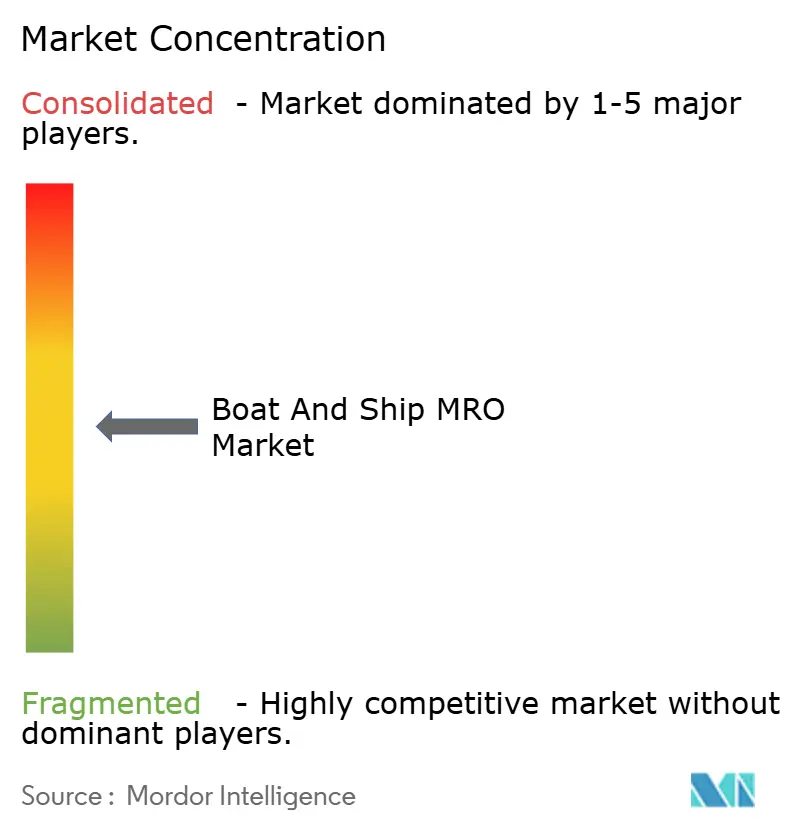
| Market Concentration | Medium |
Major Players *Disclaimer: Major Players sorted in no particular order Image © Mordor Intelligence. Reuse requires attribution under CC BY 4.0. | |
Boat And Ship MRO Market Analysis by Mordor Intelligence
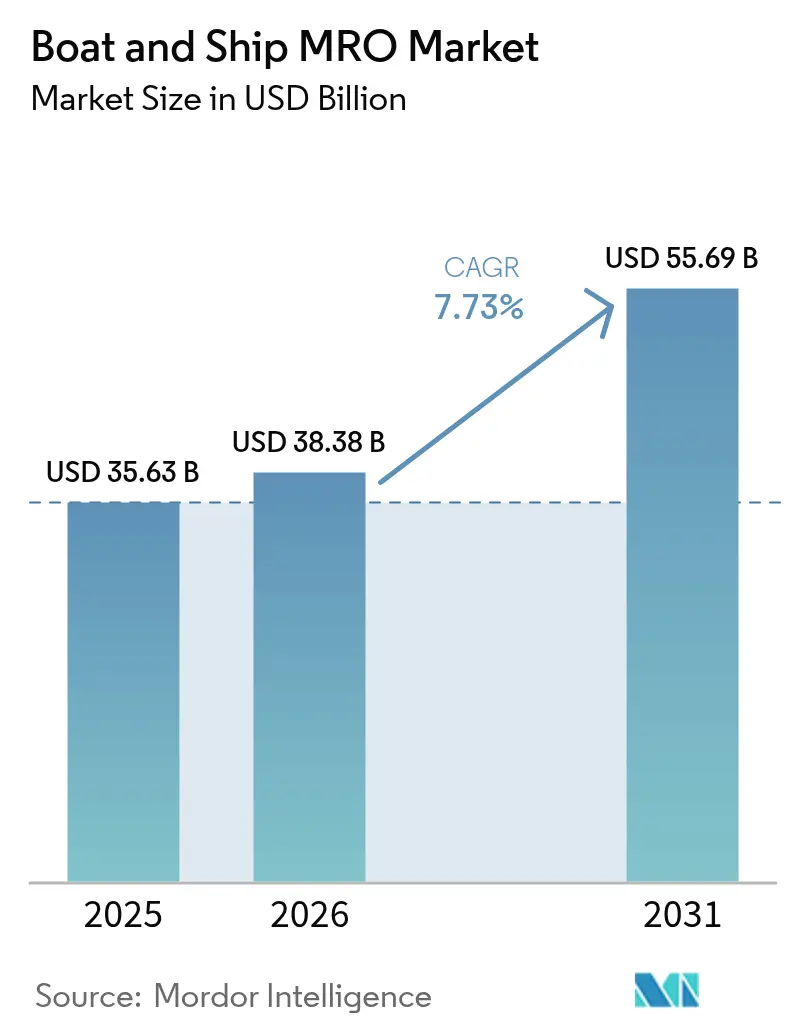
The Boat and Ship MRO Market size is projected to be USD 35.63 billion in 2025, USD 38.38 billion in 2026, and reach USD 55.69 billion by 2031, growing at a CAGR of 7.73% from 2026 to 2031. As of 2024, fleet owners are grappling with rising costs and stringent compliance requirements. The average age of vessels has reached a significant milestone, coinciding with the International Maritime Organization (IMO) tightening performance thresholds through its Energy Efficiency Existing Ship Index (EEXI) and Carbon Intensity Indicator (CII) regimes, set to take effect in the near future. While condition-based monitoring is prolonging docking intervals, the scope of overhauls during each visit is broadening. This shift has led to a notable increase in average yard invoices. Predictive maintenance platforms, spearheaded by OEMs such as Wärtsilä and ABB, now oversee a substantial number of vessels, resulting in a significant reduction in unplanned downtime. Meanwhile, green-retrofit subsidies in Europe and North America are driving the adoption of technologies like scrubbers, ballast-water systems, and dual-fuel engines. This trend is compelling mid-tier yards to either specialize or relinquish work to larger, vertically integrated OEM networks.
Key Report Takeaways
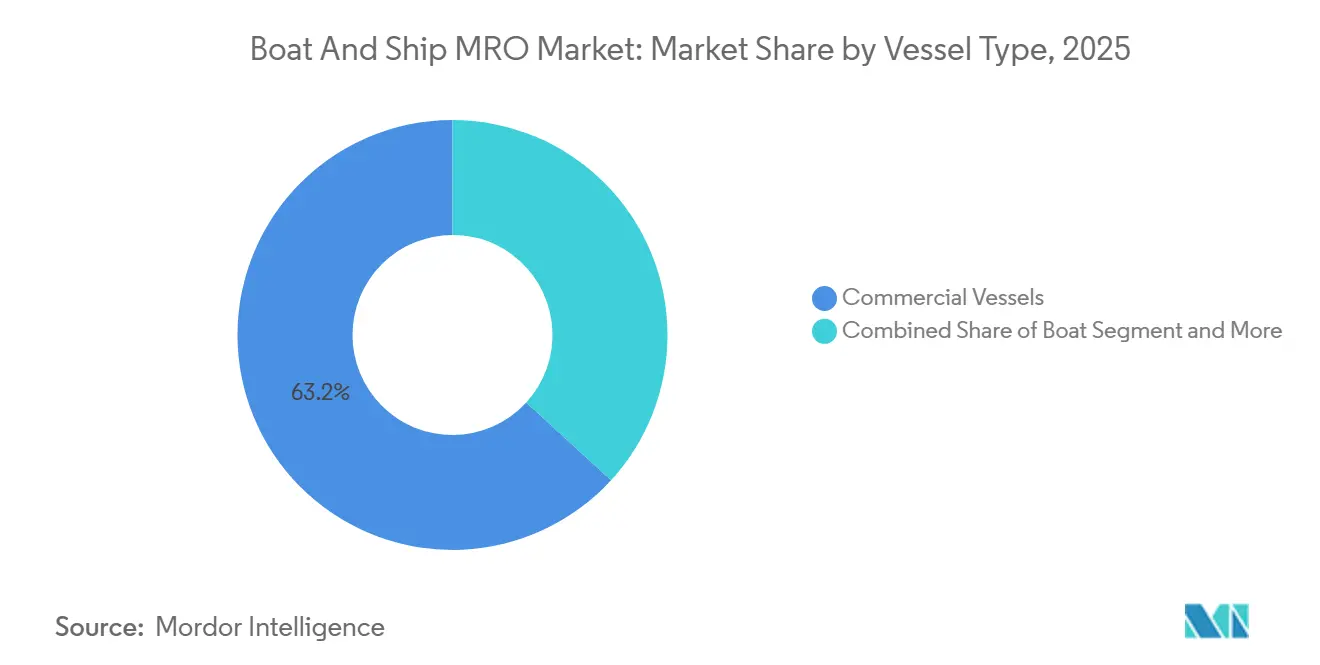
- By vessel type, commercial craft led with 63.17% of boat and ship MRO market share in 2025 and is projected to post the highest CAGR of 7.75% till 2031.
- By vessel application, commercial platforms accounted for 58.73% of the boat and ship MRO market size in 2025, yet defense programs are advancing at a 7.87% CAGR through 2031.
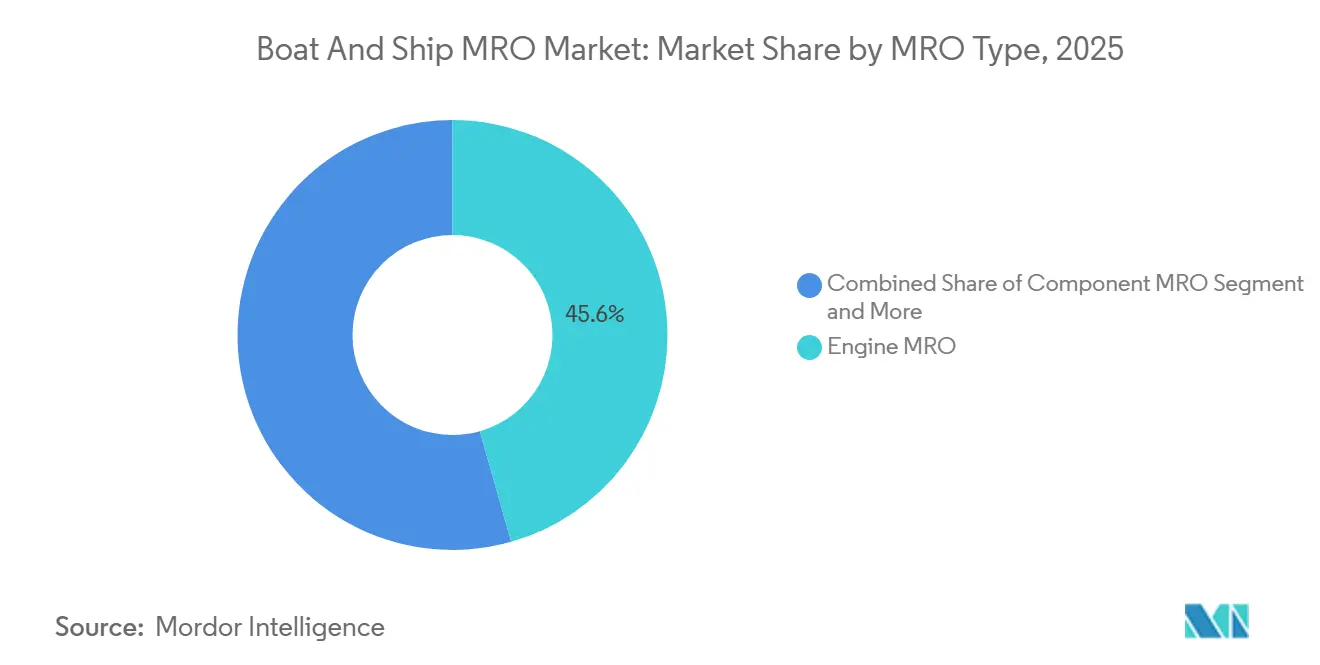
- By MRO type, engine work accounted for 45.56% of 2025 spending, whereas modifications and retrofits are forecast to expand at a 7.78% CAGR through 2031.
- By service-provider type, independent yards captured a 52.37% share in 2025, but OEM-affiliated networks are set to grow fastest at 7.85% through 2031.
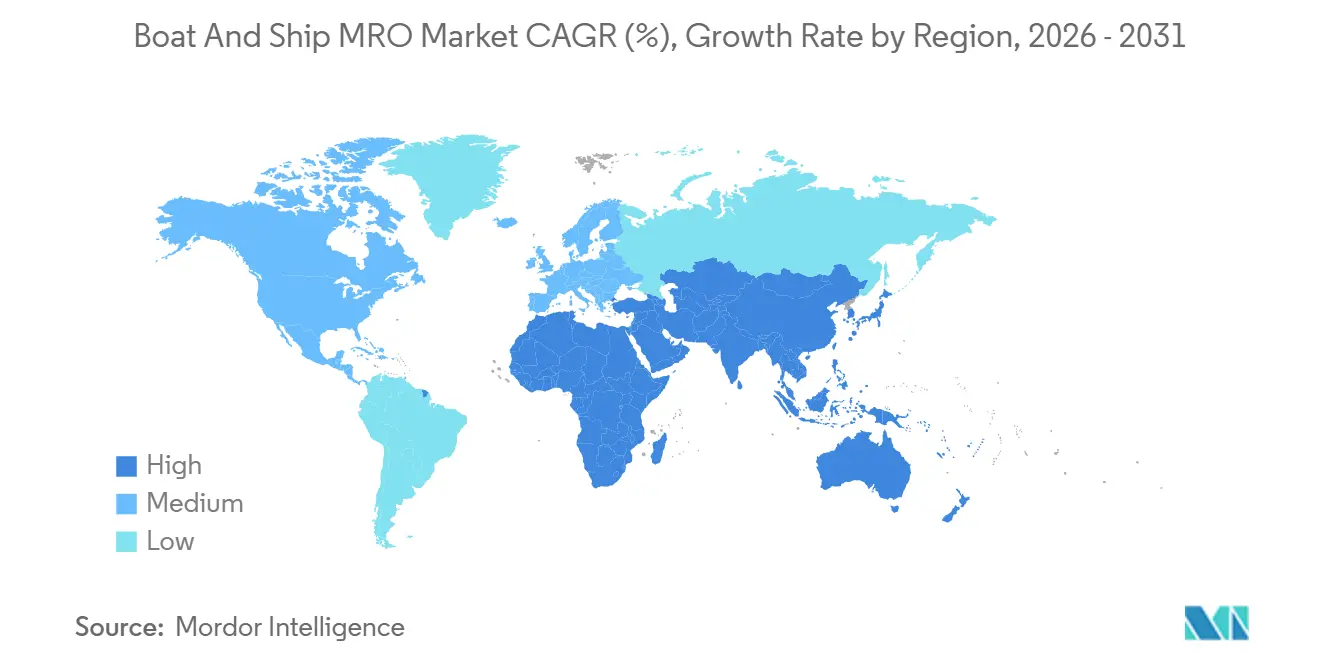
- By geography, Asia Pacific accounted for 36.73% of revenue in 2025 and is projected to maintain a 7.83% growth trajectory, supported by Chinese yard consolidation and India’s Sagarmala coastal shipping push.
Note: Market size and forecast figures in this report are generated using Mordor Intelligence’s proprietary estimation framework, updated with the latest available data and insights as of 2026.
Market Trends and Insights
Drivers Impact Analysis of Boat And Ship MRO Market*
| Driver | (~) % Impact on CAGR Forecast | Geographic Relevance | Impact Timeline |
|---|---|---|---|
| Stricter IMO Environmental Mandates | +1.8% | Global, with EU and North America leading enforcement | Medium term (2-4 years) |
| Aging Global Vessel Fleet | +1.5% | Global, concentrated in Europe and Asia Pacific | Long term (≥ 4 years) |
| Growth in Commercial Marine Trade | +1.2% | Asia Pacific core, spillover to Middle East and Africa | Medium term (2-4 years) |
| Naval Fleet Modernization Budget | +1.0% | North America, Europe, Asia Pacific (India, Japan, South Korea) | Long term (≥ 4 years) |
| Predictive-Maintenance Adoption by Mid-Sized Yards | +0.9% | Europe and North America early adopters, Asia Pacific scaling | Short term (≤ 2 years) |
| Green-Retrofit Subsidies for Coastal Tourism Craft | +0.6% | Europe (Mediterranean, Baltic), North America (Great Lakes, coastal states) | Medium term (2-4 years) |
| Source: Mordor Intelligence | |||
Stricter IMO Environmental Mandates
In 2026, the EEXI and CII rules came into full effect, imposing penalties on vessels rated in lower performance bands. This has driven ship owners to adopt energy-efficiency retrofits, including measures such as low-friction hull coatings, propeller re-pitching, and engine derating. Starting in 2027, FuelEU Maritime will impose monetary penalties for voyages heading to the EU. This makes it economically viable for ships, especially those with significant remaining service life, to consider converting to scrubbers or LNG. In 2024, Maersk undertook retrofitting on a substantial portion of its container ships, achieving a notable reduction in fleet fuel consumption and postponing newbuild orders [1]“Sustainability Report 2025,” Maersk, maersk.com . Ballast-water installation backlogs now stretch into mid-2026 at Singapore and South Korean yards, reinforcing the competitive edge of facilities holding class approvals and OEM alliances.
Aging Global Vessel Fleet
The median age of merchant fleets has significantly increased, as owners delayed new builds during the pandemic. For older ships, steel renewals now account for a substantial portion of dry-dock budgets. Meanwhile, engine invoices are primarily driven by crankshaft grinding and turbocharger refurbishments. This trend is evident in the U.S. Jones Act fleet, where the average tanker age continues to rise. With replacement costs becoming prohibitively high, operators are increasingly committed to ongoing mid-life overhauls. Furthermore, independent yards, lacking access to OEM technical data, face difficulties executing complex diesel upgrades, leading to a shift of such work to branded service centers.
Growth in Commercial Marine Trade
In recent years, seaborne volumes have grown significantly, driven by container flows from Asia to North America and U.S. LNG exports to Europe. Ultra-large container vessels (ULCVs) and huge crude carriers (VLCCs) now require graving docks with wider beams, sidelining mid-tier facilities. Over the same period, MSC conducted numerous dry-dockings across multiple nations, opting for yards that offered swift turnarounds and scrubber capabilities. New regional hubs are emerging in the UAE and India, driven by corridors such as the India-Middle East-Europe Economic Corridor.
Naval Fleet Modernization Budget
In FY 2026, the U.S. Navy allocated a substantial budget for ship construction, with a significant portion directed toward Columbia-class SSBNs. These vessels will require specialized maintenance, repair, and overhaul (MRO) services at key facilities, including Electric Boat and Newport News. Meanwhile, Japan, India, and South Korea are actively expanding their destroyer and submarine fleets. They are incorporating long-term support clauses into their contracts, ensuring sustained yard utilization for decades. Furthermore, these defense contracts, characterized by cost-plus terms, require security clearances, thereby strengthening the positions of industry incumbents such as Huntington Ingalls, BAE Systems, and Fincantieri.
Restraints Impact Analysis of Boat And Ship MRO Market*
| Restraint | (~) % Impact on CAGR Forecast | Geographic Relevance | Impact Timeline |
|---|---|---|---|
| High Capital Intensity and Dock-Capacity Scarcity | -0.8% | Global, acute in North America and Europe | Medium term (2-4 years) |
| Marine-Fuel Price Volatility Limiting Budgets | -0.6% | Global, most severe in emerging markets | Short term (≤ 2 years) |
| Skilled Labor Gap in Composite-Hull Repair | -0.4% | Europe and North America, niche impact in Asia Pacific | Long term (≥ 4 years) |
| Cyber-Security Compliance Cost for Connected Vessels | -0.3% | Global, with stricter enforcement in Europe and North America | Medium term (2-4 years) |
| Source: Mordor Intelligence | |||
High Capital Intensity & Dock-Capacity Scarcity
Constructing a new dock for large ships can require significant investment and take several years, a timeline that deters expansion in regulated areas. U.S. East Coast shipyards operate at high capacity, with naval projects dominating the most sought-after slots; for instance, a major facility in Norfolk dedicated a substantial portion of its capacity to Navy surface combatants. Environmental clearances can lengthen these timelines, as highlighted by the California Coastal Commission's recent blockage of a dock extension in San Diego.
Marine-Fuel Price Volatility Limiting Budgets
In 2024-25, very-low-sulfur fuel oil prices fluctuated significantly. A notable price increase could eliminate profits for a small-sized bulker, leading owners to delay maintenance activities such as painting and steel work. In European hubs, LNG bunker prices also showed considerable volatility, leading to some dual-fuel retrofits being postponed. Independent yards, dependent on spot contracts, faced cancellations as operators prioritized cash conservation. In contrast, OEM networks benefited from the stability provided by multi-year service agreements.
*Our forecasts treat driver/restraint impacts as directional, not additive. The impact forecasts reflect baseline growth, mix effects, and variable interactions.
Boat And Ship MRO Market Segment Analysis
By Vessel Type:
Commercial Dominance Masks Yacht ComplexityCommercial vessels held 63.17% of the boat and ship MRO market share in 2025 and are projected to post a 7.75% CAGR till 2031. With an extensive global fleet, the Panama Canal's recent draft restrictions prompted container ships to renew hull coatings, ensuring they retained their transit slots. While yachts represent a smaller tonnage class, they command premium returns on a dollar-per-meter basis. European yards in key countries secured a majority of high-value refits recently. However, labor shortages in composite repairs significantly extended queue times. Demand for recreational boats remains fragmented, channeled through marinas and mobile technicians. In contrast, research ships and dredgers depend on specialized yards adept at DP system calibration. Consequently, the boat and ship MRO market showcases varied service models, limiting economies of scale across its sub-segments.
The commercial fleet's retrofit cycle, with scrubber installations alone projected to contribute significantly to the market over the coming years, serves as a cornerstone for the boat and ship MRO market. While yacht refits are influenced by the discretionary spending of high-net-worth individuals—contracting in recent years but witnessing a rebound in the near future—boat work remains subject to seasonal fluctuations. These seasonal demands create staffing challenges each spring in North America. Such disparities compel yards to carve out specializations; those attempting to straddle both yachts and commercial hulls frequently find themselves grappling with margin underperformance, a consequence of mismatches in tooling and talent.



By Vessel Application:
Defense Outpaces Commercial GrowthCommercial traffic accounted for 58.73% of the boat and ship MRO market in 2025, yet naval projects are set to record the fastest 7.87% CAGR through 2031 as modernization budgets rise. The U.S. Navy is making a significant investment to expand Groton facilities to support Columbia-class lifecycle operations. Meanwhile, Japan has approved a notable increase in its maritime defense budget for the upcoming fiscal year. While commercial revenues surpass those of the defense sector, the former face narrowing margins due to competitive tenders, prompting shipyards to focus on extended naval contracts.
Defense Maintenance, Repair, and Overhaul (MRO) operations are constrained by rigorous cybersecurity mandates and compliance with the Defense Federal Acquisition Regulation Supplement (DFARS). These requirements impose substantial infrastructure costs on shipyards, thereby raising entry barriers. Commercial entities are increasingly adopting naval availability contracts, agreeing to fixed annual fees in exchange for uptime assurances, a model that primarily benefits Original Equipment Manufacturer (OEM) networks. In the private-vessel MRO segment, the market remains highly fragmented, with a yard's reputation outweighing pricing considerations in the selection process.
By MRO Type:
Retrofits Accelerate Amid Regulatory PressureEngine work accounted for 45.56% of 2025 spending, but retrofits will post the quickest 7.78% CAGR to 2031, driven by scrubber, ballast-water, and dual-fuel conversions. Wärtsilä reported a significant increase in 2025 retrofit bookings for its dual-fuel engines, highlighting a strategic shift. Meanwhile, Component MRO is leveraging predictive analytics, resulting in a notable reduction in emergency repairs for fleets using ABB’s monitoring suite.
Dry-dock and hull operations remain capital-intensive, as graving-dock amortization demands a substantial volume of work. With class-approved sensors, condition-based surveys now enable vessels to achieve extended docking windows. This not only alleviates scheduling pressures but also expands the scope of work during each visit. As a result, retrofits generate consistent, high-value demand, solidify relationships among yards, classification approvals, and OEM partnerships, and create a distinct separation from standard commodity repair shops.
By Service Provider Type:
OEM Networks Gain ShareIndependent providers retained a 52.37% share in 2025, but OEM-affiliated MROs are projected to compound at 7.85% through 2031. In a relatively short period, Wärtsilä's global service organization and Rolls-Royce's PerformancePlus contracts, which meld remote diagnostics with performance guarantees, have captured a significant share of the agreements for commercial vessels in Europe.
Independent yards, especially in Turkey and Romania, are offering considerably lower prices than their Western European counterparts for hull steel and paint jobs, areas where proprietary data carry less weight. While in-house operator facilities can manage daily repairs, they fall short in scale for extensive overhauls. As a result, the boat and ship MRO market is splitting into two distinct segments: high-tech OEM ecosystems and cost-effective independents, leaving a diminishing middle ground.
Geography Analysis
APAC Boat and Ship MRO Market
Asia Pacific dominated the boat and ship MRO market, accounting for 36.73% of revenue in 2025 and forecast to grow at a 7.83% CAGR through 2031. Chinese consolidation led by CSSC, Hanwha Ocean's recent deal with Philly Shipyard, marking South Korea's return to the Jones Act, and India's Sagarmala expansions are pivotal drivers. Seatrium, based in Singapore, secured a significant contract for offshore wind vessel refits in the near term, capitalizing on the combined strengths of Keppel and Sembcorp [2]“Annual Report 2025,” Seatrium Ltd., seatrium.com . While Japan's submarine life-extension program bolsters demand at Mitsubishi and Kawasaki yards, geopolitical tensions dampen Western owners' interest in Chinese facilities.
North America Boat and Ship MRO Market
North America grapples with a dock shortage, as naval orders consume a substantial portion of available capacity. The Jones Act, while protective, inflates domestic MRO costs significantly compared to global norms. Recently, Canada’s Seaspan clinched a significant contract for icebreaker MRO, and U.S. yards like NASSCO are balancing Navy and commercial bookings well into the future, nudging operators to consider Mexican docks.
Europe Boat and Ship MRO Market
Europe harmonizes high-value naval and yacht endeavors with competitive commercial propositions from Turkey and Romania. Fincantieri's contract for the Italian Navy's LHD includes decades of lifecycle commitments, and Navantia's export of S-80 Plus submarines ensures Spanish facilities remain busy for an extended period [3]“FY 2026 Shipbuilding Budget Highlights,” U.S. Navy, navy.mil . While EU Innovation Fund subsidies for green retrofits favor local yards, budget-conscious owners are still opting to send tankers to Turkish graving docks, enjoying significant cost savings.

Regulatory Landscape
Global boat and ship MRO is increasingly shaped by IMO and regional decarbonization and safety mandates that translate into retrofit, inspection, and documentation workloads. In 2026, EEXI and CII enforcement is pushing owners to schedule energy-efficiency retrofits during planned dockings. Separately, the EU ETS maritime phase-in requires companies to surrender allowances for 70% of reported CO2 emissions from 2025, which reinforces demand for efficiency upgrades and emissions-related maintenance planning for EU-linked voyages.
Compliance obligations also tighten around safety-critical equipment and hazardous-material documentation. IMO amendments entering into force in January 2026 strengthen mandatory maintenance and thorough examination requirements for lifeboats, rescue boats, and launching appliances. SOLAS Regulation II-1/3-13 introduces requirements covering the design, testing, and maintenance of lifting appliances and anchor handling winches. Parallel pressure comes from ship recycling and hazardous materials controls, including the shift to a unified certificate format for the Inventory of Hazardous Materials (IHM) associated with ship recycling rules. The May 2026 EU deadline to transpose Directive (EU) 2024/1203 expands criminal liability for environmental offenses linked to ship recycling and IHM-related non-compliance, increasing the value of traceable repair records and waste-handling processes at MRO sites.
Value Chain Analysis
The boat and ship MRO value chain begins with vessel operators and asset managers, who schedule class surveys, overhauls, and retrofit packages, and then turns into service delivery across independent yards, naval shipyards, and OEM-affiliated networks. Classification societies and flag/state authorities shape the scope through survey regimes and approvals, while OEMs (engine, propulsion, automation, and emission-abatement suppliers) capture recurring revenue through spares, technical data, and digital diagnostics that increasingly determine access to complex work such as dual-fuel conversions, ballast-water systems, and advanced controls. Supporting layers include parts distributors and logistics providers, steel and coatings suppliers, and specialist subcontractors (NDT, electrical, HVAC, composite repair). Practical bottlenecks typically center on dry-dock availability, skilled labor, and lead times for critical components.
The 2026 evidence points to both capacity additions and capability shifts that affect how work is executed and sourced. India moved to expand domestic repair infrastructure with in-principle approval for a INR 1,570 crore ship repair facility at Vadinar, Gujarat, to be developed by Cochin Shipyard Ltd and Deendayal Port Authority, which strengthens upstream capacity for hull and machinery jobs linked to coastal shipping and regional trade. In the defense supply chain, the U.S. Navy continued widening repair scopes at South Korean yards for underway support vessels, showing how constrained domestic slots drive demand to allied facilities. Separately, NSWC Crane opened a Metal Additive Manufacturing Repair Center to conduct cold spray repairs, bringing select repair processes in-house and shortening turnaround for certain parts and surface restoration needs. High-volume commercial repair ecosystems in Asia also reflect consolidation and throughput advantages, as large enterprise groups reported thousands of completed vessels in the first half of 2026, supporting scale in procurement, labor deployment, and dock utilization.
Competitive Landscape
The leading participants hold a significant share of the global dry-dock capacity, indicating a moderately concentrated market. In the U.S. and the U.K., Huntington Ingalls and BAE Systems dominate the naval MRO sector, leveraging their expertise in nuclear propulsion and holding crucial security clearances. Meanwhile, Fincantieri, Naval Group, and thyssenkrupp Marine Systems lead defense initiatives in continental Europe. In the commercial arena, Damen, Seatrium, and Cosco compete for hull contracts, focusing on turnaround speed and pricing.
OEM service networks like Wärtsilä, Rolls-Royce, and Caterpillar are strengthening their market presence. By integrating predictive analytics with their parts monopolies, they are effectively locking clients into proprietary ecosystems. While high-margin niches such as composite-hull repairs, autonomous-vessel maintenance, and electrification retrofits offer lucrative opportunities, they require advanced skills and significant capital investment.
Supported by state backing, Korean players Hanwha Ocean and HD Hyundai are offering competitive bids that challenge established players on Jones Act and allied-navy contracts, putting pressure on profit margins. In a move favoring digitally advanced yards, classification societies are revising regulations to allow condition-based survey intervals, reducing the demand for traditional dock cycles.
Boat And Ship MRO Industry Leaders
BAE Systems plc
Huntington Ingalls Industries Inc.
Damen Shipyards Group
Hyundai Heavy Industries Co.
Seatrium Limited
- *Disclaimer: Major Players sorted in no particular order
Boat And Ship MRO Market Companies Covered in this Report
- Huntington Ingalls Industries Inc.
- Zamakona Yards
- Abu Dhabi Shipbuilding Co.
- Bender CCP, Inc.
- Mitsubishi Heavy Industries Ltd.
- Bath Iron Works (General Dynamics)
- Rhoads Industries Inc.
- BAE Systems PLC
- Damen Shipyards Group
- Hyundai Heavy Industries Co.
- General Dynamics NASSCO
- Seatrium Limited
- ST Engineering
- Fincantieri S.p.A.
- Rolls-Royce Power Systems
- Caterpillar Inc. (Cat Marine)
- Wärtsilä Corporation
- ABB Group (ABB Marine & Ports)

Market Opportunities and Future Outlook
Regulatory-driven retrofits and compliance documentation create visible whitespace for yards and OEM networks that can execute multi-system upgrades on tight schedules, particularly where backlogs already exist. With EEXI and CII in full effect in 2026 and FuelEU Maritime penalties scheduled to begin in 2027 for EU-bound voyages, owners are bundling efficiency measures, emissions-abatement upgrades, and survey work into fewer but larger dockings. This raises the value per visit for providers that can integrate engineering, class approvals, and spares. Opportunities also expand around hazardous materials control and recycling-linked compliance, where stricter EU enforcement and the May 2026 transposition deadline for Directive (EU) 2024/1203 increase the premium on auditable IHM updates, certified waste handling, and digital job traceability.
Capacity investments and allied-navy sourcing decisions are also reshaping where work can be placed, enabling new hubs and modernized facilities. India advanced multiple supply-side levers, including the in-principle approval for the INR 1,570 crore Vadinar ship repair facility and a proposed multiyear infrastructure expansion at L&T Kattupalli. Europe added waterfront throughput via completion of a new 315-meter outfitting quay at Genoa Sestri Ponente under a broader expansion program. In defense MRO, the U.S. Navy expanding repair scopes at South Korean shipyards highlights continued demand for qualified non-domestic capacity for select maintenance availabilities, favoring yards with security processes, documentation rigor, and proven delivery performance. Technology opportunities continue to move into the mainstream as naval industrial base initiatives such as NSWC Crane's additive repair center support faster component restoration, while OEM-led predictive maintenance platforms, for example from Wärtsilä and ABB, reinforce demand for providers that can pair digital diagnostics with parts supply and field service execution.
Recent Industry Developments in Boat And Ship MRO Market
- April 2026: BAE Systems San Diego Ship Repair Inc. won a USD 33.5 million Naval Sea Systems Command contract to perform maintenance, modernization, and repair work for USS AUGUSTA (LCS 34). The award strengthens BAE Systems workload visibility in a key U.S. Navy maintenance hub and supports continued investment in labor, planning, and certified processes for surface-combatant availabilities.
- October 2025: Huntington Ingalls Industries and HD Hyundai Heavy Industries executed a memorandum of agreement to collaborate on distributed shipbuilding and pursue teaming on auxiliary and commercial vessels. The collaboration reflects how U.S. maritime capacity constraints are pushing primes and major foreign shipbuilders to coordinate on production and lifecycle support approaches that can also influence future MRO partnering and sourcing models.
- July 2024: Seatrium Limited announced a major contract award tied to its offshore and marine engineering portfolio, reinforcing backlog for complex, multi-discipline project execution. The win supports utilization of its integrated yard capabilities and supplier network, which can also spill over into repair and upgrade workstreams that require heavy engineering and tight turnaround management.


Boat And Ship MRO Market Report Scope and Research Methodology
Market Definition and Coverage
For this study, the market covers services and spare-part related work used to keep boats and ships operating safely, efficiently, and in line with class and regulatory requirements, including scheduled maintenance, repairs, and overhauls carried out in yards or afloat.
Scope exclusions: Newbuild ship construction and routine onboard consumables that are not part of a maintenance job are not counted in this market sizing.
Segments Covered in This Report
- By Vessel Type
- Boat
- Yacht
- Commercial Vessels
- Other Types
- By Vessel Application
- Private
- Commercial
- Defense
- By MRO Type
- Engine MRO
- Component MRO
- Dry-dock / Hull
- Modifications and Retrofits
- Other Types
- By Service Provider Type
- Independent Yards
- OEM-Affiliated MROs
- In-house Operator Facilities
- By Geography
- North America
- United States
- Canada
- Rest of North America
- South America
- Brazil
- Argentina
- Rest of South America
- Europe
- Germany
- United Kingdom
- France
- Italy
- Spain
- Russia
- Rest of Europe
- Asia Pacific
- China
- Japan
- India
- South Korea
- Rest of Asia Pacific
- Middle East and Africa
- Saudi Arabia
- United Arab Emirates
- Turkey
- South Africa
- Rest of Middle East and Africa
- North America
Data Sources, Market Sizing, and Validation
Desk Research
Desk research starts by building a clear demand picture, so we map fleet and activity signals that drive MRO needs. Public sources such as UNCTAD shipping statistics, IMO publications, OECD indicators, and World Bank trade and macro data are used to anchor the operating environment and the likely intensity of maintenance cycles.
We then validate service-side capacity and pricing direction using materials from classification societies and flag administrations, port and maritime authority updates, and selected technical papers in marine engineering journals. Additional inputs come from company annual reports, investor presentations, tender notices, and reputable press coverage of dry dock expansions, refit pipelines, and regulatory deadlines. Where needed, we use paid subscriptions for company financials and intelligence, patent databases, and global contracts and tenders to check yard activity and technology adoption. These sources are illustrative only, and many other references were used for data collection, cross-checks, and clarification.
Primary Interviews and Surveys
Primary work is used to pressure-test assumptions that are hard to read from public data, especially service mix, utilization levels, and how pricing differs between routine maintenance and major overhauls. We speak with yard executives, service managers, procurement teams at vessel operators, and independent specialists across APAC, EMEA, and the Americas, so the model reflects differences in docking practices, compliance timing, and regional labor and parts availability.
Distribution of primary research fieldwork respondents
| Company type | Respondent position | Region |
|---|---|---|
| Top tier: 31% | CXOs: 16% | APAC: 39% |
| Mid tier: 51% | Functional/Unit leaders: 35% | EMEA: 36% |
| Smaller Players: 18% | Managers: 49% | Americas: 25% |
Market-Sizing & Forecasting
Sizing is built using a top-down approach where fleet activity and compliance requirements are translated into an addressable service demand pool, which is then priced using typical job mixes across vessel categories. To keep totals realistic, results are cross-checked with selective bottom-up approximations, such as sampled yard revenues, observed dock occupancy patterns, and sanity checks on volume times average service ticket values.
Key inputs that move the model include active fleet counts and age profile, dry docking and survey cycles guided by class rules, major retrofit triggers linked to emissions and efficiency compliance, labor-rate direction in key ship repair hubs, and parts availability signals that can extend repair duration. Where hard data is patchy, gaps are handled by using proxy indicators like port call intensity and trade volume trends, which are then adjusted using expert feedback on how much of that activity converts into paid MRO work.
Forecasts are produced using scenario analysis supported by simple multivariate relationships, with variables like fleet utilization, regulatory milestone timing, and yard capacity additions tested in optimistic and conservative cases. Assumptions are finalized only after they match what interviewees see on lead times, backlog behavior, and pricing pass-through for labor and spares.
Data Validation & Update Cycle
Validation happens in several steps, and we look for consistency across independent signals before finalizing the numbers. Model outputs are compared against fleet and trade indicators, capacity announcements from repair hubs, and observed patterns in docking frequency, so large jumps are explained rather than accepted.
When variance is high, inputs are rechecked, calculations are reviewed by a second analyst, and follow-up outreach is triggered to confirm the assumption that caused the swing, often around pricing, utilization, or service mix. Reports are refreshed annually, with interim updates when material events occur, such as major regulatory changes, unexpected capacity disruptions, or a visible shift in fleet activity. Before delivery, a final review pass is completed so clients receive the most current view available at that time.
Mordor Intelligence's Boat and Ship MRO Market Size Measured Against Other Published Estimates
Published market sizes for boat and ship MRO can look far apart because the underlying scope and counting logic are not always aligned. The year selected, what is treated as a qualifying MRO job, and how pricing is converted into USD are common places where differences start.
The gaps usually get bigger when one estimate blends adjacent services like general marine operations support, chandlery, or broader port services into the total, or when it assumes a faster price increase without checking yard utilization and labor-rate realities. Another driver is refresh cadence, since sudden shifts in docking schedules, compliance deadlines, and parts lead times can change near-term totals when the model is updated.
Benchmark comparison
| Source | Market Size | Gaps in Research Methodology |
|---|---|---|
| Mordor Intelligence | USD 38.38 B (2026) | |
| Industry Association A | USD 41.90 B (2026) | This estimate appears to include a wider set of recurring service categories around vessel upkeep, which can pull in operational support activities that are not tied to a maintenance job. |
| Global Consultancy B | USD 34.70 B (2026) | This figure seems to apply a more conservative service-intensity assumption for docking and overhaul events, and it may smooth pricing progression rather than reflecting near-term labor and spare-part cost pressure. |
The table shows a spread around the same year, and in Mordor Intelligence's model, totals are counted only when work is clearly tied to maintenance, repair, or overhaul activity instead of broader marine operations. With that tighter job definition and the added checks on fleet activity, docking cycles, and pricing reality from interviews, the result stays traceable to clear variables that can be updated as conditions change.


Key Questions Answered in the Report
What value will the boat and ship MRO market reach by 2031?
It is forecast to expand at a 7.73% CAGR by 2031 reaching market value USD 55.69 billion.
Which segment drives the highest share of boat and ship MRO spending currently?
Engine maintenance accounts for 45.56% of 2025 expenditure, reflecting the cost intensity of diesel overhauls.
Why are OEM-affiliated networks growing faster than independent yards?
Predictive-maintenance platforms and captive parts supply let OEMs bundle fixed-price, uptime-guaranteed contracts, attracting operators seeking budget certainty.
How will stricter IMO rules influence retrofit demand?
The EEXI, CII, and upcoming FuelEU Maritime regulations impose performance penalties and fines, prompting owners to install scrubbers, ballast-water systems, and dual-fuel engines during scheduled dockings.
Which region offers the strongest growth outlook for MRO providers?
Asia Pacific combines 36.73% current revenue share with a projected 7.83% CAGR, supported by Chinese yard consolidation and Indian coastal-shipping initiatives.
What is the principal capacity constraint in North American ship repair?
Naval programs occupy up to 70% of dry-dock slots, forcing commercial ships to schedule 12-18 months ahead or seek Mexican or Caribbean yards.
Page last updated on:


 Your data is secure and never sold or shared.


