
Yacht Charter Market Size and Share
Market Overview
| Study Period | 2020 - 2031 |
|---|---|
| Market Size (2026) | USD 9.80 Billion |
| Market Size (2031) | USD 12.69 Billion |
| Growth Rate (2026 - 2031) | 5.32 % |
| Fastest Growing Market | Asia-Pacific |
| Largest Market | Europe |
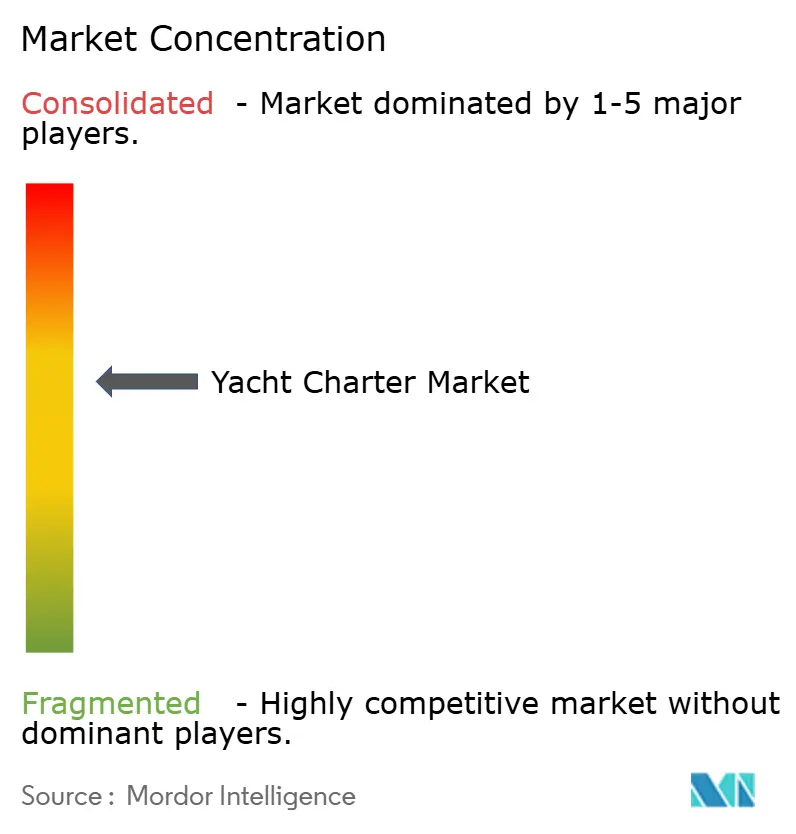
| Market Concentration | Medium |
Major Players *Disclaimer: Major Players sorted in no particular order Image © Mordor Intelligence. Reuse requires attribution under CC BY 4.0. | |
Yacht Charter Market Analysis by Mordor Intelligence
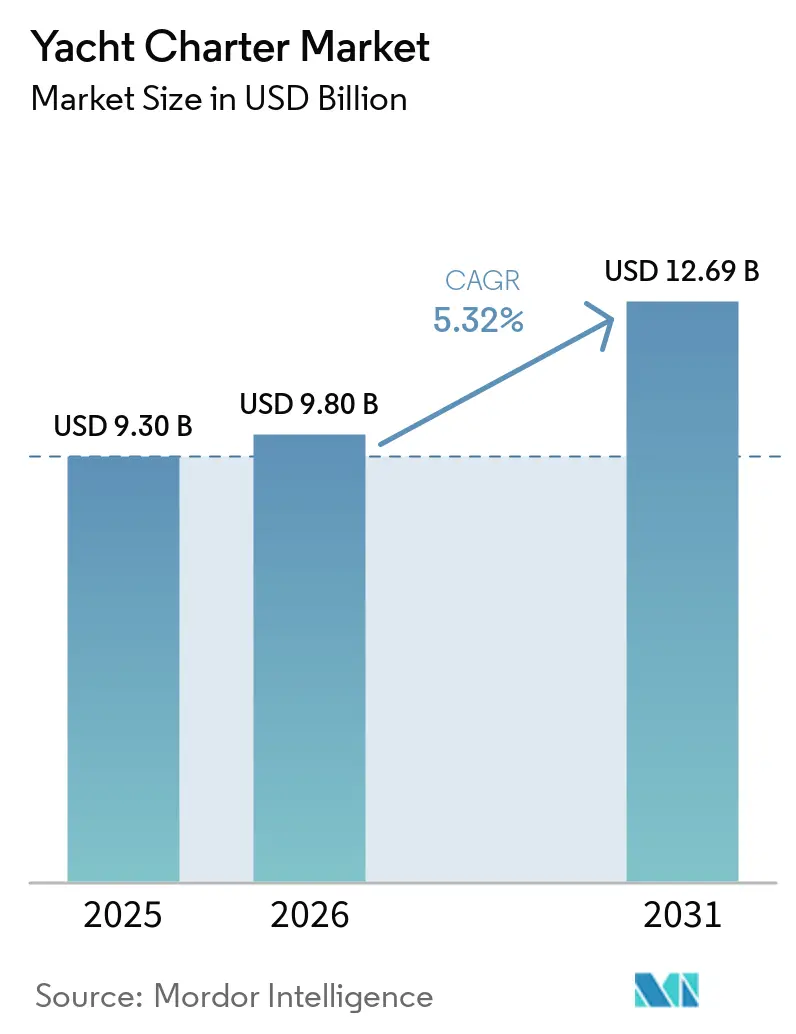
The yacht charter market size is expected to grow from USD 9.30 billion in 2025 to USD 9.80 billion in 2026 and is forecast to reach USD 12.69 billion by 2031 at 5.32% CAGR over 2026-2031. Rising wealth in Asia and the Middle East, relaxed Mediterranean rules, and digital booking tools widen access and support growth. Motor yachts remain the revenue backbone, but greener sailing options and catamarans are winning newcomers. Short-duration and cabin charters open premium experiences to wider budgets, while corporate events push the ultra-large segment forward. Competition now pivots fleet sustainability, online reach, and the ability to tailor trips for diverse cultural and business needs.
Key Report Takeaways
- By charter type, crewed charters led with 61.58% revenue share in 2025; cabin charters are projected to expand at a 9.31% CAGR to 2031.
- By yacht type, motor yachts held 57.52% of the yacht charter market share in 2025, while sailing yachts recorded the highest projected CAGR at 8.20% through 2031.
- By yacht size, the 24 to 40 m class accounted for 39.78% share of the yacht charter market size in 2025; yachts above 60 m are advancing at a 9.62% CAGR through 2031.
- By booking channel, broker-assisted bookings retained a 69.74% share in 2025, whereas online marketplaces are climbing at a 11.80% CAGR.
- By charter duration, weekly charters captured a 54.63% share in 2025; daily charters are set to rise at an 10.82% CAGR to 2031.
- By end-user, private and leisure trips formed 77.88% of 2025 revenue, yet corporate and MICE demand is forecast to grow at a 8.74% CAGR.
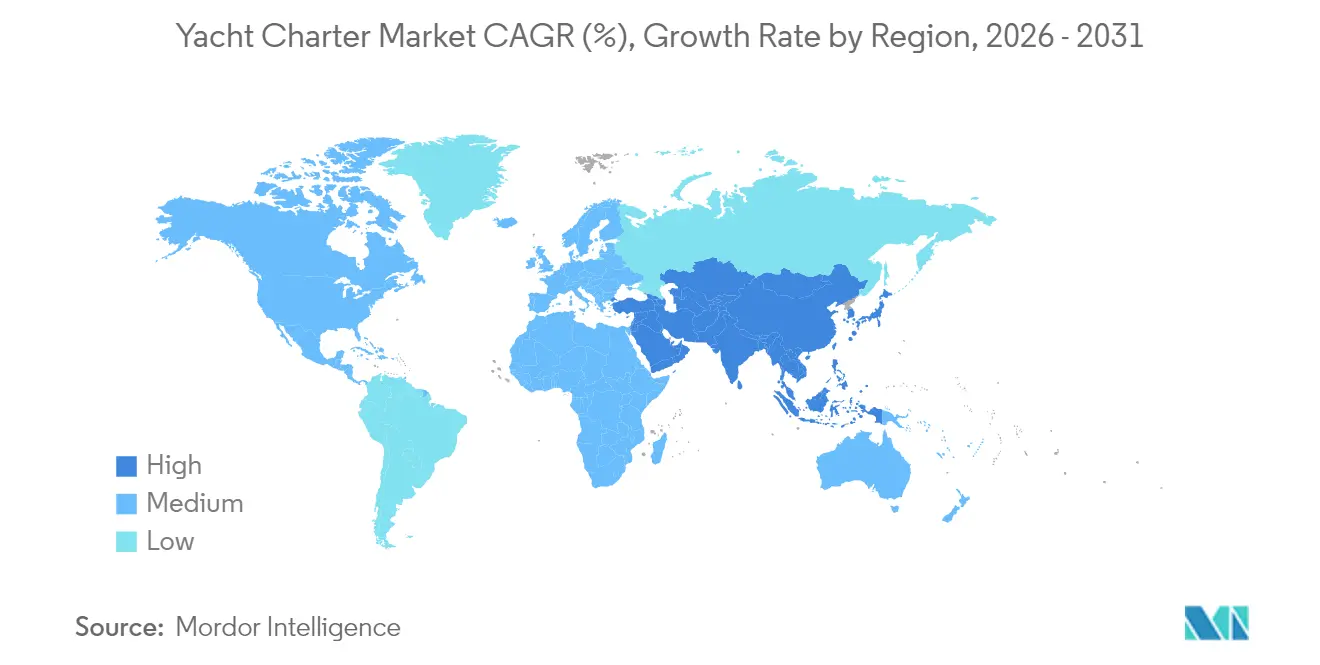
- By geography, Europe commanded 45.05% of global revenue in 2025, while Asia is on track for the fastest 8.35% CAGR over 2026-2031.
Note: Market size and forecast figures in this report are generated using Mordor Intelligence’s proprietary estimation framework, updated with the latest available data and insights as of 2026.
Market Trends and Insights
Drivers Impact Analysis of Yacht Charter Market*
| Driver | (~) % Impact on CAGR Forecast | Geographic Relevance | Impact Timeline |
|---|---|---|---|
| Surge in UHNWIs in Asia and Middle East Catalyzing First-time Charters | +1.6% | Asia, Middle East, with spillover to Mediterranean | Medium term (2-4 years) |
| Expansion of Online Platforms Boosting Utilization in Europe | +1.2% | Europe, North America | Short term (≤ 2 years) |
| Experiential Tourism Demand Driving Catamaran Charters in the Caribbean | +0.9% | Caribbean, Mediterranean | Medium term (2-4 years) |
| Relaxed Mediterranean Charter Regulations Unlocking Capacity | +0.7% | Mediterranean, particularly Greece and Croatia | Short term (≤ 2 years) |
| Corporate Incentive Travel Adoption in North America | +0.5% | North America, with spillover to Caribbean | Medium term (2-4 years) |
| Eco-friendly Hybrid-Propulsion Yachts Attracting Scandinavian and Oceania Clientele | +0.4% | Scandinavia, Oceania, Western Europe | Long term (≥ 4 years) |
| Source: Mordor Intelligence | |||
Surge in UHNWIs in Asia and Middle East catalyzing First-time Charters
The expanding UHNWI population in Asia and the Middle East is fundamentally reshaping the yacht charter market, with approximately 44% of family offices looking to increase allocations to luxury assets, including yacht investments, in 2025. This wealth surge creates a new class of first-time charterers who view yachting as a status symbol and an exclusive retreat from increasingly dense urban centers. The trend is particularly pronounced in China, where the number of individuals with investable assets exceeding USD 30 million grew by 15% in 2024, creating ripple effects across the global charter market. Knight Frank's Wealth Report 2025 reveals that these new entrants are not merely passive consumers but actively influence yacht design and amenities, demanding culturally specific experiences that charter companies must adapt to. The impact extends beyond Asia's waters, with Mediterranean charter operators reporting a 22% increase in Asian clientele in 2024, driving innovation in service offerings and cultural accommodations aboard luxury vessels.[1]Liam Bailey, “The Wealth Report 2025,” Knight Frank, knightfrank.com.
Expansion of Online Platforms Boosting Utilization in Europe
Digital marketplace platforms are revolutionizing the European yacht charter landscape by dramatically reducing idle vessel time and expanding the customer base beyond traditional wealthy demographics. Click&Boat, Europe's leading yacht charter platform, has achieved a 28.13% traffic share, primarily from France and Italy, while emerging platforms like Boataround are gaining significant traction in Central Europe. These platforms have transformed the booking process, with users spending an average of 11 minutes per session exploring listings, resulting in a 30% increase in overall fleet utilization rates compared to traditional broker-only models. The democratization effect is particularly evident in Croatia, where PlainSailing.com reports that digital bookings have contributed to a 7% increase in UK-originated charters in 2024, with Lefkas in Greece emerging as a particularly popular destination due to its affordability and favorable sailing conditions. This digital transformation is not merely changing how yachts are booked but is fundamentally altering who books them, with millennials now representing 35% of all online yacht charter customers in Europe.
Experiential Tourism Demand Driving Catamaran Charters in the Caribbean
The Caribbean market is experiencing unprecedented growth as travelers increasingly prioritize immersive experiences over traditional luxury accommodations. This shift is evidenced by the rise of eco-sailing with hybrid or electric propulsion systems and customized itineraries that blend cultural immersion with natural exploration. The San Blas Islands have emerged as a premier destination, known for their untouched beauty and cultural richness, while the Exuma Cays are gaining popularity for their unique wildlife interactions and secluded settings. Catamaran Adventures reports that 80% of charter companies have noted increased demand for catamarans, which offer superior stability and space compared to monohull vessels.
Relaxed Mediterranean Charter Regulations Unlocking Capacity
Regulatory liberalization across Mediterranean countries has significantly expanded the yacht charter market capacity, most notably in Greece, where introducing the 'e-Charter Permission' system now enables non-EU-flagged yachts over 35 meters LOA to charter for up to 28 days annually. This regulatory shift replaces previous restrictions that required foreign-flagged yachts to be owned by companies with Greek branches, effectively opening the market to a broader range of international vessels. The impact is particularly significant for the superyacht segment, with the Greek government implementing a Special Charter Fee based on a yacht's duration in Greek waters rather than imposing blanket restrictions. Similar regulatory easing in Croatia has contributed to its emergence as a charter hotspot for 2025, with Nautilus Yachting highlighting the Dalmatian Coast as a prime booking area. These regulatory changes create a more unified Mediterranean charter environment, reduce operational complexities for fleet operators, and enable more efficient deployment of vessels across multiple jurisdictions, ultimately increasing overall market capacity and operational flexibility.[2]“Greece Opens Superyacht Charters,” Boat International, boatinternational.com.
Restraints Impact Analysis of Yacht Charter Market*
| Restraint | (~) % Impact on CAGR Forecast | Geographic Relevance | Impact Timeline |
|---|---|---|---|
| Peak-season Crew Shortages Inflating Mediterranean Charter Costs | -0.8% | Mediterranean, particularly Greece, Croatia, and Italy | Short term (≤ 2 years) |
| IMO Tier III Compliance Refits Pressuring Margins | -0.6% | Global, with higher impact in Europe and North America | Medium term (2-4 years) |
| Limited Marina Berths on Caribbean Islands Constraining Fleet Growth | -0.4% | Caribbean, particularly British Virgin Islands and Bahamas | Long term (≥ 4 years) |
| High Discretionary-Spend Sensitivity in European Market | -0.3% | Europe, particularly Southern European countries | Medium term (2-4 years) |
| Source: Mordor Intelligence | |||
Peak-season Crew Shortages Inflating Mediterranean Charter Costs
The Mediterranean yacht charter market is grappling with a critical crew shortage during peak seasons, driving operational costs up by 15-20% in 2024 and forcing operators to make difficult trade-offs between service quality and profitability. This shortage is particularly acute for specialized roles such as engineers and chefs, with some owners opting for minimum crewing standards to reduce costs despite the potential impact on service quality. Charter operators report that crew salaries have increased by up to 25% for the 2025 season as companies compete for qualified personnel, with these costs inevitably passed on to clients through higher charter rates. The shortage has strategic implications for fleet deployment, with some operators redirecting vessels to regions with more stable labor markets or investing in crew retention programs that include year-round employment guarantees and professional development opportunities to secure talent in an increasingly competitive labor market.[3]“Mediterranean Crew Salary Trends 2025,” Burgess, burgessyachts.com.
IMO Tier III Compliance Refits Pressuring Margins
The International Maritime Organization's Tier III nitrogen oxide (NOx) emission standards are creating significant financial pressure on yacht charter operators, with compliance refits costing between USD 200,000 and USD 500,000 per vessel, depending on size and existing systems. These regulations, which apply to vessels constructed after January 1, 2016, and operating in Emission Control Areas (ECAs), require a 75% reduction in NOx emissions compared to Tier II standards. Charter operators face a strategic dilemma: absorb these compliance costs, accept reduced margins, or pass them on to customers and risk losing price-sensitive segments. The impact is particularly severe for mid-sized operators with fleets of 5-15 vessels, who lack both the economies of scale of larger companies and the niche appeal of boutique operators.
*Our forecasts treat driver/restraint impacts as directional, not additive. The impact forecasts reflect baseline growth, mix effects, and variable interactions.
Yacht Charter Market Segment Analysis
By Charter Type:
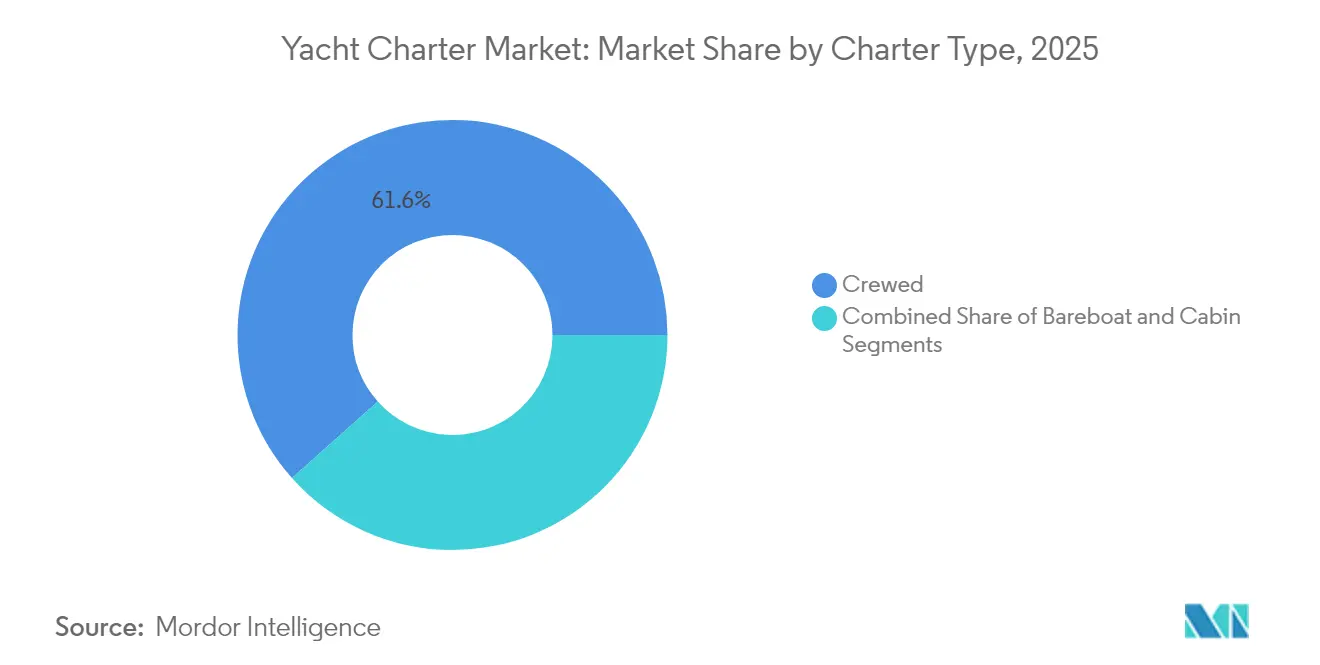
Cabin Charters Democratize Luxury AccessCrewed Charters had a 61.58% of the yacht charter market share in 2025, due to a fully staffed service that appeals to newcomers and time-pressed travelers. Vessels in this class often assign one crew member per guest pair, reinforcing value through personalized care. While modest in revenue, Cabin charters are scaling quickly at a 9.31% CAGR, broadening the yacht charter market to middle-income groups who pay per cabin rather than per vessel. In Southeast Asia, cabin offers now represent one in five bookings, underscoring their role in market expansion.
Digital booking hubs report that 70% of 2025 cabin and crewed reservations came via online channels, indicating transparency and convenience outweigh the historical reliance on personal brokers. Bareboat charters, roughly 40-60% cheaper than crewed trips, remain the choice for licensed sailors and contribute steady off-season income in tradewind regions. Enhanced navigation software and remote support deepen bareboat safety, enlarging the qualified client pool. Operators combining flexible staffing, add-on chef packages, and easy online checkout stand to capture the next wave of demand in the yacht charter industry.



By Yacht Type:
Sustainability Drives Sailing ResurgenceMotor yachts accounted for 57.52% of the 2025 revenue pool, favored for expansive saloons and faster repositioning between hotspots. Yet rising eco-awareness is steering an 8.20% CAGR for sailing yachts, especially on Mediterranean island loops where wind availability suits carbon-light cruising. Meanwhile, the yacht charter market size for catamarans has surged, as two-hull designs match the stability of generous deck plans prized by families.
Hybrid propulsion, once a niche, saw more than 300 yachts added to global fleets in 2024, meeting both regulatory obligations and tenant preference for quiet anchorage stays. Operators blending sail and hybrid tech market fuel-savings of 20-30%, resonating with budget-sensitive renters as fuel prices fluctuate. Choice is now less about pure speed and more about aligning trip ethos with traveler values. Motor-yacht builders answer by integrating solar arrays and battery banks, signaling that sustainability has moved from optional to baseline expectation within the yacht charter market.
By Yacht Size:
Ultra-Large Segment Defies Economic HeadwindsVessels between 24 m and 40 m commanded 39.78% of 2025 revenue, the sweet spot for 8-12 guests who want luxury without super-port fees. These yachts often combine gym space, beach clubs, and shallow drafts, suiting Mediterranean harbors and Caribbean anchorages. Despite higher running costs, yachts above 60 m are growing at a 9.62% CAGR as elite clients seek status events and unmatched privacy. The yacht charter market size for this bracket benefits from corporate retreats, brand launches, and influencer activations that justify premium rates.
Sub-24 m craft make up 65% of all contracts, vital for first-time renters testing the waters. Stabilizer upgrades and gyro systems lessen motion, lowering seasickness concerns and widening appeal. The 40 to 60 m range bridges volume and exclusivity; demand is steady among multi-family groups that prefer self-contained cinemas and spas, yet remain under prevailing berth limits in European marinas. Balanced fleet portfolios across size classes help operators hedge economic swings and capture cross-selling upsell paths in the yacht charter industry.
By Booking Channel:
Digital Platforms Challenge Broker DominanceOffline brokers still own 69.74% of 2025 bookings because they orchestrate bespoke routes and VIP concierge services. Their deep yacht knowledge and port relationships reassure high-spend clients. However, the online segment is scaling fastest at 11.80% CAGR, bringing transparent price filters, reviews, and instant contracts that appeal to tech-native audiences. Click&Boat leads Europe with 28.13% traffic share, while GetMyBoat tops in the United States at 14.01%.
Platforms use virtual walkthroughs and AI-matching to narrow selections efficiently, encouraging explorers to book shoulder-season slots and smaller vessels. Brokers strike back by integrating chatbots and photo-realistic 3D tours, creating a blended service path. The yacht charter market now rewards firms that can move seamlessly between channels, giving planners speedy information yet backing it with human expertise. Expect alliances where brokers white-label tech engines and platforms invest in destination specialists.
By Charter Duration:
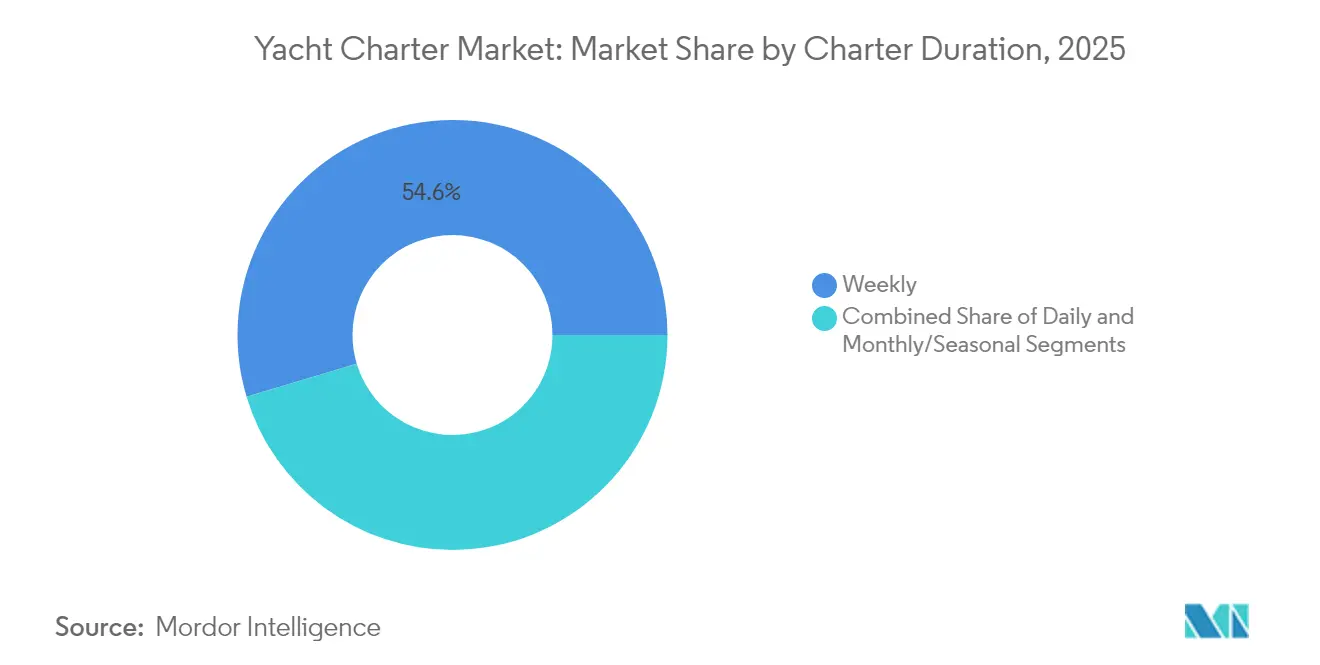
Daily Charters Expand Market AccessibilityWeekly charters dominate the yacht charter market with a 54.63% share in 2025, offering the optimal balance between operational efficiency for operators and immersive experiences for clients. This duration allows charterers to explore multiple destinations while providing operators with predictable scheduling and reduced turnover costs compared to shorter charters. However, daily charters are experiencing the strongest growth at 10.82% CAGR (2026-2031), driven by changing consumer preferences for shorter, more frequent leisure experiences rather than extended vacations. This shift is particularly evident in coastal urban markets where affluent professionals seek luxury experiences that fit within weekend timeframes.
While smaller in transaction volume, the monthly/seasonal charter segment represents a significant portion of market value due to the premium pricing these extended charters command. This segment is particularly strong in winter Caribbean and summer Mediterranean seasons, where wealthy clients seek extended escapes from unfavorable weather in their home regions.
By End-user:
Corporate Segment Drives InnovationThe private and leisure segment dominates the yacht charter market with a 77.88% share in 2025, reflecting the industry's historical focus on vacation and lifestyle experiences. This segment's strength is particularly evident in traditional charter destinations like the Mediterranean and Caribbean, where personal leisure remains the primary motivation for chartering. Though smaller, the corporate and MICE (Meetings, Incentives, Conferences, and Exhibitions) segment is experiencing the fastest growth at 8.74% CAGR (2026-2031), driven by companies seeking distinctive venues for high-value client engagement and team-building activities.
The corporate segment's growth is reshaping yacht design and amenities, with newer vessels increasingly incorporating features specifically tailored to business functions, such as enhanced connectivity, multimedia capabilities, and configurable spaces that can transition between formal meetings and relaxed networking. This trend is particularly pronounced in Asia, where corporate usage for entertainment is driving a shift toward larger yachts ranging from 60ft to 130ft.
Geography Analysis
Europe Yacht Charter Market
Europe retained a 45.05% share of global revenue in 2025, underpinned by dense marina networks and standardized charter rules. Greece’s new e-Charter Permission drew a wave of non-EU superyachts, while Croatia’s Dalmatian Coast captured price-sensitive bookings. Crew wage inflation of up to 25% and limited peak-season berths raise costs; online portals make secondary ports visible, smoothing demand over the entire year.
APAC Yacht Charter Market
Asia is the fastest-rising market, predicted to expand at an 8.35% CAGR from 2026 to 2031. China’s pool of individuals with more than USD 30 million in liquid assets jumped 15% in 2024, and marinas in Hainan, Phuket, and Bali are scaling to meet larger hull drafts. Digital discovery replaces broker gatekeeping, helping first-time charterers arrange corporate sail-aways and family reunions. Regional governments offer tax breaks on new marinas, spurring private investment.
Caribbean and North America Yacht Charter Market
The Caribbean holds winter appeal as yachts migrate from Europe for dual-season revenue. Catamaran charters climbed 15% year-on-year in 2024 thanks to spacious designs suited to island hopping. Growth is capped by berth shortages in the British Virgin Islands and Bahamas, while tightened U.S. environmental rules, such as California’s Commercial Harbor Craft Regulation, raise compliance stakes for operators repositioning to Pacific ports. North America benefits from a strong domestic base and rising corporate incentives afloat, opening chances for themed charters that merge meetings with leisure.
Mordor Intelligence provides coverage of the yacht charter market across other key regional markets. Detailed country-level analysis extends to Saudi Arabia incorporating local coverage and market participation, as required.

Regulatory Landscape
Yacht charter operations are shaped by flag-state codes, port-state controls, and regional taxation and environmental rules, which affect where vessels can embark guests and how charters are contracted. In Europe, liberalization measures such as Greece's e-Charter Permission (introduced in January 2024) broaden access for non-EU-flagged superyachts, while other jurisdictions have tightened administrative requirements, including Spain's move toward an Affidavit of Responsibility/self-declaration approach for charter authorization, with 2026 positioned as a transition year. In the Caribbean, itinerary design has become more compliance-led after the British Virgin Islands' rules effective June 2025, which limit foreign-flagged charter yachts to a capped number of entries or pickups per year in BVI waters.
Safety, manning, and environmental compliance continue to add operating overhead. Transport Malta's Commercial Yacht Code (CYC) 2025 entered into full operational force in July 2025 and governs design, safety, manning, and welfare for commercial yachts under its framework, reinforcing the role of flag-state compliance in charter eligibility. At the global level, IMO amendments in force from January 2026 (including SOLAS and MARPOL-related updates referenced under MSC.532(107)) introduce additional testing and survey requirements for certain ship equipment, and extend specific safety-of-navigation requirements to larger pleasure yachts operating in polar waters. EU environmental frameworks such as FuelEU Maritime (Regulation (EU) 2023/1805) also push charter managers toward MRV-style monitoring practices and emissions-linked contract clauses, increasing the need for standardized voyage reporting across fleets operating in European waters.
Value Chain Analysis
The yacht charter value chain covers asset supply (newbuild acquisition and refit), regulatory readiness (class, flag compliance, surveys, and manning standards), and commercial execution through charter management and distribution. Owners and fleet managers procure or refit yachts through specialized shipyards and service networks, then place vessels into charter programs that require ongoing maintenance, crew sourcing (STCW-aligned roles such as engineers and chefs), provisioning, insurance, and marina access. Compliance-linked upgrades, including emissions- and survey-related refits, run alongside operational constraints such as berth availability in peak destinations, which makes marina relationships and seasonal repositioning capability central to the operating model.
Demand is routed through broker-assisted channels and online marketplaces, with charter managers coordinating itinerary planning, concierge services, and contracting, typically supported by maritime agents, logistics providers, and luxury travel partners. This segment has added integrated logistics and travel linkages, reflected in partnerships such as Peters and May and Burgess (announced April 2025) to manage shipping for Burgess's global fleet and newbuild projects, and luxury cross-selling alliances such as Denison Yachting and Northern Jet (March 2025). These relationships shorten lead times for repositioning and support end-to-end customer delivery, while supply-side bottlenecks, including longer procurement cycles for larger yachts and shortages of specialized crew, continue to affect utilization, pricing, and the feasibility of rapid fleet expansion in high-demand regions.
Competitive Landscape
Market concentration is moderate. Dream Yacht Charter and The Moorings anchor the traditional fleet model, while Zizoo and GetMyBoat lead digital disruption. Sunsail and The Moorings secured an exclusive deal with Dufour to add 75 yachts over two seasons, reinforcing premium status. Reciprocal U.S. tariffs on EU yachts, announced in April 2025, may redirect procurement to domestic builders, tilting competitive balance.
Technology investment now decides speed to market. ViewYacht’s 2025 channel-manager rollout synchronizes inventory across platforms, cutting broker admin time. Virtual tours, AI price predictors, and personalized itineraries based on past feedback drive retention. Environmental credentials add a parallel contest; The Moorings’ OCEAN Promise with Blue Marine Foundation signals the shift from optional charity to core brand value.
White-space opportunities lie in Indonesia and the Philippines, where marinas are coming online and crews are plentiful. Health-and-wellness packages, from onboard nutritionists to mindfulness coaches, remain underexploited differentiators. Firms that can blend sustainable fleets, digital reach, and specialized experiences are best placed to enlarge their footprint in the yacht charter market.
Yacht Charter Industry Leaders
OceanBLUE Yachts Ltd.
Burgess
Simpson Marine
Northrop and Johnson
Dream Yacht Worldwide
- *Disclaimer: Major Players sorted in no particular order
Yacht Charter Market Companies Covered in this Report
- Dream Yacht Worldwide
- The Moorings
- Sunsail
- Burgess
- Ocean Independence
- Northrop and Johnson (MarineMax, Inc.)
- Y.CO (THE YACHT COMPANY)
- Fraser Yachts (MarineMax, Inc.)
- Imperial Yachts
- Camper and Nicholsons
- Edmiston
- Bluewater Yachting
- CharterWorld
- Boatsetter
- GetMyBoat
- Zizoo
- Navtours
- Asta Yachting
- Yachtico
- OceanBLUE Yachts Ltd.

Market Opportunities and Future Outlook
Standardized, verifiable sustainability measurement and reporting is creating a differentiation path for charter operators and brokers that can support client-facing environmental performance claims. In February 2026, SYBAss announced the formal approval of ISO/TS 23099, a harmonized method to assess and compare environmental performance of large yachts (30 m+), which aligns with the direction of EU operational reporting needs under FuelEU Maritime. This opens room for charter management companies to bundle emissions reporting, compliant fuel planning, and transparent surcharges into charter agreements, particularly for fleets operating across multiple Mediterranean jurisdictions where rules and taxes vary by embarkation and routing.
Hospitality-branded and digitally enabled charter distribution is also expanding the competitive set beyond traditional broker networks. In March 2026, Four Seasons Yachts commenced the maiden voyage of Four Seasons I in the Mediterranean, and in June 2026, Orient Express launched its first large yacht on the French and Italian Riviera, reinforcing the overlap between luxury hospitality and yachting experiences. On the distribution side, platform activity such as IDOSY YACHTS launching a digital charter booking platform in May 2026 adds momentum to direct discovery and booking, complementing the market's shift toward online marketplaces. Capital activity is another route to scale capability, with Wave Expandary signing an agreement in May 2026 to acquire an 80% stake in Camper & Nicholsons International (subject to approvals), pointing to ongoing investor interest in integrated superyacht services platforms that can combine brokerage, charter management, and cross-border operations.
Recent Industry Developments in Yacht Charter Market
- May 2026: Wave Expandary Limited signed an agreement to acquire an 80% stake in Camper & Nicholsons International for EUR 40 million, valuing the business at EUR 50 million. The transaction highlights continued consolidation across superyacht brokerage and services, with scale supporting investment in compliance, digital distribution, and global client servicing.
- November 2025: Ancient announced a strategic investment in Burgess. The funding move supports a leading brokerage and charter management platform and enables broader capability building in a market where sustainability compliance and technology-enabled client acquisition are becoming more central.
- March 2024: Sanlorenzo S.p.A. closed the acquisition of 95% of Simpson Marine Limited for an equity consideration of USD 10 million. The deal tightens links between yacht manufacturing, regional distribution, and charter-related services in Asia, supporting more integrated customer pathways from purchase to charter and management.


Yacht Charter Market Report Scope and Research Methodology
Market Definition and Coverage
For this study, the yacht charter market is defined as the revenue generated from renting yachts for leisure, travel, and event use, whether the charter is crewed, bareboat, or cabin-based. The market is measured in value and covers bookings made through brokers as well as online marketplaces.
Scope exclusions: Yacht sales, refit services, marina berthing, and routine maintenance spend are excluded because they are not charter rental revenue.
Segments Covered in This Report
- By Charter Type
- Bareboat
- Cabin
- Crewed
- By Yacht Type
- Sailing Yacht
- Motor Yacht
- Catamaran and Others
- By Yacht Size
- Less than 24 meters
- 24 to 40 meters
- 40 to 60 meters
- More than 60 meters
- By Booking Channel
- Broker-Assisted Offline
- Online Marketplace
- By Charter Duration
- Daily
- Weekly
- Monthly/Seasonal
- By End-user
- Private and Leisure
- Corporate and MICE
- Government and Institutional
- By Geography
- North America
- United States
- Canada
- Mexico
- Rest of North America
- South America
- Brazil
- Argentina
- Rest of South America
- Europe
- United Kingdom
- Germany
- France
- Italy
- Spain
- Greece
- Croatia
- Rest of Europe
- Middle East and Africa
- Saudi Arabia
- United Arab Emirates
- Egypt
- Turkey
- South Africa
- Rest of Middle East and Africa
- Asia-Pacific
- China
- Japan
- India
- South Korea
- Thailand
- Rest of Asia Pacific
- North America
Data Sources, Market Sizing, and Validation
Desk Research
Desk research was first used to map the activity footprint of yacht tourism and charter operations, and then to set realistic boundaries around what counts as charter revenue. We leaned on public sources such as UNWTO tourism indicators, Eurostat tourism and coastal statistics, the US Bureau of Economic Analysis travel and tourism satellite accounts, US Coast Guard boating safety and vessel information releases, and customs or port authority publications where available.
To connect demand and supply signals, we also reviewed annual reports and investor presentations of listed leisure and travel businesses, association websites for boating and marine recreation, and reputable press coverage on fleet additions and seasonality. Where company-level numbers were limited, we used a paid subscription for company financials and intelligence to standardize revenues and currency conversions across countries. The sources listed above are illustrative, and many other public documents and databases were used to collect, cross-check, and clarify data points.
Primary Interviews and Surveys
Primary work was used to sanity-check the demand pool, pricing logic, and how utilization shifts by season and region, since public data rarely explains these details clearly. We spoke with a mix of charter operators, brokers, marina-linked service providers, and frequent charter customers across major yachting routes in APAC, EMEA, and the Americas, and then reconciled differences in how daily, weekly, and seasonal charters are priced and sold.
Distribution of primary research fieldwork respondents
| Company type | Respondent position | Region |
|---|---|---|
| Top tier: 37% | CXOs: 17% | APAC: 48% |
| Mid tier: 41% | Functional/Unit leaders: 37% | EMEA: 31% |
| Smaller Players: 22% | Managers: 46% | Americas: 21% |
Market-Sizing & Forecasting
Sizing starts with a top-down build where tourism trips and coastal leisure demand are translated into likely charter participation, and then converted into value using region-level charter mix and typical price ladders. The model is anchored on practical inputs such as seasonal utilization patterns, average charter duration (daily versus weekly), the share of crewed versus bareboat bookings, yacht size mix (less than 24 m through more than 60 m), and booking channel split between broker-assisted offline and online marketplace sales.
Those totals are then checked using selective bottom-up approximations, mainly by rolling up sampled operator revenues and applying sampled average price per charter day multiplied by expected operating weeks. When gaps appear, such as thin disclosure for smaller fleets or informal operators, we adjust using penetration assumptions that are tested again in interviews until the numbers stay consistent across regions.
For forecasting, scenario analysis is used so growth is not pushed by one driver only. Assumptions on pricing progression, fleet availability, and travel sentiment are stress-tested with expert views, and the final forecast follows the scenario that best matches observed booking behavior and planned capacity additions.
Data Validation & Update Cycle
Outputs are cross-checked against independent signals such as tourism flow changes, marina activity commentary, and visible shifts in charter duration and yacht size preferences. If a country or region shows a sudden jump that cannot be explained by demand, pricing, or capacity, the inputs are revisited and a second pass is done before sign-off.
A multi-step internal review is followed, where calculations, conversions, and key assumptions are checked by another analyst. The report is refreshed annually, and interim updates are triggered when material events affect travel, fuel, regulation, or fleet supply. Before delivery, a fresh review is completed so clients receive the latest updated view.
Mordor Intelligence's Yacht Charter Market Estimate Compared With Other Published Estimates
Published numbers for yacht charter often do not match because each publisher chooses a different scope and timing, and the differences are not always stated clearly. Gaps usually come from what counts as charter revenue, how pricing is averaged across daily and weekly hires, and whether online marketplace commissions are treated as the full booking value or only the net.
The main gap comes from whether adjacent marine leisure spending is blended in with rentals, where Mordor Intelligence counts only charter revenue across bareboat, cabin, and crewed formats and then tests price and utilization assumptions by yacht size and duration before finalizing the total.
Benchmark comparison
| Source | Market Size | Gaps in Research Methodology |
|---|---|---|
| Mordor Intelligence | USD 9.30 B (2025) | |
| Trade Journal A | USD 8.40 B (2023) | Uses an earlier base year and often reflects a narrower capture of charter revenue, which can undercount newer online marketplace volumes and post-2023 pricing resets in peak regions. |
| Regional Consultancy B | USD 8.80 B (2024) | Leans on broad averaging of charter prices without consistently separating daily versus weekly duration mix, which can skew totals in markets with strong seasonality and higher crewed share. |
The spread across figures is largely explained by scope clarity, base-year timing, and how price and duration mix are handled. By keeping the revenue definition tied to charter rentals and by running simple cross-checks against utilization and booking patterns, the estimate stays traceable to repeatable inputs rather than one-off assumptions.


Key Questions Answered in the Report
What is the current Yacht Charter Market size?
The yacht charter market size is USD 9.80 billion in 2026.
How are online platforms impacting yacht charter bookings?
Online marketplaces are growing at a 11.80% CAGR, bringing transparent pricing and broader access while still coexisting with broker expertise.
Why are daily charters becoming popular?
Busy professionals favor short luxury escapes; daily charters, advancing at an 10.82% CAGR, cater to this time-sensitive demand.
Which yacht size segment holds the largest share
The 24 to 40 m category captures 39.78% of 2025 revenue, balancing luxury features with manageable operating costs.
Page last updated on:




