
Bioburden Testing Market Size and Share
Market Overview
| Study Period | 2020 - 2031 |
|---|---|
| Market Size (2026) | USD 1.78 Billion |
| Market Size (2031) | USD 3.26 Billion |
| Growth Rate (2026 - 2031) | 12.85 % |
| Fastest Growing Market | Asia-Pacific |
| Largest Market | North America |
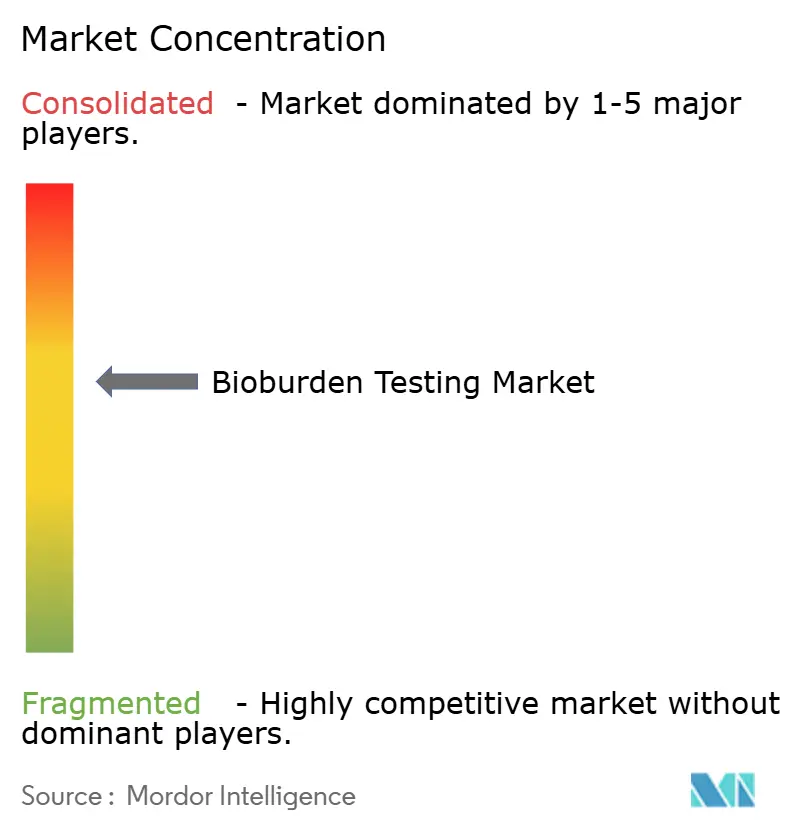
| Market Concentration | Medium |
Major Players *Disclaimer: Major Players sorted in no particular order Image © Mordor Intelligence. Reuse requires attribution under CC BY 4.0. | |
Bioburden Testing Market Analysis by Mordor Intelligence
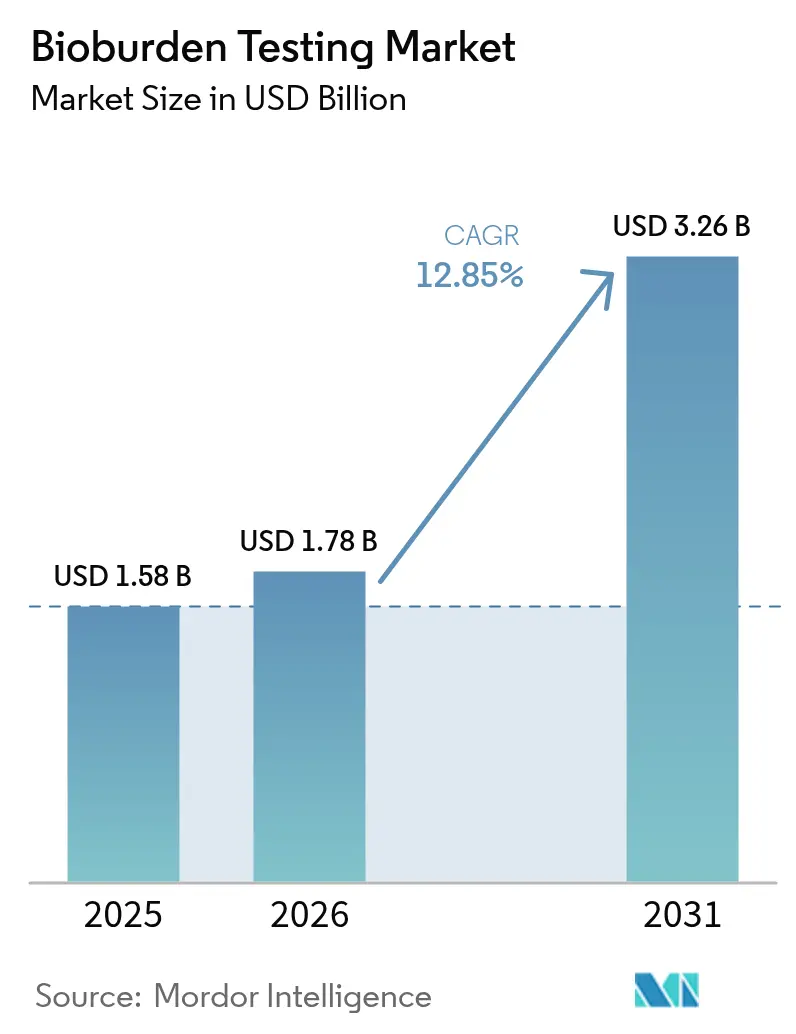
The Bioburden Testing Market size was valued at USD 1.58 billion in 2025 and estimated to grow from USD 1.78 billion in 2026 to reach USD 3.26 billion by 2031, at a CAGR of 12.85% during the forecast period (2026-2031). Demand accelerates as cell and gene therapy pipelines expand, single-use bioprocessing systems proliferate, and regulators intensify real-time sterility oversight. Manufacturers now favor automated, PCR-enabled instruments that shorten detection windows while pairing them with disposable consumables that curb cross-batch risks. Rapid enumeration technologies further strengthen the bioburden testing market by compressing sample-to-result timelines, a necessity for continuous manufacturing lines. Contract development and manufacturing organizations (CDMOs) deepen adoption as outsourcing grows, while persistent shortages of trained microbiologists spur interest in AI-assisted colony counting.
Key Report Takeaways
- By product type, instruments led with a 62.95% revenue share of the bioburden testing market in 2025; consumables are expected to rise at a 15.61% CAGR through 2031.
- By enumeration method, plate count techniques held 39.22% of bioburden testing market share in 2025, while rapid and alternative methods are set to expand at a 13.89% CAGR to 2031.
- By application, in-process bioprocess testing accounted for 34.45% of bioburden testing market size in 2025, yet environmental monitoring is forecast to accelerate at a 14.12% CAGR.
- By end-user, pharmaceutical and biopharmaceutical manufacturers commanded 49.12% of demand in 2025; CROs and CMOs are poised to grow at 15.19% CAGR.
- By geography, North America dominated with a 38.18% revenue share in 2025, whereas Asia-Pacific is projected to post a 14.2% CAGR through 2031.
Note: Market size and forecast figures in this report are generated using Mordor Intelligence’s proprietary estimation framework, updated with the latest available data and insights as of 2026.
Market Trends and Insights
Drivers Impact Analysis of Bioburden Testing Market*
| Driver | (~) % Impact on CAGR Forecast | Geographic Relevance | Impact Timeline |
|---|---|---|---|
| High frequency of product recalls in rapid-release supply chains | +2.1% | North America, EU | Short term (≤ 2 years) |
| Stringent cGMP and ISO 13485 audits for sterility compliance | +1.8% | APAC, global | Medium term (2-4 years) |
| Shift toward single-use bioprocessing equipment | +1.6% | North America, EU, APAC | Medium term (2-4 years) |
| Rising bioreactor contamination events in cell & gene therapy facilities | +1.4% | North America, EU | Short term (≤ 2 years) |
| Microbiome-based therapeutics requiring ultra-low detection thresholds | +1.2% | North America, EU | Long term (≥ 4 years) |
| Adoption of continuous manufacturing | +1.0% | Global | Long term (≥ 4 years) |
| Source: Mordor Intelligence | |||
High Frequency of Product Recalls Driven by Rapid-Release Supply Chains
Recurring recalls underscore how speed-focused logistics can let contaminants slip through routine checks. FDA notices in 2024 for sulfamethoxazole/trimethoprim tablets and atovaquone suspensions illustrated the costly fallout of microbial lapses.[1]Manufacturers now view preventive testing as cheaper than multi-month shutdowns and brand damage. Generic drug makers with tight margins feel this pressure most, which lifts routine sampling volumes and positions the bioburden testing market as an essential quality gate.
Stringent cGMP & ISO 13485 Audits for Sterility Compliance
The 2024 US Quality Management System Regulation aligned domestic rules with ISO 13485, raising the bar for documentation and real-time monitoring.[2] PIC/S Annex 1 revisions require continuous oversight rather than periodic checks. When Sanofi’s Massachusetts plant logged 20% rejected runs, regulators highlighted historic contamination rates, prompting peers to adopt automated alerts and audit-ready data trails. Such mandates expand instrument sales and software subscriptions across the bioburden testing market.
Shift Toward Single-Use Bioprocessing Equipment Boosting Test Volumes
Disposable bioreactors, filters, and connectors avoid the cleaning validations demanded by stainless-steel systems yet compel sterility proof for each lot. Thermo Fisher and Sartorius reported rising orders for single-use assemblies bundled with rapid detection kits. Every campaign therefore triggers additional lot-release tests, swelling consumable demand within the bioburden testing market.
Rising Bioreactor Contamination Events in Cell & Gene Therapy Facilities
Cell therapy batches worth millions can be lost to a single microbial intrusion that standard culture assays may not flag. Updated FDA viral-safety guidance stresses in-process checks and raw-material screening. Facilities now install continuous sensors that detect viable but non-culturable organisms, driving purchases of next-generation PCR and impedance platforms.
Restraints Impact Analysis of Bioburden Testing Market*
| Restraint | (~) % Impact on CAGR Forecast | Geographic Relevance | Impact Timeline |
|---|---|---|---|
| High upfront cost of automated enumeration platforms | -1.5% | Emerging APAC, MEA | Short term (≤ 2 years) |
| Shortage of trained microbiologists | -1.2% | APAC, MEA | Medium term (2-4 years) |
| False-negative risk in rapid sterility assays | -0.9% | North America, EU | Medium term (2-4 years) |
| Supply bottlenecks for high-purity agar & reagents | -0.7% | Global | Short term (≤ 2 years) |
| Source: Mordor Intelligence | |||
High Upfront Cost of Automated Enumeration Platforms
Systems such as Rapid Micro Biosystems’ Growth Direct exceed USD 500,000, excluding validation outlays. Small generics plants struggle to amortize that spend, slowing instrument uptake despite clear efficiency gains. Financing hurdles are most acute in India, Indonesia, and parts of Africa where capital budgets remain tight.
Supply Bottlenecks for High-Purity Agar & Reagents
Shortfalls in BD BACTEC bottles and fetal bovine serum forced labs to ration consumables in 2024.[3] With few global agar suppliers, any disruption reverberates worldwide, lengthening lead times and elevating costs.
*Our forecasts treat driver/restraint impacts as directional, not additive. The impact forecasts reflect baseline growth, mix effects, and variable interactions.
Bioburden Testing Market Segment Analysis
By Product:
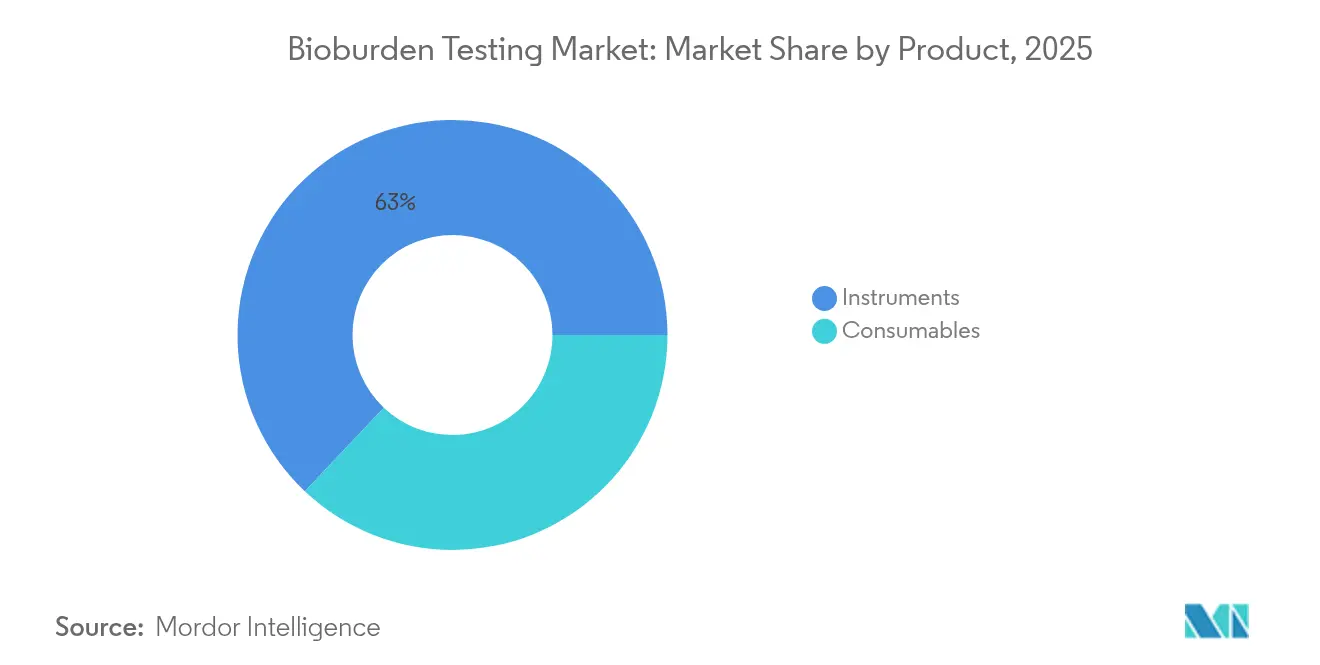
Automation Drives Consumables GrowthConsumables posted the quickest revenue expansion, advancing at a 15.61% CAGR even though instruments still captured 62.95% of the bioburden testing market in 2025. Growth in single-use manufacturing pushes fresh culture media, filters, and rapid test kits into every production cycle, lifting volume demand. Automated identification instruments benefit from high-throughput cell and gene therapy pipelines that require swift, accurate readouts.
Disposable items now anchor contamination-prevention strategies because they eliminate cross-batch residue. Manufacturers intensify supplier audits to secure uninterrupted consumables flow, offsetting reagent bottlenecks. Meanwhile, AI-enabled imaging microscopes and PCR modules remain capital priorities for large plants aiming to reduce analyst touch time and boost data integrity across the bioburden testing market.

By Enumeration Method:
Rapid Technologies Challenge Traditional ApproachesPlate count assays retained 39.22% of bioburden testing market share in 2025, yet rapid techniques are climbing at 13.89% CAGR on the back of real-time manufacturing needs. Flow cytometry and ATP bioluminescence deliver answers in hours, not days, aiding facilities that have adopted continuous lines.
Hybrid testing regimes now merge legacy culture plates for regulatory familiarity with fluorescence-based counts for speed. AI colony counters cut read time to 30 seconds while holding 95% accuracy. These efficiencies slash analyst bottlenecks and reinforce the bioburden testing market size outlook through 2031.
By Application:
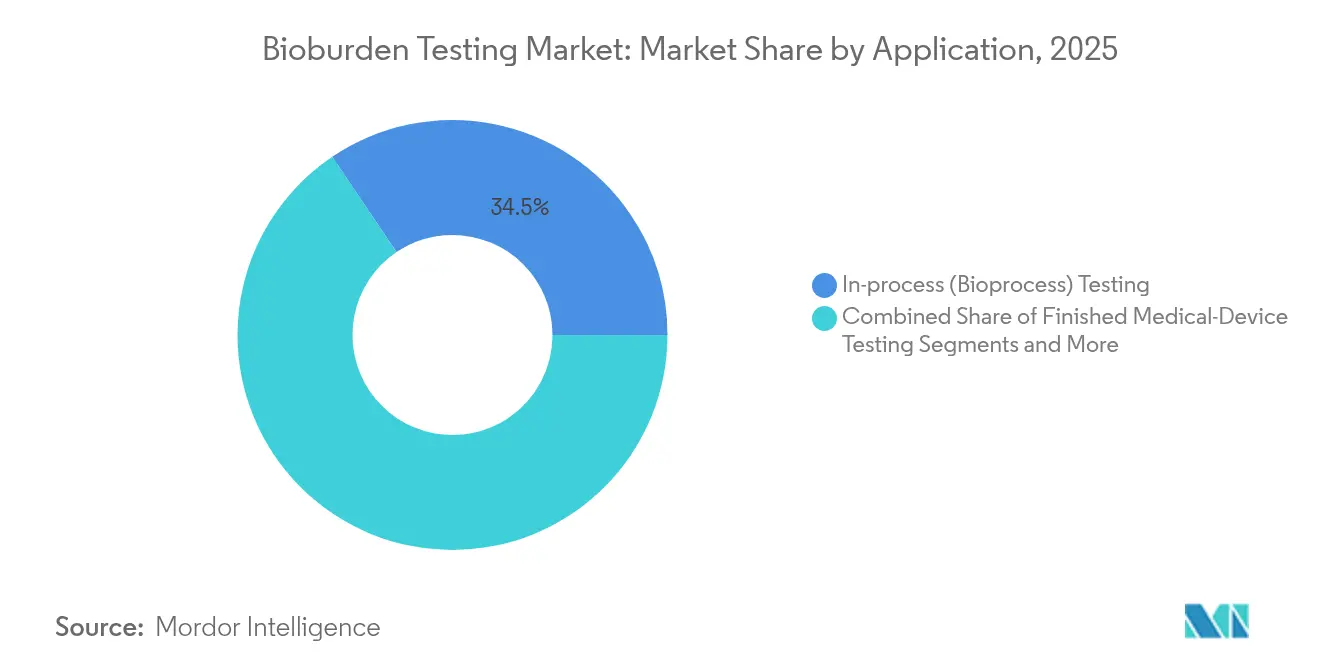
Environmental Monitoring Gains Regulatory EmphasisIn-process testing was the largest slice of bioburden testing market size at 34.45% during 2025. Nonetheless, environmental monitoring is on track for the fastest gains at 14.12% CAGR following the EU’s Annex 1 revisions.
Manufacturers extend air and surface sampling beyond cleanrooms into gowning, warehousing, and personnel zones. The bioMérieux 3P ENTERPRISE platform integrates automated sample capture with cloud analytics, offering audit-ready dashboards. Such end-to-end visibility strengthens contamination control and underpins long-term expansion for the bioburden testing market.
By End-User:
CROs and CMOs Drive Outsourcing TrendPharma and biotech firms generated 49.12% of 2025 demand, yet outsourcing momentum positions CROs and CMOs for 15.19% CAGR growth through 2031. Cell therapy sponsors in particular lean on CDMOs to supply dedicated suites that meet ultra-low bioburden thresholds without incurring direct capital expense.
Academic labs assist in early-stage assay innovation, while medical-device makers request tailored protocols for implantables that cannot undergo terminal sterilization. Heightened specialization enlarges service backlogs, fueling sustained gains for the broader bioburden testing market.
Geography Analysis
North America Bioburden Testing Market
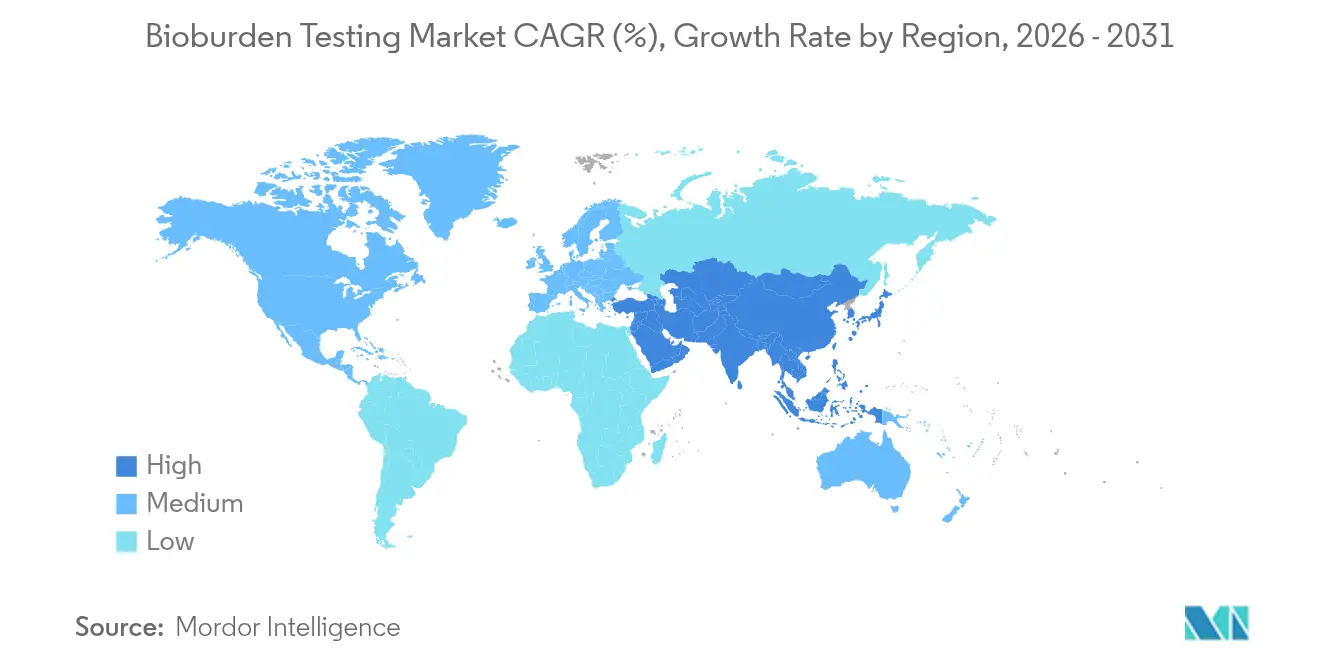
North America led with 38.18% of global revenues in 2025 as FDA rule harmonization and a dense network of high-value biologics plants favored advanced detection investments. Canada and Mexico strengthen regional totals by upgrading facilities to US compliance levels, broadening customer bases for rapid enumeration suppliers.
APAC Bioburden Testing Market
Asia-Pacific is forecast to grow at 14.2% CAGR, propelled by China, India, South Korea, and Singapore. Rising GMP adherence and greater biologics capacity spark bulk orders for automated incubators, PCR kits, and disposable media packs. Public-private training initiatives aim to close microbiologist gaps, yet demand still outpaces talent supply across much of Southeast Asia, magnifying prospects for AI-assisted testing modules within the bioburden testing market.
EMEA and South America Bioburden Testing Market
Europe sustains expansion through strict Annex 1 enforcement that compels continuous facility monitoring. Germany, the United Kingdom, and France approve sizeable capital budgets for inline sensors and cloud data-management suites. Meanwhile, Middle East, Africa, and South America register incremental gains as generic-driven manufacturing hubs invest in basic plate-count capacity and gradually transition toward quicker molecular assays.
Regulatory Landscape
Bioburden testing requirements for sterile medical devices are tied to consensus standards and quality-system rules that regulators use to review validation packages for sterilization and ongoing control. In the United States, the FDA recognizes ANSI/AAMI/ISO 11737-1:2018 under its consensus standards program for determining the population of microorganisms on medical devices, and it also directs manufacturers to sterilization-related expectations that connect bioburden data to process development and routine monitoring.
A notable compliance change is the FDA Quality Management System Regulation (QMSR) alignment with ISO 13485, which became effective on February 2, 2026, tightening documentation and audit readiness around microbiological controls and data integrity. In Europe, Regulation (EU) 2017/745 (MDR) requires technical documentation that includes validation reports for bioburden testing for sterile-labeled devices, reinforcing the need for defensible methods, sampling rationales, and traceable records during conformity assessment with notified bodies such as BSI.
Value Chain Analysis
The value chain runs from raw-material and consumable suppliers through instrument manufacturers and a services layer that supports method development, validation, and routine bioburden release testing. Upstream inputs include specialized culture media and reagents, agar plates, buffers, sterile filtration materials, and single-use sampling accessories, which feed into instrument workflows such as automated incubation, imaging or colony counting, and PCR-enabled detection. Standardization through ISO 11737-1 (recognized by the FDA for device submissions) and risk-based controls reinforced by EU GMP Annex 1 increase the need for consistent materials, documented method suitability, and traceable data across sites.
Execution is often handled through contract testing and CRO/CDMO networks that provide surge capacity and regulatory-aligned reporting, with established providers including Nelson Labs, NAMSA, Eurofins, Cambrex, and Cormica. This services-heavy structure helps manufacturers that lack trained microbiologists or need independent verification for validations, but it also creates dependencies on lab capacity, lead times, and consumables availability. To reduce operational risk, buyers increasingly dual-source critical consumables and testing partners, while pairing traditional culture methods with rapid microbiological methods to shorten quarantine windows without losing compendial continuity.
Competitive Landscape
The sector remains moderately fragmented. Becton Dickinson, Sartorius, Thermo Fisher Scientific, and bioMérieux offer integrated ecosystems that bundle instruments, media, and analytics, capturing about 42% of worldwide revenue. Rapid Micro Biosystems disrupts the field with fully automated culture detection that halves release times without altering compendial methods.
Strategic moves emphasize AI and machine learning. BD’s plan to spin off its Biosciences and Diagnostic Solutions arm into a USD 3.4 billion pure-play entity underscores focus on growth niches. Sartorius launched the Octet R8e system in May 2025, raising sensitivity benchmarks for real-time biomolecular interaction analysis.
White-space opportunities cluster around live biotherapeutic product assays, continuous manufacturing integrations, and underserved emerging markets. Suppliers that can deliver both hardware and validation consulting hold a competitive edge because end-users increasingly seek turnkey contamination-control programs rather than standalone tools. Market consolidation is expected as mid-tier players acquire niche software firms to bolster data integrity offerings.
Bioburden Testing Industry Leaders
-
Becton, Dickinson and Company
-
Charles River Laboratories Inc.
-
Merck KGaA
-
Thermo Fisher Scientific
-
bioMérieux SA
- *Disclaimer: Major Players sorted in no particular order
Bioburden Testing Market Companies Covered in this Report
- Beckton Dickinson
- Sartorius
- Merck KGaA (MilliporeSigma)
- Thermo Fisher Scientific
- bioMérieux
- Rapid Micro Biosystems
- Danahar
- Solventum
- Hardy Diagnostics
- Mesa Laboratories
- Synbiosis (SDI)
- Microbiologics
- Don Whitley Scientific
- Lonza Group
- Advanced Instruments
- Cherwell Laboratories
- STERIS
- Hygiena
Market Opportunities and Future Outlook
A key opportunity is the broader adoption of risk-based microbiological control frameworks that require refreshed SOPs, validation packages, and more frequent, data-rich monitoring across raw materials, in-process samples, and the environment. The FDA QMSR effective date (February 2, 2026) increases the premium on ISO 13485-aligned documentation, electronic data integrity, and audit-ready traceability, supporting demand for integrated instrument-software workflows and validation support services. In parallel, the FDA updated its Pyrogen and Endotoxins Testing: Questions and Answers guidance in March 2026, reinforcing risk-based sampling and alternative methods, which strengthens pull for contamination-control programs that often sit alongside bioburden testing in QC organizations.
Rapid microbiological methods and AI-assisted analysis also fit facilities constrained by microbiologist shortages and continuous manufacturing needs, since hours-to-result workflows can reduce hold times and investigation cycles. Market evidence includes NIIMBL advancing work in 2026 to validate rapid sterility and bioburden testing approaches (including the Mango M6 system) for biopharmaceutical manufacturing, indicating structured pathways for method credibility and adoption. On the services side, long-term end-to-end release testing agreements and laboratory expansions can create room for instrument vendors and consumables suppliers to embed into standardized service menus used by pharma, biotech, and medical-device manufacturers.
Recent Industry Developments in Bioburden Testing Market
- May 2026: Merck KGaA announced a five-year agreement to provide end-to-end analytical and biosafety release testing services for Genetix Biotherapeutics gene therapy portfolio. The deal elevates outsourced release-testing footprints for advanced therapies and strengthens demand for validated microbiological and biosafety workflows that include bioburden-related controls.
- August 2025: Nelson Labs expanded its Wiesbaden, Germany facility to increase capacity for packaging and microbiological testing, including bioburden. The added European lab throughput supports device and pharma customers managing tighter sterility documentation requirements and helps reduce lead-time pressure during validation and routine release cycles.
- November 2024: bioMérieux released the 3P ENTERPRISE environmental monitoring suite, combining automated sampling with cloud-based incubation management. The launch reinforces the shift toward connected, audit-ready environmental monitoring programs that feed into broader contamination control strategies alongside bioburden testing.
Bioburden Testing Market Report Scope and Research Methodology
Market Definition and Coverage
For this study, the bioburden testing market covers revenues tied to testing that counts viable microorganisms on raw materials, in-process samples, finished medical devices, and controlled manufacturing environments, along with the related instruments and consumables used to run these checks.
Scope exclusions: Viral assays and viral load testing, plus endotoxin and other pyrogen testing, are excluded from the market totals.
Segments Covered in This Report
- By Product
- Instruments
- Automated Microbial Identification Systems
- Polymerase Chain Reaction (PCR) Systems
- Microscopes
- Other Instruments
- Consumables
- Culture Media & Reagents
- Other Consumables
- Instruments
- By Enumeration Method
- Membrane Filtration
- Plate Count Method
- Most Probable Number (MPN)
- Rapid/Alternative Methods (flow-cytometry, ATP)
- By Application
- Raw-Material Testing
- In-process (Bioprocess) Testing
- Finished Medical-Device Testing
- Equipment-Cleaning Validation
- Environmental Monitoring Swabs & RODAC plates
- By End-User
- Pharmaceutical & Biopharmaceutical Manufacturers
- Medical-Device Manufacturers
- Contract Research & Manufacturing Organizations (CROs/CMOs)
- Academic & Research Laboratories
- By Geography
- North America
- United States
- Canada
- Mexico
- Europe
- Germany
- United Kingdom
- France
- Italy
- Spain
- Rest of Europe
- Asia-Pacific
- China
- Japan
- India
- Australia
- South Korea
- Rest of Asia-Pacific
- Middle East and Africa
- GCC
- South Africa
- Rest of Middle East and Africa
- South America
- Brazil
- Argentina
- Rest of South America
- North America
Data Sources, Market Sizing, and Validation
Desk Research
Desk research was used to set the market boundary, build the initial demand pool, and sanity-check the direction of change across regions. We relied on public technical and regulatory references such as USP and ISO standards (including ISO 11737 for bioburden), FDA guidance and recall databases, and European Commission medical device regulation information, since these references help clarify where bioburden testing is expected and how it is typically performed.
To support model inputs, we also used sources such as the U.S. Census Bureau manufacturing series, UN Comtrade for import and export patterns, and peer-reviewed microbiology and cleanroom contamination control literature to understand method adoption and typical testing frequency. Company annual reports, investor presentations, and reputable press were reviewed to identify capacity expansions, lab footprint shifts, and instrumentation adoption. For financials and supporting signals where public data was too broad, we used selective paid database subscriptions for company financials, patent scanning, and shipment-level trade signals. The examples listed here are illustrative and not exhaustive, and other public sources were also reviewed for data collection, validation, and clarification.
Primary Interviews and Surveys
Primary work focused on cross-checking demand drivers for routine bioburden testing in pharma manufacturing, medical device production, and contract testing labs, then pressure-testing assumptions on testing frequency and pricing. Interviews were conducted with lab operators, QA and validation leaders, and product specialists across major regions, so gaps in secondary data could be closed and key inputs could be confirmed before finalizing the sizing.
Distribution of primary research fieldwork respondents
| Company type | Respondent position | Region |
|---|---|---|
| Top tier: 39% | CXOs: 13% | APAC: 44% |
| Mid tier: 46% | Functional/Unit leaders: 27% | EMEA: 30% |
| Smaller Players: 15% | Managers: 60% | Americas: 26% |
Market-Sizing & Forecasting
Sizing starts with a top-down build where regulatory-driven testing needs are reconstructed from the underlying production footprint in biopharma and medical devices, then translated into annual test volumes and spend. The spend pool is shaped using a practical price logic across instruments and consumables, and it is then split by region using manufacturing activity and cleanroom intensity as guiding signals.
In the model, key inputs include the number of relevant manufacturing sites and cleanroom lines, the share of batches that require bioburden release testing, routine environmental monitoring frequency, the mix of methods (membrane filtration, plate count, MPN, and rapid methods), and average consumables used per test cycle. We also track the rate of shift toward automation and rapid techniques, because that changes both throughput and the average selling price profile over time.
For forecasting, scenario analysis is applied around method adoption and capacity additions. It is supported with a multivariate regression view that ties market growth to indicators such as biologics output, medical device manufacturing expansion, and contracted testing penetration. Where bottom-up details are missing for smaller labs or emerging countries, gaps are handled through proxy ratios (tests per site and spend per batch) validated in interviews, then adjusted to align with observable production signals.
Data Validation & Update Cycle
Validation is done through triangulation across independent checks, so a single data source does not determine the market total. We compare model outputs with external signals such as regional manufacturing growth, lab capacity indicators, and method adoption patterns. When outliers show implausible price or volume jumps, we investigate the drivers behind them.
Before sign-off, the work goes through multi-step analyst reviews where assumptions, calculations, and unit conversions are re-checked. Any high-variance items trigger re-contact with selected interviewees for confirmation. The report is refreshed annually, and interim updates are completed when material events occur, such as major regulatory shifts or meaningful capacity expansions. Right before delivery, a final pass is completed so clients receive the most current view available.
Mordor Intelligence's Bioburden Testing Market Size Measured Against Other Published Estimates
Published market sizes for bioburden testing often vary because the included test scope, pricing treatment, and timing choices are not uniform across publishers. Even when similar end users are discussed, differences in what gets counted as bioburden testing and how instruments versus consumables are valued can move the totals.
A refresh-led gap shows up most clearly when currency timing and average selling price progression are handled differently, since rapid method adoption and automation can shift the mix year to year. By keeping the pricing year aligned to the stated market year and re-checking outputs against testing frequency signals and capacity additions, Mordor Intelligence reduces drift that can happen when older price points are carried forward.
Benchmark comparison
| Source | Market Size | Gaps in Research Methodology |
|---|---|---|
| Mordor Intelligence | USD 1.78 B (2026) | |
| Global Consultancy A | USD 1.44 B (2024) | Uses an earlier base year and may apply a broader or narrower inclusion of adjacent microbiology testing activities, and near-term instrument ASP uplift can be smoothed, which changes the level for the current year. |
| Industry Publisher B | USD 1.56 B (2025) | Anchors the value to a single-year point estimate, and the method-mix shift toward rapid tools may be modeled with a faster ASP ramp without the same cross-check against routine test frequency and lab utilization patterns. |
Across these figures, the spread is mainly explained by timing and price-mix choices, along with small differences in what is counted as bioburden-related testing. When scope is kept consistent and the year-specific currency and pricing assumptions are re-validated against operating signals, the market value becomes easier to trace and repeat over future refreshes.
Key Questions Answered in the Report
What is the current value of the bioburden testing market?
The market generated USD 1.78 billion in 2026 and is forecast to reach USD 3.26 billion by 2031.
Which segment contributes most to bioburden testing market size today?
Instruments account for 62.95% of 2025 revenue, reflecting sustained investment in automated identification and PCR platforms.
Why are rapid enumeration methods gaining popularity?
They shorten result times from days to hours, a critical need for continuous manufacturing lines that cannot afford lengthy hold periods.
Which region is expanding fastest in the bioburden testing market?
Asia-Pacific is projected to grow at a 14.2% CAGR through 2031 due to increased GMP compliance and biologics capacity.