
Benzene-Toluene-Xylene (BTX) Market Size and Share
Market Overview
| Study Period | 2021 - 2031 |
|---|---|
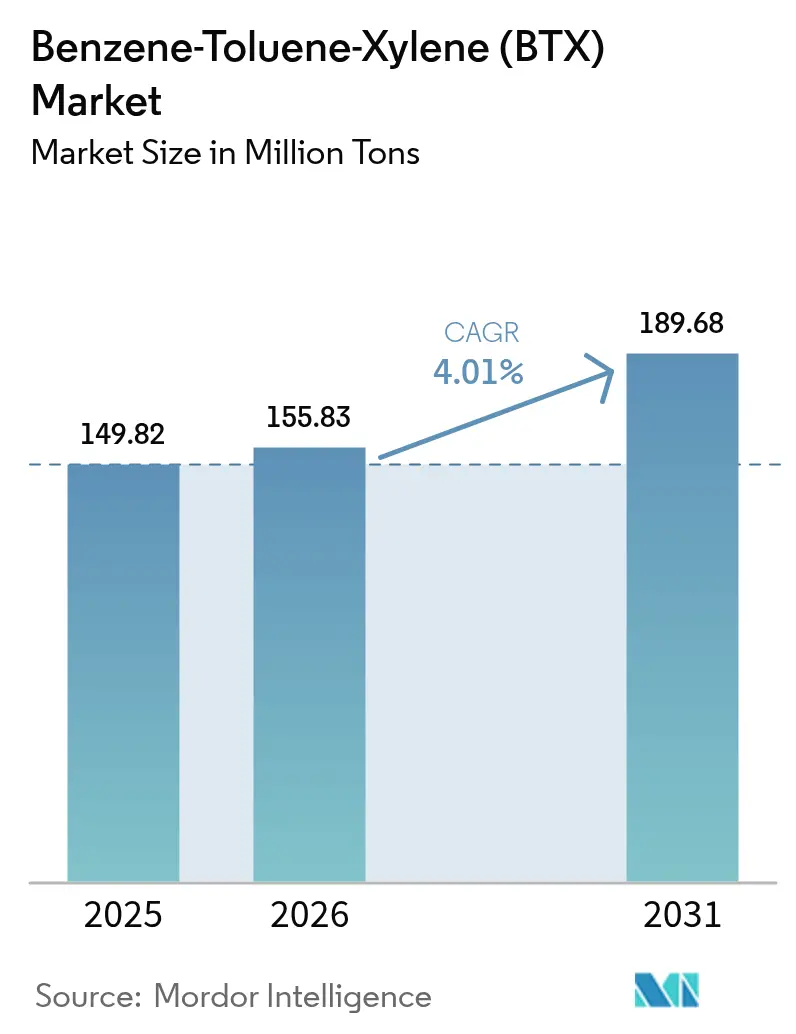
| Market Volume (2026) | 155.83 Million tons |
| Market Volume (2031) | 189.68 Million tons |
| Growth Rate (2026 - 2031) | 4.01 % |
| Fastest Growing Market | Asia Pacific |
| Largest Market | Asia Pacific |
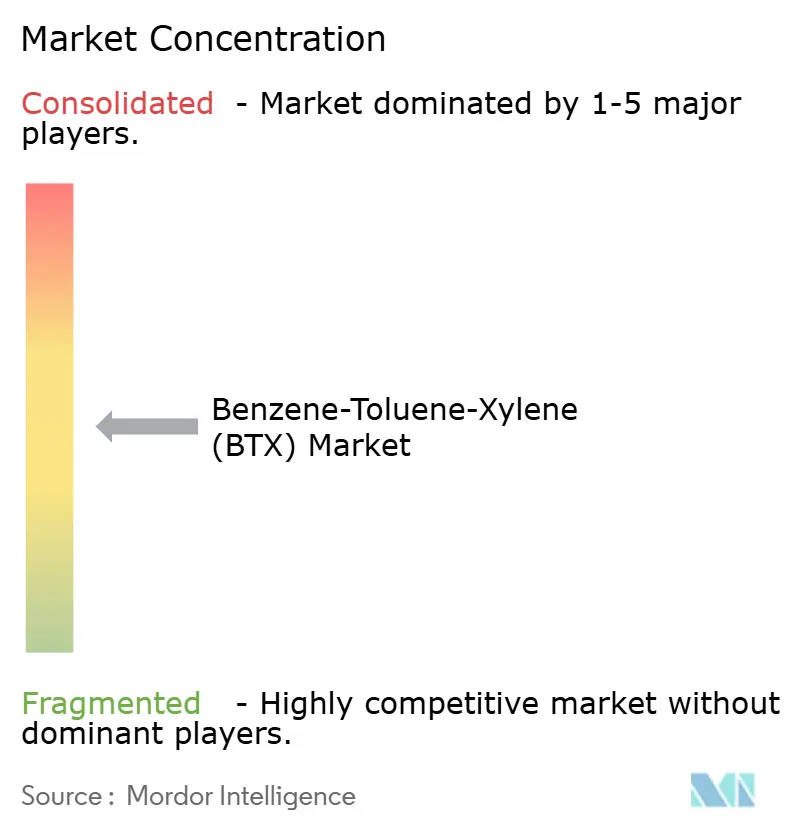
| Market Concentration | Medium |
Major Players *Disclaimer: Major Players sorted in no particular order Image © Mordor Intelligence. Reuse requires attribution under CC BY 4.0. | |
Benzene-Toluene-Xylene (BTX) Market Analysis by Mordor Intelligence
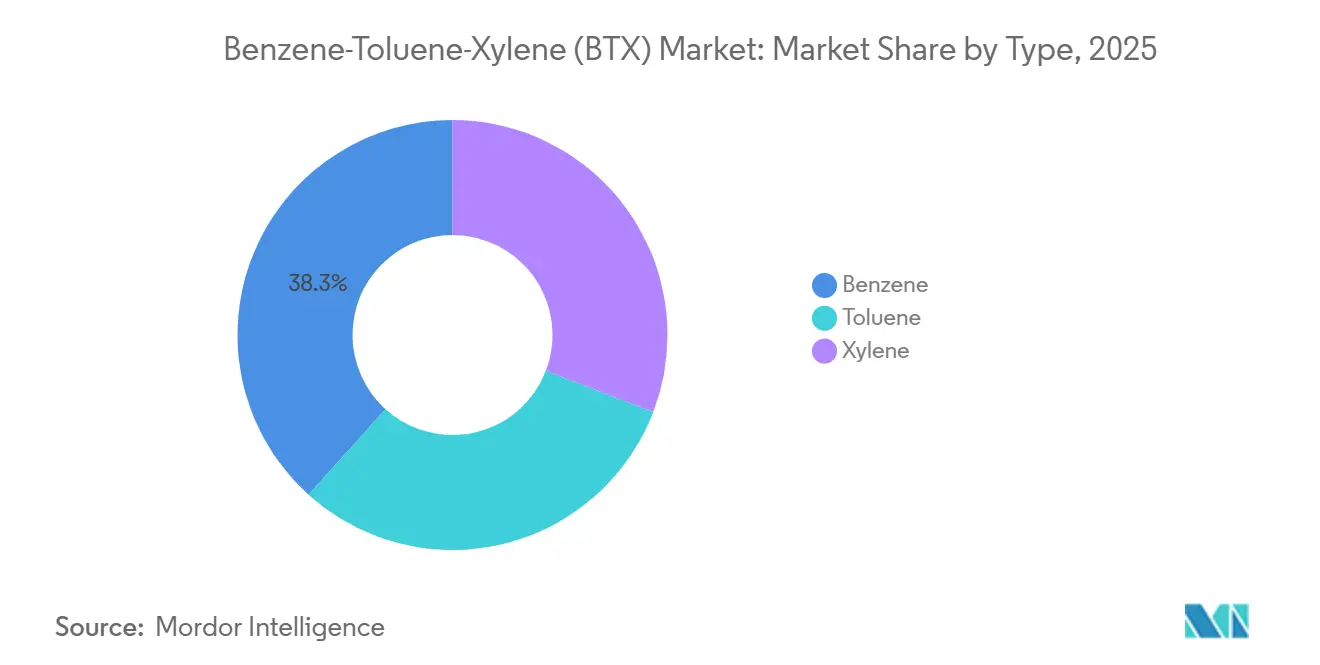
The Benzene-Toluene-Xylene Market size is projected to be 149.82 million tons in 2025, 155.83 million tons in 2026, and reach 189.68 million tons by 2031, growing at a CAGR of 4.01% from 2026 to 2031. Asia-Pacific holds 62.41% of global volume, supported by large integrated aromatics complexes in China, India, and Malaysia that feed the downstream polyester, styrene, and solvent value chains. Benzene remains the largest product-type slice at 38.33% because it underpins ethylbenzene-to-styrene and cyclohexane-to-nylon routes, whereas toluene is the fastest-growing component at 4.48% CAGR as chemical-intermediate demand for benzene and xylene derivatives outpaces legacy solvent uses. Refinery-petrochemical integration is realigning supply economics; new captive configurations in the United States and Saudi Arabia lift para-xylene and benzene yield while tightening merchant availability, a trend that pushes independent buyers toward long-term offtake contracts. Near-term opportunities lie in bio-based aromatics and circular feedstock loops, but commercial volumes remain limited to pilot-scale demonstration plants in North America and Europe.
Key Report Takeaways
- By product type, benzene accounted for 38.33% of the BTX market share in 2025, whereas toluene is projected to post the fastest 4.48% CAGR through 2031.
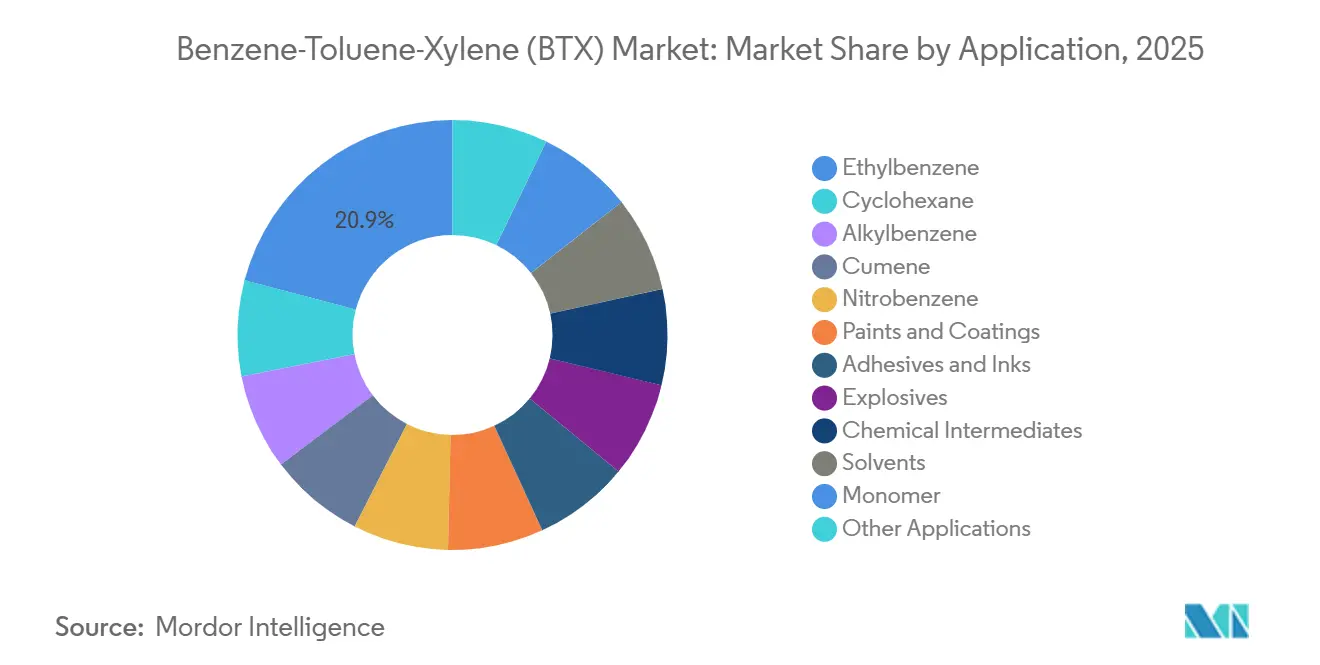
- By application, ethylbenzene retained a 20.91% share of the BTX market size in 2025, while chemical intermediates are set to expand at a 4.79% CAGR between 2026 and 2031.
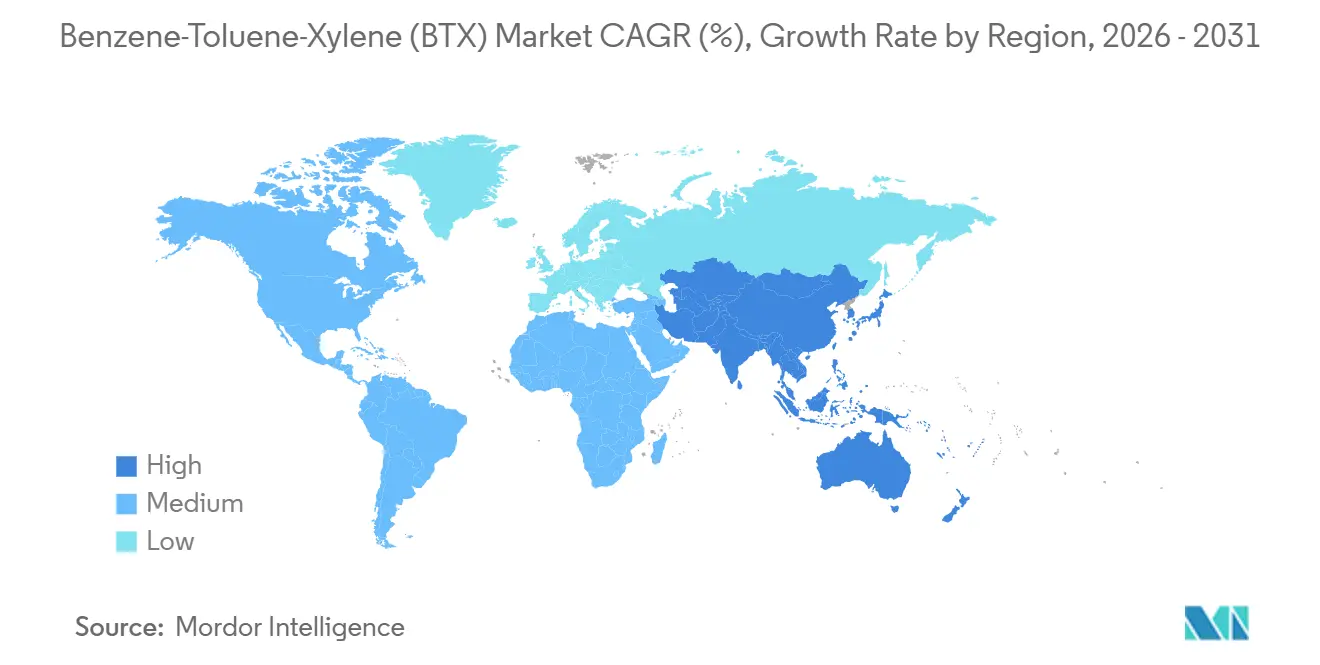
- By geography, the Asia-Pacific region commanded 62.41% of the BTX market share in 2025 and is projected to advance at a 4.22% CAGR through 2031.
Note: Market size and forecast figures in this report are generated using Mordor Intelligence’s proprietary estimation framework, updated with the latest available data and insights as of 2026.
Market Trends and Insights
Drivers Impact Analysis of Benzene-Toluene-Xylene (BTX) Market*
| Drivers | (~) % Impact on CAGR Forecast | Geographic Relevance | Impact Timeline |
|---|---|---|---|
| CAPEX boom in new aromatics complexes (Asia and Middle-East) | +1.2% | Asia-Pacific (China, India, Malaysia) and Middle East (Saudi Arabia) | Medium term (2-4 years) |
| Surging PET demand keeps para-xylene balances tight | +0.9% | Global, concentrated in Asia-Pacific | Short term (≤ 2 years) |
| Refinery-petrochemical integration unlocking captive BTX extraction | +0.8% | Global (Middle East, Asia-Pacific, North America) | Medium term (2-4 years) |
| Styrene-linked ethylbenzene revival in post-tariff U.S. and India | +0.6% | United States and India | Short term (≤ 2 years) |
| China's Aromatics-Plus policy incentives for high-purity BTX | +0.7% | China, spillover to Asia-Pacific | Medium term (2-4 years) |
| Source: Mordor Intelligence | |||
CAPEX Boom in New Aromatics Complexes Reshapes Regional Supply
Between 2024 and 2027, China, India, Saudi Arabia, and Malaysia are set to unveil greenfield and brownfield aromatics projects. In March 2024, a para-xylene unit was inaugurated in Gulei, boasting a significant capacity. Meanwhile, a facility at Pengerang is on the verge of completion, eyeing a mid-2026 debut. Late in 2024, a project expanded its capacity by leveraging a toluene hydro-dealkylation loop for benzene production. Together, these ventures contribute to BTX supply, further solidifying Asia-Pacific's dominance in production. By mandating compliance with ISO 9001 and ISO 14001, the projects emphasize construction quality, emissions monitoring, and worker safety. This commitment elevates initial capital intensity but mitigates operational risks over the project's lifespan[1].
Surging PET Demand Keeps Para-Xylene Balances Tight
In India, Indonesia, and Vietnam, where per-capita PET penetration lags behind North America's, the demand for polyethylene terephthalate resin is surging, predominantly for beverage bottles. Para-xylene, accounting for the majority of xylene demand, is in high demand because producing purified terephthalic acid (PTA) requires this feedstock. Zhejiang-based Rongsheng Petrochemical operates para-xylene facilities with significant annual capacity, running at high utilization, which leaves little room for unexpected demand surges. While ortho and meta-xylene together make up a smaller portion of xylene consumption, their growth is tempered, largely due to phthalic anhydride's struggle against plasticizer substitutions. In January 2026, the premium of para-xylene over mixed xylene reached its peak since 2021. This price surge has led refiners to modify their toluene disproportionation loops, resulting in a trade-off where ortho-xylene and benzene outputs are compromised. To protect downstream polymer catalysts, adherence to ASTM D5453 standards is crucial, ensuring sulfur levels remain below 1 ppm[2].
Refinery-Petrochemical Integration Unlocks Captive Extraction
Integrated crude-to-chemicals schemes now represent a significant portion of the newly added refining capacities. ExxonMobil's Beaumont upgrade merges a crude unit with an aromatics recovery train, producing mixed BTX for nearby styrene and polyethylene assets. Similarly, Saudi Aramco and ExxonMobil push forward with the Samref VFA project, targeting a 2027 launch. This initiative will convert Arabian Heavy crude into benzene and para-xylene streams. Motiva has greenlit an aromatics hub at Port Arthur, Texas, aiming to reroute reformate away from gasoline. These integrations reduce BTX cash costs compared to standalone naphtha crackers, capitalizing on heavy ends and sidestepping merchant feed premiums. However, this strategy comes with diminished spot liquidity, heightening the risk of price surges during unexpected outages.
Styrene-Linked Ethylbenzene Revival in Post-Tariff Markets
In 2025, U.S. styrene production surged year-on-year, as Section 232 tariffs effectively sidelined Asian imports from the Gulf Coast. In August 2024, Chevron Phillips Chemical executed a debottlenecking process, boosting its styrene output, which in turn elevated ethylbenzene demand annually. Trinseo, in January 2025, augmented its styrene capacity and secured benzene supply through tolling agreements. India is on a similar trajectory, forecasting a CAGR in styrene demand through 2031. This trend has led Reliance Industries to explore an expansion, leveraging its captive ethylbenzene. To prevent polymer yellowing, the Bureau of Indian Standards mandates a styrene purity of over 99.7% under IS 517, steering producers towards higher-spec benzene feed.
Restraints Impact Analysis of Benzene-Toluene-Xylene (BTX) Market*
| Restraints | (~) % Impact on CAGR Forecast | Geographic Relevance | Impact Timeline |
|---|---|---|---|
| Carcinogenicity-driven occupational exposure curbs | -0.5% | Global (OSHA in United States, EU regulations, WHO guidance) | Long term (≥ 4 years) |
| VOC caps in paints/adhesives favour low-aromatic blends | -0.4% | North America and Europe (EPA, EU Directive 2004/42/EC) | Medium term (2-4 years) |
| Octane-for-aromatics trade-off in gasoline pool after E10 rollout | -0.3% | Global, primarily North America, Europe, Brazil | Short term (≤ 2 years) |
| Source: Mordor Intelligence | |||
Carcinogenicity-Driven Exposure Limits Raise Compliance Costs
The U.S. Occupational Safety and Health Administration (OSHA) enforces strict benzene exposure limits: a time-weighted average of 1 ppm and a short-term ceiling of 5 ppm. These measures are in response to links between benzene overexposure and acute myeloid leukemia. Operators are now mandated to invest in sealed loading arms, vapor-recovery systems, and real-time air monitors. Additionally, they must finance annual blood tests for staff with exposure records surpassing the set thresholds. The World Health Organization (WHO) and corresponding EU directives advocate for these stringent thresholds on a global scale. Retrofitting a mid-1980s aromatics extraction train to meet contemporary ventilation and monitoring standards demands significant investment. Furthermore, for a plant with 100 personnel, ongoing surveillance and personal protective equipment (PPE) expenses are considerable. In 2025, Shell closed its aging Pulau Bukom benzene unit, deeming the upgrade costs economically unviable. Similarly, SABIC shut down its Geleen operations for the same reason.
VOC Caps in Coatings Redirect Solvent Demand
In a move to tighten regulations, the EPA has updated its aerosol-coating air-toxic rules, designating high reactivity factors to benzene, toluene, and xylene. As a result, these substances are now limited to a combined content of 5 wt% in spray paints. Meanwhile, Europe's Directive 2004/42/EC imposes stringent restrictions on VOCs in decorative paints: water-based grades are capped at 30 g/L, and solvent systems at 300 g/L. This effectively sidelines aromatics from products boasting eco-labels. In response to these regulations, AkzoNobel has pivoted, now using aromatic-free carriers in its European paint range, albeit at the expense of pricier isoparaffinic solvents. Similarly, PPG has reformed its North American industrial coatings, replacing xylene annually with propylene glycol ethers. These shifts underscore a broader trend: as regulatory pressures mount and retailers lean away from legacy solvents, there's a noticeable pivot, channeling more toluene and xylene into chemical-intermediate applications.
*Our forecasts treat driver/restraint impacts as directional, not additive. The impact forecasts reflect baseline growth, mix effects, and variable interactions.
Benzene-Toluene-Xylene (BTX) Market Segment Analysis
By Product Type:
Benzene Maintains Volume Leadership While Toluene Sets the PaceIn 2025, benzene accounted for 38.33% of the total volume, bolstering chains from ethylbenzene to styrene, cyclohexane to nylon, and cumene to bisphenol A. Ethylbenzene, in particular, consumed a major share of the 2025 benzene output. The market for benzene derivatives within the Benzene-Toluene-Xylene (BTX) segment is projected to grow steadily through 2031. Demand from detergents and polyurethanes has secured an additional share from cumene, nitrobenzene, and alkylbenzene. Cyclohexane, accounting for a notable portion of benzene's usage, is witnessing growth, driven by the increasing adoption of nylon 6 fiber in automotive under-hood components.
Toluene, while smaller today, is the Benzene-Toluene-Xylene (BTX) market’s fastest-advancing aromatic at a 4.48% CAGR. As of now, a significant portion of toluene is being funneled into disproportionation and trans-alkylation units, producing benzene and para-xylene, a notable rise from earlier years. While traditional sectors like paint, ink, and adhesives—previously accounting for a substantial share of toluene's consumption—have diminished due to VOC regulations, niches such as explosives and nitration chemistry continue to thrive. Adhering to ASTM purity standards ensures that metal and sulfur contaminants remain within catalyst-tolerance limits, thereby enhancing downstream efficiency.

By Application:
Ethylbenzene Dominates but Intermediates Grow FastestEthylbenzene held 20.91% of 2025 demand and remains the single-largest outlet. This trend is set to continue, especially with global styrene capacities projected to grow significantly by 2031. Despite the growth of other derivatives, ethylbenzene's share in the Benzene-Toluene-Xylene (BTX) market is anticipated to remain strong. Meanwhile, chemical intermediates, primarily through toluene disproportionation and transalkylation, are forecast to record a 4.79% CAGR. These processes convert surplus toluene into benzene and xylene, addressing para-xylene shortfalls. Cyclohexane maintains a consistent share, closely linked to nylon fiber demand. At the same time, cumene and alkylbenzene are benefiting from rising demands in detergents and polycarbonates.
Toluene's usage is evolving. While paints, coatings, and inks are facing tighter solvent-content regulations, there's a growing trend of using toluene as a chemical intermediate, driven by refiners aiming for enhanced value. In the xylene market, para-xylene dominates, commanding the majority of isomer demand. It's primarily used to produce purified terephthalic acid for PET. Ortho-xylene, with its niche share in phthalic anhydride, is gradually gaining ground, albeit slowly, due to shifts in plasticizer preferences. Meta-xylene's allocation in isophthalic acid is predominantly linked to the demand for high-performance coatings.
Geography Analysis
APAC Benzene-Toluene-Xylene (BTX) Market
Asia-Pacific anchored 62.41% of 2025 volume and is forecast to clock a 4.22% CAGR through 2031. China commands a significant portion of the regional demand, driven by para-xylene production operating at near full capacity. Meanwhile, India is set to bolster this demand further, with additional aromatics capacity being added between 2024 and 2026. In Japan and South Korea, capacity dynamics shift as output is reduced in some units and exports are redirected towards Southeast Asia.
North America Benzene-Toluene-Xylene (BTX) Market
North America sees its Benzene-Toluene-Xylene (BTX) market size stabilize, albeit with greater integration. By 2026, new capacity is set to be introduced, predominantly targeting in-house styrene and polyester chains. While Canada maintains steady benzene output, Mexico faces challenges with unit utilization, hindered by delays in refinery modernization.
EMEA and South America Benzene-Toluene-Xylene (BTX) Market
Europe’s share shrinks as traditional refineries shift focus from aromatics. Some units have been closed or repurposed for biofuel production. However, certain facilities remain resilient, boasting significant production capacities. South America, spearheaded by a major complex, contributes to the global volume, while contributions from the Middle-East and Africa rise, buoyed by capacity extensions and new projects.
Regulatory Landscape
BTX production, storage, and use are governed by chemical safety and air-emissions regimes that increase monitoring and compliance requirements, especially for benzene. In the United States, benzene, toluene, ethylbenzene, and xylene are regulated as hazardous air pollutants under Clean Air Act Section 112, and in April 2026 the US EPA finalized amendments to the NESHAP for Chemical Manufacturing Area Sources that tightened requirements such as leak detection and repair and standards for certain equipment. This reinforces the need for vapor control and maintenance programs across aromatics units.
In Europe, EU REACH remains the core framework for restrictions on hazardous substances and downstream article compliance, with Annex XVII updates in 2025. The European Commission adopted Regulation (EU) 2026/859 in April 2026 to amend Annex XVII restrictions for 2,4-dinitrotoluene in articles. Separately, US EPA TSCA obligations continue to shape data governance for benzene, including the May 2026 action extending the TSCA 8(d) health and safety data reporting deadline for benzene (CASRN 71-43-2) among 16 chemicals to May 21, 2027. This affects producers and importers managing legacy study submissions.
Value Chain Analysis
The BTX value chain starts with hydrocarbon feedstocks, primarily naphtha from crude oil refining and pyrolysis gasoline from steam crackers. BTX is produced via catalytic reforming and steam cracking, then separated and upgraded through extraction and fractionation trains. Producers also rely on secondary conversions, including toluene disproportionation, transalkylation, and hydrodealkylation, to rebalance benzene and xylene output toward downstream demand. In practice, refinery-petrochemical integration is a key operating model in this market, tightening captive supply for nearby styrene, polyester, and other derivative chains while reducing spot availability for independent buyers.
BTX distribution depends on bulk liquid logistics, including tank farms, pipelines where available, and rail or road for inland movements, plus seaborne trade for inter-regional balancing. The economics are tied to where large aromatics complexes sit relative to derivative demand centers. Downstream, benzene supports the ethylbenzene-styrene and cyclohexane-nylon routes, while xylenes (especially para-xylene) feed PTA and PET chains. Solvent demand for toluene and xylenes is increasingly shaped by VOC rules. Benzene exposure and emissions compliance add cost and operational complexity across loading, storage, and transport interfaces, which pushes the chain toward closed handling systems and audited product stewardship.
Competitive Landscape
The Benzene Toluene Xylene (BTX) market is moderately fragmented. ExxonMobil’s Singapore and Beaumont hubs pair crude units with aromatics extraction and downstream styrene, removing merchant benzene exposure. Strategic themes center on scale integration, regional arbitrage, and feedstock agility. Bio-BTX and chemically recycled aromatics still sit at pilot scale. Mounting capacity additions in Asia-Pacific and the Middle-East are already compressing merchant benzene margins, sharpening the focus on integrated models and low-cost logistics.
Benzene-Toluene-Xylene (BTX) Industry Leaders
-
Exxon Mobil Corporation
-
China Petrochemical Corporation
-
Reliance Industries Limited
-
Shell plc
-
SABIC
- *Disclaimer: Major Players sorted in no particular order
Benzene-Toluene-Xylene (BTX) Market Companies Covered in this Report
- BASF
- BP p.l.c.
- Chevron Phillips Chemical Company LLC
- China Petrochemical Corporation
- China National Offshore Oil Corporation (CNOOC)
- Dow
- ENEOS Corporation
- Exxon Mobil Corporation
- Formosa Plastics Group
- GS Caltex Corporation
- INEOS
- IRPC Public Company Limited
- JFE Chemical Corporation
- JX Nippon Oil & Gas Exploration Corporation (ENEOS)
- Mitsubishi Gas Chemical Trading, Inc.
- MOLGROUP
- OCI Company Ltd.
- Reliance Industries Limited
- SABIC
- Shell plc
- S-OIL Corporation
- TotalEnergies
- YEOCHUN NCC CO., LTD.
Market Opportunities and Future Outlook
Two opportunity pockets stand out: (1) higher-value, integrated aromatics supply anchored around polyester and styrenics, and (2) early-stage circular and bio-based aromatics pathways that can supply drop-in BTX to existing derivative assets. Tight para-xylene dynamics already influence BTX optimization, as reflected in January 2026 when the premium of para-xylene over mixed xylene reached its highest level since 2021 in the report context. That pricing pressure led to operational changes in toluene conversion loops, affecting benzene and ortho-xylene yields, and it increases the value of flexible conversion and purification capacity at integrated sites.
Circular BTX is moving from pilot and demonstration activity toward more concrete technology and offtake steps. Encina Development Group signed a long-term supply agreement with BASF in June 2024 for chemically recycled circular benzene for BASF's Ccycled lineup, indicating how recycled aromatics can enter mainstream derivative portfolios. On the technology side, January 2026 reporting highlighted Zeopore Technologies and BioBTX work on increasing BTX yield from mixed plastic and biomass waste using integrated catalytic pyrolysis approaches. This supports additional process-development and licensing whitespace for circular feedstock loops alongside conventional reforming and extraction.
Recent Industry Developments in Benzene-Toluene-Xylene (BTX) Market
- June 2026: Reliance Industries Limited outlined a strategic evolution of its Oil-to-Chemicals business toward converting crude into higher-value materials, including green chemicals and specialty materials. The shift reinforces the move among integrated players to prioritize petrochemical value over fuels, supporting aromatics and derivative chains that consume BTX. It also signals additional focus on integration and feedstock flexibility within large refining-petrochemical hubs.
- September 2025: China Petrochemical Corporation (Sinopec) began construction of an integrated refining and petrochemical upgrading project in Xinjiang that includes an 800,000-ton-per-year aromatics complex. The project adds long-lead capacity aimed at higher-value petrochemicals and strengthens China's onshore aromatics platform. Such integrated investments can reshape regional BTX trade flows by increasing captive supply to domestic derivative units.
- November 2024: Sinopec and Saudi Aramco started building a USD 9.82 billion joint venture petrochemical complex in Fujian, China, featuring a 2 million ton-per-year paraxylene facility. The investment anchors para-xylene supply to the polyester chain and increases the importance of integrated aromatics production in Asia-Pacific. It also supports the region's role as the largest BTX production and consumption center, influencing global balances for xylenes and related intermediates.
Benzene-Toluene-Xylene (BTX) Market Report Scope and Research Methodology
Market Definition and Coverage
This report defines the BTX market as the benzene, toluene, and xylene volumes supplied and consumed for chemical and industrial uses, tracked across major producing and consuming regions and consolidated to a global total.
Scope exclusions: We exclude downstream derivative polymers and resins revenue (for example, styrene plastics and polyester). The focus stays on BTX itself as a product volume market rather than end-use chain revenues.
Segments Covered in This Report
- By Type
- Benzene
- Toluene
- Xylene
- Ortho-xylene
- Meta-xylene
- Para-xylene
- By Application
- Benzene
- Ethylbenzene
- Cyclohexane
- Alkylbenzene
- Cumene
- Nitrobenzene
- Other Applications
- Toluene
- Paints and Coatings
- Adhesives and Inks
- Explosives
- Chemical Intermediates
- Xylenes
- Solvents
- Monomer
- Other Applications
- Benzene
- By Geography
- Asia-Pacific
- China
- India
- Japan
- South Korea
- Rest of Asia-Pacific
- North America
- United States
- Canada
- Mexico
- Europe
- Germany
- United Kingdom
- Italy
- France
- Rest of Europe
- South America
- Brazil
- Argentina
- Rest of South America
- Middle-East and Africa
- Saudi Arabia
- South Africa
- Rest of Middle-East and Africa
- Asia-Pacific
Data Sources, Market Sizing, and Validation
Desk Research
Desk research was used to map the supply chain and identify the main demand pools before setting sizing assumptions. We relied on public, non-paywalled source types such as IEA oil and petrochemicals indicators, US Energy Information Administration refinery series and gasoline blendstock-linked indicators, Eurostat industrial production and trade tables, UN Comtrade trade flows for aromatics, and customs and chemical statistics published by national statistical offices in key producing countries.
On the industry side, we reviewed company annual reports and investor presentations for capacity additions, turnarounds, and integration moves that can shift BTX availability. We also tracked press releases and reputable trade news for major outages and new aromatics complex start-ups. Where available, we supplemented with paid subscriptions for company financials and intelligence, plus news and financials screening, and an import-export shipment-level database to sanity check trade-driven balancing. The desk sources listed here are illustrative only, and we used additional public references to collect, cross-check, and clarify inputs.
Primary Interviews and Surveys
Primary interviews and structured surveys were conducted with refiners and aromatics producers, petrochemical marketers and distributors, and downstream buyers that use BTX as a feedstock or solvent. We used these discussions to validate operating rates, typical contract versus spot mix, regional price formation patterns, and expected changes in trade and integration, and then we rechecked any large gaps that appeared during modeling across APAC, EMEA, and the Americas.
Distribution of primary research fieldwork respondents
| Company type | Respondent position | Region |
|---|---|---|
| Top tier: 33% | CXOs: 18% | APAC: 47% |
| Mid tier: 49% | Functional/Unit leaders: 34% | EMEA: 35% |
| Smaller Players: 18% | Managers: 48% | Americas: 18% |
Market-Sizing & Forecasting
The sizing model is built mainly through a top-down lens, where regional aromatics supply, trade balances, and downstream pull are used to reconstruct the global BTX demand volume. We then reconcile across regions so re-exports are not double counted. To keep the work practical, we corroborate totals with selective bottom-up checks, such as sampled plant capacity times utilization, supplier and trader roll-ups for key hubs, and simple volume times average selling price tests where price visibility is strong.
We treated a set of market fingerprints as core inputs, including refinery catalytic reforming and steam cracker aromatics yields, nameplate and effective aromatics capacity by region, operating-rate swings tied to turnarounds and margins, import-export movements of benzene and mixed xylenes, and the split of BTX into major derivative routes (for example, benzene into styrenics and nylon-linked chains, and xylene into monomer demand). For forecasting, we used scenario analysis anchored on expected capacity starts, utilization normalization, and macro demand signals, then adjusted using expert consensus from interviews on trade tightness and pricing behavior. Where a country-level time series was missing, we bridged it using regional proxies and cross-checked implied volumes against trade and capacity signals so the gap-fill stayed reasonable.
Data Validation & Update Cycle
Validation was handled in steps so obvious errors are caught early and edge cases are discussed before sign-off. We compare model outputs against independent signals such as regional capacity utilization ranges, reported production indicators, and net trade direction, then we investigate outliers like sudden volume jumps that do not match known start-ups or outages.
Assumptions are reviewed by another analyst and then revalidated through follow-up outreach when a critical input changes, such as a large unit shutdown, a new aromatics complex ramp, or an abnormal price spread that can redirect flows. Reports are refreshed annually, and interim updates are made when material events occur, followed by a final pass so clients receive the latest view rather than an older snapshot.
Mordor Intelligence's Benzene Toluene Xylene Btx Market Size Measured Against Other Published Estimates
Published BTX numbers often do not line up because the market is expressed using different units and different boundaries. In some studies, pricing and currency choices also shift a value estimate materially. Some sources blend BTX with downstream derivatives, which can make the total appear larger even when the tracked BTX volumes are not equivalent.
A common gap driver is refresh timing. Aromatics spreads and regional ASPs can move quickly around turnarounds, refinery runs, and new capacity ramps, so a model using older price points can land on a different value even if tons are similar. By updating regional ASP logic with consistent currency timing, then rechecking the implied value against volume signals and trade direction, Mordor Intelligence keeps the estimate closer to the BTX product volume market rather than a mixed revenue pool.
Benchmark comparison
| Source | Market Size | Gaps in Research Methodology |
|---|---|---|
| Mordor Intelligence | 149.82 Million tons (2025) | |
| Industry Portal A | USD 12.20 B (2025) | Uses a narrower value scope that appears closer to selected BTX-related revenue pools, and it does not clearly show how BTX volumes and region-wise prices are converted into a global USD figure. |
| Market Publisher B | USD 62.80 B (2025) | Likely includes broader aromatics and derivative-linked value capture, and the pricing and currency conversion approach is not transparent, which can inflate or compress the total versus a BTX-only valuation. |
Overall, the spread in published values mainly reflects whether BTX is treated as a volume market with a traceable regional ASP build, or treated as a broader revenue bucket that mixes adjacent chemical chains. Our approach stays repeatable because totals can be followed back to capacity, utilization, trade flow direction, and a clearly timed price assumption set.
Key Questions Answered in the Report
How large will global BTX demand be by 2031?
It is forecast to reach 189.68 million tons by 2031, rising at a 4.01% CAGR, from 155.83 million tons in 2026.
Which region consumes the most BTX today?
Asia-Pacific leads with 62.41% of 2025 volume and is also the fastest-growing region at 4.22% CAGR.
Why is para-xylene so important to BTX producers?
Para-xylene supplies majority of xylene demand because it is the essential feedstock for purified terephthalic acid used in PET resin.
What is driving benzene demand in the United States?
Post-tariff styrene capacity additions are lifting ethylbenzene consumption, which in turn raises benzene requirements at Gulf Coast complexes.