
Market Overview
| Study Period | 2018 - 2031 |
|---|---|
| Forecast Data Period | 2026 - 2031 |
| Base Year Market Size (2025) | USD 31.97 Billion |
| Market Size (2026) | USD 32.92 Billion |
| Market Size (2031) | USD 38.13 Billion |
| Growth Rate (2026 - 2031) | 2.98 % |
| Market Concentration | Low |
Major Players *Disclaimer: Major Players sorted in no particular order Image © Mordor Intelligence. Reuse requires attribution under CC BY 4.0. | |
Bangladesh Freight And Logistics Market Analysis by Mordor Intelligence
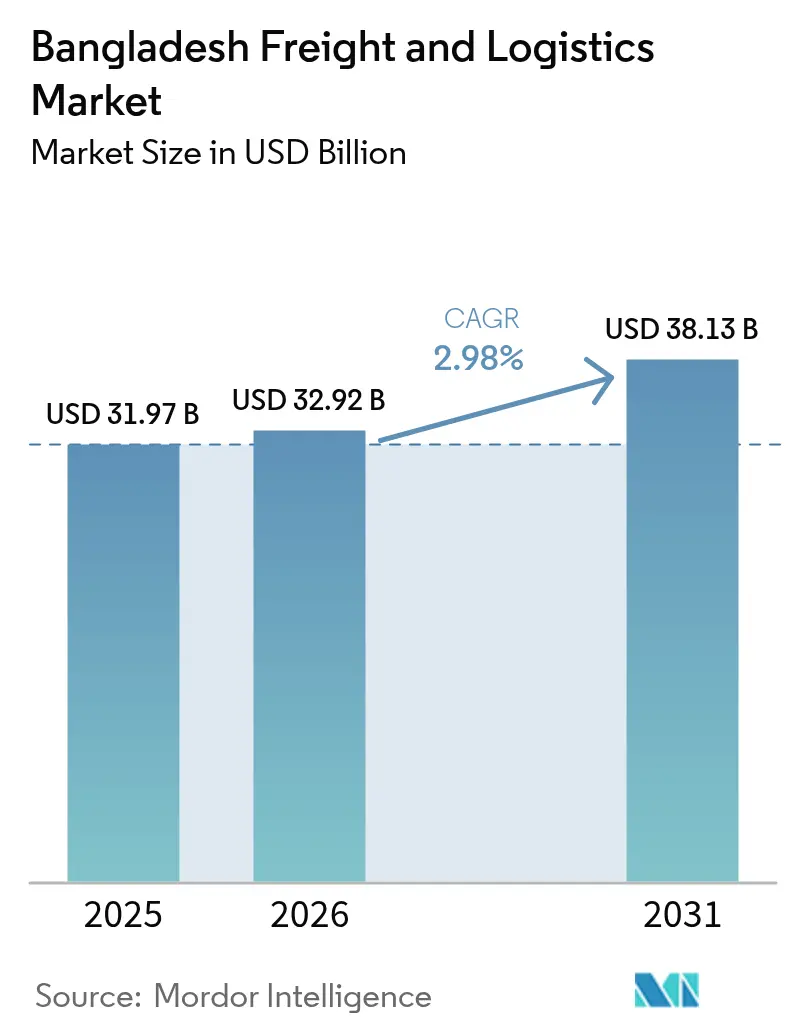
The Bangladesh freight and logistics market size in 2026 is estimated at USD 32.92 billion, growing from 2025 value of USD 31.97 billion with 2031 projections showing USD 38.13 billion, growing at 2.98% CAGR over 2026-2031. Expansion rests on resilient export momentum, led by ready-made garments, rising e-commerce volumes, and incremental progress on road, bridge, and port projects. Demand for value-added services is broadening as shippers seek reliability, visibility, and compliance across supply chains. Digital customs reforms are trimming clearance times, while public–private investment in deep-sea capacity signals a gradual modal shift toward larger vessels. Nonetheless, chronic road congestion, shallow port drafts, and limited rail capacity keep average logistics costs high and temper the growth trajectory of the Bangladesh freight and logistics market.
Key Report Takeaways
- By end user industry, manufacturing captured 35.20% of the Bangladesh freight and logistics market size in 2025; wholesale and retail trade is set to grow at a 3.27% CAGR between 2026-2031.
- By logistics function, freight transport led with 53.10% of the Bangladesh freight and logistics market share in 2025, while Courier, Express, and Parcel is projected to expand at a 3.47% CAGR between 2026-2031.
- By freight transport mode, road freight transport accounted for 68.75% revenue share in 2025; air freight transport is poised for the fastest 3.54% CAGR between 2026-2031.
- By warehousing type, non-temperature-controlled facilities held 91.55% revenue share in 2025, whereas the temperature-controlled segment is set to advance at a 3.40% CAGR between 2026-2031.
- By CEP segment, domestic services commanded a 63.80% revenue share 2025; international CEP shows the fastest projected 3.59% CAGR between 2026-2031.
- By freight forwarding mode, sea freight forwarding dominated with 75.20% revenue share in 2025; air freight forwarding is forecast to climb at a 3.61% CAGR between 2026-2031.
Note: Market size and forecast figures in this report are generated using Mordor Intelligence’s proprietary estimation framework, updated with the latest available data and insights as of 2026.
Bangladesh Freight And Logistics Market Trends and Insights
Drivers Impact Analysis*
| Driver | (~) % Impact on CAGR Forecast | Geographic Relevance | Impact Timeline |
|---|---|---|---|
| Explosive growth of RMG and emerging non-RMG exports fuelling time-sensitive logistics | +1.6% | National, with concentration in Dhaka and Chattogram | Medium term (2-4 years) |
| Government megaprojects Padma Bridge, Matarbari Port unlocking multimodal corridors | +1.3% | National, with emphasis on Southwest and Southeast regions | Long term (≥ 4 years) |
| Bilateral and regional transit pacts BBIN, BIMSTEC enabling cross-border through-flows | +0.9% | National, with concentration on border regions with India, Nepal, and Bhutan | Medium term (2-4 years) |
| Digitization push national single window and port community systems slashing dwell times | +0.8% | National, with initial impact at major ports and border crossings | Medium term (2-4 years) |
| Rising demand for temperature-controlled logistics for pharma and seafood exports | +0.6% | National, with concentration in major production and export hubs | Short term (≤ 2 years) |
| Foreign direct investment in logistics infrastructure driving capacity expansion | +0.5% | National, with focus on major economic zones and port cities | Medium term (2-4 years) |
| Source: Mordor Intelligence | |||
Explosive Growth of RMG and Emerging Non-RMG Exports Fueling Time-Sensitive Logistics
Ready-made garment exports reached USD 38.48 billion in 2024 and continue climbing, while non-traditional destinations added USD 6.33 billion in 2024. Knitwear and woven apparel shipments are rising in double digits, creating heavier demand for predictable transit times and compliant documentation[1]“RMG Exports Cross USD 38 Billion Mark,” Md Saifuddin, tbsnews.net . Buyers in Japan, Australia, and Latin America require stricter labelling and shorter replenishment cycles, spurring investments in bonded trucking, value-added warehousing, and parcel-level tracking. As order sizes shrink and frequency rises, the Bangladesh freight and logistics market is shifting from bulk movement toward agile, time-definite services that protect margin and reputation.
Government Megaprojects (Padma Bridge, Matarbari Port) Unlocking Multimodal Corridors
Padma Bridge has halved travel times between Dhaka and the southwest, opening routes once bypassed by exporters[2]“Padma Bridge Operations Company Gets Green Light,” Tapan Biswas, tbsnews.net . Policy makers expect up to 4 million new jobs over the next decade, intensifying intra-country freight flows. Matarbari deep-sea port, scheduled for 2027, will receive 100,000-plus DWT vessels, removing feeder legs that currently add extra expense to shipping costs. The link between Padma Bridge, Mongla Port, and Matarbari will gradually forge a triangle of road, rail, and maritime options, encouraging carriers to redesign networks and helping the Bangladesh freight and logistics market capture transit traffic from northeast India and Bhutan.
Bilateral and Regional Transit Pacts (BBIN, BIMSTEC) Enabling Cross-Border Through-Flows
The BBIN Motor Vehicles Agreement, supported by SASEC financing, has introduced electronic cargo tracking, integrated check posts, and streamlined documentation[3]“Bangladesh SASEC Road Connectivity Report,” Asian Development Bank, adb.org. Corridor 2 now handles 65% of India-Bangladesh road trade, and a trial run using ECTS cut border dwell to three hours. Transit cargo through Chattogram and Mongla ports for Indian importers is becoming routine, positioning the country as a coastal gateway for Himalayan economies. These developments diversify revenue streams and raise service benchmarks across the Bangladesh freight and logistics market.
Digitization Push, National Single Window and Port Community Systems Slashing Dwell Times
The Customs Strategic Plan 2024-2028 targets full Single Window coverage by 2027 and end-to-end automation of declarations by 2026. Pilot implementations cut release time for compliant consignments at Chattogram to 48 hours, down from 104. AI-driven risk engines are separating low-risk shipments, while mandatory Maritime Single Window protocols introduced in 2024 harmonize data across shipping lines, agents, and terminals. Faster processing improves vessel utilization, lowers inventory buffers, and strengthens the competitiveness of the Bangladesh freight and logistics market.
Restraints Impact Analysis*
| Restraint | (~) % Impact on CAGR Forecast | Geographic Relevance | Impact Timeline |
|---|---|---|---|
| Chronic congestion on Dhaka-Chattogram highway increasing transit times | -1.3% | National, with acute impact on Dhaka-Chattogram corridor | Short term (≤ 2 years) |
| Shallow draft at Chattogram port creating feeder dependence and higher trans-shipment cost | -0.9% | National, with primary impact on international trade flows | Medium term (2-4 years) |
| Skills gap in cold-chain and DG handling limiting service quality for high-value cargo | -0.8% | National, with concentration in major logistics hubs | Medium term (2-4 years) |
| Limited rail freight capacity and lack of ICD connectivity | -0.6% | National, with emphasis on major economic corridors | Long term (≥ 4 years) |
| Source: Mordor Intelligence | |||
Chronic Congestion on Dhaka-Chattogram Highway Increasing Transit Times
The 240 km long Dhaka-Chattogram Highway corridor handles more than 90% of external trade yet offers average speeds of 19-22 km/h. Frequent lane closures, dense mixed traffic, and limited bypasses undermine schedule reliability. As 61.65% of the load picked (tons) travels by road, long queues translate into stock-outs, overtime costs, and missed vessel connections. Expressway upgrades are planned, but land acquisition and funding gaps delay completion, constricting the medium-term growth of the Bangladesh freight and logistics market.
Shallow Draft at Chattogram Port Creating Feeder Dependence and Higher Trans-shipment Cost
Handling 3.26 million TEUs in 2024, Chattogram Port cannot berth container ships above 9.5 m draft, forcing cargo onto feeder services via Colombo or Singapore. Additional handling pushes ocean freight up by 15-25% and extends voyage time by 4-6 days. While the Bay Terminal and Matarbari projects promise relief, financing, dredging, and road linkage works must converge before direct mainline calls become routine. Until then, the Bangladesh freight and logistics market absorbs higher costs and faces eroding margins, especially for low-value garments.
*Our forecasts treat driver/restraint impacts as directional, not additive. The impact forecasts reflect baseline growth, mix effects, and variable interactions.
Segment Analysis
By End User Industry: Manufacturing Centrality Reflects Export Orientation
Manufacturing accounted for 35.20% of the revenue share of the Bangladesh freight and logistics market. RMG requirements dominate but are becoming more sophisticated, ranging from vendor-managed inventory to carton-level barcoding. The sector’s logistics bill is set to grow with integrated warehouse-transport bundles replacing spot trucking.
Wholesale and retail trade is poised for rapid growth. Digital marketplaces doubled order counts in two years, driving parcel density and reverse-logistics needs. This vertical will outpace others at 3.27% CAGR (2026-2031) as omnichannel chains open fulfillment centers near Dhaka and Chattogram. Construction and agriculture, though smaller, still require bulk inland movement of cement, steel, seeds, and perishables, demanding improved multimodal transfers and cold chain nodes.




By Logistics Function: CEP Segment Accelerates on E-commerce Surge
The freight transport segment contributed 53.10% of the Bangladesh freight and logistics market share. Moderate expansion reflects incremental highway upgrades and steady export flows. Road haulage represents 68.75% of the freight transport segment value because shippers continue to rely on trucking between cluster factories and ports. Manufacturing alone generates a significant share of road freight spending, underscoring how garments anchor domestic line-haul demand.
The Courier, Express, and Parcel segment is projected to grow at a CAGR of 3.47% from 2026 to 2031. Domestic parcels dominate as of 2025, but a faster 3.59% CAGR (2026-2031) in international traffic is reshaping service design. E-commerce accounted for 41.73% of CEP turnover in 2024, compelling operators to improve last-mile address accuracy, real-time status alerts, and pick-up lockers. As digital buyers expect two-day delivery to Tokyo or Toronto, the Bangladesh freight and logistics market is pushing CEP providers to integrate customs data feeds, bonded warehouses, and airside trucking for seamless export fulfilment.
By Courier, Express, and Parcel: International Segment Outpaces Domestic Growth
Domestic CEP services yielded a 63.80% revenue share in 2025. Operators battle inconsistent address formats and traffic bottlenecks that slow last-mile runs. Initiatives such as geo-coded digital postcodes and two-wheeler electric fleets are improving hit rates and lowering delivery windows, making city logistics a critical differentiator within the Bangladesh freight and logistics market.
International CEP is forecasted to grow at a CAGR of 3.59% between 2026-2031. Direct air links to Guangzhou, Dubai, and Istanbul now allow garments, leather goods, and handicrafts to reach consumers sooner. Global integrators provide trade compliance dashboards, while local partners offer doorstep pick-ups. Customs automation, electronic advance data, and electronic duty-merchandise systems together shorten export parcel clearance, bolstering the competitive edge of Bangladesh-based sellers.
By Warehousing and Storage: Temperature-Controlled Segment Gains Momentum
Non-temperature-controlled warehouses accounted for 91.55% of warehousing value inside the Bangladesh freight and logistics market. Most structures remain single-story sheds with manual handling and basic inventory systems. The wholesale and retail trade sector consumed half of this space, given the country’s growing grocery and fashion networks, while the manufacturing sector taking significant space to stage exports.
The temperature-controlled niche is gathering pace as pharmaceutical exports rise and seafood players target frozen value. The segment is forecasted to expand at a 3.40% CAGR (2026-2031), yet unmet demand persists, especially beyond major urban clusters. New public-private cold hubs, supported by USTDA financing, plan pallet racking, solar backup, and tele-monitoring to shrink the post-harvest loss rate.
By Freight Transport: Road Dominance Persists Amid Modal Shift Efforts
Road transport generated a 68.75% revenue share in the freight transport segment. Despite wide usage, load efficiency is low, with trucks carrying 61.65% of the load picked (tons) but covering only 33.34% of the load moved (ton-km) in 2024, evidence of short, congested hauls. Manufacturers and retailers were significant contributors to the segment. Regulators are piloting weigh-in-motion, axle bans, and GPS-based tolling to lift productivity and curb overloading.
Sea and inland waterways, with 60.57% of the load moved (ton-km) while only 21.05% of the load picked (tons), confirmed their efficiency. The segment will likely grow by 2030 as Matarbari and Bay Terminal add berth capacity. Rail freight transport held a minimal market share in 2024 but offers scale economies once gauge conversion and ICD links mature. Air freight transport posted the quickest 3.54% CAGR (2026-2031) outlook, buoyed by pharmaceuticals and premium knitwear. Together, these trends signal a gradual diversification of the Bangladesh freight and logistics market away from an over-road dependence.

By Freight Forwarding: Air Segment Grows on High-Value Cargo Demand
Sea and Inland Waterways freight forwarding amassed 75.20% of forwarding activity in the Bangladesh freight and logistics market in 2025. Box volumes grew 6.8% despite vessel draft limits at Chattogram. Forwarders invest in feeder slot agreements and inland water trans-loading barges to stabilize schedules and mitigate tide restrictions.
Air freight forwarding is expected to enjoy a 3.61% CAGR (2026-2031) outlook. Pharmaceuticals, technical textiles, and sample shipments need temperature logging, chain-of-custody, and warranty services unavailable in general cargo lanes. Forwarders are adding GDP-compliant containers, cool dollies, and data loggers to command premium yields. Land-road-rail forwarding under “others” benefits from BBIN transit rights that reduce border formalities on the Dhaka–Siliguri–Kathmandu lanes.
Geography Analysis
The Dhaka-Chattogram axis forms the backbone of the Bangladesh freight and logistics market, hosting the densest warehouse clusters, freight terminals, and CEP sorting centers. Yet it also carries the country’s worst congestion, with peak-hour speeds barely 20 km/h, forcing shippers to build larger safety stocks. Bridge toll reforms, weigh-in-motion scales, and completion of the Dhaka Elevated Expressway are expected to ease bottlenecks, but short-term relief is limited.
To the southwest, Padma Bridge has rerouted cargo previously ferried across the river, cutting Dhaka-Khulna transit from nine to three hours. The link is attracting garment factories, agro processors, and logistics parks that can bypass metropolitan traffic. The government plans to connect Mongla Port by dual-gauge rail and four-lane road will further diversify gateways, gradually rebalancing freight flows across the Bangladesh freight and logistics market.
The southeast anchors the ocean trade. Chattogram handled 3.26 million TEUs in 2024, but vessel-size restrictions and urban sprawl force truck queues on approach roads. Matarbari deep-sea port, plus the Bay Terminal reclamation, aims to double capacity and accommodate Panamax ships, giving the Bangladesh freight and logistics market a chance to become a regional trans-shipment option for northeast India, Bhutan, and Nepal. Border districts are also modernizing, with integrated check posts at Benapole and Tamabil linking customs, immigration, and quarantine under one roof, shortening document processing and encouraging road-rail multimodal solutions.
Regulatory Landscape
Bangladesh is aligning transport, trade facilitation, and infrastructure governance around multimodal efficiency and digital compliance, led by the National Logistics Policy 2025 approved on November 6, 2025. The policy framework emphasizes a long-horizon shift toward greater use of rail and inland waterways, alongside build-out of a digital logistics ecosystem that links customs and transport data flows, reinforcing ongoing National Board of Revenue customs automation efforts under the Customs Strategic Plan 2024-2028.
Port-sector regulation is also moving toward greater PPP participation and paperless processes. The Ministry of Shipping is drafting the Private Jetty and Terminal Construction, Operation and Management Policy-2026 to enable private development and operation of jetties and terminals, while the Chittagong Port Authority continues to expand digital port tools such as the Port Community System, e-delivery orders, e-payment services, and e-gate passes. On the infrastructure side, ECNEC approved the Bay Terminal Marine Infrastructure Development Project in April 2026, anchoring regulatory and project approvals needed to support larger-vessel handling and associated marine works.
Value Chain Analysis
The Bangladesh freight and logistics value chain is anchored by export-led shippers (notably ready-made garments) and high-volume domestic distributors (wholesale and retail), feeding demand into trucking, freight forwarding, and CEP networks concentrated on the Dhaka-Chattogram corridor. Upstream inputs include fleets, fuel, labor, and compliance systems (customs, documentation, security), while core service layers span line-haul road transport to ports and airports, international and domestic forwarding, and warehousing (predominantly non-temperature-controlled, with a smaller but strategically important temperature-controlled niche for pharmaceuticals and seafood).
Key nodes and intermediaries include Chattogram Port and associated off-dock facilities/ICDs, border crossings handling BBIN-enabled road trade, and air gateways used for time-sensitive exports. Operational friction points such as highway congestion, clearance system disruptions (including reported Asycuda World issues in 2025), and constrained rail connectivity between port and inland depots elevate inventory buffers and increase demand for value-added services such as visibility, compliant handling, and bonded movements. On the enabling side, policy and investment initiatives such as the National Logistics Policy 2025, Bay Terminal and Matarbari developments, and proposed reforms around foreign participation in off-dock facilities/ICDs are reshaping how capital, technology, and global operating standards move through the value chain.
Competitive Landscape
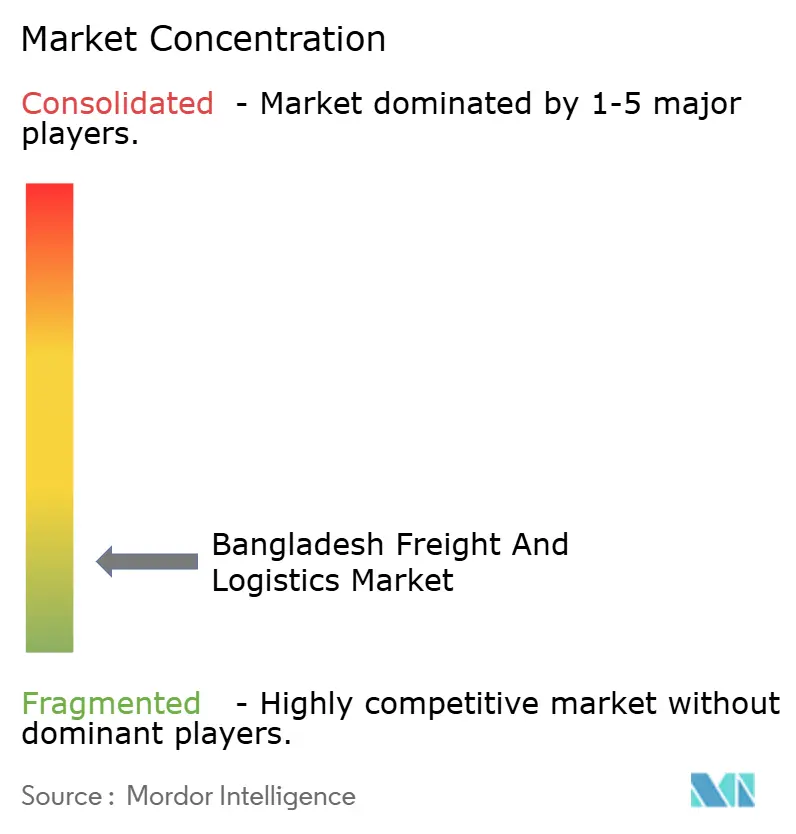
Competition remains fragmented, as no single operator controls a dominant national share across modes. Global multinationals command international forwarding, express, and container terminal concessions, leveraging technology, global contracts, and risk management standards. Domestic fleets dominate short-haul trucking and general warehousing, often using family-owned fleets that offer agility and deep local knowledge. The Bangladesh freight and logistics market is witnessing gradual consolidation, with mid-sized firms merging to meet minimum fleet requirements, quality audits, and IT investments set by large exporters and the National Logistics Policy 2024.
Strategic investment is a critical differentiator. A.P. Moller-Maersk’s USD 800 million stake in Laldia Container Terminal will add three deep berths and advanced gate automation, enhancing throughput and linking seamlessly to the company’s inland depots. DHL’s EUR 26 million (USD 28.16 million) facility in north Dhaka doubles parcel sort capacity and incorporates sustainable aviation fuel modularity to lower Scope 3 emissions. Toll Group’s new forwarding branch, backed by Japan Post, brings healthcare GMP competencies and alternative-fuel vehicle trials, broadening choices for pharmaceutical shippers.
Digital adoption has become the frontline of competitive positioning inside the Bangladesh freight and logistics market. Global players deploy AI route optimization, blockchain bill-of-lading, and IoT sensor networks, while leading local carriers partner with fintechs for cashless collections. Smaller operators risk being crowded out unless they pool resources for shared visibility platforms. The forthcoming ICD at Dhirasram and rail gauge conversions present new opportunities for asset-right forwarders to plug into port-to-factory shuttles, re-shaping rivalry based on multimodal reliability rather than solely on price.
Bangladesh Freight And Logistics Industry Leaders
DHL Group
DSV A/S (including DB Schenker)
A.P. Moller - Maersk
Kuehne + Nagel
FedEx
- *Disclaimer: Major Players sorted in no particular order

Market Opportunities and Future Outlook
Port capacity and productivity upgrades are a key whitespace area because shallow draft constraints at Chattogram and feeder dependence translate into longer transit cycles and higher end-to-end logistics costs. The July 2026 inauguration of RSGT International's upgraded Patenga container terminal in Chattogram, following a USD 170 million investment that doubled annual capacity to 600,000 TEU and added ship-to-shore cranes and hybrid RTGs, highlights active momentum toward higher-throughput terminal operations. At the same time, the Bay Terminal marine infrastructure program (ECNEC approval in April 2026, with World Bank financing referenced in the project plan) and ongoing workstreams at Matarbari provide a clear pipeline for larger-vessel accommodation and improved yard-gate fluidity, giving operators a practical basis to expand container handling, inland distribution, and port-centric logistics services.
Digitization and trade facilitation also create near-term opportunity, tied to ongoing reform programs. The National Logistics Policy 2025 and the Customs Strategic Plan 2024-2028 emphasize end-to-end data integration, while the Chittagong Port Authority's push toward a paperless port via Port Community System tools, e-payment, and e-gate passes supports scalable visibility services for forwarders and CEP players. In addition, multilateral programs such as ADB Technical Assistance (Logistics Sector Development, through Q2 2027) offer a structured pathway for feasibility studies and project identification across multimodal logistics, supporting participation by third-party logistics providers, terminal operators, and technology vendors within defined investment pipelines.
Recent Industry Developments
- July 2026: DHL Express Bangladesh added 18 electric vehicles to its pickup and delivery fleet in Dhaka as part of a broader electrification plan. This reduces reliance on internal-combustion last-mile vans and improves DHL's ability to support ESG-driven shipper requirements in international express and time-definite deliveries.
- November 2025: APM Terminals (A.P. Moller - Maersk) signed a 30-year concession agreement with the Chittagong Port Authority to design, finance, build, and operate the Laldia Container Terminal in Chattogram. The agreement formalizes a long-dated PPP structure for deepening terminal capability and introduces global terminal operating standards that can influence service levels for carriers and forwarders calling Bangladesh.
- September 2024: DHL Express announced a new Dhaka facility investment to expand parcel handling and sorting capability. The added processing capacity supports higher shipment volumes from exporters and e-commerce sellers while improving time-definite service performance through faster sortation and dispatch cycles.


Research Methodology Framework and Report Scope
Market Definition and Coverage
This market covers the total value of freight and logistics services delivered in Bangladesh, including moving goods, forwarding shipments, warehousing and storage, and courier, express, and parcel services, across domestic and international flows linked to the country.
Scope exclusions: We exclude passenger transport, financial services attached to postal networks, and purely digital platforms that do not provide physical logistics execution.
Segmentation Overview
- End User Industry
- Agriculture, Fishing, and Forestry
- Construction
- Manufacturing
- Oil and Gas, Mining and Quarrying
- Wholesale and Retail Trade
- Others
- Logistics Function
- Courier, Express, and Parcel (CEP)
- By Destination Type
- Domestic
- International
- By Destination Type
- Freight Forwarding
- By Mode of Transport
- Air
- Sea and Inland Waterways
- Others
- By Mode of Transport
- Freight Transport
- By Mode of Transport
- Air
- Pipelines
- Rail
- Road
- Sea and Inland Waterways
- By Mode of Transport
- Warehousing and Storage
- By Temperature Control
- Non-Temperature Controlled
- Temperature Controlled
- By Temperature Control
- Other Services
- Courier, Express, and Parcel (CEP)
Data Sources, Market Sizing, and Validation
Desk Research
Desk research starts with demand and trade signals that can be checked repeatedly, before we build service-level assumptions. We relied on public statistics and policy sources such as the Bangladesh Bureau of Statistics, Bangladesh Bank balance of payments releases, Bangladesh Customs and National Board of Revenue trade publications, and Ministry of Road Transport and Bridges and port authority updates for capacity and infrastructure changes.
To translate activity into revenue, we also reviewed sources such as UN Comtrade and World Bank logistics and trade indicators, along with company annual reports, investor presentations, reputable local and international press, and association websites that track freight handling and warehousing activity. Where filings are limited, we used a paid news and financials database and a paid logistics supply chain and freight rate database to cross-check price ranges and directional rate changes over time. These desk sources are not exhaustive, and we drew on additional references to collect data points, validate assumptions, and clarify gaps.
Primary Interviews and Surveys
We interview and survey freight forwarders, carriers, warehouse operators, customs agents, and shippers active in Bangladesh. Their responses clarify trade demand, fleet and warehouse utilization, lane prices, storage use, service mix, and customs or port delays. Where answers conflict, we re-contact respondents and compare the field evidence with Bangladesh trade and transport data.
Distribution of primary research fieldwork respondents
| Company type | Respondent position |
|---|---|
| Top tier: 27% | CXOs: 18% |
| Mid tier: 48% | Functional/Unit leaders: 32% |
| Smaller Players: 25% | Managers: 50% |
Market-Sizing & Forecasting
Our core model uses a top-down build where Bangladesh trade flows, domestic distribution activity, and logistics intensity are translated into demand pools by service line, and then converted into value using service-specific price and mix assumptions. The totals are then corroborated with selective bottom-up approximations, such as sample provider revenue roll-ups, lane-based rate checks, and volume times average selling price (ASP) checks for high-visibility activities.
Inputs that materially shape the size include export and import tonnage and value, container throughput and port handling signals, road freight dominance in modal mix, warehousing temperature-control penetration, and CEP demand tied to domestic and cross-border parcels. For forecasting, we use scenario analysis supported by short time-series smoothing on key drivers like trade growth, infrastructure commissioning timelines, and observed rate normalization, and we validate those paths with expert views on how quickly service prices reset. When bottom-up indicators are patchy, we apply conservative fill factors tied to capacity and utilization patterns, and we recheck that implied revenue per ton or per parcel stays within interview-confirmed ranges.
Data Validation & Update Cycle
Validation is handled through stepwise checks that compare model outputs against independent signals, and then push any outliers back for review. We run variance checks across service lines so that implied pricing and activity ratios (such as revenue per ton moved, revenue per parcel, and warehousing revenue per occupied area) do not drift away from what operators describe as workable in Bangladesh.
Before sign-off, the model is reviewed in multiple passes, and follow-up calls are triggered when a new data release or a major event changes a core assumption. Reports are refreshed annually, and interim updates are made when material shifts occur in currency, trade volumes, fuel or freight rates, or capacity additions. Right before delivery, analysts do a final update sweep so the view is aligned to the latest public releases and field feedback.
Mordor Intelligence's Bangladesh Freight and Logistics Market Estimate Compared With Other Published Estimates
Published market sizes for Bangladesh freight and logistics can look different even when the market name sounds identical, because the refresh timing and the conversion to USD tend to move the number by a lot in a currency-sensitive country. Differences also show up when firms treat ASP changes as a straight line, rather than tying them to rate cycles and mix shifts across road freight, forwarding, warehousing, and CEP.
When we force all inputs to align to the same base year and exchange-rate timing, the biggest gap drivers become clearer, including whether CEP and forwarding are fully included, how domestic versus international flows are counted, and whether warehousing revenue is linked to occupancy and temperature-controlled penetration or treated as a flat add-on. The update cadence and re-contact checks also matter because trade growth, congestion, and project timelines can swing quarterly, which is why the model is refreshed with these signals before the market total is finalized, a discipline applied by Mordor Intelligence.
Benchmark comparison
| Source | Market Size | Gaps in Research Methodology |
|---|---|---|
| Mordor Intelligence | USD 31.97 B (2025) | |
| Industry Association A | USD 29.40 B (2025) | Often stays closer to freight transport and core warehousing revenues, and may exclude CEP and parts of forwarding that are bundled into shipper spend, which compresses the total. |
| Global Consultancy B | USD 35.60 B (2025) | Typically uses broader logistics spend proxies and applies uniform ASP escalation, which can overstate value when rates normalize or when mode and service mix shifts toward lower-yield moves. |
The spread in the table is mainly explained by what gets counted as logistics revenue and how USD conversion and price movement are timed. By anchoring the model to service-level activity checks and then testing implied pricing against field feedback, we keep a practical estimate that can be reproduced and updated as new trade and rate signals come in.


Key Questions Answered in the Report
What is the current value of the Bangladesh freight and logistics market?
The market is worth USD 32.92 billion in 2026 and is projected to grow to USD 38.13 billion by 2031.
Which logistics function holds the largest share?
Freight transport leads with 53.10% of Bangladesh freight and logistics market share in 2025.
Which segment is expanding the fastest?
The Courier, Express, and Parcel (CEP) segment shows the quickest 3.47% CAGR (2026-2031), spurred by e-commerce growth.
How will Padma Bridge affect freight flows?
Padma Bridge has already cut Dhaka-Khulna travel times, creating new southwest corridors and diversifying gateways away from the congested Dhaka-Chattogram axis.
Why is shallow draft at Chattogram Port a constraint?
Limited draft forces reliance on feeder vessels, adding 15-25% to freight costs and extending ocean transit by several days.
What technology initiatives are improving customs efficiency?
Implementation of the Bangladesh Single Window and AI-based risk assessments is lowering clearance times, making border crossings more predictable for shippers.
Page last updated on:




