
Aviation Headsets Market Size and Share
Market Overview
| Study Period | 2020 - 2031 |
|---|---|
| Market Size (2026) | USD 1.31 Billion |
| Market Size (2031) | USD 1.75 Billion |
| Growth Rate (2026 - 2031) | 5.88 % |
| Fastest Growing Market | Asia-Pacific |
| Largest Market | North America |
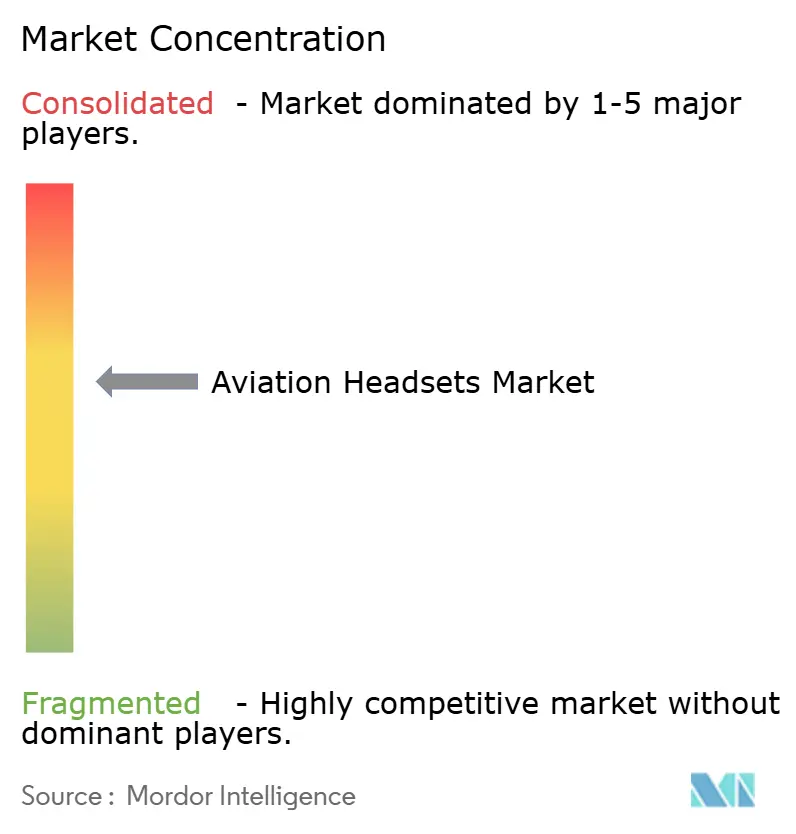
| Market Concentration | Medium |
Major Players *Disclaimer: Major Players sorted in no particular order Image © Mordor Intelligence. Reuse requires attribution under CC BY 4.0. | |
Aviation Headsets Market Analysis by Mordor Intelligence
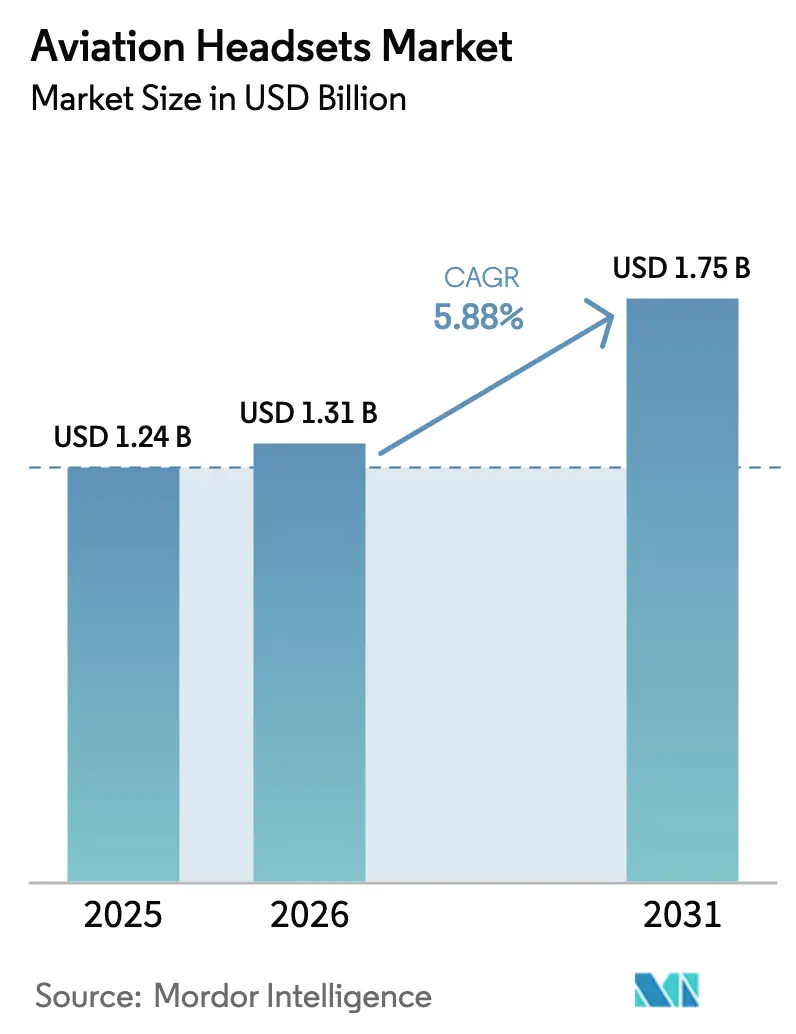
The aviation headsets market size was valued at USD 1.24 billion in 2025 and estimated to grow from USD 1.31 billion in 2026 to reach USD 1.75 billion by 2031, at a CAGR of 5.88% during the forecast period (2026-2031). This sustained rise reflects rapid uptake of headsets in electric vertical take-off and landing (eVTOL) programs, continued growth in commercial airline and military fleets, and a sharp rebound in pilot training enrolments as carriers rebuild capacity. Stricter global hearing-protection mandates, steady defense retrofit cycles, and widening acceptance of certified wireless connectivity in cockpits reinforce demand. Supply chain resilience for acoustic components and the fight against counterfeit products remain pivotal. Yet, established manufacturers leverage R&D investments and certification expertise to protect their share and margin within the aviation headsets market.
Key Report Takeaways
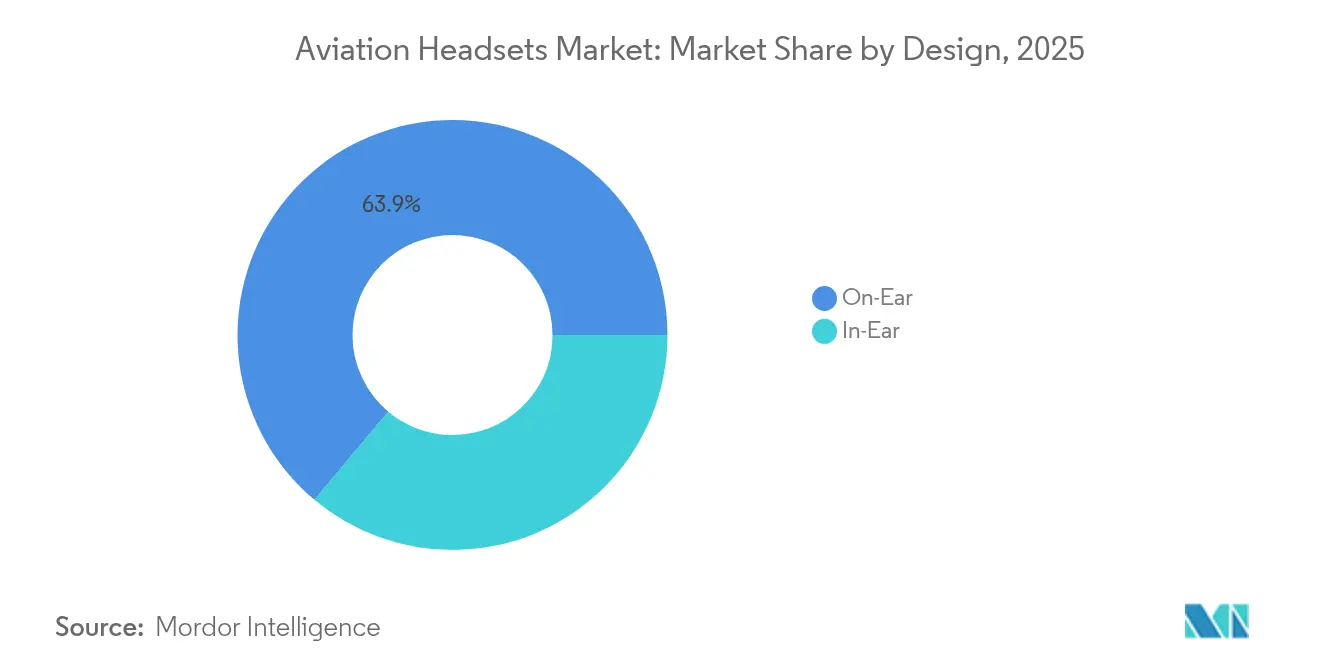
- By design, on-ear models held 63.90% of the aviation headset market share in 2025, while in-ear variants are set to expand at a 7.10% CAGR to 2031.
- By connectivity, wired solutions captured 57.10% of the aviation headsets market size in 2025; wireless offerings are projected to grow at 8.15% CAGR over 2026-2031.
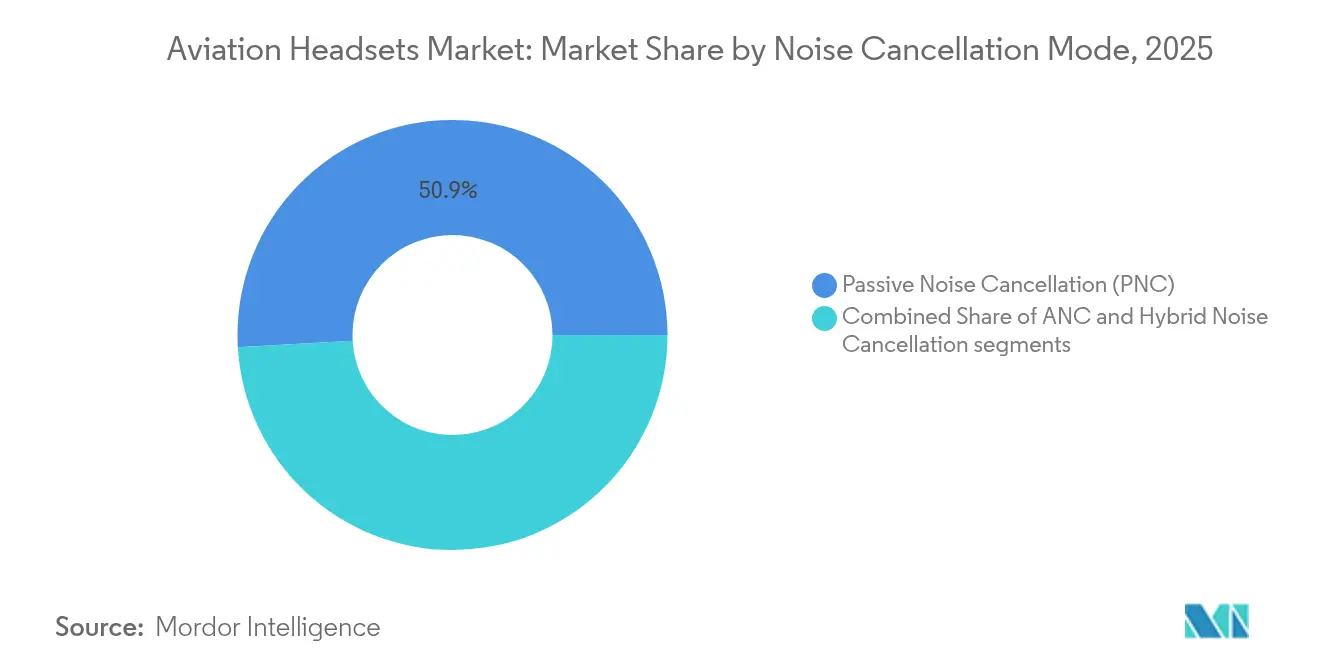
- By noise-cancellation mode, passive products commanded 50.90% of the aviation headset market share in 2025; active noise cancellation (ANC) is advancing at an 8.25% CAGR.
- By application, commercial aviation led with 49.20% revenue share in 2025, while the eVTOL and urban air-mobility segment is forecasted to expand at a 9.85% CAGR to 2031.
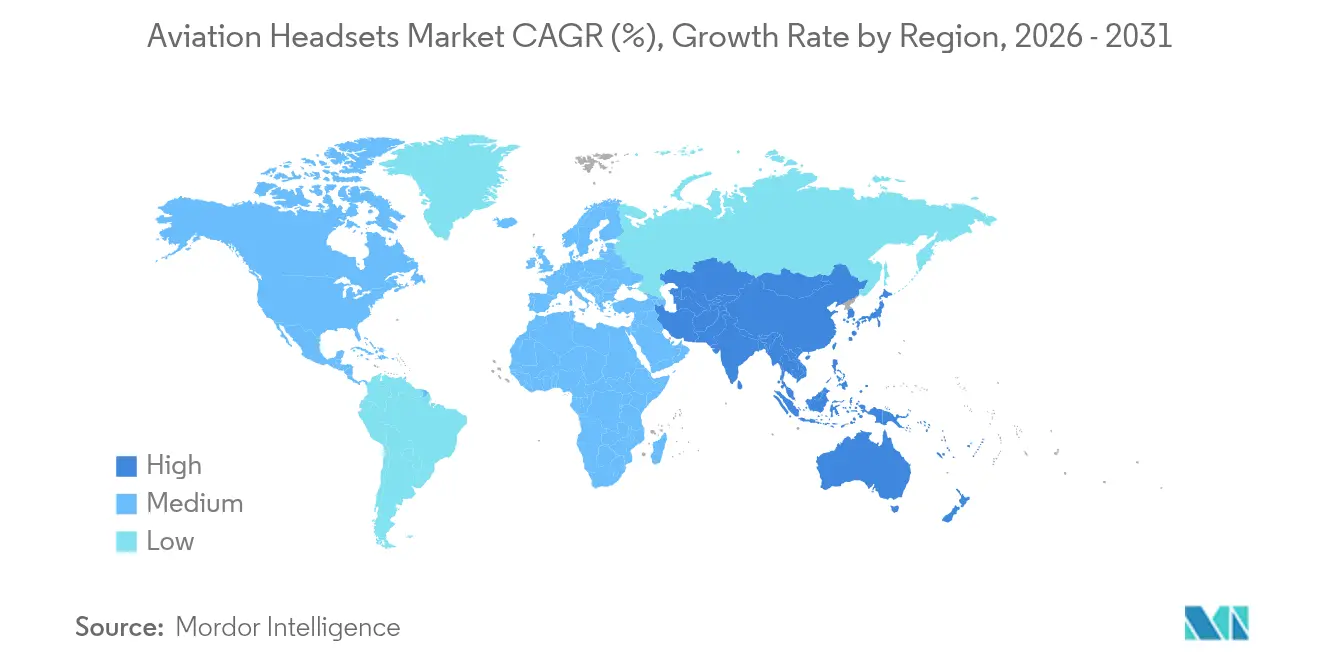
- By geography, North America accounted for 45.10% of the aviation headsets market in 2025; Asia-Pacific is the fastest-growing region, with a 7.85% CAGR through 2031.
Note: Market size and forecast figures in this report are generated using Mordor Intelligence’s proprietary estimation framework, updated with the latest available data and insights as of 2026.
Global Aviation Headsets Market Trends and Insights
Drivers Impact Analysis*
| Driver | (~) % Impact on CAGR Forecast | Geographic Relevance | Impact Timeline |
|---|---|---|---|
| Surge in pilot‐training enrolments | +1.2% | Global, highest in North America and Asia-Pacific | Medium term (2-4 years) |
| Rapid adoption of Bluetooth and IP cockpit connectivity | +0.8% | North America and Europe, spreading to Asia-Pacific | Short term (≤ 2 years) |
| Stringent hearing-protection mandates in commercial aviation | +0.6% | Global, led by North America and Europe | Long term (≥ 4 years) |
| Rising demand from eVTOL and urban air-mobility operators | +1.4% | North America and Europe, early Asia-Pacific pilots | Medium term (2-4 years) |
| Defense retrofit programs for 3-D audio/ANC upgrades | +0.7% | North America, Europe, select Asia-Pacific nations | Long term (≥ 4 years) |
| Litigation-driven shift to certified low-pressure clamping designs | +0.5% | Global, liability-sensitive markets | Medium term (2-4 years) |
| Source: Mordor Intelligence | |||
Surge in Pilot Training Enrolments
Airlines worldwide are accelerating hiring to close pandemic-era gaps and support fleet growth expected this decade. Flight schools often require each trainee to purchase a personal certified headset for hygiene and safety, directly increasing unit demand. The US Federal Aviation Administration (FAA) forecasts increased pilot throughput to back its Advanced Air Mobility (AAM) roadmap. Active noise-reduction models see heightened uptake because instructors report lower fatigue and clearer intercom audio, encouraging students to invest in premium gear.
Rapid Adoption of Bluetooth and IP Cockpit Connectivity
International Telecommunication Union (ITU) specifications for Wireless Avionics Intra-Communications, finalized in 2024, give aircraft OEMs a common framework to certify cockpit headsets that operate without cords. Boeing and Airbus have begun integrating these standards into next-generation flight decks, creating a first-mover edge for vendors that secure Supplemental Type Certificates ahead of rivals. General aviation pilots value cable-free freedom, while airlines weigh wireless benefits against rigorous reliability testing.
Stringent Hearing-Protection Mandates in Commercial Aviation
The Occupational Safety and Health Administration (OSHA) reiterates that cockpit noise above 85 dB can cause irreversible hearing loss without adequate protection.[1]Source: Occupational Safety and Health Administration, “Standard Interpretations on Hearing Protection,” osha.gov Air Line Pilots Association (ALPA) guidance reinforces airlines’ duty of care to supply compliant headsets. Consequently, airlines are phasing out passive models on longer sectors in favor of ANC units that meet or exceed FAA Flight Standards Service requirements.
Litigation-Driven Shift to Certified Low-Pressure Clamping Designs
Prolonged headset wear can trigger headache claims and ergonomic lawsuits. FAA Technical Standard Orders (TSO) require whole-system certification rather than component testing, adding cost but enhancing liability protection. Manufacturers who document low side-pressure designs—such as Bose’s A30—gain traction with airlines intent on reducing occupational health risk.
Restraints Impact Analysis*
| Restraint | (~) % Impact on CAGR Forecast | Geographic Relevance |
|---|---|---|
| Premium pricing and high total cost of ownership | -1.8% | Global, particularly affecting price-sensitive segments and emerging markets |
| Proliferation of counterfeit and uncertified headsets | -0.9% | Global, with concentration in markets with weak enforcement |
| Aircraft-battery safety certification hurdles for wireless models | -0.7% | Global, with stricter impact in North America and Europe due to regulatory oversight |
| Supply risk for rare-earth acoustic components | -0.5% | Global, with particular vulnerability in Asia-Pacific manufacturing hubs |
| Source: Mordor Intelligence | ||
Premium Pricing and High Total Cost of Ownership
Flagship ANC aviation headsets often list between USD 899 and USD 1,299, which can exceed a student pilot’s quarterly tuition budget. Price sensitivity is highest in general aviation communities across Latin America, Africa, and parts of Asia, slowing conversions from passive to active models. Device-lifecycle costs also include periodic battery or rechargeable-pack replacements, spare ear-seal sets, and, for some operators, TSO recertification fees, all of which suppress near-term adoption despite long-run health benefits.
Proliferation of Counterfeit and Uncertified Headsets
An expanding grey market offers low-cost look-alikes that claim TSO compliance yet only certify the microphone capsule. FAA guidance clarifies that altering a TSO-approved sub-assembly voids compliance unless approved by the original manufacturer.[3]Source: US Federal Aviation Administration, “Innovate28 Implementation Plan,” faa.gov Pilots who unknowingly purchase counterfeits risk communication failure and forfeit product-liability protections, prompting legitimate vendors to invest in authentication programs and educating distributors to preserve trust in the aviation headsets market.
*Our forecasts treat driver/restraint impacts as directional, not additive. The impact forecasts reflect baseline growth, mix effects, and variable interactions.
Segment Analysis
By Design: On-Ear Leadership, In-Ear Momentum
On-ear models dominated 63.90% of the aviation headset market share in 2025, proving passive isolation and broad compatibility with legacy intercom impedances. In-ear designs, however, are on track for a 7.10% CAGR through 2031. Their smaller footprint aligns with integrated helmet systems in eVTOL prototypes and military rotorcraft. Airlines continue standardizing on-ear ANC for long-haul crews, citing reduced fatigue. At the same time, charter operators adopt in-ear units to accommodate tight cockpit geometries and lighter weight requirements.
In-ear innovation also supports emerging hybrid ANC algorithms that compensate for seal variability common to earbud formats. As flight decks migrate toward head-up displays and eye-tracking controls, manufacturers push compact eartip-based sensor arrays to collect biometric data without adding headband pressure. This convergence between audio and physiological monitoring broadens value propositions, reinforcing share gains by the in-ear segment within the aviation headsets market.



By Type: Wireless Acceleration, Wired Reliability
Wired headsets held 57.10% of the aviation headsets market size in 2025, reflecting regulators’ long-standing preference for fail-safe, power-independent communication paths. Wireless variants are forecasted to grow at 8.15% CAGR, particularly in instructional and personal-ownership segments where pilots prioritize freedom of movement. General aviation leads adoption because portable power supplies and interference-testing hurdles are less stringent than scheduled airline operations.
Commercial carriers, while cautious, now evaluate wireless options for newer flight decks that already integrate encrypted Bluetooth Low Energy channels. The FAA and EASA continue monitoring electromagnetic-compatibility test data, and certification successes over the next two years will likely accelerate fleet-wide replacement cycles. Military procurement teams view wireless as critical for modular cockpits and rapid aircraft re-role, further stimulating demand in the aviation headsets market.
By Noise Cancellation Mode: ANC Disrupts Passive Norms
Passive designs still commanded 50.90% market share in 2025 due to lower price points and zero dependence on onboard power, a draw for cost-constrained flight schools. Active noise cancellation, however, is gaining 8.25% annually, fueled by OSHA and EASA regulations that assign employers explicit responsibility for hearing-risk mitigation. Airline buyers often cite a measurable reduction in crew fatigue when switching to ANC, translating into safer operations on ultra-long-range routes.
Hybrid systems that blend passive attenuation with adaptive digital filters are emerging as a sweet spot, especially for helicopters and turboprops, where vibration signatures evolve rapidly with flight regime. Vendors are layering value by embedding CO-detection and audio equalization into ANC firmware, positioning headsets as multi-sensor safety hubs rather than mere audio devices in the aviation headsets industry.
By Application: eVTOL Upsets Commercial Aviation Dominance
Commercial aviation contributed 49.20% of 2025 revenue, underpinned by routine replacement cycles and rising global air traffic movements. Yet headsets specified for eVTOL and urban air mobility are projected to expand at a 9.85% CAGR, outpacing every legacy segment. Certification of piloted eVTOL services in early-adopter cities triggers specialized training programs, each cadet requiring devices tuned for highly automated environments and continuous data streaming.
Military modernization continues to underpin steady demand, with 3-D spatial audio retrofits improving situational awareness. General aviation rebounds on post-pandemic leisure flying, whereas air-traffic-control headsets remain a niche, stable vertical driven by tower and center upgrades. Over the forecast period, rising urban-air-mobility sorties are set to incrementally erode commercial aviation’s share, reshaping long-term revenue mix in the aviation headsets market.
Geography Analysis
North America retained 45.10% of global revenue in 2025, supported by robust flight-school enrollments, fleet renewal in regional and long-haul categories, and accelerated defense spending on cockpit-audio retrofit programs. The United States remains the largest contributor, leveraging its sizable general-aviation community and AAM demonstration corridors. Canada’s aerospace supply chain and helicopter-intensive resource sector lend steady incremental demand, whereas Mexico’s tourism-driven airline expansion supports headset refresh cycles in narrowbody fleets.
Asia-Pacific shows the most pronounced momentum, with a 7.85% CAGR through 2031. China’s civil aviation regulator authorizes new pilot-training centers and local eVTOL assembly lines. India’s UDAN regional connectivity scheme multiplies commercial pilot requirements, and government sponsorship of aerospace skill parks supports headset procurement for simulators. Japan, South Korea, and Singapore run early commercial UAM trials, standardizing on ultra-light in-ear ANC headsets compatible with high-automation cockpits.
Europe maintains measured growth as EASA stamps global benchmarks for VTOL certification. Airlines headquartered in Germany, France, and the United Kingdom invest in ANC upgrades to comply with more rigid cockpit noise-exposure rules. Concurrently, defense ministries allocate funds to digitalize legacy fleets, including spatial-audio headsets for multi-role fighter and transport aircraft. Southern and Eastern Europe record brisk general-aviation and aerial-work activity, broadening the regional addressable base within the aviation headsets market.

Regulatory Landscape
Aviation headsets used in certificated aircraft are governed by aviation audio-system minimum performance standards under FAA TSO-C139a. This covers aircraft microphones, headsets, handsets, and speakers, and it supersedes legacy TSOs such as TSO-C50c, TSO-C57a, and TSO-C58a. In Europe, EASA aligns through ETSO-C139a, which links requirements back to established audio-system characteristics and performance metrics (for example, via RTCA DO-214A references), shaping headset design targets for intercom compatibility, audio intelligibility, and environmental robustness.
Across both FAA and EASA regimes, manufacturers pursuing TSO authorization (TSOA) must evidence compliance through structured qualification and environmental tests, commonly including RTCA DO-160 protocols. This raises the bar for new entrants and keeps certification capability as a durable competitive lever. For Part 121-style airline operations and other tightly controlled use cases, operator procurement practices often favor FAA-approved, TSO-compliant equipment. Wireless models add additional scrutiny around electromagnetic compatibility and aircraft battery safety approvals before wider adoption in line operations.
Value Chain Analysis
The aviation headset value chain begins with specialized component suppliers for microphones and speakers, ANR/ANC electronics and DSP modules, headband and ear-seal materials, and battery and charging sub-systems for wireless or hybrid-power designs. These inputs flow to headset integrators and brands such as Bose, David Clark, and Lightspeed Aviation, which combine acoustic engineering with safety and certification work, including TSO/ETSO compliance activities, and perform reliability validation against aviation environmental test expectations.
Downstream, products reach customers through a mix of direct-to-customer channels, authorized dealers and distributors, and operator procurement programs that bundle support and configuration. Integration and tuning increasingly extend beyond hardware, as vendors coordinate profiles and interoperability with aircraft or powerplant ecosystems, for example through B2B aviation supply programs such as Rotax Care. Aftermarket services and spares (ear seals, mic covers), along with firmware updates for smart or connected headsets, also support lifecycle revenue and help differentiate against counterfeit and uncertified supply.
Competitive Landscape
Moderate concentration defines the competitive arena: no vendor exceeds half of worldwide unit shipments, yet the top five account for a clear majority. Bose leverages proprietary TriPort ANC and low-clamp-force architecture, securing long-haul airline contracts and premium general-aviation loyalty. David Clark sustains share through rugged construction, TSO pedigree, and a robust military catalog. Lightspeed differentiates via software-enabled safety functions—such as Kanari Smart Alert for CO detection—extending value beyond audio.
Strategic moves mirror three themes. First, platform integration: headset makers bundle mobile apps that log cockpit environmental data, creating subscription-ready ecosystems. Second, certification speed: vendors race to complete wireless TSO submissions to capture early airline retrofit budgets. Third, supply-chain resilience: leading brands reshore driver and microphone element production after the US Government Accountability Office flagged rare-earth dependency risks.
New entrants face steep barriers: capital-intensive acoustic-chamber facilities, multi-year regulatory testing, and the need to demonstrate lithium-battery safety for wireless models. Nevertheless, niche innovators focusing on eVTOL-specific designs or defense-grade bone-conduction microphones can still carve out a share by partnering with airframe OEMs at the prototype stage, demonstrating that technological differentiation—not price cuts—remains the dominant competitive lever in the aviation headsets market.
Aviation Headsets Industry Leaders
Bose Corporation
David Clark Company
3M Company
Lightspeed Aviation Inc.
Keenfinity GmbH
- *Disclaimer: Major Players sorted in no particular order

Market Opportunities and Future Outlook
Software-defined performance and platform-specific tuning have created a clear whitespace for headset makers beyond traditional hardware refresh cycles. In July 2026, Lightspeed Aviation and BRP-Rotax announced a Delta Zulu Active Noise Reduction and audio profile tailored to Rotax 912, 915, and 916 iS/c engine acoustic characteristics, with deployment through the Rotax Care program in August 2026 and broader firmware updates planned for existing users in fall 2026. This type of ecosystem linkage supports premiumization through measurable cockpit audio improvements, and it also creates recurring engagement opportunities via updates and configuration management, particularly in general aviation fleets where Rotax-powered aircraft remain common.
A second opportunity comes from accelerating certification and compliance differentiation as operators seek higher hearing protection and verified equipment provenance. OSHA's 85 dB hearing-risk threshold and airline duty-of-care guidance intersect with FAA and EASA TSO/ETSO expectations, which tends to favor vendors able to document whole-system compliance and ergonomic improvements such as low-pressure clamping designs. The premium price tier is already visible, with Bose's A30 positioned at USD 1,299 as of June 2026, indicating scope for feature-led segmentation (ANC performance, comfort, and certified connectivity) alongside authentication programs that protect channel integrity from counterfeit products.
Recent Industry Developments
- April 2026: 3M PELTOR ComTac VI headsets used on NASA Artemis II Orion crew mission. The aerospace grade headset integration for space missions underscores the role of rugged wireless headsets in high-profile programs and validates market demand for reliable cockpit communications in extreme environments.
- April 2026: Bose marks 40th ANR aviation headset anniversary during SUN 'n FUN Aerospace Expo. The brand milestone reinforces leadership in active noise reduction headsets and supports branding and demand momentum across commercial and defense aviation segments.
- March 2026: DoD contract award for headset-microphone equipment (SPE7MX26D0022). The defense procurement activity expands the footprint for rugged, integrated headset systems and demonstrates long-term sole-source supply relationships in military programs.


Research Methodology Framework and Report Scope
Market Definition and Coverage
We define the aviation headsets market as revenues earned from certified headsets used for pilot and crew audio communication and hearing protection in aircraft operations, including wired and wireless models sold to commercial, military, and general aviation users.
Scope exclusions: this sizing excludes non-aviation consumer headphones, uncertified gaming headsets, and cockpit intercom systems sold as standalone equipment.
Segmentation Overview
- By Design
- On-Ear
- In-Ear
- By Type
- Wired
- Wireless
- By Noise Cancellation Mode
- Active Noise Cancellation (ANC)
- Passive Noise Cancellation (PNC)
- Hybrid Noise Cancellation
- By Application
- Commercial Aviation
- Military Aviation
- General Aviation
- eVTOL and Urban Air Mobility (UAM)
- Air Traffic Control (ATC)
- By Geography
- North America
- United States
- Canada
- Mexico
- Europe
- United Kingdom
- Germany
- France
- Russia
- Rest of Europe
- Asia-Pacific
- China
- Japan
- India
- South Korea
- Australia
- Rest of Asia-Pacific
- South America
- Brazil
- Rest of South America
- Middle East and Africa
- Middle East
- United Arab Emirates
- Saudi Arabia
- Qatar
- Rest of Middle East
- Africa
- South Africa
- Rest of Africa
- Middle East
- North America
Data Sources, Market Sizing, and Validation
Desk Research
Desk research is used to set the boundaries and build the starting demand picture before interviews. We typically rely on public aviation activity signals and safety context, such as ICAO air transport statistics, FAA civil aviation and pilot data, EASA rulemaking and safety publications, and IATA operational indicators.
To convert activity into market value assumptions, we also review sources such as U.S. Bureau of Transportation Statistics datasets, U.S. International Trade Commission import and tariff lookups for headset related categories (where applicable), and peer reviewed hearing conservation and cockpit noise studies. Company filings, product certification notes, and reputable aviation press are then used to understand product cycles, price bands, and distribution patterns, which we cross-check with paid subscriptions for company financials and patent databases where it helps clarify innovation direction. This list is not exhaustive, and many other public sources were consulted to collect, validate, and clarify data points during the work.
Primary Interviews and Surveys
Primary work focuses on validating what actually gets purchased and replaced in each operator group, then aligning that with pricing and mix by headset type. We interview and survey stakeholders such as airline and MRO procurement teams, flight schools and training operators, defense oriented maintainers, distributors, and pilot communities across APAC, EMEA, and the Americas, so assumptions from desk research can be stress-tested and specific gaps can be closed.
Distribution of primary research fieldwork respondents
| Company type | Respondent position | Region |
|---|---|---|
| Top tier: 25% | CXOs: 14% | APAC: 42% |
| Mid tier: 58% | Functional/Unit leaders: 42% | EMEA: 34% |
| Smaller Players: 17% | Managers: 44% | Americas: 24% |
Market-Sizing & Forecasting
Sizing starts with a top-down demand pool reconstructed from aviation activity, then narrowed using headset fitment and replacement logic by operator type. We estimate the active user base and usage intensity using indicators such as commercial aircraft utilization, pilot population and training throughput, fleet modernization and retrofit cycles, and the share of active versus passive noise reduction preferences that influences average selling price.
Once those totals are built, we corroborate them with selective bottom-up checks, such as sampled unit volumes through key channels, a limited supplier and distributor roll-up for sanity checks, and an ASP times volume cross-check for major application buckets. Where respondent inputs indicate missing visibility, we apply conservative fill rates that are revisited during validation rounds. For forecasting, we use scenario analysis supported by multivariate regression, where air traffic growth, training activity, defense procurement cadence, and certification driven technology shifts are the main drivers that are stress-tested with expert feedback so the path stays realistic.
Data Validation & Update Cycle
We validate the model by comparing outputs against independent signals, then checking for unusual jumps in units, pricing, or mix that do not match aviation activity patterns. If a variance looks large, we re-test assumptions through follow-up questions with respondents and by revisiting the underlying public series used in the build.
Before sign-off, the work goes through multiple analyst reviews so calculations, currency handling, and year alignment remain consistent end to end. Reports are refreshed annually, and interim updates are made when material events occur, such as certification shifts, supply disruptions, or sudden fleet and training changes. Right before delivery, a final pass is completed so clients receive the latest updated view.
Mordor Intelligence's Aviation Headsets Market Size Compared With Other Published Estimates
Published market values for aviation headsets can look far apart because sources do not always count the same buyers, the same headset categories, or the same point in the selling chain. In addition, the base year, currency conversion timing, and how replacement demand is treated can push totals up or down even when the growth story sounds similar.
Key gap drivers in this market usually come from whether estimates include only civil aviation or also military programs, how they treat training fleets versus in-service fleets, and whether passive models and accessories are bundled into headset revenue. By tracking fleet activity inputs, replacement cycles, and currency normalization steps, Mordor Intelligence keeps the estimate tied to a repeatable demand pool and avoids mixing in adjacent audio categories or one-time channel stocking effects.
Benchmark comparison
| Source | Market Size | Gaps in Research Methodology |
|---|---|---|
| Mordor Intelligence | USD 1.24 B (2025) | |
| Global Consultancy A | USD 1.63 B (2024) | Uses an earlier base year and appears to include a broader set of aviation communication headsets, which can pull in ground-support and non-certified products that are not counted in a strict cockpit-use scope. |
| Industry Publisher B | USD 0.37 B (2024) | Likely focuses on a narrower general aviation and training-only spend and may undercount military and commercial airline replacement cycles, which reduces the implied installed-base driven demand. |
The spread in the table is mainly explained by what gets counted as an aviation headset sale and which operator groups are included. Our approach stays transparent because the value is built from clear activity and replacement drivers, then adjusted only after cross-checks against channel and pricing reality, which makes the outcome easier to replicate and update over time.


Key Questions Answered in the Report
What is the current size of the aviation headsets market?
The aviation headsets market is valued at USD 1.31 billion in 2026 and is on track to reach USD 1.75 billion by 2031, growing at a 5.88% CAGR.
Which design segment holds the largest share?
On-ear headsets dominate with 63.90% aviation headsets market share in 2025, favored for proven noise isolation in traditional cockpits.
How fast is the wireless headset segment expanding?
Wireless models are projected to post an 8.15% CAGR between 2026 and 2031 as certification barriers fall and pilots seek cable-free mobility.
Which region shows the highest future growth?
Asia-Pacific is expected to grow at 7.85% CAGR, driven by rapid fleet expansion, pilot-training investments, and early urban-air-mobility adoption.
Why are active noise-cancellation headsets gaining popularity?
Stricter global hearing-protection mandates and evidence that ANC reduces pilot fatigue are pushing airlines and training schools toward active models.
What are the key challenges facing headset manufacturers
High upfront prices, counterfeit products, and rare-earth supply chain constraints pose notable hurdles, though certification leadership helps mitigate risk.
Page last updated on:





