
Automotive Torque Converter Market Size and Share
Market Overview
| Study Period | 2020 - 2031 |
|---|---|
| Market Size (2026) | USD 29.07 Billion |
| Market Size (2031) | USD 34.61 Billion |
| Growth Rate (2026 - 2031) | 3.55 % |
| Fastest Growing Market | Asia Pacific |
| Largest Market | Asia Pacific |
| Market Concentration | Medium |
Major Players *Disclaimer: Major Players sorted in no particular order Image © Mordor Intelligence. Reuse requires attribution under CC BY 4.0. | |
Automotive Torque Converter Market Analysis by Mordor Intelligence
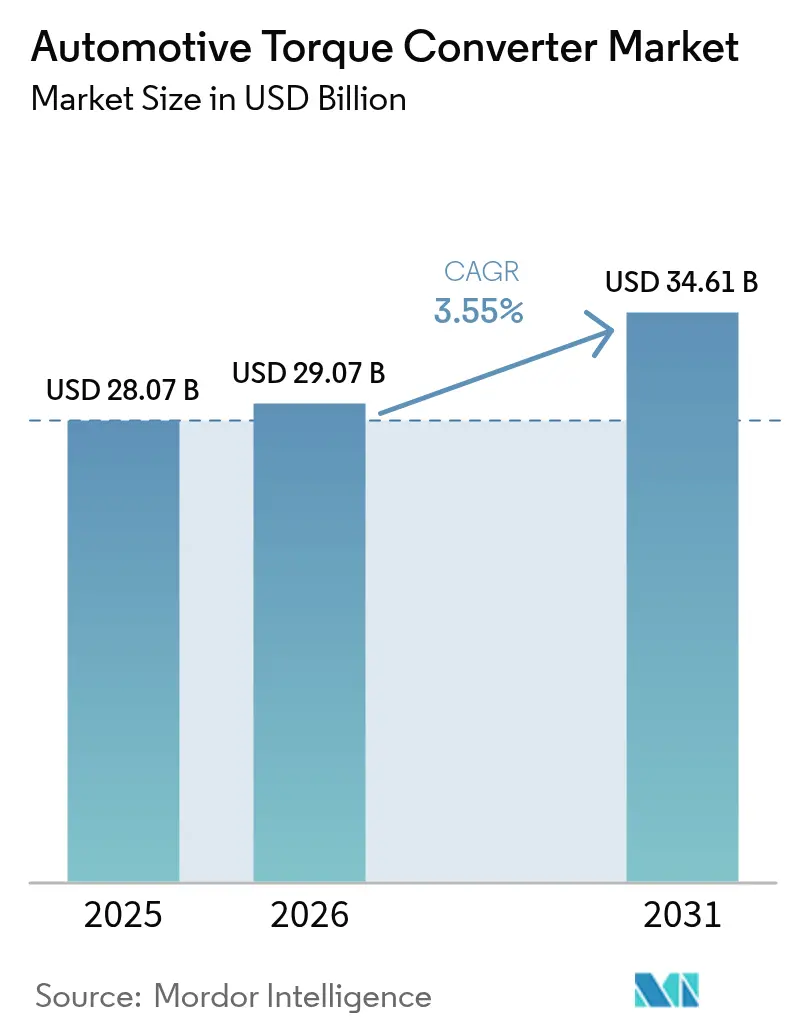
The Automotive Torque Converter Market size was valued at USD 28.07 billion in 2025 and estimated to grow from USD 29.07 billion in 2026 to reach USD 34.61 billion by 2031, at a CAGR of 3.55% during the forecast period (2026-2031). The measured headline pace belies a deep transition as hybrid powertrains, multi-speed automatics, and rising commercial-vehicle production reshape demand patterns. Automatic-transmission adoption in emerging economies keeps baseline volumes rising, while developed regions channel investment toward hybrid-dedicated converter architectures that improve fuel economy and emissions performance. Supply-chain near-shoring in North America, continued light-commercial expansion after the pandemic, and OEM pressure for eight- and ten-speed gearboxes add further momentum. Conversely, pure battery-electric drivetrains and the growing popularity of DCT and CVT technologies temper long-term outlooks in some passenger-car segments. Raw-material cost swings in aluminum and copper inject additional uncertainty into component margins.
Key Report Takeaways
- By transmission type, hydraulic automatics retained 39.68% of the automotive torque converter market share in 2025, while hybrid-dedicated automatics are set to advance at a 10.35% CAGR through 2031.
- By vehicle type, passenger vehicles led with 63.12% of the automotive torque converter market revenue share in 2025; light commercial vehicles exhibit the fastest growth at an 8.05% CAGR to 2031.
- By component, pump assemblies accounted for 37.19% of the automotive torque converter market size in 2025, whereas lock-up clutch systems will expand at a 8.92% CAGR to 2031.
- By hybridization level, ICE-only applications held a 74.62% share of the automotive torque converter market in 2025; plug-in hybrids are forecast to post the highest 11.94% CAGR to 2031.
- By sales channel, OEM supply commanded 84.05% of the automotive torque converter market share in 2025, while the aftermarket is projected to grow at 7.12% CAGR as vehicle lifecycles lengthen.
- By geography, Asia-Pacific captured 38.35% of the automotive torque converter market share in 2025 and is set to grow at 7.08% CAGR to 2031.
Note: Market size and forecast figures in this report are generated using Mordor Intelligence’s proprietary estimation framework, updated with the latest available data and insights as of 2026.
Market Trends and Insights
Drivers Impact Analysis of Automotive Torque Converter Market*
| Driver | (~) % Impact on CAGR Forecast | Geographic Relevance | Impact Timeline |
|---|---|---|---|
| Soaring Automatic-transmission Penetration In Emerging Markets | +1.2% | Asia-Pacific, Latin America | Medium term (2-4 years) |
| Hybrid And Mild-hybrid Boom Drives Lock-up Torque-converter Demand | +0.8% | Global, with concentration in Europe & China | Short term (≤ 2 years) |
| OEM Pressure For 8-/10-speed Fuel-efficiency Upgrades | +0.6% | North America, Europe | Medium term (2-4 years) |
| Recovery Of Global Light-commercial Production Post-covid | +0.4% | Global | Short term (≤ 2 years) |
| Next-gen High-temperature ATF Fluids Enable Higher Stall Torque | +0.3% | Global | Long term (≥ 4 years) |
| NVH Regulations Spur Advanced Multi-damping Converter Designs | +0.2% | Europe, North America | Long term (≥ 4 years) |
| Source: Mordor Intelligence | |||
Soaring Automatic-Transmission Penetration in Emerging Markets
Escalating urban congestion and rising disposable incomes sharply increase automatic-transmission uptake in large developing nations. China’s automatic transmission is shifting millions of vehicles from manual to automatic transmission solutions. Similar momentum is visible in India, where Renault’s competitively priced Kiger CVT places a fully automatic option within sub-10-lakh budgets, eroding the long-standing manual bias.[1]Scale effects follow: as local volumes grow, unit costs fall, unlocking further penetration. Allison Transmission’s USD 100 million expansion in Chennai aims to double output by 2027, demonstrating supplier commitment to this demand wave. Regional champions such as Shaanxi Fast Auto Drive Group leverage entrenched manufacturing bases to capture incremental orders across commercial and passenger segments.
Hybrid & Mild-Hybrid Boom Drives Lock-up Torque-Converter Demand
Hybrid powertrains require converters with refined lock-up mechanisms that minimise slip during engine-off phases and enable seamless torque blending. Ford’s Ranger PHEV places an e-motor and separator clutch ahead of the converter, highlighting new integration layouts that increase lock-up duty cycles. ZF’s plug-in hybrid transmission for BMW’s X5 xDrive40e replaces conventional converters with integrated motors, yet still demonstrates how hydraulic coupling principles evolve in electrified systems, cutting fuel use by up to 70%. Stellantis already fields 30 European hybrid models, each deploying electrified dual-clutch transmissions that deliver a 20% CO₂ cut. As hybrids bridge the affordability gap to full BEVs, the automotive torque converter market benefits from sustained lock-up component innovation.
OEM Pressure for 8-/10-Speed Fuel-Efficiency Upgrades
More gear ratios demand compact, low-inertia converters and smarter hydraulic controls. Mercedes-Benz’s 9G-TRONIC reaches 92% hydraulic-circuit efficiency via advanced oil-supply architecture, claiming 54% of its drivetrain fuel-saving potential.[2] Mazda’s SKYACTIV-Drive raises lock-up engagement from 64% to 88% of operations, demonstrating the integral role of converters in multi-speed optimisations. PACCAR’s TX-8 shows parallel advances on the commercial side, offering first-gear lock-up and 5% better fuel economy. As OEMs chase official cycle targets and real-world savings alike, converter suppliers must deliver precision manufacturability and control-software compatibility to secure program awards
Recovery of Global Light-Commercial Production Post-COVID
E-commerce growth keeps last-mile fleets expanding, and driver shortages raise demand for automatic transmissions that reduce fatigue. Allison’s new 4440 series, standard on Hino Profia FS snow-removal trucks, showcases tailored torque converters that simplify seasonal heavy-duty tasks.[3] Similar logic underpins Allison’s deal with Lingong Heavy Machinery, where converters deliver high-torque starts for 136 t mining dump trucks under extreme load. Regulatory pushes for cleaner logistics add urgency: operators view automatic gearboxes paired with hybrid or alternative-fuel powertrains as the quickest route to compliance without sacrificing uptime.
Restraints Impact Analysis of Automotive Torque Converter Market*
| Restraint | (~) % Impact on CAGR Forecast | Geographic Relevance | Impact Timeline |
|---|---|---|---|
| BEV Drivetrains Eliminate Torque Converters | -0.9% | Global, concentrated in Europe & China | Medium term (2-4 years) |
| Rising DCT/CVT Share In Compact Cars | -0.5% | Asia-Pacific, Europe | Short term (≤ 2 years) |
| Volatile Aluminum & Copper Prices Inflate BOM Cost | -0.3% | Global | Short term (≤ 2 years) |
| E-clutch Modules Replacing Converters In Dedicated Hybrids | -0.2% | Europe, North America | Long term (≥ 4 years |
| Source: Mordor Intelligence | |||
BEV Drivetrains Eliminate Torque Converters
Pure electric vehicles use direct motor drive, sidelining traditional converters. BorgWarner’s pivot to electric torque-vectoring modules for Polestar SUVs illustrates incumbent diversification away from hydraulic components. However, infrastructure gaps and battery costs keep hybrids and ICEs prevalent in emerging markets, softening the restraining effect until after 2030.
Rising DCT/CVT Share in Compact Cars
Cost-efficient CVTs and fast-shifting DCTs erode converter automatics in fuel-economy sensitive B- and C-segment cars. JATCO’s Guangzhou plant alone ships 1 million CVT units a year, representing 20% of global CVT output and underscoring scale economics. Dana’s beltless VariGlide CVT and Punch Powertrain’s VT5 for crossovers raise durability while lowering weight, making them attractive alternatives. Mazda’s converter-less eight-speed automatic with multi-plate clutches matches manual shift feel, proving consumers will accept new architectures when performance aligns
*Our forecasts treat driver/restraint impacts as directional, not additive. The impact forecasts reflect baseline growth, mix effects, and variable interactions.
Automotive Torque Converter Market Segment Analysis
By Transmission Type:
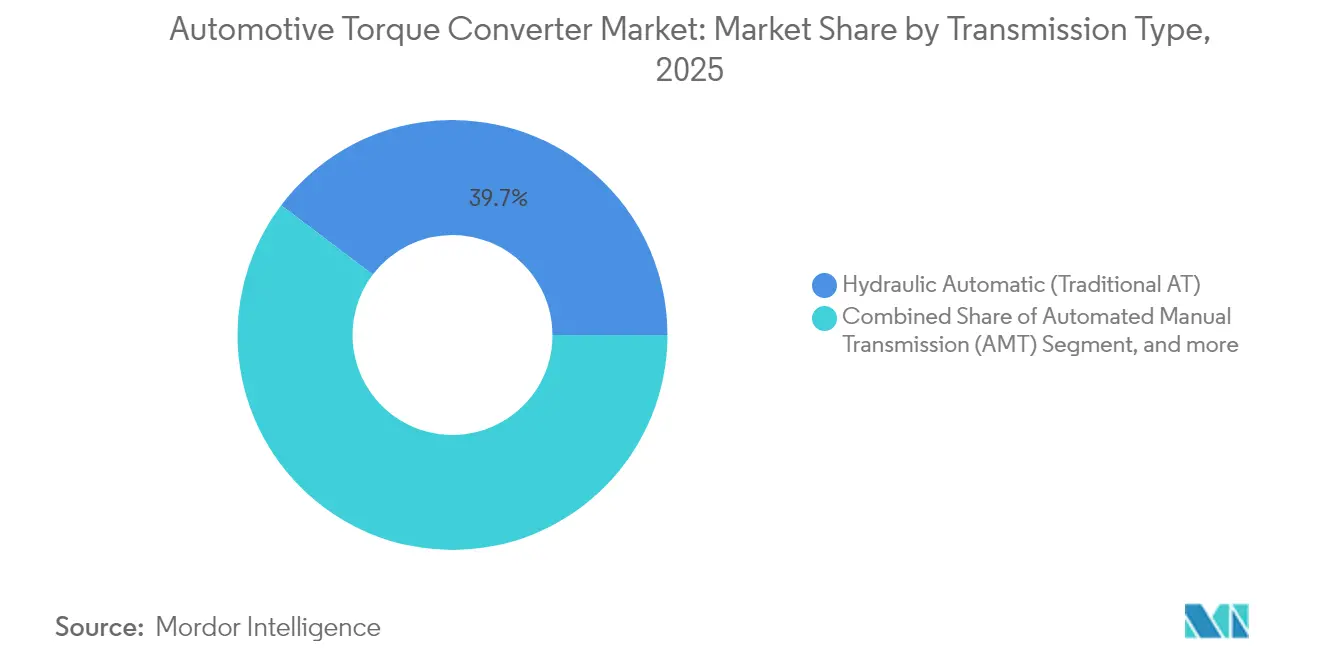
Hybrid Systems Drive InnovationHybrid-dedicated automatics are forecast to grow 10.35% annually, while hydraulic automatics still held 39.68% of the automotive torque converter market share in 2025. The dual structure means converters must span legacy ICE duty and new hybrid cycles, where frequent engine restarts test lock-up durability. OEMs such as ZF embed electric motors into eight-speed boxes, retaining a slimmed hydraulic coupling that smooths engine engagement and absorbs torsional spikes. Automated manuals linger in specialised heavy-duty fleets because fuel efficiency outweighs shift quality, whereas CVTs gain ground in cost-constrained small cars. Over the period, converters supporting integrated e-clutch modules will capture incremental value even as pure hydraulic units plateau because hybrids dominate mid-price electrification offerings.
Hybrid transmission growth compels suppliers to redesign pumps for lower parasitic drag and develop multi-mode lock-ups that engage under electrically assisted low-torque conditions. Converter casings migrate toward high-strength steels and clad aluminium to manage added heat from rapid clutch cycling. Software integration becomes critical as torque hand-off between motor and engine intensifies. Tier-ones that provide complete hydraulic controls alongside hardware retain pricing power, while stand-alone converter makers face margin pressure. The automotive torque converter market therefore rewards firms able to validate hybrid-ready designs quickly for global platforms.

By Vehicle Type:
Commercial Segments Accelerate AdoptionPassenger cars dominated revenue with a 63.12% of the automotive torque converter market share in 2025, yet light commercial vehicles are growing fastest at an 8.05% CAGR. Urban freight, food delivery, and e-commerce logistics prioritise automatic gearboxes that cut driver fatigue in stop-start routes. Fleet managers focus on total cost of ownership, boosting demand for converters paired with eight-speed boxes that promise fuel savings without steep acquisition costs. In emerging markets, ride-hailing services also push for automatic transmissions that appeal to younger drivers unfamiliar with manuals. Conversely, premium European passenger-car buyers increasingly choose hybrids or BEVs where traditional converters may be absent, creating a nuanced demand balance.
Heavy commercial vehicles, though the smallest subgroup, require bespoke high-capacity converters that withstand extreme torque and high thermal loads. Due to range and power density constraints, applications such as mining haulage or municipal snow removal are resistant to full electrification. Allison’s latest series offers first-gear lock-up and twin torsional dampers, delivering smoother launches and reducing clutch wear. Such attributes encourage operators to shift from manuals despite higher upfront costs. The automotive torque converter market therefore benefits from commercial-segment resilience even as passenger-car electrification accelerates.
By Component:
Lock-up Systems Lead InnovationPump assemblies controlled 37.19% of the automotive torque converter market revenue in 2025, yet lock-up clutches will expand at 8.92% CAGR as efficiency regulations tighten. Most future gains hinge on extending lock-up activation across broader speed maps, which lifts real-world consumption results without wholesale powertrain redesign. Mercedes-Benz’s 9G-TRONIC proves the concept, attributing more than half its savings to hydraulic-system refinements alone. Advanced friction materials and variable-damping designs now mitigate shudder during early engagement, a capability essential for hybrids where frequent engine restarts previously hampered comfort.
Electric auxiliary pumps emerge as a complementary growth pocket because they trim parasitic drag when mechanical demand is low. Meanwhile, turbine and stator blades see slower value growth as design maturity curbs differentiation. Converter suppliers increasingly bundle integrated temperature sensors, speed pickups, and control valves, linking mechanical parts to transmission ECUs for adaptive strategies. As hybrid adoption rises, components that manage thermal spikes and reverse torque flow during regenerative braking secure higher attachment rates. This shift realigns profit pools within the automotive torque converter market toward smart sub-assemblies rather than bulk castings.
By Hybridization Level:
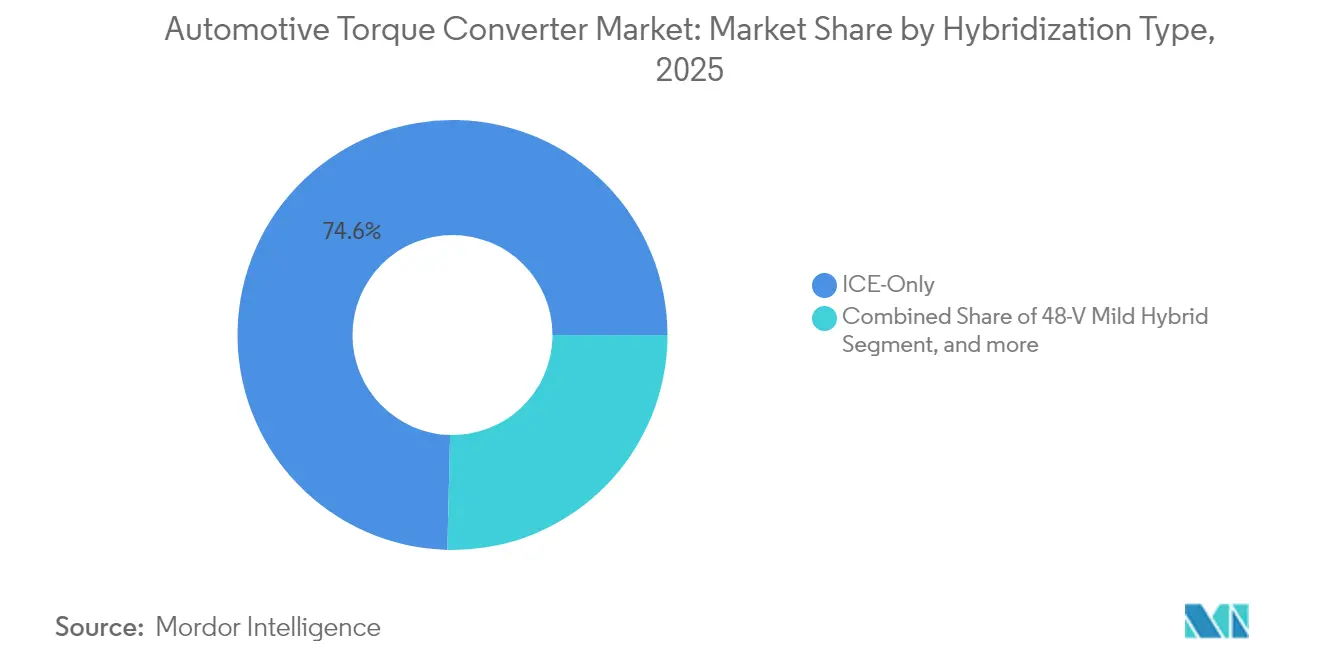
Plug-in Hybrids SurgeICE-only drivelines held 74.62% of the automotive torque converter market size in 2025, but plug-in hybrids head the growth league at a 11.94% CAGR. This split reflects varied global charging infrastructure: emerging economies lean on mature internal combustion supply chains, whereas regulators in Europe, China, and parts of North America incentivise plug-ins as a bridge to full electrics. The converter’s role differs by architecture. Mild-hybrid 48-V systems largely preserve conventional units, yet software extends lock-up operation and adds idle-stop features. Full and plug-in hybrids sometimes replace converters with e-clutches; however, many OEMs still rely on compact hydrodynamic couplings for smooth engine re-engagement, especially in larger vehicles.
Converter makers adapt housings for axial-flux motors or incorporate separator clutches near the impeller to secure access to upcoming model cycles. Thermal management is important because electric-only periods cool the fluid, and engine restarts generate rapid temperature changes. Integrating heat exchangers or active fluid heaters into converter casings becomes a differentiator. Even if BEVs erode share beyond 2031, the intervening decade of hybrid growth anchors a sizeable opportunity set inside the automotive torque converter market.
By Sales Channel:
Aftermarket Complexity IncreasesOEM channels controlled 84.05% of the automotive torque converter market share in 2025, but the replacement market will grow at 7.12% CAGR as vehicles stay on the road longer. Sophisticated converters with integrated electronics reach end-of-life later and require specialised tools for service, tilting business toward authorised networks. Independent rebuilders respond by forming alliances with tier-one suppliers to secure parts and diagnostic data. Hybrid models entering the maintenance cycle need lock-up assemblies capable of higher engagement counts, shifting the aftermarket demand mix toward premium components.
Software pairing between the transmission ECU and the replacement converter adds complexity. Some OEMs lock calibrations, steering customers back to franchised workshops. Nonetheless, value-oriented fleets in Latin America and Southeast Asia maintain an appetite for remanufactured units when downtime trumps perfect shift quality. The evolving channel balance ensures continued volume diversity within the automotive torque converter market, but suppliers must offer service data packages and training to capture post-sale revenues.
Geography Analysis
APAC Automotive Torque Converter Market
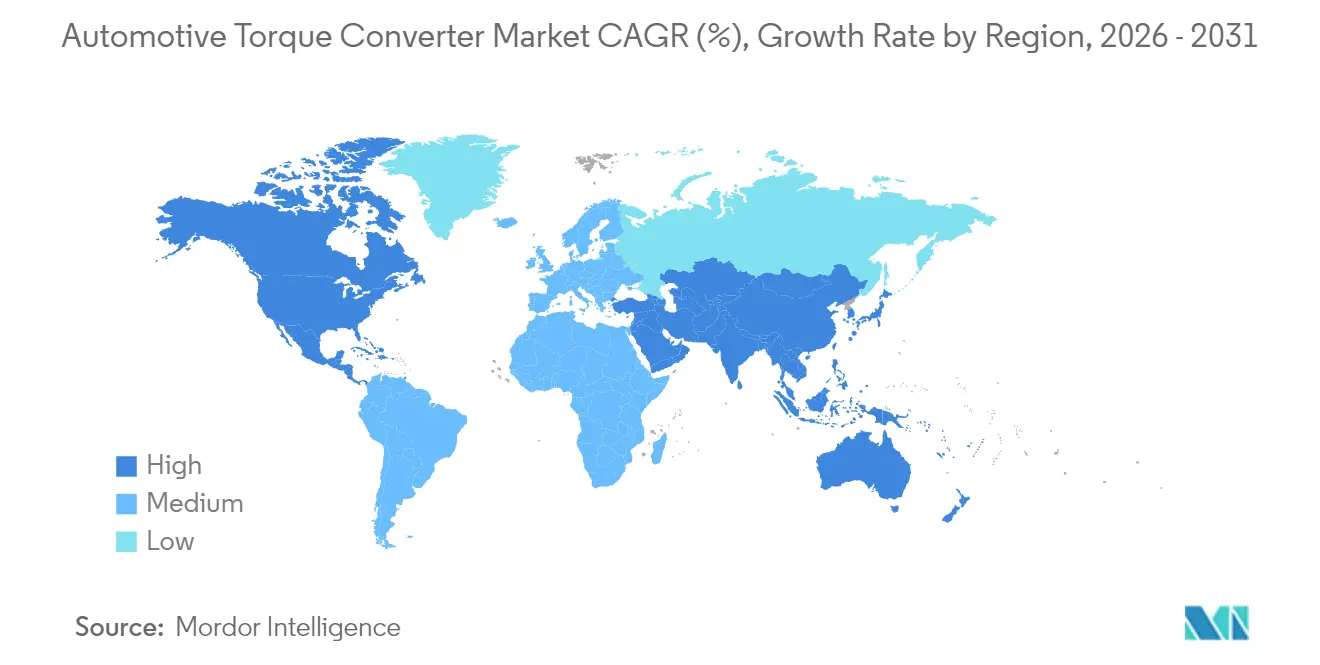
Asia-Pacific held 38.35% of the automotive torque converter market revenue in 2025 and should grow 7.08% per year to 2031, supported by China’s ascent as the top vehicle exporter and sustained commercial-vehicle demand. Local champions such as Shaanxi Fast Auto Drive Group broaden converter portfolios for hybrid trucks, while Japan supplies cutting-edge CVT output via JATCO’s one million-unit Guangzhou plant. India’s accelerating automatic-transmission uptake, highlighted by Allison’s Chennai capacity doubling, further cements the region’s central role. Cost-competitive manufacturing and deep supply chains make APAC the nexus of global sourcing for mature hydraulic and new hybrid converter designs.
North America and Europe Automotive Torque Converter Market
North America presents a mixed landscape: high baseline automatic penetration keeps unit volumes solid, yet electrification pushes converters into more specialised niches. Commercial-vehicle segments remain robust as urban freight fleets seek reliability upgrades over manual gearboxes, and OEMs such as PACCAR integrate fuel-saving lock-up features across eight-speed boxes. Europe’s stringent CO₂ rules quicken the pivot toward hybrids and BEVs. ZF’s plug-in hybrid units for BMW models exemplify the region’s leadership in integrating electric motors inside transmissions, sustaining converter demand in progressively evolved forms. Both markets illustrate how regulation simultaneously restrains and reshapes the automotive torque converter market rather than eliminating it outright.
MEA and South America Automotive Torque Converter Market
South America, the Middle East, and Africa trail on automatic-transmission penetration yet promise catch-up demand as urbanisation deepens. Local assembly to bypass import tariffs gains momentum, with tier-ones scouting joint ventures for cost-sensitive offerings. Fleet operators in Brazil and the Gulf increasingly choose automatic gearboxes for driver retention and uptime, even where road-fuel subsidies persist. Although small today, these regions complement mainstream revenue centres and diversify geographic risk for converter suppliers.
Regulatory Landscape
Torque converter designs and validation are shaped by test and performance standards used across OEM and tier-one qualification, including SAE J2362 for torque converter stall testing and Japan-focused hydrodynamic torque-converter test codes such as JASO C 201:2007. These frameworks support durability, NVH, and efficiency verification for lock-up clutches, dampers, and related mechatronic elements that must meet increasingly demanding vehicle-level compliance targets.
In Europe, type-approval and emissions durability requirements are tightening under Euro 7 (EU Regulation 2024/1257), with key provisions applying from 29 November 2026. This raises compliance pressure on powertrain component performance and durability in regulated vehicle programs. In the United States, trade policy is a direct cost variable for imported torque converter assemblies and related parts under Section 232 actions, and USMCA compliance and administrative processes (including an inclusions window opened for April 1 to April 14, 2026) influence sourcing, localization, and pricing decisions for North American supply chains.
Value Chain Analysis
The automotive torque converter value chain starts with metallic and friction-material inputs (notably steel, aluminum, and copper-intensive subcomponents) and moves through precision forming and joining operations for impellers, turbines, stators, and lock-up clutch modules. Typical manufacturing steps include stamping/forming of shells and blades, specialized welding/brazing, machining, balancing, and end-of-line validation, followed by integration into automatic transmissions or hybrid-dedicated ATs at tier-one or OEM transmission plants.
Upstream and midstream participants include global transmission and driveline suppliers such as Aisin, ZF Friedrichshafen, BorgWarner, Schaeffler, Valeo, and Voith, along with regional casting and machining ecosystems that support cost-competitive production. Downstream, OEM programs dominate volumes, reflecting the report’s OEM-heavy sales mix, while the aftermarket is supplied by rebuilders and performance/remanufacturing specialists such as Sonnax and Precision Industries, supported by distributor networks and remanufacturing cores. Supply-chain risk management has shifted toward localized footprints and multi-sourcing, reinforced by large installed manufacturing bases such as Schaeffler’s Wooster, Ohio operation, which has produced more than 40 million torque converters since 1997.
Competitive Landscape
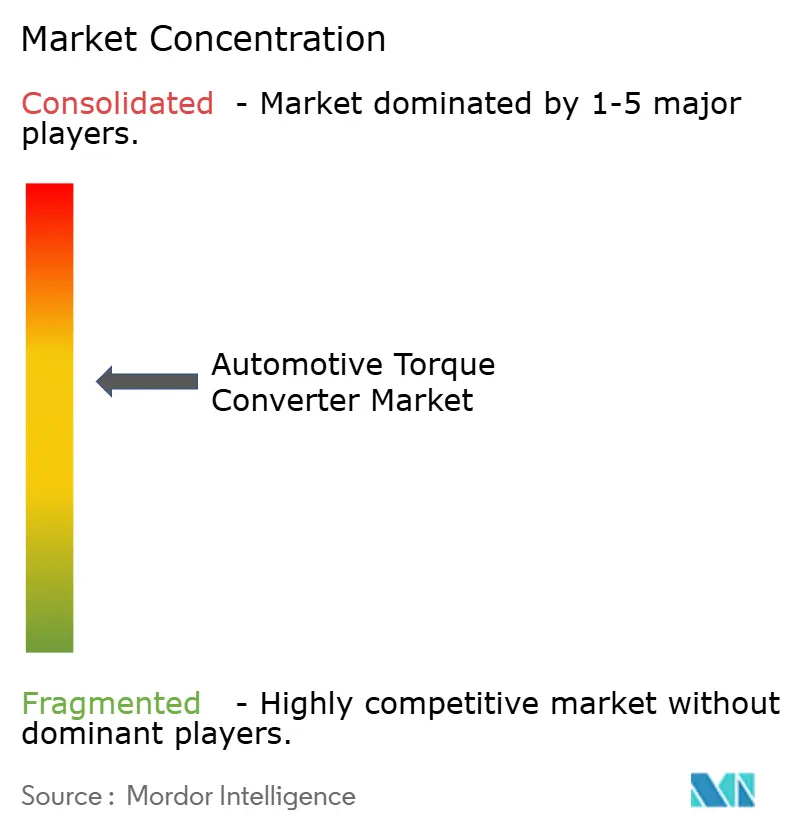
Market concentration remains moderate as established firms defend their share with technology breadth while regional specialists chip away at cost tiers. ZF Friedrichshafen posted EUR 41.4 billion sales in 2024 despite an 11% dip, yet its integrated powertrain strategy that couples converters with control electronics underpins stickiness among premium OEMs.[4] BorgWarner’s evolution toward electric torque-vectoring modules for Polestar BEVs shows incumbents pivoting to adjacent technologies to hedge converter volume risk. Aisin Corporation delivered CNY 4,909.5 billion FY2024 revenue, up on strong take-rates for hybrid transmissions and electric drive units that reuse converter manufacturing know-how, macrotrends.
M&A tightens competitive fields. Schaeffler’s acquisition of Vitesco Technologies targets EUR 600 million annual synergies by 2029, combining e-motor, inverter, and hybrid geartrain competence into one house. Vertical integration offers scale economies in precision machining and friction-material development vital for next-generation lock-up clutches. Niche champions, meanwhile, chase rugged off-highway opportunities: Allison Transmission pairs converters with control logic tuned for 136-ton mining trucks and snow-removal fleets, where electrification pressures are muted. Regional manufacturers in China leverage low-cost casting capacity to win on price, particularly for legacy four- and six-speed boxes still prevalent in export-focused production runs.
Success hinges on balancing incremental efficiency improvements with long-term electrification bets. Players investing in thermally optimised casings, active fluid management, and software-defined shift strategies preserve relevance even if pure hydraulic volumes flatten. Conversely, firms tied solely to commodity cast components risk erosion as OEMs demand integrated mechatronics. The automotive torque converter market, therefore, rewards R&D agility, diversified product roadmaps, and proximity to growing APAC assembly hubs.
Automotive Torque Converter Industry Leaders
-
Aisin Corporation
-
ZF Friedrichshafen AG
-
BorgWarner Inc.
-
Jatco Ltd.
-
Schaeffler AG
- *Disclaimer: Major Players sorted in no particular order
Automotive Torque Converter Market Companies Covered in this Report
- Aisin Corporation
- BorgWarner Inc.
- ZF Friedrichshafen AG
- Schaeffler AG (LuK)
- Jatco Ltd.
- Allison Transmission Holdings
- Hyundai Transys Co., Ltd.
- Continental AG
- Valeo SA
- Punch Powertrain
- Exedy Corporation
- Kapec Co. Ltd.
- Precision Industries
- Sonnax Transmission Company
- Voith GmbH & Co. KGaA
- Subaru Corporation
- Robert Bosch GmbH
- General Motors (GM Powertrain)
Market Opportunities and Future Outlook
Whitespace is forming around localization of automatic transmission and torque converter-related capacity in growth and resilience-driven geographies, especially where OEMs and tier-ones align supply with regional assembly. A clear example is Aisin’s announced JPY 32 billion investment (February 2026) to expand an existing plant and establish a new facility in India for local production of automatic transmissions and CVTs. General Motors also announced a USD 40 million investment (March 2026) to expand capacity at Toledo Propulsion Systems to support new transmission variants for the Chevrolet Equinox and GMC vehicle lines. These moves create opportunities for converter suppliers and sub-suppliers that can deliver regionally compliant, cost-optimized pump, turbine, stator, and lock-up clutch content for multi-speed and hybrid-capable transmission programs.
A second opportunity is the increasing professionalization of the service and performance aftermarket as converter complexity rises, especially around lock-up clutch control, damping, and tighter balance tolerances. Aftermarket manufacturers and distributors expanding production and distribution, including Randy’s Transmissions adding new facilities in Utah and North Carolina (February 2026), point to continued investment in converter and transmission manufacturing closer to end markets. At the same time, OEM efforts to raise lock-up utilization in multi-speed automatics and hybrid duty cycles keep demand focused on higher-value lock-up clutch systems, thermal management features, and tighter integration with transmission controls, rather than commodity castings alone.
Recent Industry Developments in Automotive Torque Converter Market
- May 2026: BorgWarner announced it won conquest program awards in Asia for combustion and hybrid powertrain programs, including a wet dual-clutch system for a Chinese OEM SUV platform with friction-material engineering aimed at reducing drag torque. The win strengthens BorgWarner’s position in high-volume Asian programs where efficiency and thermal robustness are key requirements, and it underscores the competitive pressure on conventional converter-based architectures from alternative transmission technologies.
- February 2026: ZF and BMW extended their 8HP automatic transmission partnership through the 2030s under a multi-billion-euro agreement covering continued development and supply. The long-horizon commitment supports sustained demand for core automatic-transmission hardware and related subsystems across premium and electrified applications, reinforcing the strategic role of suppliers that can deliver hybrid-capable evolutions of established AT platforms.
- January 2026: Aisin began contract manufacturing Mazda-developed six-speed automatic transmissions at its AISIN Drivetrain, Inc. subsidiary in Indiana, expanding localized production in North America. Bringing transmission manufacturing closer to US vehicle assembly improves lead times and supply continuity for OEM programs, and it increases the pull-through opportunity for locally sourced torque converter assemblies and components.
Automotive Torque Converter Market Report Scope and Research Methodology
Market Definition and Coverage
This market covers torque converters used in automotive drivetrains, where torque multiplication and smooth power transfer are provided between the engine and the transmission. Revenue is captured across both OEM demand and replacement demand.
Scope exclusions: It excludes non-automotive torque converters used in industrial equipment and marine applications, and it excludes manual clutch assemblies that do not use a torque converter.
Segments Covered in This Report
- By Transmission Type
- Automated Manual Transmission (AMT)
- Dual-Clutch Transmission (DCT)
- Continuously Variable Transmission (CVT)
- Hydraulic Automatic (Traditional AT)
- Hybrid Dedicated AT (e-Torque Converter)
- By Vehicle Type
- Passenger Vehicles
- Light Commercial Vehicles
- Heavy Commercial Vehicles
- By Component
- Pump
- Turbine
- Stator
- Lock-up Clutch
- By Hybridization Level
- ICE-Only
- 48-V Mild Hybrid
- Full/Strong Hybrid
- Plug-in Hybrid
- By Sales Channel
- OEM
- Aftermarket
- By Geography
- North America
- United States
- Canada
- Rest of North America
- South America
- Brazil
- Argentina
- Rest of South America
- Europe
- Germany
- United Kingdom
- France
- Spain
- Russia
- Rest of Europe
- Asia-Pacific
- China
- Japan
- India
- South Korea
- Rest of Asia-Pacific
- Middle East and Africa
- Saudi Arabia
- United Arab Emirates
- South Africa
- Egypt
- Nigeria
- Rest of Middle East and Africa
- North America
Data Sources, Market Sizing, and Validation
Desk Research
Desk research was used to build the first draft of the demand pool and the pricing guardrails, before assumptions were tested in interviews. We referenced public production and parc indicators, such as OICA vehicle production statistics and national transport agency vehicle registration releases, to understand where automatic and hybrid-equipped fleets are expanding.
For trade flow and localized supply signals, we reviewed customs and trade datasets such as UN Comtrade, along with association and standards references (for example, SAE technical papers and NHTSA or EPA documentation where powertrain regulations influence transmission choices). Company annual reports, investor presentations, and reputable press were used to map product positioning and channel mix, while a paid subscription covering company financials and another covering shipment-level trade records were used selectively to sanity-check revenue scale. These sources are illustrative only, and many other public references were also reviewed during data collection, validation, and clarification.
Primary Interviews and Surveys
Primary work focused on confirming what share of automatic transmissions still use torque converters, and how content per vehicle changes by vehicle class and regional powertrain preferences. We spoke with a mix of component suppliers, transmission system stakeholders, and aftermarket participants across APAC, EMEA, and the Americas, so gaps from desk research could be addressed and then checked back against the same set of market assumptions.
Distribution of primary research fieldwork respondents
| Company type | Respondent position | Region |
|---|---|---|
| Top tier: 38% | CXOs: 13% | APAC: 47% |
| Mid tier: 48% | Functional/Unit leaders: 27% | EMEA: 34% |
| Smaller Players: 14% | Managers: 60% | Americas: 19% |
Market-Sizing & Forecasting
Sizing starts from a top-down build where vehicle production and in-use fleet signals are reconstructed into a torque-converter fitted volume pool, and then translated into value using region-sensitive average selling price ranges. Once the demand pool is framed, selective bottom-up checks are applied through sampled ASP x volume math by vehicle type and sales channel, followed by reasonableness checks against publicly visible revenue exposure cues from relevant business lines.
Key inputs used in the model include passenger versus commercial vehicle output, automatic transmission penetration by region, the share of hybrid powertrains that still pair with torque converters, OEM versus aftermarket mix (replacement timing was stress-tested using vehicle parc age), and material cost pass-through expectations that influence ASP progression. Where bottom-up visibility is weaker, such as informal replacement channels in some countries, the gap is handled using conservative channel share brackets that are then re-tested with interview feedback.
Forecasting is carried out using scenario analysis supported by an ARIMA trend layer for core vehicle production and automatic penetration, and then adjusted with expert views on technology mix shifts, including multi-speed automatic adoption versus DCT and CVT substitution. The result is a forecast that can be recreated with the same input series, and it remains explainable when assumptions need to be updated.
Data Validation & Update Cycle
Outputs are validated by comparing implied torque-converter units per vehicle and revenue per unit against independent signals like transmission mix commentary, regional production shifts, and channel share expectations gathered in interviews. Any large variance triggers a step-back review of the few inputs that usually move the market most, namely automatic penetration, hybridization assumptions, and ASP change rates, and then the relevant experts are re-contacted when needed.
Before sign-off, the model is reviewed in multiple analyst passes so calculation logic, unit consistency, and currency timing are checked end to end. Reports are refreshed annually, and interim updates are made when material events change vehicle production outlook, regulations, or powertrain technology direction, followed by a final pre-delivery pass to keep figures current.
Mordor Intelligence's Automotive Torque Converter Market Size Compared Against Other Published Estimates
Published market sizes for torque converters often do not match because the term can be scoped in different ways, and the base year and channel coverage are not always aligned. Differences also show up when some models lean heavily on a single production series, while others blend in replacement demand and pricing changes differently.
The main gap comes from whether the value is counted at the torque-converter component level across OEM plus aftermarket, or whether adjacent transmission parts and non-automotive converters get mixed in, and then priced using broad averages. Mordor Intelligence treats OEM and aftermarket separately and ties the value build to automatic and hybrid fitment rates by region, which reduces overcounting when transmission technology mix shifts quickly.
Benchmark comparison
| Source | Market Size | Gaps in Research Methodology |
|---|---|---|
| Mordor Intelligence | USD 29.07 B (2026) | |
| Global Consultancy A | USD 7.31 B (2024) | Uses a smaller value pool that appears closer to a narrower component-only scope and earlier base year, and it is not clearly explicit on how OEM versus replacement revenues are treated, which can compress totals. |
| Industry Research House B | USD 7.59 B (2024) | Anchors the estimate on a 2024 base with a different channel split and pricing path, and the definition can differ on whether the count is torque converters only or broader torque-converter market adjacencies, which shifts the value level. |
The spread across sources is mainly explained by the year used, the inclusion of aftermarket value, and how tightly the product definition is kept to automotive torque converters. By keeping the demand pool connected to transmission fitment and then checking it with channel and price reality checks, the market size stays traceable to inputs that can be revisited when conditions change.
Key Questions Answered in the Report
What is the current size of the automotive torque converter market?
The market stands at USD 29.07 billion in 2026 and is projected to reach USD 34.61 billion by 2031.
Which region leads the automotive torque converter market?
Asia-Pacific dominates with 38.35% revenue share in 2025 and a 7.08% CAGR outlook through 2031.
Why are lock-up clutches attracting investment?
They expand converter efficiency by engaging over a wider speed range, driving a 8.92% CAGR and meeting stricter fuel-economy rules.
What role does the aftermarket play?
Although OEM channels hold 84.05% share, the aftermarket grows 7.12% annually as longer vehicle life and hybrid complexity boost replacement part requirements.