
Automotive Selective Catalytic Reduction Market Size and Share
Market Overview
| Study Period | 2021 - 2031 |
|---|---|
| Market Size (2026) | USD 11.40 Billion |
| Market Size (2031) | USD 16.26 Billion |
| Growth Rate (2026 - 2031) | 7.36 % |
| Fastest Growing Market | Asia-Pacific |
| Largest Market | Asia-Pacific |
| Market Concentration | Low |
Major Players *Disclaimer: Major Players sorted in no particular order Image © Mordor Intelligence. Reuse requires attribution under CC BY 4.0. | |
Automotive Selective Catalytic Reduction Market Analysis by Mordor Intelligence
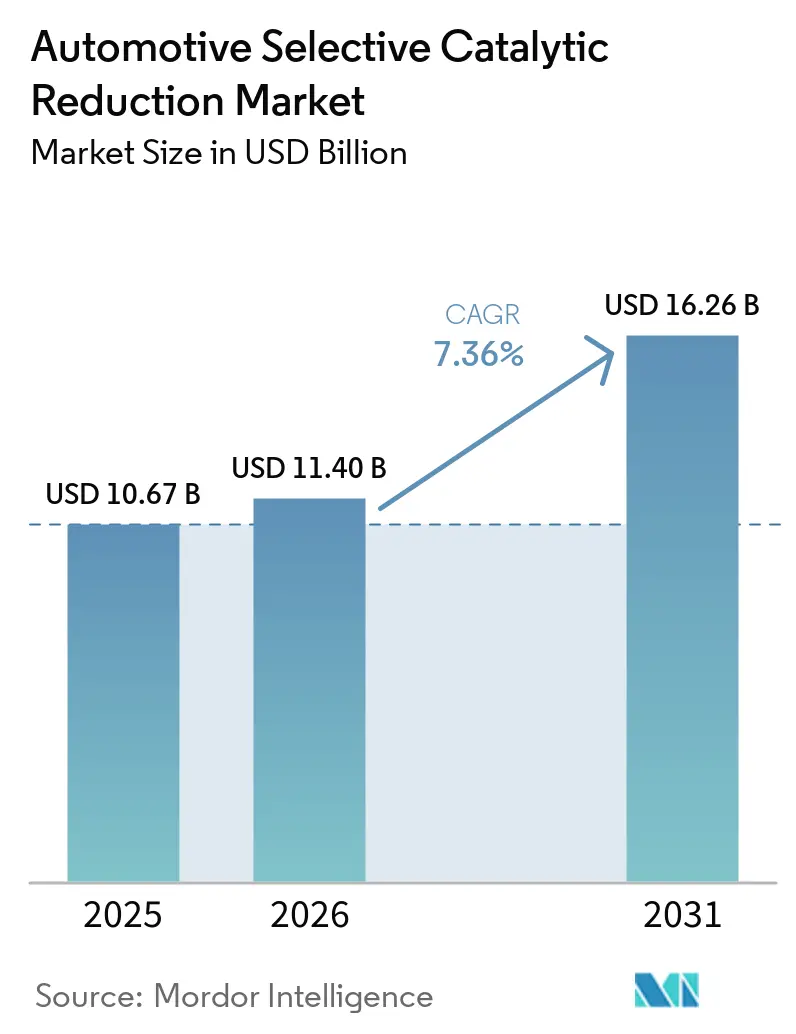
The automotive selective catalytic reduction market size was valued at USD 10.67 billion in 2025 and is estimated to grow from USD 11.40 billion in 2026 to reach USD 16.26 billion by 2031, at a CAGR of 7.36% during the forecast period (2026-2031). The automotive selective catalytic reduction market is expanding as stricter emissions regulations require diesel vehicles to control nitrogen oxide emissions more effectively. Euro 7 applies to new light-duty vehicle models from November 2026 and consolidates light- and heavy-duty requirements into a single legislative package, with new limits on non-exhaust particles. U.S. model-year 2027 standards require significant reductions in nitrogen oxide emissions from heavy-duty engines, pushing vehicle design toward integrated catalyst, dosing, heating, and sensor systems. The market also benefits from commercial fleet renewal in Asia and North America, while declining light-duty diesel demand in mature markets limits the addressable passenger vehicle base. Suppliers offering complete aftertreatment systems hold an advantage, as vehicle manufacturers are increasingly qualifying multiple related components together for multi-year platforms.
Key Report Takeaways
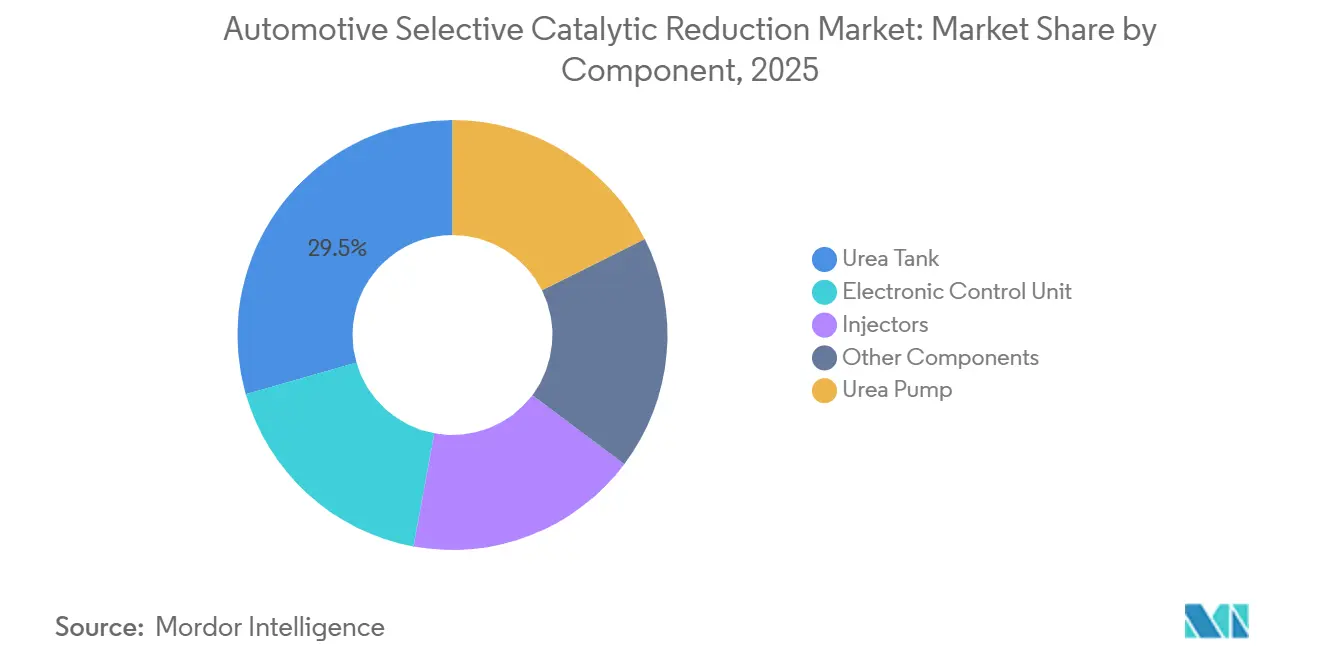
- By component, urea tanks held 29.45% of the automotive selective catalytic reduction market share in 2025, while urea pumps are forecast to grow at a 7.85% CAGR through 2031.
- By vehicle type, passenger vehicles held 48.14% of the automotive selective catalytic reduction market share in 2025, while heavy commercial vehicles are forecast to grow at an 8.13% CAGR through 2031.
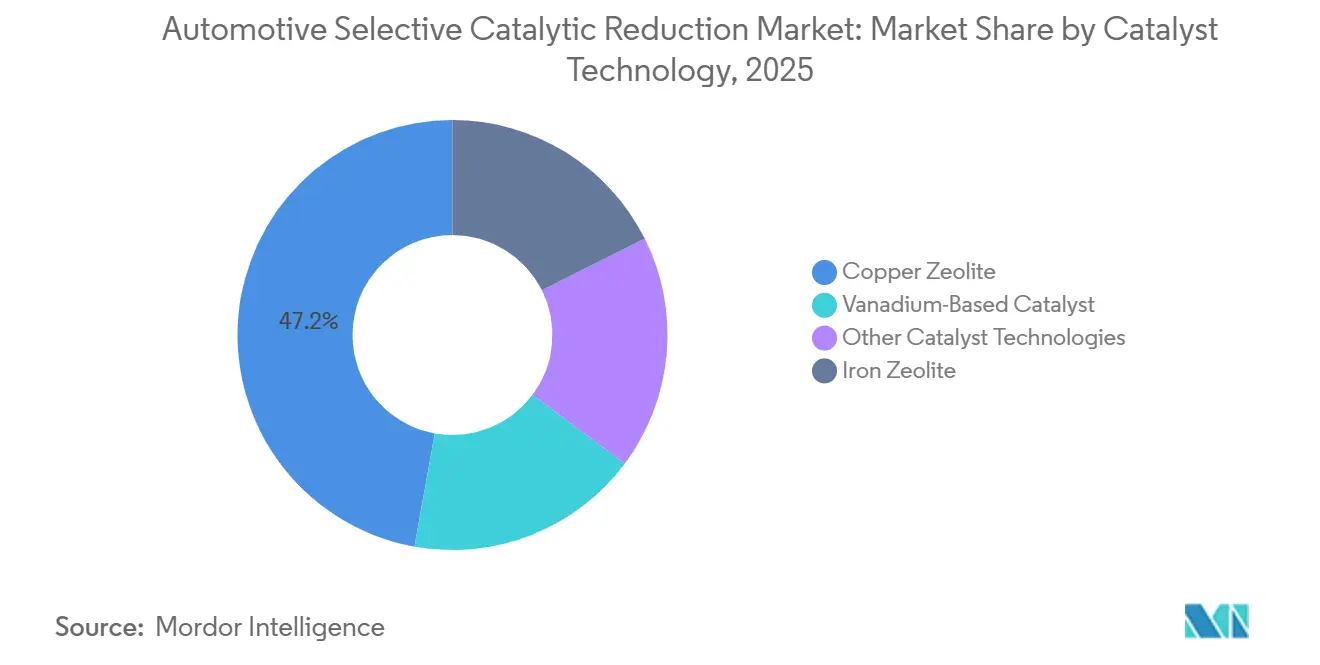
- By catalyst technology, copper zeolite held 47.18% of the automotive selective catalytic reduction market share in 2025 and is forecast to grow at an 8.45% CAGR through 2031.
- By geography, Asia-Pacific held 38.31% of the automotive selective catalytic reduction market share in 2025 and is forecast to grow at an 8.22% CAGR through 2031.
Note: Market size and forecast figures in this report are generated using Mordor Intelligence’s proprietary estimation framework, updated with the latest available data and insights as of January 2026.
Global Automotive Selective Catalytic Reduction Market Trends and Insights
Drivers Impact Analysis*
| Drivers | (~) % Impact on CAGR Forecast | Geographic Relevance | Impact Timeline |
|---|---|---|---|
| Tightening NOx Emission Standards | +2.5% | Global, with frontline effects in the EU, North America, China, and India | Short term (≤ 2 years) |
| Growth of Diesel Commercial Vehicle Fleets | +1.7% | Asia-Pacific core, with spillover to South America, the Middle East, and Africa | Medium term (2-4 years) |
| Expansion of SCR in Emerging Automotive Markets | +1.3% | ASEAN, India, Brazil, Gulf Cooperation Council (GCC), and South Africa | Medium term (2-4 years) |
| Low-Temperature Catalyst and Thermal-Management Advances | +1.0% | Global, with priority in European and North American cold-start compliance zones | Medium term (2-4 years) |
| Digital Closed-Loop Dosing and NOx Sensor Integration | +0.7% | Global, with faster adoption, where in-service conformity testing is required | Long term (≥ 4 years) |
| Source: Mordor Intelligence | |||
Tightening NOx Emission Standards Compel System-Level Redesigns
The regulatory cycle beginning in 2026 places more demanding requirements on the automotive selective catalytic reduction market than the Euro VI cycle. Euro 7 applies to new light-duty model types from November 2026, while heavy-duty vehicle type approvals begin in May 2028. The US model-year 2027 rule lowers the heavy-duty engine nitrogen oxide limit to 35 mg per horsepower-hour from 200 mg per horsepower-hour. Cummins has responded with a twin-module SCR design that uses two 5 kW electric heaters and a dedicated 48 V alternator for thermal control[1]. These requirements make catalysts, heaters, dosing equipment, and sensors more interdependent within one emissions-control system. India is expected to notify Bharat Stage VII during fiscal year 2026 for rollout in 2030, extending this vehicle upgrade cycle to a large commercial vehicle manufacturing base.
Growth of Diesel Commercial Vehicle Fleets Sustains Installation Base
Heavy commercial vehicle production in Asia supports a durable installation base for the automotive selective catalytic reduction market despite passenger vehicle electrification. China produced more than 900,000 heavy-duty trucks in 2025, and the GB VI Phase B transition requires the installation of SCRs on new heavy-duty diesel vehicles. India's PM-Gati Shakti expressway program has reduced freight times along key corridors and boosted demand for compliant long-haul trucks. South Korea and Japan also continue their own commercial vehicle upgrade cycles through weight-based taxes and stronger compliance monitoring. China's in-service conformity program creates an aftermarket need because some operating trucks do not meet real-world targets. A 2026 study of 24 heavy-duty trucks found that compliant China VI vehicles reduced nitrogen oxide emissions by 59.6% against China V vehicles, while non-compliant vehicles had emission factors 85.6% higher than China V benchmarks.
Expansion of Selective Catalytic Reduction (SCR) in Emerging Automotive Markets Creates a Second Growth Curve
Thailand, Vietnam, and Indonesia are aligning their emissions frameworks with Euro 5 and Euro 6 benchmarks, creating a separate demand base for the automotive selective catalytic reduction market. Thailand's 2028 Euro III phase-out deadline is encouraging fleet replacement and SCR procurement for operators using higher-value freight corridors. The installed base of older vehicles also creates demand for replacement catalysts and dosing units as enforcement tightens. Brazil's Euro 6-aligned PROCONVE P-8 standard and the Gulf Cooperation Council's alignment with Euro 5 and Euro 6 benchmarks are prompting Tier-1 suppliers to consider local supply chains. Vehicle makers entering these markets with Euro 6-certified platforms can use established SCR configurations without fully redesigning the architecture. This approach can shorten the qualification process for compliance-ready components.
Low-Temperature Catalyst and Thermal-Management Advances Redefine System Architecture
Cold starts and low-load urban driving remain a key catalyst challenge because exhaust temperatures can fall below 150°C. Research published in 2026 found that mild hydrothermal aging can selectively inhibit the oxidation half-cycle of standard SCR over Cu-SSZ-13, and that changing oxygen partial pressure can restore DeNOx efficiency, giving catalyst developers a defined route to improve performance. BASF Metivo's GenV+ CuSCR catalyst has been qualified with several global truck customers and is designed for low-temperature conversion under EPA 2027 and Euro 7 operating conditions. The company reported a 30-40% reduction in nitrogen oxide emissions across heavy-duty operating temperatures compared with its GenIV predecessor. A 2026 Society of Automotive Engineers (SAE) paper found that a compact heater-mixer unit with close-coupled SCR could meet US, European, and Chinese requirements while preventing urea deposits.
Restraints Impact Analysis*
| Restraints | (~) % Impact on CAGR Forecast | Geographic Relevance | Impact Timeline |
|---|---|---|---|
| High System, Installation, and Maintenance Costs | -1.8% | Global, most acute in price-sensitive ASEAN, South Asia, the Middle East, and Africa markets | Medium term (2-4 years) |
| DEF Availability and Quality Constraints | -1.1% | North America and South Asia, especially India, with spillover to ASEAN, the Middle East, and Africa | Short-term (≤ 2 years) and medium-term (2-4 years) |
| Light-Duty Electrification and Declining Diesel Adoption | -1.4% | Western Europe and China primarily, with a moderate effect in North America | Long term (≥ 4 years) |
| Source: Mordor Intelligence | |||
High System, Installation, and Maintenance Costs Constrain Emerging-Market Penetration
The automotive selective catalytic reduction market faces cost pressure because systems require a catalyst, dosing unit, nitrogen oxide sensors, an electronic control unit (ECU), installation, and ongoing maintenance. The use of diesel exhaust fluid and periodic catalyst replacement or reconditioning add to lifetime operating costs. In price-sensitive truck markets, including India, Southeast Asia, and Sub-Saharan Africa, fleet buyers often assess total ownership cost before selecting a compliant vehicle. More advanced dual-dosing and close-coupled SCR layouts increase system complexity and can raise maintenance requirements. A 2025 Society of Automotive Engineers (SAE) paper identified the difficulty of combining accurate diesel exhaust fluid dosing, diagnostics, and fail-safe functions in a cost-effective control unit. Limited specialist service capacity in India's Tier-2 and Tier-3 cities can also increase downtime when medium-duty truck systems fail.
DEF Availability and Quality Constraints Introduce Operational Risk
The reliability of diesel exhaust fluid supply constrains the automotive selective catalytic reduction market and poses a direct risk to system operation. Several major U.S. DEF production facilities entered scheduled maintenance periods lasting up to 8 months in 2025, straining inventories amid steady demand. North American urea output was 35 million gallons below demand in 2025. In March 2026, the Society of Indian Automobile Manufacturers warned of uncertainty regarding technical-grade urea due to Middle Eastern shipping disruptions and limited visibility into deliveries beyond early April 2026. SCR systems require diesel exhaust fluid with a 32.5% urea concentration per ISO 22241, and contaminated or improperly diluted fluid can damage catalyst substrates and trigger on-board diagnostic warnings. EPA guidance issued in August 2025 allowed adjustments to SCR inducement systems, but did not resolve the underlying supply chain exposure.
*Our forecasts treat driver/restraint impacts as directional, not additive. The impact forecasts reflect baseline growth, mix effects, and variable interactions.
Segment Analysis
By Component: Dosing Precision Drives the Fastest-Growing Sub-System
Urea tanks accounted for 29.45% of the automotive selective catalytic reduction market share in 2025, making them the largest component segment. Their position reflects use across vehicle types and the material requirements of high-density polyethylene and reinforced-composite tanks in commercial vehicles. Röchling Automotive supplies SCR tank systems with molded anti-sloshing structures and filling systems for truck and passenger vehicle manufacturers. Its 30-liter commercial vehicle tank design reduced weight by 0.8 kg compared to earlier designs. Injectors and electronic control units form the next component tier. Injector demand tracks new-vehicle production, while ECUs are gaining importance as more systems use multiple sensors for closed-loop control.
Urea pumps are forecast to expand at a 7.85% CAGR through 2031, above the overall automotive selective catalytic reduction market growth rate. Dual-dosing and close-coupled designs require accurate delivery across multiple dosing points. Bosch's DI-SCR double-injection technology uses a close-coupled and an underfloor dosing position, which increases pump requirements and dosing precision. A 2026 Society of Automotive Engineers (SAE) study found that software-controlled dosing can identify deposit faults and begin regeneration before crystallization harms catalyst performance. EPA on-board diagnostic requirements and India's draft remote-OBD data-upload rule are supporting demand for more capable ECUs and sensors.

By Vehicle Type: Heavy Commercial Vehicles Drive the Fastest SCR Growth
Passenger vehicles held 48.14% of the automotive selective catalytic reduction market share in 2025. This reflected the historical depth of diesel use in European premium vehicles and several Asian vehicle categories. India's BS VI Phase 2 framework continued to require SCR fitment on new diesel passenger vehicles. Europe's passenger diesel base is narrowing as new diesel registrations fell below 10% of sales in 2025. Battery electric and plug-in hybrid vehicles together represented 28% of new registrations in 2025, up 6 percentage points from 2024. Existing diesel fleets continue to support demand for replacement catalysts and diesel exhaust fluid (DEF).
Heavy commercial vehicles are forecast to grow at an 8.13% CAGR through 2031, making them the fastest-growing vehicle category in the automotive selective catalytic reduction market. This demand is tied to regulatory fleet renewal in major commercial vehicle regions. Cummins unveiled its EPA 2027-compliant X15 engine in 2026 with a twin-module SCR system. The company states that the configuration reduces exhaust back pressure by 44% compared with a single-module arrangement. Light commercial vehicles benefit from production growth in Southeast Asia and South Asia and face less immediate pressure to electrify than passenger cars. Scania and Umicore developed a Twin SCR arrangement that separates the close-coupled and underfloor catalyst stages to ensure high-temperature compliance and control vanadium sublimation.
By Catalyst Technology: Copper Zeolite Widens Its Structural Advantage
Copper zeolite accounted for 47.18% of the automotive selective catalytic reduction market share in catalyst technology in 2025. Its chabazite-based forms, including CuCHA and CuSSZ-13, combine hydrothermal stability with low-temperature activity. These properties are important as real-driving and in-service tests place greater attention on cold-start and idle emissions. Research published in the Royal Society of Chemistry's journal showed that the performance of Cu-SSZ-13 can be tuned by oxygen partial pressure after mild hydrothermal aging. Iron zeolite remains the second-largest technology segment. It offers sulfur tolerance and high-temperature stability for markets with inconsistent fuel sulfur quality and heavy-duty operating conditions above 500°C.
Copper zeolite is forecast to grow at an 8.45% CAGR through 2031, the fastest rate among catalyst technologies in the automotive selective catalytic reduction market. BASF Metivo's chabazite-based GenV+ CuSCR platform is designed to maintain conversion at lower temperatures while reducing nitrous oxide emissions. Vanadium catalysts remain relevant in heavy-duty and non-road applications where sulfur resistance and a wide operating range are more important than low-temperature activity. Umicore's 2025 patent application describes a multilayer vanadium washcoat that supports nitrogen oxide conversion below 250°C and above 500°C while suppressing nitrous oxide formation. Fe₂O₃-SiO₂/Al₂O₃ and Nb-Fe supported on pre-sulfided CeO₂ are emerging formulations that have demonstrated performance comparable with platinum-group-metal catalysts from 300°C to 450°C.
Geography Analysis
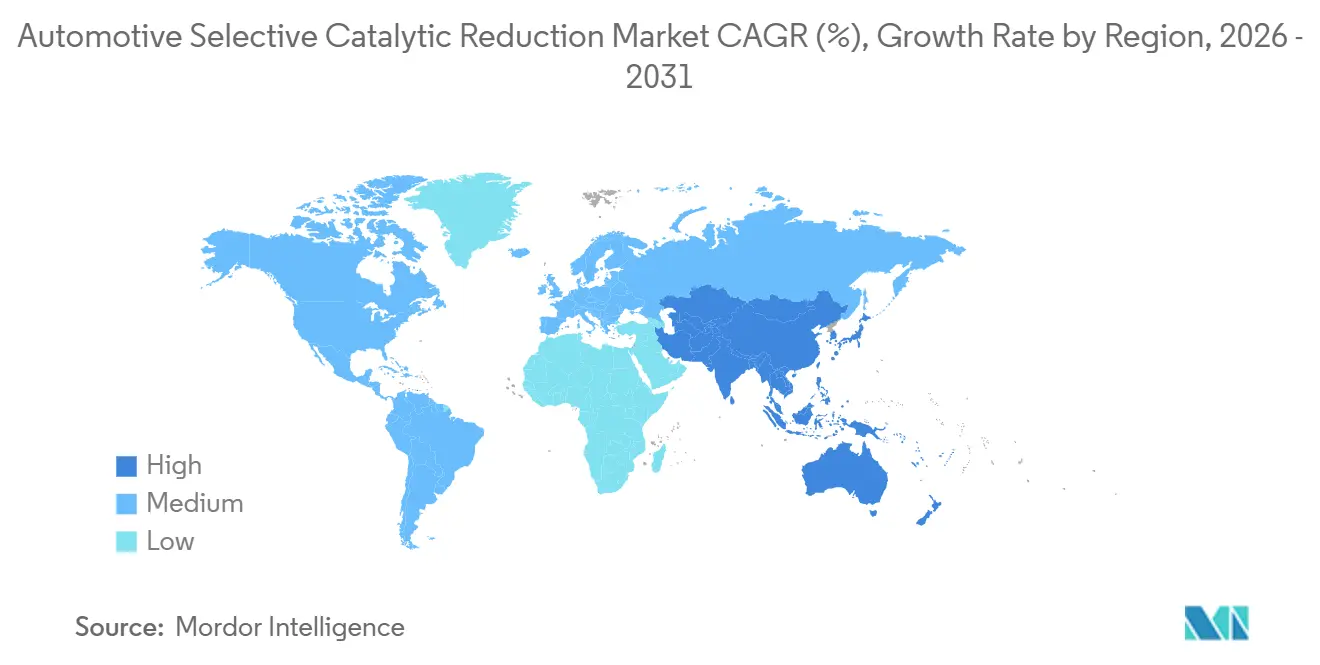
Asia-Pacific held 38.31% of the automotive selective catalytic reduction market share in 2025 and is forecast to grow at an 8.22% CAGR through 2031. China is the regional anchor, as GB VI Phase B requires SCR on new heavy-duty diesel vehicles. More than 900,000 heavy-duty trucks were produced in China in 2025[2]. India is expanding through BS VI Phase 2 real-driving-emissions compliance and a June 2026 draft requirement for real-time On-Board Diagnostics II (OBD-II) data uploads from new commercial vehicles. Japan and South Korea contribute specialized catalyst and sensor manufacturing, while Thailand, Vietnam, and Indonesia are moving toward Euro 5 and Euro 6-equivalent requirements.
North America is the second-largest regional market for automotive selective catalytic reduction and an important center for aftertreatment design. The U.S. EPA's model-year 2027 rule requires more than an 80% reduction in nitrogen oxide emissions from current heavy-duty levels. Cummins' twin-module X15 and Detroit's Gen 6 close-coupled pre-SCR approach represent different methods of meeting this requirement. Mexico's PROAIRE programs are progressively tightening commercial vehicle standards along the USMCA production corridor. Planned maintenance at U.S. Diesel Exhaust Fluid (DEF) plants during 2025 demonstrated how quickly inventory conditions can tighten. Yara's Sluiskil facility captures and liquefies 800,000 tons of carbon dioxide annually from DEF production beginning in 2026.
Europe is a mature automotive selective catalytic reduction market where commercial vehicle growth contrasts with declining passenger diesel demand. Diesel trucks represented 87% of the regional truck fleet in 2025, while diesel passenger registrations were below 10% of new-car sales. Euro 7 is driving an SCR catalyst upgrade cycle for close-coupled and dual-dosing systems to meet real-world conditions. Germany remains an important market as it is home to Volkswagen Group, Daimler Truck, BMW, and MAN Truck & Bus. Brazil, the Middle East, and Africa represent earlier-stage opportunities, as PROCONVE P-8 and progressive Euro-equivalent alignment encourage supply chain investment. Yara's Cubatão plant also produces ammonia using renewable biomethane to produce technical-grade urea.
Competitive Landscape
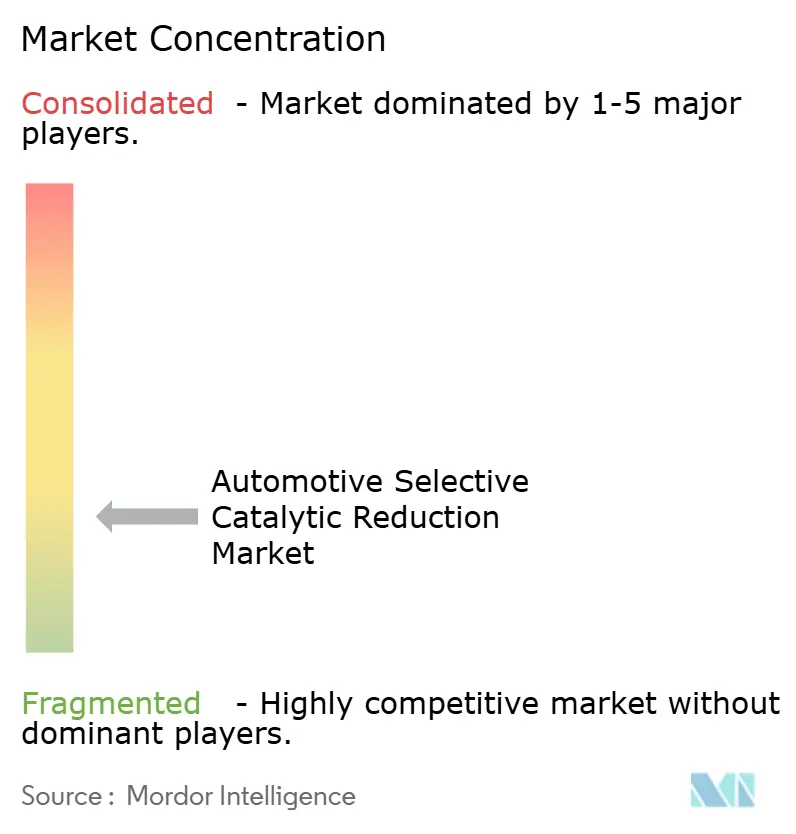
The automotive selective catalytic reduction market is fragmented. BASF Metivo, Umicore, and Johnson Matthey supply a majority of catalyst formulations to global vehicle makers. FORVIA, Tenneco, Cummins, Eberspächer, OPmobility, Bosch, and DENSO compete across dosing, sensing, and integrated aftertreatment modules. BASF Metivo's zeolite synthesis capability and Umicore's precious-metal recycling capability support long-term platform relationships, making supplier changes more difficult for vehicle makers. The market, therefore, contains both specialized component competition and broader system-level competition.
Johnson Matthey agreed to acquire CORMETECH in May 2026 and completed the USD 360 million transaction in July 2026. The acquisition expanded its clean air solutions work into stationary power generation and industrial applications, reducing reliance on light-duty diesel demand. Johnson Matthey also identified a USD 1 billion project pipeline tied to U.S. data center construction. FORVIA's BlueBox SCR technology, Cummins' EPA27 twin-module system, and Bosch's DI-SCR platform represent different approaches to achieving low nitrogen oxide performance under real driving conditions. The market favors suppliers that can meet component, control, and vehicle integration requirements simultaneously.
Closed-loop dosing already uses upstream and downstream nitrogen oxide sensor signals to adjust Diesel Exhaust Fluid (DEF) injection in real time in Euro 6-compliant systems. The next area of competition involves using sensor data to predict catalyst degradation before an on-board diagnostic threshold is reached. U.S. Patent 12546241, granted in 2025, describes predicting tailpipe nitrogen oxide conversion and ammonia slip using aftertreatment degradation models, enabling dosing adjustments before non-compliance occurs. Euro 7's longer durability obligations and stricter monitoring requirements raise the engineering threshold for smaller entrants. The market is likely to continue rewarding suppliers with proven qualification histories across multiple vehicle platforms.
Automotive Selective Catalytic Reduction Industry Leaders
-
Robert Bosch GmbH
-
Cummins Inc.
-
Tenneco Inc.
-
FORVIA
-
BASF
- *Disclaimer: Major Players sorted in no particular order
Recent Industry Developments
- September 2026: BASF's Environmental Catalyst and Metal Solutions division rebranded as Metivo, part of BASF Group, reflecting a strategic repositioning of its mobile emissions catalyst and precious metal services businesses. The rebranding aligns with Metivo's standalone commercial profile and its focus on next-generation catalyst platforms, including GenV+ CuSCR for Euro 7 and EPA27 compliance cycles.
- July 2026: Johnson Matthey completed the acquisition of CORMETECH Inc. for an enterprise value of USD 360 million, following satisfaction of all customary closing conditions, including regulatory approvals. CORMETECH, a U.S. manufacturer of SCR catalysts for stationary power generation serving more than 400 customers, extends Johnson Matthey's Clean Air Solutions reach beyond automotive applications into the data-center emissions-control market.
Global Automotive Selective Catalytic Reduction Market Report Scope
Automotive Selective Catalytic Reduction (SCR) is an exhaust after-treatment technology that reduces diesel engine emissions by converting harmful nitrogen oxides into nitrogen and water. The system operates by injecting a urea-based solution, commonly known as diesel exhaust fluid (DEF), into the exhaust stream.
The automotive selective catalytic reduction market is segmented by component, vehicle type, catalyst technology, and geography. By component, the market is segmented into urea tank, urea pump, electronic control unit, injectors, and other components. By vehicle type, the market is segmented into passenger vehicles, light commercial vehicles, and heavy commercial vehicles. By catalyst technology, the market is segmented into copper zeolite, iron zeolite, vanadium-based catalyst, and other catalyst technologies. The report also covers market size and forecasts for automotive selective catalytic reduction across 15 countries in major regions. The market sizes and forecasts are provided in terms of value (USD).
| Urea Tank |
| Urea Pump |
| Electronic Control Unit |
| Injectors |
| Other Components |
| Passenger Vehicles |
| Light Commercial Vehicles |
| Heavy Commercial Vehicles |
| Copper Zeolite |
| Iron Zeolite |
| Vanadium-Based Catalyst |
| Other Catalyst Technologies |
| Asia-Pacific | China |
| India | |
| Japan | |
| South Korea | |
| ASEAN Countries | |
| Rest of Asia-Pacific | |
| North America | United States |
| Canada | |
| Mexico | |
| Europe | Germany |
| United Kingdom | |
| France | |
| Italy | |
| NORDIC Countries | |
| Rest of Europe | |
| South America | Brazil |
| Argentina | |
| Rest of South America | |
| Middle East and Africa | Saudi Arabia |
| South Africa | |
| Rest of Middle East and Africa |
| By Component | Urea Tank | |
| Urea Pump | ||
| Electronic Control Unit | ||
| Injectors | ||
| Other Components | ||
| By Vehicle Type | Passenger Vehicles | |
| Light Commercial Vehicles | ||
| Heavy Commercial Vehicles | ||
| By Catalyst Technology | Copper Zeolite | |
| Iron Zeolite | ||
| Vanadium-Based Catalyst | ||
| Other Catalyst Technologies | ||
| By Geography | Asia-Pacific | China |
| India | ||
| Japan | ||
| South Korea | ||
| ASEAN Countries | ||
| Rest of Asia-Pacific | ||
| North America | United States | |
| Canada | ||
| Mexico | ||
| Europe | Germany | |
| United Kingdom | ||
| France | ||
| Italy | ||
| NORDIC Countries | ||
| Rest of Europe | ||
| South America | Brazil | |
| Argentina | ||
| Rest of South America | ||
| Middle East and Africa | Saudi Arabia | |
| South Africa | ||
| Rest of Middle East and Africa | ||
Key Questions Answered in the Report
What is current market size of Automotive Selective Catalytic Reduction Market?
The automotive selective catalytic reduction market size was valued at USD 10.67 billion in 2025 and is estimated to grow from USD 11.40 billion in 2026 to reach USD 16.26 billion by 2031, at a CAGR of 7.36% during the forecast period (2026-2031).
Which vehicle category has the highest projected growth?
Heavy commercial vehicles have the highest projected growth, with a forecast of 8.13% CAGR through 2031.
Why is copper zeolite important for diesel aftertreatment?
Copper zeolite held 47.18% of the catalyst technology value in 2025 and is forecast to grow at an 8.45% CAGR.
Which region leads the demand for automotive Selective Catalytic Reduction (SCR) systems?
Asia-Pacific led with a 38.31% share in 2025 and is forecast to expand at an 8.22% CAGR through 2031.