
Selective Catalytic Reduction System Market Size and Share
Market Overview
| Study Period | 2021 - 2031 |
|---|---|
| Market Size (2026) | USD 5.54 Billion |
| Market Size (2031) | USD 7.45 Billion |
| Growth Rate (2026 - 2031) | 6.13 % |
| Fastest Growing Market | Asia-Pacific |
| Largest Market | Asia-Pacific |
| Market Concentration | Low |
Major Players *Disclaimer: Major Players sorted in no particular order Image © Mordor Intelligence. Reuse requires attribution under CC BY 4.0. | |
Selective Catalytic Reduction System Market Analysis by Mordor Intelligence
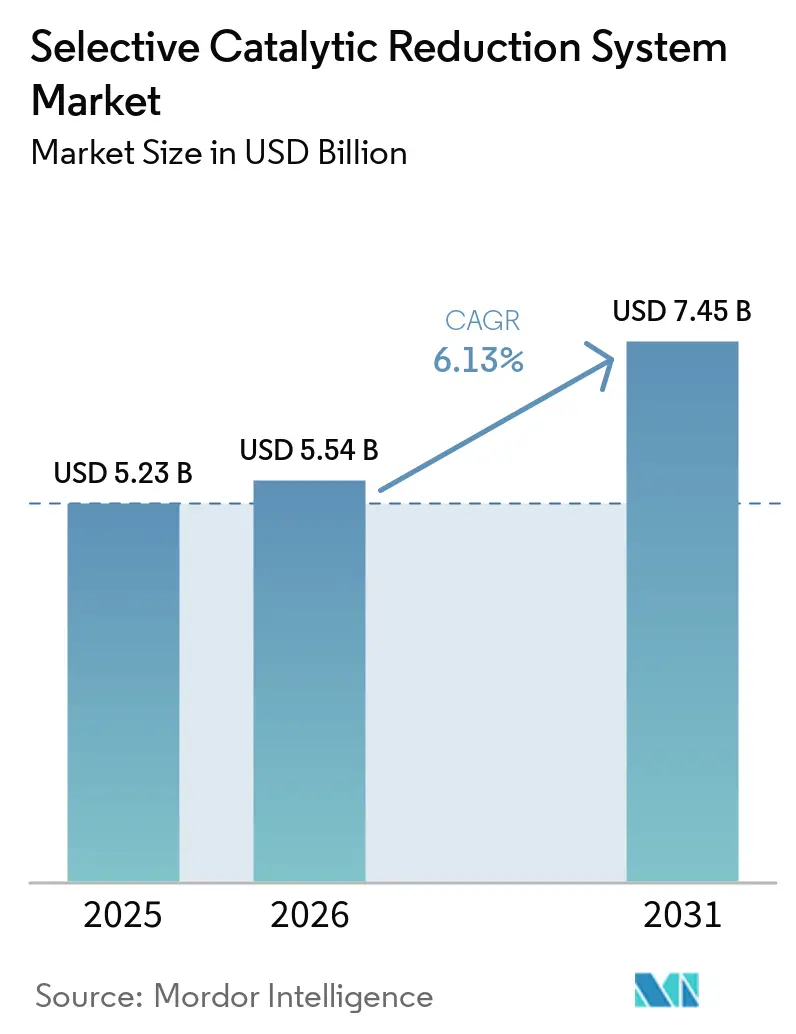
The Selective Catalytic Reduction System market size was estimated at USD 5.23 billion in 2025 and is estimated to grow from USD 5.54 billion in 2026 to USD 7.45 billion by 2031, at a CAGR of 6.13% during the forecast period (2026-2031). Emission regulations support demand across power generation, automotive, industrial manufacturing, and marine applications. The current cycle extends compliance activity to cement kilns, biomass boilers, and marine propulsion. Retrofit projects in Asia-Pacific add replacement and upgrade demand to an established installed base. Hydrogen-fueled internal combustion engines present another application for purpose-designed Selective Catalytic Reduction (SCR) systems, which can limit tailpipe NOx emissions. These factors influence procurement, product design, and service opportunities across the Selective Catalytic Reduction System market.
Key Report Takeaways
- By catalyst type, vanadium-based catalysts held 50.18% of the Selective Catalytic Reduction System market share in 2025, while zeolite-based catalysts are forecast to expand at a 6.71% CAGR through 2031.
- By installation type, retrofit installations held 53.44% of the Selective Catalytic Reduction System market share in 2025 and are forecast to grow at a CAGR at 7.08% through 2031.
- By end-user industry, automotive accounted for 42.03% of the Selective Catalytic Reduction System market size in 2025, while power generation is forecast to grow at a 7.34% CAGR through 2031.
- By geography, Asia-Pacific held 37.15% of global revenue in 2025 and is forecast to expand at a 6.84% CAGR through 2031.
Note: Market size and forecast figures in this report are generated using Mordor Intelligence’s proprietary estimation framework, updated with the latest available data and insights as of January 2026.
Market Trends and Insights
Drivers Impact Analysis of Selective Catalytic Reduction System Market*
| Drivers | (~) % Impact on CAGR Forecast | Geographic Relevance | Impact Timeline |
|---|---|---|---|
| Tightening NOx Standards for Stationary and Mobile Sources | +1.8% | Global | Short term (≤ 2 years) |
| Marine Tier III Compliance and SCR Retrofit Demand | +0.8% | Global, highest in APAC, EU, and Arctic NOx Emission Control Areas (NECAs) | Medium term (2-4 years) |
| Expansion of High-NOx Industrial and Power Assets in Asia-Pacific | +1.0% | APAC core, with spillover to South Asia and ASEAN | Short-term (≤ 2 years) and medium-term (2-4 years) |
| Low-Temperature Catalyst Deployment in Cement and Biomass Applications | +0.5% | APAC and EU, with early gains in India, Germany, and France | Medium term (2-4 years) |
| Digital Ammonia-Dosing and Closed-Loop Emissions Control | +0.4% | Global | Short-term (≤ 2 years) and medium-term (2-4 years) |
| SCR Validation for Hydrogen-Fueled Internal-Combustion Engines | +0.3% | EU, North America, and Japan | Long term (≥ 4 years) |
| Source: Mordor Intelligence | |||
Tightening NOx Emission Standards for Stationary and Mobile Sources
Regulatory requirements for stationary and mobile sources increased in 2026, expanding the role of the selective catalytic reduction (SCR) system market in compliance. The US Environmental Protection Agency finalized amendments to the New Source Performance Standards (NSPS) on January 9, 2026, identifying SCR as the best system of emission reduction for new large, high-utilization natural gas turbines above 850 million British thermal units per hour (MMBtu/h) and a 45% capacity factor. The rule set a 5-ppm NOx standard for covered units that began construction after December 13, 2024, bringing post-combustion treatment into gas turbine projects that previously relied on combustion controls. Euro 7 will apply to new light-duty type approvals from November 2026 and lower diesel NOx limits from 80 mg/km to 30 mg/km while extending testing to colder and lower-load conditions. These conditions support Cu-zeolite catalysts that remain active at 150-180°C, compared with the 250°C threshold cited for conventional vanadium formulations. The EPA's July 2026 draft proposal retained 90% of prior heavy-duty NOx reductions for Model Year 2027 (MY2027) and later engines, maintaining the need for commercial-vehicle SCR systems.
Marine Tier III Compliance and SCR Retrofit Demand
Marine regulations create a retrofit pipeline because ocean-going vessels often remain in operation for 25-30 years. IMO Resolution MEPC.399(83), adopted on April 11, 2025, entered into force on May 1, 2026, and updated SCR guidance and NOx measurement requirements for relevant vessels. The new framework uses a performance-based demonstration of sufficient accuracy for catalyst-condition monitoring rather than an explicit ±5% accuracy requirement. The March 2026 activation of the Norwegian Sea and Canadian Arctic as NOx Emission Control Areas applied Tier III requirements to routes that previously did not require aftertreatment. These requirements limit emissions from slow-speed engines to 3.4 g/kWh and shorten the planning window for affected operators. The selective catalytic reduction system market also faces an operational constraint, as ISO 18611-1-compliant AUS 40 supply and storage infrastructure has not scaled evenly across Arctic and sub-Arctic ports. Amendments to the NOx Technical Code 2008, adopted at MEPC 83 and expected to enter into force on March 1, 2027, will update SCR retrofit certification for vessels undergoing substantial modification from January 2028.
Expansion of High-NOx Industrial and Power Assets in Asia-Pacific
Asia-Pacific demand combines a replacement and upgrade cycle in China with first-install activity in India, Vietnam, Indonesia, and Thailand. China's power fleet above 200 MW operates under a 50 mg/Nm³ NOx ceiling, shifting demand toward replacement catalysts, mid-size boilers, and industrial applications. India has a 210 GW thermal fleet and applies the Central Electricity Authority norm of 100 mg/Nm³ for new units, along with phased limits for legacy facilities. This framework supports a multi-year retrofit pipeline that extends through at least 2028. High-sulfur coal can shorten vanadium catalyst replacement cycles to three years, compared with the five-year planning assumption, increasing recurring catalyst needs at affected sites. China is also extending low-NOx requirements to cement kilns, glass furnaces, and medium-sized industrial boilers under provincial schedules running from 2025 to 2030. Southeast Asian coal and gas projects operate under tightening national ambient standards, adding demand that was previously limited.
Low-Temperature Catalyst Deployment, Digital Ammonia-Dosing, and Hydrogen Engine Validation
Low-temperature catalysts expand the selective catalytic reduction system market across cement, biomass, gas turbine, marine, and hydrogen-engine applications where exhaust conditions vary. Digital dosing platforms combine upstream and downstream NOx sensors with mid-bed ammonia sensors to manage urea injection more precisely. These systems reduce urea use by 8-12% compared with map-based open-loop dosing, while reagent costs account for 15-20% of lifecycle expenditure in high-utilization mobile and marine applications. Neural-network control methods support real-time injection adjustments during engine load changes and address cold-start NOx control needs[1]. A 2025 patent describes a digital-twin marine SCR control architecture that links injection-state monitoring with catalyst-degradation tracking. A 2026 SAE International (SAE) paper reported that hydrogen internal-combustion engines, with targeted thermal-management changes and diesel-derived SCR architectures, can meet 20 mg/hp-h ultra-low NOx targets.
Restraints Impact Analysis of Selective Catalytic Reduction System Market*
| Restraints | (~) % Impact on CAGR Forecast | Geographic Relevance | Impact Timeline |
|---|---|---|---|
| High Capital, Retrofit, and Lifecycle Operating Costs | -1.2% | Global, most acute in developing South and Southeast Asia | Short term (≤ 2 years) |
| Catalyst Poisoning, Fouling, and Shortened Service Life | -0.7% | APAC high-sulfur coal, biomass, and waste incineration globally | Medium term (2-4 years) |
| Light-Duty Electrification Reducing the Addressable Diesel Base | -0.5% | Europe, North America, and China | Long term (≥ 4 years) |
| Reagent Availability, Storage, and Maritime Bunkering Uncertainty | -0.3% | Arctic NOx Emission Control Areas (NECAs), ASEAN, and South America | Medium term (2-4 years) |
| Source: Mordor Intelligence | |||
High Capital, Retrofit, and Lifecycle Operating Costs
Capital requirements remain a key consideration in regions where authorities enforce compliance inconsistently or impose penalties below installation costs. A full-scale retrofit of a 600 MW coal unit typically costs USD 15-25 million, excluding downtime, ammonia storage, and catalyst management. This cost affects utilities in South Asia and Southeast Asia that operate with narrow regulated tariff margins. In high-dust and high-sulfur coal environments, ammonium bisulfate fouling below 300°C can require catalyst replacement after 3 years instead of the usual 5-year assumption. Smaller cement, steel, and chemical companies may find that ownership costs exceed noncompliance penalties in areas with weak enforcement. Advanced dosing controls can reduce reagent use, but they do not eliminate the primary capital requirement for the Selective Catalytic Reduction System market.
Catalyst Poisoning, Electrification, and Reagent Availability
Catalyst deactivation limits performance in coal combustion, biomass co-firing, waste incineration, and automotive operations. Potassium and sodium damage Brønsted acid sites on vanadium-based V₂O₅-WO₃/TiO₂ catalysts, and a 2025 study linked higher alkali loading with faster activity loss. Phosphorus from lubricant ash and hydrothermal aging during diesel particulate filter regeneration affects Cu-zeolite catalysts. Regeneration approaches for catalysts affected by multiple metals remain in the early commercial stage, so operators often incur full replacement costs [2]. At the same time, light-duty diesel electrification reduces the long-term automotive base in Europe, North America, and China. Marine projects may also face delays in areas where AUS 40 storage, distribution, and bunkering capacity remains limited, especially around Arctic emission control areas.
*Our forecasts treat driver/restraint impacts as directional, not additive. The impact forecasts reflect baseline growth, mix effects, and variable interactions.
Selective Catalytic Reduction System Market Segment Analysis
By Catalyst Type:
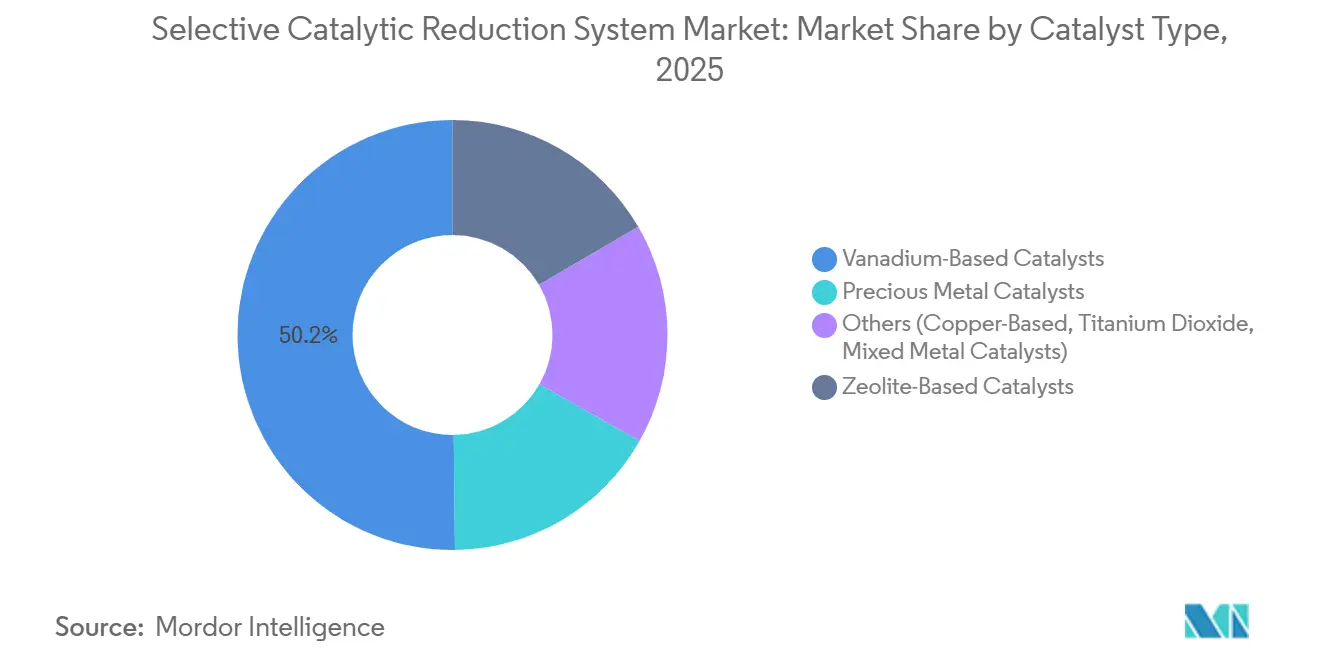
Zeolite Growth Challenges Vanadium's Bulk PositionVanadium-based catalysts held 50.18% of the catalyst-type Selective Catalytic Reduction System market share in 2025. This position reflected their long-standing deployment in high-dust coal-fired power plants across Asia and North America. These systems tolerate SO₂ exposure and demanding flue-gas conditions. Their established installed base supports replacement demand in utility applications. Vanadium remains relevant where procurement decisions prioritize mechanical durability and proven field performance. Therefore, the Selective Catalytic Reduction System market continues to rely on vanadium systems for many large stationary installations.
Zeolite-based catalysts are forecast to grow at a CAGR of 6.71% through 2031. Cu-SSZ-13 and Fe-zeolite formulations achieve higher nitrogen oxide (NOx) conversions below 200°C, supporting Euro 7 cold-start requirements and applications with variable exhaust temperatures. Cu-zeolite production in Jiangsu, China, has expanded across OEM and aftermarket channels for automotive and non-road equipment. Precious-metal catalysts are used in specialized applications, including passive Selective Catalytic Reduction (SCR) designs for hydrogen engines without urea infrastructure. Other materials, including copper-based, titanium dioxide, and mixed-metal formulations, address specific process requirements. Vanadium pentoxide pricing and China's control over rare-earth precursors for Cu-zeolite washcoats pose distinct supply risks, encouraging OEMs to maintain dual-sourcing strategies.

By Installation Type:
Retrofit Dominance Signals an Asset-Sweating Compliance EconomyRetrofit installations held 53.44% of the installation-type segment in 2025. Retrofit activity is also forecast to grow at a CAGR of 7.08% through 2031. This trend indicates that compliance spending is concentrated on existing assets rather than only on new capacity. Aging power and industrial facilities must comply with emissions regulations even when owners defer full replacement. The Selective Catalytic Reduction System market benefits from the need to preserve the operating life of regulated equipment. Retrofit demand becomes especially important when mandatory limits take effect after an asset has entered service.
New installations continue to support gas turbine projects in the United States and the Middle-East, new-build vessels, and first-generation industrial facilities in Southeast Asia. However, the global installed fleet is reaching compliance thresholds faster than the greenfield pipeline. The other category includes catalyst replacement and regeneration contracts, which become more important as installed systems age. Leading integrators offer modular SCR designs that can reduce retrofit timelines from months to weeks. Shorter installation periods reduce downtime concerns for smaller industrial operators. Lifecycle management agreements can also cover catalyst replacement, reagent optimization, and performance obligations throughout the equipment's life.
By End-User Industry:
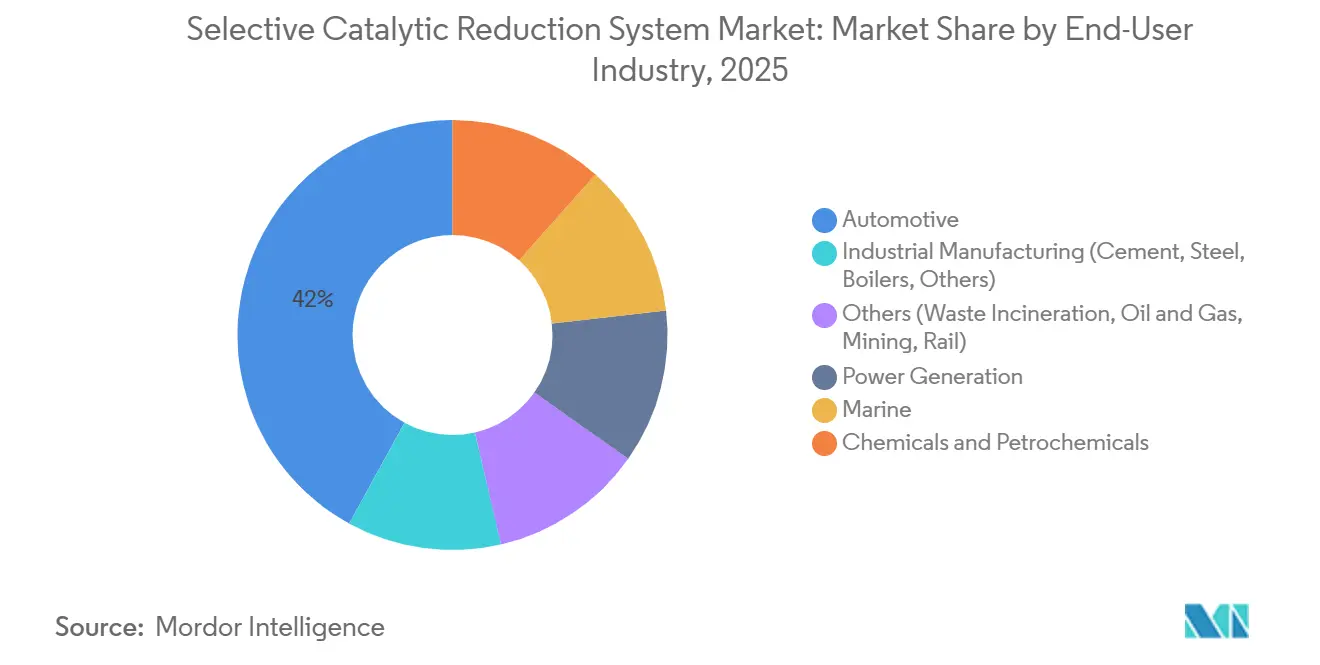
Power Generation Overtakes in Growth as Automotive Sustains ScaleAutomotive accounted for 42.03% of global revenue in 2025, making it the largest end-user segment in the Selective Catalytic Reduction System market. Diesel commercial vehicles in North America, Europe, and Asia sustain this installed base. These fleets require urea-dosing maintenance and ongoing aftertreatment service. Euro 7 and EPA heavy-duty requirements also keep new platform qualification active. Automotive demand will remain important even as its share declines relative to faster-growing end uses. Light-duty electrification creates a long-term constraint, but it does not eliminate demand for commercial vehicles.
Power generation is forecast to grow at a CAGR of 7.34% through 2031. Natural-gas combined-cycle additions serving data-center electricity demand support this growth in the United States and Western Europe. Coal-fleet upgrades in India, Vietnam, and Indonesia provide a second source of demand. Marine applications account for less than 10% of global revenue but require compact reactor designs for space-constrained engine rooms. Chemicals and petrochemicals use SCR on fired heaters, reforming furnaces, and process flares, while industrial manufacturing uses SCR in cement kilns, steel sintering plants, and boilers. Hydrogen commercial vehicles may preserve SCR demand because 2026 technical testing demonstrated ultra-low NOx performance with suitable thermal management and aftertreatment.
Geography Analysis
APAC Selective Catalytic Reduction System Market
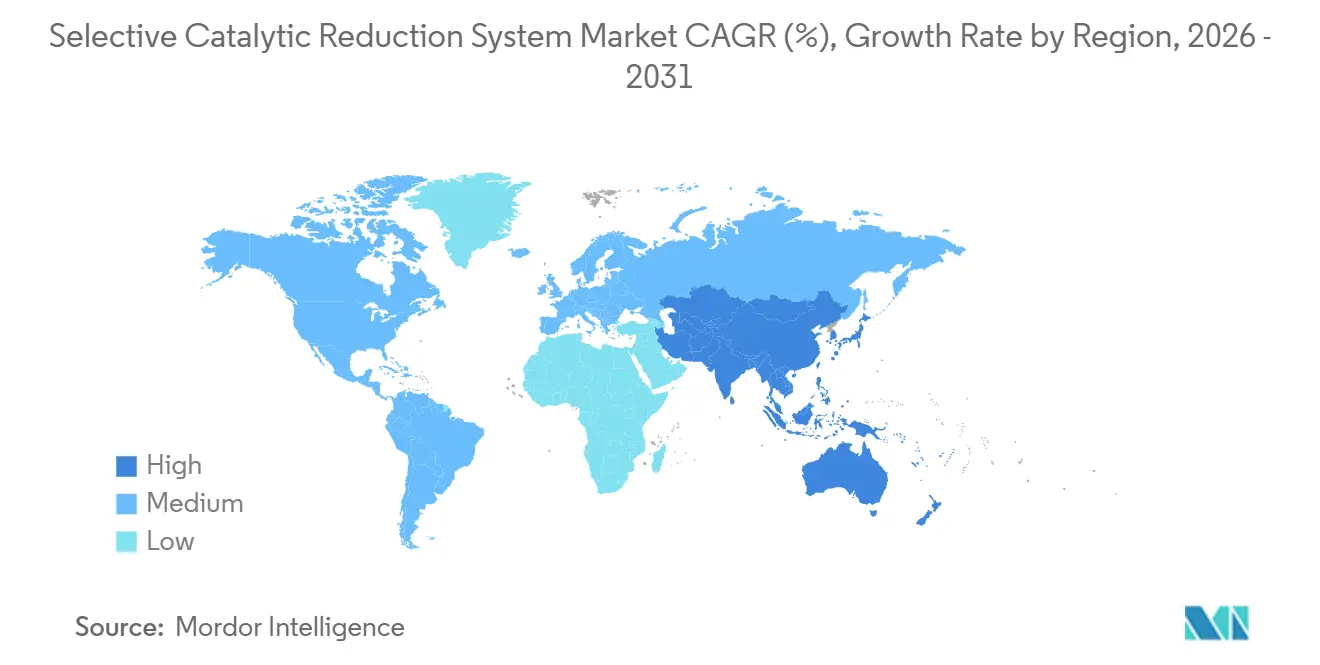
Asia-Pacific held 37.15% of the Selective Catalytic Reduction System market share in 2025 and is forecast to register a CAGR of 6.84% through 2031. China has an established SCR base for coal-fired capacity above 200 MW, with a 50 mg/Nm³ NOx ceiling. Demand in the country is shifting toward replacement cycles, mid-size industrial boilers, and emissions controls for cement, glass, and steel. India operates a 210 GW thermal fleet under phased Central Electricity Authority NOx requirements, including a 100 mg/Nm³ limit for new units. Therefore, India supports first-install retrofits across a large coal fleet. Japan and South Korea support adopting premium, high-activity catalysts to meet industrial boiler requirements.
North America and Europe Selective Catalytic Reduction System Market
North America and Europe remain key regions in the Selective Catalytic Reduction System market due to regulatory enforcement. The United States requires SCR for covered high-utilization natural gas turbines under the January 2026 New Source Performance Standards (NSPS) amendments. Aging gas turbines also create retrofit opportunities during mid-life renovations. Europe continues to support automotive SCR through Euro 7, even as electrification gradually reduces demand from the light-duty fleet. Stationary demand comes from best-available-technique cycles for cement, steel, and chemical facilities. Nordic markets gained additional marine demand from the activation of the Norwegian Sea NOx Emission Control Area (NECA) in March 2026.
MEA and South America Selective Catalytic Reduction System Market
South America, the Middle-East, and Africa have distinct demand conditions. Brazil supports automotive and petrochemical SCR applications through heavy-vehicle standards and industrial activity in São Paulo and Rio de Janeiro. Currency volatility and reagent import costs constrain smaller operators in Argentina and the rest of South America. Saudi Arabia's industrial diversification and additions to gas-fired power capacity support competition for gas-turbine SCR systems. Siemens Energy secured six SGT5-4000F turbine contracts for Oman's Misfah and Duqm independent power projects in 2025. South Africa's aging coal fleet and environmental enforcement create an early opportunity for industrial SCR. However, the country's renewable energy transition may limit the long-term thermal power base.
Competitive Landscape
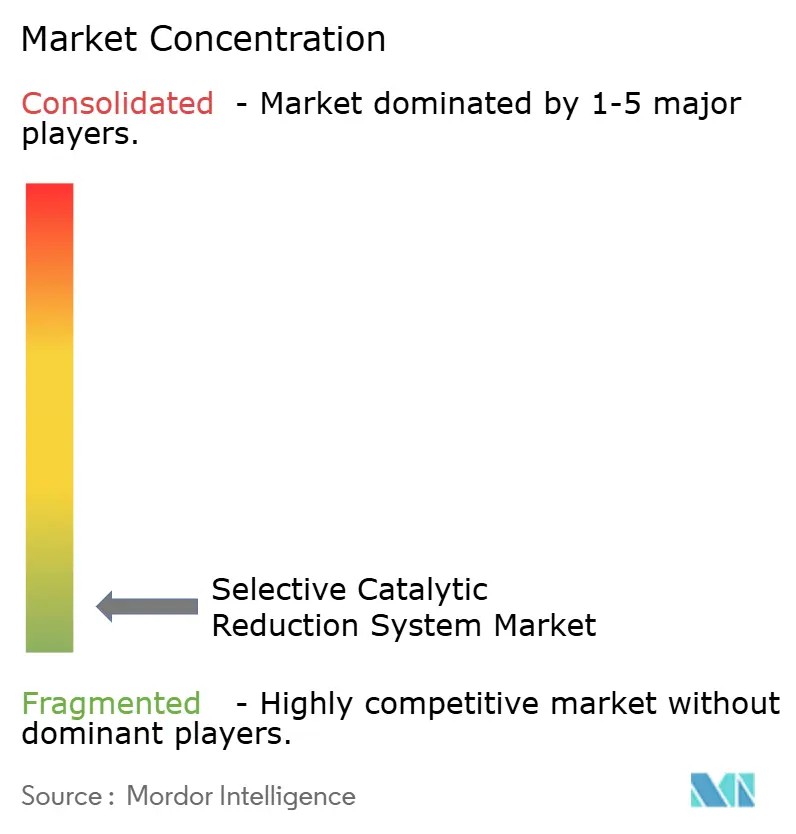
The Selective Catalytic Reduction System market is fragmented. Engine OEMs integrate exhaust aftertreatment functions into their equipment offerings, while Tier-1 system suppliers compete through dosing-control software and thermal-management capabilities. Catalyst specialists compete through access to vanadium, rare-earth, and zeolite materials. This structure limits any single company’s ability to lead pricing across all end uses. It also keeps procurement decisions focused on application requirements, lifecycle service, and local engineering support.
Robert Bosch GmbH and FORVIA are developing precision dosing, reactor-temperature management, and Euro 7 compliance packages for automotive OEMs. ANDRITZ, Mitsubishi Heavy Industries, and Babcock & Wilcox compete through stationary-source engineering, catalyst-lifecycle management, and integrated controls that combine SCR with flue-gas desulfurization and activated-carbon equipment. A 2025 patent for digital-twin marine control shows how software capabilities can move between automotive and industrial SCR applications. ANDRITZ agreed in June 2025 to acquire Diamond Power International from Babcock & Wilcox, expanding its position in boiler maintenance services serving industrial power customers also targeted by SCR projects. Shandong Longking Environmental Protection Co. uses domestic procurement advantages and international Engineering, Procurement, and Construction (EPC) relationships in cement-plant and industrial-boiler contracts. These strategies reflect competition for initial equipment orders and recurring support work.
Marine SCR remains a business opportunity because it accounts for less than 10% of global revenue and requires specialized maritime certification and compact engineering. Newly activated emission-control areas increase retrofit demand, while reagent logistics can delay deployment. Predictive emissions software is another area without a single established platform across mixed industrial fleets. Cummins signed a multi-year supply agreement with Circe Energy in 2026 for natural-gas generator sets used in Texas data-center microgrids, illustrating an OEM model that combines prime power, aftertreatment, and long-term service. Smaller SCR suppliers may need OEM, industrial-automation, or energy-management partnerships to offer a comparable bundled service. This commercial model favors providers that can link hardware performance to long-term operational support.
The Selective Catalytic Reduction System market requires suppliers to tailor reactor layouts, catalysts, dosing systems, and service models to each application. Automotive systems need rapid response during cold starts and changing vehicle loads. Stationary systems require long operating periods under dust, sulfur, and temperature constraints. Marine equipment must fit within limited engine-room space and operate alongside the vessel’s fuel and reagent arrangements. These operating conditions limit direct product standardization and make application experience important during supplier selection. Local installation capability can matter as much as the initial equipment specification. Long-term service support remains central when operators assess operating risk.
Selective Catalytic Reduction System Industry Leaders
-
Cummins Inc.
-
FORVIA
-
Robert Bosch GmbH
-
ANDRITZ
-
Ducon Environmental Systems Inc.
- *Disclaimer: Major Players sorted in no particular order
Selective Catalytic Reduction System Market Companies Covered in this Report
- ANDRITZ
- Babcock & Wilcox Enterprises, Inc.
- Cummins Inc.
- Ducon Environmental Systems Inc.
- Dürr CTS
- FORVIA
- GE Vernova
- Kautex Textron GmbH & Co. KG
- MITSUBISHI HEAVY INDUSTRIES, LTD.
- Robert Bosch GmbH
- Shandong Longking Environmental Protection Co., Ltd.
- Siemens Energy
- Süd-Chemie India Pvt. Ltd.
- Tenneco Inc.
- YANMAR Marine International
Recent Industry Developments in Selective Catalytic Reduction System Market
- June 2026: GE Vernova secured an order from Vietnam Electricity (EVN) for two 9HA.02 gas turbines for the Quang Trach II LNG power plant. The combined-cycle project will exceed 1.6 GW, with commercial operations expected by 2030. The plant will require integrated SCR aftertreatment to comply with Vietnam’s national emission standards for NOx.
- February 2026: GE Vernova secured a contract with Lincoln Electric System to supply two LM6000 VELOX aeroderivative gas turbine packages for the Terry Bundy Generating Station in Lincoln, Nebraska. The project will add 100 MW of power generation capacity and require SCR integration to meet EPA New Source Performance Standards (NSPS) compliance obligations. The units are scheduled to begin commercial operations in 2029.
Global Selective Catalytic Reduction System Market Report Scope
Selective catalytic reduction (SCR) is an advanced active emissions control technology that injects a liquid reducing agent into an exhaust stream to convert toxic nitrogen oxides into harmless nitrogen gas and water vapor. The technology achieves reductions of up to 90%.
The selective catalytic reduction system market is segmented by catalyst type, installation type, end-user industry, and geography. By catalyst type, the market is segmented into vanadium-based catalysts, zeolite-based catalysts, precious metal catalysts, and others (copper-based, titanium dioxide, mixed metal catalysts). By installation type, the market is segmented into new installations, retrofit installations, and others (catalyst replacement and regeneration). By end-user industry, the market is segmented into power generation, automotive, marine, chemicals and petrochemicals, industrial manufacturing (cement, steel, boilers, others), and others (waste incineration, oil and gas, mining, rail). The report also covers market size and forecasts for the selective catalytic reduction system across 15 countries in major regions. The market sizes and forecasts are provided in terms of value (USD).
Segmentation Overview
| Vanadium-Based Catalysts |
| Zeolite-Based Catalysts |
| Precious Metal Catalysts |
| Others (Copper-Based, Titanium Dioxide, Mixed Metal Catalysts) |
| New Installations |
| Retrofit Installations |
| Others (Catalyst Replacement and Regeneration) |
| Power Generation |
| Automotive |
| Marine |
| Chemicals and Petrochemicals |
| Industrial Manufacturing (Cement, Steel, Boilers, Others) |
| Others (Waste Incineration, Oil and Gas, Mining, Rail) |
| Asia-Pacific | China |
| India | |
| Japan | |
| South Korea | |
| ASEAN Countries | |
| Rest of Asia-Pacific | |
| North America | United States |
| Canada | |
| Mexico | |
| Europe | Germany |
| United Kingdom | |
| France | |
| Italy | |
| NORDIC Countries | |
| Rest of Europe | |
| South America | Brazil |
| Argentina | |
| Rest of South America | |
| Middle-East and Africa | Saudi Arabia |
| South Africa | |
| Rest of Middle-East and Africa |
| By Catalyst Type | Vanadium-Based Catalysts | |
| Zeolite-Based Catalysts | ||
| Precious Metal Catalysts | ||
| Others (Copper-Based, Titanium Dioxide, Mixed Metal Catalysts) | ||
| By Installation Type | New Installations | |
| Retrofit Installations | ||
| Others (Catalyst Replacement and Regeneration) | ||
| By End-User Industry | Power Generation | |
| Automotive | ||
| Marine | ||
| Chemicals and Petrochemicals | ||
| Industrial Manufacturing (Cement, Steel, Boilers, Others) | ||
| Others (Waste Incineration, Oil and Gas, Mining, Rail) | ||
| By Geography | Asia-Pacific | China |
| India | ||
| Japan | ||
| South Korea | ||
| ASEAN Countries | ||
| Rest of Asia-Pacific | ||
| North America | United States | |
| Canada | ||
| Mexico | ||
| Europe | Germany | |
| United Kingdom | ||
| France | ||
| Italy | ||
| NORDIC Countries | ||
| Rest of Europe | ||
| South America | Brazil | |
| Argentina | ||
| Rest of South America | ||
| Middle-East and Africa | Saudi Arabia | |
| South Africa | ||
| Rest of Middle-East and Africa | ||
Key Questions Answered in the Report
What is current market size of Selective Catalytic Reduction System Market?
The Selective Catalytic Reduction System market size was estimated at USD 5.23 billion in 2025 and is estimated to grow from USD 5.54 billion in 2026 to USD 7.45 billion by 2031, at a CAGR of 6.13% during the forecast period (2026-2031).
Which catalyst type leads selective catalytic reduction systems?
Vanadium-based catalysts led the catalyst-type segment with a 50.18% share in 2025, supported by high-dust coal-fired applications.
Why are Selective Catalytic Reduction (SCR) retrofits expanding?
Retrofit installations held 53.44% share in 2025 and are projected to grow at a 7.08% CAGR. Existing regulated assets need upgrades without a full equipment replacement cycle.
Which end user is growing fast for SCR equipment?
Power generation is forecast to grow at a 7.34% CAGR through 2031, supported by gas-turbine additions and coal-fleet compliance work. Automotive remains the largest end-user group by 2025 revenue.