
Automotive Data Logger Market Size and Share
Market Overview
| Study Period | 2020 - 2031 |
|---|---|
| Forecast Data Period | 2026 - 2031 |
| Market Size (2026) | USD 4.73 Billion |
| Market Size (2031) | USD 6.82 Billion |
| Growth Rate (2026 - 2031) | 7.63 % |
| Fastest Growing Market | Asia Pacific |
| Largest Market | North America |
Major Players *Disclaimer: Major Players sorted in no particular order Image © Mordor Intelligence. Reuse requires attribution under CC BY 4.0. | |
Automotive Data Logger Market Analysis by Mordor Intelligence
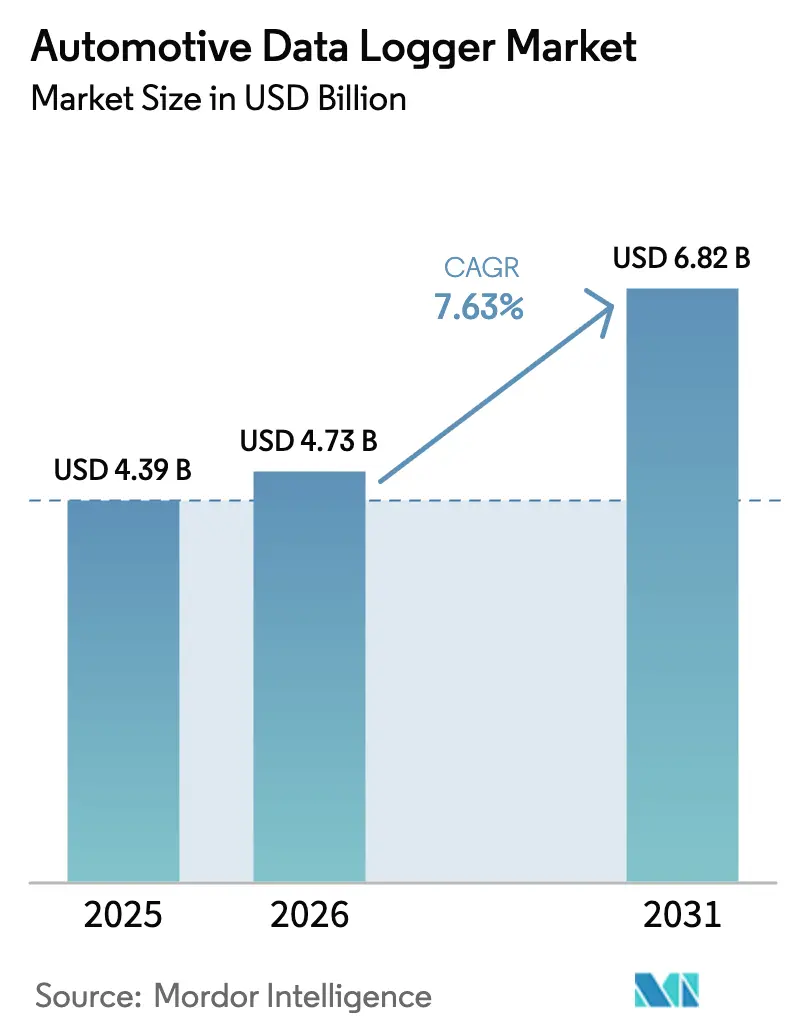
The Automotive Data Logger Market size is expected to grow from USD 4.39 billion in 2025 to USD 4.73 billion in 2026 and is forecast to reach USD 6.82 billion by 2031 at 7.63% CAGR over 2026-2031.
The expansion reflects a decisive industry shift toward predictive, data-centric vehicle management that enhances safety, efficiency, and lifecycle cost control. Regulatory mandates in the European Union, China, and other major regions are accelerating the adoption of event data recorders and broader data-logging capabilities. Growing sensor counts in advanced driver-assistance systems (ADAS) and the transition to centralized, software-defined vehicle architectures are increasing demand for high-bandwidth, secure logging platforms. Heightened fleet digitalization, usage-based insurance in emerging economies, and the need for real-time analytics across electrified fleets further reinforce growth opportunities. Competitive differentiation has begun to pivot from hardware alone toward integrated data-management ecosystems capable of over-the-air (OTA) updates, cybersecurity compliance, and advanced analytics.
Key Report Takeaways
- By application, ADAS led with 36.02% revenue share in 2025; autonomous driving R&D is projected to expand at a 13.14% CAGR through 2031.
- By connection type, USB dominated the automotive data logger market, with 40.28% of the share in 2025, while automotive Ethernet is poised to grow at a 10.62% CAGR to 2031.
- By hardware type, stand-alone loggers dominated the automotive data logger market and captured 34.01% of the revenue share in the 2025 automotive data logger market size; cloud-based software agents represent the fastest-growing category at 9.11% CAGR.
- By memory capacity, the 32-128 GB tier dominated the automotive data logger market, accounting for a 31.74% share in 2025; capacities above 512 GB are forecast to rise at an 8.15% CAGR.
- By end user, OEMs held the highest market share in the dominated automotive data logger market, 43.25% in 2025; fleet operators are expected to advance at 10.31% CAGR.
- By channel, OEM-fitted solutions commanded the automotive data logger market with 56.62% share in 2025, while the aftermarket segment is set to grow at 9.32% CAGR.
- By vehicle type, passenger cars retained 66.88% share in the automotive data logger market in 2025; medium and heavy commercial vehicles show the highest growth at 9.63% CAGR.
- By propulsion, internal-combustion vehicles remain dominated the automotive data logger market with 65.72% share in 2025, yet battery-electric vehicles are projected to register a 12.08% CAGR.
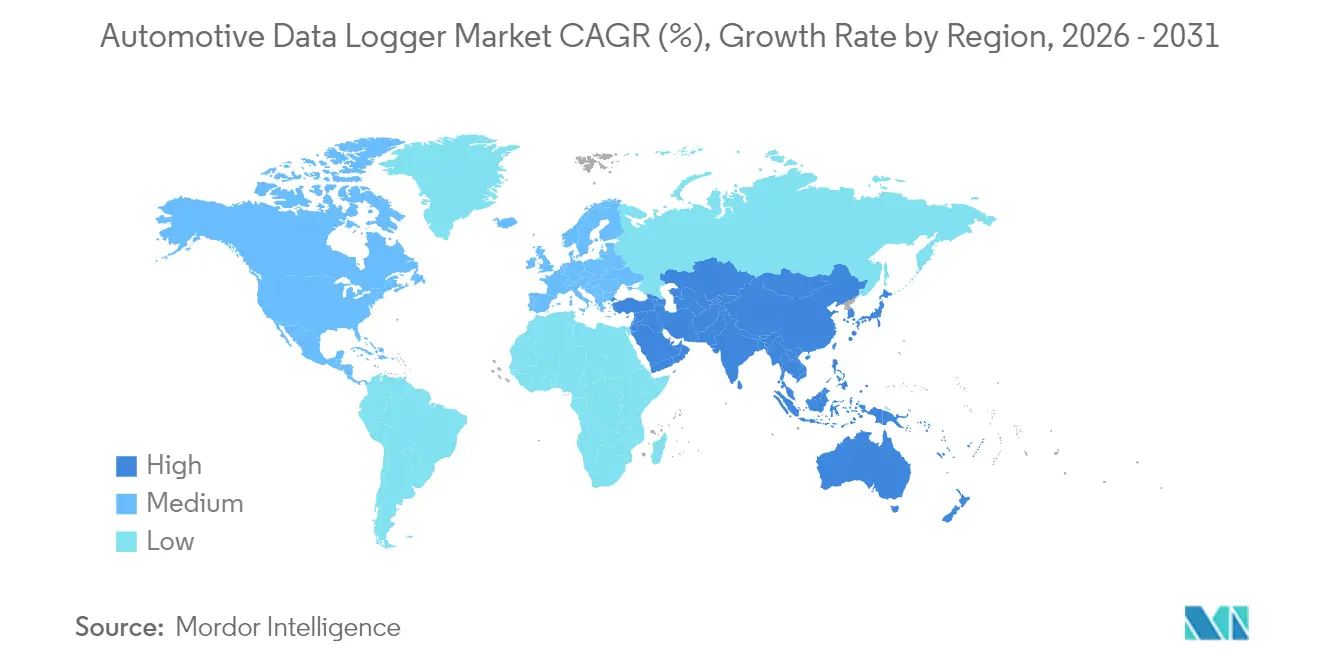
- Regionally, North America led the automotive data logger marketwith 30.92% share in 2025, whereas Asia-Pacific is the fastest-growing region at 10.09% CAGR through 2031.
Note: Market size and forecast figures in this report are generated using Mordor Intelligence’s proprietary estimation framework, updated with the latest available data and insights as of 2026.
Market Trends and Insights
Drivers Impact Analysis of Automotive Data Logger Market*
| Driver | % Impact on CAGR Forecast | Geographic Relevance | Impact Timeline |
|---|---|---|---|
| Surge in Sensor Fusion Data in Level-3+ AD | +2.1% | North America and EU leading, Asia-Pacific following | Long term (≥ 4 years) |
| Regulatory Push for Autonomous-Ready E/E Systems | +1.8% | Global, with early adoption in EU and China | Medium term (2-4 years) |
| OEM Shift to Software-Defined Vehicles & Logging | +1.5% | Global, with premium segments first | Medium term (2-4 years) |
| Real-Time Fleet Analytics to Reduce EV TCO | +1.2% | North America and EU, expanding to Asia-Pacific | Medium term (2-4 years) |
| Usage-Based Insurance Growth in Emerging Markets | +0.9% | Asia-Pacific core, spill-over to South America | Short term (≤ 2 years) |
| Mandated EDRs in Euro-NCAP & China NCAP 2026+ | +0.7% | EU and China, potential global harmonization | Short term (≤ 2 years) |
| Source: Mordor Intelligence | |||
Soaring Volume of Sensor-Fusion Data in Level 3+ AD Systems
Modern premium vehicles will need up to 278 GB of embedded memory in 2026 versus 90 GB in 2025, a threefold rise directly tied to multi-sensor ADAS suites[1]“Memory Trends for Advanced Driver-Assistance Systems,” Micron Technology, micron.com. BlackBerry IVY and NXP S32K5 MCUs showcase industry progress in secure multi-sensor data handling. Vehicles employing 60-400 sensors now generate petabyte-scale datasets over their lifetimes, stimulating long-term demand in the automotive data logger market for high-reliability storage and rapid offload capabilities.
Regulatory Push for Autonomous-Ready E/E Architectures
UN ECE Regulation 160 mandates event data recorders that capture discrete vehicle parameters for several seconds pre-incident, driving OEM demand for compliant, high-capacity logging subsystems[2]“Regulation No. 160: Event Data Recorders,” United Nations Economic Commission for Europe, unece.org. Suppliers like Continental respond with scalable software platforms integrating cybersecurity and OTA update readiness. Centralized computing architectures, now demonstrating 30-40% wiring reductions, intensify processing loads and elevate the automotive data logger market requirement for robust throughput and embedded security.
Usage-Based Insurance Adoption in Emerging Economies
Fleet and personal lines increasingly deploy telematics to refine risk models. Octo Telematics already supports 6 million connected policies across 20 countries, highlighting scalability potential in Asia and South America[3]“Connected Insurance Solutions Overview,” Octo Telematics, octotelematics.com. For data-logger suppliers, this presents immediate opportunities to package secure, insurer-grade data streams for underwriting and claims validation.
Real-Time Fleet Health Analytics to Cut TCO for Electrified Fleets
North American and European operators of battery-electric delivery and transit fleets rely on continuous logging of charge cycles, temperature profiles, and driving patterns to extend battery life and optimize routing. Continental’s VDO Fleet platform integrates tachograph data with predictive analytics that cut unplanned downtime, widening adoption across APAC as charging infrastructure matures.
Restraints Impact Analysis of Automotive Data Logger Market*
| Restraint | % Impact on CAGR Forecast | Geographic Relevance | Impact Timeline |
|---|---|---|---|
| Cybersecurity Risks Limiting Data Access | -1.3% | Global, with stricter enforcement in EU and China | Short term (≤ 2 years) |
| Raw Flash Price Volatility Raising BOM Costs | -0.8% | Global, affecting cost-sensitive segments most | Short term (≤ 2 years) |
| Lack of Unified Data Standards Across OEMs | -0.7% | Global, with fragmentation between US, EU, and Asia-Pacific standards | Medium term (2-4 years) |
| OEM Reluctance to Share Data with Insurers | -0.6% | North America and EU primarily, emerging in Asia-Pacific | Medium term (2-4 years) |
| Source: Mordor Intelligence | |||
Cyber-Security Risks Driving Data-Access Restrictions
UNECE WP.29 R156 obliges manufacturers to maintain certified cybersecurity management systems, curtailing unauthorized third-party data tapping. China’s data-localization rules require on-shore storage and state security assessments for outbound transfers, complicating cross-border R&D collaboration. Providers are embedding Uptane-based secure-update frameworks and hardware root-of-trust elements to satisfy regulators while ensuring business continuity in the automotive data logger market.
High Raw-Flash Price Volatility Inflating BOM Cost
DRAM and NAND supply cannot keep pace with 30-35% annual demand growth for automotive-grade memory, leading to price swings that compress margins. Automotive specifications spanning –40 °C to +105 °C and AEC-Q100 qualification narrow the supplier pool, an issue highlighted by Western Digital’s automotive portfolio updates. Long-term supply agreements protect availability yet limit flexibility in adopting emerging, lower-cost technologies.
*Our forecasts treat driver/restraint impacts as directional, not additive. The impact forecasts reflect baseline growth, mix effects, and variable interactions.
Automotive Data Logger Market Segment Analysis
By Application:
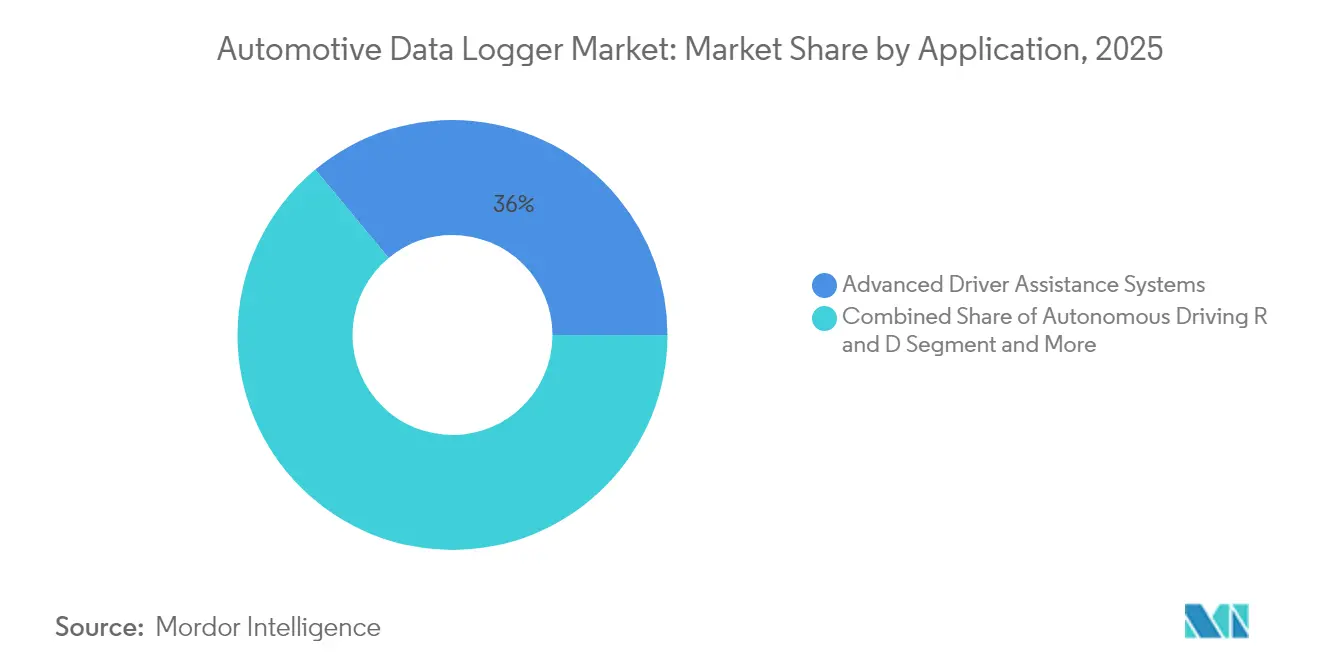
ADAS Dominance Faces Autonomous DisruptionADAS accounted for the largest automotive data logger market slice in 2025 at 36.02%. The segment’s growth is anchored in regulatory calls for lane-keeping, automated braking, and driver-monitoring functions. In parallel, autonomous-driving R&D is charted to grow at 13.14% CAGR, underpinned by sensor-rich prototypes that create terabytes of daily data. Commercial fleet management continues steady adoption for predictive maintenance, while insurance telematics gains traction in Asia and Latin America. Emerging use cases, such as infotainment analytics and OTA validation, demand continuous logging of user interaction and software execution data. This application convergence positions data-management platforms as multipurpose hubs, enabling OEMs to monetize insights while reducing hardware redundancy.
Across these use cases, developers require deterministic storage, granular time-stamping, and open APIs. The automotive data logger market size for ADAS and infotainment combined commanded half of the total revenues 2025. As Level 3 trials progress, prototypes often employ more than 512 GB of onboard storage. Over the forecast period, the rising deployment of domain-controller architectures and edge analytics will further strengthen the value proposition for integrated logging and processing solutions.



By Connection Type:
Ethernet Emerges as USB AlternativeUSB dominated the automotive data logger market with a 40.28% share in 2025 because of its ubiquity in test benches and aftermarket retrofits. Yet the bandwidth ceiling of single-lane USB limits its future role in high-resolution sensor data offload. Automotive Ethernet, supported by single-pair variants such as 100BASE-T1, is forecast to post a 10.62% CAGR. Tier-1 suppliers bundle multi-protocol gateways that couple CAN-FD and Ethernet to balance legacy support and future scalability. The Ethernet products' automotive data logger market size is expected to double by 2031 as OEMs migrate to zonal architectures.
Other connection types, such as Cellular 5G connectivity, underpin real-time cloud backhaul for fleet use cases. At the same time, Wi-Fi Direct supports garage or depot offloads where bandwidth costs must be contained. Suppliers are increasingly packaging adaptable transceivers and software-defined radios that allow firmware-based switching between standards, mitigating obsolescence risk.
By Hardware Type:
Cloud Migration AcceleratesStand-alone loggers dominated the automotive data logger market with a 34.01% share in 2025 due to their ruggedness and independence. Cloud-native agents, however, will record the highest growth at 9.11% CAGR as OEMs virtualize electronic control units (ECUs). Continental’s vECU Creator exemplifies how developers compile and test software in the cloud before hardware is ready, compressing development cycles. The automotive data logger market share of embedded OEM modules is also rising because regulatory mandates encourage factory integration.
Hardware consolidation yields lower power draw, smaller harnesses, and easier OTA patching. Cloud-linked loggers provide lifecycle cost savings via remote diagnostics and dynamic storage allocation. Suppliers focusing on encryption, compression, and smart-stream selection stand to capture incremental value as data volumes expand.
By Memory Capacity:
High-Capacity Demand SurgesThe 32-128 GB band dominated the automotive data logger market with a 31.74% share in 2025, matching today’s Level 2 ADAS requirements. Vehicles under Level 3 development programs already test capacities above 512 GB, the fastest-growing bracket at 8.15% CAGR. As sensor counts scale, demand for error correction, power-loss protection, and extended temperature tolerance drives premium pricing. Automotive data logger market size for high-capacity tiers will reflect the shift to centralized storage pools managed by real-time controllers.
Micron’s projections indicate 4 TB per autonomous vehicle by 2030. Suppliers are therefore adopting mixed-memory architectures blending MRAM for instant-on logs, NOR for boot code, and NAND for bulk storage. Concurrently, software compression and intelligent sampling aim to slow physical capacity growth, balancing BOM costs against the relentless data-generation curve.
By End User:
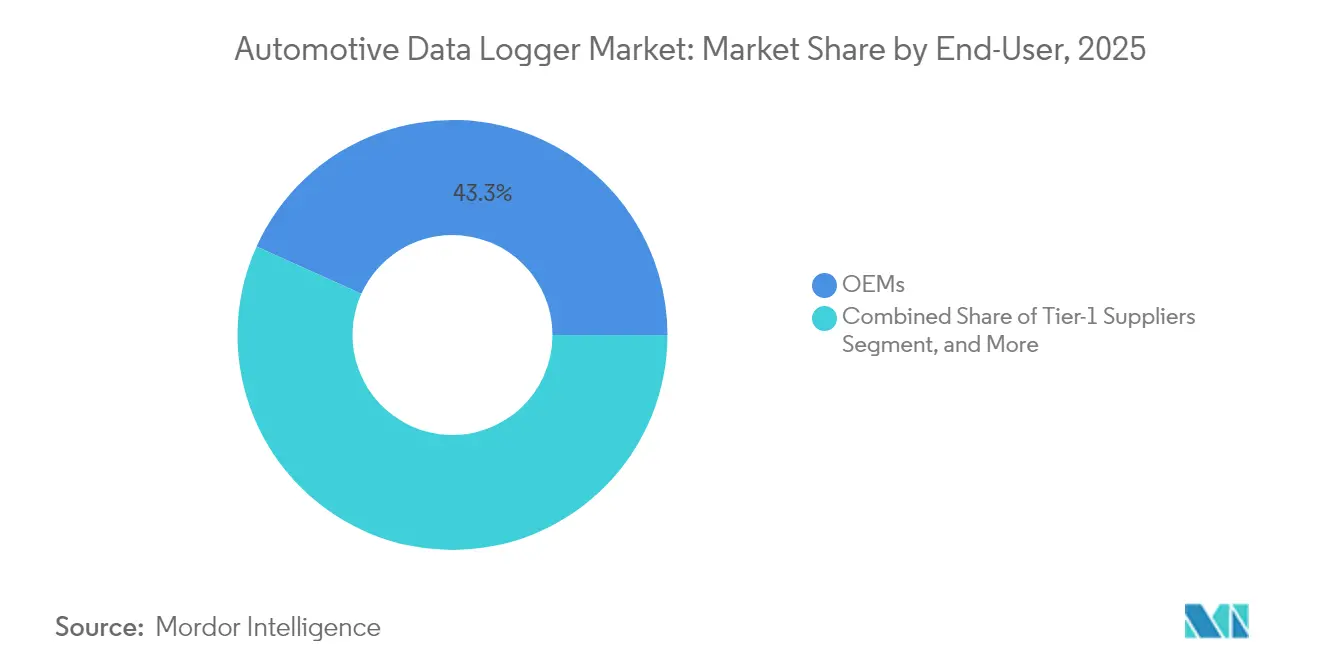
Fleet Operators Drive GrowthOEMs kept the largest stake in the automotive data logger market with 43.25% in 2025, leveraging in-house data for product engineering and regulatory compliance. Fleet operators will outpace other groups at 10.31% CAGR because predictive analytics lowers the total cost of ownership through reduced downtime. Tier-1 suppliers integrate component validation telemetry into broader service offerings, while insurers harness telematics to verify risk profiles.
Regulators and test agencies require traceable, tamper-proof logs for homologation and safety validation, creating a specialized niche demand. The automotive data logger market benefits from growing collaboration among OEMs, fleets, and insurers to pool anonymized data, accelerating model training for advanced analytics without compromising privacy mandates.
By Channel:
Aftermarket Gains MomentumOEM-fitted systems captured a 56.62% share in the automotive data logger market in 2025 under the influence of EDR regulations. Yet aftermarket providers are ramping up at 9.32% CAGR, capitalizing on the vast installed base of vehicles predating regulatory deadlines. The EU Data Act, effective September 2025, will require automakers to provide secure third-party data access interfaces, reducing historical barriers to aftermarket innovation.
OTA-deployable software agents blur channel distinctions by enabling subscription-based features post-sale. For the automotive data logger market, hybrid deployment models combining factory-installed gateways and dealer-installed expansion modules will become common, especially for mixed fleets spanning multiple model years.
By Vehicle Type:
Commercial Vehicles AcceleratePassenger cars dominated the automotive data logger market with 66.88% of sales in 2025, benefiting from scale economies. Heavy commercial vehicles, however, will log the highest CAGR at 9.63% as logistics firms embrace predictive powertrain maintenance and regulatory compliance (for example, tachograph mandates). Light commercial segments leverage telematics to optimize last-mile deliveries, while off-highway machinery adopts loggers for equipment health monitoring under harsh conditions.
Bosch’s Electronic Horizon has demonstrated measurable fuel savings in trucking by integrating topographic data with powertrain controls, highlighting value capture beyond raw data collection. The automotive data logger market is evolving from passive recorders to active enablers of operational efficiency across vehicle classes.
By Propulsion:
Electric Vehicles Lead InnovationInternal combustion models remain the volume bedrock, with a 65.72% share in the automotive data logger market in 2025. Battery-electric vehicles (BEVs) will expand fastest, at 12.08% CAGR, driven by battery state-of-health monitoring, charging analytics, and thermal-management logging. Hybrids require dual-powertrain data correlation, while fuel-cell models need hydrogen stack performance tracking.
Mahindra’s EV telematics platform, deployed in 24 countries, showcases how granular battery data improves range accuracy and residual-value forecasting. As electrification advances, standardized interfaces such as ISO 15118 for smart charging will feed additional telemetry to cloud analytics, reinforcing growth prospects in the automotive data logger market.
Geography Analysis
North America Automotive Data Logger Market
North America dominated the automotive data logger market with a 30.92% share in 2025 due to mature fleet telematics adoption and insurer telematics penetration. Regulatory focus centers on privacy and cybersecurity rather than prescriptive device standards, prompting OEM investment in consent management and encryption. Regional fleets increasingly deploy machine-learning-driven predictive maintenance to extend asset life and minimize roadside incidents.
APAC Automotive Data Logger Market
Asia-Pacific is projected to grow at 10.09% CAGR through 2031. China mandates data localization and real-time uploads to government-approved servers for intelligent connected vehicles, reshaping global architecture decisions. Indian commercial fleets are integrating telematics quickly to meet new safety and tax compliance rules, while Japanese regulators emphasize driver-readiness monitoring for advanced autonomy trials. The region’s strong uptake of electric vehicles mirrors national industrial policies, amplifying demand for high-capacity loggers able to process battery and ADAS data in concert.
Europe Automotive Data Logger Market
Europe maintains a leading regulatory influence. Regulation 2019/2144 obliges event data recorders in all new cars and vans, and the forthcoming Data Act will open manufacturer data silos to third parties under strict consent rules. German suppliers pioneer privacy-by-design principles, embedding on-device anonymization before transmission. Compliance costs spur collaboration across the value chain, with suppliers like Continental offering turnkey cybersecurity and logging stacks that comply with UN ECE and EU directives.

Regulatory Landscape
Automotive data logger requirements are shaped by safety, cybersecurity, and software update compliance regimes that increasingly treat logging as part of the vehicle type-approval evidence trail. In the European Union, General Safety Regulation (EU) 2019/2144 supports broader fitment of event data recorders (EDRs), while UNECE type-approval rules used across many markets, notably UN Regulation No. 155 (CSMS) and UN Regulation No. 156 (SUMS), require OEMs to maintain secure, auditable records of cybersecurity events and software versions throughout the vehicle lifecycle.
Technical compliance is commonly demonstrated through recognized standards that influence logger architectures and downstream supplier requirements. ISO/SAE 21434 anchors cybersecurity engineering processes for vehicle systems and components, while ISO 24089 (including the July 2024 Amendment 1 update) sets software update engineering requirements that elevate needs for authenticated update evidence, software version traceability, and tamper-resistant logs consistent with UN R156 expectations. In the United Kingdom, guidance referenced by the Vehicle Certification Agency on cybersecurity and software updating shows how these UNECE-aligned obligations cascade to the supply base, tightening controls on data extraction interfaces and affecting aftermarket access models.
Value Chain Analysis
The value chain spans automotive-grade memory and compute (NAND/DRAM, MCUs/SoCs), networking and transceivers (CAN/CAN-FD, LIN, FlexRay, Automotive Ethernet), logger hardware and embedded modules, and software layers for acquisition, time synchronization, compression/encryption, and upload/OTA management. Tier-1s and specialist tool vendors integrate these components into stand-alone loggers, embedded OEM modules, OBD devices, and cloud-based agents, then distribute through OEM engineering programs, validation labs, fleet/telematics platforms, and aftermarket channels. Service layers increasingly add secure APIs, data governance, and analytics.
Recent partner-led integrations also point to where value capture is shifting, from device installation toward OEM-connected data access and platform interoperability. In 2026, Geotab expanded OEM telematics connectivity through partnerships, including integration of Polestar vehicles (May 2026) and a global alliance with Toyota Connected (June 2026), enabling fleet data access without physical device deployment. OCTO Telematics partnered with Volkswagen Group Info Services AG (March 2026) to ingest multi-brand vehicle data directly into its platform, while CARUSO Dataplace partnered with Polestar (June 2026) to provide secure API-based access. Together, these moves underscore the role of data marketplaces and OEM connectivity layers as intermediaries between vehicles, third-party service providers, and end users.
Competitive Landscape
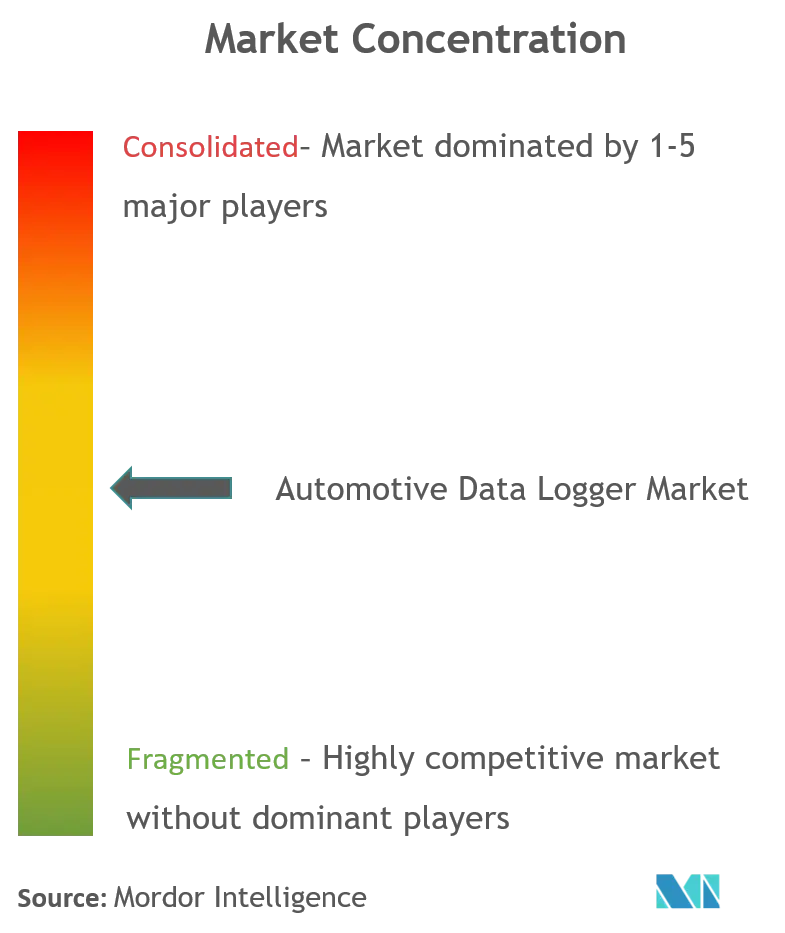
The automotive data logger market is moderately fragmented, featuring traditional Tier-1s (Bosch, Continental, HARMAN), semiconductor leaders (NXP, Renesas, Qualcomm), and cloud-native software entrants. Competitive advantage is shifting toward vertically integrated solutions that combine secure hardware, flexible middleware, and analytics platforms. NXP’s 2025 acquisition of TTTech Auto strengthens its ability to supply gateway controllers paired with deterministic Ethernet and OTA support. Bosch and Continental leverage deep OEM ties to embed logging functions into broader domain controllers, while software specialists emphasize rapid, OTA-deployable analytics.
Strategic themes include consolidating processing, networking, and power management into single platforms that reduce wiring by up to 40%. Providers compete to meet rigorous automotive cybersecurity standards without sacrificing data-sharing flexibility required by insurers and fleets. Emerging white spaces include off-highway machinery, micro-mobility, and developing-market fleets where incumbents have limited reach. Cloud scalability and subscription models redefine revenue streams, disadvantaging pure-hardware vendors unless they evolve toward service-oriented offerings.
Recent strategic moves illustrate the trend. NXP’s S32K5 MCU, launched March 2025, integrates embedded MRAM and AI accelerators calibrated for zonal architectures. TTTech Auto’s May 2025 logger targets software-defined vehicle validation with synchronized multi-gigabit capture. Bosch’s 2024 partnership with Amazon Web Services extends digital-logistics platforms into commercial vehicles. Together, these moves signal heightened race toward holistic, software-centric ecosystems.
Automotive Data Logger Industry Leaders
Robert Bosch Gmbh
Vector Informatik GmbH
Continental
National Instruments
Aptiv PLC
- *Disclaimer: Major Players sorted in no particular order
Automotive Data Logger Market Companies Covered in this Report
- Robert Bosch GmbH
- Vector Informatik GmbH
- Continental AG
- Racelogic Ltd
- TTTech Auto AG
- National Instruments Corp.
- Intrepid Control Systems Inc.
- Kontron (MEN Mikro)
- Ipetronik GmbH & Co. KG
- NSM Solutions
- Aptiv PLC
- HARMAN International
- Autel Intelligent Technology
- Verizon Connect
- Danlaw Inc.
- LG Innotek
- NXP Semiconductors
- Qualcomm Technologies
- Huawei Technologies
- TomTom Telematics (Bridgestone)
- Teltonika
- ZF Friedrichshafen AG
- Mobileye
- KPIT Technologies

Market Opportunities and Future Outlook
Regulatory and standards-driven data access requirements are creating near-term whitespace for compliant logging, consent management, and secure interface products across OEM-fitted and service ecosystems. In Europe, EDR obligations under Regulation (EU) 2019/2144 extend to heavier vehicle categories for new types from January 7, 2026, widening demand for compliant capture, storage, and retrieval workflows beyond passenger cars. EU Delegated Regulation 2026/699 (adopted in March 2026) also mandates bi-directional access to in-vehicle data streams for diagnostics and repair and maintenance information (RMI) use cases, reinforcing opportunities for logger vendors and telematics platforms that can broker standardized, permissioned access while maintaining auditability under cybersecurity constraints.
In North America, regulatory timing adjustments keep EDR capability workstreams active and shape design roadmaps and validation investments. On May 18, 2026, NHTSA published a final rule that delays the compliance schedule for expanded pre-crash data capture requirements, introducing a four-year phase-in beginning September 1, 2028. This preserves a defined window for suppliers to harden high-bandwidth capture, storage integrity, and toolchain support across multiple model cycles. Platform moves toward OEM-native data access, such as Geotab integrations with Polestar and Toyota Connected in 2026 and OCTO Telematics vehicle data integration with Volkswagen Group Info Services AG in 2026, also highlight a commercial pathway for software-first logging and analytics built on existing vehicle connectivity. As a result, secure APIs, data governance, and interoperability increasingly influence deployment decisions for fleets and insurers.
Recent Industry Developments in Automotive Data Logger Market
- May 2026: Geotab expanded OEM telematics connectivity through partnerships with Polestar and Toyota Connected, enabling fleet data access without physical device deployment. The collaboration points to a shift toward software-first data access across multiple OEMs. This move supports software platforms geared to native data streams and broadens opportunities for insurer-grade analytics.
- March 2025: TTTech Auto launched the PM-350 data logger for software-defined vehicle verification, positioned as a next-generation evolution of its PM-200 line. The release targets synchronized, high-speed capture needs in SDV and automated-driving development. It strengthens toolchains for multi-interface logging and validation.
- March 2024: NXP introduced the S32 Core Ride platform aimed at consolidating ECUs, with a production-oriented timeline targeting 2027. Centralized compute roadmaps increase the need for scalable, high-throughput logging architectures that can operate alongside zonal or domain controllers. These architectures then feed validation and safety evidence workflows.


Automotive Data Logger Market Report Scope and Research Methodology
Market Definition and Coverage
For this methodology, the automotive data logger market covers devices and related software used to capture, store, and export vehicle data for testing, diagnostics, compliance, and fleet use across passenger and commercial vehicles.
Scope exclusions: We exclude general purpose industrial data loggers and consumer gadgets that are not designed for automotive-grade vehicle data capture.
Segments Covered in This Report
- By Application
- ADAS
- Autonomous Driving R&D
- Fleet Management
- Others
- By Connection Type
- USB
- Automotive Ethernet
- Others
- By Hardware Type
- Stand-alone Data Logger
- Plug-in OBD Dongle
- Embedded OEM Module
- Cloud-based Software Agent
- By Memory Capacity
- Less than 32 GB
- 32 - 128 GB
- 128 - 512 GB
- More Than 512 GB
- By End User
- OEMs
- Tier-1 Suppliers
- Fleet Operators & Telematics Providers
- Insurance Companies
- Independent Service Providers
- Regulatory & Testing Agencies
- Research Institutions
- By Channel
- OEM-Fitted
- Aftermarket
- By Vehicle Type
- Passenger Cars
- Light Commercial Vehicles
- Medium and Heavy Commercial Vehicles
- Off-Highway Vehicles
- Two-Wheelers & Micromobility
- By Propulsion
- ICE Vehicles
- Hybrid Vehicles
- Battery Electric Vehicles
- Others
- By Geography
- North America
- United States
- Canada
- Rest of North America
- South America
- Brazil
- Argentina
- Rest of South America
- Europe
- Germany
- United Kingdom
- France
- Italy
- Spain
- Rest of Europe
- Asia-Pacific
- China
- Japan
- India
- South Korea
- Rest of Asia-Pacific
- Middle East and Africa
- Saudi Arabia
- United Arab Emirates
- South Africa
- Rest of Middle East and Africa
- North America
Data Sources, Market Sizing, and Validation
Desk Research
Desk work starts by mapping what is being logged in vehicles and why that demand is rising, and then tying it back to measurable auto production and parc signals. We rely on public sources such as OICA vehicle production statistics, NHTSA and UNECE safety rule publications, Euro NCAP test protocols, and ISO documentation around in-vehicle networking and diagnostics. We also review technical papers from SAE International, along with patent databases to understand where data logging is being added, for example ADAS validation, functional safety testing, and cybersecurity checks.
To convert these signals into a usable sizing model, we use company filings, investor presentations, and trusted press for product mix and pricing direction, then align them with import-export summaries and tender disclosures where relevant. Select paid subscriptions are used only to standardize company financials and to track shipment and contract announcements when public disclosure is thin. The desk source list is illustrative only, and many additional documents are used during data collection, validation, and clarification.
Primary Interviews and Surveys
Primary work is used to test what desk signals cannot confirm, mainly typical logger unit volumes per program, replacement cycles, and how average selling prices move as bandwidth and memory needs increase. We speak with OEM and supplier functions, test and validation teams, and fleet-focused users across APAC, EMEA, and the Americas, so assumptions can be corrected before the final totals are locked.
Distribution of primary research fieldwork respondents
| Company type | Respondent position | Region |
|---|---|---|
| Top tier: 26% | CXOs: 14% | APAC: 50% |
| Mid tier: 58% | Functional/Unit leaders: 38% | EMEA: 29% |
| Smaller Players: 16% | Managers: 48% | Americas: 21% |
Market-Sizing & Forecasting
Sizing starts with a top-down build that reconstructs demand from vehicle production and the testing and validation intensity that comes with higher ADAS content and software-heavy architectures. From there, the model is shaped using practical inputs such as the share of programs using data logging, typical logger units per vehicle program, memory capacity needs linked to test hours and sensor count, and the portion of demand that sits with OEM-fitted versus aftermarket use. Connection mix is also tracked, since automotive Ethernet adoption changes device capability needs and pricing bands.
Once totals are formed, we corroborate them with selective bottom-up checks, where sampled average selling prices are combined with shipment or program-level volumes obtained through interviews and public disclosures. When gaps appear, they are handled through range-based assumptions tied to clear drivers, such as differences between passenger cars and commercial vehicles and differing refresh cycles by end use. For forecasting, we use scenario analysis, since regulation timing, ADAS penetration, and electrification mix can shift the timing of test workloads. The final path is then aligned to what industry experts consider the most likely build rate by region.
Data Validation & Update Cycle
Validation is done in multiple passes so the final number does not depend on a single data stream. We cross-check model outputs against independent signals such as vehicle production trends, ADAS fitment direction, and reported testing investment, and then review outliers that break expected relationships between volume and pricing. If a variance cannot be explained, we go back to the assumption sheet, and if needed we re-contact respondents to confirm the driver behind the change.
Before sign-off, another analyst reviews the logic, inputs, and arithmetic so errors are caught early, then the final narrative is checked against the model so the story matches the math. Reports are refreshed annually, with interim updates triggered by material events such as major regulation changes or sharp shifts in vehicle output. Right before delivery, a final update pass is completed so clients receive the latest view available at that time.
Mordor Intelligence's Automotive Data Logger Market Size Versus Other Published Estimates
Published market sizes for automotive data loggers can land far apart because the category boundary is interpreted differently, and because pricing and adoption rates are often assumed instead of checked. Differences usually come from what gets counted as a data logger, which vehicle activities are included, and how quickly ASPs are allowed to rise with higher bandwidth and storage needs.
By tracking vehicle production, ADAS test workload signals, and ASP resets through interviews, Mordor Intelligence keeps the 2025 market value tied to logger demand that is actually triggered by automotive testing, diagnostics, and fleet usage, not by broader industrial instrumentation. The spread also widens when a study folds in adjacent tools like generic telematics hardware or includes services as a larger bundled line item, and then applies an aggressive adoption curve without reconciling it to OEM program counts and channel mix.
Benchmark comparison
| Source | Market Size | Gaps in Research Methodology |
|---|---|---|
| Mordor Intelligence | USD 4.39 B (2025) | |
| Global Consultancy A | USD 5.10 B (2025) | This estimate appears to include adjacent connected-vehicle logging and bundled telemetry hardware, which can inflate volumes beyond test and validation driven demand. It also uses a higher blended ASP without separating memory and interface mixes. |
| Industry Association B | USD 3.70 B (2025) | This estimate seems to emphasize OEM-fitted logging modules and excludes a larger share of aftermarket and fleet-led use cases. It also holds ASP progression flatter even as Ethernet and higher storage configurations become more common. |
Taken together, the comparison shows that the main swing factor is scope control, followed by how adoption and pricing are tied back to real program activity. Our approach stays repeatable because the inputs are visible, the assumptions are stress-tested with interviews, and the totals are reconciled to vehicle and testing signals before forecasting is finalized.


Key Questions Answered in the Report
What is driving growth in the Automotive Data Logger Market from 2026 to 2031?
Growth is propelled by regulatory mandates for event data recorders, rising sensor counts in advanced driver-assistance systems, adoption of software-defined vehicle architectures, and expanding fleet telematics in emerging economies.
Which application segment shows the fastest expansion?
Autonomous driving R&D is forecast to grow at 13.14% CAGR as OEMs log terabytes of multi-sensor data for Level 3+ validation.
Why is automotive Ethernet gaining traction over USB?
Ethernet offers higher bandwidth and deterministic communication needed for real-time sensor fusion, supporting a 10.62% CAGR compared with USB’s limited scalability.
How do cybersecurity regulations influence product design?
Rules such as UNECE WP.29 R156 require secure update infrastructures and strict data-access controls, leading suppliers to embed hardware roots of trust and encrypted OTA pipelines.
Which region presents the highest growth opportunity?
Asia-Pacific posts a 10.09% CAGR due to China’s intelligent-connected-vehicle regulations and India’s rapid fleet telematics adoption.
Page last updated on:





