
Automotive Acoustic Engineering Services Market Size and Share
Market Overview
| Study Period | 2019 - 2031 |
|---|---|
| Market Size (2026) | USD 6.26 Billion |
| Market Size (2031) | USD 9.46 Billion |
| Growth Rate (2026 - 2031) | 8.59 % |
| Fastest Growing Market | Asia-Pacific |
| Largest Market | Asia-Pacific |
| Market Concentration | Medium |
Major Players *Disclaimer: Major Players sorted in no particular order Image © Mordor Intelligence. Reuse requires attribution under CC BY 4.0. | |
Automotive Acoustic Engineering Services Market Analysis by Mordor Intelligence
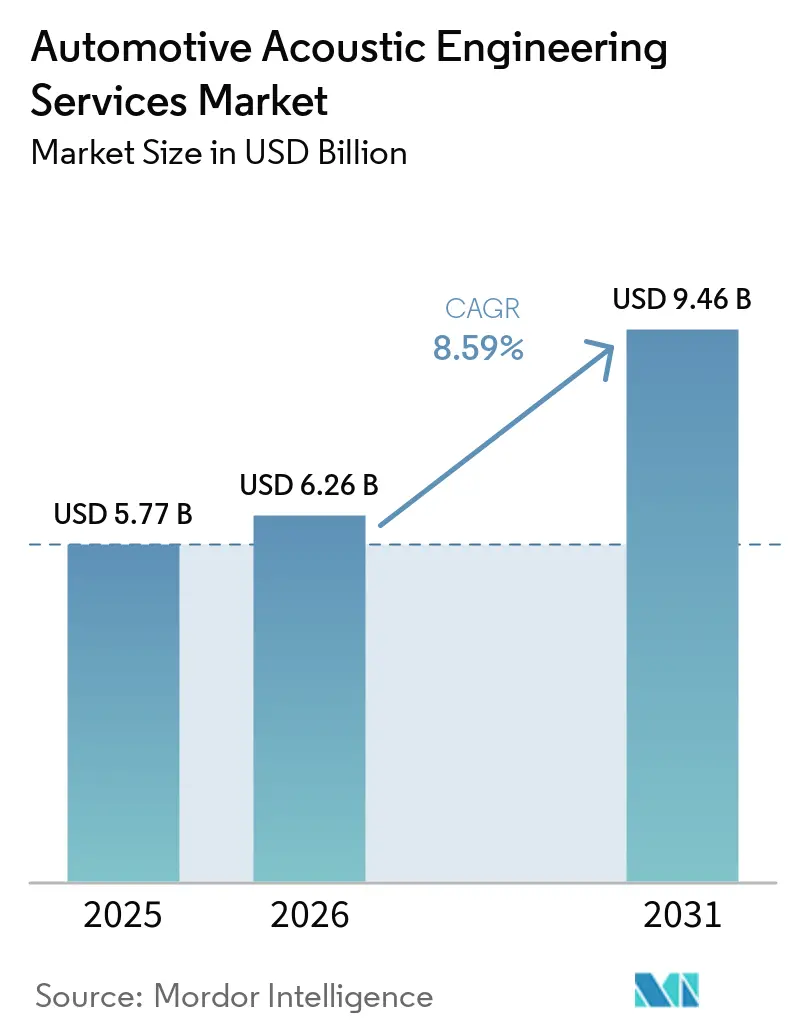
The automotive acoustic engineering services market size stands at USD 5.77 billion in 2025 and is expected to grow from USD 6.26 billion in 2026 to reach USD 9.46 billion by 2031, reflecting an 8.59% CAGR over the forecast period (2026-2031). Active enforcement of post-2025 vehicle-noise laws, the steady shift toward electric propulsion, and rising consumer insistence on library-quiet interiors together propel the automotive acoustic engineering services market. Providers secure recurring work as OEMs front-load NVH expertise in digital twins, shorten validation cycles with cloud-based toolchains, and position acoustics as a brand differentiator. Tier-1 suppliers deepen alliances with software houses to balance stricter noise limits against safety rules that still require audible warning sounds. Service opportunities also expand as lightweight body structures and connected mobility amplify new noise mechanisms.
Key Report Takeaways
- By process, designing services led with a 47.15% revenue share in 2025 and will be growing fastest at a 10.15% CAGR through 2031.
- By software, calibration solutions held 36.25% of the automotive acoustic engineering services market share in 2025 and will grow at an 8.96% CAGR.
- By application, powertrain accounted for 32.44% of the automotive acoustic engineering services market size in 2025, while the body and structure segment is projected to rise at an 11.23% CAGR to 2031.
- By vehicle type, passenger cars led with a 76.12% share in 2025 and will post a 9.82% CAGR through 2031.
- By propulsion type, internal combustion engine models commanded an 82.34% share in 2025, while electric vehicles will post the highest 12.45% CAGR.
- By end use, OEM programs retained a 65.03% share in 2025, while aftermarket is projected to grow at a 11.51% CAGR.
- By geography, Asia-Pacific held a 38.13% share in 2025 and will post the fastest growth with a 9.45% CAGR through 2031.
Note: Market size and forecast figures in this report are generated using Mordor Intelligence’s proprietary estimation framework, updated with the latest available data and insights as of January 2026.
Market Trends and Insights
Drivers Impact Analysis of Automotive Acoustic Engineering Services Market*
| Driver | (~) % Impact on CAGR Forecast | Geographic Relevance | Impact Timeline |
|---|---|---|---|
| EV Growth Exposes New NVH | +2.1% | Global, Asia-Pacific and EU surge | Short term (≤ 2 years) |
| Stringent Global Noise Regulations | +1.8% | Global, EU and China lead | Medium term (2-4 years) |
| Demand for Premium Acoustics | +1.5% | North America, Europe, high-trim Asia-Pacific | Long term (≥ 4 years) |
| Adoption of Advanced NVH Workflows | +1.2% | North America and Europe early | Medium term (2-4 years) |
| OEM “Signature-Sound” Branding | +0.9% | Premium marques worldwide | Long term (≥ 4 years) |
| Edge-AI Acoustic Analytics for OTA | +0.7% | Connected vehicle leaders | Medium term (2-4 years) |
| Source: Mordor Intelligence | |||
Rapid Growth of Electric Vehicles Exposing New NVH Challenges
The automotive industry is witnessing a significant shift towards advanced acoustic simulation technologies, driven by the need for more efficient and accurate vehicle development processes. This trend is exemplified by recent technological advancements, such as Warwick Acoustics' development of innovative car audio transducers in October 2023, which not only improved acoustic performance but also reduced the dependency on rare-earth elements in their production. These developments demonstrate how simulation technologies are enabling manufacturers to optimize both acoustic performance and sustainability objectives simultaneously, leading to more efficient product development cycles and reduced prototype costs.
Stringent Global Vehicular-Noise Regulations Tightening Post-2025
UN ECE Technical Regulation on Quiet Road Transport Vehicles mandates lower pass-by noise and compulsory acoustic vehicle-alerting systems beginning in 2026 [1]. Automakers now balance external audibility for pedestrian safety with quieter cabin targets, which raises reliance on bespoke frequency-specific modeling, pass-by simulation, and regulatory test correlation. Chinese regulators echo the framework yet add urban-noise caps, forcing local OEMs to outsource simulation and objective psychoacoustic scoring. Services cover regulation mapping, virtual certification, and homologation support, accelerating revenue for compliance-focused firms.
Rising Consumer Demand for Premium In-Cabin Acoustic Comfort
Post-pandemic buyers treat the cabin as a mobile office and wellness zone. Premium segments accept price uplifts for noise levels under 40 dB at 120 km/h, encouraging mass-segment brands to embed active noise cancellation and dampers once limited to luxury badges. Providers integrate low-density barrier mats and algorithmic ANC into early design loops, helping makers leverage quietness as a customer-retention lever during long commutes. The trend lifts per-vehicle engineering spend, especially on interior signature tuning.
Adoption of Advanced CAE and Digital-Twin NVH Workflows by OEMs
Simcenter, Virtual.Lab, and comparable suites, now let engineers predict cabin SPL early and validate through hardware-in-the-loop sound cameras. Virtual campaigns trim prototype builds significantly and shorten release timing by close to three months[2]. Engineering houses license solvers on consumption-based terms and bundles HPC compute, making CAE-as-a-Service attractive to mid-tier OEMs. Demand spikes for multi-physics coupling of structural, acoustic, and electromagnetic domains to model e-motor tonalities.
Restraints Impact Analysis of Automotive Acoustic Engineering Services Market*
| Restraint | (~) % Impact on CAGR Forecast | Geographic Relevance | Impact Timeline |
|---|---|---|---|
| Capital Cost of Infrastructure | -1.1% | Emerging markets | Long term (≥ 4 years) |
| Supply-Chain Volatility for Acoustics | -0.9% | Global, cost-sensitive models | Short term (≤ 2 years) |
| Shortage of Skilled NVH Engineers | -0.8% | Asia-Pacific, South America, Middle East and Africa | Medium term (2-4 years) |
| Cyber-Security Certification Delays | -0.6% | Europe and North America | Short term (≤ 2 years) |
| Source: Mordor Intelligence | |||
High Capital Cost of Full-Scale Acoustic Test Infrastructure
A full anechoic chamber with shaker rigs surpasses notable capex, limiting facility rollouts to large incumbents and keeping barriers high in cost-pressured regions. Small firms, therefore, lease slots or join consortia, yet scheduling conflicts slow programs. EV test cells add high-voltage safety layers, inflating costs further. Limited geography of state-of-the-art sites extends logistics time and raises project budgets for emerging-market OEMs.
Supply-Chain Volatility in Specialty Acoustic Foams and Sensors
Specialty poroelastic foams rely on niche chemical feedstocks whose shortages doubled lead times. Semiconductor crunches likewise hit MEMS microphones vital for ANC arrays. Projects were then redesigned with alternates, causing scope creep. Providers elevate supply-risk modeling into design sprints and advise dual-sourcing to buffer volatility until capacity additions stabilize inventories.
*Our forecasts treat driver/restraint impacts as directional, not additive. The impact forecasts reflect baseline growth, mix effects, and variable interactions.
Automotive Acoustic Engineering Services Market Segment Analysis
By Process:
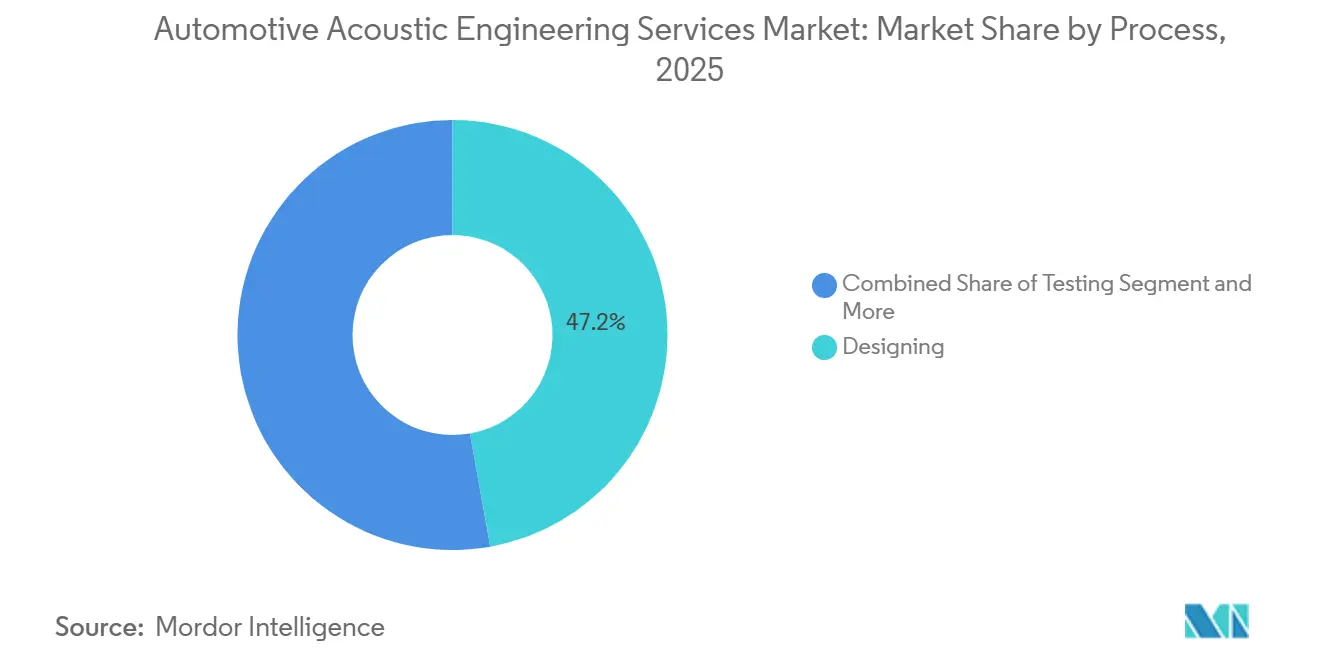
Design-Led Integration Guides Market LeadershipDesigning activities captured 47.15% of 2025 revenue as OEMs embedded acoustic models inside early architecture gates, minimizing downstream retrofits. The same segment is poised for the fastest growth at a 10.15% CAGR through 2031. The automotive acoustic engineering services market rewards firms that pivot from reactive troubleshooting toward predictive synthesis. Typical engagements start with drawing-board vibro-acoustic models, parametric dashboards, and target cascades, then flow into prototype refinement. Adoption of broadband optimization algorithms and lightweight meta-materials at the concept phase generated incremental service value. Testing services keep relevance for homologation and correlation, yet shift toward micro-step investigations such as electromagnetic compatibility for inverters and battery cooling pumps. Development services link virtual and physical trending, using seven-post shakers and mobile sound camera arrays to spot hot frequencies during ride events. The balanced process mix ensures sticky contracts that cover a full five-year model program.
Enhanced beamforming integrates with topology optimization to derive panel layouts that tame boom modes before sheet-metal freeze. The approach saves on late-stage damping mass, a critical benefit as OEMs chase range gains in electric SUVs. Services providers embed design thinking workshops with body-in-white teams, letting NVH criteria sit alongside crash and styling targets. As automation rises, design deliverables morph into parametric libraries consumable by generative CAD tools, cementing provider roles as data curators within the automotive acoustic engineering services market.

By Software:
Calibration Sophistication Drives Continued DominanceCalibration platforms held a 36.25% revenue share in 2025 and will expand at an 8.96% CAGR, as multi-microphone ANC, motor-order tracking, and 3D sound staging demand fine-grained tuning. A single premium model can require a notable number of parameter sets across trims, climates, and tire options, feeding a robust consulting stream for specialist providers. AI-assisted loop closure now auto-updates gain tables during road-load mapping, slashing validation days. Simulation solvers converge vibro-acoustic codes with electromagnetic field solvers so teams co-optimize inverter switching patterns and cabin noise. Software vendors bundle cloud license flex, enabling tiered usage across program peaks. Integration complexity fuels services revenue for middleware, interface scripting, and digital rights management.
Premium marques request bespoke playlists and binaural soundscapes curated for each nameplate. Providers fuse psychoacoustic metrics such as roughness and sharpness with brand design language. OTA pipelines then update equalization to compensate for aging dampers or new tire compounds, pivoting acoustic calibration from launch event to full lifecycle. These dynamics strengthen the automotive acoustic engineering services market as software upgrades turn into repeating high-margin annuities that extend well beyond first-sale milestones.
By Application:
Body & Structure Innovation Accelerates GrowthPowertrain domains retained a 32.44% share in 2025, yet body and structure engagements will storm ahead at an 11.23% CAGR to 2031. Multi-material mix with aluminum-steel composites and molded fiber leaves acoustic voids that need tailored damping blankets and constrained-layer laminates. Engineers run fast Fourier transforms on panel vibration to redesign bead patterns, optimize spot-weld spacing, and place viscoelastic patches. Lighter doors and panoramic roofs raise radiated sound but boost aesthetics, creating trade-offs that spur simulation-heavy contracts.
EU pass-by rules now use overall vehicle noise, pushing holistic packages where wheel-arch liners, under-floor panels, and aero wheel-covers must balance drag and sound. Service providers thus offer coupled CFD-acoustics runs inside digital twins. Cabin-quiet targets mesh with advanced material R&D; for instance, nanocell foams cut by laser for consistent pore geometry. Because these solutions often shift structural modes, providers maintain seat-of-pants domain expertise to align CAE output with subjective ride comfort expectations. Such integrated work cements revenue streams for the automotive acoustic engineering services market.
By Vehicle Type:
Passenger Cars Continue to Anchor DemandPassenger cars provided 76.12% of 2025 spending and are projected to grow at a 9.82% CAGR through 2031. The segment growth reflects high volumes and rising acoustic comfort expectations in compact crossover and luxury sedan segments. Electric SUVs now feature double-sealed doors and metameric grills for aero-acoustic mitigation, projects that demand cross-discipline NVH and CFD teams. Commercial vehicles lag in spend yet pick up momentum as delivery fleets seek quieter cabins to reduce driver fatigue and improve telematics voice clarity.
Level-3 truck pilots rely heavily on microphone arrays for cabin monitoring, so vendors recalibrate background thresholds under broad operating temperatures. This dredges up fresh consulting for sensor placement, wiring harness isolation, and AI noise classification. Over the forecast horizon, bus operators adopt acoustic hygiene to elevate passenger comfort and appeal with rideshare apps. These cascading needs reinforce passenger cars as revenue bedrock while commercial vehicles become incremental upside for the automotive acoustic engineering services market.
By Propulsion Type:
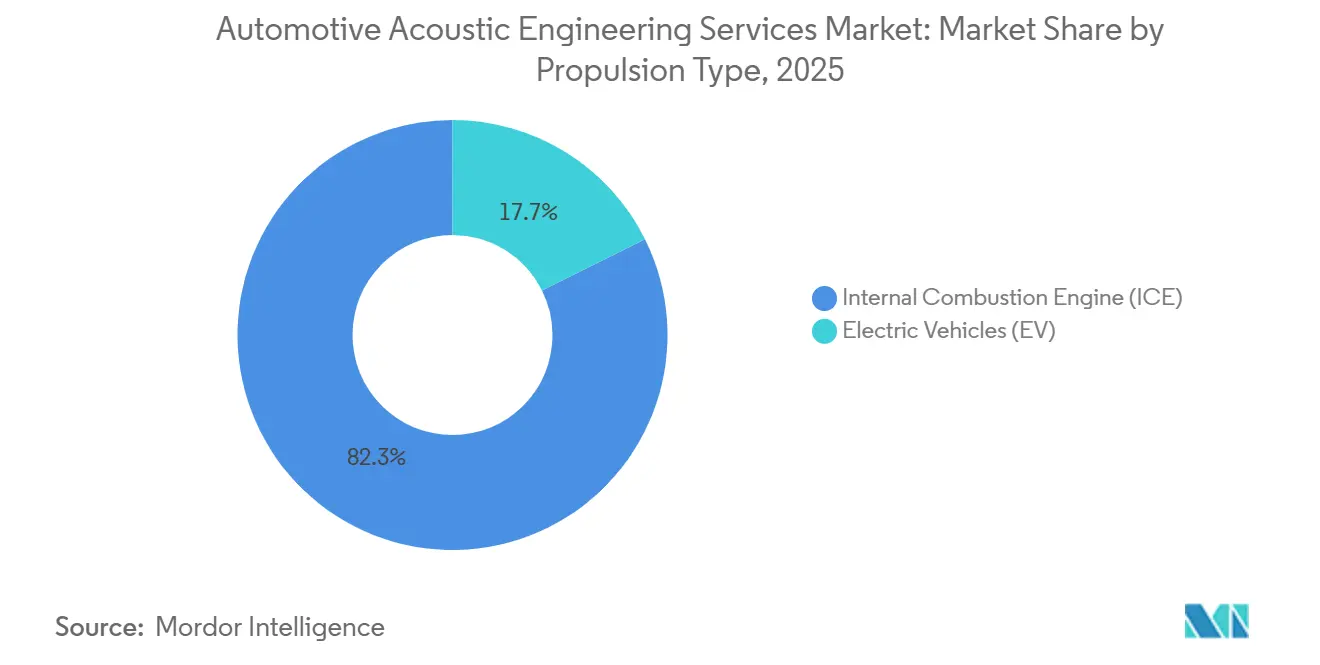
Electric Shift Opens Complex OpportunityInternal combustion models held an 82.34% share in 2025, yet electric vehicles will grow fastest at a 12.45% CAGR. Motor whine at 2,000–12,000 Hz, battery cooling fans, and inverter harmonics alter spectral energy, reshaping the NVH problem space. Teams therefore build hybrid models combining structural finite-element meshes with high-frequency boundary-element solvers. Warning-sound synthesis further enlarges the scope, covering speaker selection, psychoacoustic testing, and regional regulation mapping.
Providers cultivate ICE legacy for downsizing turbo acoustics even as they champion electric damping sheets lined with recycled PET. Hybrid SUVs complicate matters with engine on-off transitions, so Kalman filters manage phase continuity across powertrain shifts. These deeper technical layers push average project value up, buoying the automotive acoustic engineering services market size and enhancing resilience against cyclical vehicle volumes.
By End Use:
Aftermarket Services AccelerateOEM programs stayed dominant at 65.03% in 2025, but the aftermarket will post an 11.51% CAGR as fleets retrofit ANC headliners and upgraded door seals to extend vehicle life. Cabin-acoustic kit-outs present a notable margin for service providers, combining parts and tuning labor. EV-only neighborhood rules also trigger warning-sound retrofits on older battery cars, opening new compliance-driven projects.
Specialist garages partner with NVH consultants to deliver on-site spectral scans and custom damping kits in less than two days. Over-the-air audio updates follow, turning each job into a software subscription. Commercial fleets adopt subscription models where service firms monitor acoustic drift and dispatch replacement dampers proactively, diversifying the revenue footprint of the automotive acoustic engineering services market.
Geography Analysis
APAC Automotive Acoustic Engineering Services Market
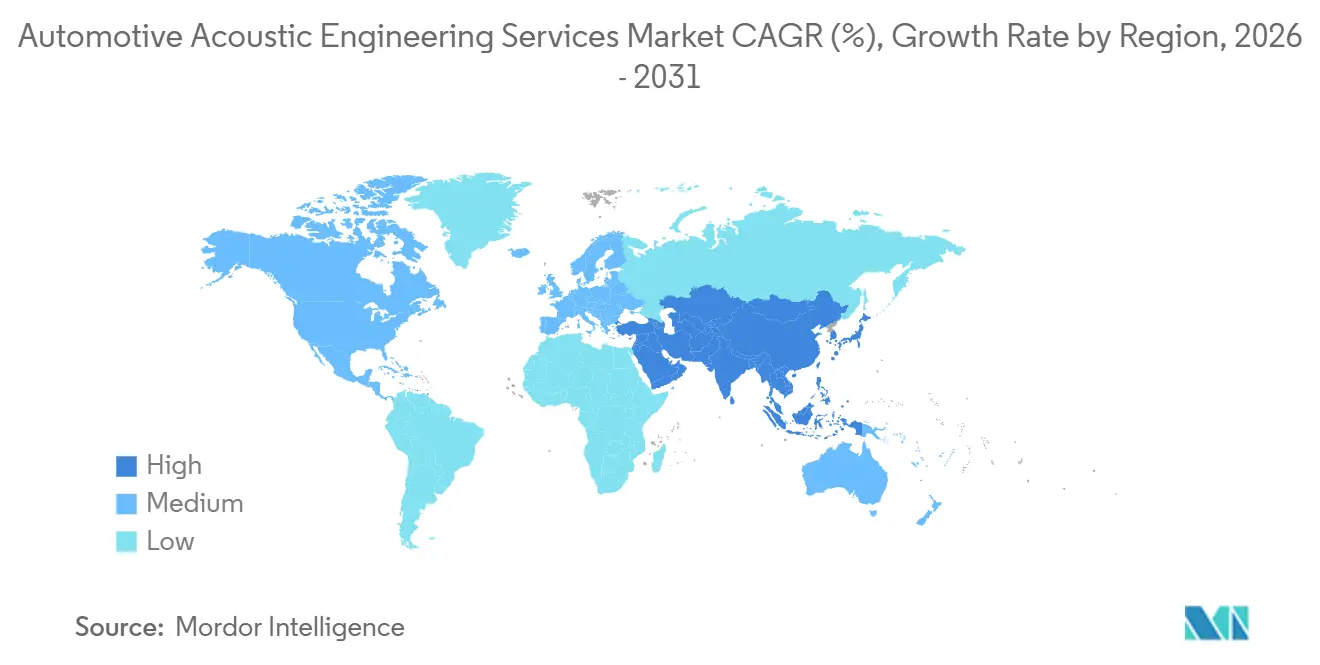
Asia-Pacific led with a 38.13% share in 2025 and will move ahead at a 9.45% CAGR to 2031 as China’s EV output surges and India strengthens as an engineering outsourcing node [3]. Government grants in Guangdong province cover a significant share of NVH tool upgrades, spurring local labs. Japanese tier-ones refine meta-materials and supply them region-wide while Korean OEMs deploy dual ANC chips in premium sedans, locking local service retainer deals. Southeast Asia sees acoustic projects tied to new CKD plants, yet talent gaps persist, so cross-border remote work bridges capacity.
Europe Automotive Acoustic Engineering Services Market
Europe commands a strong legacy owing to premium German OEMs and robust regulation. The EU Environmental Noise Directive keeps pass-by test lines booked year-round, sustaining demand for correlation runs. Germany incubates digital twin pilots while France and Italy refine lightweight felt materials recycled from textile waste. Brexit spurs UK firms to tap trans-Atlantic customers, adding revenue diversity to soften regional uncertainties. Overall, stringent sustainability targets elevate eco-acoustic materials and energy-efficient damping research.
North America Automotive Acoustic Engineering Services Market
North America shows balanced momentum. Pickup and SUV producers in the United States embed active exhaust sound enhancement to retain brand character amid downsized engines. Canada hosts MEMS microphone fabs that secure local supply for sensor-dense ANC arrays, aligning well with the United States Inflation Reduction Act incentives. Regulatory clarity from the EPA on EV alerting volumes accelerates homologation projects, and consumer affinity for premium audio systems keeps acoustic refinement atop feature wish-lists. Mexico’s assembly plants step up NVH capability to meet export noise norms, relying on consultants from Texas and Michigan for tooling and training.
Competitive Landscape
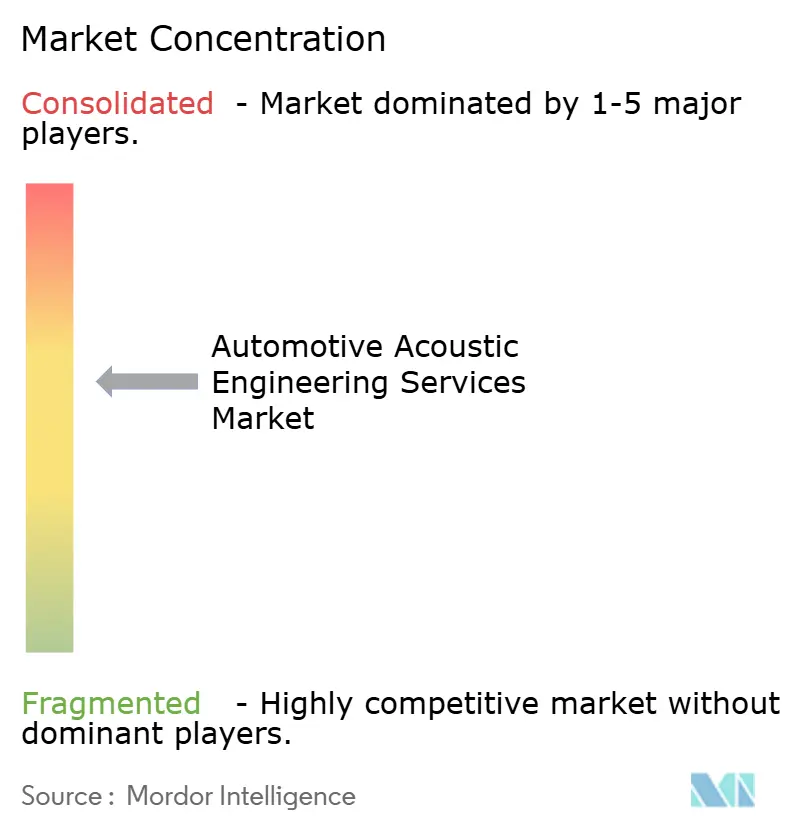
Market concentration stays moderate. Market players, including AVL, Siemens Digital Industries, and Bertrandt, hold a significant share of global revenue through end-to-end portfolios covering modeling, hardware, and consultancy. These incumbents buttress moats with proprietary solvers, domain know-how, and multi-cycle master service agreements. They also co-develop digital twin modules that plug into OEM PLM stacks, raising switching costs. Mid-sized specialists carve niches in EV tonal analysis, psychoacoustics, and AI edge analytics, often partnering with sensor or materials startups.
Strategic moves center on digital expansion and regional footholds. AVL opened a hybrid powertrain NVH center near Shanghai. Siemens acquired a Swedish AI startup to blend acoustic anomaly detection into Simcenter. Bertrandt signed a deal with a German luxury OEM for immersive sound-branding packages across upcoming battery platforms. Continental Engineering Services expands in Mexico to support North American EV programs. Such deals highlight a collaboration ethos, given the multi-physics complexity of acoustics.
White-space opportunity emerges in cyber-secure NVH cloud, biodegradable damping foams, and fleet acoustic health monitoring. New entrants exploit SaaS paths to offer subscription-only spectral analytics. Material innovators propose graphene-infused absorbers that cut mass, yet keep low-frequency absorption. Incumbents respond by creating corporate venture funds to secure future-proof solutions for the automotive acoustic engineering services market.
Automotive Acoustic Engineering Services Industry Leaders
-
AVL List GmbH
-
Siemens Digital Industries Software
-
Bertrandt AG
-
EDAG Engineering GmbH
-
FEV Group GmbH
- *Disclaimer: Major Players sorted in no particular order
Automotive Acoustic Engineering Services Market Companies Covered in this Report
- AVL List GmbH
- Siemens Digital Industries Software
- Bertrandt AG
- EDAG Engineering GmbH
- FEV Group GmbH
- HEAD acoustics GmbH
- Schaeffler Engineering GmbH
- Autoneum Holding AG
- STS Group AG
- Continental Engineering Services Ltd.
- IAV GmbH
- Müller-BBM VibroAkustik Systeme
- Signal.X Technologies LLC
- Tata Technologies
- Roechling Automotive
- Harman International Industries, Inc.
- Tenneco Inc.
Recent Industry Developments in Automotive Acoustic Engineering Services Market
- September 2026: Audio Foundry (AF), an automotive audio technology collaborative, announced Hear360 as its newest member. Hear360, an audio technology solutions company founded by GRAMMY Award-winning engineers, licenses studio-grade processing technology to product manufacturers. Through its membership, Hear360 will contribute its personalized spatial audio rendering approach to enhance the in-vehicle cabin experience alongside Audio Foundry’s community of experts, inventors, designers, and engineers.
- September 2026: ZF Commercial Vehicle Control Systems India Ltd. (CVCS India) announced that its Hemi Anechoic Chamber Testing Laboratory in Chennai received accreditation from the National Accreditation Board for Testing and Calibration Laboratories (NABL). According to the company, the facility is among the few NABL-accredited hemi-anechoic chambers in India dedicated to automotive noise, vibration, and harshness (NVH) testing and validation.
Global Automotive Acoustic Engineering Services Market Report Scope
The scope includes segmentation by process (designing, development, and testing), software (calibration, vibration analysis, acoustic simulation, and sound tuning), application (interior acoustics, body and structure, powertrain, and exterior noise), vehicle type (passenger cars and commercial vehicles), propulsion type (internal combustion engine (ICE) and electric vehicles (EV)), and end use (OEMs and aftermarket). The analysis also covers regional-level segmentation, including North America, South America, Europe, Asia-Pacific, and the Middle East and Africa. Market size and growth forecasts are presented by value in USD.
Segmentation Overview
| Designing |
| Development |
| Testing |
| Calibration |
| Vibration Analysis |
| Acoustic Simulation |
| Sound Tuning |
| Interior Acoustics |
| Body and Structure |
| Powertrain |
| Exterior Noise |
| Passenger Cars |
| Commercial Vehicles |
| Internal Combustion Engine (ICE) |
| Electric Vehicles (EV) |
| OEMs |
| Aftermarket |
| North America | United States |
| Canada | |
| Rest of North America | |
| South America | Brazil |
| Argentina | |
| Rest of South America | |
| Europe | Germany |
| United Kingdom | |
| France | |
| Italy | |
| Spain | |
| Rest of Europe | |
| Asia-Pacific | China |
| India | |
| Japan | |
| South Korea | |
| Rest of Asia-Pacific | |
| Middle East and Africa | United Arab Emirates |
| Saudi Arabia | |
| South Africa | |
| Turkey | |
| Rest of Middle East and Africa |
| By Process | Designing | |
| Development | ||
| Testing | ||
| By Software | Calibration | |
| Vibration Analysis | ||
| Acoustic Simulation | ||
| Sound Tuning | ||
| By Application | Interior Acoustics | |
| Body and Structure | ||
| Powertrain | ||
| Exterior Noise | ||
| By Vehicle Type | Passenger Cars | |
| Commercial Vehicles | ||
| By Propulsion Type | Internal Combustion Engine (ICE) | |
| Electric Vehicles (EV) | ||
| By End Use | OEMs | |
| Aftermarket | ||
| By Geography | North America | United States |
| Canada | ||
| Rest of North America | ||
| South America | Brazil | |
| Argentina | ||
| Rest of South America | ||
| Europe | Germany | |
| United Kingdom | ||
| France | ||
| Italy | ||
| Spain | ||
| Rest of Europe | ||
| Asia-Pacific | China | |
| India | ||
| Japan | ||
| South Korea | ||
| Rest of Asia-Pacific | ||
| Middle East and Africa | United Arab Emirates | |
| Saudi Arabia | ||
| South Africa | ||
| Turkey | ||
| Rest of Middle East and Africa | ||
Key Questions Answered in the Report
What is the projected value of the automotive acoustic engineering services market by 2031?
The market is expected to reach USD 9.46 billion by 2031 based on an 8.59% CAGR forecast.
Which process segment is growing fastest in automotive acoustic engineering services?
Designing services will lead growth at 10.15% CAGR as OEMs embed NVH early in vehicle architecture.
Why do electric vehicles create new demand for acoustic engineering?
EVs lack engine masking noise, exposing inverter whine and tire-road sounds that require specialized NVH solutions.
Which region holds the largest share of spending on automotive acoustic engineering services?
Asia-Pacific accounted for 38.13% of global spending, driven by China’s production scale and India’s engineering hubs.