
Automatic Tea Bag Packaging Machinery Market Size and Share
Market Overview
| Study Period | 2020 - 2031 |
|---|---|
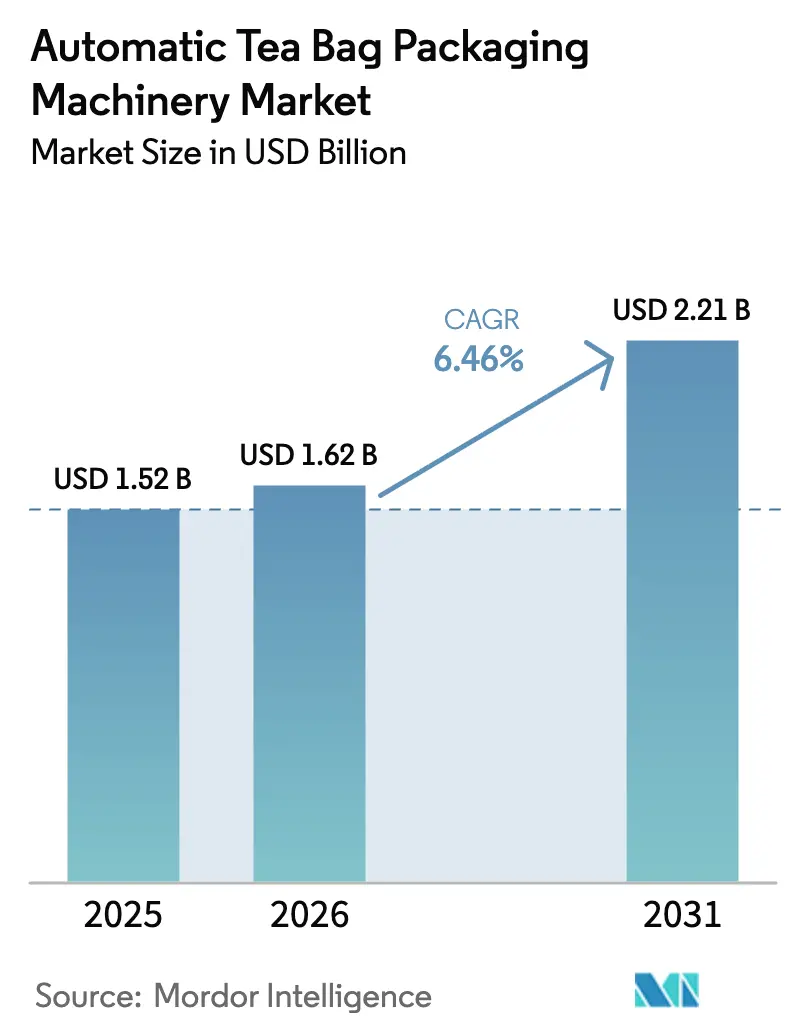
| Market Size (2026) | USD 1.62 Billion |
| Market Size (2031) | USD 2.21 Billion |
| Growth Rate (2026 - 2031) | 6.46 % |
| Fastest Growing Market | Asia Pacific |
| Largest Market | Asia Pacific |
| Market Concentration | Medium |
Major Players *Disclaimer: Major Players sorted in no particular order Image © Mordor Intelligence. Reuse requires attribution under CC BY 4.0. | |
Automatic Tea Bag Packaging Machinery Market Analysis by Mordor Intelligence
The automatic tea bag packaging machinery market size is expected to grow from USD 1.52 billion in 2025 to USD 1.62 billion in 2026 and is forecast to reach USD 2.21 billion by 2031 at 6.46% CAGR over 2026-2031. Sustained gains stem from rising global tea consumption, premium single-serve adoption, and accelerating automation that allows processors to raise throughput while keeping exacting quality standards. The shift toward portion-controlled, visually appealing formats is pushing converters to adopt machines that combine high dosing accuracy with rapid changeovers. Sustainability mandates are equally influential, prompting steep uptake of PLA and other compostable substrates that demand recalibrated sealing and quality-control modules. Competitive intensity is increasing as leading European OEMs embed Industry 4.0 functions, while cost-competitive Asian suppliers scale production capacity and shorten delivery lead times.
Key Report Takeaways
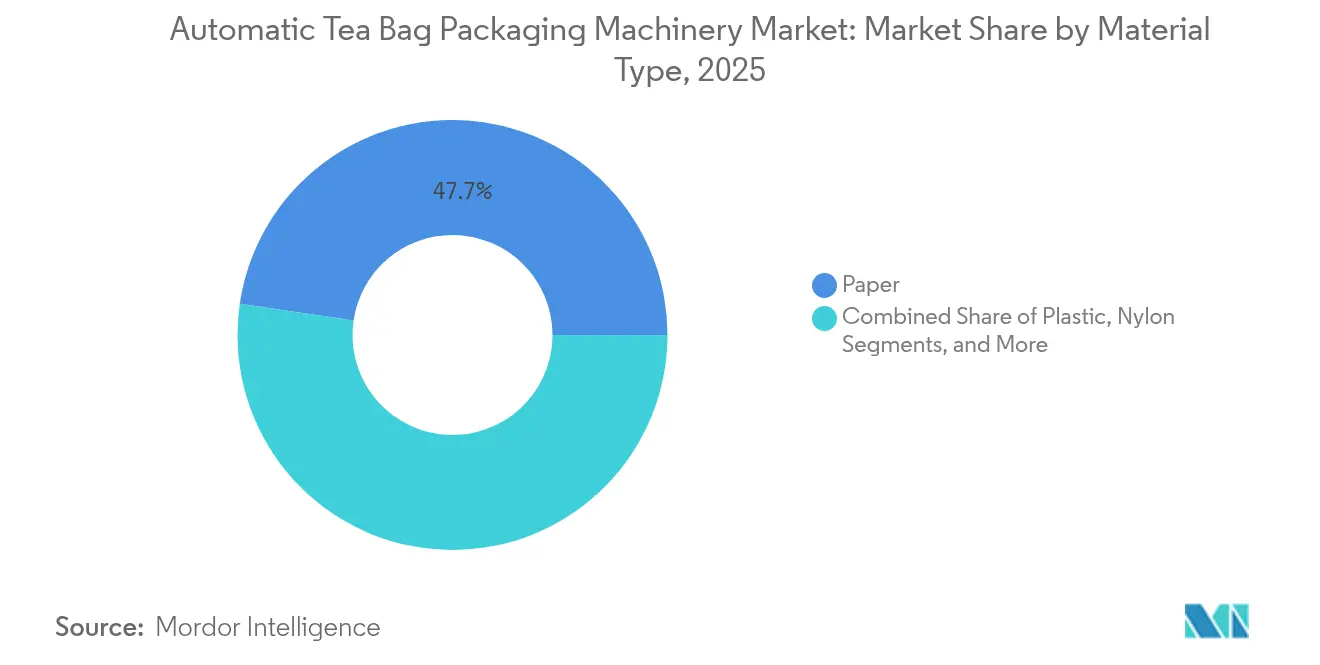
- By material type, paper captured 47.68% of the Automatic Tea Bag Packaging Machinery Market share in 2025.
- By packaging shape, Automatic Tea Bag Packaging Machinery Market size for pyramid bags is projected to grow at 8.45% CAGR between 2026-2031.
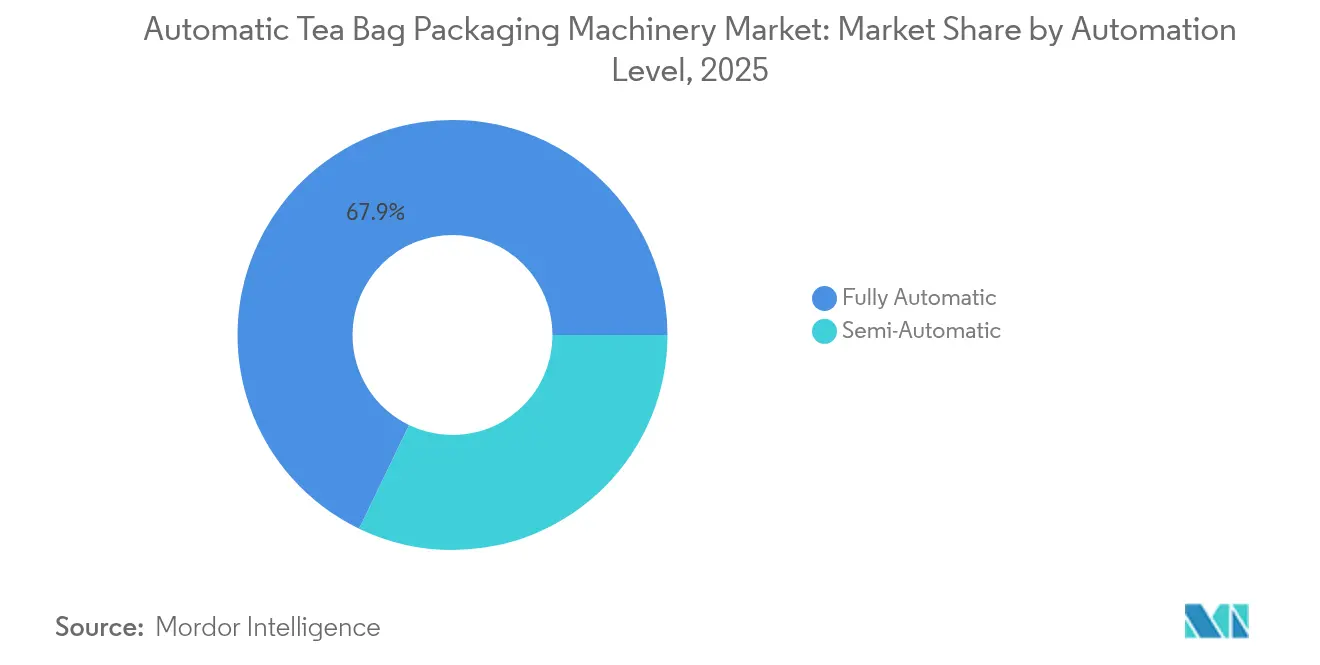
- By automation level, fully automatic systems captured 67.85% of the Automatic Tea Bag Packaging Machinery Market share in 2025.
- By line capacity, Automatic Tea Bag Packaging Machinery Market size for more than 120 bpm is projected to grow at 7.68% CAGR between 2026-2031.
- By geography, Asia-Pacific captured 42.18% of the Automatic Tea Bag Packaging Machinery Market share in 2025.
Note: Market size and forecast figures in this report are generated using Mordor Intelligence’s proprietary estimation framework, updated with the latest available data and insights as of 2026.
Market Trends and Insights
Drivers Impact Analysis of Automatic Tea Bag Packaging Machinery Market*
| Driver | (~) % Impact on CAGR Forecast | Geographic Relevance | Impact Timeline |
|---|---|---|---|
| Rising Global Tea Consumption and Premium Single-Serve Demand | +1.8% | Global, strongest in Asia-Pacific and North America | Medium term (2-4 years) |
| Growing Requirement for End-to-End Automation in Tea Packaging Plants | +2.1% | Global, focus on Europe and Asia-Pacific hubs | Long term (≥ 4 years) |
| Shift Toward Sustainable/Biodegradable Tea-Bag Substrates | +1.2% | Europe and North America are leading, and Asia-Pacific is catching up | Medium term (2-4 years) |
| Brand Differentiation Via Pyramid/Visual-Format Tea Bags | +0.9% | Premium segments worldwide | Short term (≤ 2 years) |
| Industry 4.0 Predictive-Maintenance Integration | +0.7% | Europe and North America are early adopters | Long term (≥ 4 years) |
| On-Demand Micro-Batch/D2C Flexibility Needs | +0.6% | North America and Europe e-commerce | Short term (≤ 2 years) |
| Source: Mordor Intelligence | |||
Rising Global Tea Consumption and Premium Single-Serve Demand
Global tea intake is increasing by 3.3% each year, and a disproportionate share of that growth is directed towards premium single-serve formats that rely on reliable, high-speed packaging. Functional-herbal and organic blends now command shelf space in office pantries, hospitality amenities, and foodservice channels, all of which require individually wrapped bags that control portion size and preserve bioactive compounds. Premium brands often adopt pyramid shapes to showcase whole-leaf content, obliging converters to invest in machines that deliver precise volumetric dosing, as well as tight ultrasonic seals. Demand is particularly strong in the Asia-Pacific and North America regions, where processors are expanding high-throughput lines to match rapidly evolving consumer expectations.[1]
Growing Requirement for End-to-End Automation in Tea Packaging Plants
Automation upgrades are yielding up to 15% gains in overall equipment effectiveness while trimming labor costs, scrap, and energy consumption. Servo-driven changeovers reduce downtime when switching between rectangular, pyramid, or round bags, and integrated vision modules verify seam integrity in real-time. Robotics and machine-learning algorithms now coordinate case packing and palletizing, creating a seamless flow from dosing to secondary packaging. Europe and the Asia-Pacific lead installations because exporters confront stringent traceability rules tied to food safety audits.
Shift Toward Sustainable/Biodegradable Tea-Bag Substrates
Regulation (EU) 2025/40 requires brands selling into the European Economic Area to use recyclable or compostable packaging and to limit the use of substances of concern. Large tea companies have responded by certifying PLA, unbleached kraft, and mono-material filter meshes, which in turn requires new seal-temperature profiles, anti-static controls, and barrier-coating compatibilities on machinery. North American retailers echo similar requirements through private-label scorecards, pressuring co-packers to rapidly retrofit their lines. Asian substrate suppliers ramp PLA film output to ensure local processors comply with export standards.
Brand Differentiation Via Pyramid/Visual-Format Tea Bags
Pyramid bags enable larger cut leaves to unfurl, reinforcing perceptions of premium quality while bolstering flavor extraction. Converters that can flip from flat tags to 3-D shapes without extended downtime secure more seasonal and limited-edition contracts. Ultrasonic sealing heads ensure tamper-proof seams, and clear windows on outer envelopes offer shelf impact. The trend aligns with direct-to-consumer subscription services in North America and Western Europe, where unboxing aesthetics influence reorder rates.
Restraints Impact Analysis of Automatic Tea Bag Packaging Machinery Market*
| Restraint | (~) % Impact on CAGR Forecast | Geographic Relevance | Impact Timeline |
|---|---|---|---|
| High Initial CAPEX For High-Speed Automated Lines | -1.4% | Global, most acute in developing regions | Long term (≥ 4 years) |
| Scarcity Of Skilled Mechatronics Technicians and Costly Downtime | -1.1% | Worldwide, severe in Asia-Pacific and Latin America | Medium term (2-4 years) |
| Supply-Chain Fragility for Specialty Filter Meshes and PLA Films | -0.8% | Europe and Asia-Pacific | Short term (≤ 2 years) |
| Evolving Food-Contact Rules On Novel Bio-Polymers | -0.7% | Europe, North America, export-oriented Asia | Medium term (2-4 years) |
| Source: Mordor Intelligence | |||
High Initial CAPEX For High-Speed Automated Lines
The entry ticket for a fully automatic, multi-format packaging cell surpasses USD 500,000, excluding plant retrofits and operator training. Although leasing and machinery-as-a-service contracts have emerged, many mid-sized processors in Southeast Asia, Africa, and South America still face significant financing hurdles. This cost barrier consolidates market power among large, well-capitalized exporters that can amortize investments over high volumes. Financial pressure hinders the diffusion of technology in cost-sensitive clusters, despite clear productivity benefits.
Scarcity Of Skilled Mechatronics Technicians and Costly Downtime
More than 50,000 mechatronics roles remained unfilled worldwide in 2025, stretching maintenance cycles and inflating downtime that can cost USD 10,000 per hour at large sites. Advanced packaging cells integrate robotics, IoT sensors, and AI-based quality analytics, raising the skill threshold far above conventional mechanical proficiency. OEMs therefore bundle remote diagnostics and augmented-reality repair manuals; yet, talent shortages persist, especially in the Asia-Pacific and South America regions. Scholarship programs and vendor-led academies alleviate bottlenecks only gradually.
*Our forecasts treat driver/restraint impacts as directional, not additive. The impact forecasts reflect baseline growth, mix effects, and variable interactions.
Automatic Tea Bag Packaging Machinery Market Segment Analysis
By Material Type:
Sustainability Drives Substrate ShiftsPaper substrates held a 47.68% share of the automatic tea bag packaging machinery market in 2025, thanks to legacy equipment compatibility and shopper familiarity. Nevertheless, biodegradable PLA films are projected to post the quickest 9.21% CAGR through 2031 as governments tighten compostability rules and brands chase the eco-labeling advantage. Within the automatic tea bag packaging machinery market, the size of the materials segment is dominated by paper in cost-sensitive mass channels, whereas PLA is gaining momentum among specialty retailers that emphasize zero-plastic pledges. Machinery builders have extended sealing-bar profiles and nip-roller controls to accommodate lower-melting PLA, helping co-packers toggle between fiber and bio-polymer rolls without lengthy changeovers.
A residual niche persists for nylon and silk wraps catering to ceremonial and high-grade leaf infusions, but scrutiny over microplastics and food-contact amendments limits their expansion. Investment, therefore, focuses on hybrid modules that can run paper, PLA, and nylon at the push of a touchscreen, securing processors against upcoming EU recyclability obligations. Line audits reveal that multi-material machines lift uptime by 4% and reduce film waste by 7%, signaling tangible paybacks that offset higher capital outlays.

By Packaging Shape:
Pyramid Bags Fuel PremiumizationRectangular bags accounted for 46.12% of 2025 installations because they offer mature filling speeds above 200 bpm and rely on well-tested filter papers. Yet pyramid units, while slower per lane, deliver 8.45% CAGR as retailers curate artisanal lines featuring visible botanicals. The automatic tea bag packaging machinery market size, tied to pyramid lines, is expected to exceed USD 806 million by 2031, illustrating how premiumization accelerates capital rotation toward 3D forming stations.
To capitalize on both opportunities, converters utilize dual-lane frames that alternate between flat and pyramid bags within a single shift, ensuring minimal idle time and safeguarding per-SKU profitability. Vision sensors inspect apex formation and tea-weight uniformity, and quick-release mandrels simplify sanitation across shape changes. Momentum for windowed outer pouches, which spotlight pyramid geometry, further cements demand for vertically integrated primary and secondary wrappers.
By Automation Level:
End-to-End Systems DominateFully automatic lines held 67.85% share in 2025, supported by in-line tag threading, ultrasonic sealing, and stack-and-pack modules that minimize manual touches. These systems represent the core of the automatic tea bag packaging machinery market share because they boost throughput while embedding traceability codes that auditors demand. OEM dashboards aggregate temperature, vibration, and belt-tension data, triggering alerts before failures occur, a capability that lifts OEE into the 85-90% bracket.
Semi-automatic cells remain relevant among boutique roasters and limited-edition runs where flexibility outweighs speed. The automatic tea bag packaging machinery market size, aligned to semi-automatic units, nonetheless expands modestly as micro-brands proliferate online. Suppliers therefore ship modular kits that allow owners to upgrade to full autonomy as order volumes increase, protecting the initial investment and compressing the payback period.
By Line Capacity:
Scaling for Flexibility and ThroughputInstallations rated at 61-120 bpm captured 53.55% share in 2025, providing a sweet spot between mid-range throughput and manageable footprint. Higher-speed machines operating above 120 bpm are expected to advance at a 7.68% CAGR, reflecting export contracts that require mass production for private-label supermarket chains. Within the automatic tea bag packaging machinery market, OEMs tout servo-driven indexing that enables on-the-fly acceleration when downstream case packers clear jams, thereby avoiding bottlenecks and preserving bag integrity.
Lines below 60 bpm serve artisan operators who value the gentle handling of oversized botanicals. Modular belt architecture permits processors to insert extra dosing funnels over time, eliminating the need for whole-line replacements. Safety upgrades comply with ISO 22000 and EU machine-directive standards, ensuring that even low-volume lines can access regulated export markets.
Geography Analysis
APAC Automatic Tea Bag Packaging Machinery Market
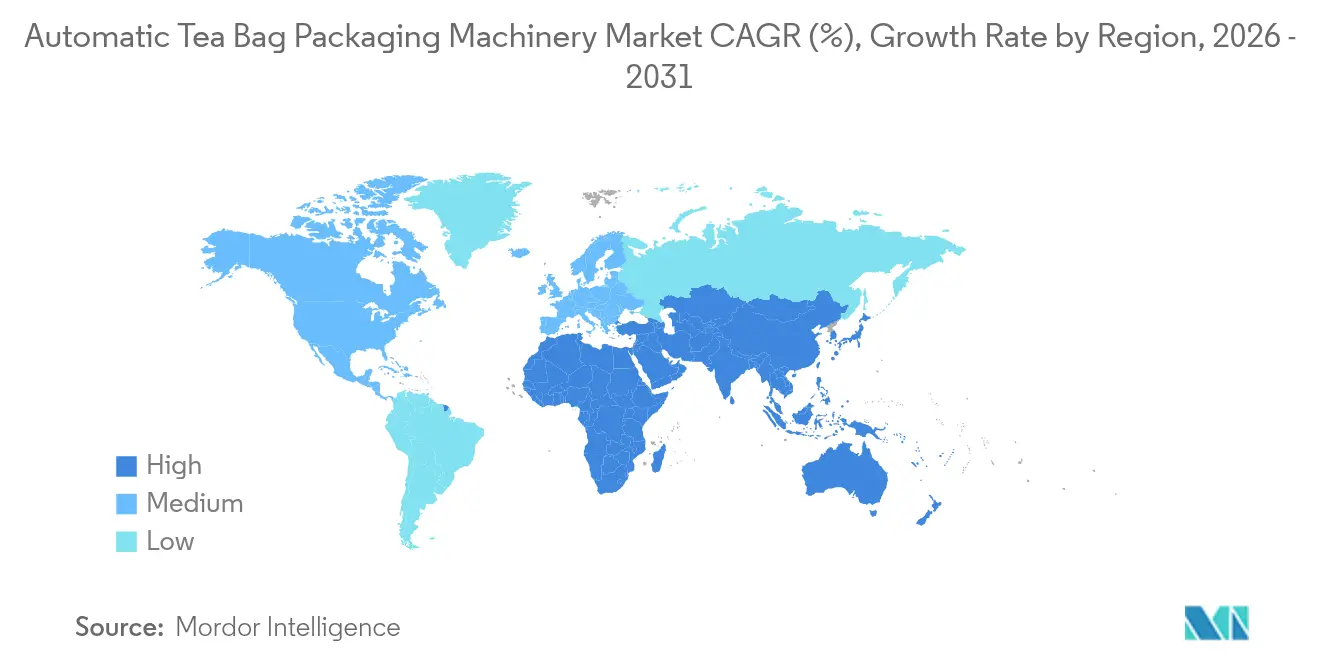
The Asia-Pacific region accounted for 42.18% of 2025 sales and is growing at an annual rate of 8.27% as China and India integrate field-to-cup value chains with smart factories. Local OEMs, such as Xiamen Sengong, refine pyramid-forming heads and predictive maintenance toolkits to match global benchmarks while maintaining price agility. Indian packers retrofit vision modules to meet EU import tolerances for seal strength, and government subsidies help cushion the costs of automation.
Europe and North America Automatic Tea Bag Packaging Machinery Market
Europe retains its role as an innovation test bed because Regulation (EU) 2025/40 compels the use of recyclable and compostable packaging, prompting machinery retrofits that adjust heat-seal bars, implement anti-static measures, and utilize inline chemical migration testers. Italian, German, and British converters upgrade to mono-material PLA or unbleached kraft film, resulting in double-digit drops in defect rates. North America follows with steady premiumization, aided by direct-to-consumer channels that valorize high-graphics envelopes and Instagram-ready pyramid sachets.
The Americas and MEA Automatic Tea Bag Packaging Machinery Market
South America, the Middle East, and Africa are experiencing a surge in unit installations, driven by gains in disposable income and the growth of urban café culture, from a relatively small base. Multilateral development banks extend soft loans for food processing modernization, helping local firms import mid-range, fully automatic lines. Regional free-trade agreements incentivize processors in Mexico, Türkiye, and Kenya to adopt EU-compliant substrates for access to premium buyers, gradually aligning technical standards worldwide.
Regulatory Landscape
Packaging-machine design and output compliance is tightening around recyclability and food-contact safety, with Europe a key anchor market. The EU Packaging and Packaging Waste Regulation (EU) 2025/40 entered into force on 11 February 2025 and is scheduled to generally apply from 12 August 2026, pushing tea brands and co-packers toward recyclable or compostable structures and, in turn, driving machinery requirements around sealing profiles, inline quality checks, and material traceability for paper and bio-based webs.
On the machinery side, the EU Machinery Regulation (EU) 2023/1230 sets harmonized health and safety requirements for machinery design and construction that packaging equipment suppliers must meet for CE-marked systems. For food-contact compliance, the EU also advanced restrictions on bisphenols via Regulation (EU) 2026/250, with transitional provisions for certain single-use final food-contact articles until 20 July 2026, reinforcing demand for migration-aware material validation across filter media, strings, tags, and adhesive systems. In the United States, food-contact materials must comply with FDA pathways (21 CFR, Food Contact Notifications, or Threshold of Regulation exemptions), which raises documentation and testing expectations for tea-bag materials and any packaging components that contact food.
Value Chain Analysis
The value chain starts with upstream suppliers of precision components and automation hardware, including servo motors, PLC controllers, sensors, and motion-control assemblies, followed by packaging-material inputs such as tea filter paper and specialty meshes (including PLA-based compostable webs, nylon, and other non-wovens). These inputs feed machinery OEMs that design and assemble automatic tea bag packaging lines with dosing, forming, sealing (including ultrasonic options), tag-and-string handling, and inspection modules; Europe (notably Germany and Italy) is a hub for high-precision engineering, while China functions as a major manufacturing center for customizable and cost-competitive equipment.
Downstream, system integrators and plant engineering partners commission complete cells that link primary bagging to secondary packaging, coding/traceability, case packing, and palletizing, then after-sales organizations provide spares, remote diagnostics, and service contracts that influence lifecycle cost and uptime. Structural bottlenecks frequently concentrate in critical automation components (PLC/servo availability and pricing) and in specialty filter/film supply, which can extend lead times and force OEMs and packers toward modular architectures and multi-material capable sealing and handling kits to keep changeovers and downtime under control.
Competitive Landscape
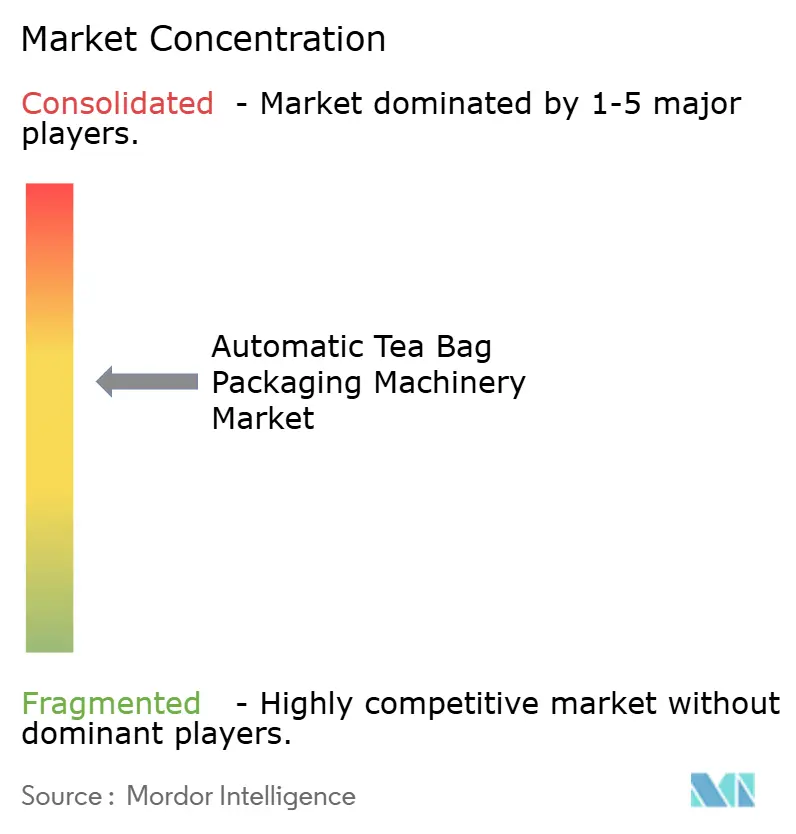
The automatic tea bag packaging machinery market remains moderately fragmented, yet the top five suppliers steadily increase their combined share as they pursue capacity expansions and digital service bundles. European majors, such as IMA and TEEPACK, leverage modular frames and embedded analytics to secure high-value contracts with multinational tea companies. They also roll out subscription-based remote monitoring that cuts downtime and deepens client lock-in.
Asian challengers, notably Xiamen Sengong and Dongguan Sammi, differentiate via competitive pricing and quick lead times while racing to certify machines for PLA and other next-generation substrates. Several have begun exhibiting at IPACK-IMA and Interpack to court Western distributors, signaling a shift toward global brand visibility. Joint ventures between European control-system firms and Chinese fabricators accelerate technology transfer and lower unit costs.
Strategic investments emphasize Industry 4.0, with vendors integrating edge-computing nodes that analyze vibration and torque patterns against cloud-hosted failure models. Machinery-as-a-service pilots gain traction among mid-sized processors that wish to bypass CAPEX barriers, paying usage-based fees tied to bag output. Compliance with U.S. FDA food-contact norms and EU substance restrictions is now a non-negotiable selling point, steering R&D spend toward multi-format sealing heads and solvent-free adhesive technologies.[3]
Automatic Tea Bag Packaging Machinery Industry Leaders
-
TEEPACK Spezialmaschinen GmbH & Co. KG
-
I.M.A. Industria Macchine Automatiche S.p.A.
-
ACMA S.p.A.
-
Xiamen Sengong Packing Equipment Co., Ltd.
-
FUSO International
- *Disclaimer: Major Players sorted in no particular order
Automatic Tea Bag Packaging Machinery Market Companies Covered in this Report
- TEEPACK Spezialmaschinen GmbH & Co. KG
- I.M.A. Industria Macchine Automatiche S.p.A.
- ACMA S.p.A.
- Xiamen Sengong Packing Equipment Co., Ltd.
- FUSO International
- Tecpacking Group (Tianjin) Co., Ltd.
- Packstec Machinery
- Sichuan KST Automatic Equipment Co., Ltd.
- Shanghai Fubo Packaging Machinery Co., Ltd.
- Quanzhou Deli Agroforestrial Machinery Co., Ltd.
- Hondon Packaging & Food Machinery Factory
- Grace Food Processing & Packaging Machinery
- Synda Pack
- Best Crown Machinery Co., Ltd.
Read Analysis of Automatic Tea Bag Packaging Machinery Companies
Market Opportunities and Future Outlook
A clear whitespace is emerging around retrofits and new-build platforms that can run compostable and mono-material webs without sacrificing seal integrity or changeover speed, shaped by the EU PPWR timeline that generally applies from 12 August 2026. This is translating into demand for machine features such as recipe-driven setups, tighter temperature and pressure control for lower-melting substrates, anti-static handling, and in-line inspection tuned to new materials, especially for premium pyramid formats that require precise forming and consistent seam quality.
Digitalization and end-of-line automation remain under-penetrated in many tea plants relative to primary bagging, creating room for OEMs and integrators to bundle performance monitoring, remote service, and secondary packaging into a single validated line offer. A concrete proof point is TEEPACKs May 2026 launch of its PACK software family (PACKstream and PACKpulse) aimed at production data analysis and efficiency monitoring, mirroring buyer priorities around OEE improvement and downtime reduction. In parallel, industry moves such as IMA Groups DIGIMECH research lab with the University of Bologna (July 2025) highlight ongoing R&D emphasis on automated and mechatronic systems that can be translated into more maintainable, data-driven packaging cells for high-mix SKU environments.
Recent Industry Developments in Automatic Tea Bag Packaging Machinery Market
- May 2026: TEEPACK introduced the PACK product family, including PACKstream and PACKpulse software, to analyze production data and monitor efficiency. The release strengthens the shift toward connected tea bag packaging lines where dashboards and diagnostics are packaged alongside machinery to reduce downtime and improve transparency across plants.
- : The acquisition of Prosys Sampling Systems Limited by IMA Group closed on February 12, 2026, expanding capabilities in sampling and quality-related systems and enabling more integrated compliance workflows adjacent to automated packaging operations.
- July 2025: IMA Group partnered with the University of Bologna to launch DIGIMECH, a joint research laboratory focused on automated and mechatronic systems. This collaboration reinforces the industry push toward advanced automation engineering that feeds into higher-performance packaging equipment, including smarter changeovers, maintainability, and control architectures.
Automatic Tea Bag Packaging Machinery Market Report Scope and Research Methodology
Market Definition and Coverage
This market covers automatic equipment used to form, fill, seal, and pack tea bags in finished formats that can be shipped for retail or foodservice. It includes stand-alone machines and integrated lines used by tea manufacturers and contract packers, and it is sized in revenue terms.
Scope exclusions: Manual packing setups, loose tea bulk packing machinery, and equipment mainly meant for coffee or other beverages are not counted.
Segments Covered in This Report
- By Material Type
- Paper
- Nylon
- Plastic
- Silk
- Other Material Types
- By Packaging Shape
- Rectangular
- Round
- Pyramid / Triangle
- Other Packaging Shapes
- By Automation Level
- Fully Automatic
- Semi-Automatic
- By Line Capacity
- less than 60 bpm
- 61 – 120 bpm
- more than 120 bpm
- By Geography
- North America
- United States
- Canada
- Mexico
- South America
- Brazil
- Argentina
- Chile
- Rest of South America
- Europe
- United Kingdom
- Germany
- France
- Italy
- Spain
- Russia
- Rest of Europe
- Asia-Pacific
- China
- India
- Japan
- South Korea
- Australia
- Rest of Asia-Pacific
- Middle East and Africa
- Middle East
- Saudi Arabia
- United Arab Emirates
- Turkey
- Rest of Middle East
- Africa
- South Africa
- Nigeria
- Rest of Africa
- Middle East
- North America
Data Sources, Market Sizing, and Validation
Desk Research
Desk work starts by building a clean equipment map for tea bag lines so that later numbers do not mix with general food packaging machinery. We review public sources such as UN Comtrade trade flows for packaging machinery categories, World Bank and IMF macro series for manufacturing activity and currency context, and national statistics offices for industrial output signals in key tea processing countries.
Next, we triangulate supply side context using company annual reports and investor presentations, press releases, association websites, and technical literature in peer reviewed packaging and food engineering journals. We also check patent databases to understand where automation features are moving, for example servo control and inspection.
When needed, our analysts use paid subscriptions for company financials and for shipment level import and export checks to stress test the direction of demand. These examples are not exhaustive, and many other public sources were also used to collect, validate, and clarify data points.
Primary Interviews and Surveys
Primary work is used to confirm what counts as an automatic tea bag packaging line in day to day buying, and to pin down realistic pricing and replacement cycles. We speak with machine OEM-side experts, automation and service partners, distributors, and tea processors, and then we recheck assumptions across APAC, EMEA, and the Americas so regional buying patterns and lead times are reflected in the model.
Distribution of primary research fieldwork respondents
| Company type | Respondent position | Region |
|---|---|---|
| Top tier: 34% | CXOs: 16% | APAC: 49% |
| Mid tier: 48% | Functional/Unit leaders: 38% | EMEA: 30% |
| Smaller Players: 18% | Managers: 46% | Americas: 21% |
Market-Sizing & Forecasting
Sizing is built mainly through a top-down reconstruction that links the addressable tea bag packing demand pool to equipment spending, and then converts it into revenue using observed price bands for machines and lines. The demand pool is shaped using a short list of practical drivers, such as tea bag output growth, the share of packaged tea shifting toward pyramid and specialty formats, line speed needs (bags per minute), and the cadence of replacement and upgrades in tea factories.
After the total is formed, it is corroborated with selective bottom-up checks based on sampled supplier revenues. We also use channel conversations on typical order sizes and ASP time volume logic for common machine configurations. Where direct revenue visibility is limited, gaps are handled through proxy indicators like installed base aging and service activity, then we run a reasonableness pass against trade movements and known expansion announcements. Forecasts rely on scenario analysis supported by interview feedback on automation adoption, labor availability, and expected pricing changes tied to steel and controls components.
Data Validation & Update Cycle
Validation is done in layers so that obvious overcounts and undercounts get caught early. Model outputs are compared with independent signals like machinery trade direction, tea packaging capacity additions, and typical lead times, and then any sharp jumps are traced back to a specific assumption before sign-off.
A second analyst reviews key inputs, and respondents are re-contacted when variance is material or when a new product launch changes what is being sold as a complete line versus an add-on module. Reports are refreshed annually, and interim updates are made when major events occur, such as large plant expansions or regulatory shifts affecting food contact packaging. Before delivery, we do a final pass to ensure the latest information is reflected in the numbers and narrative.
Mordor Intelligence's Automatic Tea Bag Packaging Equipment Market Sizing Compared With Other Published Estimates
Published market sizes for automatic tea bag packaging equipment can look far apart, even when they appear to cover the same machines. The differences usually come from what is counted as part of the equipment line, the years used as the base, and how prices are treated when currency and input costs move.
A common split in this niche is whether the value includes only packaging machinery itself or also bundles in aftermarket services, consumables, and adjacent packaging systems that sit outside the tea bag line. Another gap is the handling of automation level, where some figures roll semi-automatic and manual equipment into the same total, and then apply broad growth rates without rechecking against installation activity and replacement cycles.
Benchmark comparison
| Source | Market Size | Gaps in Research Methodology |
|---|---|---|
| Mordor Intelligence | USD 1.62 B (2026) | |
| Industry Data Publisher A | USD 1.20 B (2025) | This estimate is presented as an approximate point value and also appears to exclude semi-automatic equipment, but it additionally folds in parts, consumables, and aftermarket services, which can shift the number depending on what is treated as equipment revenue versus ongoing spend. |
| Global Advisory B | USD 19.74 B (2023) | The stated value is materially higher than typical machinery-only spend levels, which suggests a much wider scope that likely mixes broader packaging equipment categories and downstream packaging formats beyond tea bags, making year to year comparability difficult for a tea-bag-line-only view. |
The table shows that scope is the biggest driver, where counting only equipment revenue for tea bag forming, filling, sealing, and related line modules will naturally sit below totals that absorb services or broader packaging categories, a separation applied in Mordor Intelligence. With the scope held steady, the remaining spread tends to come from base-year choice, currency timing, and how ASP changes are applied during the forecast period.
Key Questions Answered in the Report
What is the size of the automatic tea bag packaging machinery market in 2026?
The market is valued at USD 1.62 billion in 2026 and is forecast to reach USD 2.21 billion by 2031.
Which region leads to demand for automated tea bag machinery?
The Asia-Pacific region captures 42.18% of global revenue in 2025 and is expanding at the fastest rate of 8.27% annually.
Which material segment is growing the quickest?
Machines configured for biodegradable PLA film are expected to show the highest 9.21% CAGR through 2031.
Why are pyramid bags gaining traction?
They visually showcase whole-leaf teas, support premium pricing, and enhance infusion quality, resulting in an 8.45% CAGR for related machinery.
What restrains wider automation adoption?
High initial CAPEX and a shortage of skilled mechatronics technicians limit uptake, especially in developing economies.
How are sustainability regulations shaping machinery design?
EU Regulation 2025/40 mandates recyclable or compostable packaging, compelling OEMs to certify machines for PLA, unbleached kraft, and other eco-friendly substrates.