
Market Overview
| Study Period | 2019 - 2031 |
|---|---|
| Forecast Data Period | 2026 - 2031 |
| Base Year Market Size (2025) | USD 201.37 Million |
| Market Size (2026) | USD 215.24 Million |
| Market Size (2031) | USD 300.34 Million |
| Growth Rate (2026 - 2031) | 6.89 % |
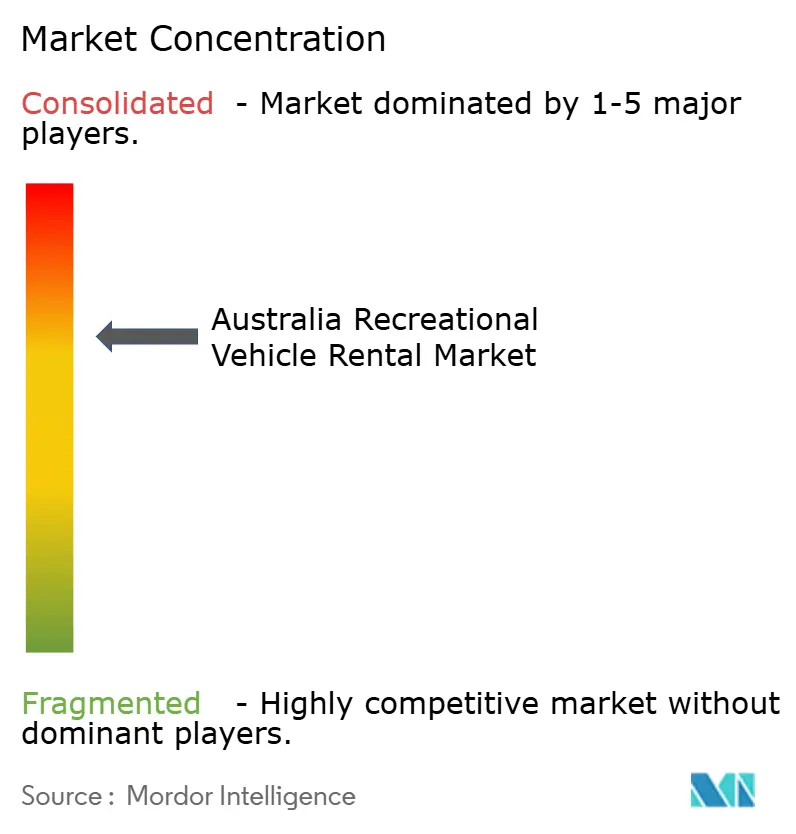
| Market Concentration | Medium |
Major Players
*Disclaimer: Major Players sorted in no particular order Image © Mordor Intelligence. Reuse requires attribution under CC BY 4.0. |
|
Australia Recreational Vehicle Rental Market Analysis by Mordor Intelligence
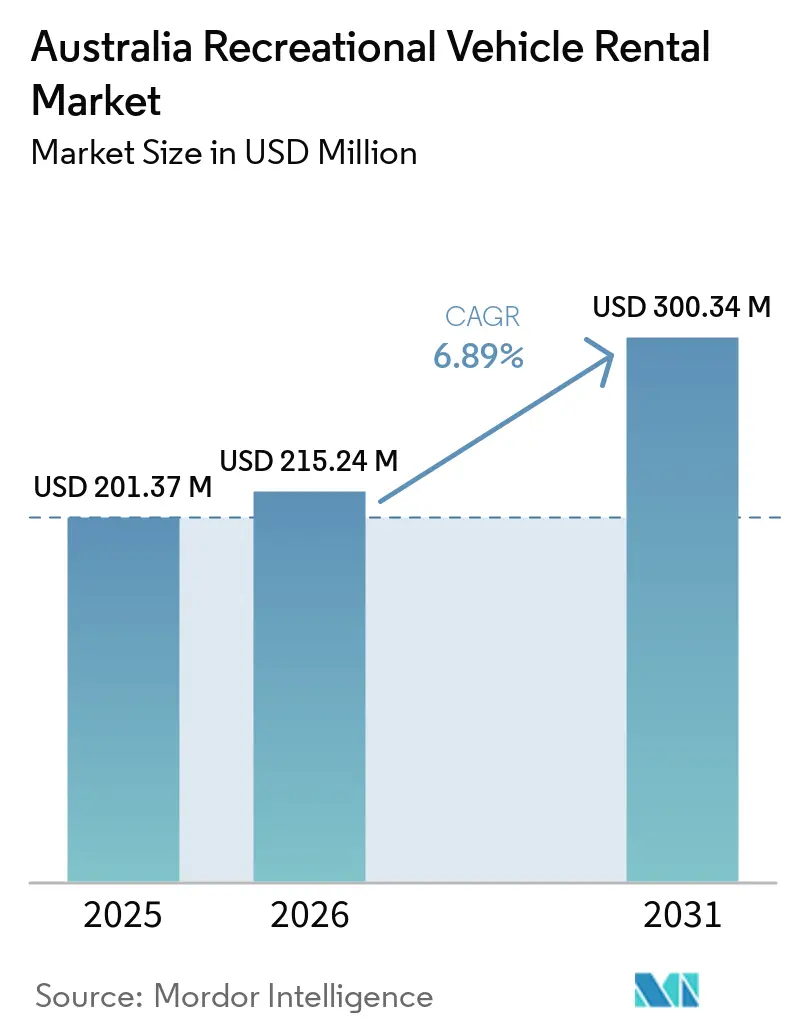
The Australian recreational vehicle rental market size was valued at USD 201.37 million in 2025 and is estimated to grow from USD 215.24 million in 2026 to reach USD 300.34 million by 2031, at a CAGR of 6.89% during the forecast period (2026-2031). Domestic caravan and camping travel gives the Australian recreational vehicle rental market a broad demand base, while inbound visitors add demand for longer self-drive trips. Tourism Research Australia reported strong caravan and camping activity in 2025, with travel concentrated in regional areas where self-contained vehicles can substitute for limited lodging options[1]“Caravan and Camping Data,” Tourism Research Australia, tra.gov.au. Operators are responding by combining gateway depots with regional access points and by using digital booking tools to manage vehicle availability. Higher vehicle ownership costs also make hiring an accessible option for travelers who want to test a recreational vehicle before buying one. Platform-based supply broadens choice, although it also increases pressure on conventional operators to maintain service consistency and price discipline.
Key Report Takeaways
- By product type, motorhomes recorded a 54.14% share and are expected to post the highest growth rate, with an 8.66% CAGR through 2031.
- By rental supplier type, fleet operators held 71.86% of revenue in 2025, while private and individual owners will be the fastest-growing at 6.95% CAGR through 2031.
- By booking type, online booking held a 62.86% share in 2025 and is the fastest-growing channel, with an 8.01% CAGR through 2031.
- By rental duration, short-term rentals held 53.94% of revenue in 2025, while mid-term rentals are the fastest-growing duration, with an 8.94% CAGR through 2031.
- By end use, family travel held 42.89% of revenue in 2025, while digital nomad and remote-work travel will record the highest disclosed growth rate, at an 8.94% CAGR through 2031.
- By region, New South Wales held a 35.14% share in 2025; Western Australia is projected to be the fastest-growing region at 7.95% CAGR through 2031.
Note: Market size and forecast figures in this report are generated using Mordor Intelligence’s proprietary estimation framework, updated with the latest available data and insights as of January 2026.
Australia Recreational Vehicle Rental Market Trends and Insights
Drivers Impact Analysis*
| Driver | (~)% Impact on CAGR Forecast | Geographic Relevance | Impact Timeline |
|---|---|---|---|
| Experiential Tourism and Travel Demand | +2.2% | Queensland, New South Wales, Western Australia | Short term (≤ 2 years) |
| Recovery of International Visitor Arrivals | +1.4% | New South Wales, Queensland, Western Australia | Short term (≤ 2 years) |
| Peer-to-Peer Platform Liquidity | +1.0% | New South Wales, Victoria | Medium term (2-4 years) |
| Try-Before-You-Buy Demand | +0.8% | Queensland, Victoria, New South Wales | Medium term (2-4 years) |
| Shorter Domestic Holidays | +0.6% | New South Wales, Victoria, South East Queensland | Short term (≤ 2 years) |
| Connected-Vehicle Premiumization | +0.4% | New South Wales, Victoria | Long term (≥ 4 years) |
| Source: Mordor Intelligence | |||
Experiential Road Trip Tourism and Regional Travel Demand
Road-based leisure travel continues to support the Australia recreational vehicle rental market because travelers can set their own routes and schedules. Caravan and camping travel had a strong regional footprint in 2025, which supports demand beyond the largest cities. Self-contained vehicles are useful where accommodation capacity is limited or where travelers want to change locations frequently. This pattern encourages operators to consider regional pickup points alongside airport and urban depots. It also supports a mix of vehicle types suited to coastal routes, wine regions, and remote touring. Near-city corridors benefit from shorter domestic breaks, while longer regional routes can lift rental days per booking.


Recovery of International Visitor Arrivals
Inbound travel remains important to the Australia recreational vehicle rental market because overseas visitors often need transport and accommodation in a single booking. The Australian Bureau of Statistics recorded 8,402,400 visitor arrivals, a 5.5% growth in short-term visitor arrivals during the 2024-25 financial year[2]"Overseas arrivals and departures, Australia - 2024-25 financial year," Australian Bureau of Statistics, abs.gov.au. International travelers commonly begin their trips in gateway cities before moving on to established touring routes. That behavior favors operators that can provide clear pickup processes, reliable roadside support, and vehicles suited to multi-week itineraries. New South Wales, Queensland, and Western Australia remain particularly relevant because they combine arrival gateways with well-known touring areas. The recovery also gives operators a reason to maintain multilingual booking information and clear vehicle orientation materials.
Peer-to-Peer Platform Liquidity and Idle RV Monetization
Peer-to-peer platforms add supply to the Australia recreational vehicle rental market without requiring every vehicle to be owned by a rental company. Private owners can use these platforms to earn income from vehicles that would otherwise remain unused. The model gives renters access to a wider range of vehicle layouts, locations, and price points. It also encourages established operators to improve online availability, response times, and customer support. Managed services can reduce the practical burden on owners who want assistance with handovers, cleaning, and bookings. As these services develop, the distinction between privately listed supply and professionally managed supply becomes less clear.
Try-Before-You-Buy Demand Among Prospective RV Owners
Rental use can help prospective buyers understand how a vehicle performs on real trips before making a purchase. This role is more relevant when vehicle prices, maintenance requirements, and storage costs make ownership decisions harder to reverse. The Caravan Industry Association of Australia described a changed production environment after post-pandemic demand normalized. Dealership-linked rental programs can connect the travel experience with the purchase journey. Some renters who later buy a vehicle may return as owners who list it through a platform. That link can support supply availability even when the original renter leaves the rental customer base.
Restraints Impact Analysis*
| Restraint | (~)% Impact on CAGR Forecast | Geographic Relevance | Impact Timeline |
|---|---|---|---|
| Seasonal Utilization and Fleet Idle-Time Volatility | -0.8% | Queensland, Tasmania, Northern Territory | Short term (≤ 2 years) |
| High Operating Costs | -0.6% | National | Medium term (2-4 years) |
| Limited Charging and Overnight Infrastructure | -0.4% | Western Australia, Northern Territory, South Australia | Long term (≥ 4 years) |
| Residual-Value Risk from Rapid Fleet Liquidations | -0.3% | Queensland, New South Wales | Medium term (2-4 years) |
| Source: Mordor Intelligence | |||
Seasonal Utilization and Fleet Idle-Time Volatility
Seasonality remains a practical restraint for the Australia recreational vehicle rental market because demand rises sharply around holidays and favorable weather periods. A vehicle that is fully booked in summer may have limited use in a quieter month. This makes fleet planning difficult because operators must balance missed peak bookings against off-season idle time. Regional differences are important, particularly in weather-sensitive destinations and areas with a concentrated dry-season tourism window. Mid-term travel, workforce accommodation, and emergency housing can create use outside the traditional leisure calendar. These alternative uses may improve utilization, but they do not remove the need for careful seasonal pricing and fleet allocation.
High Insurance, Maintenance and Depot Operating Costs
Insurance, repairs, cleaning, and depot operations can limit the profitability of fleet expansion in the Australia recreational vehicle rental market. Higher replacement values and more complex repairs can raise the cost of maintaining rental-ready vehicles. Gateway depots also require accessible locations, trained staff, and quick turnaround procedures. Operators with several vehicle categories must manage more parts, service needs, and handover requirements. These conditions favor businesses that can spread fixed costs across a larger fleet and booking base. They can also encourage partnerships, selective regional coverage, and tighter control of fleet age and utilization.
*Our forecasts treat driver/restraint impacts as directional, not additive. The impact forecasts reflect baseline growth, mix effects, and variable interactions.
Segment Analysis
By Product Type: Motorhomes Support Independent Travel
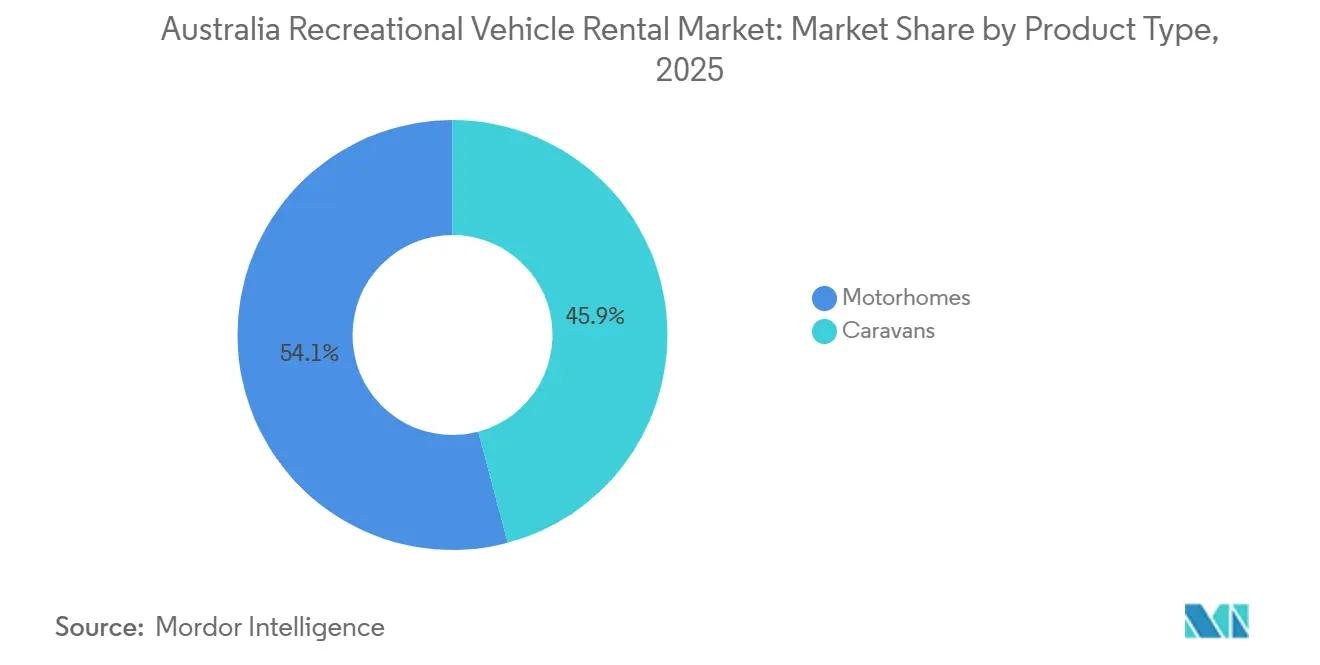
Motorhomes captured 54.14% share in 2025 and are set to record an 8.66% CAGR through 2031, making them the fastest-growing disclosed product segment in the Australia recreational vehicle rental market. Their appeal stems from combining sleeping, cooking, and travel functions in a single unit. Families, retirees, and international visitors value the independence a self-contained layout provides. Operators offer a range of layouts to match different trip lengths, driving experience levels, and amenity expectations. A well-matched vehicle reduces friction during the trip and supports positive customer feedback.
Caravans remain a complementary option for travelers who already own a suitable tow vehicle. Conventional travel trailers, fifth-wheel trailers, pop-top units, off-road caravans, and hybrid models address different trip requirements. Caravans allow travelers to set up accommodation and use the towing vehicle separately for local travel. Rental providers can communicate these differences through route-specific recommendations and practical handover materials. A broad mix allows providers to serve weekend trips, family holidays, and remote touring, keeping caravans relevant within the Australia recreational vehicle rental market.

By Rental Supplier Type: Fleet Operators Provide Consistency While Private Supply Expands Choice
Fleet operators held 71.86% of the Australia recreational vehicle rental market share in 2025. Their position reflects established depot networks, recognized brands, and standardized processes for pickup, support, and return. Large operators offer travelers predictable vehicle conditions and roadside assistance, with airport and city locations useful for visitors starting a self-drive trip. Fleet ownership requires substantial investment but gives operators control over maintenance and customer experience, which remains a meaningful competitive advantage in the market.
Private and individual owners were identified as the fastest-growing supplier group, posting a 6.95% CAGR to 2031. Peer-to-peer platforms allow owners to reach renters without building their own booking systems, adding supply in locations with limited conventional fleet coverage. Payment systems, availability tools, and protection products make this model practical, though service quality can vary. Platforms need clear standards for vehicle condition, support, and handover to meet traveler expectations.
By Booking Type: Online Booking Improves Availability and Planning
Online booking accounted for 62.86% share in 2025 and is set to record an 8.01% CAGR through 2031, making it the fastest-growing disclosed booking channel. Digital channels allow travelers to compare vehicle options, pickup locations, trip dates, and included features before committing. They also give operators a direct way to update availability when a vehicle is returned, serviced, or moved between depots, which can improve utilization for fleets operating across multiple locations. Online tools are especially useful for travelers planning from overseas or organizing multi-stop itineraries. Platform listings extend this function to private owners who may not otherwise reach a large audience. The quality of search functionality, availability of information, and customer support can influence conversion as much as the headline rental price, making digital service design relevant to both operational performance and customer acquisition.
Offline booking remains useful for customers who prefer a conversation before choosing a vehicle. Telephone teams and physical depots can assist with longer trips, unusual vehicle requirements, and questions about towing or remote travel. These interactions are particularly important for older travelers, corporate users, and travelers unfamiliar with Australian roads. A blended approach allows each booking channel to serve a distinct customer need. Straightforward short trips can be handled efficiently online, while longer bookings may benefit from personal support before departure. Physical depots can focus on orientation, upgrades, and vehicle handover, allowing operators to direct staff time where it has the greatest value.
By Rental Duration: Mid Term Travel Creates a Different Utilization Pattern
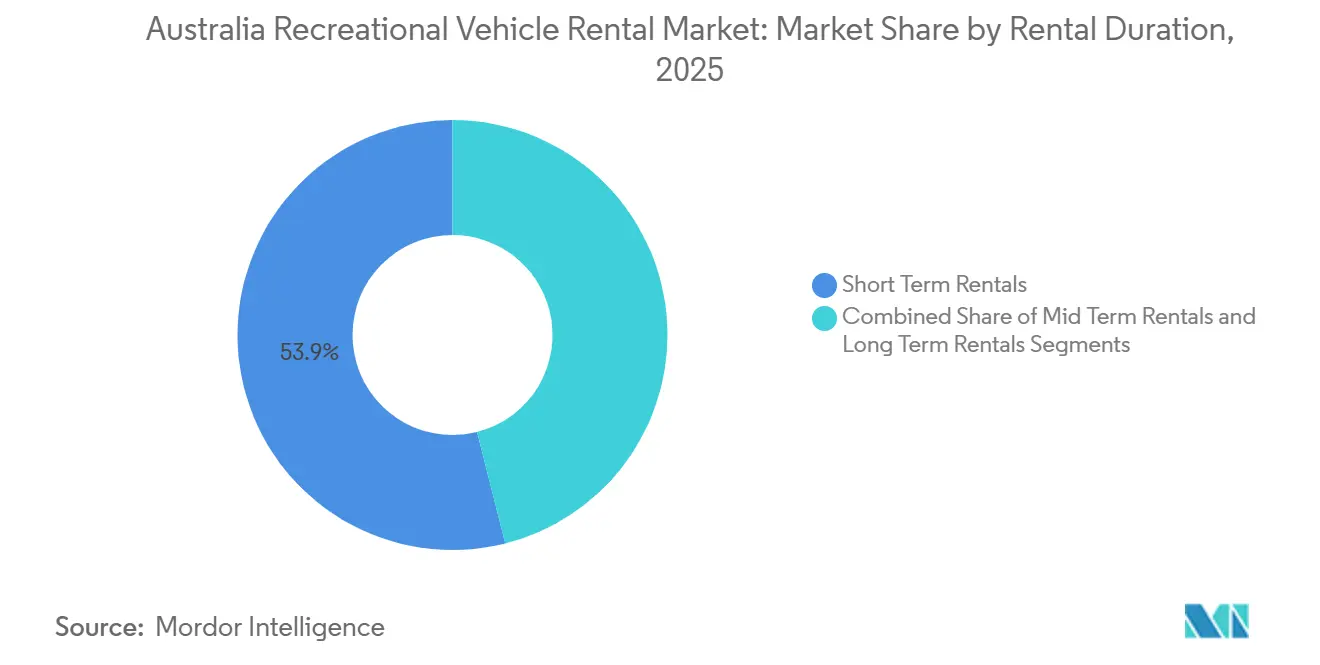
Short-term rentals accounted for 53.94% of revenue in 2025, while mid-term rentals are projected to record an 8.94% CAGR through 2031. Short breaks remain important because long weekends, school holidays, and local events generate concentrated demand, providing a volume base for many fleets. Mid-term trips generate more days per booking and reduce handovers for the same period of vehicle use, suiting travelers who want to explore several regions without moving between conventional accommodations. A suitable duration mix reduces dependence on a limited number of high-demand weekends and helps depots schedule cleaning, inspections, and maintenance more consistently. Mid-term demand is linked to remote work flexibility, extended domestic travel, and longer overseas itineraries, creating demand for connectivity, practical storage, reliable power, and comfortable sleeping arrangements.
Long-term rentals remain a smaller but strategically useful part of the duration mix. Corporate projects, workforce accommodation, disaster response, and extended remote travel can all generate demand for longer use, though they can limit vehicle availability during peak leisure periods. Long-term users tend to prioritize reliability and practical living features over premium finishes, with larger tanks, durable sleeping arrangements, and power systems often mattering more than cosmetic upgrades. Providers that can manage these requirements may reach customers outside the usual holiday segment, offering a route to more stable utilization when leisure demand is uneven.

By End Use: Family Demand Provides Volume While Remote Work Broadens Use Cases
Family travel accounted for 42.89% of revenue in 2025, while digital nomad and remote-work travel recorded an 8.94% CAGR through 2031. Family trips benefit from the ability to transport people, food, and equipment within a single travel format. School vacation periods generate high demand for larger motorhomes and practical caravan layouts. Self-catering allows households to manage travel budgets and routines, while the format enables families to select destinations that are less dependent on hotel availability. These characteristics make family travel a stable base for the Australia recreational vehicle rental market. Providers can strengthen their family offering by clearly communicating details on bed configurations, child-seat options, storage, and kitchen facilities. These practical details can influence customer decisions more than broad vehicle descriptions. Reliable pickup procedures are particularly important when families begin trips during busy vacation periods.
Couples and groups contribute demand across several vehicle sizes and travel styles. Compact campervans can suit couples seeking a straightforward road trip, while groups may book multiple units for shared itineraries or events. Booking patterns vary by destination, time of year, and planned activity level. Providers can address these needs through clear capacity information and flexible vehicle options. A varied end-use mix reduces reliance on a single traveler profile. Digital nomad and remote-work travel was the fastest-growing disclosed end-use category. Some travelers seek longer stays that combine work with regional travel, increasing the importance of connectivity, power supply, interior space, and reliable service support. This use case can also generate demand outside school vacation periods.
Geography Analysis
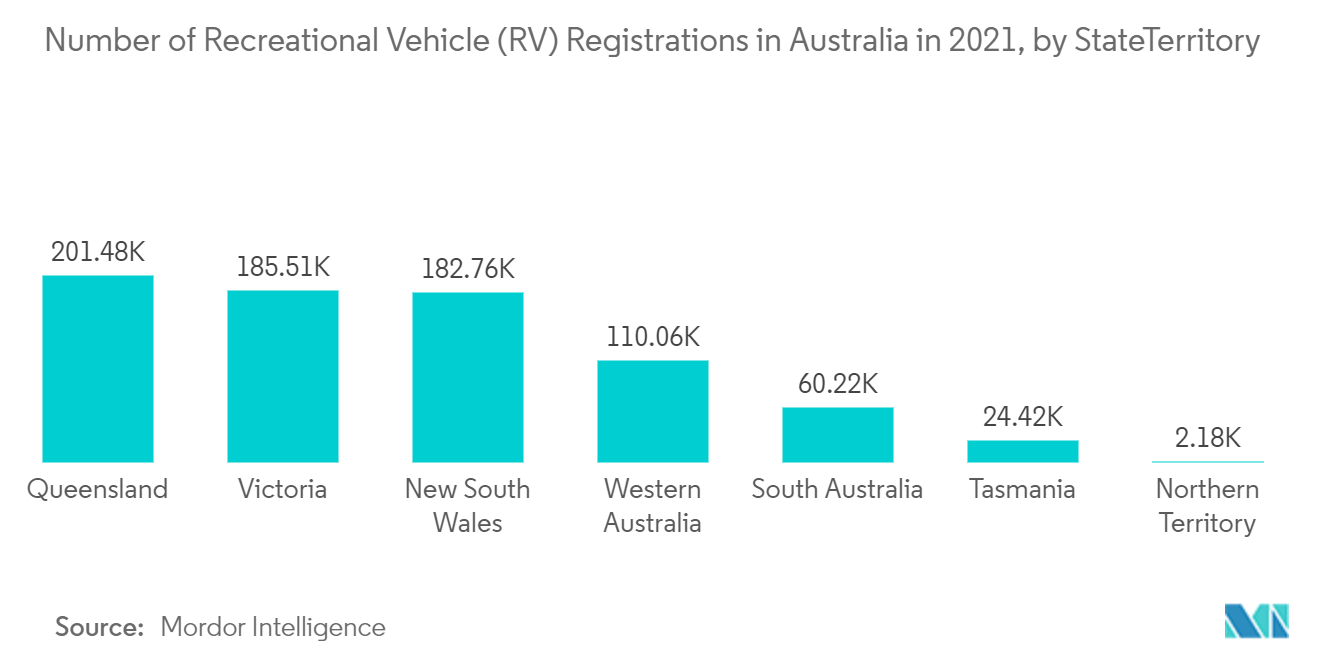
New South Wales accounted for 35.14% of Australia's recreational vehicle rental market share in 2025. Sydney serves as a major arrival point for visitors and a practical starting point for regional self-drive travel, with access to coastal routes, inland regions, and short-break destinations. Visitor arrivals continued to recover during the 2024-25 financial year, supporting demand in major gateway locations. Victoria and Queensland also remain important, as Melbourne, Brisbane, the Gold Coast, and Cairns connect travelers with established road-trip routes, requiring a range of vehicle options to serve both short and extended trips.
Western Australia recorded a 7.95% CAGR through 2031, making it the fastest-growing disclosed state market, with long-distance routes favoring self-contained vehicles. South Australia attracts travelers heading to inland landscapes and wine regions, while Tasmania's compact geography suits multi-destination road trips. The Northern Territory follows a strong dry-season pattern centered on national parks, and the Australian Capital Territory functions primarily as a short-break and transit location.
Regional travel creates opportunities beyond the largest urban depots. Operators need to match vehicle capabilities with planned route conditions, particularly in Western Australia, the Northern Territory, and other remote areas, where customer briefing on fuel availability, road conditions, and communication is essential. A larger regional footprint improves convenience but raises servicing and repositioning challenges, making geographic strategy closely linked to operational capability.
Competitive Landscape
The Australia recreational vehicle rental market is moderately consolidated, where larger operators benefit from scale while regional providers and platforms retain room to compete. Tourism Holdings Limited operates several recognized brands across different traveler budgets and vehicle formats. Its position was strengthened by the merger with Apollo Tourism & Leisure, which the Australian Competition and Consumer Commission addressed through a clearance process that included fleet divestment requirements. Large fleet operators benefit from established depots, maintenance systems, and roadside support, making reliability and network access important competitive factors.
Platform businesses introduce a different form of competition by aggregating privately owned vehicles. Camplify connects vehicle owners, renters, and dealer locations, reducing owner effort while providing renters a more structured handover experience. This places pressure on fleet operators to offer convenient online booking and clear service standards. Regional specialists compete through local route knowledge, convenient locations, or area-specific vehicle configurations. Fleet size alone does not define competitive position, as service quality, digital tools, and local coverage also influence customer choice.
Competition is shaped by the balance between capital-heavy fleets and flexible privately listed supply. Larger firms negotiate with suppliers and manage broad support networks, while smaller providers respond more quickly to local travel patterns. Platforms can add vehicles rapidly during peak periods but must maintain trust across varying vehicle conditions. A provider's ability to deliver a dependable experience from booking through vehicle return remains central to customer retention, supporting a moderately consolidated market structure.
Australia Recreational Vehicle Rental Industry Leaders
-
Tourism Holdings Limited
-
Camplify Holdings Limited
-
JUCY Group
-
Cruisin' Motorhomes Pty Ltd
-
Travellers Autobarn
- *Disclaimer: Major Players sorted in no particular order

Recent Industry Developments
- June 2026: Tasvanlife, a Tasmanian campervan hire company, launched Australia's first full-electric camper vans, based on the Farizon SV van with an 82 kWh battery and a 319 km WLTP range. Features include an induction cooktop, large fridge, electric kettle, plumbed sink, external shower, and a 2 kW electric heater.
- November 2025: Thrifty expanded its Northern Territory fleet with 25 Mitsubishi Triton GSR 4×4 campers, giving travelers more options for exploring remote areas of Australia.
- November 2025: B Group acquired a 12.7% stake in Camplify, an RV rental platform in Australia, in a multi-million-dollar deal, integrating Camplify's services into JB's network and offering managed rentals at select dealers.


Australia Recreational Vehicle Rental Market Report Scope
The scope of the report includes product type, rental supplier type, booking type, rental duration, end use, and region. By Product Type, the market is segmented into Motorhomes (Class A Motorhomes, Class B Motorhomes, and Class C Motorhomes) and Caravans (Conventional Caravans, Fifth-Wheel Caravans, Pop-Top Caravans, Off-Road Caravans, and Hybrid Caravans). By Rental Supplier Type, the market is segmented into Fleet Operators (National Fleet Operators and Regional Fleet Operators) and Private and Individual Owners (Peer-to-Peer Rental Platforms and Independent Individual Owners). By Booking Type, the market is segmented into Online Booking (Direct Operator Websites, Online Travel Agencies (OTAs), and Peer-to-Peer Rental Sites) and Offline Booking (Telephone Booking and Physical Desks/Walk-ins). By Rental Duration, the market is segmented into Short-Term Rentals, 1-7 Days, Mid-Term Rentals, 8-30 Days, and Long-Term Rentals, More Than 30 Days. By End Use, the market is segmented into Family Travel, Couple Travel, Group Travel, Solo and Backpacker Travel, Digital Nomad and Remote-Work Travel, Events, Festivals and Sporting Trips, and Corporate, Project and Work-Related Travel. By Region, the market is segmented into New South Wales, Victoria, Queensland, Western Australia, South Australia, Tasmania, Australian Capital Territory, and Northern Territory. Market forecasts are provided in terms of Value (USD).


Key Questions Answered in the Report
What is driving demand for recreational vehicle rentals in Australia?
Domestic road trips, regional tourism, and the recovery in inbound travel support demand. Self-contained travel is also useful where lodging options are limited.
Which recreational vehicle rental product is growing fastest in Australia?
Motorhomes recorded the highest disclosed product growth rate, with an 8.66% CAGR through 2031.
Why do travelers choose a motorhome or campervan in Australia?
A motorhome or campervan combines transport, sleeping space, and self-catering facilities, which can support flexible multi-stop travel.
What role do peer-to-peer platforms play in recreational vehicle hire?
Peer-to-peer platforms connect private owners with renters and can expand vehicle choice, local availability, and price options.
Page last updated on:





