
Augmented Reality (AR) In Healthcare Market Size and Share
Market Overview
| Study Period | 2020 - 2031 |
|---|---|
| Market Size (2026) | USD 1.91 Billion |
| Market Size (2031) | USD 6.13 Billion |
| Growth Rate (2026 - 2031) | 26.29 % |
| Fastest Growing Market | Asia-Pacific |
| Largest Market | North America |
| Market Concentration | Medium |
Major Players *Disclaimer: Major Players sorted in no particular order Image © Mordor Intelligence. Reuse requires attribution under CC BY 4.0. | |

Augmented Reality (AR) In Healthcare Market Analysis by Mordor Intelligence
Augmented reality in healthcare market size in 2026 is estimated at USD 1.91 billion, growing from 2025 value of USD 1.51 billion with 2031 projections showing USD 6.13 billion, growing at 26.29% CAGR over 2026-2031. The growth pace shows that hospitals, training centers, and home-care providers are moving from isolated pilots to enterprise-wide deployments that improve surgical accuracy, shorten learning curves, and raise patient engagement. FDA clearances for intra-operative head-mounted systems and the post-pandemic priority on touch-free visualization tools have turned augmented reality into a clinical requirement rather than an experimental add-on[1]. Hardware continues to generate the bulk of current revenue, yet demand is shifting toward turnkey service contracts that cover workflow integration, data security, and outcomes monitoring. North America leads adoption because of its mature reimbursement systems, while Asia-Pacific delivers the steepest growth as governments fund technology that eases physician shortages. Competitive intensity is building as device majors embed AR into imaging suites and younger firms secure multi-center trials that validate efficacy.
Key Report Takeaways
- By component, hardware controlled 54.72% of Augmented Reality in Healthcare market share in 2025; services are projected to grow at a 27.90% CAGR to 2031.
- By application, surgical planning & guidance held 41.86% of the Augmented Reality in Healthcare market size in 2025 and is expanding at 28.35% CAGR through 2031.
- By technology, handheld devices led revenue with 38.12% in 2025, while head-mounted displays post the fastest 28.12% CAGR.
- By Product, AR displays generated 35.02% of 2025 revenue and is growing at 27.86% CAGR.
- By end user, hospitals & clinics accounted for 51.20% of 2025 revenue; research laboratories record the highest 28.80% CAGR.
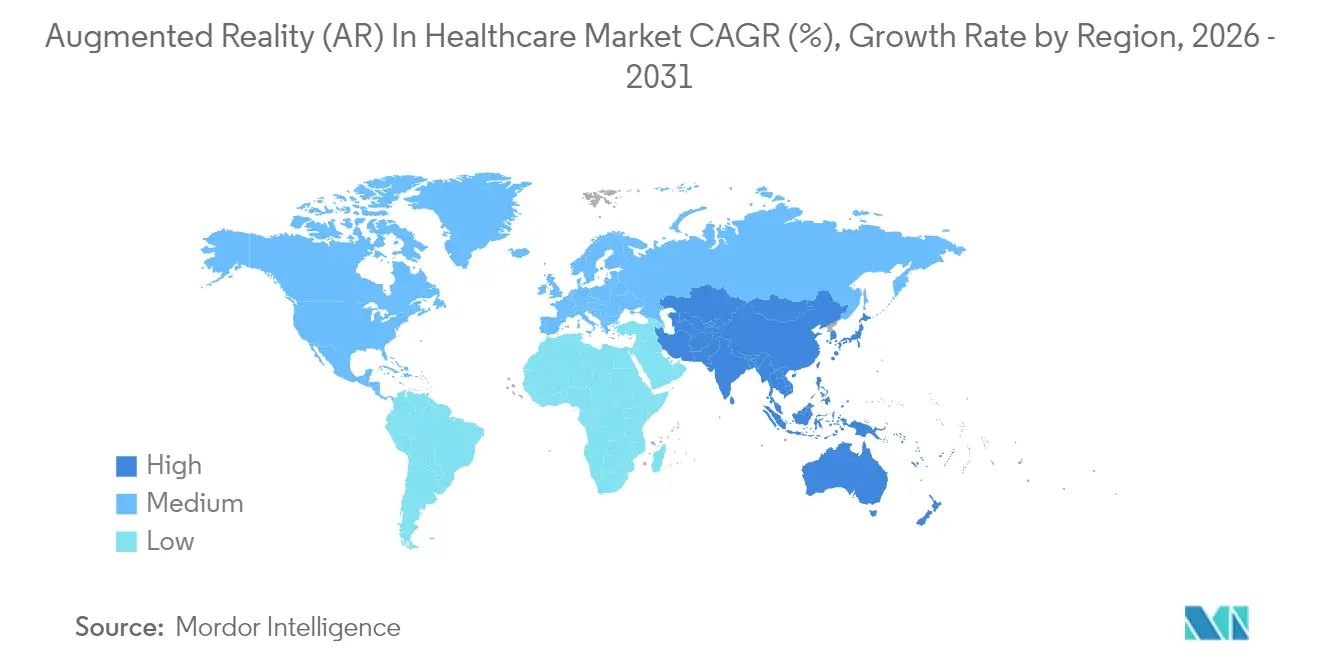
- By geography, North America captured 42.60% revenue in 2025; Asia-Pacific is advancing at 27.10% CAGR.
Note: Market size and forecast figures in this report are generated using Mordor Intelligence’s proprietary estimation framework, updated with the latest available data and insights as of 2026.
Market Trends and Insights
Drivers Impact Analysis of Augmented Reality (AR) In Healthcare Market*
| Driver | % Impact on CAGR Forecast | Geographic Relevance | Impact Timeline |
|---|---|---|---|
| Growing adoption of augmented reality for surgical training & guidance | +6.2% | Global, strongest in North America & EU | Medium term (2-4 years) |
| Increasing investments & funding in augmented-reality healthcare start-ups | +4.8% | North America & EU core, expanding to APAC | Short term (≤2 years) |
| Rising demand for minimally invasive procedures enhanced by visualization | +5.1% | Global, particularly developed markets | Long term (≥4 years) |
| Expanding use of augmented reality in patient education & rehabilitation | +3.9% | APAC leading, emerging markets following | Medium term (2-4 years) |
| Integration of augmented reality with medical-imaging systems | +4.3% | Global, concentrated in major healthcare hubs | Medium term (2-4 years) |
| Accelerating digital transformation & telehealth adoption post-COVID | +2.7% | Global, with rural and underserved areas prioritized | Short term (≤2 years) |
| Source: Mordor Intelligence | |||
Growing Adoption of AR for Surgical Training & Guidance
Medical schools and major centers have adopted immersive simulators that combine high-resolution overlays with haptic feedback, cutting error rates and trimming the hours required to reach proficiency. Mayo Clinic reports lower procedural complications when residents practice on AR modules before entering the theatre[2]. Recent prototypes add voice-controlled navigation that lets surgeons reposition virtual anatomy without touching screens, lowering infection risk and mental workload. These capabilities align with competency-based curricula that mandate objective performance tracking, something marker-based cameras and motion analytics supply natively. As reimbursement policies move toward outcomes, training directors view AR as a cost-effective path to faster credentialing. Medium-term momentum is therefore locked in; growth later accelerates when cloud-hosted libraries make updates available across entire residency networks.
Increasing Investments in AR Healthcare Start-Ups
Venture funding has pivoted from experimental prototypes to firms holding multiple FDA clearances and live hospital contracts. Augmedics drew USD 82.5 million in its 2024 Series D, bringing total backing to USD 149 million and supporting a 250-hospital roll-out of its xvision spine system. Strategic acquirers such as Stryker and Philips now value clinical data sets and integration know-how more than raw optics, prompting tuck-in deals that accelerate time-to-market. Capital inflows shorten the gap between concept and commercial production, which compresses product life cycles and raises competitive pressure. Over the next two years, boards will reward platforms that publish peer-reviewed outcomes and prove cost avoidance rather than those relying on general XR hype.
Rising Demand for Minimally Invasive Procedures Enhanced by Visualization
Surgeons using AR-guided laparoscopy have recorded 43% lower intraoperative blood loss and fewer postoperative infections versus standard video scopes. Three-dimensional overlays project hidden vessels and bile ducts onto live imagery, letting physicians choose tighter incision paths and spare adjacent tissue. Force-feedback-equipped robots further limit trauma, with prototype systems slashing peak instrument forces by 43% in preclinical trials. Hospitals quantifying total episode costs see shorter stays and fewer readmissions, which boosts margins under bundled-payment rules. Long-term growth therefore rests on a virtuous loop of clinical and economic benefits that build strong ROI cases for administrators.
Expanding Use of AR in Patient Education & Rehabilitation
Patients who preview their own anatomy with AR tablets grasp procedural steps more clearly, which reduces pre-operative anxiety and raises consent quality, highlighting the broader potential of mixed reality in healthcare. Post-stroke individuals using gesture-tracked rehabilitation games regained wider ranges of motion and reported higher adherence than peers on standard exercise sheets. Tele-rehab extensions now stream clinician dashboards that score movement accuracy in real time, letting therapists adjust routines remotely. APAC health ministries back these programs to stretch limited specialist staff across rural populations. As 5G networks mature, cross-border services will widen, positioning patient-facing AR as the next high-volume contributor to the augmented reality in healthcare market.
Restraints Impact Analysis of Augmented Reality (AR) In Healthcare Market*
| Restraints Impact Analysis | (~) % Impact on CAGR Forecast | Geographic Relevance | Impact Timeline |
|---|---|---|---|
| High initial cost of augmented-reality hardware & integration | -3.8% | Global, most acute for smaller facilities | Short term (≤2 years) |
| Data privacy & cybersecurity concerns in clinical environments | -2.9% | Global, strictest in EU | Medium term (2-4 years) |
| Lack of standardized regulatory & reimbursement frameworks | -3.2% | Global, with pronounced impact in emerging markets | Medium term (2-4 years) |
| Limited clinical evidence and validation of long-term outcomes | -2.5% | Global, hospitals with evidence-based purchasing policies | Long term (≥4 years) |
| Source: Mordor Intelligence | |||
High Initial Cost of AR Hardware and Integration
Entry-level smart glasses start near USD 5 000, yet the fully loaded cost of an enterprise surgical suite surpasses USD 250 000 once software licenses, training, and IT build-outs are counted. Smaller regional hospitals hesitate because reimbursement codes for AR-assisted procedures are still limited, forcing them to shoulder capital expenses upfront. Custom links to PACS, EMR, and navigation stacks add further expense when vendors lack common interoperability standards. Early adopters counter these concerns with operating-lease models and evidence that procedure times can drop enough to free operating room capacity. Even so, near-term growth is capped where funding is tight or where CFOs demand three-year payback horizons.
Data Privacy and Cybersecurity Concerns in Clinical Environments
Immersive overlays pull live imaging, EMR data, and biometric signals into one viewport, expanding the attack surface that hackers could exploit. Regulators now treat headset firmware and cloud renderers as covered components under HIPAA and GDPR, raising compliance workloads. Researchers demonstrated that adversarial pixels can inject false vessel contours, proving that patient safety risks extend beyond data theft[3]. Hospitals therefore impose encrypted transport layers and multi-factor authentication, steps that can introduce latency unless systems are optimized. Vendor risk-assessment questionnaires have doubled in length since 2023, delaying procurement cycles in Europe and parts of Asia.
*Our forecasts treat driver/restraint impacts as directional, not additive. The impact forecasts reflect baseline growth, mix effects, and variable interactions.
Augmented Reality (AR) In Healthcare Market Segment Analysis
By Component:
Services Drive Long-Term Value CreationIn 2025 hardware composed 54.72% of Augmented Reality in Healthcare market revenue, reflecting the up-front purchase of optical engines, sensors, and compute packs. The Augmented Reality in Healthcare market size for services is, however, expanding fastest at 27.90% CAGR through 2031 as hospitals demand turnkey workflow mapping, staff certification, and cybersecurity support alongside devices. Vendor contracts are moving to recurring subscription bundles, giving suppliers year-over-year revenue visibility while easing capital budgeting hurdles for providers. Hardware margins, in contrast, are slipping when generic waveguides and commodity processors lower differentiation; firms that pivot to managed services preserve profitability. Over the forecast period, custom analytics dashboards, remote calibration, and guaranteed uptime clauses will become standard, aligning AR procurement with broader digital-health sourcing models. This transition mirrors the path already traveled by radiology PACS and surgical robotics, where service revenue now exceeds hardware sales. Manufacturers who excel at clinical onboarding and cross-platform integration will secure higher renewal rates, cementing services as the primary engine of lifetime customer value.
Second-generation deployments demonstrate that robust services shorten learning curves and boost utilization. Hospitals that buy devices without structured support often stall below 40% usage after six months, while sites on full-service plans exceed 75% utilization within the first year. These metrics help CFOs justify subscription spending, creating a self-reinforcing cycle that channels budget growth toward service line items. As a result, investors increasingly assess competitive positioning by the scale of field-support teams and the depth of implementation playbooks rather than optical specifications alone. Services thus shift bargaining power away from component suppliers toward integrators that own the clinical relationship, reshaping competitive hierarchy across the Augmented Reality in Healthcare market.


By Technology:
Head-Mounted Displays Gain Surgical AdoptionHandheld tablets and phones delivered 38.12% of 2025 revenue because their familiar form factor lowered entry barriers for patient-education kiosks and bedside use. Head-mounted displays now post a 28.12% CAGR as operating-room teams value hands-free navigation and 3-D depth cues critical for intricate procedures. Apple Vision Pro’s first documented shoulder-replacement case showed surgeons completing tasks 19% faster than those using 2-D screens, proving clinical viability. Lightweight optics and battery sleeves have trimmed headset weight below 220 grams, mitigating neck fatigue that previously hampered adoption. Future releases add myoelectric gesture sensors, enabling sterile interaction without voice commands that struggle in noisy theatres. Over the forecast window, hybrid architectures will appear: surgeons will reference patient-specific holograms through headsets while circulating nurses trigger medication reminders on handheld consoles. Vendors that synchronize annotations across both device classes stand to capture multi-department budgets and lock in cloud-rendering subscriptions.
Commercial momentum also reflects progress in regulatory pathways. The FDA’s 510(k) panel cleared 16 head-mounted systems in 2024 alone, prompting group-purchasing organizations to negotiate framework agreements that pool demand across member hospitals. Such deals remove administrative friction, accelerating volume ramps. Long term, extended-reality chipsets built on 3-nanometer nodes will unlock 4K-per-eye resolution, positioning headsets to anchor even pathology and catheterization lab workflows. Consequently, research labs investing in next-generation optics are laying the foundation for a technology mix that tilts definitively toward head-mounted modalities by decade’s end.
By Product:
AR Displays Lead Both Share and GrowthAR displays generated 35.02% of 2025 revenue and are growing at 27.86% CAGR, an uncommon dual leadership that underscores their centrality to every workflow. The Augmented Reality in Healthcare market share advantage arises because crisp, wide-field visuals directly influence surgeon confidence and patient comprehension. SCHOTT’s high-index glass wafers now allow mass-production of waveguides that boost brightness 40% without enlarging optics. On the backplane, micro-OLED arrays deliver 3,000 nits, ensuring anatomical overlays remain visible under surgical lights. Sensors and input devices follow as enabling categories, supplying spatial mapping and gesture capture, yet their revenue ranks lower because many units are embedded inside the display chassis. Semiconductor components, critical though they are, behave like commodities once vendors lock design wins, so their pricing trends downward even as unit volume climbs.
The dominance of displays feeds a growing aftermarket for optical calibration and sterilisable lens covers, both bundling into service contracts that raise lifetime account value. Hospitals experimenting with remote tele-mentoring found that display clarity, not bandwidth, dictated mentor satisfaction scores, reinforcing the thesis that visualization performance governs clinical acceptance. Early indications show that AI up-scalers integrated at the edge can refine model overlays in real time, hinting that future differentiation will blend optical hardware with on-device intelligence. For now, firms that control proprietary coating recipes and etalon stacks set the performance ceiling and thus capture premium margins inside the Augmented Reality in Healthcare market.
By Application:
Surgical Planning Dominates Across MetricsSurgical planning & guidance absorbed 41.86% of 2025 revenue and advances at 28.35% CAGR, cementing its status as the anchor segment of the Augmented Reality in Healthcare market size. Clinicians appreciate the quantifiable outcome gains: shorter incision lengths, reduced fluoroscopy exposure, and fewer readmissions. FDA clearances for Augmedics xvision and ImmersiveTouch give hospitals regulatory confidence to scale beyond pilot phases. Growth continues as spine and craniomaxillofacial workflows expand into orthopedics and structural heart, areas demanding high-fidelity overlay registration. Training and education rank second; however, they overlap heavily with surgical modules, indicating that many vendors repurpose anatomical models across both revenue streams. Rehabilitation and remote monitoring form the youngest sub-cluster, leveraging inertial sensors and cloud analytics to gamify patient exercise and supply insurers with adherence metrics.
Product-market fit in surgery sparks ecosystem effects: implant makers pre-load AR visualization files onto sterilised drives, while imaging vendors embed spatial registration tags into CT datasets. These linkages lock surgeons into vertically integrated toolchains that elevate switching costs. At the same time, machine-learning libraries transform intra-operative video into continuous quality-assurance datasets, which hospitals mine for performance improvement programs. The upshot is that surgical planning not only fuels device sales but also catalyzes service, software, and data-analytics revenue, making it the flywheel around which the broader Augmented Reality in Healthcare market revolves.

By End User:
Research Labs Accelerate Translational AdoptionHospitals & clinics generated 51.20% of 2025 turnover, reflecting their purchasing power and central role in acute care. The Augmented Reality in Healthcare market size contribution from research laboratories, however, is racing ahead at 28.80% CAGR because grant-funded institutes pilot experimental features and publish peer-reviewed evidence. Their validations persuade hospital boards to issue broader requests for proposals, creating a pipeline effect that seeds future clinical revenue. Academic centers sit in between, training residents on AR platforms they will later demand as attending surgeons. Pharmaceutical firms and device makers deploy AR during R&D to visualise molecular structures or simulate implant placement, representing a smaller but strategically important niche.
Research labs also shape standards. Consortia led by Cleveland Clinic and University College London are drafting open data formats that enable headset-agnostic overlays, lowering integration burdens for hospitals downstream. Vendor partnerships with these labs therefore pay dual dividends: early performance feedback plus influence over emerging interoperability norms. As a result, firms courting laboratory relationships may capture a disproportionate share of long-run clinical spend, reinforcing the labs’ pivotal role in the Augmented Reality in Healthcare market.
Geography Analysis
North America Augmented Reality (AR) in Healthcare Market
North America retained 42.60% revenue in 2025, reflecting premium pricing power and a regulatory environment that has cleared 69 augmented-reality or virtual-reality devices to date. The United States dominates regional uptake as integrated-delivery networks bundle AR into digital theatre rebuilds, while Canada’s publicly funded system channels grants toward rural tele-rehab pilots. Mexico shows budding demand tied to its medical-tourism corridor, where private hospitals promote AR-guided orthopedic packages for inbound patients. Cross-border collaborations allow U.S. academic surgeons to mentor Mexican procedures in real time, foreshadowing hemispheric service lines that could unlock fresh device shipments.
APAC Augmented Reality (AR) in Healthcare Market
Asia-Pacific posts the highest 27.10% CAGR, giving it outsize influence on future Augmented Reality in Healthcare market growth. China funds provincial-level procurement of AR simulators for resident training, targeting doubled specialist numbers by 2030. India couples tele-mentoring headsets with government insurance that reimburses minimally invasive procedures, narrowing urban–rural outcome disparities. Japan pushes precision applications that converge with its robotics industry, while South Korea layers 5G slicing onto surgical feeds to prove remote cadaver dissections across islands. Australia’s CSIRO anchors multi-center trials focusing on indigenous health, ensuring regional data diversity that shapes global algorithms. Collectively, Asia-Pacific buyers prize scalable, cost-efficient bundles, steering suppliers toward modular designs and aggressive price-performance road maps.
EMEA and South America Augmented Reality (AR) in Healthcare Market
Europe delivers steady though slower expansion as health ministries require rigorous cost–benefit dossiers before acquisition. Germany leverages its optics supply chain to localise headset production, which satisfies EU sovereignty goals and trims import dependencies. The United Kingdom embeds AR evaluations inside NHS Clinical Entrepreneur programs that favor population-wide impact over boutique innovations. France and Italy host academic hubs where choreographed multi-discipline teams validate AR across cardiology, oncology, and orthopedics, driving ecosystem breadth. Middle East & Africa and South America remain nascent; Gulf hospitals import turnkey suites for medical-tourism clusters, while Brazil’s research institutes explore public-sector tele-rehab to extend reach into the Amazon basin. Infrastructure gaps limit scale today, yet fast mobile-broadband rollouts position these regions for late-decade acceleration.
Regulatory Landscape
In the United States, AR-enabled systems used for surgical guidance, visualization, and other clinical workflows typically fall under FDA medical device oversight, with the FDA Digital Health Center of Excellence maintaining a public AR/VR device list that reached 104 entries as of February 2026, with most clearances coming through the 510(k) pathway and a smaller number via De Novo. In late 2025, FDA CDRH launched the Technology-Enabled Meaningful Patient Outcomes (TEMPO) pilot and began collecting statements of interest on January 2, 2026, reinforcing the direction toward real-world evidence generation and clearer expectations for software-heavy and connected device performance in routine care settings.
In Europe, AR software that meets the definition of medical device software is commonly classified under EU MDR Rule 11 of Regulation (EU) 2017/745, with MDCG 2019-11 (Rev. 1, updated in June 2025) guiding how intended use and clinical impact drive Class IIa, IIb, or III outcomes, shaping notified-body effort and documentation scope. For developers building AR features that incorporate AI, international harmonization work is increasingly influential: IMDRF issued its Good Machine Learning Practice (GMLP) guiding principles (N88, 2025), and opened public consultation on the draft Technical Framework for AI Life Cycle Management (N93) on April 10, 2026, with comments closing July 10, 2026, signaling stronger life-cycle controls for updates, risk management, and post-market performance monitoring.
Competitive Landscape
The augmented reality in healthcare market supports a moderately fragmented field where top players own complementary but not dominant positions. Microsoft capitalizes on its HoloLens platform and Azure compliance blocks to offer full-stack delivery that integrates with major EMR vendors, giving it an enterprise edge for health-system-wide deployments. Siemens Healthineers and Philips embed AR into imaging suites, bundling head-mounted navigation with intra-operative CT, thereby tapping existing radiology budgets. Augmedics, Surgical Theater, and ImmersiveTouch specialize in high-acuity surgical niches, using proprietary registration algorithms to maintain clinical differentiation despite smaller resource pools. Brainlab pursues a software-first strategy: its Elements suite feeds AI-derived segmentations into multi-modal headsets, and the company aims to accelerate this approach via a planned IPO that would fund deeper AI-AR convergence.
Competitive intensity is shifting from optics to workflow. Hardware component costs are falling 12% annually, turning advanced waveguides into commodities. Consequently, firms now race to lock hospitals into cloud dashboards that score procedures, populate audit logs, and forecast implant sizes. Those analytics loops create data moats that dissuade platform switching, echoing electronic-health-record battles a decade earlier. M&A is therefore tilting toward software talent and regulatory dossiers rather than lens patents. Another vector is cybersecurity maturity: vendors able to certify end-to-end encryption and zero-trust architectures win multi-hospital contracts in Europe where GDPR penalties loom large. Finally, partnerships between AR specialists and robotics companies point to integrated digital-surgery suites that could consolidate procurement under fewer suppliers by 2030.
Investors monitor three leading indicators: renewal rates for software subscriptions, the depth of referenceable peer-review studies, and the number of multi-specialty workflows supported within a single interface. Companies scoring high on all three metrics raise barriers even against well-funded new entrants. Meanwhile, open-source initiatives backed by academic consortia threaten to commoditize baseline visualization engines, pressuring incumbents to deliver premium functionality such as AI-generated safety alerts. The competitive balance remains fluid, but the trajectory favors firms that embed deeply into clinical operations rather than those banking solely on optical breakthroughs.
Augmented Reality (AR) In Healthcare Industry Leaders
-
Siemens Healthineers
-
Koninklijke Philips N.V.
-
AccuVein Inc.
-
Vuzix Corporation
-
Augmented Pixels Inc
- *Disclaimer: Major Players sorted in no particular order

Augmented Reality (AR) In Healthcare Market Companies Covered in this Report
- Microsoft
- Siemens Healthineers
- Koninklijke Philips
- AccuVein
- EchoPixel
- Vuzix
- Augmented Pixels Inc.
- CAE Healthcare
- Intuitive Surgical
- Surgical Theater
- Orca Health Inc.
- Augmedix
- Medivis
- Magic Leap
- SentiAR
- XRHealth
- RealWear
- Brain Lab
- ImmersiveTouch
- SyncThink
- Medical Realities
- Pico Interactive
Read Analysis of Augmented Reality (AR) In Healthcare Companies
Market Opportunities and Future Outlook
A near-term opportunity sits in workflow-integrated AR for orthopedic and other procedure-centric settings, supported by ongoing FDA clearances that broaden the set of commercially deployable systems. For example, Pixee Medical announced FDA 510(k) clearance in April 2026 for Knee+ NexSight for total knee arthroplasty on a compact AR platform, reinforcing a productization trend around procedure-specific navigation that fits existing operating-room routines and procurement pathways. This creates whitespace for vendors and integrators that bundle devices with implementation services (cybersecurity hardening, PACS/EMR connectivity, staff training, and audit logging), aligning with provider demand for turnkey contracts rather than standalone hardware.
Another opportunity area is evidence-backed clinical adoption beyond pilots, particularly where published feasibility and training results reduce buyer uncertainty and help standardize protocols. In 2026, peer-reviewed studies reported AR integration for laparoscopic and robotic-adjacent workflows and demonstrated training benefits from real-time 3D ultrasound in AR, while a July 2026 feasibility report described AR-assisted cholangioscopy using Apple Vision Pro during live biliary interventions. As more clinical teams validate AR for intra-procedural visualization and skills transfer, suppliers that can operationalize performance monitoring (latency, registration accuracy, user interaction logging) and support controlled software change management are positioned to compete for multi-site rollouts across hospitals, ambulatory surgical centers, and academic networks.
Recent Industry Developments in Augmented Reality (AR) In Healthcare Market
- April 2026: Pixee Medical announced FDA 510(k) clearance for its Knee+ NexSight solution for total knee arthroplasty on a new compact augmented reality platform. The clearance expands the set of procedure-specific AR guidance systems that hospitals can procure through established U.S. regulatory pathways, supporting broader commercialization in orthopedics. It also increases competitive pressure on incumbent navigation and digital-surgery vendors to match workflow fit and clinical integration.
- June 2025: Sphere announced integration of its AI-powered mixed reality platform with Vuzix smart glasses. The combination targets workflow automation and hands-free information access, which are relevant for healthcare use cases such as remote support and guided tasks where visual overlays and real-time collaboration are needed. This kind of software-hardware pairing strengthens ecosystem-style deployments rather than single-product rollouts.
- July 2024: Vuzix reported that Linkou Chang Gung Memorial Hospital and the First Affiliated Hospital of Dalian Medical University hosted live surgical broadcasts using Vuzix M400 smart glasses. The deployments highlighted AR-enabled remote surgical instruction and collaboration in large hospital environments, validating demand for hands-free capture and streaming. Such use cases reinforce purchasing justification in training, mentoring, and procedural standardization programs.
Augmented Reality (AR) In Healthcare Market Report Scope and Research Methodology
Market Definition and Coverage
For this study, the augmented reality in healthcare market covers revenues generated from AR hardware, software, and related services that overlay digital content onto real clinical or training environments for healthcare use.
Scope exclusions: We exclude pure virtual reality experiences with no real world overlay, plus broad consumer AR uses that are not intended for healthcare workflows.
Segments Covered in This Report
- By Component
- Hardware
- Software
- Services
- By Technology
- Head-Mounted Devices
- Handheld Devices
- By Product
- AR Displays
- AR Sensors
- AR Input Devices
- AR Semiconductor Components
- Other Products
- By Application
- Surgical Planning & Guidance
- Medical Training & Education
- Patient Monitoring & Rehabilitation
- Other Applications
- By End User
- Hospitals & Clinics
- Research Laboratories
- Academic & Training Institutes
- Other End Users
- Geography
- North America
- United States
- Canada
- Mexico
- Europe
- Germany
- United Kingdom
- France
- Italy
- Spain
- Rest of Europe
- Asia-Pacific
- China
- Japan
- India
- Australia
- South Korea
- Rest of Asia-Pacific
- Middle East & Africa
- GCC
- South Africa
- Rest of Middle East & Africa
- South America
- Brazil
- Argentina
- Rest of South America
- North America
Data Sources, Market Sizing, and Validation
Desk Research
Desk research was used to build the starting structure of the market model and to set realistic ranges for adoption and spending by end users. We relied on public sources such as the US FDA device databases and guidance, the US Centers for Medicare and Medicaid Services (CMS) coverage and payment references, the World Health Organization (WHO) health system statistics, and national health agencies that publish workforce and hospital activity indicators.
On the supply side, we reviewed company filings, investor presentations, product brochures, and press releases to understand typical AR use cases in surgery support, training, and rehabilitation. We also checked peer reviewed medical journals for evidence signals (for example, procedure time impacts and training outcomes) that influence purchasing decisions. In addition, we used paid subscriptions for company financial intelligence, patent databases, and news and financials to track product pipelines, partnerships, and expansion activity. These sources are not exhaustive, and many other references were consulted to collect data, validate assumptions, and clarify open questions.
Primary Interviews and Surveys
Primary work focused on interviews and structured surveys with AR technology suppliers, medical device ecosystem participants, hospital and clinic decision makers, and training institute stakeholders. Since adoption patterns differ by care setting and region, we tested our assumptions across major geographies and then reconciled the feedback into one consistent demand story that could be modeled and rechecked.
Distribution of primary research fieldwork respondents
| Company type | Respondent position | Region |
|---|---|---|
| Top tier: 29% | CXOs: 12% | APAC: 46% |
| Mid tier: 57% | Functional/Unit leaders: 40% | EMEA: 33% |
| Smaller Players: 14% | Managers: 48% | Americas: 21% |
Market-Sizing & Forecasting
Market sizing was built using a top-down and bottom-up mix, where the top-down side starts from healthcare digitization spend and procedure volumes, and then narrows to AR applicable use cases through adoption and budget share assumptions. To keep the totals realistic, we corroborated outputs with selective bottom-up checks such as sampled average selling price ranges for head mounted and handheld devices, typical software subscription levels, and channel feedback on project sizes for pilots and rollouts.
A few inputs that materially shaped the model were the installed base growth of AR capable devices in clinical settings, training seat counts in academic and hospital programs, procedure volumes for specialties that commonly use guidance and visualization, and the pace of regulatory clearances that influence buying confidence. We also tracked hospital capital spending cycles and the share of deployments moving from pilot to scaled use, which helped avoid overstating early stage projects. Where bottom-up signals were patchy by country, we used proxy indicators like hospital count by tier and specialist density, and then normalized results through regional averages discussed with interviewees.
For forecasting, scenario analysis was used so that adoption speed, pricing movement, and deployment scale could be flexed in a controlled way year by year. The final forecast path was selected after we aligned the scenarios to expert expectations on clinical evidence, procurement timelines, and practical implementation constraints.
Data Validation & Update Cycle
Outputs were checked through multiple passes so that outliers could be spotted early, explained, and corrected if needed. We compared model totals against independent signals such as reported AR program expansions, regulatory activity trends, and the implied spend per site, and then we ran variance checks across regions to ensure growth rates stayed plausible.
Before sign-off, assumptions were reviewed by another analyst and any large gaps triggered re-contact with selected respondents for clarification. Reports are refreshed on an annual cycle, and interim updates are completed when material events occur that can change adoption or pricing. Right before delivery, the latest public developments are reviewed again so clients receive an updated view instead of an older frozen snapshot.
Mordor Intelligence's Healthcare Augmented Reality Market Size Compared Against Other Published Estimates
It is normal to see different market values for AR in healthcare because publishers do not always count the same things or use the same year and price logic. Differences usually come from whether hardware, software, and services are all included, how pilot projects are treated, and how quickly pricing is assumed to decline as volumes rise.
Some published figures blend adjacent categories like VR or a wider extended reality bundle, and others include broad consumer wellness experiences that are not part of clinical workflows. In Mordor Intelligence, the value is limited to AR-specific healthcare use across hardware, software, and services, and a deployment is counted only when it is tied to healthcare end users such as hospitals, clinics, research labs, or training institutes.
Benchmark comparison
| Source | Market Size | Gaps in Research Methodology |
|---|---|---|
| Mordor Intelligence | USD 1.91 B (2026) | |
| Trade Publisher A | USD 2.01 B (2024) | Uses an earlier base year and does not clearly state whether services and implementation revenues are counted, which can shift totals depending on what is treated as market revenue versus project cost. |
| Industry Report B | USD 0.97 B (2024) | Appears to focus mainly on hardware and software sales and may undercount service-heavy deployments and enterprise rollout spend, which tends to be meaningful in hospital adoption stages. |
The table shows that the spread is mainly explained by scope and the way deployments are classified, not by a simple math error. By keeping inclusions consistent across components and tying demand to real healthcare end-user adoption signals, our estimate stays easier to trace and reproduce year over year.
Key Questions Answered in the Report
What is the current value of the Augmented Reality in Healthcare market?
The market stands at USD 1.91 billion in 2026 and is on track to reach USD 6.13 billion by 2031.
Which segment grows fastest through 2031?
Services record the highest 27.90% CAGR because hospitals increasingly seek turnkey implementation contracts.
How large is surgical planning within the overall opportunity?
Surgical planning & guidance holds 41.86% of 2025 revenue and is expanding at 28.35% CAGR, making it the anchor application.
Which region delivers the strongest growth?
Asia-Pacific advances at 27.10% CAGR as large-scale public programs fund physician-training and remote-care deployments.
What are the main barriers to adoption?
High up-front acquisition costs and heightened cybersecurity requirements slow near-term uptake, especially among smaller facilities.
Who are key players shaping competitive dynamics?
Microsoft, Siemens Healthineers, Philips, Augmedics, Brainlab, and Surgical Theater lead through platform scale, regulatory clearances, and specialized surgical workflows.