
Asphalt Pavers Market Size and Share
Market Overview
| Study Period | 2019 - 2031 |
|---|---|
| Market Size (2026) | USD 3.23 Billion |
| Market Size (2031) | USD 4.15 Billion |
| Growth Rate (2026 - 2031) | 5.13 % |
| Fastest Growing Market | Middle East and Africa |
| Largest Market | Asia Pacific |
| Market Concentration | Medium |
Major Players *Disclaimer: Major Players sorted in no particular order Image © Mordor Intelligence. Reuse requires attribution under CC BY 4.0. | |
Asphalt Pavers Market Analysis by Mordor Intelligence
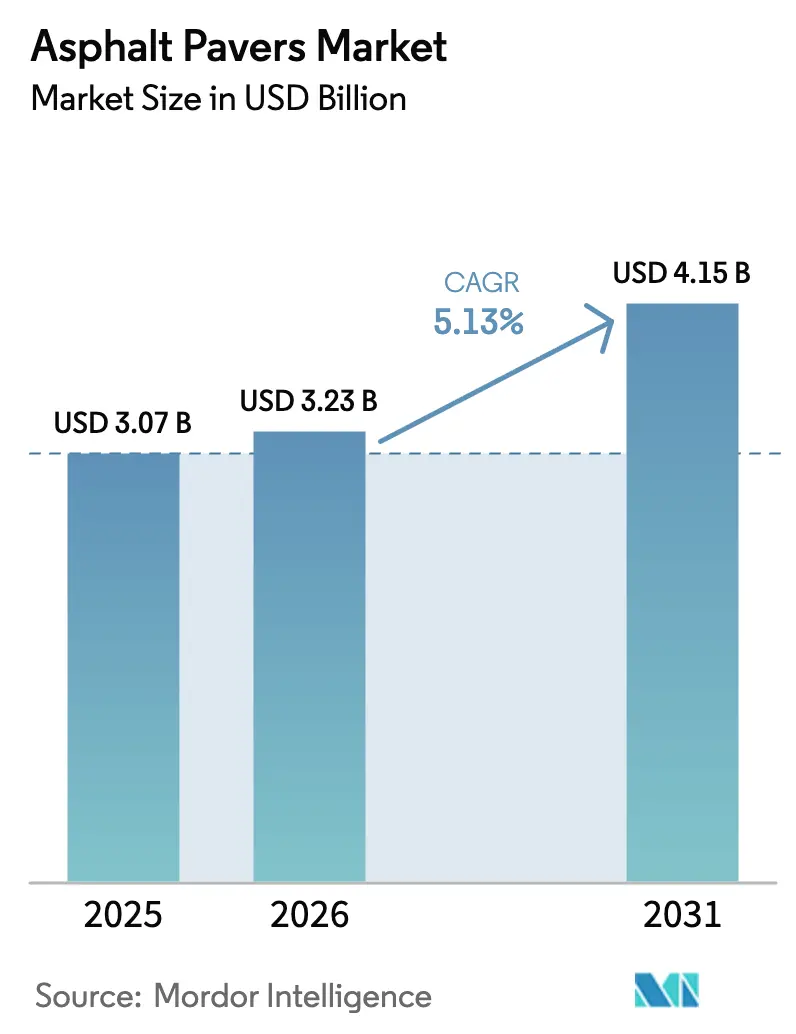
The asphalt paver market size is expected to grow from USD 3.07 billion in 2025 to USD 3.23 billion in 2026 and is forecast to reach USD 4.15 billion by 2031 at a 5.13% CAGR over 2026–2031. This steady climb reflects large-scale public-works allocations, a building frenzy in emerging megacities, and precision-technology packages that trim material waste and labor hours. Accelerated U.S. federal road funding, China’s expressway additions, and India’s Bharatmala highway program are keeping bid pipelines full, while warm-mix asphalt formulations are lengthening construction seasons in temperate climates. Contractors are gravitating toward machines that pair grade control with telematics because the data stream supports predictive maintenance and compliance documentation. Simultaneously, price-sensitive buyers in Africa and Southeast Asia are welcoming cost-competitive Chinese brands, even as emission rules in North America and Europe tilt demand toward Stage V-compliant engines and electric-drive options. The asphalt paver market stands at the intersection of productivity, sustainability, and data monetization, creating fresh opportunities for OEMs that can bundle hardware with software and training.
Key Report Takeaways
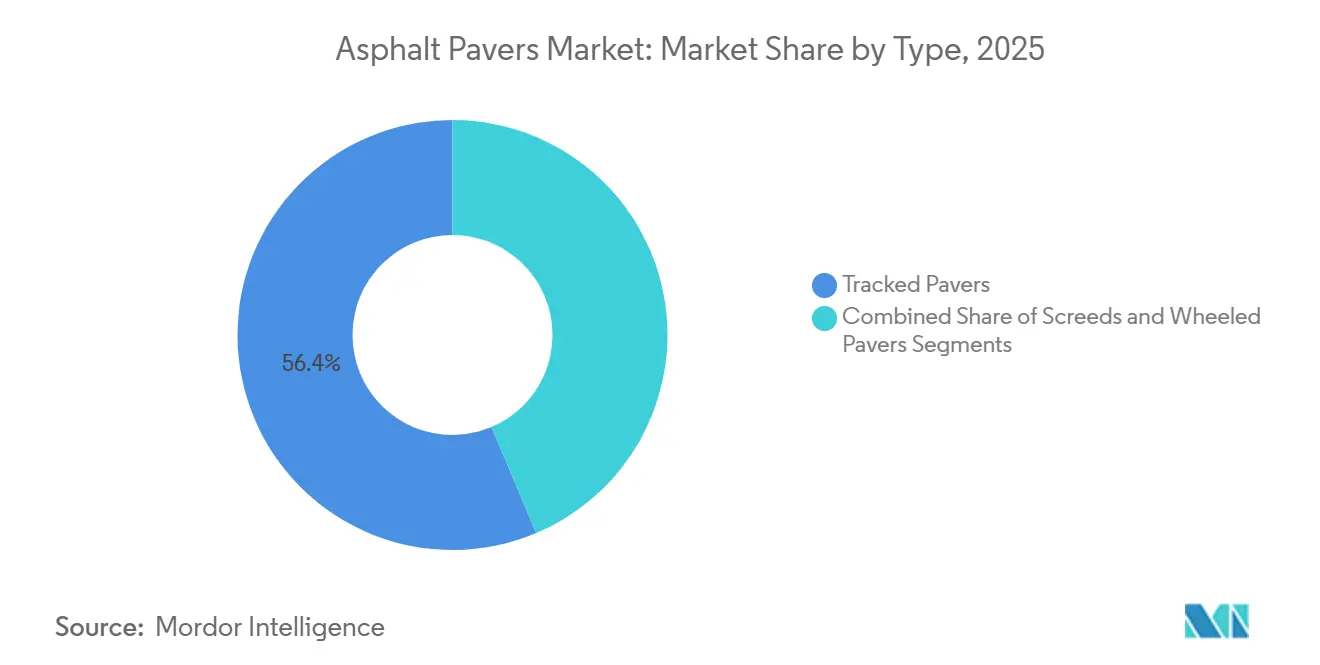
- By type, tracked pavers led with 56.36% asphalt paver market share in 2025, whereas screeds are advancing at a 6.88% CAGR through 2031, the fastest pace among all segments.
- By paving range, the standard 2.4-2.55 m width category accounted for 35.87% revenue share; units above 2.55 m are projected to post a 7.58% CAGR to 2031.
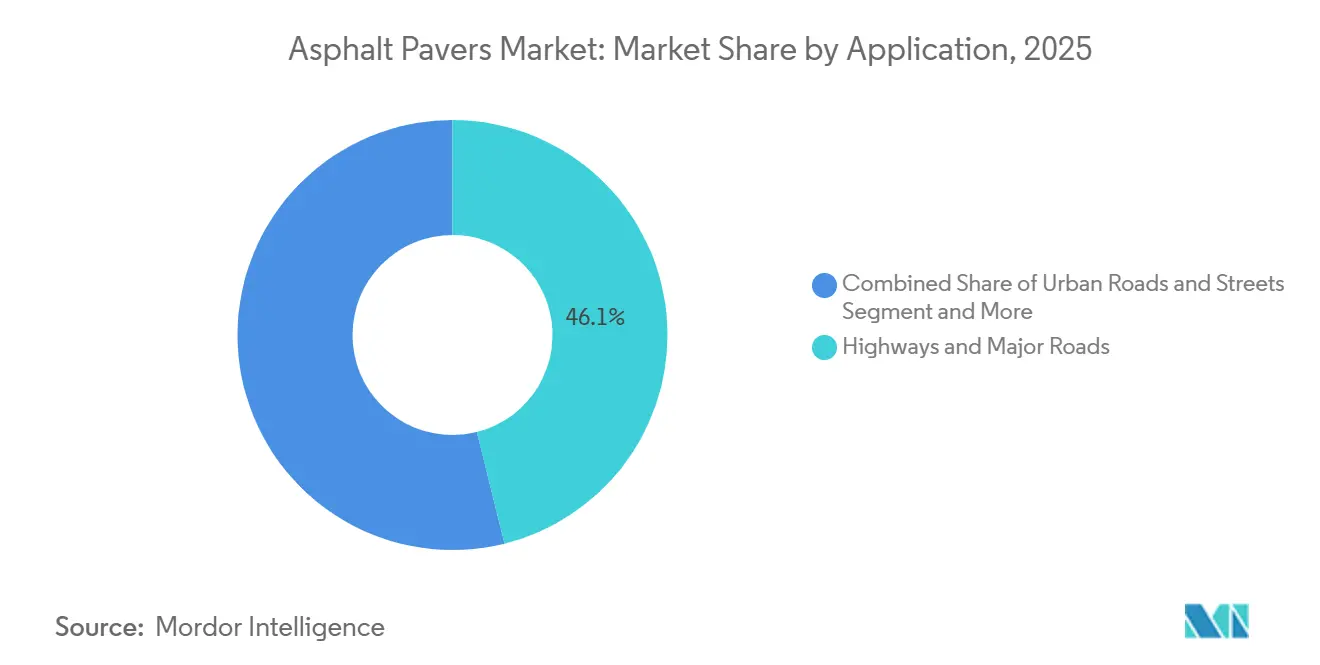
- By application, highways and major roads accounted for 46.12% of the 2025 demand, while airport runway projects are poised to grow at a 7.99% CAGR through 2031.
- By end-user, government and public agencies commanded 51.24% of 2025 spend, yet rental companies are expanding at a 6.17% CAGR as contractors pursue fleet flexibility.
Note: Market size and forecast figures in this report are generated using Mordor Intelligence’s proprietary estimation framework, updated with the latest available data and insights as of January 2026.
Market Trends and Insights
Drivers Impact Analysis of Asphalt Pavers Market*
| Driver | (~)% Impact on CAGR Forecast | Geographic Relevance | Impact Timeline |
|---|---|---|---|
| Road-building and Urbanization | +1.8% | Asia-Pacific core, spill-over to Middle East | Long term (≥ 4 years) |
| Accelerated Infrastructure Funding | +1.5% | North America, selective EU programs | Medium term (2-4 years) |
| Integration of Telematics and Grade-Control | +0.9% | Global, led by North America and Europe | Medium term (2-4 years) |
| Warm-Mix Asphalt Adoption | +0.7% | North America, Northern Europe | Short term (≤ 2 years) |
| Demand for Compact Pavers in Dense Cities | +0.5% | APAC urban centers, European metros | Long term (≥ 4 years) |
| Spray-Paver Bonded-Overlay Technology | +0.4% | North America, Europe | Medium term (2-4 years) |
| Source: Mordor Intelligence | |||
Surge in Road-Building and Urbanization Across APAC
Rapid urbanization is spurring a wave of highway and municipal road projects in the Asia-Pacific. China's Guangdong had plans to complete 12,000 km of new expressways in 2025, and India aims for 17,000 km of upgrades by 2027, guaranteeing multi-year order books for tracked machines[1]. Belt and Road financing is underwriting arterial-road tenders in Indonesia and Vietnam, each exceeding USD 5 billion in 2025, while tier-2 Indian cities are adding compact pavers for neighborhood streets. The Asian Development Bank estimates that developing Asia needs USD 1.7 trillion in annual infrastructure investment through 2030, assuring that the asphalt paver market will outpace Western regions in absolute unit growth[2].
Accelerated Infrastructure Funding in North America
The U.S. Infrastructure Investment and Jobs Act earmarked USD 110 billion for roads and bridges, with around 76% of the funds already obligated by mid-2025. State transportation departments are emphasizing preventive maintenance, raising demand for thin-overlay screeds and spray-bonded pavers. Canada’s Investing in Canada program is injecting CAD 33.5 billion into public transit, green infrastructure, and social infrastructure, guiding specifications toward tracked pavers with cold-weather packages. Warm-mix asphalt mandates enable paving in temperatures as low as 10 °C, adding four to six extra working weeks and lifting annual machine utilization.
Integration of Telematics and Grade-Control Boosting ROI
Telematics and automated grade control are significantly reducing asphalt overages, according to a 2025 civil engineering field study. Contractors now track screed temperature, fuel burn, and idle hours remotely, scheduling service before breakdowns occur. Rental firms are pivoting to usage-based pricing, billing per cubic meter of asphalt placed, which further accelerates technology uptake among smaller contractors. European traceability rules require digital placement logs, a compliance edge that Tier 1 OEMs leverage to protect premium pricing.
Warm-Mix Asphalt Adoption Extending Paving Seasons
Warm-mix asphalt accounted for approximately 40% of the United States' tonnage as of the latest reports, witnessing a significant increase in the last 2-3 years. Lower mix temperatures shrink fuel use and GHG emissions, aligning with state climate targets. Longer paving seasons improve fleet utilization and hasten payback on new units, justifying the price premium of warm-mix-ready screeds. OEMs are fielding heated screed plates that maintain compaction temperature even at low ambient readings, reducing callbacks.
Restraints Impact Analysis of Asphalt Pavers Market*
| Restraint | (~)% Impact on CAGR Forecast | Geographic Relevance | Impact Timeline |
|---|---|---|---|
| High Capital and Maintenance Costs | -0.6% | Global, acute in emerging markets | Long term (≥ 4 years) |
| Expansion of Rental Business Model | -0.5% | North America, Western Europe | Medium term (2-4 years) |
| Bitumen-Price Volatility | -0.4% | Global, linked to crude-oil markets | Short term (≤ 2 years) |
| Skilled-Operator Shortages | -0.3% | North America, Europe, Australia | Long term (≥ 4 years) |
| Source: Mordor Intelligence | |||
High Capital and Maintenance Costs of Advanced Pavers
Telematics-equipped tracked pavers can list between USD 450,000 and USD 650,000, pricing many smaller contractors out of the ownership model. Maintenance needs grow more complex as sensor suites, hydraulics, and embedded software demand OEM-certified service providers, seldom found in rural regions. Import tariffs and limited access to credit further raise the total cost of ownership in emerging economies, pushing buyers toward basic models that skip premium electronics. Chinese brands offer stripped-down machines at a robust discount, but the technology gap narrows their appeal in regulated markets.
Expansion of Equipment Rental Business Model
Rental penetration reached over 50% of construction-equipment spending in North America in 2025, as contractors sought flexibility and balance-sheet relief. Utilization rates above 70% encourage rental houses to refurbish fleets rather than buy new, extending replacement cycles and compressing OEM volumes. Volume discounts of up to 25% erode manufacturer margins, though service-parts sales and telematics subscriptions partly offset the shortfall. Rental’s arrival in India and Southeast Asia signals a global diffusion that will reshape sales strategies over the decade.
*Our forecasts treat driver/restraint impacts as directional, not additive. The impact forecasts reflect baseline growth, mix effects, and variable interactions.
Asphalt Pavers Market Segment Analysis
By Type – Tracked Pavers Dominate as Screeds Surge
Tracked pavers captured 56.36% of 2025 revenue, illustrating contractor trust in their traction on soft base layers and steep grades. Wheeled variants remain favored for urban resurfacing because quicker relocation lowers idle time, yet their market share is eroding as tracked models add higher travel-speed modes. The screed segment stands out with a 6.88% CAGR to 2031, propelled by pavement-preservation budgets that emphasize thin overlays and bonded-wearing courses. State maintenance outlays in the United States channeled the majority of 2025 highway funds into preventive treatments, boosting orders for extendable screeds. This demand reinforced the appeal of intelligent screeds that auto-correct tamper frequency for temperature swings.
Electrified tracked machines debuted in 2025, promising quieter night paving and compliance with zero-emission mandates in dense cities. Wheeled pavers have responded with tighter turning radii and semi-autonomous steering to remain relevant. Screed suppliers now integrate sensors that capture mat density and temperature, feeding project owners with audit-ready reports and elevating after-sales software revenue. The convergence of type categories foreshadows multi-role platforms able to toggle between highway, street, and overlay duties through bolt-on modules.

By Paving Range – Wide Pavers Accelerate on Mega-Projects
Standard 2.4-2.55 m widths yielded 35.87% of 2025 revenue, matching single-lane highway specifications in most regions. Yet machines above 2.55 m are growing at 7.58% CAGR as airport runways and multi-lane expressways demand faster passes and fewer cold joints. China’s 3.75 m lane requirements for future autonomous trucking push even wider screeds, inspiring models that place two lanes in one go. Compact ranges under 1.5 m cover bike paths and pedestrian precincts, benefiting from European city plans that expand car-free zones.
Airport tenders routinely cite airline delay costs of USD 50,000-100,000 per hour, justifying investment in wide pavers capable of relentless throughput. European OEMs have capitalized, with flagship units securing high-profile runway jobs at Frankfurt and Amsterdam during 2025. Narrow urban alleys in Jakarta and Ho Chi Minh City are fueling uptake of sub-1.5 m pavers, a sweet spot that Asian manufacturers are exploiting with lightweight, rubber-track designs. Buyers now evaluate range categories through total project economics rather than sticker price, further segmenting demand by application urgency.
By Application – Airports Outpace Highways
Highways and major roads absorbed 46.12% of paving-equipment demand in 2025, reflecting government dominance in surface-transport spending. Airports, however, will expand at a 7.99% CAGR to 2031, driven by passenger recovery and runway capacity upgrades. The International Air Transport Association expects 5.2 billion passengers in 2026, propelling a rush for polymer-modified asphalt mixes that endure high jet-blast heat. The asphalt paver market size for airport jobs is set to rise as reconstruction cycles tighten. Urban streets and collector roads underpin steady volumes for compact machines, while parking-lot paving tracks commercial real-estate trends.
Runway closures carry stiff penalties, so project owners mandate 24/7 operations and telemetry to document mat density. Rental providers stock wide pavers with laser-guided screeds specifically for these compressed timelines. Highway paving is shifting toward intelligent compaction, where on-board sensors guide roller sequences, minimizing premature cracking. Municipal night work is spurring demand for battery-electric pavers that trim noise and emissions, opening a green premium niche yet to be fully captured.
By End-User – Rental Companies Reshape Procurement
Government and public agencies retained a 51.24% 2025 share, driven by sovereign infrastructure mandates. Private contractors, although the second-largest segment, are pivoting to leasing, offloading depreciation and maintenance to rental specialists. The resulting 6.17% CAGR for rental companies will reshape OEM revenue models around fleet packages, extended warranties, and predictive-maintenance dashboards. The asphalt paver market share of rental fleets could be among the highest by 2031 if current utilization holds.
OEMs have started offering rental-optimized SKUs with quick-swap screeds and ruggedized telematics, cutting downtime between hires. Public-sector owners in emerging regions still prefer outright purchase for asset-control reasons, but multilateral lenders that fund PPP roads often require lifecycle cost analysis, indirectly favoring rental. Subscription models that bundle equipment, operator training, and consumables on a monthly fee are spreading from Germany to the wider EU, signaling another layer of service-based disruption.
Geography Analysis
North America, APAC and EMEA Asphalt Pavers Market
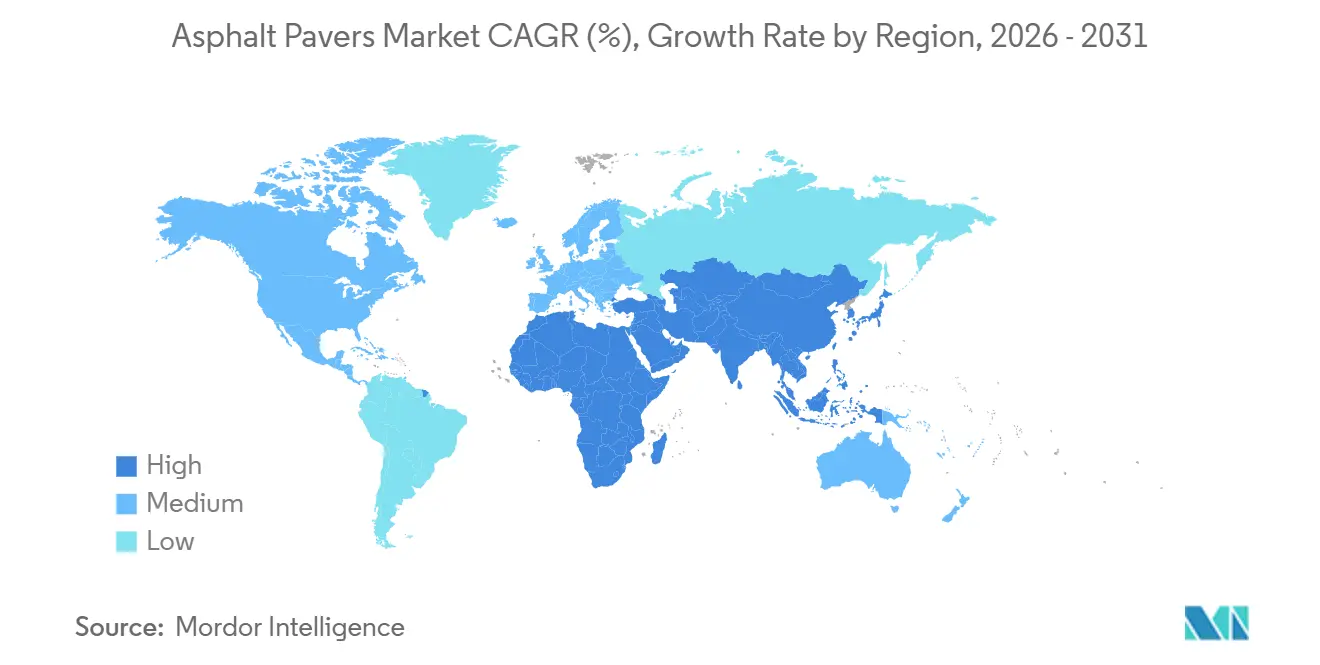
Asia-Pacific contributed 37.92% of 2025 revenue and is advancing at a 5.09% CAGR, anchored by India’s Bharatmala highway program and provincial expressways in China. Middle East and Africa, though smaller in absolute terms, will accelerate at 6.57% CAGR through 2031 as oil-funded sovereign plans finance multilane corridors and airport expansions. Saudi Arabia earmarked USD 40 billion for transport under Vision 2030, and the UAE is modernizing 2,500 km of federal highways to support autonomous-vehicle pilots. Sub-Saharan African projects financed under Belt and Road terms favor lower-cost Chinese pavers, yet technology gaps in telematics and emission compliance limit penetration in North American and EU tenders.
The Americas, Europe and Oceania Asphalt Pavers Market
North America is growing at a 3.15% CAGR thanks to ongoing federal appropriations and state-level climate-resilience programs that call for warm-mix asphalt and spray-overlay gear. Europe registers a modest 2.88% CAGR as fiscal constraints weigh on new build, though the European Green Deal pushes municipalities toward electric pavers for night work. South America’s 2.01% rate reflects currency volatility and public-debt overhang, yet Brazil’s Rota 2030 road upgrades linked to EV charging corridors provide a mid-term tailwind. Oceania sits at 2.89% CAGR, driven by seismic-resilience retrofits in New Zealand and Australia’s rolling infrastructure plan.
Europe, Middle East and India Asphalt Pavers Market
Divergent regulation shapes product specifications. The EU’s Stage V engine rules raise unit cost but create a compliance moat protecting premium OEMs. Middle Eastern buyers demand high-temperature and dust-filtration features to withstand desert climates. India’s IS 16246 standard, introduced in 2024, enforces screed-heating uniformity and compaction thresholds, pruning the influx of low-end imports. Such fragmentation compels global manufacturers to run region-specific certification portfolios, inflating R&D and inventory carrying costs.
Regulatory Landscape
Emissions compliance is a primary regulatory driver shaping asphalt paver powertrain and aftertreatment choices across major markets. In Europe, non-road mobile machinery (NRMM) engines used in paving equipment must meet Stage V limits under Regulation (EU) 2016/1628, which raises certification and integration requirements for OEMs selling into EU tenders. In the United States, EPA Tier 4 Final standards for nonroad compression-ignition engines (40 CFR Part 1039) are enforced through mandatory certification pathways and compliance oversight, elevating the cost of entry for non-compliant imports and reinforcing demand for documented engine conformity.
Regulation is also broadening beyond engines toward unit-level environmental and operating specifications. China issued GB/T 46234-2025 (environmental protection technical specifications for asphalt pavement hot-in-place recycling units) on August 29, 2025, with implementation from March 1, 2026, indicating tighter expectations around emissions and environmental performance for road construction and maintenance equipment. Complementing mobile equipment controls, state-level air programs such as the Illinois EPA rules for batch mix asphalt plants (covering PM, SO2, and VOM under Illinois administrative codes) influence project permitting and scheduling, indirectly affecting equipment utilization windows and contractor compliance documentation needs.
Value Chain Analysis
The asphalt paver value chain connects raw materials and paving-material ecosystems (aggregates, binder suppliers, asphalt mix producers) with paving contractors, logistics providers, and equipment OEMs that supply pavers, screeds, and digital control systems. Upstream volatility in binder and fuel costs influences contractor purchasing cycles, while downstream performance-based specifications (ride quality, mat temperature, density documentation) increasingly pull demand toward pavers packaged with grade control and telematics for audit-ready reporting.
On the supply side, OEM value creation centers on core assemblies (tractor and screed), precision manufacturing, and integration of electronics (sensors, controllers, GNSS/3D guidance). Partnerships with machine control providers are becoming a common route to accelerate feature deployment, exemplified by Dynapac and Leica Geosystems launching automated steering and screed-edge control compatibility on SD25 and XD25 pavers in April 2025. Field deployment of autonomous and intelligent paving solutions on live projects, including XCMG systems operated on the Sultan Said bin Taimur Road dualisation works in Oman during 2026, also points to software stacks, connectivity, and jobsite process integration adding weight alongside traditional parts and service networks.
Competitive Landscape
Competition is moderately concentrated, led by Caterpillar, Wirtgen Group, Volvo Construction Equipment, Fayat Group, and Ammann together. Caterpillar’s success hinges on its dealer network and proprietary telematics, which lock customers into service contracts. Wirtgen leverages German engineering to rule wide pavers and premium screeds, banking on patented automated-leveling software. Volvo’s minority stake in telematics supplier Trackunit enables it to embed predictive-maintenance analytics at the controller level, opening up subscription revenue streams.
Chinese brands XCMG, SANY, and Zoomlion together are advancing in Africa and Southeast Asia by pairing cost advantages with Belt and Road project financing. Emission-compliant powertrains and advanced telematics remain their weak points in regulated markets, but joint ventures with European sensor firms aim to close the gap. Fayat Group is integrating Dynapac and BOMAG parts supply to reduce inventory duplication and cross-sell compaction rollers, a move that raises customer switching costs.
White-space opportunities abound in electric-drive pavers for night-time urban contracts and in modular screeds that let fleet owners match width to job requirements without purchasing multiple machines. Scandinavian startups are piloting zero-emission prototypes, yet small production runs keep prices high. ISO 9001 quality management and regional engine certifications such as EPA Tier 4 Final in North America have become cost-of-entry thresholds, elevating barriers for newcomers and supporting incumbent margins.
Asphalt Pavers Industry Leaders
-
Caterpillar Inc.
-
Fayat Group
-
Ammann Group
-
Wirtgen Group
-
Volvo Construction Equipment
- *Disclaimer: Major Players sorted in no particular order

Asphalt Pavers Market Companies Covered in this Report
- Caterpillar Inc.
- Volvo Construction Equipment AB
- Wirtgen Group
- Fayat Group
- Ammann Group
- Astec Industries Inc.
- XCMG Construction Machinery Co. Ltd.
- SANY Heavy Industry Co. Ltd.
- Komatsu Ltd.
- Zoomlion Heavy Industry Sci-Tech Co. Ltd.
- Sakai Heavy Industries Ltd.
- Shantui Construction Machinery Co. Ltd.
- LeeBoy Inc.
- Sumitomo Construction Machinery Co. Ltd.
- Weiler Inc.
- Mauldin Paving Products
Market Opportunities and Future Outlook
Digitized paving packages that bundle pavers and screeds with automated machine control, documentation, and fleet uptime tools offer a clear opportunity, especially where tender requirements increasingly specify measurable placement quality and traceability. The U.S. Infrastructure Investment and Jobs Act (USD 110 billion for roads and bridges) continues to support near-term procurement activity, while the shift toward preventive maintenance and thin overlays supports demand for intelligent screeds and spray-paver workflows that minimize material overages.
Autonomy and coordinated jobsite operation are moving from pilots toward more repeatable deployments in controlled settings, which creates whitespace for OEMs and technology partners that can industrialize machine-to-machine coordination and remote supervision. In May 2026, Oman’s Ministry of Transport, Communications and Information Technology publicly launched AI-powered autonomous asphalt paving technologies on the Sultan Said bin Taimur Road Dualization Project to optimize thickness and elevation control, giving buyers a reference point for automation ROI. Similar multi-machine coordination narratives across Asia and the Middle East, alongside tightening emissions frameworks in Europe and Tier 4 Final compliance expectations in North America, is shaping product-roadmap emphasis on electrification-ready platforms, hybridized auxiliary systems (screed heating and hydraulics), and software-enabled compliance reporting tied to contractor prequalification needs.
Recent Industry Developments in Asphalt Pavers Market
- March 2026: Caterpillar announced updates to its Cat AP1000 wheeled and AP1055 tracked asphalt pavers, including maintenance-focused layout changes and new smooth SDX screed plate options. The refresh targets higher uptime and finish consistency, while also reinforcing the role of incremental platform upgrades as rental and contractor fleets standardize on proven models.
- January 2026: Wirtgen Group unveiled new Dash 5 generation 10-foot road pavers (Vogele SUPER 2000-5 X and SUPER 2003-5 X) at Conexpo 2026. The launch expands the premium paver lineup for high-throughput roadbuilding and supports OEM strategies centered on integrated automation and digital paving workflows.
- November 2025: Ammann launched the CEV Stage V-compliant Apollo AP1000 hydrostatic tracked paver in India. Introducing a higher-emissions-compliance configuration for a major growth market strengthens Ammann’s ability to compete on government-funded corridors where specifications and lifecycle considerations are tightening.
Asphalt Pavers Market Report Scope and Research Methodology
Market Definition and Coverage
For this methodology, the asphalt pavers market covers the revenues generated from machines used to place and pre-compact asphalt mixes on roads and other paved surfaces, including core paver platforms and their standard screed systems.
Scope exclusions: Road milling, standalone compaction rollers, asphalt mixing plants, and general earthmoving equipment are excluded unless they are purchased as an asphalt paving machine.
Segments Covered in This Report
- By Type
- Tracked Pavers
- Wheeled Pavers
- Screeds
- By Paving Range
- Less than 1.5 m
- 1.5 to 2.3 m
- 2.4 to 2.55 m
- Above 2.55 m
- By Application
- Highways and Major Roads
- Urban Roads and Streets
- Parking Lots and Driveways
- Airport Runways and Taxiways
- By End-User
- Government and Public Agencies
- Private Construction Contractors
- Rental Equipment Companies
- By Geography
- North America
- United States
- Canada
- Rest of North America
- South America
- Brazil
- Argentina
- Rest of South America
- Europe
- Germany
- United Kingdom
- France
- Italy
- Rest of Europe
- Asia-Pacific
- China
- India
- Japan
- South Korea
- Rest of Asia-Pacific
- Middle East and Africa
- United Arab Emirates
- Saudi Arabia
- Turkey
- Egypt
- South Africa
- Rest of Middle-East and Africa
- North America
Data Sources, Market Sizing, and Validation
Desk Research
Desk work starts with mapping the demand side so we can understand where paving machines are actually used. Public road spending and project pipelines are reviewed from sources such as the U.S. Federal Highway Administration, Bureau of Transportation Statistics, Eurostat, and national transport ministries, focusing on road length, resurfacing activity, and budget outlays.
We then add supply-side context using sources such as UN Comtrade for trade flows, OECD and World Bank macro series for construction activity signals, and patent databases for technology direction (for example, automation and screed control). We also check company annual reports, investor presentations, and reputable press coverage to confirm product positioning and regional exposure. Where disclosures are limited, paid databases are used for company financials and news screening, and the sources listed here are illustrative, with other public and paid references used to cross-check data, clarify assumptions, and resolve gaps.
Primary Interviews and Surveys
Primary work focuses on validating how paving activity translates into paver demand, along with typical replacement cycles and the mix of tracked versus wheeled units across regions. We speak with OEM-side experts, dealers and rental channels, and contractors that execute highway and urban resurfacing, then we re-check assumptions with regional specialists across APAC, EMEA, and the Americas.
Distribution of primary research fieldwork respondents
| Company type | Respondent position | Region |
|---|---|---|
| Top tier: 28% | CXOs: 14% | APAC: 39% |
| Mid tier: 53% | Functional/Unit leaders: 33% | EMEA: 35% |
| Smaller Players: 19% | Managers: 53% | Americas: 26% |
Market-Sizing & Forecasting
Sizing is built using a top-down approach where road construction and resurfacing activity is reconstructed by region, and then converted into addressable paver demand using usage intensity and fleet renewal logic. To keep the totals realistic, we corroborate outputs using selective bottom-up checks such as sampled unit shipments by region, channel feedback on annual placements, and ASP times volume snapshots for key paver classes.
Key inputs include road network expansion and resurfacing budgets, kilometers paved and rehabilitated, contractor fleet age and replacement timing, mix of tracked versus wheeled pavers by job type, screed width and paving range preferences, and regional import intensity for paving equipment. Where bottom-up indicators are missing, gaps are handled by applying ranges from comparable markets and then tightening them through interview feedback and observed trade patterns.
For forecasting, scenario analysis is used so demand can be flexed based on infrastructure funding pace, construction cycles, and equipment price movement. The forward view is then adjusted using expert consensus on procurement lead times, utilization rates in peak seasons, and expected shifts toward higher-capability screeds and automation features.
Data Validation & Update Cycle
Validation happens through multiple cross-checks that compare the model outputs against independent signals such as highway spending, equipment trade values, and reported order momentum in public filings. If a region shows a sharp year-on-year jump that does not match these signals, the assumptions are reopened, and respondents are re-contacted to confirm whether the change reflects real demand or a data artifact.
Before sign-off, the full model is reviewed step-by-step to keep calculation logic, currency conversions, and year mapping consistent across regions and time periods. Reports are refreshed annually, and interim updates are made when material events occur, such as major public funding programs, sharp input-cost swings, or unusual demand disruptions. Just before delivery, a final analyst pass is completed so clients receive the latest updated view.
Mordor Intelligence's Asphalt Pavers Market Size Compared Against Other Published Estimates
Published market sizes for asphalt pavers often differ because teams do not treat the equipment scope, pricing basis, and timing in the same way. Differences in whether attachments are counted, how ASPs are handled across regions, and how quickly assumptions are refreshed can all shift the final number.
Some published figures roll broader road construction equipment into the total, or they include asphalt plants and compaction equipment that sit next to pavers in a contractor fleet. In Mordor Intelligence, the estimate is limited to asphalt paver machines with their standard screed systems, and adjacent categories are kept out so the value stays tied to paving-specific demand signals and replacement behavior.
Benchmark comparison
| Source | Market Size | Gaps in Research Methodology |
|---|---|---|
| Mordor Intelligence | USD 3.23 B (2026) | |
| Industry Association A | USD 2.80 B (2026) | Uses a narrower definition that largely tracks new unit sales only, and it can understate value when rental fleet purchases and higher-spec screed configurations lift average selling prices. |
| Global Consultancy B | USD 3.90 B (2026) | Applies a wider equipment basket by bundling related paving train machinery and service revenues, and it can overstate the paver-only market when bundled categories are not separated by application. |
The spread in the table mostly comes from what gets bundled into the equipment set and how pricing is carried through the model. By keeping the scope tied to paver platforms and validating key variables like resurfacing activity, fleet renewal, and regional ASP movement, the final value stays easier to trace and repeat when assumptions are updated.
Key Questions Answered in the Report
What is the current value of the asphalt paver market?
The asphalt paver market size was USD 3.23 billion in 2026 and is forecast to reach USD 4.15 billion by 2031.
Which type of paver generates the most revenue?
Tracked pavers led with 56.36% revenue share in 2025 due to superior traction on uneven surfaces.
Which application will grow fastest through 2031?
Airport runway and taxiway paving is projected to post a 7.99% CAGR, the highest among all applications.
How will rental fleets affect equipment sales?
Rental companies are growing at 6.17% CAGR, extending replacement cycles yet boosting demand for service contracts and telematics subscriptions.
Which region is poised for the highest growth?
Middle East and Africa will expand at 6.57% CAGR, propelled by oil-funded megaprojects and airport expansions.