
Market Overview
| Study Period | 2021 - 2031 |
|---|---|
| Forecast Data Period | 2026 - 2031 |
| Base Year Market Size (2025) | USD 6.71 Billion |
| Market Size (2026) | USD 7.05 Billion |
| Market Size (2031) | USD 9.29 Billion |
| Growth Rate (2026 - 2031) | 5.67 % |
| Market Concentration | Medium |
Major Players *Disclaimer: Major Players sorted in no particular order Image © Mordor Intelligence. Reuse requires attribution under CC BY 4.0. | |
Asia-Pacific Starch Sweetener Market Analysis by Mordor Intelligence
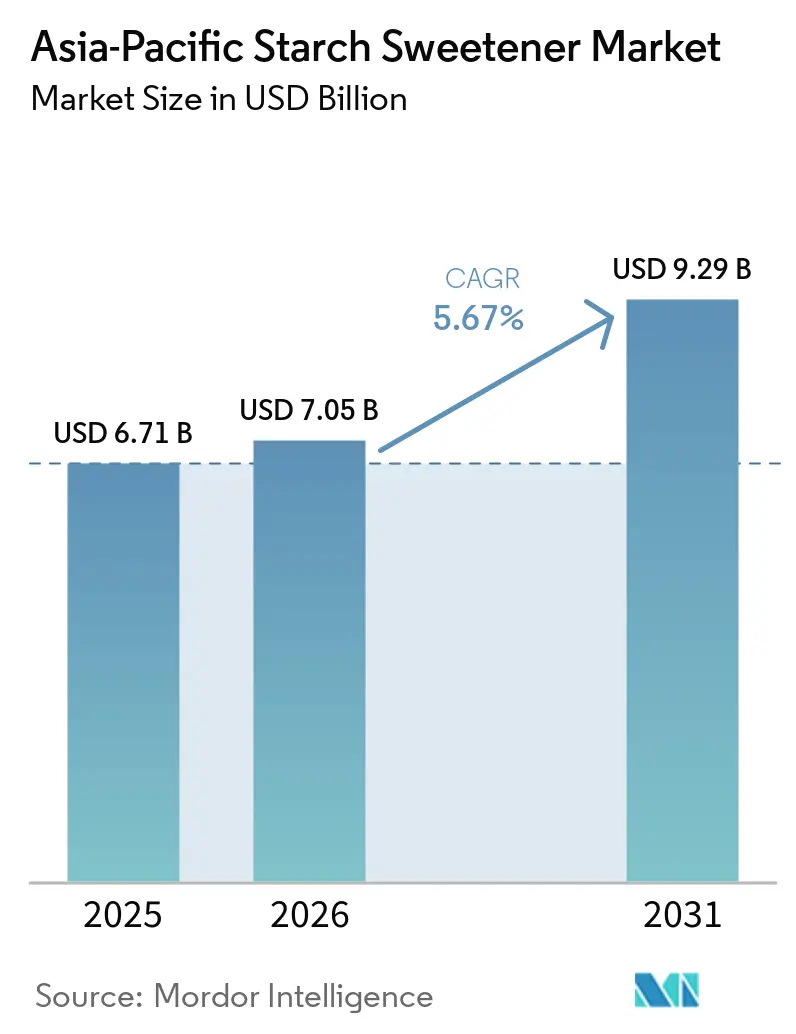
The Asia-Pacific starch sweetener market size was valued at USD 6.71 billion in 2025 and estimated to grow from USD 7.05 billion in 2026 to reach USD 9.29 billion by 2031, at a CAGR of 5.67% during the forecast period (2026-2031). The region’s food-processing base provides the core demand for glucose syrups, high-fructose corn syrup, dextrin, and related ingredients used in prepared foods and industrial formulations. India’s food-processing activity is expanding alongside packaged-food demand, which supports regular purchasing of functional sweetener inputs by food manufacturers. The market is also shaped by feedstock availability, processing capability, and the specifications required by beverage, bakery, dairy, and pharmaceutical customers. China’s established corn wet-milling base gives suppliers scale, while Southeast Asian cassava processing gives buyers another sourcing option for products that require different functional characteristics.
Key Report Takeaways
- By product type, high-fructose corn syrup held 41.72% of the Asia-Pacific starch sweetener market share in 2025, while glucose syrup is forecast to grow at 6.76% CAGR through 2031.
- By source, corn accounted for 60.38% of the Asia-Pacific starch sweetener market share in 2025, while tapioca is projected to expand at 6.58% CAGR through 2031.
- By form, liquid products held 65.37% share in 2025, while solid grades are forecast to grow at 6.77% CAGR through 2031.
- By application, food and beverages accounted for 67.18% of the Asia-Pacific starch sweetener market size in 2025, while pharmaceuticals are projected to expand at 6.89% CAGR through 2031.
- By geography, China held 38.76% of the Asia-Pacific starch sweetener market share in 2025, while India is forecast to grow at 7.05% CAGR through 2031.
Note: Market size and forecast figures in this report are generated using Mordor Intelligence’s proprietary estimation framework, updated with the latest available data and insights as of January 2026.
Market Trends and Insights
Drivers Impact Analysis of Asia-Pacific Starch Sweetener Market*
| Driver | (~) % Impact on CAGR Forecast | Geographic Relevance | Impact Timeline |
|---|---|---|---|
| Rising demand for processed and convenience foods | +1.3% | Regional-wide, with concentration in China, India, and Southeast Asia | Medium term (2–4 years) |
| Expansion of the bakery and confectionery industry | +0.9% | China, India, Japan, South Korea | Medium term (2–4 years) |
| Increasing consumption of packaged beverages | +0.8% | Regional-wide, with high intensity in Southeast Asia and India | Short term (≤ 2 years) |
| Rising demand for dairy products and frozen desserts | +0.6% | China, India, Australia, Southeast Asia | Medium term (2–4 years) |
| Expanding food processing industries across emerging Asian economies | +1.0% | Indonesia, Thailand, Vietnam, India | Long term (≥ 4 years) |
| Technological advancements in enzymatic and fermentation processes | +0.5% | Japan, South Korea, China | Long term (≥ 4 years) |
| Source: Mordor Intelligence | |||
Rising Demand for Processed and Convenience Foods
The expansion of the processed and convenience food industry across Asia-Pacific is creating opportunities for starch sweetener manufacturers, as food producers increasingly use glucose syrups, dextrose, and other starch-derived ingredients in packaged snacks, bakery products, confectionery, sauces, and ready-to-eat meals. These ingredients provide sweetness, improve texture, retain moisture, and enhance product consistency during processing. In India, the food processing sector recorded an average annual growth rate of 6.55% over the nine years ending in 2023–24, according to the Ministry of Food Processing Industries[1]. The expansion of food manufacturing and value-added product categories is increasing demand for versatile and cost-effective ingredients. As packaged food consumption grows across regional markets, manufacturers are likely to increase their use of starch sweeteners in diverse food formulations.
Expansion of the Bakery and Confectionery Industry
The expansion of the bakery and confectionery industry across Asia-Pacific is supporting demand for starch sweeteners, which are widely used in cakes, biscuits, pastries, candies, chocolates, and other sweet products. Glucose syrups and dextrose help control crystallization, improve texture, retain moisture, and maintain product consistency, while maltose-based sweeteners contribute sweetness and browning during baking. According to FAO data, Asia produced approximately 372 million tonnes of wheat in 2024, highlighting the region's substantial agricultural and food-processing base[2]. The growth of commercial bakeries, packaged biscuits, and confectionery manufacturing is creating opportunities for starch sweetener suppliers. Increasing demand for convenient bakery snacks and innovative confectionery products is expected to further support market growth.
Increasing Consumption of Packaged Beverages
The growing consumption of packaged beverages across Asia-Pacific is creating opportunities for starch sweeteners, which are used in carbonated soft drinks, fruit-flavored drinks, energy drinks, and ready-to-drink beverages. Ingredients such as glucose syrups and high-fructose corn syrup provide sweetness, improve mouthfeel, and support consistent flavor profiles in beverage formulations. According to the National Bureau of Statistics of China, China's beverage manufacturing industry produced approximately 188.9 million tonnes of beverages in 2024, reflecting the scale of the country's packaged beverage production industry[3]. The expansion of beverage manufacturing, wider product availability, and demand for convenient ready-to-drink formats are supporting ingredient consumption. This shift is expected to sustain demand for starch sweeteners among beverage manufacturers across the region.
Rising Demand for Dairy Products and Frozen Desserts
The expansion of the dairy products and frozen desserts industry across Asia-Pacific is supporting demand for starch sweeteners, which are used in ice cream, flavored milk, yogurt, milkshakes, and other dairy-based products. Glucose syrups and dextrose help improve texture, control ice crystal formation, enhance mouthfeel, and maintain product stability during storage. These ingredients also contribute sweetness and support formulation flexibility in reduced-sucrose and specialty dairy products. According to the National Bureau of Statistics of China, China produced approximately 30.79 million tonnes of milk in 2024, reflecting the scale of the country's dairy supply base. The growth of dairy processing, cold-chain infrastructure, and demand for convenient frozen desserts is creating opportunities for starch sweetener suppliers. Increasing product innovation and consumption of packaged dairy desserts are expected to further support market demand.
Restraints Impact Analysis of Asia-Pacific Starch Sweetener Market*
| Restraint | (~) % Impact on CAGR Forecast | Geographic Relevance | Impact Timeline |
|---|---|---|---|
| Volatility in corn, rice, wheat, and cassava prices | -0.8% | Regional, with amplified exposure in China, Thailand, and Indonesia | Short term (≤ 2 years) |
| Growing preference for natural and high-intensity sweeteners | -0.7% | Japan, Australia, South Korea, urban China | Long term (≥ 4 years) |
| Increasing consumer scrutiny of high-sugar processed foods | -0.5% | Australia, Japan, South Korea, urban India | Medium term (2–4 years) |
| Regulatory differences in food additive standards and labeling requirements | -0.3% | Regional-wide, with complexity in Japan, South Korea, and Australia | Long term (≥ 4 years) |
| Source: Mordor Intelligence | |||
Volatility in Corn, Rice, Wheat, and Cassava Prices
Fluctuations in the prices of corn, rice, wheat, and cassava pose a significant restraint on the Asia-Pacific starch sweetener market, as these agricultural commodities serve as key raw materials for starch extraction and sweetener production. Changes in weather conditions, crop yields, seasonal availability, and transportation costs can influence raw material procurement expenses. Price volatility makes it difficult for manufacturers to maintain stable production costs and establish consistent pricing for glucose syrups, dextrose, and other starch-based sweeteners. Smaller producers may face greater pressure on profit margins due to limited purchasing power and storage capacity.
Growing Preference for Natural and High-Intensity Sweeteners
The growing preference for natural and high-intensity sweeteners poses a restraint on the Asia-Pacific starch sweetener market, as consumers increasingly seek alternatives that align with their health and dietary preferences. Ingredients such as stevia, monk fruit extracts, and sucralose can provide sweetness at lower usage levels, creating competition for conventional starch-based sweeteners in selected food and beverage applications. Food manufacturers may reformulate products to reduce sugar content or respond to demand for alternative sweetening solutions. This shift can limit the use of glucose syrups, dextrose, and high-fructose corn syrup in certain product categories. Additionally, the availability of diverse sweetener options allows manufacturers to adjust formulations according to taste, cost, and nutritional requirements.
*Our forecasts treat driver/restraint impacts as directional, not additive. The impact forecasts reflect baseline growth, mix effects, and variable interactions.
Asia-Pacific Starch Sweetener Market Segment Analysis
By Product Type:
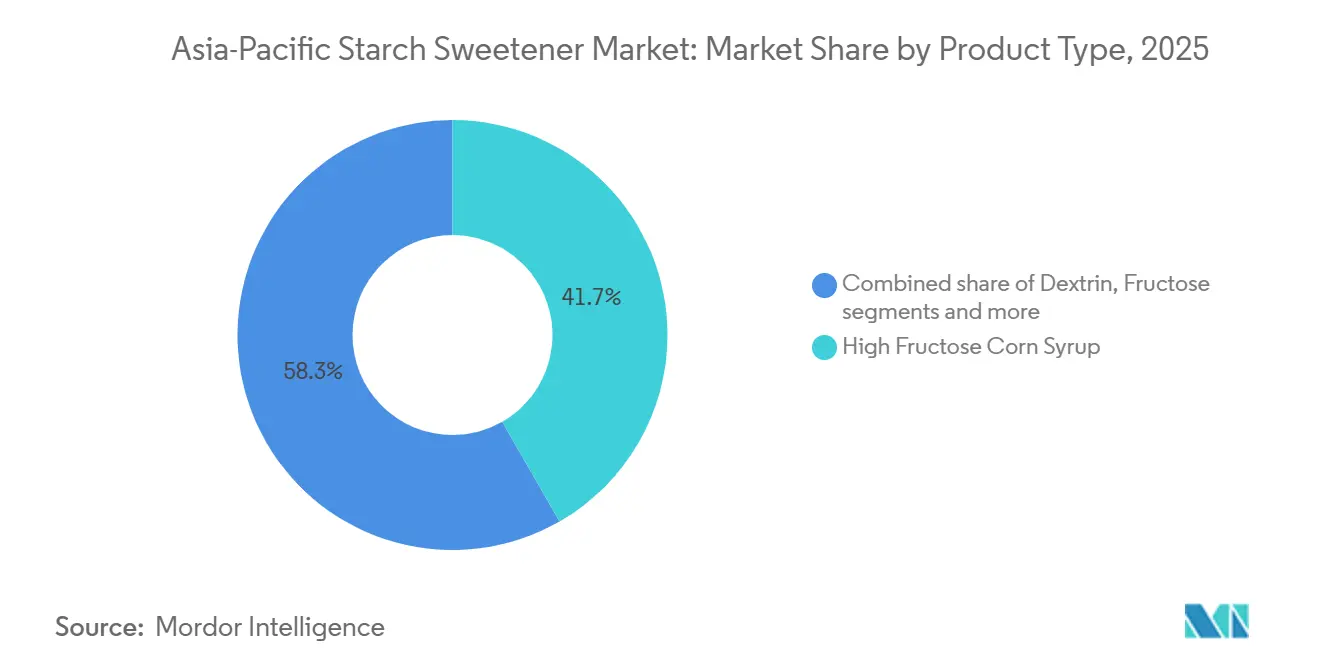
High-Fructose Corn Syrup Anchors Demand While Glucose Syrup Broadens Its UsesHigh-fructose corn syrup held 41.27% of the Asia-Pacific starch sweetener market in 2025, supported by its cost and sweetness profile in large beverage and confectionery operations. China and South Korea have large-scale drink manufacturing systems that can use liquid sweeteners in continuous production, which makes delivery consistency and product handling important purchasing factors. High-fructose corn syrup remains suited to applications where producers need reliable sweetness, easy handling, and a stable input for high-output processing lines. Its position also depends on corn availability and on the ability of processors to control conversion yields, manage quality, and maintain dependable supply.
Glucose syrup is forecast to grow at 6.76% CAGR through 2031, the fastest rate among product types. Food formulators use it for moderate sweetness and moisture retention in bakery and confectionery products, where texture and shelf stability matter to the finished product. Pharmaceutical manufacturers use glucose syrup as an excipient vehicle in oral liquid formulations, and Roquette lists glucose syrup grades for pharmaceutical use. This expands demand beyond food applications and rewards suppliers that can meet controlled-quality requirements, provide documentation, and supply consistent grades. Dextrin remains important as a carrier and encapsulation material, while fructose is used in selected reduced-glycemic and health-oriented applications.

By Source:
Corn Leads Supply While Tapioca Broadens Southeast Asian OptionsCorn accounted for 60.38% of the source category in 2025, giving it the leading share of the Asia-Pacific starch sweetener market size. China’s corn wet-milling infrastructure supports this position through large processing bases, established supply chains, and proximity to major food and beverage customers. Corn offers established conversion processes for high-fructose corn syrup, glucose syrup, dextrin, and other derivatives used in several end-use categories. It also supports large processors serving domestic food and beverage customers with bulk volumes, standard grades, and regular deliveries. The source remains exposed to changes in agricultural availability and competing demand from other uses, which keeps procurement planning central to production decisions.
Tapioca is projected to grow at 6.58% CAGR through 2031, making it the fastest-growing feedstock category. Cassava-based inputs provide a gluten-free option and can be competitive for Southeast Asian processors that are located close to regional cultivation and processing centers. The source offers a way to diversify procurement where corn availability becomes less certain or where customers need different functional properties. Tapioca processing also aligns with Thailand’s role in regional cassava supply and gives processors a relevant alternative for selected syrup and starch applications. Wheat, potato, and other sources serve narrower applications where buyers need specific viscosity, sensory, or nutritional characteristics.
By Form:
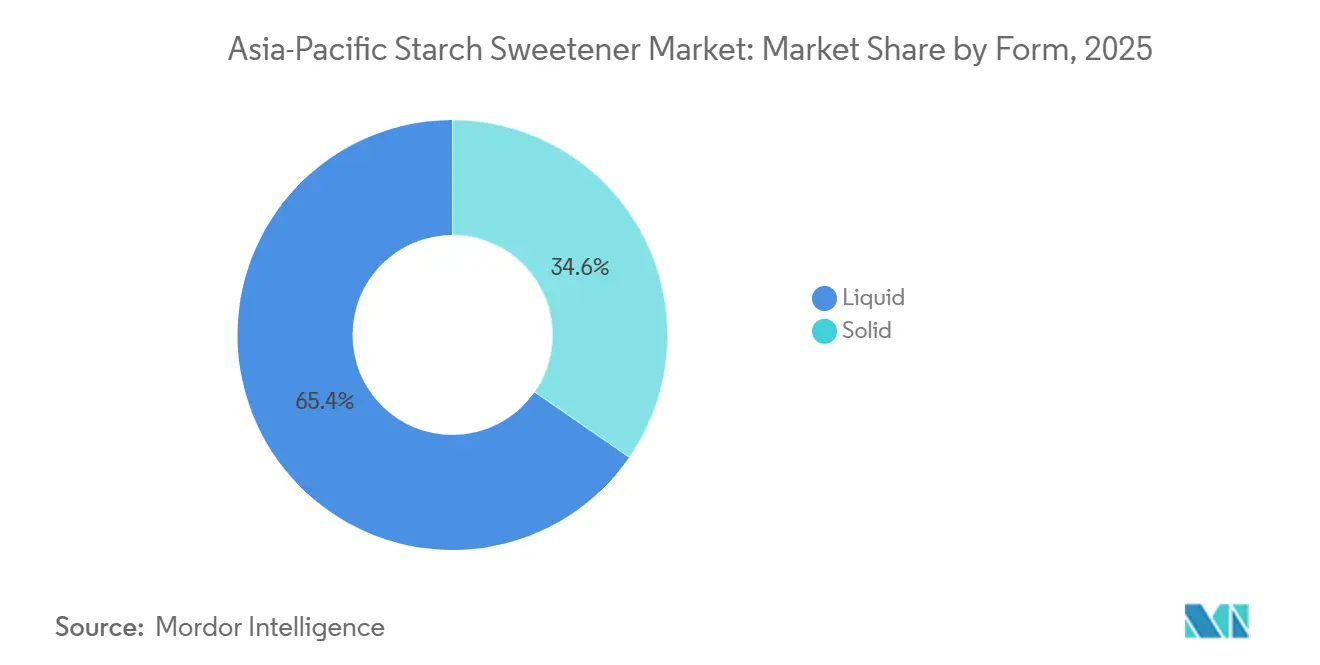
Liquid Products Retain Their Base While Solid Grades Gain New UsesLiquid products held 65.37% of the form segment in 2025 because beverage bottlers, confectionery plants, and dairy processors are built around pump-fed ingredient systems. This format integrates well with large manufacturing lines in China, Japan, and South Korea, where automated handling supports efficient production. Liquid syrup also reduces the need for end users to dissolve powders before use and helps maintain standardized mixing during high-volume runs. The installed equipment base supports its continued role in the Asia-Pacific starch sweetener market, particularly in established food and beverage facilities. Suppliers with tank storage, bulk delivery, and quality-control systems are well positioned in these applications because they can support regular and predictable replenishment.
Solid grades are forecast to grow at 6.8% CAGR through 2031. Powdered glucose and maltodextrin are useful in instant beverages, nutritional products, and tablet formulations, where dry handling provides practical benefits. Solid products can lower handling concerns where liquid distribution infrastructure is limited, especially outside major manufacturing hubs. They are also appropriate for shelf-stable formats sold through online food channels, where storage and transportation needs differ from bulk industrial supply. Higher-solids enzyme processes can produce more concentrated liquid syrups and reduce shipping water, according to IFF’s product information.
By Application:
Food and Beverages Hold Volume While Pharmaceuticals Grow FasterFood and beverages accounted for 67.18% of the Asia-Pacific starch sweetener market size in 2025, making it the leading application. Bakery and confectionery, dairy and desserts, and beverages create broad recurring use of syrups and carbohydrate ingredients across daily-consumption products. These customers value sweetness, moisture control, body, and processing consistency because these attributes affect manufacturing performance and finished-product quality. Expansion of regional food processing supports regular ingredient demand across this customer base. Suppliers that can meet food safety and formulation requirements across several countries gain an advantage when customers operate standardized regional product portfolios.
Pharmaceuticals are projected to grow at 6.89% CAGR through 2031, the fastest application rate. Oral medication demand supports use of glucose syrup in syrup and suspension formulations, where excipients contribute to product stability and delivery. Pharmaceutical-grade material requires higher control over purity, documentation, and quality systems, creating a stricter supply requirement than many food applications. This can create a value premium compared with food-grade material and encourages investment in analytical capability, traceability, and validated manufacturing practices. Roquette’s pharmaceutical portfolio identifies glucose syrup as an excipient for pharmaceutical formulations.
Geography Analysis
China Starch Sweetener Market
China held 38.76% of the Asia-Pacific starch sweetener market share in 2025 and remains the region’s central supply and demand base. Integrated wet-milling capacity supports production close to dense food and beverage manufacturing clusters, reducing distance between ingredient processors and major users. The country’s processors can benefit from scale in corn procurement, conversion, and bulk distribution, which reinforces their role in high-volume categories. Food-additive compliance under China’s GB 2760 standard remains important because it determines permitted uses and labeling requirements for food ingredients. Domestic documentation and strong quality systems therefore matter alongside price, particularly for suppliers serving large branded food manufacturers.
APAC Starch Sweetener Market
India is projected to expand at 7.05% CAGR through 2031, the fastest geographic rate in the region. The country’s food-processing expansion supports demand from bakery, confectionery, beverage, and dairy manufacturers that need affordable and reliable ingredients. Domestic producers serve price-sensitive buyers, while multinational companies view the country as a long-term production and sales opportunity with broad customer coverage. Japan and South Korea are more mature markets for premium glucose syrups, crystalline fructose, and modified dextrins.
Southeast Asia is a major manufacturing corridor for consumption and production, especially across Indonesia, Thailand, Vietnam, and Singapore. Thailand’s cassava base supports its role in tapioca-derived starch sweeteners and regional exports, adding a relevant supply option for ingredient buyers. Indonesia and Vietnam add demand through expanding packaged-food and quick-service restaurant formats, which require dependable ingredients at different price points. Singapore has a smaller production base but an important role in formulation and regional product development for multinational ingredient suppliers. Cargill reopened its refurbished Innovation Center in Singapore in April 2025, combining culinary, bakery, dairy, confectionery, beverage, and core science laboratories.
Competitive Landscape
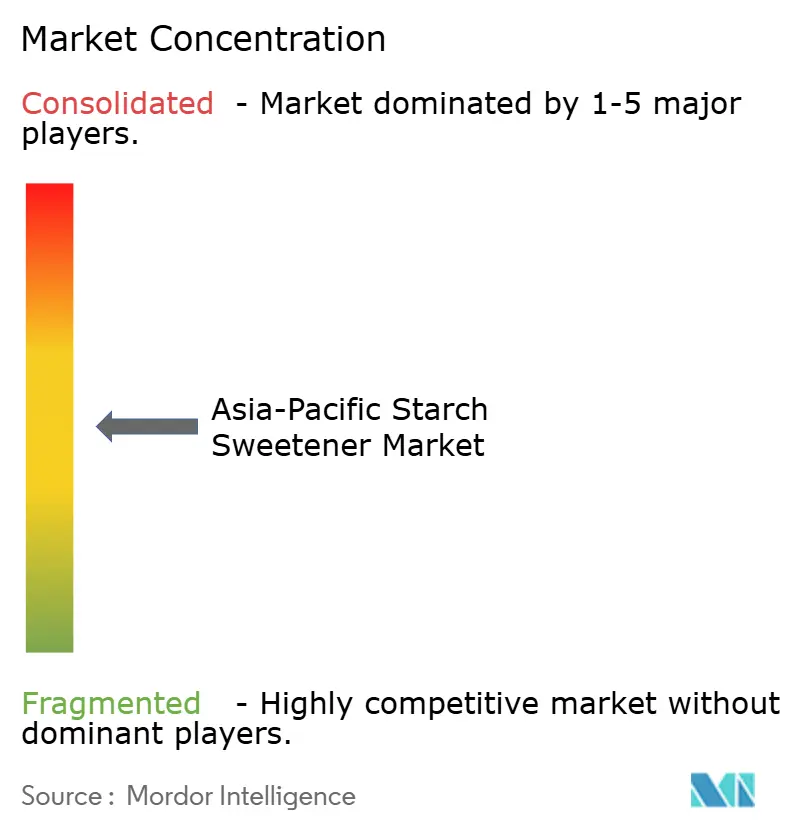
The Asia-Pacific starch sweetener market has moderate concentration because global ingredient companies operate alongside large Chinese processors and domestic suppliers. Competition varies by product grade, geography, customer requirements, and the level of technical support expected by each buyer group. High-volume categories favor producers with integrated wet-milling capacity, efficient bulk delivery, and the ability to manage feedstock procurement across changing conditions. Higher-value categories favor firms that can offer application support, dependable specifications, recognized quality systems, and documentation suited to regulated food or pharmaceutical uses. This structure allows large local processors to compete on volume while specialist suppliers compete on technical service, formulation knowledge, and higher-quality product grades.
Roquette’s March 2026 pilot-center opening in Lianyungang is a strategic move toward quicker validation of starch and polyol solutions for food and nutrition customers. The center combines laboratory work and pilot-scale process testing, which supports more tailored product development and can shorten the transition from product concept to commercial validation. Cargill’s April 2025 reopening of its Singapore Innovation Center is another move that strengthens regional formulation support for food and ingredient customers. Tate & Lyle’s February 2026 launch of Yume M Stevia adds a fermentation-derived natural-sweetener option to its portfolio. These actions show that major suppliers are competing through product development, customer support, and reduced-sugar solutions as well as through conventional starch-based products.
Chinese processors compete strongly in domestic and ASEAN export markets where price, capacity, delivery reliability, and a close understanding of local customer needs are decisive. Pharmaceutical-grade glucose syrup remains an area where certified local supply is more limited and quality requirements are higher. Food safety systems and pharmaceutical manufacturing requirements can restrict access to these customer groups, especially for firms without the required quality infrastructure. Enzyme suppliers can also influence the competitive position of processors by enabling higher-solids production and lower resource use.
Asia-Pacific Starch Sweetener Industry Leaders
-
Cargill Incorporated
-
The Archer Daniels Midland Company
-
Tereos S.A.
-
Ingredion Incorporated
-
Tate & Lyle PLC
- *Disclaimer: Major Players sorted in no particular order
Asia-Pacific Starch Sweetener Market Companies Covered in this Report
- Cargill, Incorporated
- The Archer-Daniels-Midland Company
- Tereos S.A.
- Ingredion Incorporated
- Tate & Lyle PLC
- Roquette Frères S.A.
- International Flavors & Fragrances Inc.
- Südzucker AG
- AGRANA Beteiligungs-AG
- Global Sweeteners Holdings Limited
- Zhucheng Dongxiao Biotechnology Co., Ltd.
- Zhucheng Xingmao Corn Developing Co., Ltd.
- COFCO Biochemical (Anhui) Co., Ltd.
- Shandong Xiwang Sugar Industry Co., Ltd.
- Daesang Corporation
- Matsutani Chemical Industry Co., Ltd.
- Showa Sangyo Co., Ltd.
- Gulshan Polyols Limited
- Grain Processing Corporation
- Sukhjit Starch and Chemicals Limited
Recent Industry Developments in Asia-Pacific Starch Sweetener Market
- May 2026: Xingmao Corn Group advanced a large-scale corn starch and starch-sugar project in China. At its Horgos Division Industrial Park project, the first phase completed construction and equipment installation, with commissioning and trial production expected by the end of June 2026. Planned annual output includes 100,000 tonnes of dextrose monohydrate, 30,000 tonnes of anhydrous dextrose, and 300,000 tonnes of liquid glucose syrup, alongside 650,000 tonnes of corn starch.
- March 2026: Roquette inaugurated a starch and polyol pilot center at its Lianyungang, China plant, spanning over 1,000 square meters. Initiated in late 2024, the center integrates physicochemical analysis, lab-scale research, and pilot-scale industrial transformation to shorten time-to-market for starch and polyol solutions for customers in beverages, bakery, dairy alternatives, and specialized nutrition.
- April 2025: Cargill reopened its refurbished Innovation Center in Singapore, supported by the Singapore Economic Development Board and Enterprise Singapore. The center integrates culinary, bakery, dairy, confectionery, beverage, and core science labs, serving as Cargill's regional product development hub for Asia's food and ingredient sectors.
Asia-Pacific Starch Sweetener Market Report Scope
Starch sweeteners are carbohydrate-based sweetening ingredients produced by processing starch derived from sources such as corn, wheat, rice, and cassava into sugars or sugar-based syrups. The Asia-Pacific starch sweetener market is segmented by product type, source, application and geography. Based on product type, the market is segmented into high fructose corn syrup, dextrin, fructose, and glucose syrup. Based on source, the market is segmented into corn, wheat, tapioca, potato, and others. Based on form, the market is segmented into liquid and solid. Based on application, the market is segmented into food and beverages, pharmaceuticals, personal care, and other applications. Based on geography, the market is segmented into China, India, Japan, Australia, South Korea, Indonesia, Thailand, Singapore, Rest of Asia-Pacific. For each segment, the market sizing and forecasting have been done in value terms (USD billion).
Segmentation Overview
By Product Type
| High-Fructose Corn Syrup (HFCS) |
| Dextrin |
| Fructose |
| Glucose Syrups |
| Others |
By Source
| Corn |
| Wheat |
| Tapioca |
| Potato |
| Others |
By Form
| Liquid |
| Solid |
By Application
| Food and Beverages | Bakery and Confectionery |
| Dairy and Desserts | |
| Beverages | |
| Meat and Poultry | |
| Other Food and Beverages | |
| Pharmaceuticals | |
| Personal Care and Cosmetics | |
| Other Applications |
By Geography
| China |
| India |
| Japan |
| Australia |
| South Korea |
| Indonesia |
| Thailand |
| Singapore |
| Rest of Asia-Pacific |
| By Product Type | High-Fructose Corn Syrup (HFCS) | |
| Dextrin | ||
| Fructose | ||
| Glucose Syrups | ||
| Others | ||
| By Source | Corn | |
| Wheat | ||
| Tapioca | ||
| Potato | ||
| Others | ||
| By Form | Liquid | |
| Solid | ||
| By Application | Food and Beverages | Bakery and Confectionery |
| Dairy and Desserts | ||
| Beverages | ||
| Meat and Poultry | ||
| Other Food and Beverages | ||
| Pharmaceuticals | ||
| Personal Care and Cosmetics | ||
| Other Applications | ||
| By Geography | China | |
| India | ||
| Japan | ||
| Australia | ||
| South Korea | ||
| Indonesia | ||
| Thailand | ||
| Singapore | ||
| Rest of Asia-Pacific | ||
Key Questions Answered in the Report
What is the forecast growth rate for Asia-Pacific starch sweeteners?
The Asia-Pacific starch sweetener market is forecast to grow at a 5.67% CAGR from 2026 to 2031, reaching USD 9.29 billion.
Which product type holds the largest share in Asia-Pacific?
High-fructose corn syrup leads the product category with 41.72% share in 2025.
Which feedstock is growing fastest for starch sweeteners in Asia-Pacific?
Tapioca is the fastest-growing source category, with a projected 6.58% CAGR through 2031.
Which application is expanding fastest across the region?
Pharmaceuticals are projected to grow at 6.89% CAGR through 2031, supported by demand for oral liquid formulations.