
Market Overview
| Study Period | 2021 - 2031 |
|---|---|
| Forecast Data Period | 2026 - 2031 |
| Base Year Market Size (2025) | USD 12.73 Billion |
| Market Size (2026) | USD 13.43 Billion |
| Market Size (2031) | USD 17.59 Billion |
| Growth Rate (2026 - 2031) | 5.53 % |
| Market Concentration | Medium |
Major Players *Disclaimer: Major Players sorted in no particular order Image © Mordor Intelligence. Reuse requires attribution under CC BY 4.0. | |
Asia-Pacific Flavor And Fragrance Market Analysis by Mordor Intelligence
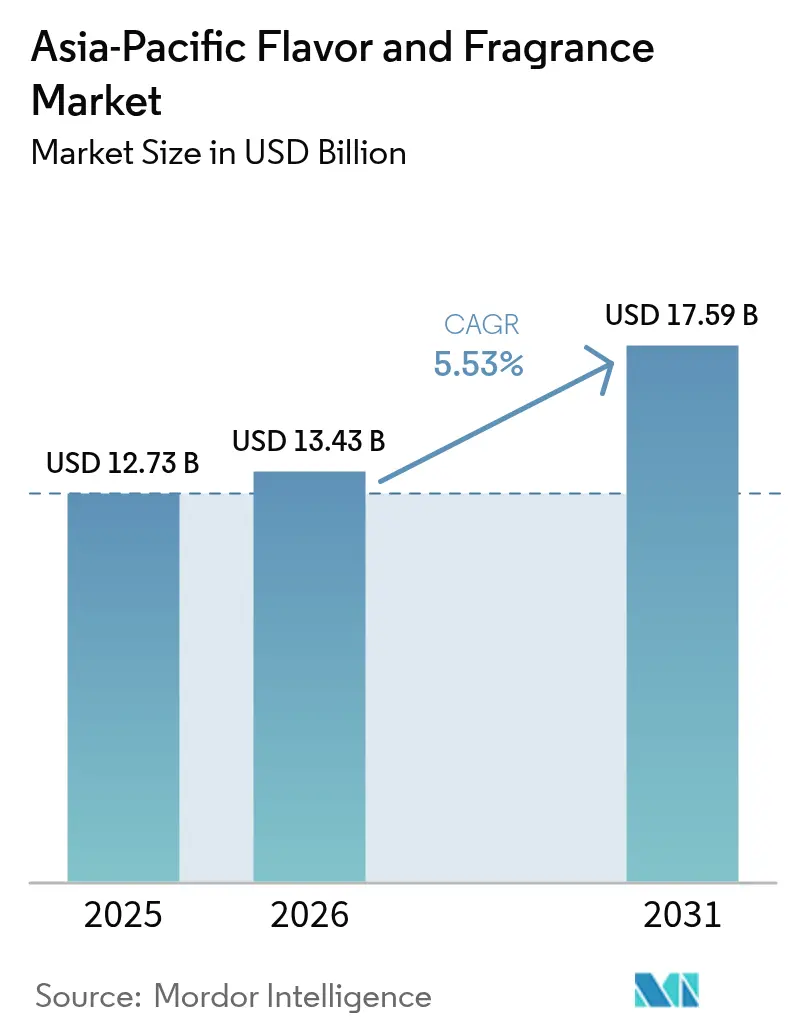
The Asia-Pacific flavors and fragrances market size demonstrated robust performance by reaching USD 12.73 billion in 2025. The Asia-Pacific flavors and fragrances market was valued at USD 12.73 billion in 2025 and estimated to grow from USD 13.43 billion in 2026 to reach USD 17.59 billion by 2031, at a CAGR of 5.53% during the forecast period (2026-2031). The region has established itself as an indispensable hub for both consumption patterns and technological innovation in sensory ingredients, primarily influenced by the substantial increase in consumer purchasing power and their evolving preferences towards high-quality, premium food products with enhanced functional benefits. The biotechnology landscape in the region is undergoing significant transformation in production methodologies, with notable institutions such as the Tokyo University of Science spearheading innovations through the development of sophisticated bioengineered enzymes. These enzymes have revolutionized the industry by enabling the efficient conversion of agricultural waste materials into valuable vanillin through streamlined single-step processes.
Key Report Takeaways
- By product type, flavors led with 57.35% of Asia-Pacific flavors and fragrances market share in 2025 and are projected to grow at a 6.74% CAGR through 2031.
- By source, synthetic inputs accounted for 69.45% share of the Asia-Pacific flavors and fragrances market size in 2025, while natural sources are forecast to advance at a 6.62% CAGR between 2026-2031.
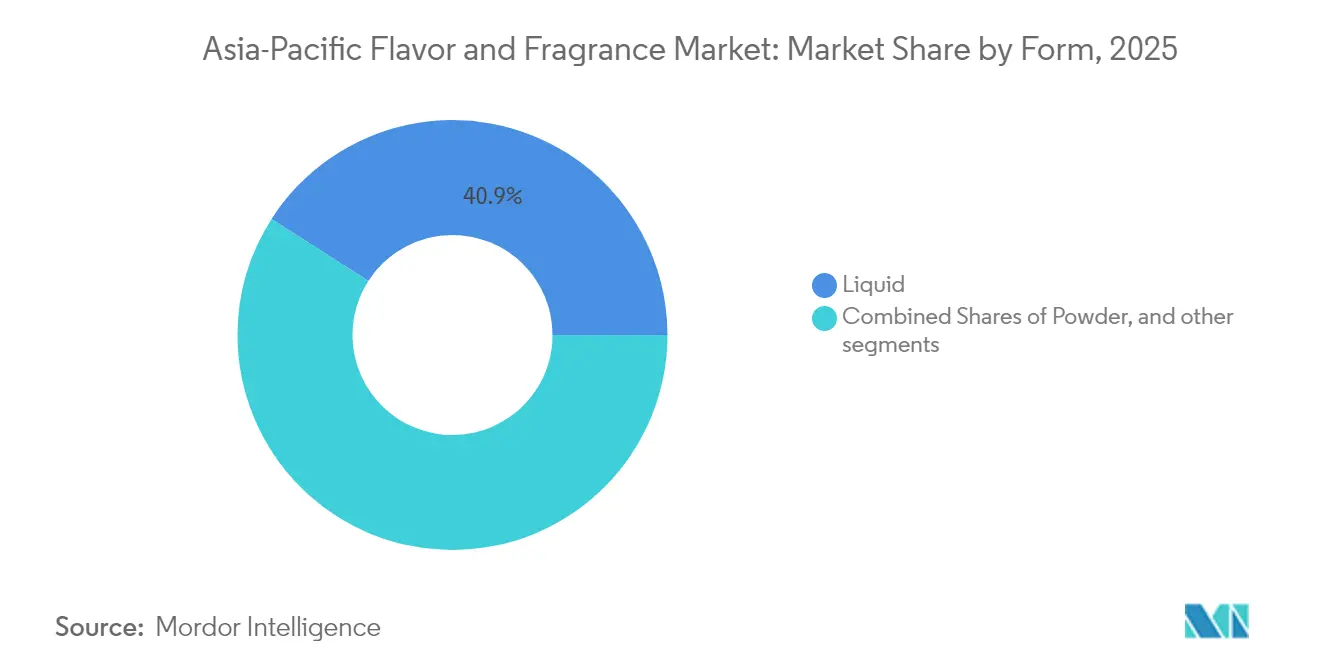
- By form, liquid formats captured 40.92% share of the Asia-Pacific flavors and fragrances market size in 2025 and powders are poised for a 6.35% CAGR to 2031.
- By application, beverages commanded 35.88% share of the Asia-Pacific flavors and fragrances market size in 2025 and will expand at a 6.49% CAGR through 2031.
- By geography, China dominated with 42.10% share of the Asia-Pacific flavors and fragrances market size in 2025 and is expected to register a 6.58% CAGR to 2031.
Note: Market size and forecast figures in this report are generated using Mordor Intelligence’s proprietary estimation framework, updated with the latest available data and insights as of 2026.
Market Trends and Insights
Drivers Impact Analysis of Asia-Pacific Flavor And Fragrance Market*
| Driver | (~) % Impact on CAGR Forecast | Geographic Relevance | Impact Timeline |
|---|---|---|---|
| Expansion of processed and convenience foods industry | +1.2% | China, India, Southeast Asia core markets | Medium term (2-4 years) |
| Growing preference for functional flavors with health benefits | +0.9% | Japan, South Korea, Australia with spillover to emerging markets | Long term (≥ 4 years) |
| Innovations in flavor and fragrance formulations using biotechnology | +0.8% | Japan, China, Singapore innovation hubs | Long term (≥ 4 years) |
| Rising interest in traditional and regional flavors | +0.7% | APAC regional, strongest in Southeast Asia | Medium term (2-4 years) |
| Demand for sustainable and eco-friendly flavors and fragrances | +0.6% | Global with leadership in Japan, Australia, South Korea | Long term (≥ 4 years) |
| Development of multi-sensory flavors and fragrances combining taste and aroma | +0.6% | Urban centers across major APAC markets | Medium term (2-4 years) |
| Source: Mordor Intelligence | |||
Expansion of Processed and Convenience Foods Industry
The demand for packaged meals with extended shelf life that replicate home-cooked flavors continues to grow among urban households, driven by their need for convenience and time-saving solutions. Southeast Asian consumers demonstrate strong daily consumption patterns for cookies, with a significant portion expressing willingness to pay premium prices for innovative flavor experiences. The expansion of digital grocery platforms and on-demand delivery services enhances product accessibility across markets, while the increasing participation of women in the workforce generates consistent market demand. Major food companies in China, Indonesia, and India are establishing strategic partnerships with specialized flavor houses to accelerate product reformulation processes that cater to local taste preferences. This substantial increase in order volume allows contract manufacturers to optimize their investments in spray-drying and liquid blending equipment, fostering economies of scale that promote broader flavor application across processed food categories.
Growing Preference for Functional Flavors with Health Benefits
Growing consumer awareness of the relationship between diet and wellness has driven significant demand for beverages containing botanicals, amino acids, and probiotic cultures that provide immunity and energy benefits. The global functional beverage market continues to experience substantial growth, with the Asia-Pacific region emerging as the primary growth driver. Japan's Foods with Health Claims regulatory framework serves as a comprehensive model for transparent efficacy labeling, influencing regulations across the region and establishing a standardized approval process. Manufacturers are incorporating umami compounds to improve satiety and mouthfeel while reducing sodium content, supporting weight management and low-sugar product lines. The premium positioning of these beverages enables higher pricing to offset the increased costs of bioactive ingredient extraction and stabilization, fostering a continuous cycle of margin growth and research investment.
Innovations in Flavor and Fragrance Formulations Using Biotechnology
Biotechnology applications in flavor production continue to advance through innovative enzyme engineering methods, creating sustainable production pathways that effectively address both cost challenges and environmental concerns in the industry. The Tokyo University of Science's breakthrough in developing bioengineered enzymes has established a new method for vanillin production from agricultural waste materials, marking a significant shift toward circular economy principles in flavor manufacturing processes[1]. Newcastle University's development of biocatalyst technology for solvent-free flavor ester production showcases strong potential for industrial implementation, delivering enhanced catalytic performance and repeated usability in production environments. These technological advancements align with current regulatory frameworks that favor natural ingredients while reducing industry reliance on fluctuating agricultural commodity markets, providing substantial advantages to businesses that implement biotechnology-enabled flavor production systems.
Rising Interest in Traditional and Regional Flavors
Regional flavor preferences continue to shape consumer behavior as people increasingly seek authentic taste experiences that connect them to cultural heritage and local ingredient traditions. Research examining East Asian culinary traditions reveals that fundamental elements such as rice, soy products, and umami-rich fermented foods form the backbone of these cuisines, transcending national boundaries while preserving distinct local characteristics. This evolution presents significant opportunities for flavor companies to develop comprehensive region-specific portfolios that authentically capture traditional taste profiles in modern applications, especially as food manufacturers work to distinguish their products in competitive markets. The ongoing shift toward traditional flavors harmonizes with clean-label preferences, as consumers increasingly make strong associations between regional ingredients and authenticity, which in turn drives substantial demand for locally-sourced flavor compounds and traditional processing methods.
Restraints Impact Analysis of Asia-Pacific Flavor And Fragrance Market*
| Restraint | (~) % Impact on CAGR Forecast | Geographic Relevance | Impact Timeline |
|---|---|---|---|
| Stringent regulatory frameworks and approval processes | -0.8% | China, Japan, South Korea with regional spillover | Short term (≤ 2 years) |
| Limited shelf life and storage challenges for natural flavor and fragrance products | -0.6% | Tropical APAC regions, supply chain dependent markets | Medium term (2-4 years) |
| Variability in quality and potency of natural raw ingredients | -0.5% | Indonesia, India, Thailand agricultural regions | Medium term (2-4 years) |
| Fluctuations in global commodity prices impacting ingredient costs | -0.7% | Global with acute impact on import-dependent markets | Short term (≤ 2 years) |
| Source: Mordor Intelligence | |||
Stringent Regulatory Frameworks and Approval Processes
The diverse and intricate regulatory framework across Asia-Pacific jurisdictions poses substantial compliance challenges for businesses aiming to enter these markets or innovate their products. China's implementation of GB 2760-2024, taking effect in February 2025, introduces more stringent regulations on food additive definitions and usage limitations, compelling manufacturers to undertake comprehensive product reformulations [2]. Similarly, Japan's regulatory decision to prohibit the use of 3,6-dimethyl-5,6,7,7a-tetrahydro-2(4H)-benzofuranone from January 2025 illustrates the dynamic nature of safety assessment protocols, requiring businesses to maintain vigilant monitoring systems [3]. The fragmented nature of regulations across these markets necessitates companies to develop and maintain distinct product development approaches for each jurisdiction. This regulatory complexity significantly increases development costs and extends time-to-market periods, creating particular challenges for smaller enterprises that often lack specialized regulatory expertise and financial resources.
Limited Shelf Life and Storage Challenges for Natural Flavor and Fragrance Products
Natural flavor compounds encounter significant stability limitations that affect supply chain operations and inventory management across Asia-Pacific's diverse climate conditions. Research demonstrates that natural flavorings experience substantial degradation in their intensity during storage periods, while synthetic alternatives maintain higher stability under identical conditions. The tropical environments prevalent in Southeast Asia accelerate this degradation process, necessitating specialized packaging solutions and robust cold chain infrastructure that increase distribution costs. Consumer preferences for natural ingredients create a fundamental challenge between market demand and technical feasibility, limiting product development opportunities and market penetration potential of natural flavor solutions.
*Our forecasts treat driver/restraint impacts as directional, not additive. The impact forecasts reflect baseline growth, mix effects, and variable interactions.
Asia-Pacific Flavor And Fragrance Market Segment Analysis
By Product Type:
Flavors Drive Market LeadershipFlavors dominate the market with a substantial 57.35% share in 2025, demonstrating their fundamental role in shaping food and beverage applications. The segment's robust growth trajectory, marked by a CAGR of 6.74% through 2031, underscores the increasing demand for innovative flavor solutions across diverse consumer segments. The industry's evolution has led to a significant shift toward multi-sensory experiences, where taste and aroma elements merge to create unique product offerings that bridge traditional category boundaries.
This transformation is exemplified by strategic initiatives such as Givaudan's establishment of L'Appartement 125, a Fine Fragrance Creative Centre in Shanghai, in October 2024. The facility serves as a collaborative hub for partnerships with local brands, enabling the integration of cultural nuances into fragrance development. Through these strategic investments, flavor and fragrance companies are well-positioned to capitalize on opportunities across multiple segments while addressing the sophisticated consumer preferences for products that deliver comprehensive sensory experiences.


By Source:
Synthetic Dominance Faces Natural ChallengeSynthetic sources dominate the market with a 69.45% share in 2025, primarily due to their significant cost advantages and highly reliable supply chains. These characteristics make synthetic sources particularly attractive for large-scale food and beverage manufacturers who require consistent, high-volume ingredient supplies for their production processes.
Natural sources are experiencing rapid growth at a 6.62% CAGR through 2031, as consumers increasingly seek clean-label products and regulatory bodies implement supportive frameworks for natural ingredients. This market evolution demonstrates a clear shift toward premium positioning, where natural ingredients command higher prices despite their increased production costs and supply chain complexities. Nature-identical compounds serve as an intermediate solution in this landscape, offering manufacturers a practical way to balance evolving consumer preferences with operational efficiency requirements.
By Form:
Liquid Leadership Challenged by Powder InnovationLiquid forms maintain a dominant position with a 40.92% market share in 2025, primarily because manufacturers find them highly adaptable for beverage applications. These forms integrate seamlessly into existing manufacturing processes, making them a preferred choice for production facilities. The liquid segment's strong market position is further reinforced by well-established infrastructure and deep formulation expertise, which creates substantial barriers for new market entrants.
Powder forms demonstrate remarkable growth potential, recording a 6.35% CAGR through 2031. This growth is fueled by their extensive applications in convenience foods and their ability to remain stable for longer periods, particularly beneficial in tropical climate regions where storage conditions can be challenging. The market also encompasses other innovative forms, including encapsulated products and specialized delivery systems, where companies invest in developing proprietary technologies to distinguish themselves from competitors and capture specific market segments.
By Application:
Beverage Supremacy Reflects Health TrendsThe beverage applications segment commands a substantial 35.88% market share in 2025 and is expected to maintain robust growth at a 6.49% CAGR through 2031. This segment's market leadership underscores its role as a primary innovation center for functional and premium products in the industry. The strong market position is fundamentally supported by consumer behavior, particularly in Southeast Asia, where customers consistently demonstrate a willingness to invest in products offering unique and distinctive flavor experiences.
Traditional application segments, including dairy, bakery, and confectionery, continue to hold significant market positions through their high-volume consumption patterns. The savory snacks category has found success through innovative flavor development, particularly in bold and spicy profiles that resonate with changing consumer preferences. In the specialized meat applications segment, manufacturers focus on achieving authentic taste replication while incorporating advanced preservation technologies. The expanding functional beverage market is driving innovation toward health-beneficial flavor compounds, with umami-rich formulations experiencing increased adoption among consumers who seek satisfying taste alternatives to animal-based ingredients.
Geography Analysis
China Flavor and Fragrance Market
China dominates the Asia-Pacific flavors and fragrances market with a substantial 42.10% market share in 2025. This market leadership position is built on the country's robust manufacturing infrastructure and expanding consumer base. The market's strength is underpinned by continued urbanization trends, steady increases in disposable incomes, and evolving consumer preferences that increasingly favor premium and functional products.
China is also exhibiting the most rapid growth in the region, with a projected CAGR of 6.58% through 2031. This growth trajectory is supported by the expanding middle class, increased consumer spending power, and the ongoing transformation of consumer preferences. The market's expansion is further reinforced by the rising demand for processed foods, beverages, and personal care products that require flavor and fragrance components.
ASEAN and Australia Flavor and Fragrance Market
Southeast Asian markets, including Indonesia, Thailand, and Singapore, are experiencing notable growth driven by economic development and shifting dietary patterns toward processed and convenience foods. Australia represents a mature market segment characterized by sophisticated regulatory frameworks and established consumer preferences for natural and organic ingredients. Major industry players are responding to these market dynamics, as demonstrated by Givaudan's CHF 50 million investment in an Indonesian facility and IFF's expansion of their Shanghai center in October 2024. These strategic regional investments enable companies to build local capabilities and strengthen customer relationships essential for long-term market success.
Regulatory Landscape
Regulation of flavors and fragrances in Asia-Pacific is shaped by country-specific positive lists, use limits, and labeling rules, which tend to raise compliance costs and extend reformulation cycles for companies that operate across multiple jurisdictions. China implemented GB 2760-2024 (National Food Safety Standard for the Usage of Food Additives) effective February 8, 2025, tightening definitions and maximum use levels that directly affect permitted flavoring uses in processed foods and beverages.
Regulatory modernization and coordination also moved forward in 2025-2026. Singapore enacted the Food Safety and Security Act in 2025, with Tranche 1 provisions effective November 28, 2025, and brought the Food (Amendment) Regulations 2025 into operation on January 30, 2026, updating requirements relevant to food additives and flavoring labeling. At the regional level, APFRAS 2026 in Seoul (May 11-12, 2026) culminated in the APFRAS Seoul 2026 Declaration adopted by 14 member countries, reinforcing momentum around science-based regulatory harmonization that influences how flavor and additive standards evolve across the region.
Value Chain Analysis
The Asia-Pacific flavor and fragrance value chain begins with agricultural and petrochemical feedstocks (spices, botanicals, citrus, terpenes, and aroma chemicals), then moves into extraction, fermentation or chemical synthesis, and compounding (blending, spray-drying, encapsulation). The chain ultimately supports food, beverage, and personal care manufacturers, where formulation and sensory validation are anchored in regional application laboratories and innovation centers that translate local taste preferences into scalable liquid and powder systems for high-volume customers.
Distribution and last-mile technical service can be decisive given the region's fragmented customer base and diverse regulatory regimes. Global and regional distributors connect multinational flavor houses with local manufacturers, and Brenntag expanding its distribution partnership with Givaudan to include Malaysia and Singapore (January 2026) reflects how specialty distribution can speed up customer access to premium ingredients and technical support. Capacity localization is also reshaping supply reliability and lead times, with new manufacturing footprints in Southeast Asia supporting faster supply of key formats such as savory and snack flavor powders.
Competitive Landscape
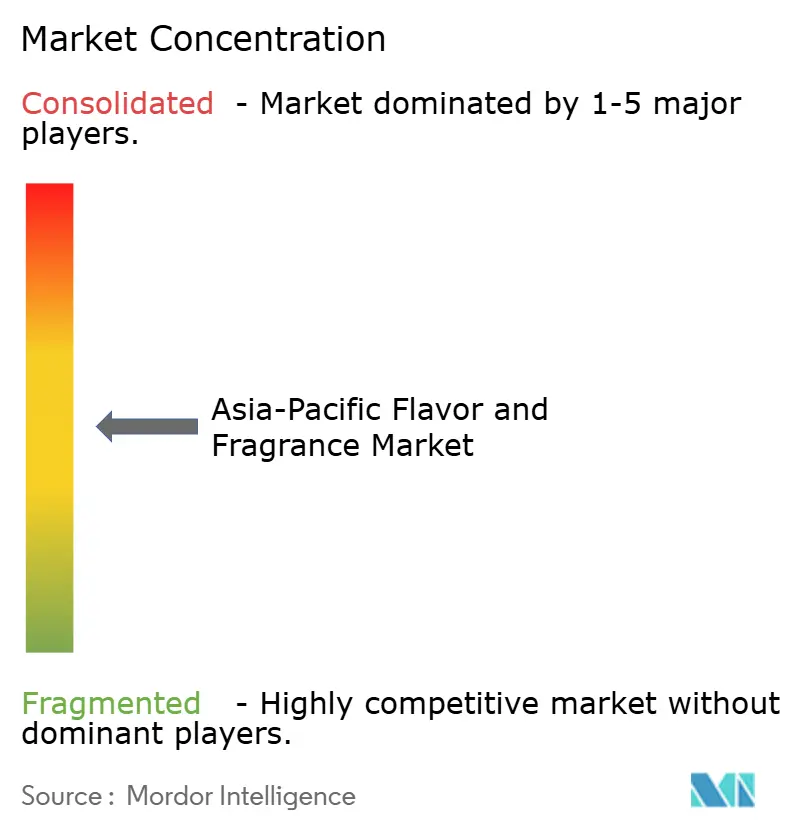
The Asia-Pacific flavors and fragrances market structure enables both established multinational corporations and emerging regional players to thrive, characterized by moderate concentration and significant fragmentation. The market's competitive landscape is dominated by global industry leaders, with Givaudan achieving CHF 7.4 billion in 2024 sales and recording 8.8% growth in Asia-Pacific, while dsm-firmenich generated EUR 12.31 billion in combined revenues. These companies have established their market presence through strategic investments in local innovation centers and production facilities, ensuring deep understanding of regional preferences and compliance with regulatory requirements.
Biotechnology-enabled production methods and sustainable ingredient sourcing represent the fastest-growing segments within the market. This growth is evidenced by increased patent filings for Lamiaceae bioactives, particularly from Korea, China, and the U.S., as manufacturers respond to rising consumer demand for natural preventive health solutions. The development of bioengineered enzymes for flavor compound synthesis has transformed production methods, offering both cost efficiency and environmental benefits.
Other market segments show development through technological advancement and innovation. Companies implementing artificial intelligence in flavor development gain competitive advantages through improved consumer preference prediction and product optimization capabilities. Additionally, businesses investing in multi-sensory product development create unique value propositions that support premium pricing strategies, further diversifying their market offerings and revenue streams.
Asia-Pacific Flavor And Fragrance Industry Leaders
-
Givaudan
-
DSM-Firmenich
-
International Flavors & Fragrances Inc.
-
Symrise AG
-
Archer Daniels Midland Co.
- *Disclaimer: Major Players sorted in no particular order
Asia-Pacific Flavor And Fragrance Market Companies Covered in this Report
- Givaudan S.A.
- DSM-Firmenich
- International Flavors & Fragrances Inc.
- Symrise AG
- Archer Daniels Midland Co.
- Sensient Technologies Corp.
- MANE Group
- Takasago International Corp.
- T. Hasegawa Co., Ltd.
- Robertet SA
- Huabao International Holdings
- Zhejiang NHU Co., Ltd.
- Shanghai Apple Flavor & Fragrance Co.
- Guangzhou Baihua Flavour & Fragrance Co.
- Kerry Group plc
- SH Kelkar & Company Ltd.
- Synergy Flavours APAC
- Kanbo International Group
- PT Indesso Aroma
- Atul Ltd.
Read Analysis of Asia-Pacific Flavor And Fragrance Companies
Market Opportunities and Future Outlook
Local manufacturing and formulation ecosystems in Southeast Asia are opening room for faster turnaround on culturally specific taste profiles, along with formats optimized for hot and humid logistics. A clear signal is Givaudan inaugurating a 24,000 square meter production facility in Cikarang, Indonesia in July 2026 (CHF 50 million investment), focused on savory, sweet, and snack flavor powders, which strengthens regional supply and shortens lead times for processed foods and beverage adjacencies that depend on stable dry formats.
Portfolio specialization and technology-enabled differentiation are also creating room in higher-value flavors and fragrance ingredients, including taste modulation, masking, and clean-label systems that align with tighter additive and labeling requirements. Industry restructuring supports targeted expansion by pure-play taste and scent suppliers, as shown by IFF announcing the sale of its Food Ingredients business to CVC Capital Partners for USD 4.3 billion (May 2026), which sharpens IFF's strategic focus on Taste and Scent and shifts competitive intensity in customer segments that rely on integrated ingredient bundles. Separately, Singapore is strengthening pathways for novel foods and novel ingredients through its safety assessment framework and enabling programs such as FRESH (a joint initiative involving SFA, Nanyang Technological University, and A*STAR), which supports dossier readiness for emerging sensory and functional ingredient concepts used in beverages and other applications.
Recent Industry Developments in Asia-Pacific Flavor And Fragrance Market
- July 2026: Givaudan inaugurated a CHF 50 million, 24,000 square meter production facility in Cikarang, Indonesia, to manufacture savory, sweet, and snack flavor powders for Indonesia and wider Southeast Asia. The site expands local capacity for dry formats used heavily in convenience foods and snacks and supports shorter replenishment cycles versus importing. It also reinforces Southeast Asia as a manufacturing hub for region-specific taste profiles and application support.
- May 2026: International Flavors & Fragrances Inc. announced the sale of its Food Ingredients business to CVC Capital Partners for USD 4.3 billion. The divestment sharpens IFF's portfolio around higher-margin Taste, Scent, and Health & Biosciences activities. Competitive dynamics shift as customers that previously bought bundled ingredient solutions reassess sourcing and supplier partnerships.
- October 2024: Givaudan opened L'Appartement 125, a Fine Fragrance Creative Centre in Shanghai, designed to collaborate with local brands on fragrance creation. The facility strengthens on-the-ground creative and co-development capabilities, which supports faster iteration on culturally nuanced scent profiles. It also supports premiumization strategies in beauty and personal care across China, the region's largest market.
Asia-Pacific Flavor And Fragrance Market Report Scope and Research Methodology
Market Definition and Coverage
This market covers the sales value of flavor and fragrance ingredients used to create taste and scent in consumer end products across Asia-Pacific, counted at the point they are sold into food, beverage, and personal and home care manufacturing.
Scope exclusions: Excludes finished consumer products and retail sales values (such as packaged foods, perfumes, or cosmetics sold to shoppers).
Segments Covered in This Report
- By Product Type
- Flavors
- Fragrance
- By Source
- Natural
- Synthetic
- Nature Identical
- By Form
- Powder
- Liquid
- Others
- By Application
- Dairy
- Bakery
- Confectionery
- Savory Snacks
- Meat
- Beverage
- Others
- By Geography
- China
- India
- Japan
- Australia
- Indonesia
- South Korea
- Thailand
- Singapore
- Rest of Asia-Pacific
Data Sources, Market Sizing, and Validation
Desk Research
Desk research helped us build the starting structure for the Asia-Pacific model and set realistic demand drivers by country. We relied on public sources such as national statistics offices in the region, UN Comtrade trade flows for key aroma chemicals and flavor inputs, FAO food processing indicators, and World Bank macro series that reflect consumption strength.
To keep assumptions grounded, we also reviewed sources such as customs tariff schedules, published standards and guidance from food-safety regulators, and peer-reviewed chemistry and food-science journals that indicate substitution trends between natural and synthetic inputs. Company annual reports, investor presentations, and reputable press coverage were used to sanity-check capacity additions, plant moves, and exposure to end markets. For company financials, patent records, and shipment-level trade checks, we also used select paid database subscriptions where they were relevant. These examples are not exhaustive, and many other public and paid sources were also referenced for data collection, validation, and clarification.
Primary Interviews and Surveys
Primary work focused on filling gaps that desk sources do not fully explain, especially pricing progression, mix shifts between natural and synthetic, and how demand differs by end-use. We spoke with manufacturers, distributors, and downstream formulators across APAC, and the inputs were used to test penetration and usage-rate assumptions before finalizing the model.
Distribution of primary research fieldwork respondents
| Company type | Respondent position |
|---|---|
| Top tier: 32% | CXOs: 17% |
| Mid tier: 46% | Functional/Unit leaders: 39% |
| Smaller Players: 22% | Managers: 44% |
Market-Sizing & Forecasting
Market sizing starts with a top-down build where end-use production and consumption indicators in Asia-Pacific are reconstructed into a demand pool for flavor and fragrance ingredients, then filtered using adoption and dosage patterns discussed in interviews. When the steps are followed country by country and then summed, the total can be audited later with the same driver set.
Key inputs used in the model include processed food output and mix, beverage volumes, beauty and personal care manufacturing trends, and import-export movement for relevant ingredient categories. We also track price direction using observable cost signals, along with an assumed mix split between natural and synthetic, since those shifts can change value even when volumes stay stable. The totals are then corroborated with selective bottom-up approximations, such as sampled supplier roll-ups, channel checks on typical selling prices, and a few volume-by-price spot checks for high-usage applications, which helps us adjust for gaps where country data is thin.
For forecasting, scenario analysis is used so growth is not driven by one single assumption, and the scenario weights are aligned to what respondents expect on demand resilience and substitution trends. The forward view is built by updating the same driver set each year and re-running the model, so the forecast remains traceable to clear variables rather than a single headline CAGR.
Data Validation & Update Cycle
Outputs are validated through several checks, including reconciling implied per-capita consumption with income and urbanization signals, and comparing trade-derived movements with the direction of domestic manufacturing. When a variance looks too large for a given country or end-use, the assumptions are revisited and a follow-up call is triggered with the most relevant respondent type.
Before sign-off, the model goes through multi-step analyst reviews where formula integrity, unit consistency, and currency conversion timing are rechecked. Reports are refreshed annually, and interim updates are made when major events materially change input costs, regulations, or end-market production. Right before delivery, a final pass is completed so clients receive the most up-to-date view aligned to the latest available data releases.
Mordor Intelligence's Asia Pacific Flavor and Fragrance Market Size Versus Other Published Estimates
Published market sizes for Asia-Pacific flavors and fragrances can look different even when they sound like they cover the same thing. The main reasons are usually differences in what is counted as the market, which year is treated as the base, and how prices and mix are carried forward in the forecast.
The biggest gap driver in this market is whether aroma chemicals and adjacent ingredient buckets are folded into the total. Mordor Intelligence counts flavor and fragrance ingredients by stated end-use applications in the region and keeps mix and price progression tied to validated usage patterns rather than a single growth uplift. Other estimates can also move based on a more aggressive scenario for natural ingredients, different currency timing, or a refresh cadence that does not recheck assumptions after cost or regulatory changes.
Benchmark comparison
| Source | Market Size | Gaps in Research Methodology |
|---|---|---|
| Mordor Intelligence | USD 12.73 B (2025) | |
| Global Consultancy A | USD 12.64 B (2024) | Uses a different base year and growth window, and the scope description is broader, which can pull in adjacent end-user coverage and a faster assumed mix shift toward premium natural ingredients. |
| Industry Publisher B | USD 10.44 B (2024) | Starts from a lower 2024 revenue base and splits the market into aroma chemicals and natural flavors and fragrances, which can undercount application-level usage in certain downstream categories when mapped at a higher aggregation. |
Taken together, the spread is mainly explained by scope treatment, base-year choice, and how price and mix are carried through the forecast. By keeping inputs tied to observable end-market signals and repeating the same steps across countries and applications, we end up with a total that is easier to trace and re-validate when new data arrives.
Key Questions Answered in the Report
How large is the Asia-Pacific flavors and fragrances market in 2026?
It is valued at USD 13.43 billion and is projected to hit USD 17.59 billion by 2031 on a 5.53% CAGR path.
Which product type currently dominates demand?
Flavors lead with 57.35% share in 2025 and will remain the fastest-growing segment through 2031.
Why is China so important for suppliers?
China holds 42.10% regional share and posts a 6.58% CAGR, driven by processed-food output and premium beauty consumption.
Which application shows the fastest expansion?
Beverages, supported by functional and premium drink launches, command 35.88% share and a 6.49% CAGR to 2031.
How are regulations affecting market entry?
Stricter additive and labeling rules across China, Japan, and South Korea raise compliance costs and favor firms with strong regulatory teams.