
Market Overview
| Study Period | 2021 - 2031 |
|---|---|
| Forecast Data Period | 2026 - 2031 |
| Base Year Market Size (2025) | USD 147.51 Billion |
| Market Size (2026) | USD 159.33 Billion |
| Market Size (2031) | USD 216.93 Billion |
| Growth Rate (2026 - 2031) | 8.02 % |
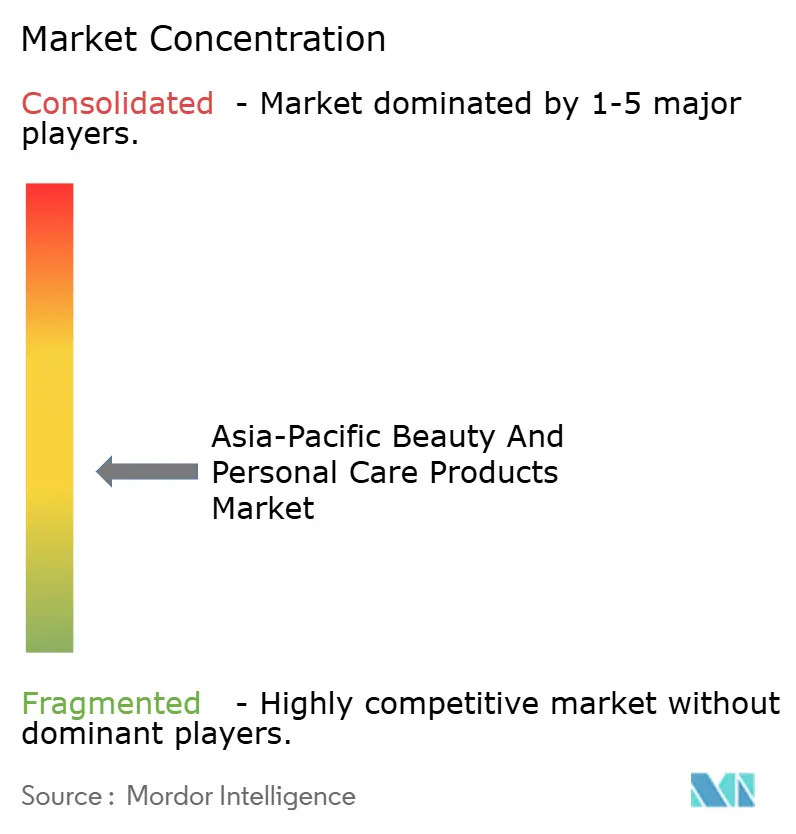
| Market Concentration | Medium |
Major Players
*Disclaimer: Major Players sorted in no particular order Image © Mordor Intelligence. Reuse requires attribution under CC BY 4.0. |
|
Asia-Pacific Beauty and Personal Care Products Market Analysis by Mordor Intelligence
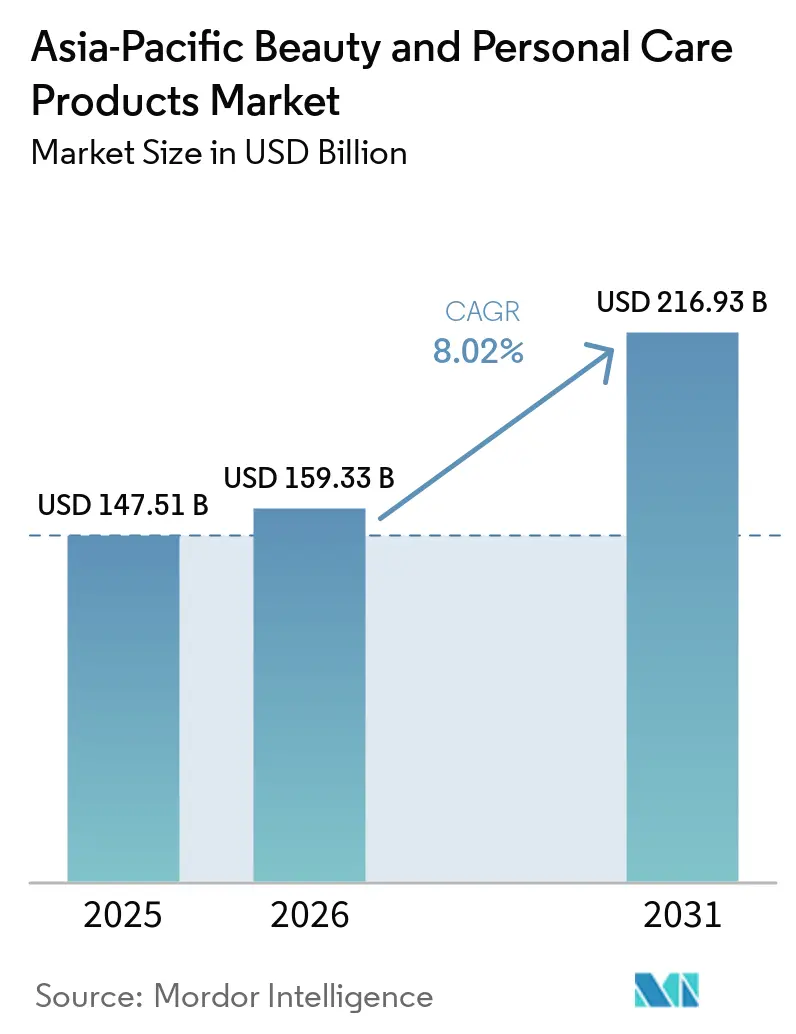
The Asia-pacific beauty and personal care products market size is expected to grow from USD 147.51 billion in 2025 to USD 159.33 billion in 2026 and is forecast to reach USD 216.93 billion by 2031 at 8.02% CAGR over 2026-2031. Demographic, cultural, and technological shifts are fueling this growth across the region. In emerging economies, rising disposable incomes and urbanization are broadening the middle-class consumer base, leading to heightened demand for both essential and premium beauty products. A surge in personal grooming and self-care, influenced by social media, evolving beauty standards, and a digitally-savvy youth, is bolstering the market. Moreover, the integration of technologies like AI-driven skincare diagnostics and AR virtual try-ons is revolutionizing the consumer experience, offering tailored solutions. The rise of e-commerce and mobile shopping has made products more accessible and convenient, further boosting consumption. In response to consumer demand for clean, sustainable, and cruelty-free products, brands are now prioritizing ethical, plant-based, and scientifically-formulated offerings. Additionally, the market's growth is buoyed by rising segments in men's grooming, age-specific solutions, and dermo cosmetics.
Key Report Takeaways
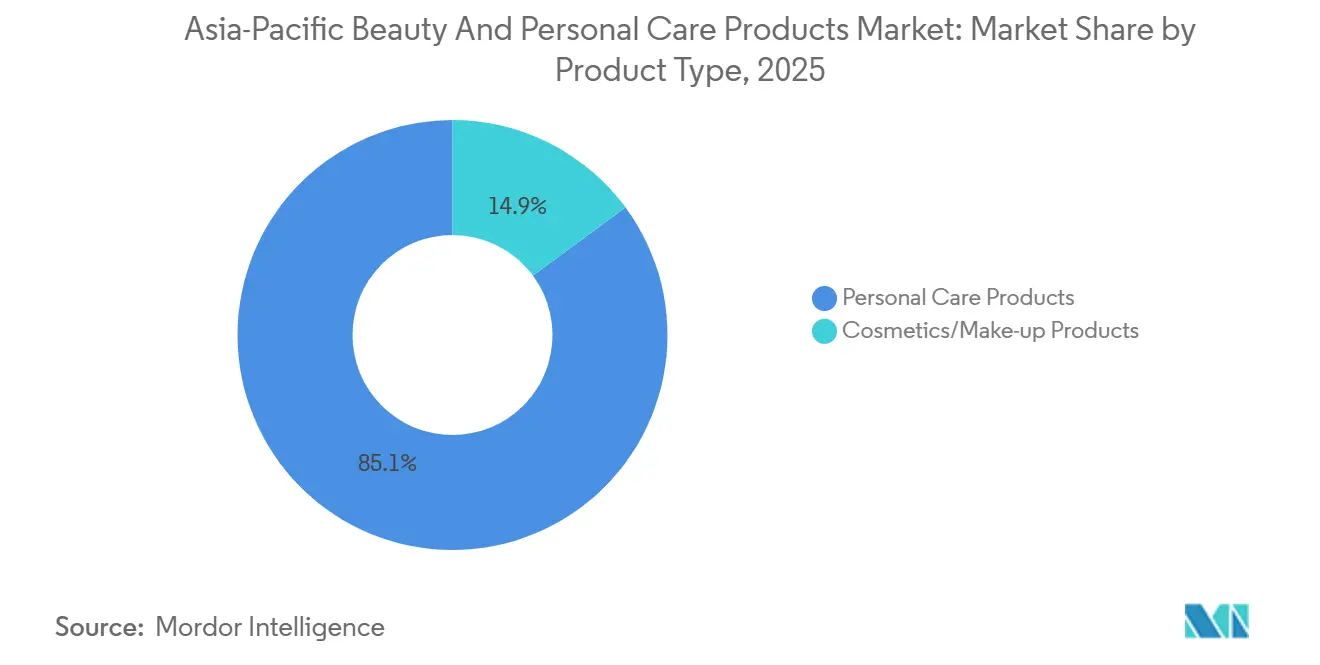
- By product type, Personal care products held 85.12% of 2025 revenue, while cosmetics captured 14.88%; cosmetics are projected to expand at a 7.51% CAGR through 2031.
- By category, Premium lines commanded 24.61% share in 2025 and are advancing at an 8.03% CAGR, outperforming the mass tier that still accounts for 75.39% of sales.
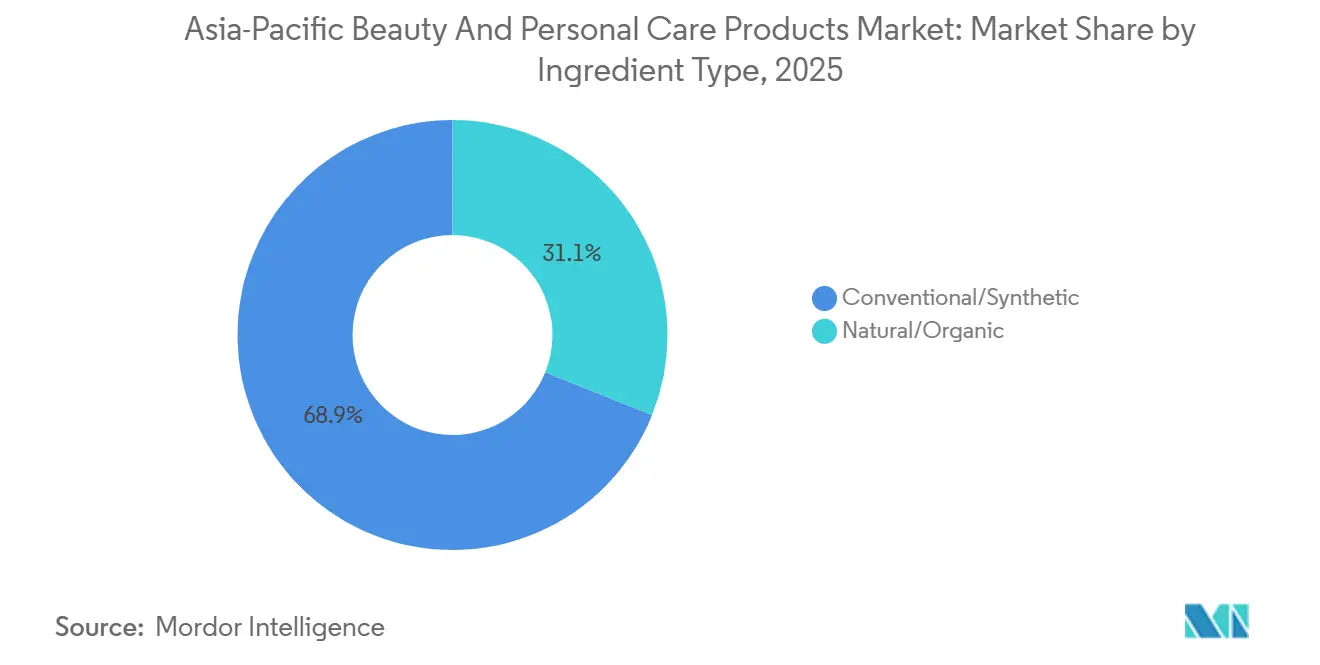
- By ingredient type, Conventional ingredients delivered 68.93% of 2025 value, but natural and organic variants are accelerating at an 8.14% CAGR through 2031.
- By distribution channel, Health & beauty stores retained 36.45% share in 2025, yet online retail is the fastest-growing channel at an 8.51% CAGR.
- By country, China generated 40.31% of regional sales in 2025, while Indonesia is forecast to post the fastest geographic expansion at an 8.34% CAGR to 2031.
Note: Market size and forecast figures in this report are generated using Mordor Intelligence’s proprietary estimation framework, updated with the latest available data and insights as of 2026.
Asia-Pacific Beauty and Personal Care Products Market Trends and Insights
Drivers Impact Analysis*
| Driver | (~) % Impact on CAGR Forecast | Geographic Relevance | Impact Timeline |
|---|---|---|---|
| Rising demand for premium and natural beauty products | +0.8% | China, Japan, South Korea, Australia, Singapore | Medium term (2-4 years) |
| Increasing beauty and self-care awareness among consumers | +0.6% | Indonesia, India, Thailand, Philippines, Vietnam | Long term (≥ 4 years) |
| Growing influence of social media and beauty influencers | +0.7% | Regional, with highest penetration in Indonesia, Thailand, India | Short term (≤ 2 years) |
| Increasing male grooming and inclusive beauty trends | +0.4% | China, India, Singapore, urban centers across Asia-Pacific | Medium term (2-4 years) |
| Technological innovations in beauty and skincare formulations | +0.9% | China, Japan, South Korea, Singapore | Medium term (2-4 years) |
| Growing demand for anti-aging and personalized beauty solutions | +0.7% | Japan, China, South Korea, Australia | Long term (≥ 4 years) |
| Source: Mordor Intelligence | |||
Rising demand for premium and natural beauty products
Rising demand for premium and natural beauty products is a key driver of growth in the Asia-Pacific beauty and personal care products market, supported by changing consumer preferences toward safer and higher-quality formulations. Consumers across the region are increasingly seeking products made with natural, plant-based, and sustainably sourced ingredients due to growing awareness of health, wellness, and environmental impacts. Premium beauty products are gaining traction as rising disposable incomes enable consumers to spend more on specialized skincare, clean-label cosmetics, and high-performance formulations. According to a survey by Retail Asia, around 49% of Asia-Pacific consumers consider natural product attributes, including ethical and environmental factors, when making cosmetic purchases, while 81% view natural labeling as essential or desirable in 2024[1]Source: Retail Asia, “APAC consumers increasingly choose green cosmetics”, retailasia.com. This shift is encouraging manufacturers to expand premium and natural product portfolios and invest in ingredient transparency and sustainable packaging.
Increasing beauty and self-care awareness among consumers
Increasing beauty and self-care awareness among consumers is a significant driver of the Asia-Pacific beauty and personal care products market, as individuals increasingly prioritize personal grooming, skincare routines, and overall wellness. Rising exposure to digital media, beauty influencers, and online tutorials has enhanced consumer knowledge about skincare ingredients, product benefits, and preventive care. Consumers are becoming more proactive in maintaining skin health and appearance, leading to higher demand for daily-use personal care products as well as specialized solutions such as anti-aging, hydration, and sun protection products. Growing urbanization and changing lifestyles have further encouraged regular self-care practices, particularly among younger demographics. In addition, increasing participation of men in grooming and personal care routines is expanding the consumer base across multiple product categories.
Growing influence of social media and beauty influencers
The growing influence of social media and beauty influencers has emerged as a major driver of the Asia-Pacific beauty and personal care products market, significantly shaping consumer purchasing behavior and brand engagement. Social media platforms enable rapid dissemination of beauty trends, product reviews, and tutorials, encouraging consumers to experiment with new products and routines. Influencers and content creators play a key role in building brand credibility and increasing awareness of emerging beauty innovations, particularly among younger consumers. Additionally, the increasing accessibility of the internet has expanded social media usage, enhancing the visibility of beauty products and accelerating market growth across the region. For instance, in India, the total number of internet subscribers reached 954.40 million in March 2024, highlighting the expanding digital consumer base supporting online beauty engagement[2]Source: Ministry of Communications, "Universal connectivity and Digital India initiatives reaching to all areas, including tier-2/3 cities and villages," pib.gov.in.
Increasing male grooming and inclusive beauty trends
Increasing male grooming and inclusive beauty trends are significantly contributing to the growth of the Asia-Pacific beauty and personal care products market. Changing social perceptions and evolving lifestyle preferences have encouraged greater acceptance of grooming and skincare routines among male consumers. This shift has led to rising demand for products such as facial cleansers, moisturizers, hair styling products, and specialized grooming solutions tailored to men’s needs. At the same time, inclusive beauty trends that promote diverse skin tones, gender-neutral products, and personalized formulations are expanding the overall consumer base. Brands are responding by introducing broader product ranges and marketing campaigns that emphasize inclusivity and self-expression. The influence of social media and celebrity endorsements has further normalized male grooming and inclusive beauty practices across the region.
Restraints Impact Analysis*
| Restraint | (~) % Impact on CAGR Forecast | Geographic Relevance | Impact Timeline |
|---|---|---|---|
| Stringent regulatory requirements and compliance challenges | -0.5% | China (NMPA), ASEAN (ACD), Japan (MHLW), South Korea (MFDS) | Long term (≥ 4 years) |
| Supply chain disruptions and raw material price volatility | -0.6% | Global, with acute impact in Indonesia, India, Thailand | Short term (≤ 2 years) |
| Counterfeit and unbranded product market growth | -0.4% | China, India, Indonesia, Vietnam, e-commerce platforms | Medium term (2-4 years) |
| Environmental concerns over packaging waste and chemicals | -0.3% | Australia, Japan, South Korea, Singapore, EU-influenced APAC markets | Long term (≥ 4 years) |
| Source: Mordor Intelligence | |||
Stringent regulatory requirements and compliance challenges
Stringent regulatory requirements and compliance challenges act as a significant restraint on the Asia-Pacific beauty and personal care products market. Countries across the region maintain varying standards related to product safety, ingredient approvals, labeling norms, and advertising claims, making regulatory compliance complex for manufacturers. Companies must adhere to detailed testing procedures, certification processes, and documentation requirements before launching new products, which increases time-to-market. Frequent updates to cosmetic regulations and restrictions on certain chemical ingredients further add to operational uncertainty. For multinational brands, navigating diverse regulatory frameworks across multiple countries can raise administrative and legal costs. Smaller and emerging companies may face greater barriers due to limited resources for compliance management.
Counterfeit and unbranded product market growth
The growth of counterfeit and unbranded products poses a significant restraint on the Asia-Pacific beauty and personal care products market, as it undermines brand credibility and consumer trust. Counterfeit products are often sold at lower prices, attracting price-sensitive consumers while creating unfair competition for established brands. These products frequently fail to meet safety and quality standards, increasing the risk of adverse skin reactions and damaging overall consumer confidence in the market. The presence of unauthorized distribution channels, particularly through informal retail and online platforms, further complicates regulatory enforcement. Governments across the region are strengthening measures to combat illegal trade; for instance, the National Committee on Intellectual Property Rights seized counterfeit products worth USD 0.74 billion in the Philippines between January and December 2024, exceeding the 2023 figures as part of intensified enforcement efforts[3]Source: National Committee on Intellectual Property Rights (NCIPR), "NCIPR seizes record P40.99 billion counterfeit goods in 2024", ipophil.gov.ph . Despite such actions, the continued availability of counterfeit goods remains a challenge for manufacturers and regulators.
*Our forecasts treat driver/restraint impacts as directional, not additive. The impact forecasts reflect baseline growth, mix effects, and variable interactions.
Segment Analysis
By Product Type: Personal Care Dominates, Cosmetics Accelerate
Personal care products accounted for the largest share of the Asia-Pacific beauty and personal care products market in 2025, contributing 85.12% of total revenue. The dominance of this segment is primarily driven by strong and consistent consumer demand for everyday essentials such as skincare, haircare, oral care, and hygiene products. Rising awareness of personal hygiene, increasing urbanization, and growing disposable incomes across emerging economies have significantly supported the expansion of this category. In addition, frequent product innovation, including natural, organic, and dermatologically tested formulations, has strengthened consumer trust and repeat purchases. Rising demand for specialized skincare storage is also supporting the Asia Pacific beauty fridges market growth. The widespread availability of personal care products across both offline and online retail channels has further reinforced market penetration.
The cosmetics segment, although smaller in terms of market share at 14.88% in 2025, is projected to be the fastest-growing category, registering a CAGR of 7.51% through 2031. Growth in this segment is supported by rising beauty consciousness among younger consumers and increasing influence of social media trends and beauty influencers. Expanding demand for premium, personalized, and multifunctional cosmetic products is also accelerating market growth. Furthermore, the growing adoption of makeup products among male consumers and the expansion of professional beauty services are contributing to increased product usage. Continuous innovation in formulations, including long-lasting, skin-friendly, and clean-label cosmetics, is attracting a broader consumer base.


By Category: Mass Holds Share, Premium Commands Growth
The mass segment held the largest share of the Asia-Pacific beauty and personal care products market in 2025, accounting for 75.39% of total sales. Its strong market position is supported by widespread affordability and accessibility, making these products appealing to a broad consumer base across both developed and emerging economies in the region. Mass-market products benefit from extensive distribution through supermarkets, convenience stores, pharmacies, and online platforms, ensuring strong product visibility and availability. In addition, frequent product launches and promotional strategies help brands maintain high sales volumes within this segment. Growing urban populations and rising demand for everyday personal care essentials further contribute to sustained consumption.
The premium segment, while smaller in market share at 24.61% in 2025, is emerging as the fastest-growing category, advancing at a CAGR of 8.03%. Growth in this segment is largely driven by rising disposable incomes and increasing consumer willingness to spend on high-quality and specialized beauty products. Consumers are increasingly seeking advanced formulations, natural ingredients, and products that offer targeted skincare and wellness benefits. The influence of social media, beauty influencers, and evolving lifestyle aspirations has also encouraged the shift toward premium brands. Furthermore, premium products often emphasize sustainability, innovative packaging, and personalized solutions, which resonate strongly with younger and urban consumers.
By Ingredient Type: Synthetic Leads, Organic Gains Momentum
Conventional ingredients accounted for the largest share of the Asia-Pacific beauty and personal care products market in 2025, contributing 68.93% of total market value. The strong presence of this segment is primarily attributed to its cost-effectiveness, consistent product performance, and well-established supply chains. Manufacturers continue to rely on conventional ingredients due to their proven stability, longer shelf life, and scalability in mass production. In addition, many widely used formulations in skincare, haircare, and personal hygiene products are based on conventional components that meet regulatory and safety standards across multiple markets. Consumer familiarity and competitive pricing also support sustained demand for products formulated with conventional ingredients.
Natural and organic variants, although holding a smaller share, represent the fastest-growing segment and are projected to expand at a CAGR of 8.14% through 2031. Growth in this segment is driven by increasing consumer awareness regarding ingredient transparency and concerns over synthetic chemicals. Rising preference for clean-label, plant-based, and environmentally friendly products has encouraged brands to expand their natural and organic product portfolios. Consumers are increasingly associating natural formulations with safety, sustainability, and long-term skin health benefits. Additionally, the influence of wellness trends and social media advocacy for sustainable beauty has accelerated adoption across urban populations.
By Distribution Channel: Physical Stores Defend, Digital Disrupts
Health and beauty stores held the largest share of the Asia-Pacific beauty and personal care products market in 2025, accounting for 36.45% of total sales. These stores continue to attract consumers due to their specialized product assortments and professional guidance. Shoppers often prefer this channel for personalized recommendations, product demonstrations, and access to exclusive brand launches. The strong presence of established retail chains across major urban centers further supports consistent foot traffic and repeat purchases. In addition, promotional campaigns, loyalty programs, and in-store consultations enhance customer engagement and brand trust. As a result, health and beauty stores maintain a leading position within the region’s distribution landscape.
Online retail, although smaller in share, represents the fastest-growing distribution channel, expanding at a CAGR of 8.51%. The rapid growth of e-commerce platforms, mobile shopping applications, and digital payment systems has significantly improved accessibility and convenience for consumers. Increasing internet penetration and smartphone usage across Asia-Pacific countries have further accelerated online beauty purchases. The Global System for Mobile Communications Association (GSMA) reported 1.4 billion mobile internet users in Asia-Pacific in 2024, with projections reaching 1.8 billion by 2030[4]Source: Global System for Mobile Communications Association, “The Mobile Economy Asia Pacific 2025”, gsma.com. Consumers are also influenced by digital marketing strategies, social media promotions, and influencer-led product reviews, which drive online sales. Competitive pricing, doorstep delivery, and easy return policies strengthen the appeal of e-commerce platforms. Consequently, online retail is expected to witness sustained and robust growth throughout the forecast period.
Geography Analysis
China accounted for the largest share of the Asia-Pacific beauty and personal care products market in 2025, contributing 40.31% of total regional sales. The country’s dominance is supported by its large consumer base, rising disposable incomes, and strong demand for both mass and premium beauty products. Rapid urbanization and evolving beauty standards have encouraged higher spending on skincare, haircare, and cosmetic products across various demographic groups. The presence of well-established domestic and international brands, along with extensive retail and e-commerce networks, further strengthens market penetration. In addition, continuous product innovation and strong digital marketing strategies have enhanced consumer engagement and brand loyalty. As a result, China continues to play a central role in shaping regional market trends and overall revenue generation.
Indonesia is projected to be the fastest-growing market in the region, expected to register a CAGR of 8.34% through 2031. Growth is primarily driven by a rapidly expanding middle-class population and increasing awareness of personal grooming and skincare routines. Rising urbanization and improved retail infrastructure are making beauty and personal care products more accessible to a broader consumer base. Additionally, the growing influence of social media and digital commerce platforms is accelerating product adoption among younger consumers. Local and international brands are increasingly investing in product localization and affordable premium offerings to capture emerging demand. Consequently, Indonesia is anticipated to experience strong and sustained market expansion during the forecast period.
Other countries, including India, Japan, and Australia, also contribute significantly to the regional market’s development. India continues to witness rising demand driven by increasing urbanization, a young population, and growing awareness of personal hygiene and beauty products. Japan maintains a mature market characterized by strong demand for high-quality, technologically advanced, and anti-aging skincare solutions. Australia, on the other hand, demonstrates steady growth supported by consumer preference for natural, organic, and sustainable beauty products. These markets collectively support regional diversity in consumer preferences and product innovation. Their continued investment in premiumization, digital retail, and product differentiation is expected to reinforce overall Asia-Pacific market growth.
Competitive Landscape
The Asia-Pacific beauty and personal care products market is moderately fragmented, characterized by varying competitive dynamics across regions and product categories. The market features a mix of multinational corporations and regional players, each leveraging distinct strategies to capture consumer attention and drive growth. In this market, multinational giants like L'Oréal SA, Shiseido Co., Ltd., Unilever PLC, The Estée Lauder Companies Inc., and Kao Corporation maintain dominance through extensive distribution networks, significant research and development investments, and comprehensive product portfolios. On the other hand, regional companies effectively compete by utilizing their deep understanding of local markets and responding swiftly to shifting consumer preferences.
As the competitive landscape evolves, companies are increasingly focusing on strengthening their digital infrastructure. Investments in direct-to-consumer platforms, social commerce integration, and advanced personalization technologies are becoming critical. For instance, Eucerin, a dermatological skincare brand, entered the Indian market through Nykaa in October 2024. The company launched its Anti-Pigment range, addressing hyperpigmentation and uneven skin tones, along with its Sun Protection range.
Key players are also targeting specialized market segments, such as clean beauty formulations, premium men's grooming products, and targeted skincare solutions. Technological advancements are playing a pivotal role in maintaining a competitive edge. Companies are adopting artificial intelligence for personalized product recommendations, augmented reality for virtual product trials, and advanced data analytics to optimize product development and marketing strategies.
Asia-Pacific Beauty and Personal Care Products Industry Leaders
-
L'Oréal SA
-
Shiseido Co., Ltd.
-
Unilever PLC
-
The Estée Lauder Companies Inc.
-
Kao Corporation
- *Disclaimer: Major Players sorted in no particular order

Recent Industry Developments
- February 2026: Colgate-Palmolive India launched a new campaign for Colgate Visible White Purple, featuring Kriti Sanon and Abhishek Sharma to position teeth whitening as a beauty essential. The purple toothpaste uses color theory technology to cancel yellow tones, similar to established beauty products. The multi-platform campaign across television, digital, and social media represents Colgate's strategy to strengthen leadership in science-backed, beauty-forward oral care solutions.
- July 2025: CavinKare introduced a new Meera Rice Kanji Shampoo under its popular personal care brand to strengthen its haircare portfolio by blending traditional Indian hair wisdom with modern formulation. The product, inspired by the time‑tested practice of using rice kanji for smoother and shinier hair, is enriched with rice kanji and aloe vera and is designed to address common concerns such as frizz, rough texture, and dry hair between washes, promising conditioning effects lasting up to around 72 hours.
- May 2025: Chanel launched its fragrance and beauty product line on Nykaa, which represented its first entry into a third-party retail platform in India. This strategic decision demonstrated a broader trend among global cosmetics companies to partner with established local platforms to increase market access in emerging economies.


Asia-Pacific Beauty and Personal Care Products Market Report Scope
Beauty and personal care products are consumer products used for personal hygiene and skin and hair beautification. The Asia-Pacific beauty and personal care products market is segmented by product type, category, ingredient type, distribution channel, and geography. By product type, the market studied is segmented into personal care products and cosmetic/make-up products. The personal care products segment is further segmented into hair care, skin care, bath and shower, oral care, men's grooming products, deodorants & antiperspirants, and perfumes and fragrances. By cosmetics/make-up products, the market is segmented into facial care, eye cosmetics, and lip and nail make-up. By category, the market studied is segmented into premium and mass products. By ingredient, the market is segmented into natural & organic and conventional/synthetic. By distribution channel, the market studied is segmented into specialty stores, supermarkets/hypermarkets, online retail stores, and other distribution channels. By geography, the market is segmented into China, Japan, India, Australia, and the Rest of Asia-Pacific. The market sizing has been done in value terms in USD for all the abovementioned segments.
By Product Type
| Personal Care Products | Hair Care | Shampoo |
| Conditioner | ||
| Hair Colourant | ||
| Hair Styling Products | ||
| Others | ||
| Skin Care | Facial Care Products | |
| Body Care Products | ||
| Lip and Nail Care Products | ||
| Bath and Shower | Shower Gels | |
| Soaps | ||
| Others | ||
| Oral Care | Toothbrush | |
| Toothpaste | ||
| Mouthwashes and Rinses | ||
| Others | ||
| Men's Grooming Products | ||
| Deodorants and Antiperspirants | ||
| Perfumes and Fragrances | ||
| Cosmetics/Make-up Products | Facial Cosmetics | |
| Eye Cosmetics | ||
| Lip and Nail Make-up Products | ||
By Category
| Premium Products |
| Mass Products |
By Ingredient Type
| Natural and Organic |
| Conventional/Synthetic |
By Distribution Channel
| Health & Beauty Stores |
| Supermarkets/Hypermarkets |
| Online Retail Stores |
| Other Channels |
By Geography
| China |
| India |
| Japan |
| Australia |
| Indonesia |
| South Korea |
| Thailand |
| Singapore |
| Rest of Asia-Pacific |
| By Product Type | Personal Care Products | Hair Care | Shampoo |
| Conditioner | |||
| Hair Colourant | |||
| Hair Styling Products | |||
| Others | |||
| Skin Care | Facial Care Products | ||
| Body Care Products | |||
| Lip and Nail Care Products | |||
| Bath and Shower | Shower Gels | ||
| Soaps | |||
| Others | |||
| Oral Care | Toothbrush | ||
| Toothpaste | |||
| Mouthwashes and Rinses | |||
| Others | |||
| Men's Grooming Products | |||
| Deodorants and Antiperspirants | |||
| Perfumes and Fragrances | |||
| Cosmetics/Make-up Products | Facial Cosmetics | ||
| Eye Cosmetics | |||
| Lip and Nail Make-up Products | |||
| By Category | Premium Products | ||
| Mass Products | |||
| By Ingredient Type | Natural and Organic | ||
| Conventional/Synthetic | |||
| By Distribution Channel | Health & Beauty Stores | ||
| Supermarkets/Hypermarkets | |||
| Online Retail Stores | |||
| Other Channels | |||
| By Geography | China | ||
| India | |||
| Japan | |||
| Australia | |||
| Indonesia | |||
| South Korea | |||
| Thailand | |||
| Singapore | |||
| Rest of Asia-Pacific | |||


Key Questions Answered in the Report
What is the current size of the Asia-Pacific beauty and personal care market?
The Asia-Pacific beauty and personal care market size is valued at USD 159.33 billion in 2026.
Which product family is expanding fastest within regional beauty baskets?
Color cosmetics lead the growth curve, expected to climb at a 7.51% CAGR through 2031 as social occasions rebound and hybrid skincare–make-up formulas gain favor.
Why are online channels gaining share so quickly?
Livestream shopping, algorithmic curation, and friction-free mobile payments are making discovery and checkout instantaneous, lifting online sales at an 8.51% CAGR.
What makes Indonesia the most dynamic geography right now?
A median age under 30, smartphone penetration topping 75%, and mandatory halal certification that favors agile local labels are pushing Indonesia toward an 8.34% CAGR.
Which headwinds could dent growth over the next four years?
Raw-material price spikes, fragmented regulatory rules across 14+ jurisdictions, and a persistent counterfeit trade that erodes trust all weigh on expansion prospects.
Page last updated on:


 Your data is secure and never sold or shared.


