
Market Overview
| Study Period | 2020 - 2032 |
|---|---|
| Forecast Data Period | 2027 - 2032 |
| Base Year Market Size (2026) | USD 112.35 Million |
| Market Size (2027) | USD 119.65 Million |
| Market Size (2032) | USD 163.93 Million |
| Growth Rate (2027 - 2032) | 6.50 % |
| Market Concentration | Medium |
Major Players *Disclaimer: Major Players sorted in no particular order Image © Mordor Intelligence. Reuse requires attribution under CC BY 4.0. | |
Asia-Pacific Acaricides Market Analysis by Mordor Intelligence
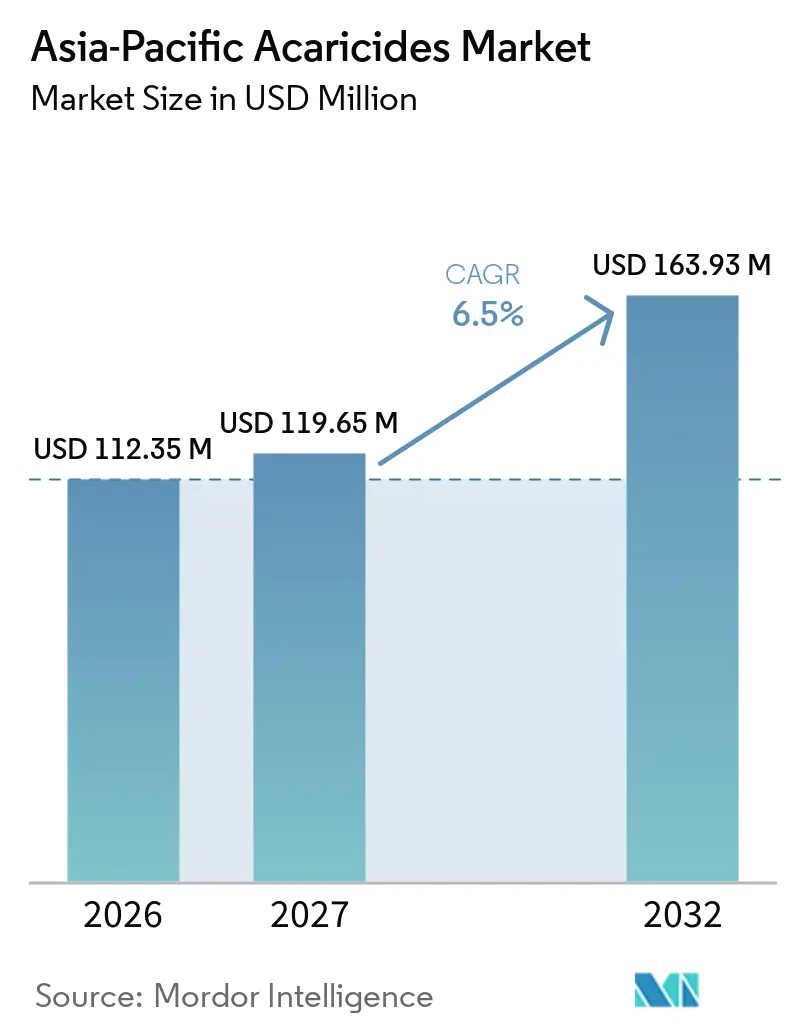
The Asia-Pacific acaricides market size was valued at USD 112.35 million in 2026 and is projected to grow from USD 119.65 million in 2027 to USD 163.93 million by 2032, registering a CAGR of 6.50% from 2027 to 2032. Acaricides are essential for protecting crops such as fruits, vegetables, and grains from mite infestations and for controlling tick-borne diseases in livestock and pets. This market is expanding due to the increasing demand for food production, the growing need for animal health solutions, and advancements in pest management practices.
Asia-Pacific is home to some of the world’s largest agricultural producers, such as China, India, and Japan. With rapid population growth and changing dietary patterns, there’s a rising demand for higher agricultural yields. Mites and ticks are known to cause significant crop damage, which makes acaricides essential for maintaining healthy crops. In India, the rising demand for cotton and soybeans requires farmers to control Tetranychus mites (spider mites), which affect these crops. Acaricides are used extensively in these regions to protect yields.
The growing livestock industry in the Asia-Pacific is another major driver. Mites and ticks on livestock not only affect animal health but also pose risks to humans through tick-borne diseases like Lyme disease and babesiosis. As the demand for meat and dairy products increases, the need for effective acaricide treatments for livestock is also on the rise. In China, the increasing demand for meat and dairy products has led to the growing use of acaricides to control ticks and mites on livestock, ensuring both animal health and productivity. For instance, according to the OECD, China's pork meat consumption increased from 55,546.4 thousand metric tons in 2022 to 56,290.0 thousand metric tons in 2023. This is expected to catalyze the overall growth of the acaricides market in the region.
Note: Market numbers in this report are based on Mordor Intelligence's proprietary estimation framework, which combines nine months of actuals with Q4 projections for base year 2026.
Asia-Pacific Acaricides Market Trends and Insights
Animal Husbandry Is the Largest Segment by Application
The Asia-Pacific region is home to some of the world’s largest and fastest-growing livestock markets. Countries like China, India, and Thailand have seen an increase in both livestock farming and the consumption of meat and dairy products due to rising incomes and population growth. In India, the demand for pork, beef, and poultry has been expanding. As livestock farming intensifies, the risk of pest infestations, especially ticks and mites, has increased, leading to a higher need for effective acaricides to protect animal health and productivity. For instance, according to FAOSTAT, India's poultry meat production increased from 4.65 million metric tons in 2021 to 5.06 million metric tons in 2023.
Ticks are vectors for several deadly diseases affecting livestock, such as tick-borne fever, babesiosis, anaplasmosis, and lyme disease. These diseases can lead to significant economic losses due to reduced milk production, weight loss, lower fertility, and even death in severe cases. Acaricides are essential in controlling tick populations and preventing the spread of these diseases. In India, bovine babesiosis caused by ticks is a serious problem in dairy cattle, affecting milk production and overall health. The increasing prevalence of such diseases has led to the greater use of acaricides to protect livestock from ticks.
The shift towards intensive livestock production systems such as large-scale poultry and dairy farms has led to higher densities of animals in confined spaces. These conditions are conducive to the rapid spread of parasitic infestations, including mites and ticks. Acaricides are used to prevent and control these infestations and reduce the associated health risks. In Vietnam and Thailand, intensive poultry farming has increased, and as a result, controlling red poultry mite infestations through acaricides has become a critical part of maintaining flock health.

China Dominates the Market
China dominates the Asia-Pacific acaricides market due to its extensive agricultural and livestock industries, high demand for pest control solutions, and agricultural modernization. The country's agricultural sector, one of the world's largest, encompasses extensive areas of crop production and livestock farming. China produces substantial volumes of crops susceptible to mite damage, including cotton, vegetables, fruits, and grains. The widespread cultivation of cotton and soybeans particularly necessitates acaricide use to combat spider mites and other pests. As one of the world's primary cotton producers, China faces significant challenges from the two-spotted spider mite (Tetranychus urticae), making acaricides essential for protecting crop yields. According to FAOSTAT, cottonseed production in China increased from 9.6 million metric tons in 2022 to 10.0 million metric tons in 2023.
As China’s livestock sector becomes more industrialized, there is growing awareness of the importance of animal health and welfare. Livestock farmers are increasingly adopting modern veterinary practices to control external parasites like ticks and mites, and acaricides are an integral part of these practices. For instance, according to FAOSTAT, China's egg production decreased from 35,129,691.05 metric tons in 2020 to 35,015,975.65 metric tons in 2022. In China’s large-scale poultry farms, ticks and mites can cause feather loss and reduced egg production. To address this, farmers use acaricides to manage these infestations and improve poultry health, ensuring higher productivity.

Competitive Landscape
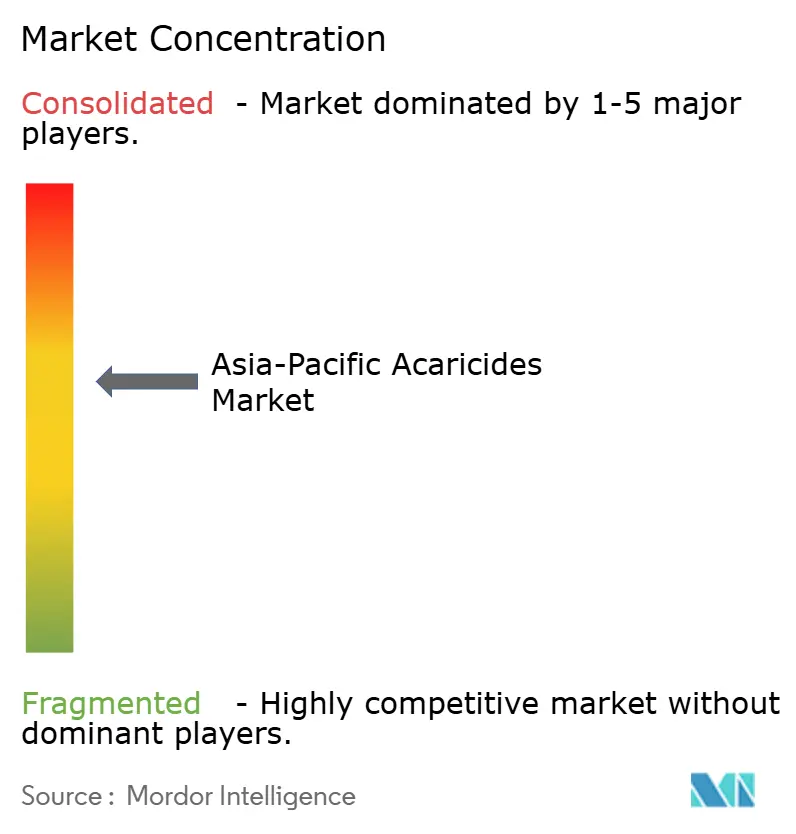
The Asia-Pacific acaricides market is moderately consolidated, with a few major players. Key players in the Asia-Pacific region include Nissan Chemical Corporation, Bayer AG, BASF SE, FMC Corporation, and Syngenta Group. Aside from the major players, many small local players are active in the region. The market in the region is witnessing rapid growth in product innovation, with a focus on increasing the retail availability of various acaricide products.
Asia-Pacific Acaricides Industry Leaders
-
Nissan Chemical Corporation
-
BASF SE
-
FMC Corporation
-
Bayer AG
-
Syngenta Group
- *Disclaimer: Major Players sorted in no particular order
Recent Industry Developments
- November 2024: Patent Acaricide WeiJing″ (Fluorofenoxime) Launched Yangnong Chemical‘s subsidiary Sinochem Crop Care Unveils Cutting-Edge Crop Protection Solution. The introduction of Sinochem Crop Care’s 威境 (WeiJing) acaricide signifies not just technological advancement but also its strong support for sustainable agricultural development. As agricultural technology progresses, 威境 (WeiJing) is poised to become one of the most recognized acaricide products on the market
- October 2022: The Institute of Plant Protection (IPP) of the Chinese Academy of Agricultural Sciences (CAAS) revealed that cyetpyrafen is a novel insecticide and acaricide developed in China, which can effectively control a variety of pests and red spider mites in horticulture and crops, and has been widely used in China.
Asia-Pacific Acaricides Market Report Scope
Acaricides are chemical agents that can kill members of arachnids like mites and ticks. The Asia-Pacific Acaricides Market is segmented by Product Type (Organochlorine, Organophosphorus, Pyrethroid, Carbamate, Natural Sources, and Other Product Types), Application Type (Agriculture, Animal Husbandry, Household Application, Industrial, and Other Application Types), and Geography (China, Japan, India, Australia, and Rest of Asia-Pacific). The report offers the market sizes and forecasts in value (USD) for all the above segments.
By Product Type
| Organochlorine |
| Organophosphorus |
| Pyrethroid |
| Carbamate |
| Natural Sources |
| Other Product Types |
By Application Type
| Agriculture |
| Animal Husbandry |
| Household Application |
| Industrial |
| Other Application Types |
By Geography
| China |
| Japan |
| India |
| Australia |
| Rest of Asia-Pacific |
| By Product Type | Organochlorine |
| Organophosphorus | |
| Pyrethroid | |
| Carbamate | |
| Natural Sources | |
| Other Product Types | |
| By Application Type | Agriculture |
| Animal Husbandry | |
| Household Application | |
| Industrial | |
| Other Application Types | |
| By Geography | China |
| Japan | |
| India | |
| Australia | |
| Rest of Asia-Pacific |
Key Questions Answered in the Report
What is the size of the Asia-Pacific acaricides market?
The Asia-Pacific acaricides market was valued at USD 112.35 million in 2026 and is projected to reach USD 163.93 million by 2032, registering a CAGR of 6.50% from 2027 to 2032.
Which country dominates the Asia-Pacific acaricides market?
China dominates the Asia-Pacific acaricides market, supported by its extensive agricultural and livestock industries, high demand for pest-control solutions, and agricultural modernization.
Who are the key players in Asia-Pacific Acaricides Market?
Nissan Chemical Corporation, Bayer AG, BASF SE, Syngenta Group, and FMC Corporation are the major companies operating in the Asia-Pacific acaricides market.
What are acaricides used for?
Acaricides are chemical agents used to control mites and ticks. They are applied across agriculture, animal husbandry, household, and industrial applications.