
| Study Period | 2019 - 2030 |
| Forecast Data Period | 2025 - 2030 |
| Historical Data Period | 2019 - 2023 |
| Market Size (2025) | USD 105.70 Billion |
| Market Size (2030) | USD 305.89 Billion |
| CAGR (2025 - 2030) | 23.68% |
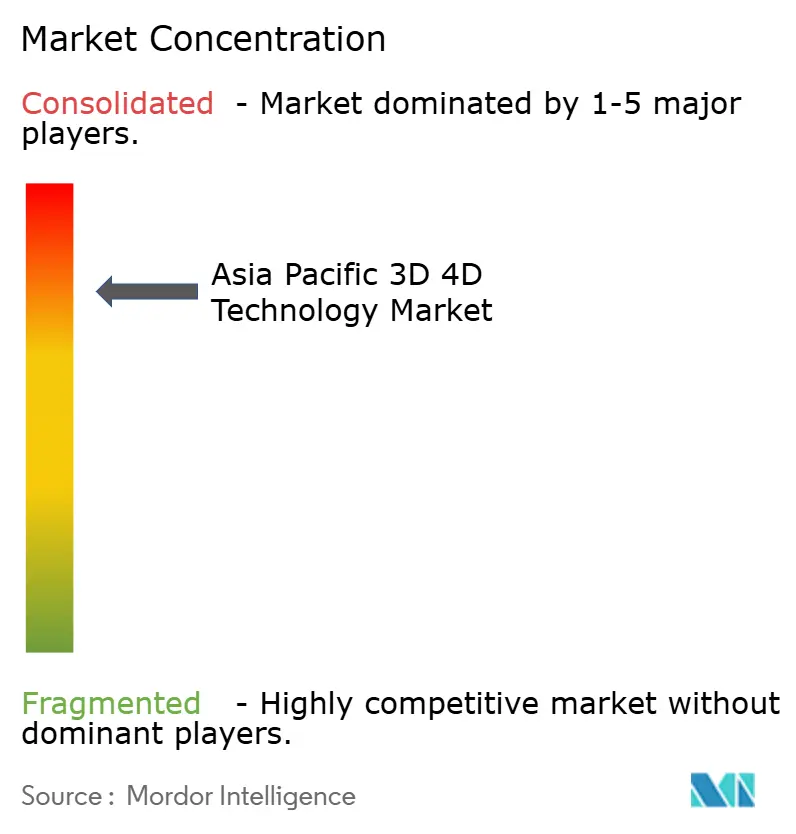
| Market Concentration | High |
Major Players *Disclaimer: Major Players sorted in no particular order |
Asia Pacific 3D 4D Technology Market Analysis by Mordor Intelligence
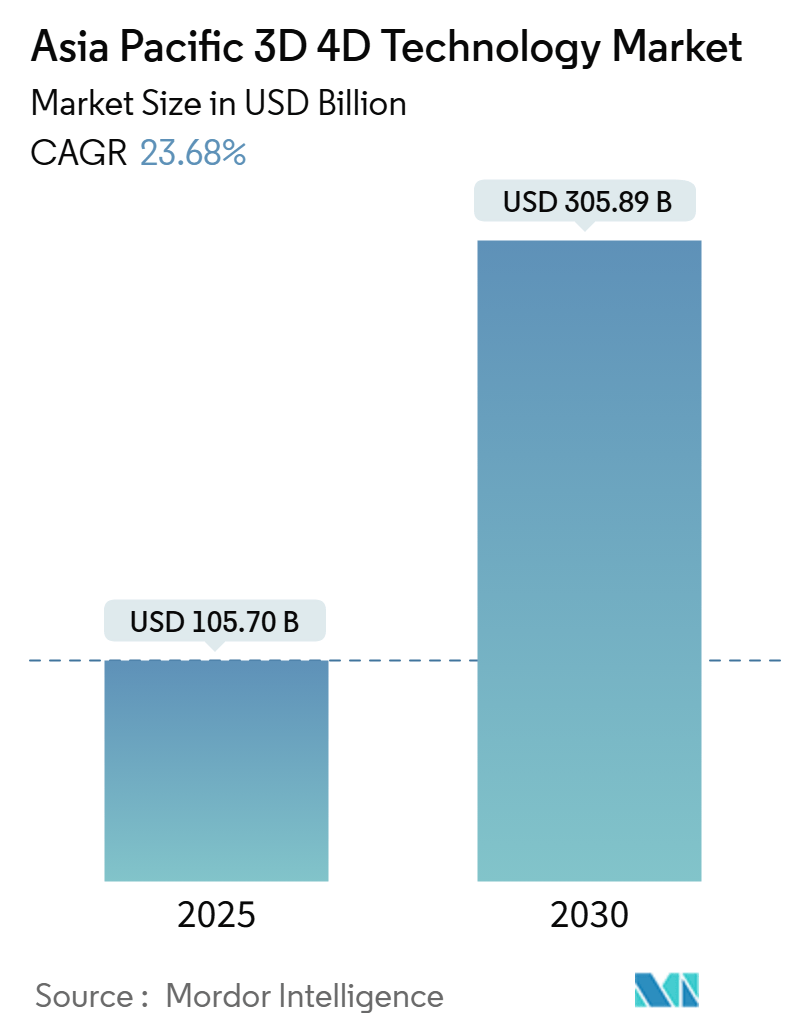
The Asia Pacific 3D 4D Technology Market size is estimated at USD 105.70 billion in 2025, and is expected to reach USD 305.89 billion by 2030, at a CAGR of 23.68% during the forecast period (2025-2030).
- Robust growth in the Asia Pacific 3D and 4D Technology Market is positioning the region as a pivotal player in the global adoption and evolution of these technologies. This surge is driven by significant investments, the creation of innovation hubs, and a rising consumer appetite for immersive experiences. The region's strategic focus on infrastructure development and technological advancements has further solidified its role as a global leader in this domain.
- Key sectors, including film, gaming, and animation, are harnessing 3D and 4D technologies to boost user engagement. The healthcare industry is swiftly adopting these technologies, employing 3D and 4D imaging for accurate medical diagnoses, surgical planning, and research. Such advanced visualization techniques offer healthcare professionals in-depth insights into patient anatomy, enhancing surgical results and treatment strategies. For instance, 3D imaging allows for the creation of detailed anatomical models, enabling surgeons to plan complex procedures with greater precision, while 4D imaging provides real-time visualization of dynamic processes, such as blood flow or organ movement, further improving diagnostic accuracy.
- The broadening application of 3D technology across diverse sectors is a primary catalyst for market growth. Sectors like manufacturing, architecture, education, and defense are increasingly embracing 3D and 4D technologies, spurring demand for related products, such as 3D scanners, modeling software, printers, and content development platforms. In manufacturing, 3D printing is revolutionizing prototyping and production processes by reducing lead times and enabling customization. In architecture, 3D modeling software is facilitating the creation of intricate designs and virtual walkthroughs, enhancing project visualization and client engagement. Countries like Japan, South Korea, and China are bolstering these advancements through national innovation initiatives, propelling market growth. For example, government-backed programs in these nations are fostering research and development, providing subsidies for technology adoption, and encouraging collaboration between academia and industry to accelerate innovation.
- The entertainment industry's appetite for 3D and 4D experiences has significantly accelerated market momentum. As consumers gravitate towards ultra-realistic experiences in films, video games, theme parks, and virtual concerts, companies are compelled to adopt cutting-edge technologies. For instance, Universal Studios Beijing has unveiled groundbreaking 4D attractions, merging next-gen visual and sensory effects. These attractions, a first in the Asia-Pacific, offer an unparalleled immersive experience by fusing physical settings with digital interactivity. Such advancements are not only enhancing consumer satisfaction but also setting new benchmarks for the entertainment industry, encouraging other players to invest in similar technologies to remain competitive.
- Yet, challenges loom. The steep costs tied to 3D printing materials and advanced imaging systems pose hurdles, especially for smaller firms. Despite tech strides, the high price of premium materials—like metal powders, polymers, and specialized resins—continues to hinder the scalability and widespread adoption of 3D and 4D solutions across sectors. Additionally, the lack of skilled workforce to operate and maintain these advanced systems further exacerbates the issue, creating a gap between technological potential and practical implementation.
- Looking forward, the Asia-Pacific is poised to uphold its dominance in the 3D and 4D technology arena. This leadership, underpinned by tech innovation, robust government backing, and a digitally adept populace, signals a bright future. Firms prioritizing cost-effective solutions and forging strategic alliances stand to gain immensely in this vibrant market. Companies that invest in training programs to build a skilled workforce and focus on developing affordable materials and equipment are likely to overcome existing barriers and capitalize on the region's growth potential.
Asia Pacific 3D 4D Technology Market Trends and Insights
3D Printer Application Segment is Expected to Hold Significant Market Share
- In 2024, the Asia-Pacific 3D and 4D technology market is set for substantial growth, primarily driven by the 3D printer application segment. This expansion is bolstered by the growth of industries like aerospace, healthcare, education, and construction, coupled with swift technological advancements and robust government initiatives championing manufacturing innovation.
- 3D printers are now pivotal in crafting intricate and lightweight components for aircraft, spacecraft, drones, and automobiles. These components are designed to boost performance, enhance structural integrity, and maximize fuel efficiency. Countries such as China, South Korea, and Japan are heavily investing in aerospace-grade 3D printing technologies. Notably, China's Commercial Aircraft Corporation (COMAC) has incorporated 3D-printed components into its C919 passenger jet, aiming for heightened efficiency and reduced production costs.
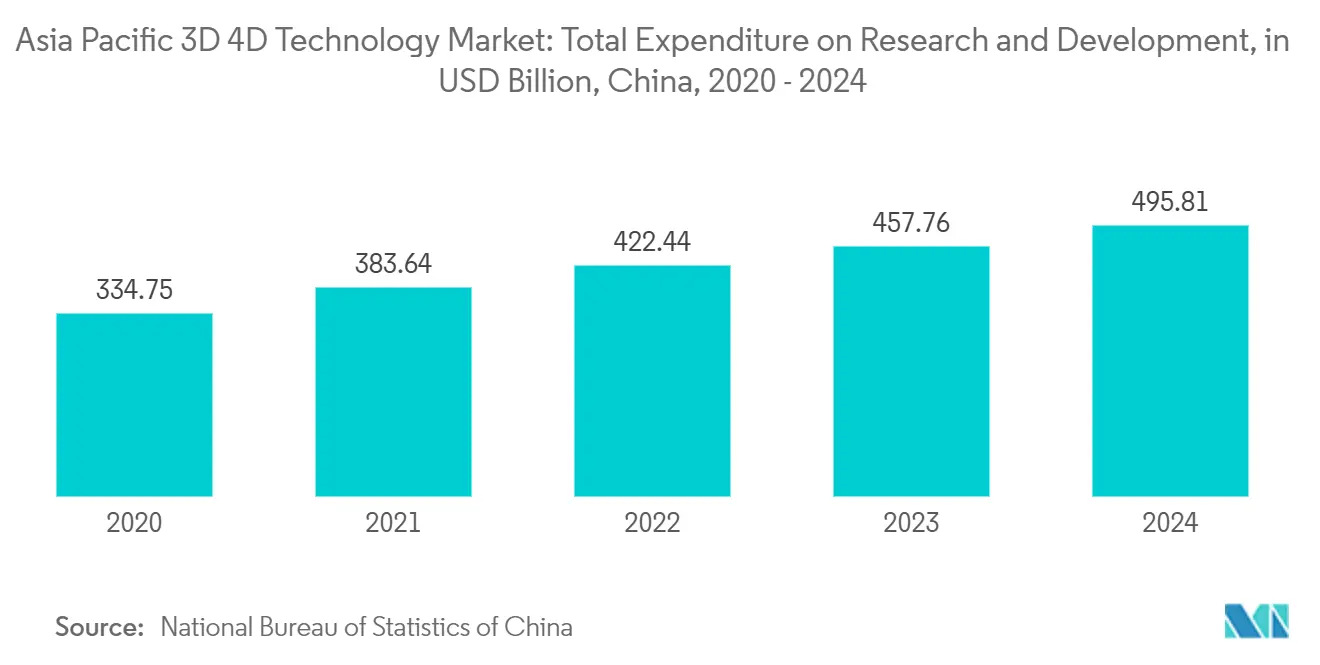
- Prototyping stands out as a primary application of 3D printers. Recently, the Asia-Pacific region has seen a marked uptick in research and development expenditure. The National Bureau of Statistics of China reported that in 2024, China's total R&D expenditure hit USD 495.81 billion. Given the pivotal role of prototypes in the R&D process, this trend is poised to bolster 3D printer adoption.
- Moreover, the healthcare sector in Asia-Pacific is witnessing a revolution, owing to 3D printing. Hospitals and research entities are harnessing this technology for patient-specific anatomical models, custom prosthetics, dental implants, and bio-printed tissues. In a landmark achievement in 2024, researchers in Singapore successfully bio-printed a functional liver tissue model, marking a significant leap in regenerative medicine. Furthermore, healthcare facilities across the region are increasingly adopting customized dental crowns, orthodontic devices, and implants tailored to individual patients.
- Across the Asia-Pacific, educational institutions are weaving 3D printing into their curricula, emphasizing its significance in engineering, medicine, and manufacturing. Universities in Australia, India, and Malaysia have set up specialized 3D printing labs, nurturing innovation and offering hands-on experiences. This move is preparing future engineers and designers with essential skills in additive manufacturing.
- In architecture and construction, 3D printing is proving to be a game-changer. Architects and builders are employing it for detailed scale models, quick prototypes, and functional construction elements. In 2024, India unveiled its inaugural 3D-printed post office in Bengaluru, showcasing 3D printing's potential to hasten construction and minimize material waste. Likewise, Australian firms are experimenting with 3D-printed houses as a solution to affordable housing challenges.
- A 2024 survey by SWZD revealed that around 57% of Asia-Pacific businesses have embraced or plan to adopt 3D printing technologies within two years. This marks a significant uptick from prior years, fueled by heightened awareness of 3D printing's cost-efficiency, customization, and sustainability advantages. With businesses leaning towards localized manufacturing and sustainable practices, the Asia-Pacific 3D printing market is poised for further expansion. As industries come to appreciate the enduring benefits of 3D and 4D technologies, the region is set to solidify its status as a global innovation and growth hub.


China is Expected to Hold Significant Market Share
- In 2024, China solidified its status as a global frontrunner in manufacturing and technology, honing in on 3D and 4D printing. The nation swiftly integrated additive manufacturing (AM) into pivotal sectors like aerospace, automotive, healthcare, construction, and consumer goods. Bolstered by government initiatives championing industrial innovation and technological autonomy, China spearheads 3D and 4D technological advancements in the Asia-Pacific arena.
- China harnesses 3D printing across vital sectors. Aerospace giants COMAC and AVIC employ 3D printing for lightweight structural components and engine parts. Hospitals in the healthcare domain are turning to 3D bioprinting for bespoke prosthetics, implants, and preliminary tissue models pivotal for regenerative medicine. Meanwhile, in consumer goods, businesses utilize 3D printing to craft personalized products, catering to the surging customization demand.
- The Chinese government is instrumental in nurturing the 3D and 4D technology landscape. With initiatives like "Made in China 2025" and the "14th Five-Year Plan for Intelligent Manufacturing," the government underscores additive manufacturing as a cornerstone of industrial evolution. These initiatives channel significant funding into research and development, foster public-private partnerships, and bolster education in cutting-edge manufacturing technologies. As a result, Chinese universities and research entities are pioneering studies in 3D printing materials, design optimization, and novel applications like bioprinting and expansive construction printing.
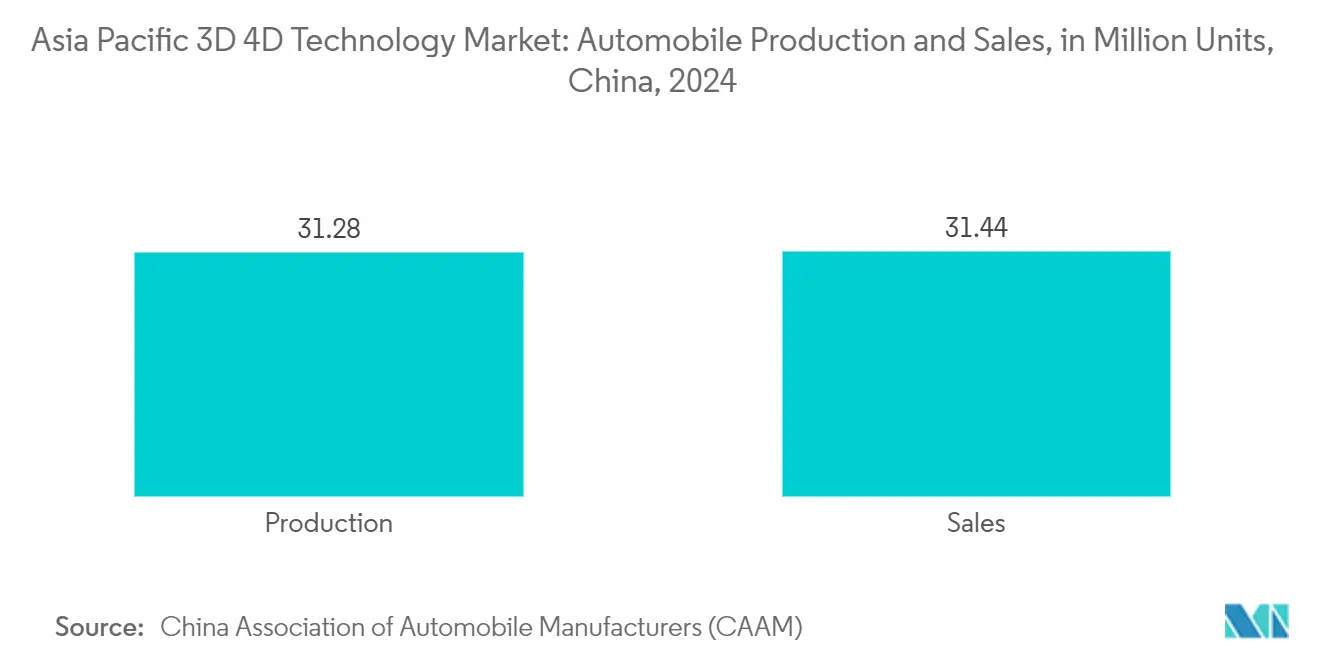
- In the automotive realm, 3D and 4D technologies have emerged as pivotal operational elements. Industry leaders BYD and Geely harness 3D printing for swift prototyping, design validation, and crafting lightweight, high-performance vehicle parts. The embrace of 4D printing, allowing components to adjust to environmental shifts, bolsters vehicle longevity and efficiency. With China's automobile production on the rise, tools for 3D modeling and simulation are becoming vital for shortening design cycles and upholding safety benchmarks. Data from the China Association of Automobile Manufacturers (CAAM) reveals that in 2024, China rolled out 31.28 million vehicles, marking a 3.7% annual uptick.
- In a landmark move in 2024, China's WinSun company showcased the promise of sustainable construction through additive manufacturing, wrapping up a commercial office project with 3D-printed concrete modules.
- Furthermore, China's drive for technological advancement, paired with its vast manufacturing capabilities and a burgeoning consumer appetite for tailored solutions, cements its stature in the Asia-Pacific 3D and 4D technology landscape. With ongoing commitments to research, education, and industrial evolution, China's dominance in global additive manufacturing trends is poised to endure through 2030.

Competitive Landscape
In the Asia-Pacific 3D and 4D technology market, major players like 3D Systems Corporation, Dolby Laboratories, Inc., LG Electronics Inc., Barco N.V., and Samsung Electronics Co., Ltd. dominate the landscape. These industry leaders are actively pursuing regional partnerships, mergers and acquisitions, and technological innovations to bolster their product offerings and secure a lasting competitive advantage. For instance, companies are increasingly focusing on integrating artificial intelligence (AI) and machine learning (ML) into their 3D and 4D solutions to enhance performance and cater to evolving customer demands. Additionally, strategic collaborations with local firms are enabling these players to expand their regional footprint and address market-specific needs effectively.
Key sectors such as healthcare, aerospace, construction, and media are fueling the demand for cutting-edge 3D and 4D technologies in the Asia-Pacific region. In healthcare, for example, 3D imaging and 4D ultrasound technologies are revolutionizing diagnostics and treatment planning. Similarly, the aerospace industry is leveraging 3D printing for prototyping and manufacturing lightweight components. With governments emphasizing investments in smart manufacturing and startups driving innovation, the market is set for continued growth, projected to extend through 2030. Furthermore, initiatives like subsidies for technology adoption and the establishment of innovation hubs are creating a conducive environment for market expansion.
Asia Pacific 3D 4D Technology Industry Leaders
3D Systems Corporation
Dolby Laboratories, Inc.
LG Electronics Inc.
Barco N.V.
Samsung Electronics Co., Ltd.
- *Disclaimer: Major Players sorted in no particular order

Recent Industry Developments
- March 2025: Researchers at Hong Kong University of Science and Technology (HKUST) have unveiled a groundbreaking 3D printer that crafts food layer by layer, harnessing the power of graphene and artificial intelligence (AI). This innovative printer not only constructs intricate edible designs but also employs precision infrared heating, ensuring top-notch product quality and safety. The use of graphene enhances the printer's efficiency and thermal conductivity, while AI algorithms optimize the printing process by adjusting parameters in real-time. This technology has the potential to revolutionize food production by enabling the creation of customized, nutritious, and visually appealing meals.
- March 2025: At the TCT Asia event, Shenzhen Addireen Technologies unveiled its XH-M660G machine, underscoring the industry's shift towards larger build volumes. Boasting an impressive build area of 660 x 660 x 1300mm, the system is tailored for pure copper and its alloys, materials that are gaining traction in sectors such as electronics and aerospace.


Asia Pacific 3D 4D Technology Market Report Scope
Technologies harness 3D visuals to craft experiences, whether mirroring reality or venturing into the virtual realm. These experiences can range from subtle technological overlaps to the depths of fully immersive gadgets. While 4D technology encompasses all four conventional dimensions, it's pivotal to note that in physics, the term, though rooted in three-dimensional space (3D), integrates the dimension of time alongside the traditional trio: length, width, and depth.
This study delves deep into the trends and dynamics shaping the 3D and 4D technology landscape in the Asia Pacific. Market estimates are anchored on the revenues generated by leading players in the 3D and 4D tech arena. Additionally, the analysis sheds light on primary growth drivers and the sway of macroeconomic factors, refining both market estimates and growth forecasts.
The Asia Pacific 3D 4D technology market is segmented by application (electrical & electronic components, 3D printer, 3D gaming, 3D displays, and other applications), by end-user industry (healthcare, entertainment and media, education, government, industrial, consumer electronics, construction, other end-user industries), and by country (China, Japan, India, South Korea, and Rest of Asia Pacific). The market sizes and forecasts are provided in terms of value in USD for all the above segments.
By Application
| Electrical & Electronic Components (IC, Transistors, Sensors Etc) |
| 3D Printer |
| 3D Gaming |
| 3D Displays |
| Other Applications |
By End User Industry
| Healthcare |
| Entertainment and Media |
| Education |
| Government |
| Industrial |
| Consumer Electronics |
| Construction |
| Other End User Industries |
By Country
| China |
| Japan |
| India |
| South Korea |
| By Application | Electrical & Electronic Components (IC, Transistors, Sensors Etc) |
| 3D Printer | |
| 3D Gaming | |
| 3D Displays | |
| Other Applications | |
| By End User Industry | Healthcare |
| Entertainment and Media | |
| Education | |
| Government | |
| Industrial | |
| Consumer Electronics | |
| Construction | |
| Other End User Industries | |
| By Country | China |
| Japan | |
| India | |
| South Korea |


Key Questions Answered in the Report
How big is the Asia Pacific 3D 4D Technology Market?
The Asia Pacific 3D 4D Technology Market size is expected to reach USD 105.70 billion in 2025 and grow at a CAGR of 23.68% to reach USD 305.89 billion by 2030.
What is the current Asia Pacific 3D 4D Technology Market size?
In 2025, the Asia Pacific 3D 4D Technology Market size is expected to reach USD 105.70 billion.
Who are the key players in Asia Pacific 3D 4D Technology Market?
3D Systems Corporation, Dolby Laboratories, Inc., LG Electronics Inc., Barco N.V. and Samsung Electronics Co., Ltd. are the major companies operating in the Asia Pacific 3D 4D Technology Market.
What years does this Asia Pacific 3D 4D Technology Market cover, and what was the market size in 2024?
In 2024, the Asia Pacific 3D 4D Technology Market size was estimated at USD 80.67 billion. The report covers the Asia Pacific 3D 4D Technology Market historical market size for years: 2019, 2020, 2021, 2022, 2023 and 2024. The report also forecasts the Asia Pacific 3D 4D Technology Market size for years: 2025, 2026, 2027, 2028, 2029 and 2030.
Page last updated on:
Asia Pacific 3D 4D Technology Market Report
Statistics for the 2025 Asia Pacific 3D 4D Technology market share, size and revenue growth rate, created by Mordor Intelligence™ Industry Reports. Asia Pacific 3D 4D Technology analysis includes a market forecast outlook for 2025 to 2030 and historical overview. Get a sample of this industry analysis as a free report PDF download.


 Your data is secure and never sold or shared.


