
Art & Craft Tools Market Size and Share
Market Overview
| Study Period | 2021 - 2031 |
|---|---|
| Market Size (2026) | USD 4.23 Billion |
| Market Size (2031) | USD 5.96 Billion |
| Growth Rate (2026 - 2031) | 7.11 % |
| Fastest Growing Market | Asia-Pacific |
| Largest Market | North America |
| Market Concentration | Medium |
Major Players *Disclaimer: Major Players sorted in no particular order Image © Mordor Intelligence. Reuse requires attribution under CC BY 4.0. | |
Art & Craft Tools Market Analysis by Mordor Intelligence
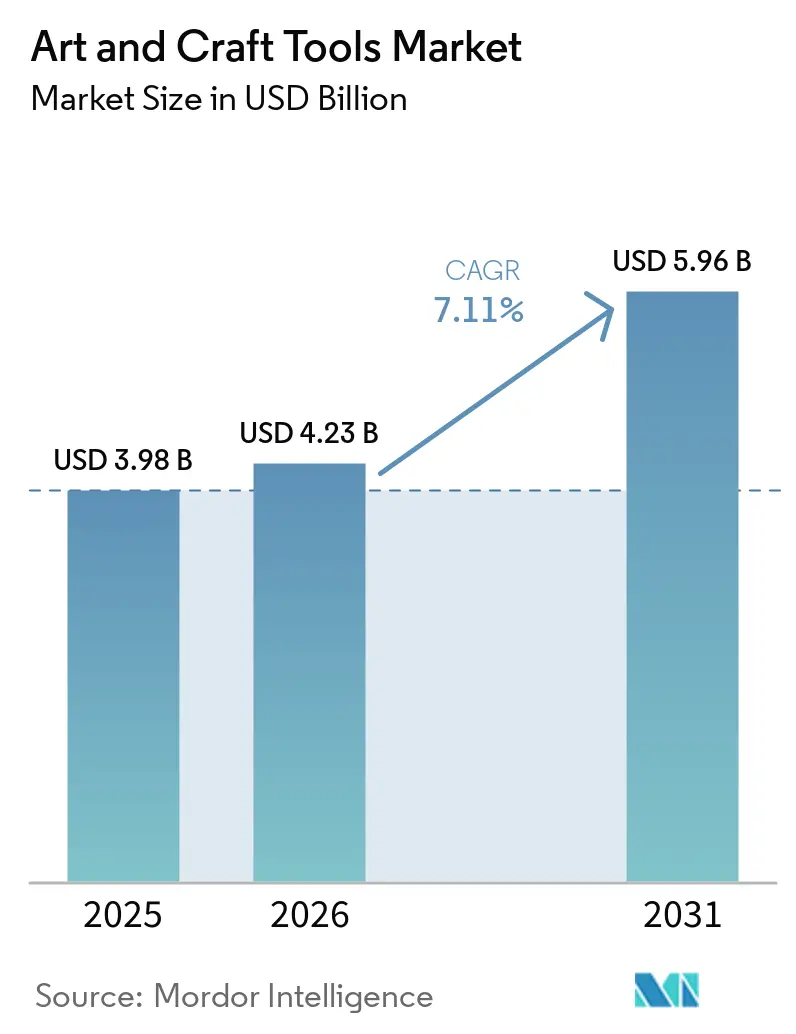
The art and craft tools market, valued at USD 3.98 billion in 2025, is projected to grow to USD 4.23 billion in 2026 and reach USD 5.96 billion by 2031, with a 7.11% CAGR from 2026 to 2031. Previously driven by seasonal school purchases, demand now spans year-round due to household recreation, therapeutic use, and professional studio needs. DIY crafting has become a popular leisure activity for younger consumers in North America and Europe, while art therapy is gaining formal adoption in schools and wellness programs. Core drawing and painting products lead the market, but there is growing interest in commercial studio formats, eco-friendly materials, and specialty retail concepts offering product guidance and trials. North America holds the largest market share, Asia-Pacific is expanding rapidly, and Europe favors established suppliers meeting strict safety and material standards. However, challenges include digital tools replacing traditional methods in professional illustration and rising material costs for plastics, metals, and wood, compounded by stricter trade policies.
Key Report Takeaways
- By product type, Drawing and Painting Tools held 39.43% share in 2025, while Paper Crafts and Decorative Items are forecast to expand at 7.96% CAGR through 2031.
- By application, Household accounted for 45.21% share in 2025, while Commercial Art Studios are projected to grow at 8.01% CAGR through 2031.
- By material, Plastic held 48.71% share in 2025, while Wood is forecast to advance at 7.84% CAGR through 2031.
- By distribution channel, Online Stores held 35.31% share in 2025, while Specialty Stores are expected to grow at 8.23% CAGR through 2031.
- By geography, North America held 42.33% share in 2025, while Asia-Pacific is forecast to expand at 9.11% CAGR through 2031.
Note: Market size and forecast figures in this report are generated using Mordor Intelligence’s proprietary estimation framework, updated with the latest available data and insights as of January 2026.
Market Trends and Insights
Drivers Impact Analysis of Art & Craft Tools Market*
| Drivers | (~) % Impact on CAGR Forecast | Geographic Relevance | Impact Timeline |
|---|---|---|---|
| Rising Use Of Art Therapy In Schools, Clinics, And Wellness Programs | +1.2% | North America and Europe, with emerging uptake in Asia-Pacific | Medium term (2-4 years) |
| Sustainability And Eco-Friendly Product Preferences | +0.9% | EU-led, with spillover to North America and Asia-Pacific | Long term (≥ 4 years) |
| Expansion Of E-Commerce Platforms Improving Product Accessibility | +1.4% | Global, with highest penetration in North America and Asia-Pacific | Short term (≤ 2 years) |
| Rising Popularity Of DIY Culture And Home-Based Crafting | +1.5% | North America, Europe, and urban Asia-Pacific centers | Medium term (2-4 years) |
| Innovation In Ergonomics, Safety, And Material Quality | +0.8% | Global, led by premium markets in Europe and North America | Long term (≥ 4 years) |
| Social Media Platforms Amplifying Creative Trends And Tutorials | +1.0% | Global, concentrated in Gen Z and Millennial demographics | Short term (≤ 2 years) |
| Source: Mordor Intelligence | |||
Rising Use of Art Therapy in Schools, Clinics, and Wellness Programs
As art therapy increasingly integrates into organized school and clinical programs, the demand for art and craft tools is solidifying. In February 2025, the Medical University of South Carolina highlighted its "Arts in Healing" initiative, providing structured art therapy to over 80 students in Florence public schools. This underscores a shift towards education-linked procurement[1]Source: Medical University of South Carolina, “Arts in Healing Program Helps Florence Students Express Emotions Through Art”, musc.edu. A systematic analysis in Frontiers in Psychology in 2025 noted a significant evolution from 2020 to 2024, emphasizing the growing intersections of art therapy with psychology, digital health, and education across various regions. With the formalization of these programs, there's a trend towards bulk procurement, standardized tool lists, and defined safety criteria. This shift positions suppliers with certified products and dependable B2B distribution channels more favorably than brands reliant on consumer impulse sales in the art and craft tools market.
Sustainability and Eco-Friendly Product Preferences
Across the art and craft tools market, sustainability is reshaping sourcing, formulation, and shelf positioning, particularly in premium and regulated channels. Faber-Castell, leveraging a direct sourcing advantage, manages over 10,000 hectares of FSC-certified forest in Brazil, ensuring a steady supply of certified pencil wood. STAEDTLER showcases the synergy of material efficiency and certification by producing select pencils from PEFC-certified upcycled wood chips, a byproduct of industrial sawing and planing. This trend is bolstered by stringent material disclosure and chemical compliance standards in Europe and the U.S. Consequently, the art and craft tools market is increasingly allocating premium shelf space to major suppliers capable of financing certification, testing, and large-scale reformulation efforts.
Expansion of E-Commerce Platforms Improving Product Accessibility
Online channels are broadening the customer base for the art and craft tools market, eliminating the stock and location constraints that once defined the industry. Digital storefronts can showcase both entry-level and specialized products, free from the assortment limitations of brick-and-mortar stores. Crayola exemplified this strategy with its "All Grown Up" adult line, debuting on Amazon in June 2026, followed by launches at Walmart, Michaels, and various grocery stores in the fall. This tactic underscores the art and craft tools market's dual use of e-commerce: driving sales volume and swiftly gauging new audiences and pricing strategies. However, brands that depend solely on third-party platforms face margin pressures unless they cultivate stronger direct relationships with customers, in addition to their marketplace presence.
Rising Popularity of DIY Culture and Home-Based Crafting
DIY crafting is no longer tied only to seasonal projects or budget-driven behavior, and that shift is supporting broader demand in the art and craft tools market. Home-based crafting now overlaps with self-expression, casual wellness activity, gifting, and social participation, which increases the number of purchase occasions through the year. This matters because the art and craft tools market can draw spending from consumers who are not trained artists but still want accessible, shareable, and visually rewarding projects. It also changes product design priorities toward beginner-friendly kits, easy formats, and outcomes that are suitable for display or gifting. In practical terms, suppliers that balance ease of use with attractive presentation are better placed to capture household demand than brands focused only on technical performance.
Restraints Impact Analysis of Art & Craft Tools Market*
| Restraint | (~) % Impact on CAGR Forecast | Geographic Relevance | Impact Timeline |
|---|---|---|---|
| Competition From Digital Art Tools And Software | -1.2% | Global, highest impact in North America and Europe | Short term (≤ 2 years) |
| Regulatory And Safety Standards Shaping Viability And Access | -0.6% | EU and North America, progressively expanding to Asia-Pacific | Medium term (2-4 years) |
| Environmental Concerns Related To Manufacturing And Disposal | -0.4% | Global, most acute in EU markets | Long term (≥ 4 years) |
| Volatility In Raw Material Prices, Particularly Plastics And Wood | -0.8% | Global, with acute risk in North America due to trade policy | Short term (≤ 2 years) |
| Source: Mordor Intelligence | |||
Competition from Digital Art Tools and Software
Digital software is increasingly replacing traditional tools in professional illustration and design. For instance, Adobe's integration of Firefly 3.0 into Photoshop and Illustrator has streamlined image creation, diminishing the reliance on premium drawing and rendering tools. However, this shift isn't felt equally across the art and craft tools market. Sectors like therapy, education, and tactile hobbies still prioritize hands-on interaction with materials. A 2025 review in Frontiers in Psychology highlighted that the benefits of art therapy are tied to this physical engagement, making direct substitution challenging. As a result, while demand may wane in professional drawing tiers, the broader market isn't facing a collapse[2]Source: Frontiers in Psychology, “An Overview of the Integration and Development Trends Between Arts and Psychotherapy”, frontiersin.org.
Volatility in Raw Material Prices, Particularly Plastics and Wood
Input cost volatility poses a persistent challenge for the art and craft tools market. Many of these products rely on materials such as polymer resins, aluminum, specialty metals, and certified timber. In early 2025, newly introduced trade measures escalated the costs of imported materials. This affected standard tools like scissors, marker barrels, and paint applicators, putting added pressure on manufacturers tied to supply chains in China and North America. The market also grapples with rising premiums on certified wood. Demand for FSC and PEFC-compliant timber is outpacing certified availability. However, larger suppliers like Faber-Castell, which controls certified forest assets, and STAEDTLER, known for its use of upcycled wood, have more flexibility in their sourcing strategies. In contrast, mid-market suppliers, especially those unable to transfer increased costs to price-sensitive retailers, find themselves in a more precarious position.
*Our forecasts treat driver/restraint impacts as directional, not additive. The impact forecasts reflect baseline growth, mix effects, and variable interactions.
Art & Craft Tools Market Segment Analysis
By Product Type:
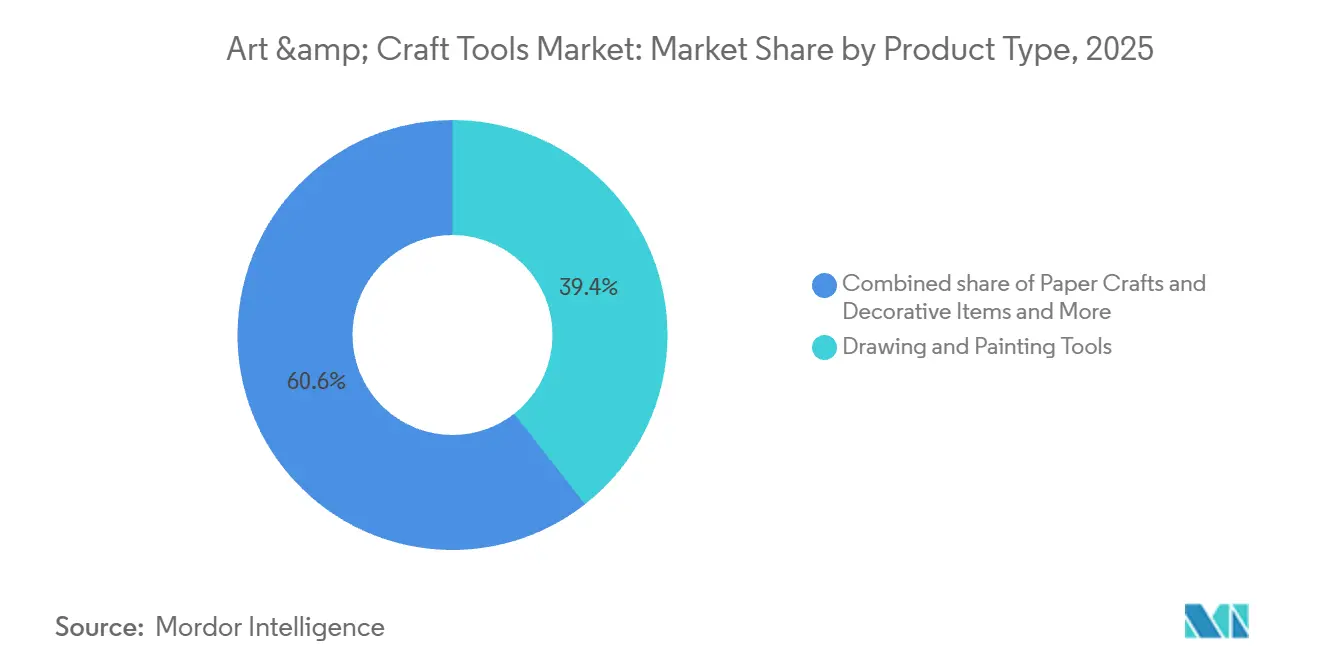
Drawing and Painting Tools Sustain Revenue DominanceIn 2025, Drawing and Painting Tools held a 39.43% share of the art and craft tools market. This segment's dominance stems from its wide range of products, including pencils, markers, paints, brushes, and surfaces, catering to users from schoolchildren to professionals. Most beginners in creative activities start with basic drawing, coloring, or painting, highlighting this segment's importance. Its layered product structure adds value, with commodity lines driving volume and premium artist materials boosting margins. In 2025, STAEDTLER enhanced this segment by launching its Artist Series, featuring Mars Lumograph colour aquarell pencils, designed with professional artists for lightfastness and watercolor use.
From 2026 to 2031, Paper Crafts and Decorative Items are expected to grow at a 7.96% CAGR, making them the fastest-growing segment in the art and craft tools market. Their growth is driven by home décor trends, gifting seasons, and creative activities in North America and Europe. The segment's low entry barriers attract new users, while specialty papers, metallic finishes, and embossed materials encourage experienced users to upgrade. Additionally, the category thrives on social media, where its visual transformations are engaging and easy for beginners to replicate.



By Application:
Household Commands Scale, Commercial Studios Drive Premium GrowthIn 2025, households held a 45.21% share of the art and craft tools market, highlighting crafting's popularity among families, hobbyists, and adults seeking leisure activities. This significant segment supports the market and includes children's value packs and premium adult kits. Purchases are influenced by seasonality, trends, gifting, and crafting's role as a calming home activity. To target this adult audience, Crayola launched its "All Grown Up" line in June 2026, featuring alcohol-based markers and artist-designed coloring books.
Commercial Art Studios are projected to grow at a CAGR of 8.01% from 2026 to 2031, making them the fastest-growing segment in the art and craft tools market. This category includes craft class venues, creative studios, and experience-focused retail formats, which purchase tools more frequently and at higher quality than households. Educational institutions also drive demand as art-based experiential learning grows. In March 2026, Crayola announced a partnership with Luxor Writing Instruments to improve access to experiential learning for India's 436 million children across 1.5 million schools. This shift shows the industry increasingly serves organized educational budgets alongside household spending.
By Material:
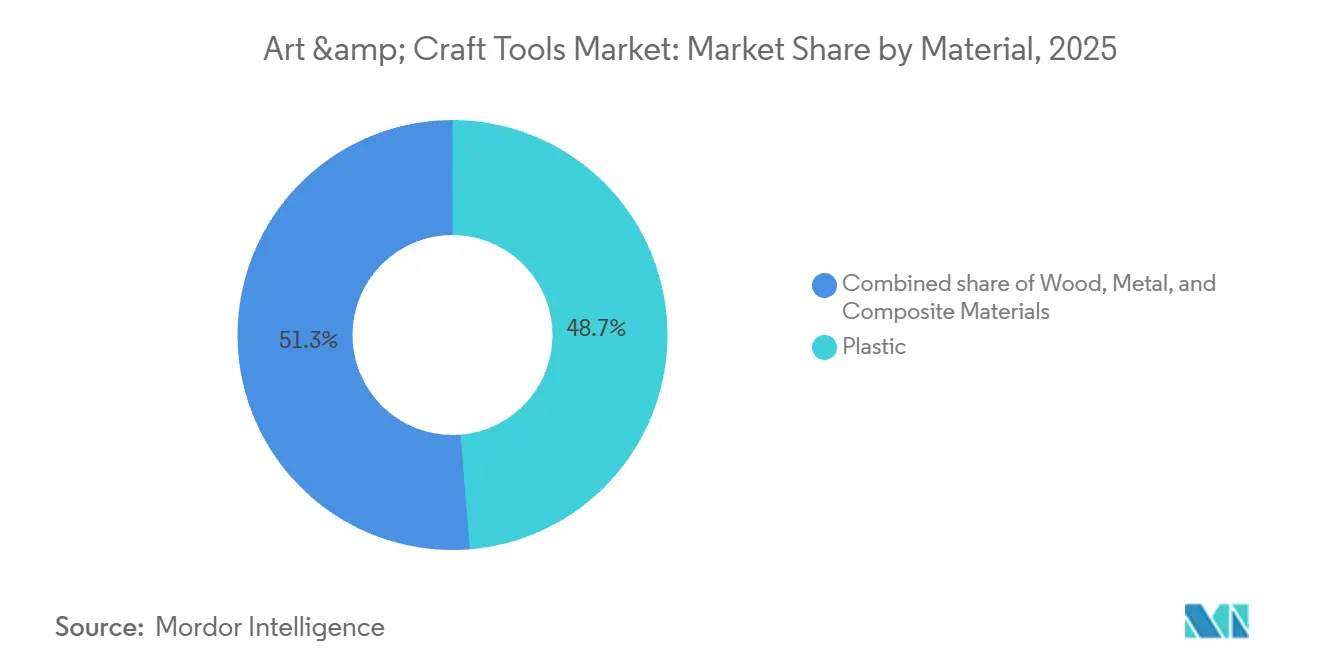
Plastic Anchors Volume, Wood Leads the Sustainability PremiumIn 2025, plastic commanded a dominant 48.71% share of the revenue in the material segment of the art and craft tools market. Its cost efficiency and versatility in molding across various categories solidified its leading position. From marker barrels and rulers to scissor handles and storage accessories, many tools heavily rely on polymer-based construction. This reliance underscores plastic's significance in households and schools, where both affordability and ergonomic design are paramount. Despite evolving compliance rules nudging suppliers towards safer, specialized formulations for children's products, the art and craft tools market continues to lean on this foundational material.
Wood is set to emerge as the fastest-growing material segment in the art and craft tools market, with a projected CAGR of 7.84% from 2026 to 2031. The allure of wood isn't just its sustainability; it's the premium feel and aesthetic appeal it imparts to pencils and related tools. Faber-Castell's certified forest base in Brazil ensures a secure supply for wood-cased pencils. Meanwhile, STAEDTLER's adoption of PEFC-certified upcycled wood exemplifies the industry's ability to merge environmental responsibility with enhanced material utilization. Moreover, in regions like Europe and North America, certified sourcing is evolving into both a compliance necessity and a gateway to market access.
By Distribution Channel:
Online Stores Lead Revenue, Specialty Stores Outpace on GrowthIn 2025, online stores held a 35.31% share, making them the top distribution channel in the art and craft tools market. Their success is due to a wider assortment, price transparency, and better visibility for niche items often missing on physical shelves. The market increasingly adopts digital-first launches, as online platforms enable cost-effective demand testing and quick feedback. For example, Crayola launched its adult line on Amazon in 2026 before expanding to physical stores.
Specialty stores are projected to grow at an 8.23% CAGR from 2026 to 2031, making them the fastest-growing channel in the art and craft tools market despite online growth. They attract customers with hands-on product trials, expert guidance, and community activities, appealing to dedicated craft users. Physical specialty retail remains important for categories where texture, color range, and tool feel influence buying decisions. This channel is expected to stay relevant for premium materials, classroom supplies, and curated project shopping in the art and craft tools sector.
Geography Analysis
North America Art & Craft Tools Market
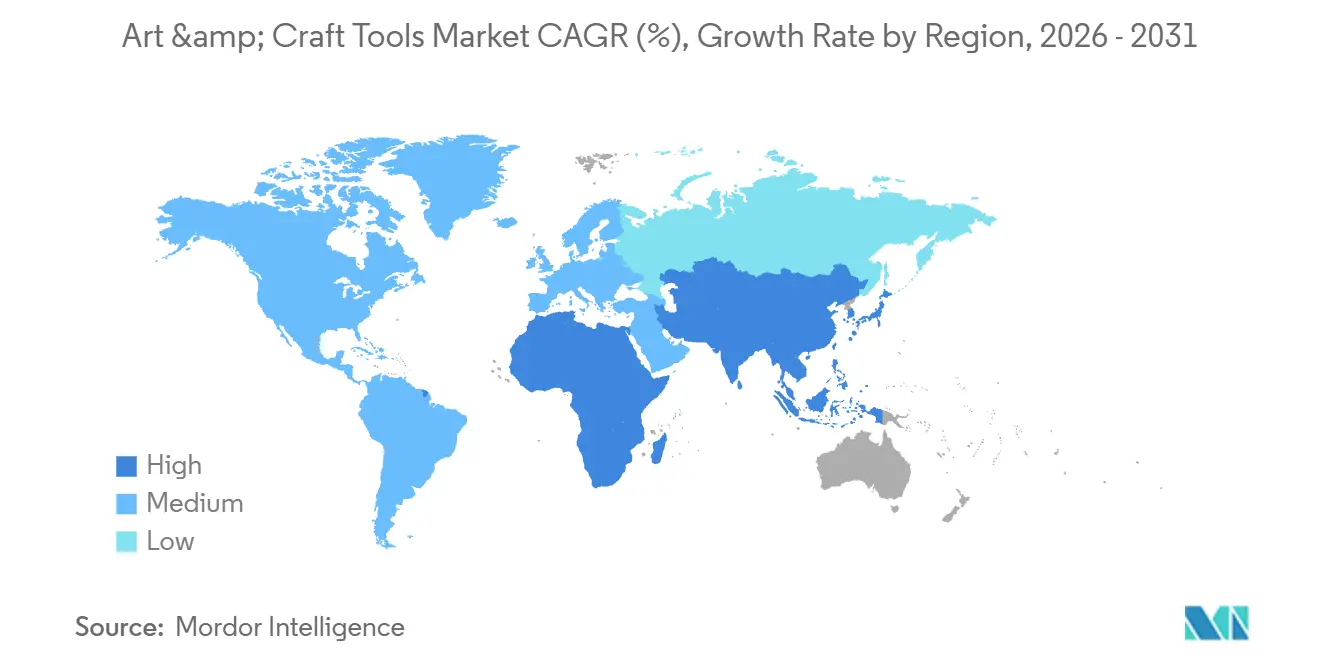
In 2025, North America commanded a dominant 42.33% share of the art and craft tools market. This region's stronghold is bolstered by widespread household engagement in crafting, a well-established network of specialty retailers, and organized procurement efforts by schools and wellness programs. Notably, the U.S. market showcases robust demand spanning children's activity products, adult recreational tools, and studio-led creative endeavors. However, despite this healthy demand, the region grapples with input cost pressures stemming from 2025 trade measures impacting imported materials across the board.
EMEA and South America Art & Craft Tools Market
Europe stands as the second major player in the art and craft tools arena, buoyed by a rich tradition in arts education and a robust base of established manufacturers. Here, regulatory standards emphasizing material safety and chemical compliance play a pivotal role, influencing market access. Such regulations inherently favor suppliers like Faber-Castell, STAEDTLER, Fiskars, and BIC, who not only adhere to these compliance systems but also enjoy established brand trust. While South America and the Middle East & Africa currently occupy smaller market shares, both regions present significant growth potential, driven by burgeoning youth populations, increased education spending, and an expanding distribution network.
APAC Art & Craft Tools Market
Asia-Pacific is on track to achieve a 9.11% CAGR through 2031, positioning it as the fastest-growing region in the art and craft tools market. This growth trajectory is underpinned by an expanding middle class, broader product accessibility, and school-driven policy demands. A testament to this potential is Crayola's March 2026 collaboration with Luxor Writing Instruments, aimed at producing and distributing co-branded products tailored for India's 436 million children. This partnership, further emphasizing experiential learning across 1.5 million schools, transcends a mere distribution agreement. While China continues to be a pivotal manufacturing hub for mid-market products, it's also evolving into a discerning consumer market for premium tools. Both international and regional brands are carving a niche among adult hobbyists and art students. Suppliers adept at balancing affordability, quality, and localized distribution stand poised to reap the most significant rewards in this growth phase.

Competitive Landscape
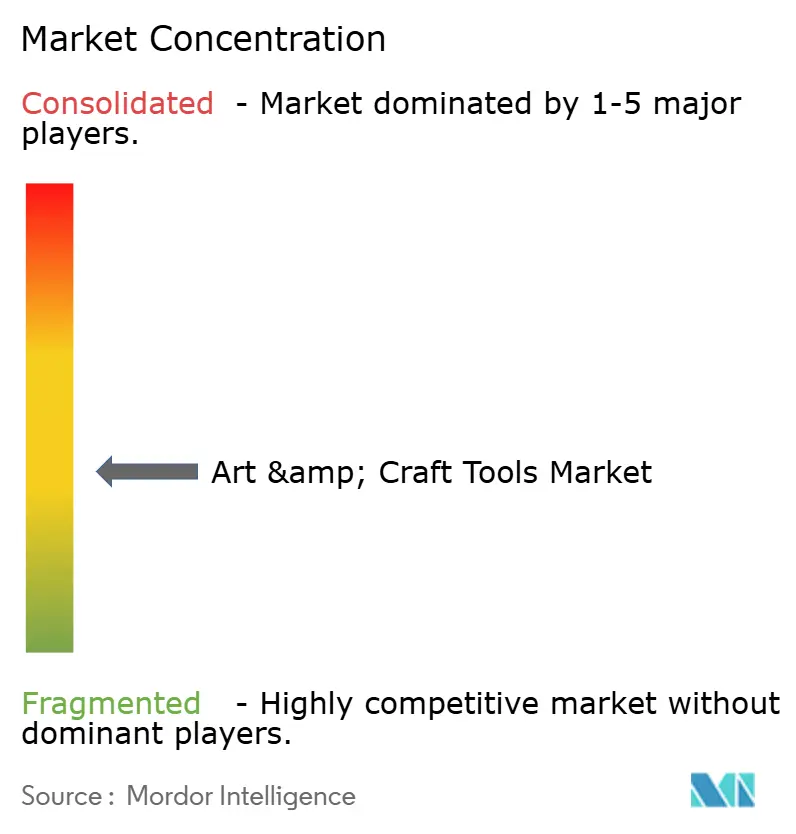
The art and craft tools market is moderately fragmented, with competition driven by product innovation, brand reputation, quality, and distribution networks. Key players, including Crayola LLC, Newell Brands Inc., Fiskars Group, Faber-Castell AG, and STAEDTLER Mars GmbH and Co. KG, maintain strong positions through diverse product portfolios, established brand equity, and a long-standing presence in educational, professional, and hobbyist segments. These companies meet consumer needs by offering products like drawing tools, painting supplies, cutting instruments, and specialty craft items.
Competition focuses on product differentiation, sustainability, and user experience. Manufacturers are introducing eco-friendly materials, non-toxic formulations, ergonomic designs, and innovative tools to attract environmentally conscious consumers, students, and professional artists. Investments in product development and premium product lines help leading companies build customer loyalty and appeal to traditional art enthusiasts and the growing DIY crafting community.
The rise of e-commerce and digital retail channels has intensified competition by improving product accessibility and enabling direct consumer engagement. Major players use omnichannel distribution, educational partnerships, and targeted marketing to boost visibility and expand their customer base. Regional brands and niche craft suppliers add to market fragmentation, driving innovation and price competition. As global interest in creative hobbies, DIY projects, and arts education grows, market participants are expected to focus on product innovation, sustainability, and distribution expansion to stay competitive.
Art & Craft Tools Industry Leaders
Hallmark Cards, Inc. (Crayola)
Newell Brands Inc.
Fiskars Group
Faber-Castell AG
STAEDTLER Mars GmbH and Co. KG
- *Disclaimer: Major Players sorted in no particular order
Art & Craft Tools Market Companies Covered in this Report
- Hallmark Cards, Inc. (Crayola)
- Newell Brands Inc.
- Fiskars Group
- Faber-Castell AG
- STAEDTLER Mars GmbH and Co. KG
- Kokuyo Camlin Ltd.
- Société BIC S.A.
- Pentel Co., Ltd.
- PILOT Corporation
- Shanghai MandG Stationery Inc.
- ACCO Brands Corporation
- Michaels Stores, Inc.
- Pelikan International Corporation Berhad
- Westcott (Acme United Corporation)
- Sakura Color Products Corporation
- General Pencil Co., Inc.
- Jo-Ann Stores, LLC
- FILA Group LLC
- Plaid Enterprises Inc.
- Arteza LLC

Recent Industry Developments in Art & Craft Tools Market
- June 2026: Crayola launched the "All Grown Up" adult coloring product line, including alcohol-based markers (8–120 count sets) and artist-designed coloring books. The line debuted on Amazon with Prime Day promotional pricing before a national physical retail rollout to Walmart, Michaels, and grocery stores in fall 2026, marking Crayola's formal entry into the premium adult recreational art tools segment.
- March 2026: Crayola announced a long-term manufacturing and distribution partnership with Luxor Writing Instruments, India's leading stationery manufacturer, to produce and distribute co-branded "Crayola by Luxor" products targeting India's 436 million children. The agreement is structured within the framework of India's National Education Policy, one of the largest single-market geographic expansion commitments in the art tools segment.
- February 2026: Faber-Castell launched the "Bloom" luxury writing instrument series under its Graf von Faber-Castell sub-brand at the Ambiente trade fair, presented alongside a record-breadth new product portfolio. The launch targeted creative professionals and young entrepreneurs, reinforcing the brand's dual positioning across premium consumer and B2B gifting channels.


Global Art & Craft Tools Market Report Scope
| Drawing and Painting Tools | Drawing Tools |
| Pencils | |
| Pens and Markers | |
| Erasers | |
| Others | |
| Painting Tools | |
| Brushes | |
| Paints | |
| Painting Surfaces | |
| Cutting Tools | Scissors |
| Knives and Blades | |
| Punching and Shaping Tools | |
| Others | |
| Paper Crafts and Decorative Items | |
| Others |
| Household |
| Educational Institutions |
| Commercial Art Studios |
| Others |
| Plastic |
| Wood |
| Metal |
| Composite Materials |
| Supermarkets and Hypermarkets |
| Specialty Stores |
| Online Stores |
| Convenience Stores |
| Other Distribution Channels |
| North America | United States |
| Canada | |
| Mexico | |
| Rest of North America | |
| Europe | Germany |
| United Kingdom | |
| Italy | |
| France | |
| Spain | |
| Netherlands | |
| Poland | |
| Belgium | |
| Sweden | |
| Rest of Europe | |
| Asia-Pacific | China |
| India | |
| Japan | |
| Australia | |
| Indonesia | |
| South Korea | |
| Thailand | |
| Singapore | |
| Rest of Asia-Pacific | |
| South America | Brazil |
| Argentina | |
| Colombia | |
| Chile | |
| Peru | |
| Rest of South America | |
| Middle East and Africa | South Africa |
| Saudi Arabia | |
| United Arab Emirates | |
| Nigeria | |
| Egypt | |
| Morocco | |
| Turkey | |
| Rest of Middle East and Africa |
| By Product Type | Drawing and Painting Tools | Drawing Tools |
| Pencils | ||
| Pens and Markers | ||
| Erasers | ||
| Others | ||
| Painting Tools | ||
| Brushes | ||
| Paints | ||
| Painting Surfaces | ||
| Cutting Tools | Scissors | |
| Knives and Blades | ||
| Punching and Shaping Tools | ||
| Others | ||
| Paper Crafts and Decorative Items | ||
| Others | ||
| By Application | Household | |
| Educational Institutions | ||
| Commercial Art Studios | ||
| Others | ||
| By Material | Plastic | |
| Wood | ||
| Metal | ||
| Composite Materials | ||
| By Distribution Channel | Supermarkets and Hypermarkets | |
| Specialty Stores | ||
| Online Stores | ||
| Convenience Stores | ||
| Other Distribution Channels | ||
| By Geography | North America | United States |
| Canada | ||
| Mexico | ||
| Rest of North America | ||
| Europe | Germany | |
| United Kingdom | ||
| Italy | ||
| France | ||
| Spain | ||
| Netherlands | ||
| Poland | ||
| Belgium | ||
| Sweden | ||
| Rest of Europe | ||
| Asia-Pacific | China | |
| India | ||
| Japan | ||
| Australia | ||
| Indonesia | ||
| South Korea | ||
| Thailand | ||
| Singapore | ||
| Rest of Asia-Pacific | ||
| South America | Brazil | |
| Argentina | ||
| Colombia | ||
| Chile | ||
| Peru | ||
| Rest of South America | ||
| Middle East and Africa | South Africa | |
| Saudi Arabia | ||
| United Arab Emirates | ||
| Nigeria | ||
| Egypt | ||
| Morocco | ||
| Turkey | ||
| Rest of Middle East and Africa | ||


Key Questions Answered in the Report
What is the expected value of the art and craft tools space by 2031?
The sector is forecast to reach USD 5.96 billion by 2031, rising from USD 4.23 billion in 2026 at a 7.11% CAGR over 2026-2031.
Which product category currently leads global demand for art and craft tools?
Drawing and Painting Tools led in 2025 with 39.43% share, helped by broad use across schools, households, and professional users.
Which application area is expanding the fastest through 2031?
Commercial Art Studios are the fastest-growing application, with an 8.01% CAGR through 2031, supported by repeat purchases and experience-led formats.
Why is Asia-Pacific growing faster than other regions?
Asia-Pacific is forecast to grow at 9.11% CAGR through 2031 because of middle-class expansion, policy-linked school demand, and broader product access.
Page last updated on:


 Your data is secure and never sold or shared.


