
Market Overview
| Study Period | 2021 - 2031 |
|---|---|
| Forecast Data Period | 2026 - 2031 |
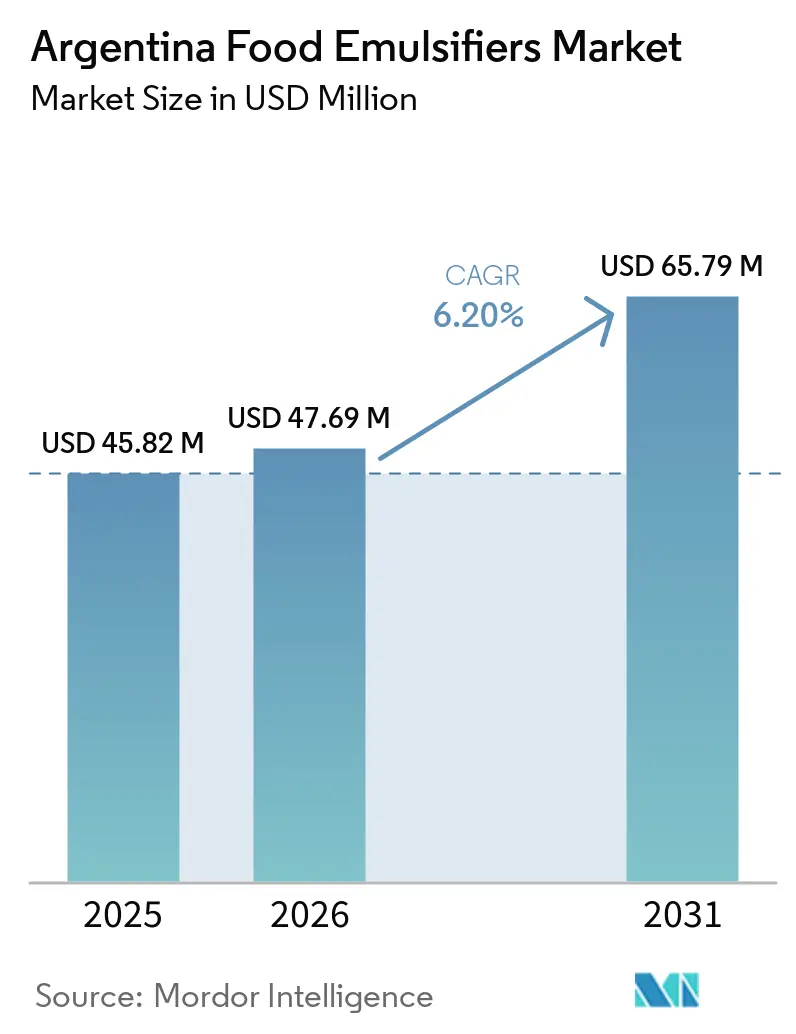
| Base Year Market Size (2025) | USD 45.82 Million |
| Market Size (2026) | USD 47.69 Million |
| Market Size (2031) | USD 65.79 Million |
| Growth Rate (2026 - 2031) | 6.20 % |
| Market Concentration | Medium |
Major Players *Disclaimer: Major Players sorted in no particular order Image © Mordor Intelligence. Reuse requires attribution under CC BY 4.0. | |
Argentina Food Emulsifiers Market Analysis by Mordor Intelligence
The Argentina food emulsifiers market size is projected to expand from USD 47.69 million in 2025 to USD 50.65 million in 2026 and USD 65.79 million by 2031, registering a CAGR of 6.20% between 2026 and 2031. The Argentina food emulsifiers market benefits from a large domestic oilseed base, which supports the availability of soy lecithin for local food manufacturers. Bakery, confectionery, processed dairy, and beverage producers continue to require ingredients that improve texture, stability, and shelf life. Demand is also moving toward plant-derived options as manufacturers simplify ingredient labels and address preferences for vegan and allergen-conscious products. Companies with local sourcing, technical formulation support, and a broad plant-based portfolio are better placed to serve these needs. Price exposure remains important because specialty imports and vegetable-oil inputs can become more expensive when exchange rates or export economics change.
Key Report Takeaways
- By product type, lecithin held 43.26% of the Argentina food emulsifiers market share in 2025, while mono- and diglycerides are forecast to grow at a 7.56% CAGR through 2031.
- By form, powder held 56.48% of the Argentina food emulsifiers market share in 2025, while liquid emulsifiers are forecast to grow at a 7.27% CAGR through 2031.
- By source, synthetic and bio-based emulsifiers held 46.52% of the market in 2025, while plant-sourced emulsifiers are forecast to grow at a 7.86% CAGR through 2031.
- By application, bakery and confectionery held 35.47% of the market in 2025, while dairy and desserts are forecast to grow at a 7.63% CAGR through 2031.
Note: Market size and forecast figures in this report are generated using Mordor Intelligence’s proprietary estimation framework, updated with the latest available data and insights as of January 2026.
Argentina Food Emulsifiers Market Trends and Insights
Drivers Impact Analysis*
| Driver | (~) % Impact on CAGR Forecasts | Geographic Relevance | Impact Timeline |
|---|---|---|---|
| Growing demand from bakery and confectionery industries | +2.0% | National, concentrated in Buenos Aires, Córdoba, and Santa Fe | Short term (≤ 2 years) |
| Increasing preference for clean-label and plant-based ingredients | +1.6% | National, stronger in urban retail-oriented segments | Medium term (2-4 years) |
| Technological advancements in emulsifier processing | +0.9% | Global, with localized applications in domestic manufacturing | Long term (≥ 4 years) |
| Expansion of lecithin supply from Argentina's oilseed base | +1.3% | Primarily Santa Fe and Buenos Aires provinces (Rosario-Paraná corridor) | Short term (≤ 2 years) |
| Increasing focus on product quality and shelf-life improvement, supporting the demand for emulsifiers | +0.6% | National | Medium term (2-4 years) |
| Regulatory framework supporting the use of approved food additives | +0.4% | National, with MERCOSUR alignment | Medium term (2-4 years) |
| Source: Mordor Intelligence | |||
Growing Demand from Bakery and Confectionery Industries
Argentina’s bakery and confectionery manufacturers provide a stable source of demand for functional emulsifiers. These ingredients support dough conditioning, product uniformity, and delayed staling in industrial and frozen bakery production. Mono- and diglycerides and DATEM are used where processors need controlled handling and repeatable finished-product characteristics. The Argentina food emulsifiers market therefore remains linked to the operating needs of bakery plants rather than only to consumer-facing product launches. New food-processing capacity can also increase demand for texture-modifying ingredients in related prepared-food lines. This relationship gives suppliers an opportunity to work with processors on formulations that combine production efficiency with longer shelf life. Food manufacturers also use emulsifiers when reformulating products to control fat content without undermining texture. Bakery suppliers can therefore demand both commodity lecithin and higher-functionality ingredients, depending on the product specification. The Argentina food emulsifiers market continues to benefit when processors invest in reliable production systems and standardized recipes.
Increasing Preference for Clean-Label and Plant-Based Ingredients
Lecithin has a clear role as a familiar ingredient in formulations that seek to reduce reliance on chemical emulsifiers. A 2025 scientific review discussed the growing relevance of food-based emulsifiers in product formulation and food applications[1]. Sunflower lecithin is receiving more attention in premium applications because it can support non-GMO and allergen-aware product positioning. This change is relevant to food manufacturers that supply retail customers and export channels with detailed ingredient requirements. Argentina’s food labeling rules also shape how manufacturers assess formulation choices. Ley 27.642 established front-of-pack warning labeling for packaged foods that exceed defined thresholds for nutrients such as added sugars, saturated fats, and sodium
Expansion of Lecithin Supply from Argentina's Oilseed Base
Argentina’s oilseed processing system is a major advantage for domestic lecithin availability. The USDA Foreign Agricultural Service forecast soybean crush at 43.00 million metric tons in marketing year 2025/26, supported by carryover stocks and crush margins. Santa Fe has a large share of national crushing capacity and remains a central origin point for soybean oil and related lecithin streams[2]. This structure shortens the path between oilseed processing and domestic food-ingredient customers. It can reduce transport requirements for local users compared with imported specialty alternatives. The Argentina food emulsifiers market gains a feedstock advantage that supports the leading position of lecithin. Export conditions can nevertheless influence local availability and pricing. In July 2025, Bunge chartered a 30,000-metric-ton Argentine soybean meal cargo to China through Terminal 6 in San Lorenzo, representing the first confirmed bulk shipment of this type since 2019.
Technological Advancements in Emulsifiers Processing
Suppliers are increasingly focused on production methods that improve purity and consistency in emulsifier systems. Enzymatic synthesis and molecular-distillation approaches can support higher-purity mono- and diglyceride products than standard production routes. This matters in bakery and dairy recipes where processors require repeatable dispersion and texture. Ingredient companies can differentiate through both processing capability and the level of support they provide during reformulation. The Argentina food emulsifiers market is exposed to these developments through regional supply networks and customer projects. Buyers that require demanding performance specifications are likely to assess technical support alongside ingredient price. Palsgaard began producing its Emulpals® powdered cake-emulsifier range at its facility in Marechal Cândido Rondon, Paraná, Brazil, in October 2025. Improvements in quality and shelf-life performance also support the use of emulsifiers when processors seek more consistent finished products. Argentina’s regulatory framework defines the approved additive environment in which those formulation choices are made[3].
Restraints Impact Analysis*
| Restraint | (~) % Impact on CAGR Forecasts | Geographic Relevance | Impact Timeline |
|---|---|---|---|
| Volatility in raw material prices | −1.6% | National, especially for synthetic and imported specialty emulsifiers | Short term (≤ 2 years) |
| High cost of specialized emulsifiers | −1.0% | National, more pronounced for SME food processors | Medium term (2-4 years) |
| Availability of alternative functional ingredients | −0.7% | National, specific to dairy and bakery applications | Medium term (2-4 years) |
| Consumer concerns regarding artificial additives | −0.5% | Urban-led, strongest in Buenos Aires metropolitan area | Long term (≥ 4 years) |
| Source: Mordor Intelligence | |||
Volatility in Raw Material Prices
Soybean and sunflower cycles affect the cost base for lecithin and glycerol-derived emulsifier systems. The Argentina food emulsifiers market is exposed to these movements because domestic oilseed products participate in international trade. Export demand can lift the value of byproducts that also support local food-ingredient supply. Imported specialty products add another layer of exposure because their local cost can rise when the peso weakens. Smaller processors often have less purchasing scale and may be unable to secure long-term supply arrangements. These conditions can delay reformulation plans when the price benefit is uncertain. Price sensitivity is stronger for specialized grades that do not have a full domestic substitute. Processors may respond by choosing standard lecithin or more established mono- and diglyceride systems when premium alternatives become expensive. That response limits the pace at which specialized formulations can spread through cost-sensitive applications.
High Cost of Specialized Emulsifiers
Distilled monoglycerides, polyglycerol esters, and specialized plant-based lecithins can carry a price premium over commodity lecithin and standard mono- and diglycerides. This is a material issue for small and medium-sized food processors that operate under strict product-cost targets. Argentina has strong crude lecithin availability from soybean crushing, but more complex refining and modification steps may require imported supply. Imports bring logistics costs and currency exposure into the final ingredient price. The Argentina food emulsifiers market therefore has a gap between local commodity availability and access to certain higher-value systems. This gap can lengthen the commercial evaluation period for new formulations. Alternative functional ingredients can also limit demand for certain emulsifier grades. Manufacturers may assess hydrocolloids, stabilizer blends, or process changes when they seek texture or phase stability.
*Our forecasts treat driver/restraint impacts as directional, not additive. The impact forecasts reflect baseline growth, mix effects, and variable interactions.
Segment Analysis
By Product Type: Lecithin Leads Through Direct Oilseed Supply
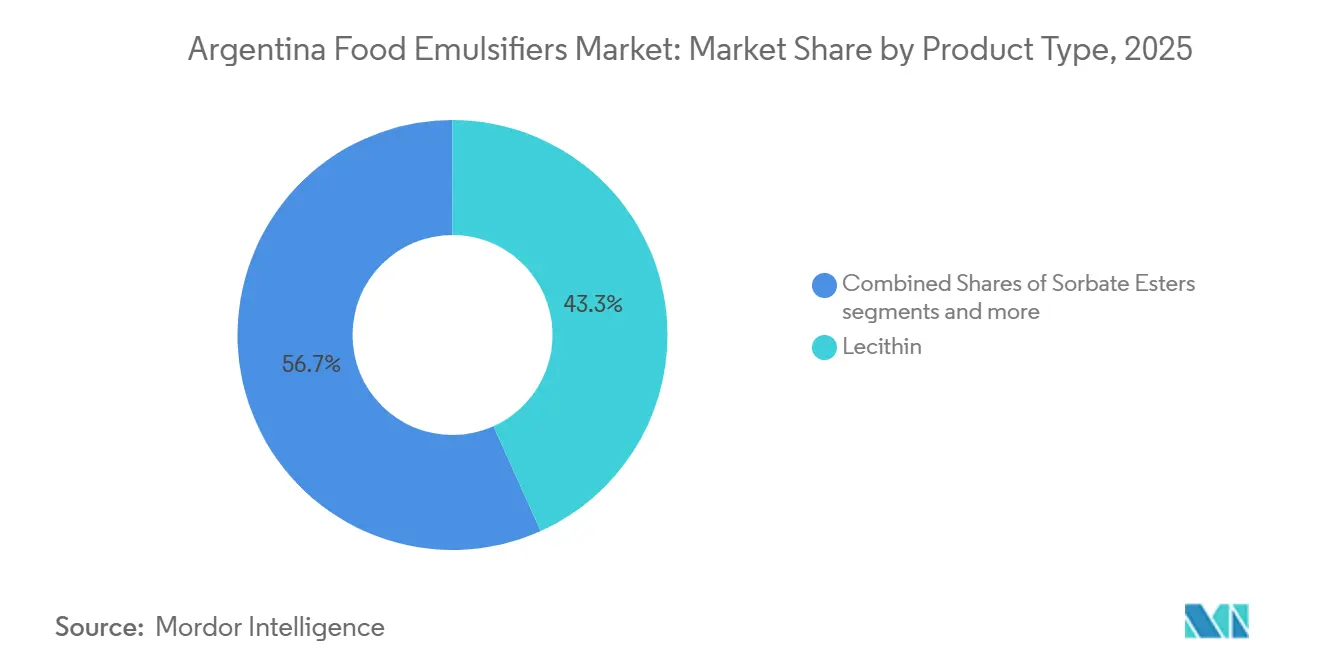
Lecithin held 43.26% of the Argentina food emulsifiers market share in 2025. Its position reflects its direct link to Argentina’s soybean crushing base and its broad utility in food processing. Local availability helps food manufacturers access a familiar emulsifier without depending entirely on imported specialty products. Lecithin is used in bakery, confectionery, dairy, and beverage applications where dispersion and texture are important. The product also aligns with clean-label demand when manufacturers look for recognizable ingredient names. The Argentina food emulsifiers industry benefits from this supply relationship because oilseed processing and food production are connected through domestic logistics.
Mono- and diglycerides are forecast to grow at a 7.56% CAGR from 2026 to 2031. Their use as anti-staling agents supports long-life bakery products that must maintain quality during distribution. They also function as stabilizers in plant-based dairy alternatives and frozen desserts. Water-dispersed monoglycerides can help aeration and ice-crystal control in ice cream and similar products. These functions make the segment relevant where manufacturers need stable texture after processing and storage. The segment’s growth is tied to practical formulation needs in bakery and dairy applications.



By Form: Powder Remains Established While Liquid Formats Gain Use
Powder emulsifiers held 56.48% of the Argentina food emulsifiers market share in 2025. Their lead reflects shelf stability, simple handling, and compatibility with industrial dry-premix operations. Powdered formats are well suited to bakery ingredient supply chains where accurate metering and storage are essential. They can be incorporated into mixes without an additional hydration step in many applications. This practical fit supports continued use across Argentina’s dispersed food manufacturing base.
Liquid emulsifiers are forecast to grow at a 7.27% CAGR from 2026 to 2031. Beverage, dairy-dessert, and sauce manufacturers use liquid systems when direct dispersion in high-moisture recipes is useful. These products can reduce the need for preparatory hydration steps in some processing lines. Their growth is also connected to premium dairy products and functional beverages that require controlled mouthfeel and phase stability. Regional supply developments can improve access to specialized liquid formats for Argentine customers. The Argentina food emulsifiers market can therefore see gradual adoption of liquids even while powder remains the more widely used form.
By Source: Synthetic and Bio-based Products Lead While Plant Sources Expand
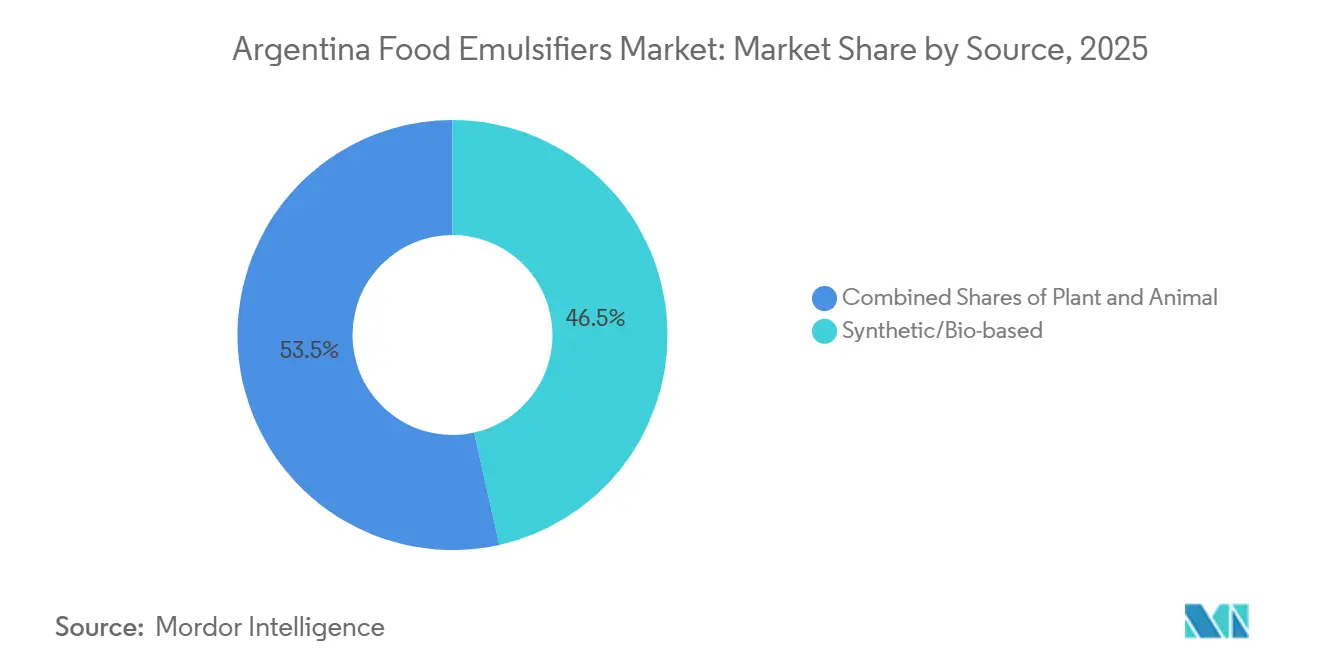
Synthetic and bio-based emulsifiers held 46.52% of the market in 2025. This share reflects the continued importance of DATEM, sodium stearoyl lactylate, and polyglycerol esters in industrial food processing. These ingredients can offer predictable technical behavior and consistent batch performance. Large producers use them in bread, pastry, and processed-meat recipes where process reliability is a high priority. Bio-based pathways can contribute when manufacturers seek a link between technical performance and more favorable feedstock sourcing.
Plant-sourced emulsifiers are forecast to grow at a 7.86% CAGR from 2026 to 2031. Sunflower and non-GMO soy lecithin are central to this growth because they fit clean-label and plant-based formulation goals. Sunflower lecithin can be particularly relevant where manufacturers seek to avoid soy allergen declarations in certain export-oriented products. Plant-derived systems also have a role in products positioned for vegan or allergen-conscious consumers. Their growth does not remove the need for technical validation, since a new source must still provide the required food-processing performance. The Argentina food emulsifiers market is well positioned to supply plant-based options through its oilseed base.

By Application: Bakery Provides Volume While Dairy and Desserts Grow Faster
Bakery and confectionery held 35.47% of the market in 2025. The segment remains the largest application because emulsifiers provide both shelf-life and texture benefits in a broad range of bakery products. Manufacturers use these ingredients to support dough handling, softness, volume, and consistency. They may also use them when reducing fat while preserving the expected eating experience. This makes bakery demand an important base for the Argentina food emulsifiers market.
Dairy and desserts are forecast to grow at a 7.63% CAGR from 2026 to 2031. This segment includes products where emulsifiers help control ice-crystal formation, stabilize texture, and provide a consistent mouthfeel. Mono- and diglycerides and phospholipid-based products have clear roles in ice cream, yogurt, and dairy desserts. Product quality depends on both the recipe and the way ingredients perform during freezing, storage, and distribution. Premium dairy lines can therefore require more specialized emulsifier systems than standard bakery products. The Argentina food emulsifiers market has an opening to serve this application with tailored technical solutions.
Geography Analysis
Demand in the Argentina food emulsifiers market is concentrated in the Buenos Aires metropolitan region, which combines a large consumer base with dense food manufacturing and retail infrastructure. Major bakery, confectionery, and processed-dairy companies maintain important production activity in Greater Buenos Aires and the adjacent province. This creates a large procurement corridor for functional food ingredients. The region is also where urban retail trends can increase attention to clean-label, plant-based, and premium food formats. Ingredient suppliers benefit from proximity to customers that need regular technical support and dependable delivery. Buenos Aires therefore remains the leading demand location for standard and specialized emulsifier systems.
Córdoba is a significant secondary consumption area because it has grain milling and dairy-processing activity. These industries use functional ingredients for domestic products and for goods supplied through intra-MERCOSUR channels. The province’s food processors can require emulsifiers for bakery mixes, dairy products, and value-added foods. Demand will depend on the pace of processing investment and the ability of companies to manage input costs. Córdoba also links agricultural production with food manufacturing, making it a practical market for suppliers that can provide local sales and application assistance. This regional demand complements the larger customer concentration around Buenos Aires.
Santa Fe is the key supply-side location, with a large share of Argentina’s oilseed crushing capacity along the Paraná River corridor. The Rosario port complex connects soybean meal, oil, and lecithin co-products with domestic and international markets. This makes the province a cost-efficient origin point for soy lecithin used by Argentine food manufacturers. The geography provides a logistics advantage because domestic customers can source from an integrated oilseed-to-lecithin network. The Argentina food emulsifiers market benefits from this local supply structure, particularly for lecithin-based products.
Competitive Landscape
Market Concentration
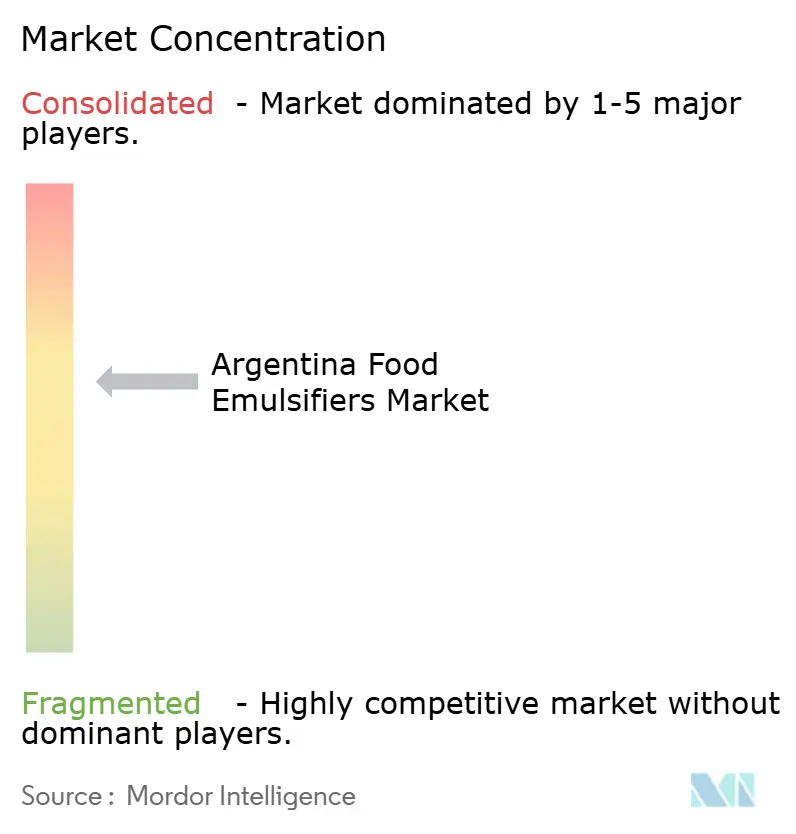
The Argentina food emulsifiers market has a moderately concentrated structure because a small group of multinational agri-processors has strong upstream access to soybean crushing and lecithin supply. Cargill, Archer Daniels Midland, and Bunge are important participants in the upstream oilseed system. Their advantage comes from large-scale processing, established export infrastructure, and access to oilseed-derived inputs. This position is especially relevant to lecithin, the leading product category. The competitive setting also includes suppliers that focus on higher-value emulsifier systems rather than bulk oilseed derivatives. Competition therefore differs by product type, customer size, and technical requirement.
Specialized suppliers, including Palsgaard, Corbion, Stern-Wywiol Gruppe, and Lipoid, compete through formulation capability and application support. They can serve customers that require particular performance in bakery, dairy, confectionery, and beverage products. Their products can be more costly than commodity lecithin, but they may offer benefits that are important in demanding applications. Local companies, including Granotec Argentina, DSI S.A., Lekigos S.A., Argenta Bioingredientes, and Cordis S.A., compete through customer proximity and familiarity with local requirements. This service model is valuable for smaller processors that need smaller order sizes or Spanish-language technical support. The Argentina food emulsifiers market therefore has both large upstream suppliers and specialized local service channels.
There is scope for products that sit between commodity lecithin and high-cost imported specialty grades. Specialty monoglyceride systems and enzymatic phospholipid blends can address customers that need better performance but remain sensitive to ingredient cost. Suppliers that can show measurable processing or finished-product benefits are more likely to gain adoption in this space. This opportunity is relevant in dairy desserts, premium bakery products, and plant-based formulations. The competitive position of each company depends on its ability to combine supply security, pricing, and technical credibility. The Argentina food emulsifiers market continues to reward suppliers that can work directly with formulation teams.
Argentina Food Emulsifiers Industry Leaders
-
Cargill, Incorporated
-
Ingredion Incorporated
-
Archer Daniels Midland Company
-
Palsgaard A/S
-
Bunge Limited
- *Disclaimer: Major Players sorted in no particular order
Recent Industry Developments
- March 2026: IFF announced the transformation of its Arroyito facility in Argentina into the company's first full fermentation-based enzyme production hub in Latin America, enhancing production capabilities for food, brewing, animal nutrition, and biofuel applications. The investment improves delivery speed and local production reliability for regional customers, reinforcing IFF's long-term commitment to Argentina as a manufacturing base.
- January 2025: ANMAT published Disposición 537/2025, establishing new procedures for import and export of food products including additives such as emulsifiers under Argentina's updated Código Alimentario Argentino framework. The regulation introduces mandatory Authorization or Notice of Import requirements and reinforces traceability documentation standards for international emulsifier suppliers.
Argentina Food Emulsifiers Market Report Scope
The Argentina food emulsifiers market is segmented by product type, form, source, and application. By product type, the market is categorized into mono- and diglycerides and derivatives, lecithin, sorbate esters, and other emulsifiers. By form, the market is divided into powder and liquid. By source, the market includes plant-based, synthetic/bio-based, and animal-derived emulsifiers. By application, the market covers bakery and confectionery, dairy and desserts, beverages, meat and meat products, soups, sauces, and dressings, and other applications. The Market Forecasts are Provided in Terms of Value (USD).
By Product Type
| Mono- and Diglycerides and Derivatives |
| Lecithin |
| Sorbate Esters |
| Other Emulsifiers |
By Form
| Powder |
| Liquid |
By Source
| Plant |
| Synthetic/Bio-based |
| Animal |
By Application
| Bakery and Confectionery |
| Dairy and Desserts |
| Beverages |
| Meat and Meat Products |
| Soups, Sauces, and Dressings |
| Other Applications |
| By Product Type | Mono- and Diglycerides and Derivatives |
| Lecithin | |
| Sorbate Esters | |
| Other Emulsifiers | |
| By Form | Powder |
| Liquid | |
| By Source | Plant |
| Synthetic/Bio-based | |
| Animal | |
| By Application | Bakery and Confectionery |
| Dairy and Desserts | |
| Beverages | |
| Meat and Meat Products | |
| Soups, Sauces, and Dressings | |
| Other Applications |
Key Questions Answered in the Report
What is the forecast growth rate for food emulsifiers in Argentina?
The Argentina food emulsifiers market is forecast to grow at a 6.20% CAGR from 2026 to 2031, reaching USD 65.79 million in 2031.
Which product type leads demand in Argentina?
Lecithin leads with a 43.26% share in 2025, supported by Argentina’s oilseed-processing base and broad use in food products.
Why are plant-sourced emulsifiers gaining importance?
Plant-sourced emulsifiers are forecast to grow at a 7.86% CAGR through 2031 as food manufacturers pursue clean-label, vegan, non-GMO, and allergen-aware formulations.
Which food application is growing the fastest?
Dairy and desserts are forecast to grow at a 7.63% CAGR through 2031, supported by demand for stable texture and ice-crystal control in dairy products.