
Market Overview
| Study Period | 2021 - 2031 |
|---|---|
| Market Size (2026) | USD 4.29 Billion |
| Market Size (2031) | USD 5.55 Billion |
| Growth Rate (2026 - 2031) | 5.31 % |
| Fastest Growing Market | Asia Pacific |
| Largest Market | North America |
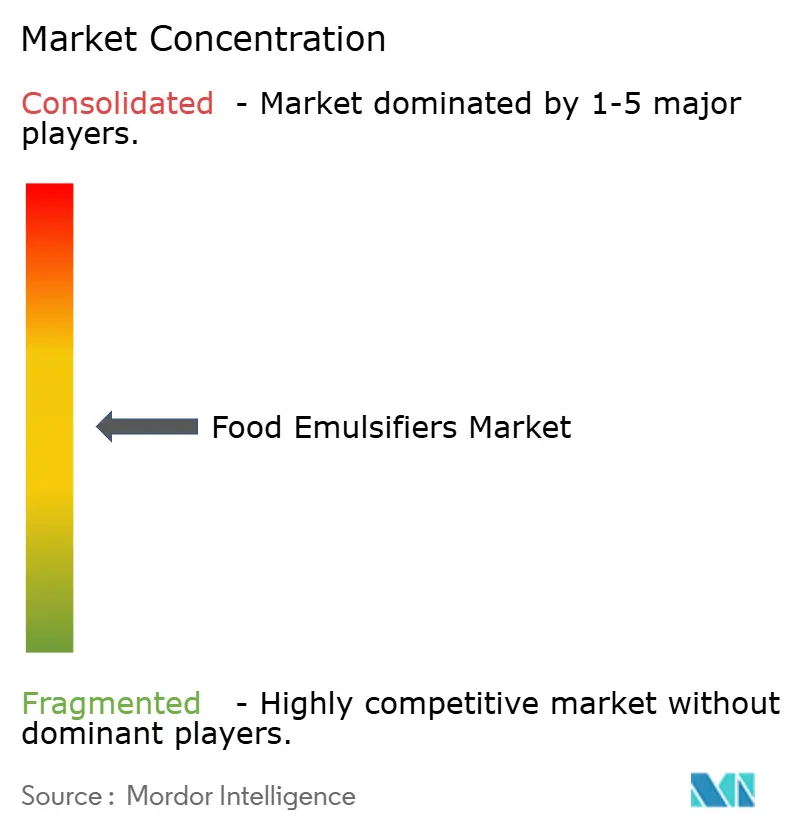
| Market Concentration | Medium |
Major Players
*Disclaimer: Major Players sorted in no particular order Image © Mordor Intelligence. Reuse requires attribution under CC BY 4.0. |
|
Food Emulsifiers Market Analysis by Mordor Intelligence
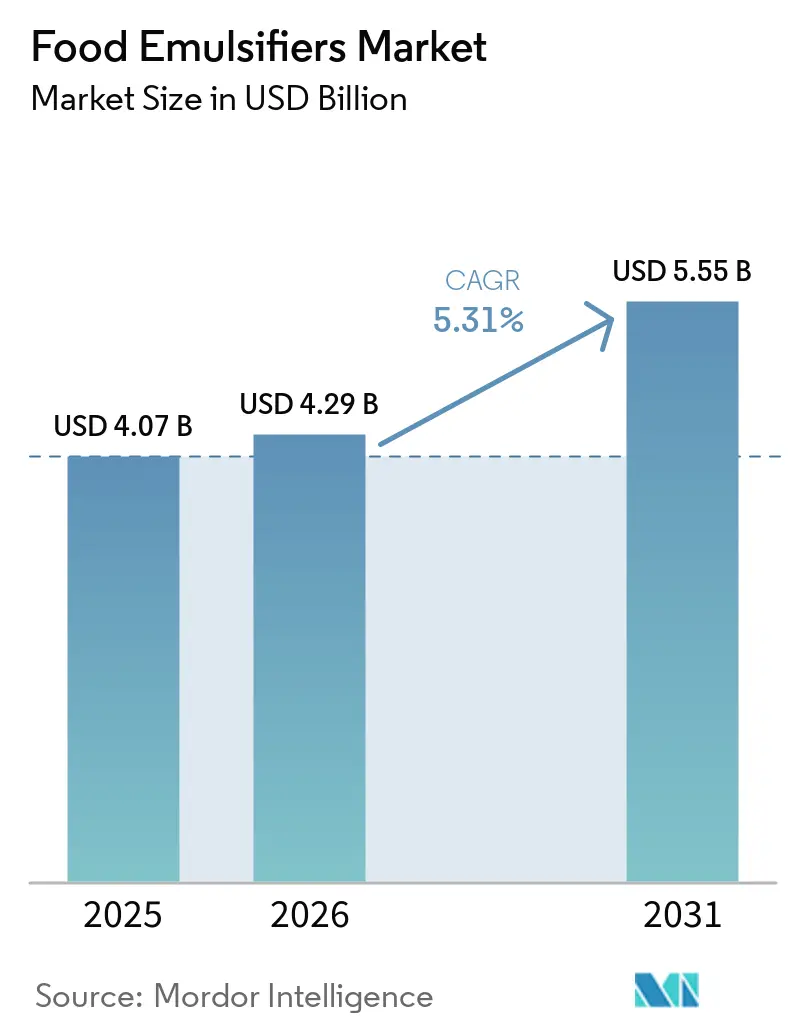
The Food Emulsifiers market size is expected to grow from USD 4.07 billion in 2025 to USD 4.29 billion in 2026 and is forecast to reach USD 5.55 billion by 2031 at 5.31% CAGR over 2026-2031. The growing demand for clean-label formulations, coupled with the increasing adoption of plant-based products, is reshaping the food and beverage market. The FDA's 2025 GRAS streamlining initiative has further accelerated this transformation by expanding the customer base and significantly reducing the time-to-market for new product blends. According to a survey conducted by the International Food Information Council (IFIC), 11% of Americans reported practicing clean eating, while 3% identified as following a plant-based diet[1]Source: International Food Information Council (IFIC), "Type of Eating Pattern or Diet Followed", www.ific . These trends highlight a shift in consumer preferences toward healthier and more sustainable options. Leading manufacturers are investing in the advancement of mono-diglyceride technologies to enhance heat stability in shelf-stable foods. To align with consumer demand for natural-origin claims, these technologies are often paired with lecithin. Multinational corporations with integrated supply chains are also scaling up their technical-service programs to support regional processors in overcoming formulation challenges, particularly in replicating textures for dairy alternatives.
Key Report Takeaways
- By product type, mono-di-glycerides and derivatives captured 33.15% of the food emulsifiers market share in 2025 while lecithin is expanding at a 5.72% CAGR through 2031.
- By form, powder variants controlled 64.20% of the food emulsifiers market size in 2025 and are advancing at a 6.28% CAGR.
- By source, synthetic and bio-based categories held 58.05% revenue share in 2025; plant-based sources are growing at a 6.55% CAGR to 2031.
- By application, bakery and confectionery represented 31.95% of the food emulsifiers market share in 2025, whereas dairy and desserts are forecast to rise at a 6.86% CAGR.
- By region, North America led with a 31.40% share in 2025; Asia-Pacific is projected to post a 6.64% CAGR to 2031.
Note: Market size and forecast figures in this report are generated using Mordor Intelligence’s proprietary estimation framework, updated with the latest available data and insights as of 2026.
Global Food Emulsifiers Market Trends and Insights
Drivers Impact Analysis*
| Driver | (~) % Impact on CAGR Forecast | Geographic Relevance | Impact Timeline |
|---|---|---|---|
| Surging demand for shelf stable and ready-to-eat food products | +1.2% | Global, with strong growth in Asia-Pacific and Latin America | Medium term (2-4 years) |
| Growing use of emulsifiers in bakery and confectionary application | +0.9% | North America and Europe core, expanding to Asia-Pacific | Long term (≥ 4 years) |
| Increased demand for texture-mimicking solution in plant-based meat alternative | +0.8% | North America and Europe leading, Asia-Pacific emerging | Short term (≤ 2 years) |
| Rapid development of tailor-made emulsifier blends for ethnic and regional foods | +0.6% | Asia-Pacific core, spill-over to North America and Europe | Medium term (2-4 years) |
| Emulsifier supporting clean label claims in 'free-form' products | +0.7% | Global, with premium positioning in developed markets | Long term (≥ 4 years) |
| Customized emulsifier blends addressing industry-specific needs | +0.5% | Global, with manufacturing hubs in Asia-Pacific | Medium term (2-4 years) |
| Source: Mordor Intelligence | |||
Surging demand for shelf-stable and ready-to-eat products
The increasing demand for shelf-stable and ready-to-eat products is driving significant shifts in emulsifier requirements. Manufacturers are focusing on developing formulations that ensure texture stability over extended storage periods. This trend is further accelerated by supply chain disruptions, which have highlighted the strategic importance of extended shelf-life products. The transition toward shelf-stable formats is fostering advancements in emulsifier technologies, with a strong emphasis on heat-resistant formulations capable of withstanding retort processing while maintaining sensory quality. For instance, Ingredion Incorporated offers EVANESSE CB6194, a vegan chickpea broth that matches the emulsification performance of traditional additives while serving as a clean-label emulsifier for creating shelf-stable vegan food products. Modern emulsifier systems now combine traditional mono-diglycerides with innovative plant-based alternatives, offering enhanced stability. This evolution presents a strategic opportunity for suppliers to deliver comprehensive solutions that effectively address both stability and clean-label requirements.
Growing use of emulsifiers in bakery and confectionary application
Manufacturers in the bakery and confectionery market are increasingly adopting advanced emulsifier systems to enhance texture and extend shelf life. The shift toward clean-label formulations is driving demand for lecithin-based and plant-derived alternatives that replicate synthetic functionality. For example, AAK offers Akolec and claims that the product line is derived from sunflower and soybean oils, supports improved nutrition, functionality, and processing across baked goods, confectionery, and plant-based dairy and meat alternatives. The European Food Safety Authority continues to validate the safety of traditional emulsifiers like polysorbates, giving manufacturers confidence in existing formulations while exploring natural options. Innovation is focusing on dual-functionality emulsifiers that stabilize and offer added benefits like dough conditioning and anti-staling. Enzyme-modified emulsifiers are emerging as key growth drivers, enhancing performance in high-moisture bakery products while maintaining clean-label appeal.
Increased demand for texture-mimicking solution in plant-based meat alternative
The growing demand for plant-based meat alternatives is driving the need for advanced emulsifier technologies capable of replicating the complex texture and sensory attributes of animal proteins. This trend is fostering innovation in protein-lipid interaction systems. Supporting this development, the USDA's National Institute of Food and Agriculture has allocated USD 11.3 million toward research in novel foods and innovative manufacturing processes, accelerating advancements in plant-based emulsification technologies [2]Source: National Institute of Food and Agriculture, “Novel Foods and Innovative Manufacturing Grants,” nifa.usda.gov. The industry faces challenges beyond basic emulsification, including the need to replicate fat distribution, protein fiber alignment, and thermal behavior during cooking. Advanced formulations are leveraging a combination of traditional emulsifiers, protein isolates, methylcellulose, and novel binding agents to deliver meat-like textures. Patent activity in this space is intensifying, with a focus on emulsion systems that maintain stability through freeze-thaw cycles while providing authentic sensory experiences. The growth of this segment depends on addressing technical barriers related to protein-fat interactions and developing scalable, cost-efficient production processes for industrial applications.
Rapid development of tailor-made emulsifier blends for ethnic and regional foods
Globalization is driving a growing demand for authentic flavors, leading to the development of customized emulsifier formulations designed to meet the specific requirements of regional and ethnic food products. As food manufacturers expand into international markets, they are prioritizing the preservation of traditional attributes that define cultural authenticity, which is becoming a key differentiator in the global food industry. According to FAO trade data, the global trade of processed foods is on the rise, with ethnic products containing emulsifiers emerging as a significant and fast-growing export category. For example, innovations in Asian cuisine focus on creating emulsifier systems optimized for high-temperature cooking, specific oil types, and traditional fermentation techniques. Similarly, Latin American food applications demand emulsifiers that are compatible with tropical ingredients and capable of withstanding extended ambient storage conditions. The development of these specialized emulsifiers requires close collaboration between emulsifier manufacturers and ethnic food producers, ensuring that traditional preparation methods are seamlessly integrated with modern emulsification technologies.
Restraints Impact Analysis*
| Restraint | (~) % Impact on CAGR Forecast | Geographic Relevance | Impact Timeline |
|---|---|---|---|
| Consumer concern over chemical additives in packaged foods | -0.8% | Global, particularly strong in North America and Europe | Long term (≥ 4 years) |
| Increasing femand for additive-free products impacting market growth | -0.6% | North America and Europe core, spreading to Asia-Pacific urban centers | Medium term (2-4 years) |
| Technical Challenges in Formulating Clear-Label Emulsions | -0.4% | Global, particularly strong in North America and Europe | Long term (≥ 4 years) |
| Consumer pushback against palm-based ingredients in emulsifiers | -0.6% | Asia-Pacific | Medium term (2-4 years) |
| Source: Mordor Intelligence | |||
Consumer concern over chemical additives in packaged foods
Rising consumer skepticism toward synthetic additives is significantly driving the demand for natural alternatives in the emulsifiers market. Despite this shift, regulatory validations continue to reinforce the market position of traditional emulsifiers in specific applications. In 2023, research identified a potential link between food additive emulsifiers and an increased risk of type 2 diabetes (T2D), with ultra-processed fruits and vegetables, cakes, biscuits, and dairy products contributing 18.5%, 14.7%, and 10% of total emulsifier intake, respectively. The study revealed a positive correlation between higher emulsifier consumption and T2D risk, raising consumer concerns[3]Source: Anti Additive Clean Label Organization, “Food additive emulsifiers linked to increased risk of type 2 diabetes”, www.anti-a.org . To address these issues, the European Food Safety Authority (EFSA) recently re-evaluated food additives, including silicon dioxide and guar gum, and reaffirmed their safety with updated guidelines. This regulatory clarity allows manufacturers to alleviate consumer concerns while maintaining product functionality. Simultaneously, the industry's focus on transparency is driving investments in alternative emulsification technologies, such as protein-based and plant-derived systems, which offer comparable performance with greater consumer appeal.
Increasing demand for additive-free products impacting market growth
The additive-free movement is disrupting traditional emulsifier applications, creating significant opportunities for natural alternatives and advanced processing technologies to reduce dependency on conventional stabilizers. This trend is particularly impactful in premium product segments, where consumers are increasingly willing to pay higher prices for products with simplified and transparent ingredient lists, reflecting a shift toward clean-label preferences. Research into alternative stabilization methods, such as high-pressure processing and novel protein functionalization, is driving innovation by enabling emulsification without traditional additives. The Institute of Food Technologists emphasizes the potential of emerging technologies that achieve emulsification through physical processes rather than chemical additives, although these methods often require substantial capital investment and process optimization. To address these challenges, manufacturers are adopting hybrid strategies that integrate minimal emulsifier usage with enhanced processing techniques, ensuring product functionality while meeting clean-label standards. This transition is generating varied economic impacts across applications, with some product categories successfully adopting additive-free formulations, while others still rely on emulsifiers to maintain safety and quality.
*Our forecasts treat driver/restraint impacts as directional, not additive. The impact forecasts reflect baseline growth, mix effects, and variable interactions.
Segment Analysis
By Product Type: Mono-Di-Glycerides Sustain Leadership as Lecithin Accelerates
Mono-diglycerides controlled 33.15% of the food emulsifiers market in 2025, reflecting their robust compatibility across both oil-in-water and water-in-oil systems. Consistent regulatory acceptance and heat stability keep them embedded in high-moisture bakery, ready-to-eat meals, and powdered beverage creamers. Demand for shelf-stable sauces has reinforced volume, especially in the Middle East and Africa distribution channels that lack cold chains. Suppliers continue to refine acyl-chain distribution to elevate aeration control without compromising label friendliness.
Lecithin, growing at a 5.72% CAGR, is gaining market share in vegan confectionery coatings and nutritional beverages, driven by the premium pricing of non-GMO sourcing. Enzymatic modifications are improving their dispersibility in high-protein formulations, displacing synthetic esters in sports nutrition products. Sorbate esters cater to a niche demand in fat-rich spreads requiring oxidative stability, while protein-based emulsifiers are being integrated into plant-based meat alternatives. Patent filings at the USPTO reflect significant research and development efforts focused on combining lecithin with bio-polyphenols to deliver antioxidant co-benefits.



By Form: Powder Convenience Entices Global Manufacturers
In 2025, powdered grades accounted for a significant 64.20% share of the food emulsifiers market and are advancing at a 6.28% CAGR, driven by their extended shelf-life of up to 24 months and reduced freight weight compared to liquid alternatives. These attributes make powdered emulsifiers a preferred choice for bakery premix suppliers, who benefit from their compatibility with automated silo systems and low microbial load. Advancements in spray-drying technology, such as the development of agglomerated particles coated with flow-aids, have further enhanced their functionality by minimizing dusting and improving wettability. This has expanded their adoption in high-speed beverage production lines, where efficiency and consistency are critical.
Although liquids hold a secondary position in the market, they remain indispensable in applications requiring rapid hydration, such as ready-to-drink protein shakes and low-viscosity sauces. To address challenges related to shelf-life and shipping costs, there is an increasing investment in concentrated paste formats, which reduce water content and shipping weight. Furthermore, USDA-supported encapsulation projects are exploring matrix-protected powders that mimic the dispersion properties of liquids upon hydration. This innovation enables manufacturers to streamline inventory management by utilizing a single SKU across multiple production lines, enhancing operational efficiency and reducing complexity.
By Source: Plant-Based Alternatives Chip Away at Synthetic Base
In 2025, synthetic and bio-based production routes contributed 58.05% of the total revenue, primarily due to their consistent functionality and cost-effectiveness in catering to high-volume staple products. Emulsifiers are known for their unique ability to interact with interfaces, particularly at the water/oil boundary. Among the myriad of food emulsifiers available, two synthetic ones, polysorbate-80 and carboxymethyl cellulose, stand out as the most prevalent. These emulsifiers are frequently employed in dairy products, enhancing yogurt's probiotic bacteria, thereby boosting their adhesion and survival rates. Following a safety evaluation of polysorbate 80, JECFA set a recommended daily intake limit at 25 mg per kg of body weight .
On the other hand, plant-derived inputs are experiencing robust growth, with a compound annual growth rate (CAGR) of 6.55%. This growth is largely driven by retailer scorecards that evaluate carbon intensity and deforestation risks, encouraging the adoption of sustainable practices. Animal-sourced alternatives, such as milk phospholipids, are gradually losing market share outside the infant-formula segment. This decline is attributed to heightened consumer awareness regarding allergen labeling and the growing emphasis on sustainability optics. New entrants in the market, focusing on transparent sourcing practices and emphasizing regenerative agriculture credentials, are gaining traction by securing co-development partnerships with emerging challenger brands.
By Application: Dairy Formulations Overtake Traditional Bakery Momentum
Bakery and confectionery claimed 31.95% of the food emulsifiers market share in 2025, supported by enduring staples such as sandwich bread and molded chocolates. Product innovation centers on dual-function powders that deliver crumb softness and frost-tolerance for frozen dough logistics.
Dairy and dessert lines, expanding at 6.86% CAGR, leverage next-generation emulsifiers to stabilize high-fat plant milks, cultured coconut yogurts, and vegan frozen novelties. Blends coupling mono-di-glycerides with hydrocolloids keep ice crystals fine during distribution, reducing sensory defects. Beverage launches show rising incorporation of cloud-emulsion technologies to suspend micronized botanicals in low-sugar teas. Meat-processing sectors deploy emulsifiers to boost water-holding and slice-ability in reformulated deli hams while retaining “no synthetic phosphate” claims.
Geography Analysis
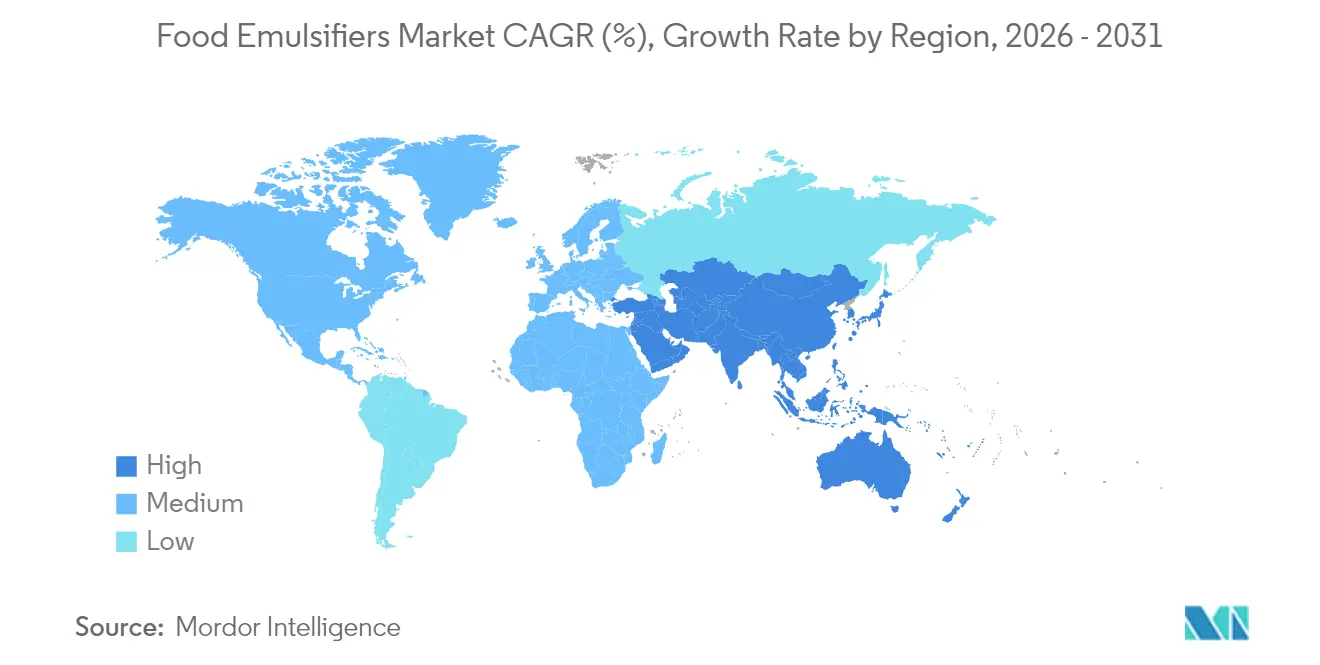
In 2025, North America maintained its position as the largest regional contributor, capturing 31.40% of global revenue. This leadership stems from advanced manufacturing capabilities and the FDA's efficient GRAS notification pathway, which accelerates the commercialization of innovative systems. U.S.-based multinational corporations continue to drive global innovation through significant R&D investments, resulting in advancements like enzyme-modified lecithin that enhances stability in functional beverages by tolerating pH fluctuations. Additionally, the expansion of Hispanic bakery chains is fueling demand for customized emulsifier blends that replicate traditional textures while adhering to USDA sodium-reduction guidelines. These factors highlight North America's ability to lead in innovation while addressing evolving consumer and regulatory requirements.
Asia-Pacific is projected to grow at a strong 6.64% CAGR through 2031, driven by rising disposable incomes and increasing demand for convenience foods in key markets such as China, India, Indonesia, and Vietnam. Regional processors are adapting Western bakery frameworks to cater to local preferences, such as softer crumbs. In India, government subsidies for cold-chain infrastructure are boosting the adoption of frozen desserts, which rely on high-performance emulsifiers for quality and consistency. Meanwhile, Chinese ingredient manufacturers are scaling up sunflower lecithin production to mitigate risks associated with soybean supply volatility. These developments position Asia-Pacific as a dynamic and rapidly expanding market.
Europe, despite being a mature market, remains a hub of innovation, driven by stringent sustainability standards and growing consumer demand for natural ingredients. The EFSA's regulatory guidance is shaping safer exposure levels and encouraging gradual reformulations to meet evolving labeling requirements. Nordic countries are leading the adoption of rapeseed-based emulsifiers, reflecting a commitment to domestic feedstocks. Meanwhile, South America and the Middle East & Africa, though smaller contributors, are witnessing accelerated growth. Multinational bakeries are expanding operations in Brazil, Saudi Arabia, and South Africa, employing localization strategies such as developing powder blends capable of withstanding high storage temperatures in equatorial supply chains. These efforts underscore the adaptability of suppliers to regional challenges and opportunities.

Regulatory Landscape
Food emulsifiers are regulated as food additives with use-conditions and purity specifications that differ by jurisdiction, driving compliance-led reformulation cycles for multinational brands. In the European Union, Regulation (EC) No 1333/2008 remains the core framework, with EFSA responsible for risk assessment and the European Commission updating Union list conditions and specifications through amendments. In January 2026, Commission Regulation (EU) 2026/196 amended additive use and specifications, including changes affecting common stabilizers and emulsifying-related additives such as carrageenan (E 407), locust bean gum (E 410), guar gum (E 412), gum arabic (E 414), xanthan gum (E 415), pectins (E 440), and starch sodium octenyl succinate (E 1450). This increases the importance of specification management for suppliers serving EU food and beverage manufacturers.
EFSA also published updated 2026 guidance on scientific data requirements for food additive applications, tightening expectations for dossiers supporting new authorizations and modifications. The guidance calls for tiered toxicological evidence and more standardized exposure and uncertainty treatment. Globally, FAO/WHO JECFA remains a key benchmark for specifications and safety evaluations, highlighted by its 100th meeting in June 2025, which supports cross-border alignment for exporters and importers of emulsifier ingredients and blends.
Value Chain Analysis
The food emulsifiers value chain starts with feedstocks such as oilseeds (soy, sunflower, rapeseed), specialty fats, carbohydrates (corn and other starch sources), and functional co-ingredients used in blends (hydrocolloids and proteins). These inputs are processed by integrated agrifood and chemical ingredient companies into core emulsifier classes (mono- and diglycerides, lecithins, esters, and systems blends), then standardized to meet customer specifications and regional additive rules. Recent vertical and horizontal moves underscore how supply security and functionality platforms are being consolidated, including Bunge completing the acquisition of IFFs soy protein concentrate, lecithin, and soy crush business (including the Solec brand) in March 2026. The deal strengthens upstream access to lecithin-linked streams feeding bakery, confectionery, and beverage emulsification systems.
Downstream, emulsifiers are sold via direct channels to multinational food manufacturers and through distributors and regional toll blenders serving SMEs, with application labs and technical service acting as a key conversion point for bakery, dairy alternatives, sauces, and ready-to-eat products. Ingredient makers are also adding regional production and partnership nodes to shorten lead times and localize formulations, including Ingredion announcing a joint venture and a 9% equity investment in Sanstar Limited in May 2026 to manufacture specialty corn-derived ingredients in India. On the innovation edge, new processing routes are entering the chain as LBB Specialties and Ruby Bio announced a July 2026 commercial development agreement for fermentation-derived, palm-free emulsifiers, indicating a pathway that reduces dependence on traditional vegetable oil supply while raising the bar on regulatory documentation and customer qualification for novel inputs.
Competitive Landscape
The food emulsifiers market is moderately fragmented. The key players in the market studied include Corbion NV, Cargill Incorporated, Kerry Group Plc, BASF SE, and Archer Daniels Midland Company, along with many private and domestic players operating in the regional and country-level markets. In order to increase their market shares, companies are focusing on developing new and innovative products by targeting the new formulation for food emulsifiers. Moreover, companies are focusing on increasing the production capacities of their existing plants while investing in research and development activities. Thus, the market studied is expected to witness numerous product launches during the forecast period.
Mid-size innovators such as Taiyo Kagaku and Ingredion are focusing on clean-label platforms, emphasizing enzymatic and fiber-based systems. Their flexible research and development frameworks enable the development of customized solutions for high-growth segments like plant-protein shakes. The increasing number of patent filings for multifunctional emulsifiers with antioxidant and antimicrobial properties highlights the industry's shift toward simplified ingredient formulations.
Collaborations between equipment manufacturers and emulsifier suppliers are becoming more strategic. The integration of high-shear mixers within application labs accelerates the transition from prototype to production, significantly reducing project timelines. New entrants are addressing localization challenges by licensing formulations to regional toll blenders, a strategy that avoids import tariffs and speeds up market entry. As scrutiny around clean-label practices grows, companies offering transparent supply chains and third-party-verified sustainability metrics are positioning themselves as preferred partners for multinational brands.
Food Emulsifiers Industry Leaders
-
BASF SE
-
Corbion NV
-
Cargill Incorporated
-
Kerry Group Plc
-
Archer Daniels Midland Company
- *Disclaimer: Major Players sorted in no particular order

Market Opportunities and Future Outlook
Capacity additions and regionalization programs are creating immediate opportunities for suppliers that can deliver consistent, compliant emulsifier performance while supporting clean-label and plant-based positioning. In 2026, multiple supply-side actions reinforced this shift, including Mitsubishi Chemical Group scheduling the start of a new sugar ester emulsifier production line at its Kyushu Plant, adding 1,100 tons per year; Lecilite Ingredients completing an expansion that doubled deoiled lecithin capacity to 2,000 MT per annum; and Bunge announcing expanded specialty lecithin production capabilities in Europe to serve food and nutrition ingredients. Together, these moves create room for formulators and brand owners to diversify sourcing (sunflower, non-GMO, and specialty fractions) and to qualify multi-regional suppliers for bakery, confectionery, dairy alternatives, and beverages.
EU regulatory tightening is also supporting demand for higher-specification, application-targeted emulsifier systems, particularly where purity and microbiological criteria become deciding factors. Commission Regulation (EU) 2026/196 updated specifications and conditions for several widely used additives that intersect with emulsification and stabilization systems, increasing the need for suppliers that can provide traceable lots, updated documentation, and reformulation support. In Latin America, localized manufacturing offers an additional angle focused on cost-to-serve and lead-time reductions, illustrated by Palsgaard initiating production of Emulpals powdered cake emulsifiers at a facility in Brazil (October 2025). The powdered format supports faster service to regional bakery and premix customers that prioritize handling and shelf-life.
Recent Industry Developments
- June 2026: Corbion launched LUMI Set, a titanium dioxide-free icing stabilizer for bakery applications. The launch targets reformulation activity in icings and decorations where color and texture stability are required without TiO2, supporting Corbion's positioning in label-aligned functional systems for commercial bakeries.
- September 2025: BASF and Louis Dreyfus Company completed the sale and purchase of BASF's Food and Health Performance Ingredients business, transferring the Illertissen, Germany production assets and around 300 employees to LDC. The transaction shifted a portfolio that includes food emulsifiers and aeration agents to a new owner with a stronger agrifood value-chain footprint, reshaping supplier relationships for customers sourcing performance ingredients from that site.
- December 2024: BASF signed a binding agreement to sell its Food and Health Performance Ingredients business, including food emulsifiers and aeration agents, to Louis Dreyfus Company. The announcement marked a strategic portfolio realignment and set up subsequent integration steps that affected continuity planning for customers relying on BASF-managed supply and technical support.


Research Methodology Framework and Report Scope
Market Definition and Coverage
For this methodology, the market covers food-grade emulsifiers sold for use in food and beverage formulations where they help oil and water phases stay stable, and they support texture, mouthfeel, and shelf life in finished products.
Scope exclusions: We exclude non-food emulsifiers used mainly in pharmaceuticals, personal care, oilfield chemicals, or other industrial applications.
Segmentation Overview
-
By Product Type
- Mono- Di-Glycerides and Derivatives
- Lecithin
- Sorbate Esters
- Other Emulsifier
-
By Form
- Powder
- Liquid
-
By Source
- Plant
- Synthetic/Bio-based
- Animal
-
By Application
- Bakery and Confectionery
- Dairy and Desserts
- Beverages
- Meat and Meat Products
- Soups, Sauces, and Dressings
- Other Applications
-
By Geography
-
North America
- United States
- Canada
- Mexico
- Rest of North America
-
Europe
- Germany
- United Kingdom
- Italy
- France
- Spain
- Netherlands
- Poland
- Belgium
- Sweden
- Rest of Europe
-
Asia-Pacific
- China
- India
- Japan
- Australia
- Indonesia
- South Korea
- Thailand
- Singapore
- Rest of Asia-Pacific
-
South America
- Brazil
- Argentina
- Colombia
- Chile
- Peru
- Rest of South America
-
Middle East and Africa
- South Africa
- Saudi Arabia
- United Arab Emirates
- Nigeria
- Egypt
- Morocco
- Turkey
- Rest of Middle East and Africa
-
North America
Data Sources, Market Sizing, and Validation
Desk Research
Desk research was used to define the market boundary and compile measurable demand indicators for food emulsifiers across major regions. We referenced public sources such as FAO food supply statistics, USDA and Eurostat food manufacturing series, UN Comtrade trade flows for relevant food ingredient categories, and Codex or national regulator guidance on permitted additives and labeling.
In parallel, we reviewed company annual reports, investor presentations, and association and press releases to track capacity additions, formulation trends, and sourcing shifts (for example, plant-based ingredient demand). Where needed, paid subscriptions focused on company financials and news, patent databases, and shipment-level trade data were used to cross-check timelines and directional changes. The desk sources listed here are illustrative only, and we also reviewed many other public materials to collect inputs, validate assumptions, and clarify open questions.
Primary Interviews and Surveys
Primary work helped convert broad indicators into market-ready assumptions, especially where public data is reported at a higher ingredient level. We interviewed emulsifier suppliers, ingredient distributors, and food manufacturers, and we collected input across APAC, EMEA, and the Americas to confirm usage rates by application and realistic price ranges.
We specifically checked how formulations are changing with clean label and functional performance needs, how procurement differs between contracts and spot buying by region, and how quickly substitution occurs between emulsifier types when prices move.
Distribution of primary research fieldwork respondents
| Company type | Respondent position | Region |
|---|---|---|
| Top tier: 37% | CXOs: 12% | APAC: 49% |
| Mid tier: 44% | Functional/Unit leaders: 34% | EMEA: 31% |
| Smaller Players: 19% | Managers: 54% | Americas: 20% |
Market-Sizing & Forecasting
Sizing was built using a top-down approach where food manufacturing output, processed food consumption patterns, and trade-linked ingredient availability were used to reconstruct the demand pool for emulsifier use by region, followed by application-level splits. The resulting totals were then checked using selective bottom-up approximations such as sampled supplier revenues, distributor channel checks, and volume-by-application estimates multiplied by representative average selling prices.
Key inputs (illustrative) included bakery and dairy production trends, ready-to-eat and convenience food growth, formulation intensity (emulsifier inclusion rates) by application, product-mix shifts toward plant-based alternatives, and regional price movement for common emulsifier classes. When a bottom-up signal was incomplete, we filled gaps using conservative penetration bands agreed in primary discussions, then stress-tested the outcomes against trade flows and food output movement.
Forecasts were developed using scenario analysis supported by a multivariate regression view at the regional level, where drivers like processed food output growth, application mix, and expected price progression were varied to form a base case and sensitivity ranges. Assumptions were kept reproducible so the model can be refreshed with the next set of public releases and expert checks.
Data Validation & Update Cycle
Model outputs were validated through multiple checks before sign-off, including cross-verifying regional totals against independent signals such as application output growth, trade direction, and the pace of capacity announcements. If a region showed an unusual jump, we rechecked the underlying drivers and ran follow-up calls to confirm whether pricing, mix, or one-time supply effects caused the change.
A multi-step review is followed where estimates are peer reviewed, key assumptions are re-tested, and final numbers are reconciled across segments to avoid double counting. Reports are refreshed annually, and interim updates are made when material events occur, followed by a final pre-delivery pass so clients receive the latest updated view.
Mordor Intelligence's Global Food Emulsifiers Market Market Sizing Compared With Other Published Estimates
Published market sizes for food emulsifiers often vary because the boundary is not always the same, even when the title sounds identical. Differences usually come from whether a study includes non-food emulsifier demand, how it handles pricing (contract versus spot and regional currency timing), and whether volume signals are tied back to food production and application usage rates.
The table shows a noticeable spread across the three values, and in Mordor Intelligence's model the count is limited to food-grade emulsifiers used in defined food and beverage applications, with application-level usage rates and region-specific pricing checks applied before totals are finalized.
Benchmark comparison
| Source | Market Size | Gaps in Research Methodology |
|---|---|---|
| Mordor Intelligence | USD 4.29 B (2026) | |
| Industry Data Publisher A | USD 4.01 B (2024) | Uses an earlier base year and can reflect different price timing, and it may treat broader ingredient functionality coverage without the same application-by-application usage rate checks. |
| Global Publisher B | USD 3.79 B (2025) | Reported base year and estimated year differ, and the scope often varies by whether liquid, powder, and functional groupings are aggregated in a way that shifts the mix and implied average price. |
Looking across the three figures, most of the difference can be explained by year alignment and how tightly the scope is tied to food-only demand signals. When the boundary, application mix, and price logic are stated clearly, the resulting size is easier to replicate and track over time, which is what decision-makers typically need for planning.


Key Questions Answered in the Report
What is the current size of the food emulsifiers market?
The market generated USD 4.29 billion in 2026 and is projected to reach USD 5.55 billion by 2031.
Which emulsifier type holds the largest food emulsifiers market share?
Mono-diglycerides and derivatives led with a 33.15% share in 2025.
Why are powdered emulsifiers growing faster than liquid forms?
Powder variants offer longer shelf life, easier shipping, and seamless integration into dry mixes, supporting a 6.28% CAGR.
Which application segment is expanding the quickest?
Dairy and dessert products, particularly plant-based alternatives, are advancing at a 6.86% CAGR through 2031.
Page last updated on:





