
Arbovirus Testing Market Size and Share
Market Overview
| Study Period | 2020 - 2031 |
|---|---|
| Market Size (2026) | USD 0.96 Billion |
| Market Size (2031) | USD 1.28 Billion |
| Growth Rate (2026 - 2031) | 5.84 % |
| Fastest Growing Market | Asia Pacific |
| Largest Market | North America |
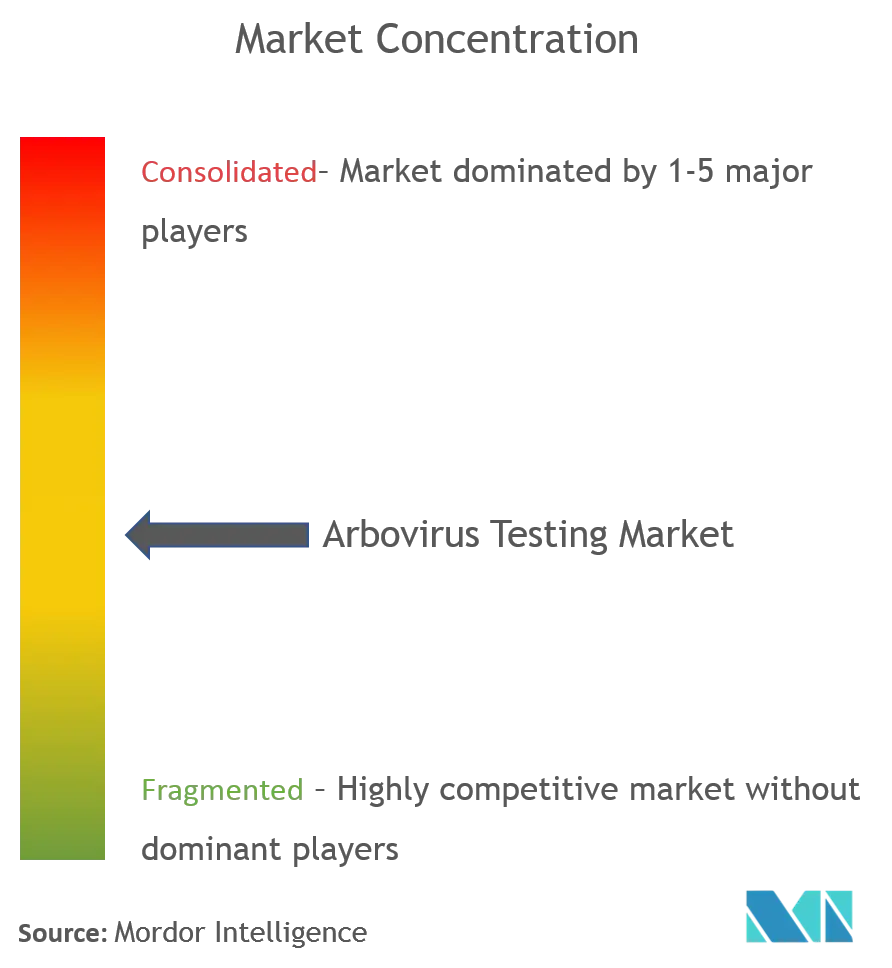
| Market Concentration | Medium |
Major Players *Disclaimer: Major Players sorted in no particular order Image © Mordor Intelligence. Reuse requires attribution under CC BY 4.0. | |
Arbovirus Testing Market Analysis by Mordor Intelligence
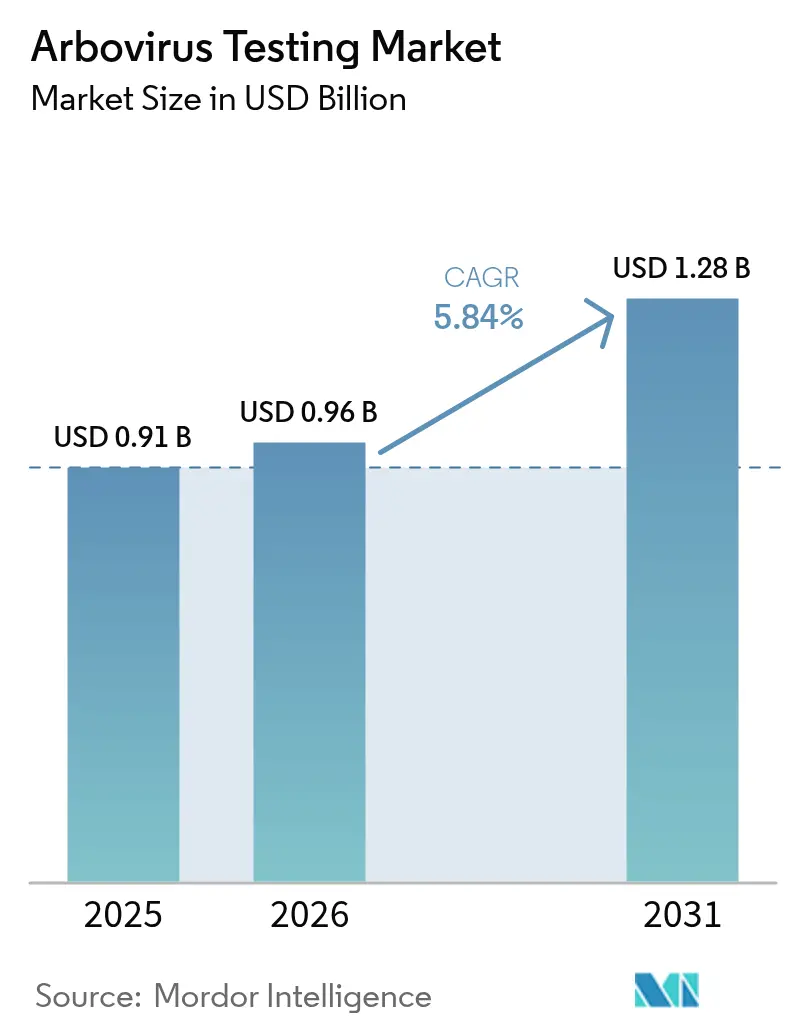
The global arbovirus testing market size in 2026 is estimated at USD 0.96 billion, growing from 2025 value of USD 0.91 billion with 2031 projections showing USD 1.28 billion, growing at 5.84% CAGR over 2026-2031. Escalating dengue, Zika, and chikungunya outbreaks, in tandem with climate-driven vector expansion, are lifting demand for rapid, decentralised diagnostics across endemic and newly affected regions. Government budgets are shifting toward infectious-disease preparedness, catalysing procurement of next-generation ELISA, RT-PCR, and isothermal amplification platforms that shorten time-to-result in field conditions. Technological breakthroughs—CRISPR-assisted multiplex RT-PCR, AI-enhanced ELISA readouts, and extraction-free workflows—are improving accuracy while cutting consumable costs, making advanced molecular tools viable for low-resource settings. Competitive intensity centres on technology rather than price; platform synergies and integrated data solutions remain the core levers for share gains.
Key Report Takeaways
- By test type, ELISA kits captured 41.98% of the arbovirus testing market share in 2025; isothermal amplification platforms are projected to expand at a 6.03% CAGR through 2031.
- By end user, hospitals and clinics accounted for 38.15% of the arbovirus testing market size in 2025, while diagnostic laboratories are forecast to grow fastest at a 6.47% CAGR to 2031.
- By geography, North America commanded 35.85% revenue share of the arbovirus testing market size in 2025; Asia-Pacific is anticipated to log the highest 7.42% CAGR between 2026-2031.
Note: Market size and forecast figures in this report are generated using Mordor Intelligence’s proprietary estimation framework, updated with the latest available data and insights as of 2026.
Market Trends and Insights
Drivers Impact Analysis of Arbovirus Testing Market*
| Driver | (~) % Impact on CAGR Forecast | Geographic Relevance | Impact Timeline |
|---|---|---|---|
| Escalating global outbreaks of dengue, Zika & chikungunya | +1.8% | Global, with highest impact in APAC and Latin America | Short term (≤ 2 years) |
| Technological advances in ELISA & RT-PCR platforms | +1.2% | Global, with early adoption in North America and Europe | Medium term (2-4 years) |
| Rapid-test adoption across LMIC primary-care settings | +1.0% | APAC, Africa, and Latin America | Medium term (2-4 years) |
| Government-funded vector-surveillance programs (genomics-enabled) | +0.8% | North America, Europe, and select APAC countries | Long term (≥ 4 years) |
| Multiplex isothermal amplification for field diagnostics | +0.6% | Global, with focus on endemic regions | Medium term (2-4 years) |
| Climate-linked procurement surges for outbreak preparedness kits | +0.4% | Global, with emphasis on tropical and subtropical regions | Short term (≤ 2 years) |
| Source: Mordor Intelligence | |||
Escalating Global Outbreaks of Dengue, Zika & Chikungunya
Record dengue notifications climbed to 13.7 million cases and 8,100 deaths across the Americas in 2024, a 260% leap over 2023 levels, pushing health-care systems toward molecular assays that enable serotype-specific management. Serological limitations during poly-virus circulation have prompted laboratories to upgrade to multiplex RT-PCR tools capable of distinguishing up to 32 arboviruses per run. Climate-related vector migration has driven local transmission in 15 previously unaffected countries, forcing non-endemic markets to stockpile diagnostic kits for front-line screening00298-9/fulltext). Novel reassortant Oropouche strains have also emerged, spurring demand for broad-spectrum detection panels. Economic modelling shows dengue now costs USD 4.1 billion annually, making early detection programs financially imperative.
Technological Advances in ELISA & RT-PCR Platforms
Next-generation ELISA readers use AI to cut indeterminate rates, lifting diagnostic accuracy to 99.6% for dengue serotype differentiation. Synthetic-biology-defined primers and CRISPR guard bands allow single-tube RT-PCR to concurrently detect 32 arboviruses without cross-reactivity penalties. Machine-learning analytics reduce false positives by 22% via amplification-curve pattern recognition. Extraction-free workflows shorten turnaround from four hours to under 65 minutes, a benefit proven during 2024 field pilots. Automation has freed skilled staff for confirmatory tasks, bolstering surge capacity during seasonal peaks.
Rapid-Test Adoption Across LMIC Primary-Care Settings
Isothermal platforms slashed deployment costs by 65% versus legacy PCR during 2024 roll-outs in 42 countries. LAMP-based devices posted 96.1% accuracy against reference labs, enabling same-day care in district clinics. FIND estimates a 4.2 million-test addressable demand at level-2 facilities, signalling a sizeable growth runway. Decentralised testing reduced health-system costs 52% by cutting patient transfers and preventing severe cases. mHealth connectivity now streams anonymised results to surveillance dashboards, strengthening outbreak intelligence while protecting privacy through encryption.
Government-Funded Vector-Surveillance Programs (Genomics-Enabled)
US GEIS scaled real-time sequencing to 28 countries in 2024, allowing rapid variant tracking and informing countermeasure allocation. Nanopore devices achieved unbiased strain typing from mosquito pools in under 3.5 hours, delivering near-instant epidemiological insight. Wastewater-based surveillance flags asymptomatic transmission earlier than clinical reporting, an essential capability given 85% of dengue infections are clinically silent. ECDC’s Enhanced Arbovirus Surveillance Network harmonised protocols across 27 EU states, unlocking joint tenders for high-throughput sequencers worth EUR 105 million in 2024. Economic models show every surveillance dollar avoids USD 24–28 in outbreak expenditure.
Restraints Impact Analysis of Arbovirus Testing Market*
| Restraint | (~) % Impact on CAGR Forecast | Geographic Relevance | Impact Timeline |
|---|---|---|---|
| Cross-reactivity complicating regulatory approvals | -0.9% | Global, with highest impact in regions with multiple co-circulating flaviviruses | Medium term (2-4 years) |
| Stringent validation requirements & long approval cycles | -0.7% | Primarily North America and Europe | Long term (≥ 4 years) |
| Scarcity of pathogen-positive reference materials | -0.5% | Global, with particular impact on emerging market manufacturers | Medium term (2-4 years) |
| Post-COVID budget diversion away from arbovirus diagnostics | -0.4% | Global, with varying regional impact based on healthcare funding models | Short term (≤ 2 years) |
| Source: Mordor Intelligence | |||
Cross-Reactivity Complicating Regulatory Approvals
Antigenic overlap among flaviviruses forces assay makers to validate against 18-virus panels, extending average approval timelines to 32 months in 2024. Multiplex assays risk performance compromise if any target shows cross-talk, prompting regulators to request geographically diverse clinical datasets that inflate trial budgets. PRNT remains the gold standard but is impractical for routine labs due to seven-day incubation, leaving a validation gap for rapid formats. Fifteen new arboviral variants identified in 2024 required additional verification cycles, resetting launch calendars. This barrier advantages large incumbents with deeper pockets and seasoned regulatory teams.
Post-COVID Budget Diversion Away from Arbovirus Diagnostics
Pandemic-era investments continue to prioritise respiratory surveillance, cutting vector-borne disease budgets by up to 40% in some LMICs during 202401234-5/fulltext). Capital previously earmarked for mosquito control and diagnostics was redirected to maintain SARS-CoV-2 PCR capacity, delaying arboviral kit procurement by eight to 12 months. International funding channels mirrored the shift; grants for dengue control fell 35% versus pre-COVID baseline. Skilled entomologists reassigned to COVID programmes have yet to return, leaving human-resource gaps in vector surveillance teams. The paradox is particularly acute in LMICs where rising case loads coincide with shrinking budgets, complicating national elimination strategies.
*Our forecasts treat driver/restraint impacts as directional, not additive. The impact forecasts reflect baseline growth, mix effects, and variable interactions.
Arbovirus Testing Market Segment Analysis
By Test Type:
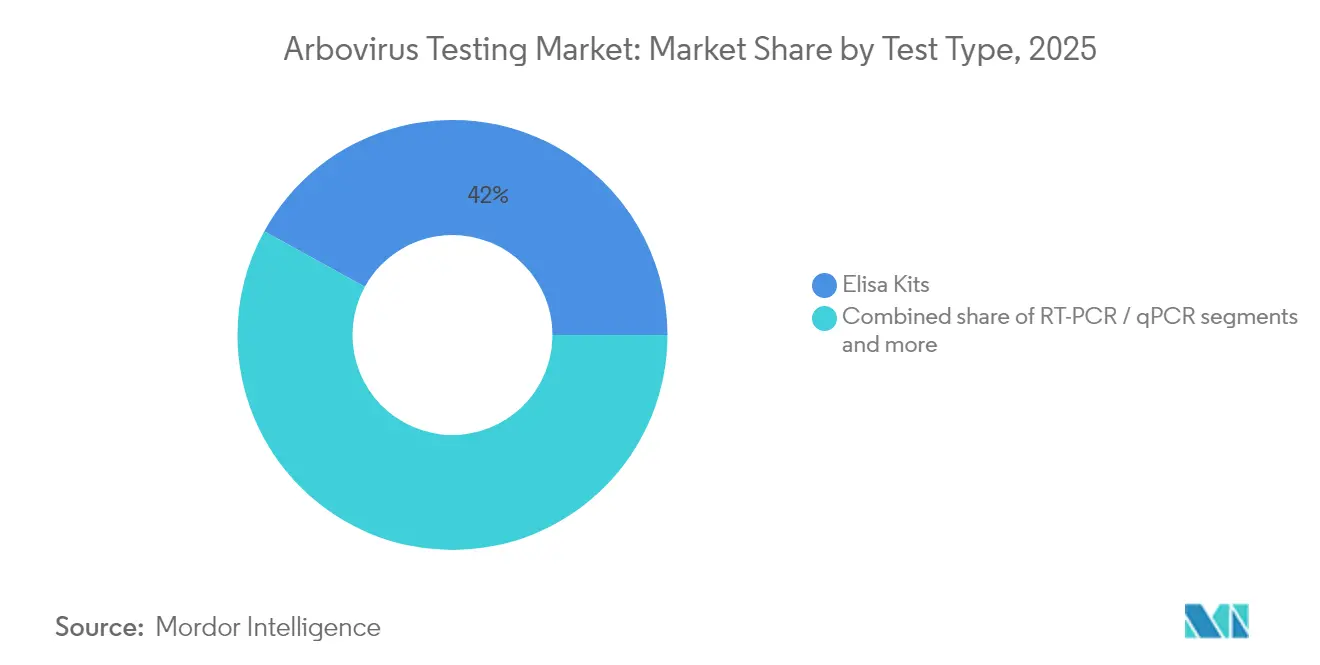
Isothermal Amplification Gains MomentumELISA maintained the largest foothold with 41.98% of arbovirus testing market share in 2025, underscoring its entrenched role in population-level screening. The segment continues to benefit from low per-test costs and simple instrumentation, yet growing demand for rapid, decentralised decisions is catalysing a shift toward isothermal technologies. Isothermal platforms are forecast to register a 6.03% CAGR and are already live in more than 650 Asia-Pacific primary centres, offering 70% cheaper operations than conventional PCR without sacrificing sensitivity.
Rapid antigen devices remain the smallest slice but have achieved 99.1% specificity for dengue NS1, improving early-phase case detection. Hybrid cartridge designs now merge immunoassay capture with isothermal amplification, blurring historical boundaries and threatening ELISA primacy. CRISPR-guided detection paired with recombinase polymerase amplification is moving through eight clinical trials and could reconfigure the arbovirus testing market once commercialised.



By End User:
Diagnostic Laboratories Drive InnovationHospitals and clinics delivered 38.15% of 2025 revenue owing to immediate care pathways, but diagnostic laboratories are poised for 6.47% CAGR as outbreak volumes reward high-throughput hubs capable of processing surges exceeding 10,000 samples per day. Centralised labs achieved 99.2% proficiency in 2024 external quality assessments compared with 91.3% for decentralised sites, reflecting deeper assay expertise and robust QC systems.
Investment in AI-assisted analytics is automating result interpretation, trimming false positives by 28% and freeing scientists for confirmatory work. Multiplex demand exploded 189% in 2024 as clinicians sought one-run differential diagnoses where dengue, chikungunya, and Zika co-circulate. Research institutes, though smaller in spend, pipeline >185 experimental assays, ensuring a steady supply of cutting-edge formats that feed commercial portfolios.
Geography Analysis
North America Arbovirus Testing Market
North America retained a 35.85% revenue lead in 2025 thanks to CDC-backed lab-capacity grants and FDA guidance that shortens review cycles for emerging-pathogen assays. Aedes aegypti has established breeding in 18 US states, up from 15 in 2023, extending the diagnostic catchment and driving new municipal procurements. Canada and Mexico co-fund cross-border incident platforms under the USD 145 million North American Health Security Partnership, harmonising reagent demand across the bloc.
APAC Arbovirus Testing Market
Asia-Pacific will post the steepest trajectory at 7.42% CAGR through 2031 as urbanisation and warming climates expand mosquito habitats. India’s National Vector-Borne Disease Control Programme dedicated USD 580 million to diagnostic infrastructure in 2024, while China advanced USD 4.1 billion in infectious-disease testing funds, 18% earmarked for arboviruses. ASEAN states invested USD 820 million to align with WHO IHR standards, and venture financing in regional med-tech exceeded USD 3.6 billion. Vector-competence studies warn that 14 more countries could sustain dengue transmission by 2030, underscoring the region’s diagnostic urgency.
Europe Arbovirus Testing Market
Europe shows stable growth, propelled by travel medicine and autochthonous clusters in France, Italy, Spain, and Croatia. The EU’s Enhanced Arbovirus Surveillance Network pooled EUR 105 million for unified diagnostics in 2024, simplifying market entry for kit makers. Southern and Central regions now document established Aedes albopictus populations, widening routine-testing geography. EMA regulatory harmonisation continues to reduce multi-country approval costs, providing a predictable arena for innovation roll-outs.
Regulatory Landscape
Regulatory oversight is tightening for arbovirus diagnostics as regulators move more tests into standardized IVD frameworks. In the United States, the FDA finalized an LDT rule in May 2024 that phases out general enforcement discretion over four years, with Stage 1 compliance beginning May 6, 2025. This raises documentation, validation, and quality-system expectations for laboratories that have historically relied on in-house arbovirus assays. The FDA also issued final guidance in September 2025 on enforcement policies for IVDs used during section 564 declared emergencies, clarifying performance and availability tradeoffs that can affect outbreak-time deployment of dengue, Zika, and chikungunya assays.
In Europe, IVDR (EU) 2017/746 remains the central gating factor for market access, particularly for higher-risk assays where implementation complexity increases the burden on manufacturers and labs. The European Commission has continued designating EU Reference Laboratories for high-risk IVDs with milestones extending through May 2026, reinforcing a more structured conformity assessment environment. Commercial precedent for IVDR-aligned arbovirus menus includes Grifols Procleix ArboPlex receiving a CE mark in April 2024 as a 4-in-1 NAT for chikungunya, dengue, West Nile, and Zika screening, while WHO and PAHO guidance continues to anchor diagnostic algorithms that combine molecular (NAT) and serological approaches in endemic settings.
Value Chain Analysis
The arbovirus testing value chain covers assay design and clinical evidence generation, regulated manufacturing of reagents and consumables, instrument and software enablement, and downstream distribution into hospitals, diagnostic laboratories, blood centers, and surveillance programs. Upstream inputs include enzymes (polymerases), synthetic oligonucleotides, and fluorescent probes, with critical production concentrated across hubs in the United States, Germany, and Singapore. Platform-tethered chemistries and proprietary master mixes create single-source dependencies for many users, while regulatory requirements (notably EU IVDR common specifications for Class D devices covering chikungunya, dengue, West Nile, and Zika) extend the validation-to-launch pathway and increase the importance of established quality management and clinical performance files.
Downstream, logistics and service execution influence adoption economics as much as assay performance. Cold-chain transport remains a practical bottleneck for RT-PCR kit distribution into tropical regions where reagent stability is a constraint, increasing the role of regional distributors, tender intermediaries, and local service capability for instrument uptime. Along the chain, Grifols scaling IVDR-cleared multiplex NAT positioning for transfusion screening (Procleix ArboPlex, CE mark April 2024) illustrates vendor execution tied to regulatory milestones, while branded menu offerings linked to installed real-time PCR systems, including Roche and other major platform ecosystems, shape procurement behavior. Peer-reviewed evaluation activity also feeds procurement confidence for decentralized molecular testing, as reflected in June 2026 analytical and clinical evaluation work on the STANDARD M10 Arbovirus Panel for multiplex screening in the Americas.
Competitive Landscape
The arbovirus testing market is moderately concentrated: the top five providers—Abbott, Roche, Thermo Fisher Scientific, Cepheid, and bioMérieux—controlled roughly majority of global revenue in 2024. Platform integration remains the competitive fulcrum; bundled instruments, reagents, and analytics lock-in customers and discourage price wars. Abbott’s ID NOW Dengue Plus, cleared in December 2024, and Roche’s cobas Liat tri-plex assay, launched February 2025, underscore the pivot to near-patient molecular accuracy.
Technology differentiation drives M&A and venture flows toward isothermal and CRISPR assets. FDA reclassification of acute-febrile-illness devices in December 2024 created a fast lane for multiplex approvals, enticing start-ups with disruptive miniaturisation to challenge incumbents. White-space persists for battery-operated sequencers and reagents tailored to novel viruses such as Oropouche, Mayaro, and Jamestown Canyon, pathogens currently underserved by commercial menus.
Thermo Fisher’s USD 180 million reagent capacity expansion (November 2024) targets emerging-market roll-outs where distribution bottlenecks often cap revenue potential. Cepheid ramped Xpert system deployment for humanitarian response scenarios, demonstrating portability during climate-related disasters. BioMérieux’s VIDAS Dengue Trio integrates antigen and antibody panels into 30-minute formats, illustrating the hybridisation trend.
Arbovirus Testing Industry Leaders
Agilent Technologies, Inc.
Thermo Fisher Scientific
NovaTec Immundiagnostica GmbH
Euroimmun AG
Abbott Laboratories
- *Disclaimer: Major Players sorted in no particular order
Arbovirus Testing Market Companies Covered in this Report
- Abbott Laboratories
- Roche
- Thermo Fisher Scientific
- Bio-Rad Laboratories
- DiaSorin
- Siemens Healthineers
- QIAGEN
- Quest Diagnostics
- Cepheid (Danaher)
- Beckton Dickinson
- BioMérieux
- Euroimmun (Revvity)
- QuidelOrtho
- Altona Diagnostics
- Fast Track Diagnostics
- InBios International
- Creative Diagnostics
- Microbix Biosystems
- Orasure Technologies
- Tetracore

Market Opportunities and Future Outlook
Product and tender whitespace is increasingly defined by standardized, multiplex molecular menus that reduce cross-reactivity risk while expanding target coverage beyond the most commercialized dengue and Zika assays. A concrete gap highlighted in 2026 field implementations and publications is multiplex coverage that includes Yellow Fever virus alongside DENV, ZIKV, and CHIKV, aligning with program needs where multiple arboviruses co-circulate and where single-run differential diagnosis reduces repeat sampling and lab workload. On the commercialization side, recent regional approvals indicate room for expansion of differentiated multiplex RT-PCR kits in Southeast Asia and other endemic geographies, exemplified by the LyteStar Arbovirus ZCD kit receiving Malaysian MDA approval (May 2024) and Thai FDA approval (April 2026).
Decentralized molecular testing is also creating opportunity for platforms and workflows designed for level-2 facilities, mobile clinics, and surveillance networks that need shorter turnaround times and simpler logistics than conventional PCR. Evidence in the innovation pipeline includes one-pot CRISPR-Dx methods reported in March 2026 for rapid CHIKV detection, and multiplex electrochemical biosensing reported in March 2026 for DENV/CHIKV/YFV in serum, pointing to alternative architectures that can reduce dependence on thermal cyclers and centralized lab staffing. WHO programs, including the Global Arbovirus Initiative and related strategy documents emphasizing regional manufacturing hubs and point-of-care molecular infrastructure, reinforce demand for assays and connectivity features that integrate with outbreak reporting and One Health surveillance workflows, including compatibility with pooled mosquito samples and genomics-enabled monitoring.
Recent Industry Developments in Arbovirus Testing Market
- May 2026: Agilent Technologies announced a two-year research collaboration with Singapore's Nucleic Acid Therapeutics Initiative (NATi) to develop end-to-end analytical and preparative workflows for complex oligonucleotide candidates, leveraging Agilent LC and LC/MS platforms. The work supports upstream characterization capabilities for nucleic-acid based solutions that can serve infectious-disease applications, reinforcing the tooling ecosystem that underpins assay development and manufacturing quality.
- February 2026: A peer-reviewed study reported implementation of a multiplex real-time ZYDC-PCR assay across Belgium, the DRC, and Cuba for simultaneous detection of DENV, ZIKV, CHIKV, and YFV. By operationalizing a broader multiplex panel that includes YFV, the work highlights a practical pathway for labs and programs seeking differential diagnosis in co-circulation settings, and it underscores a commercial gap in existing multiplex repertoires.
- April 2024: Grifols reported that its Procleix ArboPlex Assay received a CE mark under the EU IVDR as an automated 4-in-1 NAT for screening chikungunya, dengue, West Nile, and Zika viruses. The clearance supports standardization in blood screening and reinforces the role of regulated, multiplex molecular assays as IVDR compliance pressures increase for high-risk IVD use cases.


Arbovirus Testing Market Report Scope and Research Methodology
Market Definition and Coverage
The arbovirus testing market is defined as revenues earned from diagnostic testing used to detect arboviral infections in people, including test kits and reagents, instruments used for testing workflows, and testing performed across common care settings.
Scope exclusions: The sizing excludes vaccine sales, vector control products, and broad infectious disease panels when arbovirus results cannot be isolated as a separately reported component.
Segments Covered in This Report
- By Test Type (Value)
- ELISA / MAC-ELISA
- RT-PCR / qPCR
- Isothermal
- Rapid Antigen
- Others
- By End User (Value)
- Hospitals & Clinics
- Diagnostic Laboratories
- Research & Academic Institutes
- By Geography (Value)
- North America
- United States
- Canada
- Mexico
- Europe
- Germany
- United Kingdom
- France
- Italy
- Spain
- Rest of Europe
- Asia-Pacific
- China
- India
- Japan
- South Korea
- Australia
- Rest of Asia-Pacific
- South America
- Brazil
- Argentina
- Rest of South America
- Middle East and Africa
- GCC
- South Africa
- Rest of Middle East and Africa
- North America
Data Sources, Market Sizing, and Validation
Desk Research
Desk work was used to pin down the addressable disease and testing-use context before building any model totals. We relied on public health surveillance and epidemiology references, including US CDC, the World Health Organization, PAHO updates for the Americas, and ECDC resources for Europe, to confirm where outbreaks, travel-related cases, and screening needs are rising.
We also reviewed regulatory and testing-use signals through sources such as US FDA safety and clearance information, peer reviewed journals on assay performance and clinical guidance, and broader diagnostic market disclosures like annual reports and investor presentations from relevant manufacturers. For volume and trade cross-checks, we selectively used an import and export shipment-level database and a patent database to understand assay activity patterns and platform focus areas. The desk research sources mentioned are illustrative only, and other public and paid references were also used for data collection, validation, and research clarification.
Primary Interviews and Surveys
Primary conversations were used to pressure-test what drives test volumes by setting and to confirm how often molecular versus serology is used across suspected, screening, and confirmatory pathways. We spoke with a balanced mix of diagnostic laboratories, hospitals, public health stakeholders, and channel participants across key regions so assumptions on utilization, pricing, and mix could be corrected when desk indicators were not aligned.
Distribution of primary research fieldwork respondents
| Company type | Respondent position | Region |
|---|---|---|
| Top tier: 26% | CXOs: 16% | APAC: 46% |
| Mid tier: 57% | Functional/Unit leaders: 38% | EMEA: 33% |
| Smaller Players: 17% | Managers: 46% | Americas: 21% |
Market-Sizing & Forecasting
The core model starts from a top-down demand pool build where reported arboviral case burden and testing intent are translated into expected tests performed, and then converted into revenue using typical pricing by test method and setting. To keep the logic realistic, inputs are adjusted for under-testing in low access areas, repeat testing in hospitalized cases, and confirmatory rates when initial screens are positive.
Key inputs used in the model include reported dengue, Zika, chikungunya, and West Nile activity trends, seasonality and outbreak cycles by geography, the share of suspected patients routed to lab testing versus point-of-care, the molecular versus serology mix (including confirmatory PCR use), and average selling price movement for kits and reagents as volumes scale. These assumptions are corroborated with selective bottom-up approximations, such as sampled lab throughput discussions, channel checks on kit demand, and a simple volume times ASP build for a few representative care pathways, and then gaps are handled by applying conservative utilization bands where respondent feedback is thin.
For forecasting, scenario analysis is used so outbreak volatility is captured without forcing a smooth curve that does not match real arbovirus patterns. The scenarios are anchored on expert views about surveillance intensity, climate related vector spread signals, and lab capacity constraints, and then blended into a central case after consistency checks.
Data Validation & Update Cycle
Model outputs are checked against independent signals, including public surveillance direction, diagnostic lab workload commentary, and observed shifts in testing method preference, and then variances are reviewed before numbers are finalized. If a region shows an unusual spike or drop, assumptions on test-per-case, confirmatory rates, or pricing are rechecked and follow-up calls are triggered to confirm whether it is a real market shift or a modeling artifact.
Before sign-off, the work goes through multi-step analyst reviews where calculations are re-performed and key assumptions are compared across regions for logical consistency. Reports are refreshed annually, with interim updates when material events occur, and a final pre-delivery review is completed so clients receive the latest updated view.
Mordor Intelligence's Arbovirus Testing Market Sizing Compared With Other Published Estimates
Published market sizes for arbovirus testing often do not match because the included revenue streams and the timing of the base year can be set differently, and then the gaps widen when pricing and outbreak intensity are projected in different ways.
The main gap comes from mixing broad infectious disease diagnostics with arbovirus-specific testing revenues, where Mordor Intelligence counts only revenues that can be tied to arboviral assays and related testing workflows and then fixes the total with checks on test volumes, method mix, and typical ASP ranges.
Benchmark comparison
| Source | Market Size | Gaps in Research Methodology |
|---|---|---|
| Mordor Intelligence | USD 0.96 B (2026) | |
| Global Consultancy A | USD 1.12 B (2024) | Uses an earlier base year and may include adjacent infectious disease testing revenues when arbovirus lines are not separated, which can lift the total when bundle pricing is applied. |
| Industry Publisher B | USD 1.42 B (2024) | Applies a higher growth curve and a broader test scope, which can overstate revenues when outbreak-driven testing spikes are treated as steady demand and ASP declines are not fully reflected. |
The spread across sources is largely explained by scope choices and base-year timing, followed by how each model treats outbreak volatility and pricing progression. By keeping the demand pool tied to observable testing pathways and then cross-checking it with practical volume and ASP signals, we end up with a number that is easier to trace and repeat.


Key Questions Answered in the Report
What is the current size of the arbovirus testing market?
The arbovirus testing market size stood at USD 0.96 billion in 2026 and is projected to reach USD 1.28 billion by 2031.
Which region grows fastest in arbovirus diagnostics?
Asia-Pacific is forecast to post the highest 7.42% CAGR through 2031, propelled by large-scale government investments and expanding disease burden.
Which test type is gaining the most momentum?
Isothermal amplification platforms are projected to exhibit the quickest 6.03% CAGR because they deliver molecular-level sensitivity without complex cyclers.
Why are diagnostic laboratories outpacing hospitals in growth?
Laboratories offer high-throughput capacity, superior quality control, and AI-assisted analytics, driving a forecast 6.47% CAGR to 2031.
Page last updated on:





