
Saudi Arabia Aquaculture Market Analysis by Mordor Intelligence
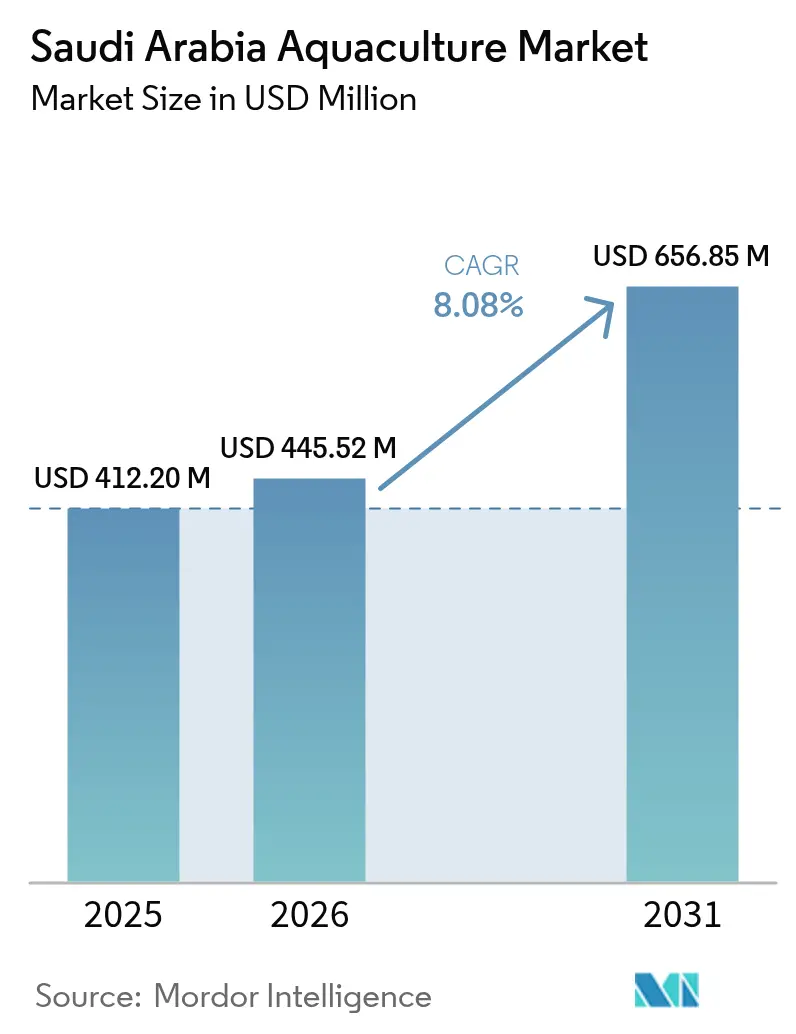
The Saudi Arabia aquaculture market size in 2026 is estimated at USD 445.52 million, growing from 2025 value of USD 412.20 million with 2031 projections showing USD 656.85 million, growing at 8.08% CAGR over 2026-2031. Recent investments in recirculating aquaculture systems (RAS), coastal cage farming, and inland desert facilities are reshaping the competitive and geographic structure of production. Government incentives, such as low-interest loans from the Saudi Agricultural Development Fund and streamlined permits under the Naama digital system, have reduced capital and administrative barriers. Rapid adoption of IoT water-quality sensors, integration of renewable-energy micro-grids, and R&D advances at King Abdullah University of Science and Technology (KAUST) are helping operators improve survival rates and lower operating costs. The sector’s gradual shift toward higher-value species, including grouper, sea bream, and marine shrimp, signals a move away from bulk, low-margin production into premium, traceable offerings that meet rising domestic food-service demand.
Key Report Takeaways
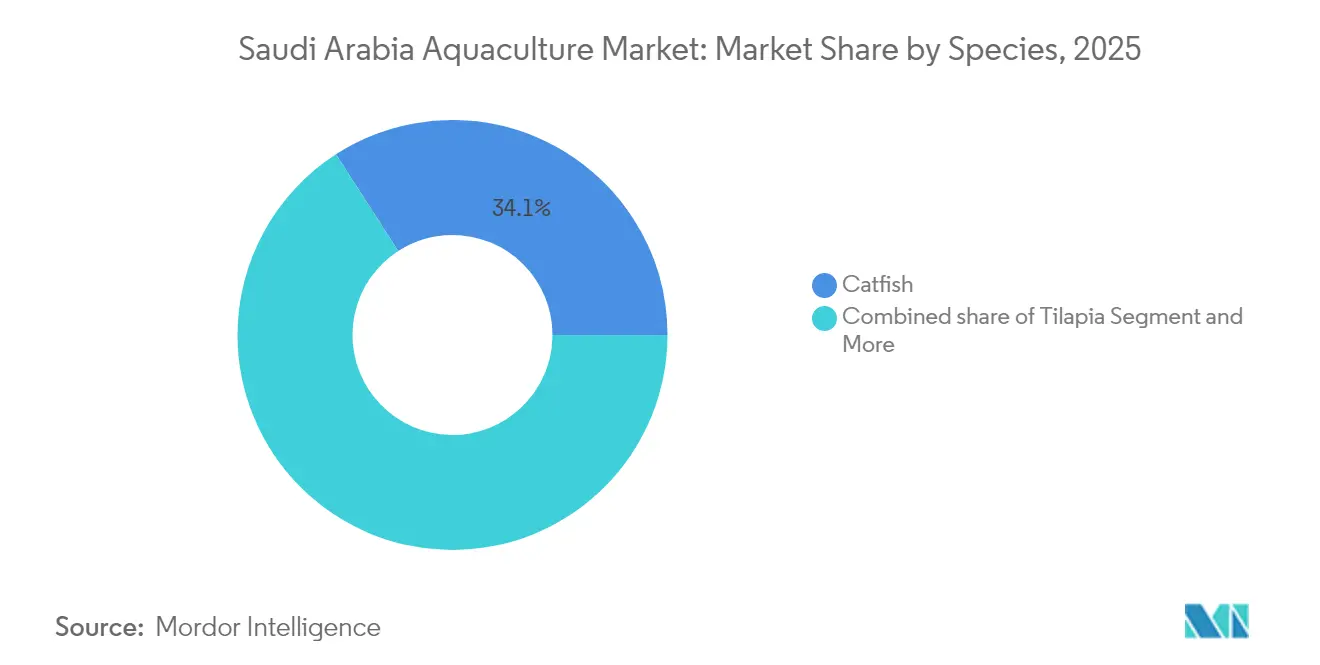
- By species, catfish held the largest 34.12% of the Saudi Arabia aquaculture market share in 2025, while shrimp is projected to post the fastest 8.72% CAGR through 2031.
Note: Market size and forecast figures in this report are generated using Mordor Intelligence’s proprietary estimation framework, updated with the latest available data and insights as of 2026.
Saudi Arabia Aquaculture Market Trends and Insights
Drivers Impact Analysis*
| Driver | (~) % Impact on CAGR Forecast | Geographic Relevance | Impact Timeline |
|---|---|---|---|
| Subsidy expansion under the USDA Seafood Import Substitution Program | +1.2% | National, with a concentration in the Red Sea coastal regions | Medium term (2-4 years) |
| Growing consumer preference for domestic, traceable seafood | +1.8% | National, with higher impact in urban centers (Riyadh, Jeddah, Dammam) | Short term (≤ 2 years) |
| Advances in Recirculating Aquaculture Systems Commercial Viability | +2.1% | National, with early adoption in NEOM and Eastern Province | Long term (≥ 4 years) |
| Rapid adoption of IoT-enabled water-quality sensors in inland farms | +0.9% | National, with a focus on inland desert facilities | Medium term (2-4 years) |
| Corporate off-take agreements with food-service majors | +1.4% | National, with a concentration in major metropolitan areas | Short term (≤ 2 years) |
| State-level aquaculture permitting reforms | +0.8% | National, through MEWA's Naama digital system | Short term (≤ 2 years) |
| Source: Mordor Intelligence | |||
Subsidy expansion under USDA Seafood Import Substitution Program
Subsidized credit from the Saudi Agricultural Development Fund expanded lending capacity. In February 2025, combined with Sharia-compliant financing options, this has enabled companies like Balady Poultry Trading to secure USD 304 million for integrated protein production facilities that include aquaculture components. Domestic feed manufacturers have begun scaling production lines dedicated to aquafeed, locking in cost advantages across the value chain. This financial architecture creates a competitive advantage for domestic aquaculture operations by lowering capital costs and extending repayment terms beyond what traditional commercial lending would offer. In December 2024, Modern Mills' USD 40 million investment in feed milling expansion specifically targets aquaculture feed production, indicating that subsidy benefits extend throughout the value chain.
Growing consumer preference for domestic, traceable seafood
Post-pandemic supply-chain disruptions heightened demand for provenance-verified seafood, especially in fine-dining and hotel chains that dominate inbound tourism. Premium buyers are now willing to pay 15-20% premiums for locally certified product lines. These price signals, coupled with expanding e-commerce channels, have improved producer margins and incentivized investment in certification systems that log origin, feed type, and harvest date. Corporate food service contracts, particularly those serving the expanding tourism and hospitality sectors in NEOM and The Red Sea Project, are establishing long-term off-take agreements that provide revenue certainty for aquaculture investments.
Advances in Recirculating Aquaculture Systems (RAS) commercial viability
KAUST researchers have cut desalination energy demand to 2.27 kWh/m³, lowering water-treatment costs for inland RAS operations. Integration of rooftop solar arrays and battery storage has enabled some farms to cover 30–40% of electricity loads via renewables. As scale increases, hybrid power configurations are projected to reach parity with grid tariffs, making inland production commercially competitive with coastal cage farming. The commercial breakthrough is further evidenced by the emergence of specialized RAS equipment suppliers and engineering firms targeting the Saudi market, indicating mature supply chain development.
Rapid adoption of IoT-enabled water-quality sensors in inland farms
Networked probes feeding real-time dissolved-oxygen, pH, and ammonia data into cloud dashboards now underpin automated feeding and aeration algorithms. Operators report labor savings up to 30% and survival-rate improvements of 5–8 percentage points. In a desert setting where water chemistry can shift within hours, predictive alerts mitigate mass-mortality risk and reduce insurance premiums. The data generated by these sensor networks is increasingly being integrated with artificial intelligence platforms to optimize feeding schedules, predict disease outbreaks, and maximize production efficiency.
Restraints Impact Analysis*
| Restraint | (~) % Impact on CAGR Forecast | Geographic Relevance | Impact Timeline |
|---|---|---|---|
| Limited vaccine availability for emerging pathogens | -1.1% | National, with a higher impact on marine cage operations | Medium term (2-4 years) |
| High electricity costs for energy-intensive RAS facilities | -1.6% | National, with a concentration in inland desert facilities | Long term (≥ 4 years) |
| Coastal zoning conflicts with recreational stakeholders | -0.8% | Red Sea and Arabian Gulf coastal zones | Short term (≤ 2 years) |
| Fragmented cold-chain infrastructure for live shellfish logistics | -0.7% | National, with critical gaps in remote coastal areas | Medium term (2-4 years) |
| Source: Mordor Intelligence | |||
Limited vaccine availability for emerging pathogens
Recent White Spot Syndrome outbreaks underscored the vulnerability of shrimp operators relying on generic vaccines formulated for other oceans. Lack of region-specific biologics forces farms to employ costly biosecurity protocols that cap stocking densities, raising unit costs by 10–15%. International suppliers remain hesitant to invest in tailored R&D until volumes justify scale, prolonging exposure to disease shocks. This gap forces Saudi operators to rely on prophylactic treatments and enhanced biosecurity measures that increase operational costs while limiting production density and growth rates.
High electricity costs for energy-intensive RAS facilities
Industrial tariffs consume up to 25% of total operating expenses for large-scale RAS farms. Mandatory backup generators and redundant chillers inflate both capital and maintenance budgets. Solar retrofits offset part of the daytime load yet require high initial outlays and land footprints, slowing adoption among mid-sized operators. Without affordable power-purchase agreements, inland expansion could decelerate. While renewable energy integration offers long-term solutions, the upfront capital requirements for solar installations and energy storage systems create additional financing hurdles for aquaculture developers. The constraint is particularly acute for inland desert facilities that cannot benefit from natural seawater cooling and must rely entirely on mechanical systems for temperature control.
*Our forecasts treat driver/restraint impacts as directional, not additive. The impact forecasts reflect baseline growth, mix effects, and variable interactions.
Segment Analysis
By Species: Shrimp Drives Premium Growth
Catfish maintained a 34.12% Saudi Arabia aquaculture market share in 2025 due to entrenched pond assets and a price point suited to mass retail. Shrimp is on track for a 8.72% CAGR through 2031, the fastest among all species, fueled by USD 3.7 billion Saudi-Chinese joint-venture funding for genetics and hatchery scale-up. Strong export premiums and expanding Gulf airline cargo hold capacity underpin the species’ margin profile. Tilapia holds a sizeable share in inland provinces because it tolerates variable water quality and commands lower feed costs, while niche operators are trialing high-value grouper, barramundi, and salmon in pilot RAS modules.
Consumer demand for sustainably raised crustaceans motivates farms to invest in traceability and antibiotic-free grow-out protocols, winning certification from the SAMAQ national quality mark. Arabian Shrimp Company’s hatchery expansions point to centralized post-larvae supply, reducing biosecurity risk for smaller growers. Although catfish volumes will continue to anchor domestic protein supply, revenue contribution from shrimp is projected to surpass catfish by 2030 as the price per kilogram doubles that of freshwater staples. These dynamics indicate an increasing bifurcation between affordable mass protein and premium export-oriented lines.

Geography Analysis
The Arabian Gulf coast, anchored by Dammam and Jubail, complements Red Sea output with quick access to major population hubs. Operators here leverage industrial utilities, existing cold-storage hubs, and petrochemical by-products for feedstock and energy integration. Higher salinity and seasonal thermal spikes necessitate species selection attuned to extreme parameters, yet offer niche premium species that command elevated price points in gourmet channels. The Red Sea Project's marine spatial planning process, while comprehensive, has designated significant coastal areas for tourism and conservation uses that exclude traditional aquaculture operations.
Production clusters span the Red Sea coast, Arabian Gulf shoreline, and emerging desert interiors. The Red Sea stretch from Jeddah to Umluj hosts the bulk of licensed cage capacity owing to stable salinity and year-round temperature profiles. NEOM-linked infrastructure upgrades, including dedicated service harbors and solar-powered desalination plants, position the region as a springboard for premium export campaigns. Environmental-baseline surveys completed in 2024 furnish granular data that inform site placement and carrying-capacity thresholds, aiding sustainable expansion.
Desert-based RAS campuses form a third node, freeing investors from maritime zoning while exploiting cheap land and abundant solar irradiance. Proximity to logistics corridors shortens haul times to Riyadh’s wholesale markets. KAUST pilot sites demonstrate integrated water-reuse and mineral-extraction schemes that upgrade waste brine into commercial co-products, creating circular-economy revenue streams. As policy incentives target water-efficient agriculture, desert aquaculture stands to capture incremental slices of the Saudi Arabia aquaculture market share in the medium term.
Regulatory Landscape
Aquaculture in Saudi Arabia is overseen primarily by the Ministry of Environment, Water and Agriculture (MEWA) through the General Directorate of Fish Resources, which manages licensing and operational oversight against national development targets, including the National Fisheries Development Program objective of reaching 600,000 tons of seafood by 2030. Licensing typically involves technical and economic feasibility studies, biosecurity plans, and proof of land or site-use rights, with permitting handled through MEWA processes (including digital workflow tools referenced in the market context such as the Naama system).
Food safety and input compliance fall under the Saudi Food and Drug Authority (SFDA), which regulates feed safety and requirements that affect both domestic sales and export eligibility. Facility audits and practice guidance are supported through the Saudi Code for Responsible Aquaculture Practices, while SAMAQ provides a national certification and labeling scheme that supports traceability and quality assurance. For exports, companies follow the National Aquaculture Products Export Manual and associated registration requirements with the competent fisheries authorities.
Value Chain Analysis
Saudi Arabia's aquaculture value chain covers broodstock and hatcheries, feed and health inputs, grow-out operations (coastal cages and ponds as well as inland RAS), harvesting, processing, cold-chain logistics, and retail and food-service channels. Large integrated producers such as National Aquaculture Group (NAQUA) anchor marine production along the Red Sea, supported by government execution through programs under the National Livestock and Fisheries Development Programme, which focuses on investment facilitation, standardized licensing pathways, and site identification, including government-referenced pipelines across multiple Red Sea locations.
Upstream dependencies center on aquafeed raw materials, with soybean and soybean meal still relying on imports even as domestic feed capacity expands (with the United States and Brazil among key suppliers). Midstream and downstream constraints identified in the report context include fragmented cold-chain infrastructure for live shellfish and the operating intensity of RAS, notably power costs, which tends to push value toward localized processing, improved logistics near major consumption hubs, and technology-enabled farm management (IoT water-quality sensors and automation) to protect survival rates and reduce labor intensity.
Market Opportunities and Future Outlook
Investment whitespace is most visible in expanding hatchery capacity, securing more localized feed inputs, and building downstream processing that links to premium, traceable seafood demand. In 2026, NAQUA began construction of a barramundi hatchery in Al Lith with 40 million fry annual capacity using RAS-oriented capabilities with MAT-KULING, which supports demand for specialized hatchery technology, biosecurity systems, and skilled services around seed supply. In parallel, the March 2026 confirmation of a single-cell protein facility in Jubail Industrial City (50,000-tonne initial annual capacity) by Saudi Industrial Investment Group and Unibio creates a feed-ingredient pathway that can reduce exposure to imported soybean markets.
Technology-led farming models are also extending beyond traditional species sets, with momentum tied to named project activity and public-private platforms. In February 2026, EcoFishCircle and Hayal International signed an MoU for a land-based Atlantic salmon farm (Blue Oasis) designed around 10,000-tonne annual capacity, pointing to demand for modular RAS systems, water-treatment equipment, and cold-chain solutions suited to premium species. Zone-led development further supports cluster formation, including the February 2026 SAR 2 billion agreement involving Topian (NEOM) and the Royal Commission for Jubail and Yanbu for an aquaculture project in the Jazan Special Economic Zone (10,000-tonne annual capacity), which underpins opportunities across utilities integration, processing, and export readiness through national certification and export-manual requirements.
Recent Industry Developments
- June 2026: The National Livestock and Fisheries Development Program signed three MoUs with Boehringer Ingelheim and AniVax to support localization of veterinary vaccine manufacturing and the development of an antigen bank. The collaboration targets biosecurity and disease-control constraints that can limit stocking density and performance, strengthening conditions for higher-intensity marine and inland production systems.
- March 2026: National Aquaculture Group (NAQUA) commenced construction of a barramundi hatchery in Al Lith, partnering with MAT-KULING and incorporating RAS-linked capabilities, with a stated capacity of 40 million fry annually. The project expands domestic fingerling supply and supports scale-up of premium finfish grow-out while reducing reliance on external seed sources.
- June 2024: KAUST and the Ministry of Environment, Water and Agriculture formed an Aquaculture Development Program partnership to advance technical capacity and support commercialization of innovative aquaculture solutions. The partnership reinforces the pipeline for translating local R&D into farm-level efficiency improvements, particularly for water- and energy-constrained RAS and desert production models.
Research Methodology Framework and Report Scope
Market Definition and Coverage
This market is defined as the value generated from aquaculture production within Saudi Arabia, covering farmed aquatic species sold in unprocessed and processed forms, measured in current USD.
Scope exclusions: Wild-caught fisheries landings and their first-sale value are excluded from this market sizing.
Segmentation Overview
- By Species (Production Analysis (Volume), Consumption Analysis (Volume and Value), Import Analysis (Volume and Value), Export Analysis (Volume and Value), and Price Trend Analysis)
- Catfish
- Salmonids (Atlantic, Steelhead)
- Tilapia
- Shellfish (Oysters, Mussels, Clams)
- Shrimp
- Other Species (Sturgeon, Striped Bass)
Data Sources, Market Sizing, and Validation
Desk Research
Desk work started by mapping the Saudi aquaculture ecosystem from production to first sale, and then assembling the main public time-series that explain supply and demand. We used sources such as FAO FishStat and FAO country fisheries profiles, UN Comtrade for seafood trade flows, Saudi government portals and statistics releases relevant to fisheries and food production, and customs and border-trade summaries where available.
To make inputs usable in a market model, we also reviewed company annual reports, investor presentations, and credible press coverage to understand capacity additions and shifts in farming technology (for example, RAS and cage farming), and to track price direction. A paid subscription for company financials and news was used selectively to cross-check reported revenue mix and expansion timelines, and a patent database was used as a light signal on farming and feed innovation activity. These desk sources are not exhaustive, and we consulted additional public and paid references to fill gaps and validate assumptions.
Primary Interviews and Surveys
Primary work was used to translate production and trade indicators into realistic price and mix assumptions, and to confirm how much output is sold as unprocessed versus processed. We spoke with a mix of farm operators, processors, feed and input participants, distributors, and informed industry experts, with coverage focused on Saudi Arabia for this country-level market.
Distribution of primary research fieldwork respondents
| Company type | Respondent position |
|---|---|
| Top tier: 31% | CXOs: 16% |
| Mid tier: 47% | Functional/Unit leaders: 29% |
| Smaller Players: 22% | Managers: 55% |
Market-Sizing & Forecasting
Sizing starts from a top-down reconstruction where national aquaculture supply is built using production and trade signals, and then converted into value using observed price bands for the main species and product forms. We corroborate the output with selective bottom-up checks, where we compare implied sales against a sample of producer and processor capacity, utilization, and channel feedback, and then adjust totals when the implied volumes or values do not look feasible.
Key inputs used in the model include aquaculture production volumes (metric tons), species mix shifts (for example, marine shrimp versus finfish), the split between unprocessed and processed sales, export and import values and volumes, and local price trends by product form. When a data series is missing for a year, the gap is handled with conservative interpolation anchored to the nearest verified points and validated again through interviews. Forecasts are built using scenario analysis, where farm expansion plans, expected yield improvements, and price normalization are tested under base, softer, and faster build-out cases, and the final path is aligned to the consensus ranges shared by primary respondents.
Data Validation & Update Cycle
Results are triangulated across multiple views, including production-led value, trade-led signals, and interview-led checks on selling prices and product mix. Outliers are flagged early, and the model is reworked when a single assumption causes an unrealistic jump in volumes, prices, or per-farm revenue.
Before sign-off, the estimates go through an internal review where assumptions are checked line by line, followed by a final variance scan against independent indicators like trade direction, processing share, and new capacity announcements. The report is refreshed annually, with interim updates when material events occur, and a last pre-delivery review is completed so clients receive the most current view available.
Mordor Intelligence's the Kingdom of Saudi Arabia Aquaculture Market Estimate Compared With Other Published Estimates
Published values for Saudi aquaculture often differ because analysts do not always count the same revenue point in the chain, and they may also mix aquaculture with broader seafood activity. Differences also come from how processed sales are treated, how trade is used (or not used) to sanity-check local demand, and whether the estimate is pegged to a single base year or smoothed across multiple years.
In our checks, the biggest gap driver is usually scope, where some figures appear to fold in wider seafood handling and distribution, while others stop at farm-gate value only, which changes the total even if volumes are similar. A second driver is the price build, since using one blended price for all species can overstate value when the mix shifts, while aggressive capacity ramp assumptions can pull forward growth. The table below shows how these practical choices can move the stated market size, and it also explains why the assumptions on processed share and trade validation matter for a Saudi-only model, which are treated explicitly by Mordor Intelligence.
Benchmark comparison
| Source | Market Size | Gaps in Research Methodology |
|---|---|---|
| Mordor Intelligence | USD 445.52 M (2026) | |
| Regional Consultancy A | USD 522.10 M (2026) | This estimate appears to use a broader value capture that can include more downstream revenue beyond farming, and the model signals are not clearly tied back to aquaculture production and processed split checks. |
| Industry Publisher B | USD 385.00 M (2024) | This figure is anchored to an earlier base year, and the scope emphasis reads closer to production-side sizing without explicitly reconciling trade signals or updating for recent processed sales expansion, which keeps the value lower. |
Taken together, the spread is mainly explained by what is counted as aquaculture value and how quickly price and mix are updated. By keeping the steps traceable to production, product form, and trade consistency checks, the final number stays easier to reproduce and audit when new capacity or export patterns change.
Key Questions Answered in the Report
How large is the Saudi Arabia aquaculture market in 2026?
The sector is valued at USD 445.52 million in 2026 and is on track to reach USD 656.85 million by 2031.
What growth rate is projected for Saudi aquaculture through 2031?
The Saudi Arabia aquaculture market is forecast to register an 8.08% CAGR over 2026-2031.
Which species is growing the quickest?
Shrimp is forecast to register a 8.72% CAGR as export demand and genetics programs scale up.
How are energy costs affecting inland aquaculture?
Electricity accounts for up to 25% of RAS operating expenses, prompting operators to adopt solar and battery solutions to mitigate tariff exposure.
Which factors most limit coastal cage expansion?
Zoning conflicts with tourism, conservation mandates, and recreational stakeholders restrict site availability along prime Red Sea and Arabian Gulf coastlines.