
Antivenom Market Size and Share
Market Overview
| Study Period | 2020 - 2031 |
|---|---|
| Market Size (2026) | USD 1.28 Billion |
| Market Size (2031) | USD 1.49 Billion |
| Growth Rate (2026 - 2031) | 3.13 % |
| Fastest Growing Market | Asia-Pacific |
| Largest Market | North America |
| Market Concentration | Medium |
Major Players *Disclaimer: Major Players sorted in no particular order Image © Mordor Intelligence. Reuse requires attribution under CC BY 4.0. | |
Antivenom Market Analysis by Mordor Intelligence
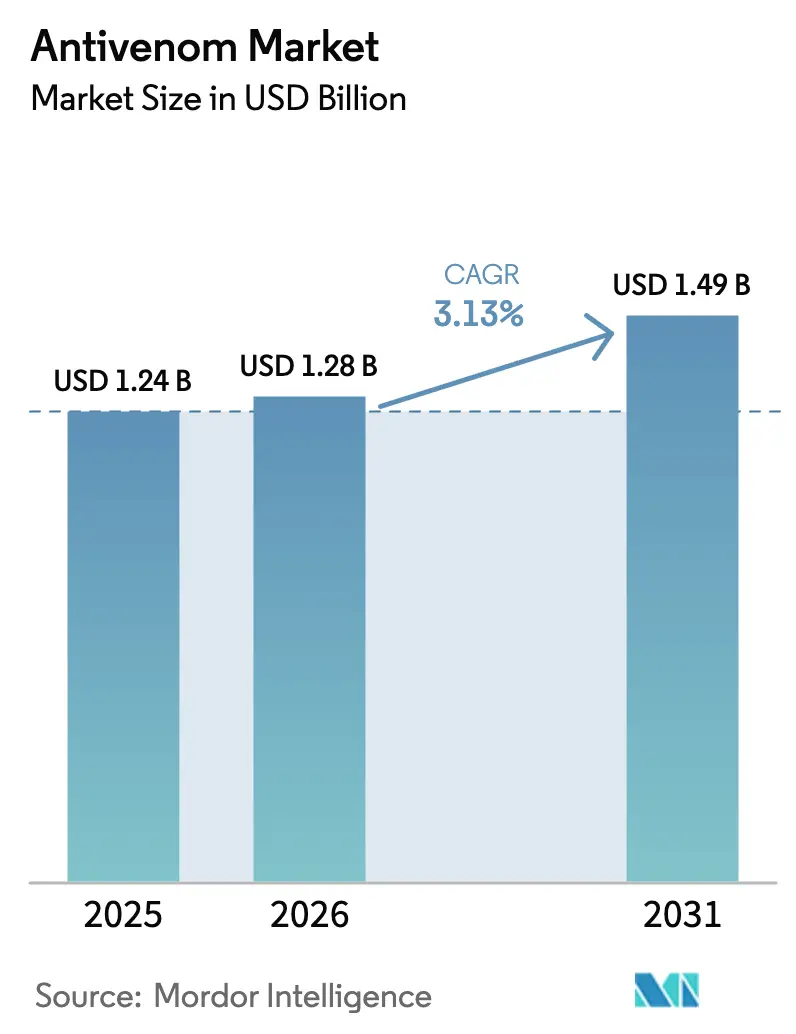
The Antivenom Market size is projected to be USD 1.24 billion in 2025, USD 1.28 billion in 2026, and reach USD 1.49 billion by 2031, growing at a CAGR of 3.13% from 2026 to 2031.
Rising snakebite incidence, government stockpiling, and WHO-driven quality standards are nudging demand upward, yet supply-chain gaps, cold-chain fragility, and high production costs temper momentum. Polyvalent equine formulations still dominate hospital formularies, but early clinical wins for recombinant monoclonal platforms foreshadow a gradual shift toward precision immunotherapy. Asia-Pacific, especially India and Southeast Asia, is moving fastest thanks to rural trauma infrastructure and mobile surveillance tools, while North America remains the highest-revenue region, supported by military and hospital contracts that enable premium pricing. Competitive intensity is climbing as the WHO prequalification weeds out substandard products and larger players consolidate to absorb GMP compliance costs.
Key Report Takeaways
- By product type, polyvalent antivenoms captured 62.43% antivenom market share in 2025, whereas other product formats are projected to expand at a 5.65% CAGR through 2031.
- By source, equine plasma accounted for 68.65% of the antivenom market size in 2025, yet recombinant DNA and monoclonal formats are advancing at a 5.78% CAGR to 2031.
- By end user, hospitals accounted for 71.32% of the antivenom market in 2025, while clinics and trauma centers are forecast to grow at a 6.32% CAGR through 2031.
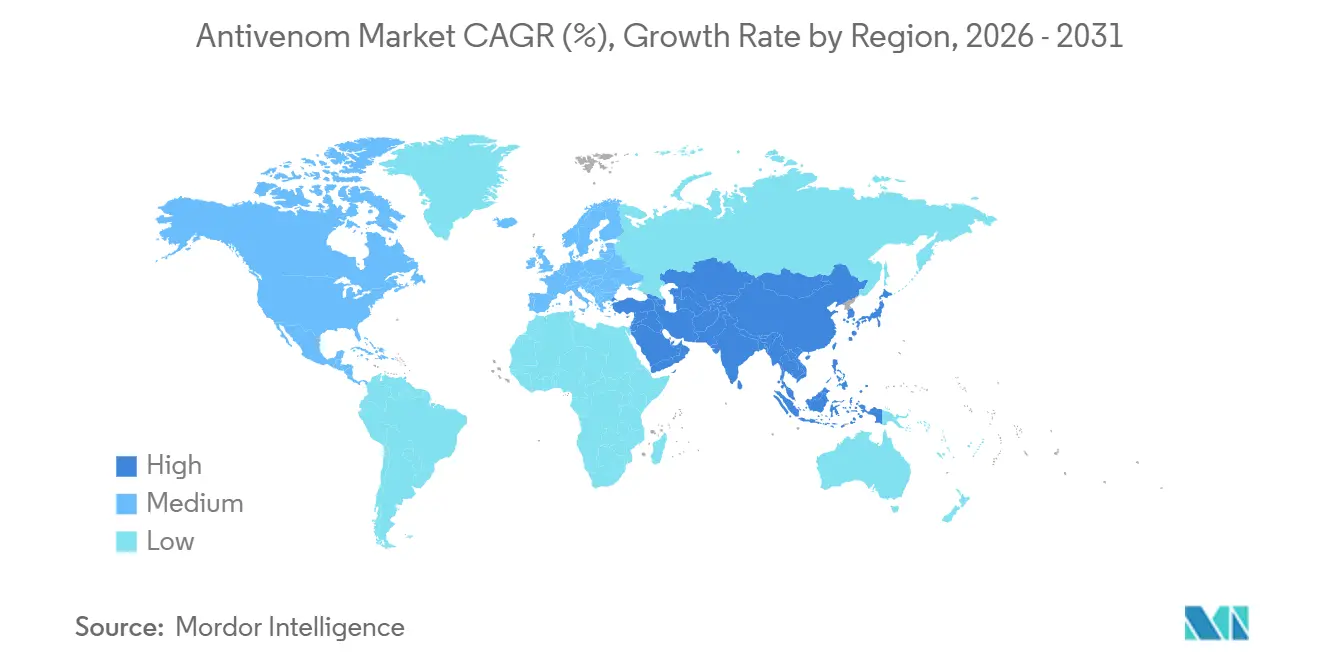
- By geography, North America led with a 43.54% revenue share in 2025; Asia-Pacific is the fastest-growing region, set to grow at a 4.54% CAGR through 2031.
Note: Market size and forecast figures in this report are generated using Mordor Intelligence’s proprietary estimation framework, updated with the latest available data and insights as of January 2026.
Market Trends and Insights
Drivers Impact Analysis of Antivenom Market*
| Driver | (~) % Impact on CAGR Forecast | Geographic Relevance | Impact Timeline |
|---|---|---|---|
| Rising Incidence of Venomous Bites and Stings | +0.9% | South Asia, sub-Saharan Africa, Latin America | Medium term (2-4 years) |
| Expansion of Government Funding and Stockpiling Programs | +0.7% | Asia-Pacific, Middle East & Africa, South America | Medium term (2-4 years) |
| Advancements in Recombinant and Monoclonal Technologies | +0.5% | North America, Europe, spillover to Asia-Pacific | Long term (≥ 4 years) |
| Strengthening Rural Healthcare and Emergency Infrastructure | +0.4% | India, Brazil, Indonesia, parts of Africa | Medium term (2-4 years) |
| International Regulatory Harmonization and WHO Pre-Qualification | +0.6% | Global, early uptake in Africa and South Asia | Short term (≤ 2 years) |
| Growing Public Awareness and Digital Reporting Platforms | +0.3% | India, Southeast Asia, Latin America | Short term (≤ 2 years) |
| Source: Mordor Intelligence | |||
Rising Incidence of Venomous Bites and Stings
WHO records show 5.4 million snakebites a year, resulting in up to 138,000 deaths and 400,000 life-long disabilities[1]World Health Organization, “Snakebite Envenoming,” WHO.INT . India alone accounts for nearly half of global mortality, with peak cases during the monsoon planting season, when agricultural workers encounter kraits and cobras. Climate change is extending the range of venomous species into former temperate zones, enlarging the addressable patient pool. Under-reporting skews official counts downward; field studies indicate the real incidence could be 30-50% higher. Unless stockpiling and local production accelerate, demand may outpace the projected growth rate of the antivenom market, stressing current supply chains.
Expansion of Government Funding and Stockpiling Programs
Following WHO guidance, many high-burden countries now budget for proactive antivenom reserves rather than ad-hoc purchases. India mandates antivenom at primary health centers, guaranteeing offtake for domestic producers such as Serum Institute and Bharat Serums. Brazil’s public system relies on Instituto Butantan for national supply, illustrating vertical integration that insulates against import shocks. Military agencies in the United States and NATO allies also procure antivenoms for troops, creating a non-cyclical demand floor. Combined civilian and defense orders stabilize revenue, enabling manufacturers to invest in capacity upgrades.
Advancements in Recombinant & Monoclonal Technologies
A February 2024 Nature Communications study demonstrated a broadly neutralizing human monoclonal that cross-reacts with multiple elapid venoms[2]Ali Khalek et al., “Broadly Neutralizing Monoclonal Antibody Against Elapid Venoms,” Nature Communications, NATURE.COM. In October 2025, a bioRxiv paper introduced a nanobody-based candidate with improved tissue penetration. WHO released Target Product Profiles in January 2025, providing developers with clear benchmarks for efficacy and stability. Although no recombinant product has commercial approval, the regulatory groundwork is in place, and high-income payers are willing to pay a premium. As production costs decline, these platforms could capture a material share after 2030.
International Regulatory Harmonization and WHO Prequalification
WHO’s prequalified list now covers products from MicroPharm, Laboratorios Silanes, and Premium Serums, offering purchasers a vetted menu that discourages low-quality imports. A December 2024 workshop in Dubai united regulators from 23 countries and agreed on mutual recognition of risk-benefit assessments. WHO GMP audits in Mexico, Spain, Iran, and South Africa further signal that quality enforcement is widening beyond traditional pharmaceutical hubs. The emerging two-tier market rewards producers that invest in compliance and sidelines manufacturers with weak documentation, intensifying competitive pressure.
Restraints Impact Analysis of Antivenom Market*
| Restraint | (~) % Impact on CAGR Forecast | Geographic Relevance | Impact Timeline |
|---|---|---|---|
| Inadequate Cold Chain and Distribution Logistics | -0.4% | Rural Africa, South Asia, Amazon basin | Short term (≤ 2 years) |
| Venom Diversity Limiting Cross-Neutralization Efficacy | -0.3% | Africa, Asia-Pacific “venom hotspots” | Medium term (2-4 years) |
| Adverse Immunogenic Reactions to Animal-Derived Antivenoms | -0.2% | Global, higher reporting in developed markets | Long term (≥ 4 years) |
| Fluctuating Supply of High-Quality Equine/Ovine Plasma | -0.3% | Europe, Latin America, parts of Asia | Medium term (2-4 years) |
| Source: Mordor Intelligence | |||
Inadequate Cold Chain & Distribution Logistics
Antivenoms must be kept between 2–8 °C from the factory to the bedside, yet rural clinics often lack reliable power for refrigeration. Temperature excursions during last-mile transport degrade potency, wasting scarce inventory. Solar-powered refrigerators and portable carriers exist, but space is limited, competing with vaccines and insulin, leading to triage decisions based on turnover rather than clinical need. Ad hoc courier networks rarely monitor temperature, leaving health posts unaware of spoilage risks. Thermostable or lyophilized formulations could unlock untapped rural demand, but these technologies are still in early deployment.
Venom Diversity Limiting Cross-Neutralization Efficacy
Snake species display region-specific venom profiles, meaning a polyvalent antivenom effective in India might fail in West Africa. WHO’s regional Target Product Profiles require proof of neutralization against local dominant species. A March 2024 PLOS NTD study cataloged 127 marketed products and found many lacked published efficacy data for their target geographies. Thailand’s 2024 audit showed 42.7% of antivenom use was inappropriate, underscoring the clinical complexity[3]PLOS Neglected Tropical Diseases, “Global Antivenom Landscape,” PLOSNTDS.ORG. Recombinant antibodies targeting conserved venom epitopes promise broader coverage, but multi-regional clinical trials remain years away.
*Our forecasts treat driver/restraint impacts as directional, not additive. The impact forecasts reflect baseline growth, mix effects, and variable interactions.
Antivenom Market Segment Analysis
By Product Type:
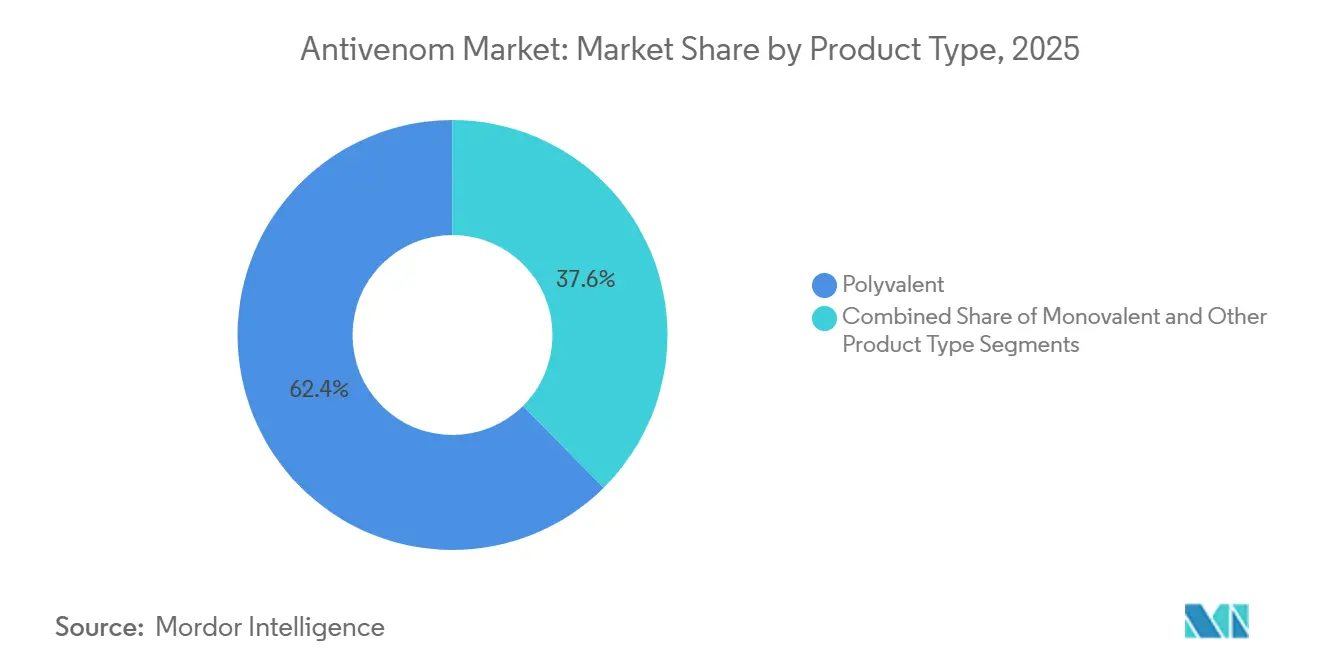
Polyvalent Formulations Dominate Despite Efficacy Trade-OffsPolyvalent antivenoms captured 62.43% of the antivenom market share in 2025, as emergency departments prefer broad-spectrum coverage to simplify inventory management. Other product formats such as lyophilized powders, Fab fragments, and experimental recombinant constructs are projected to expand at a 5.65% CAGR, signaling rising interest in precision therapy.
Hospitals value the one-vial-fits-many convenience of polyvalent products, yet these products carry antibodies irrelevant to each case, heightening the risk of adverse reactions. Regulatory guidance released in 2025 favors next-generation formats that meet tighter purity and stability metrics. Lyophilized versions remove cold-chain constraints, appealing to military and remote clinics, although reconstitution adds a time-critical step. As clinical evidence mounts, polyvalent dominance will erode gradually, making early investment in thermostable or recombinant lines a strategic play for 2030 and beyond.



By Source:
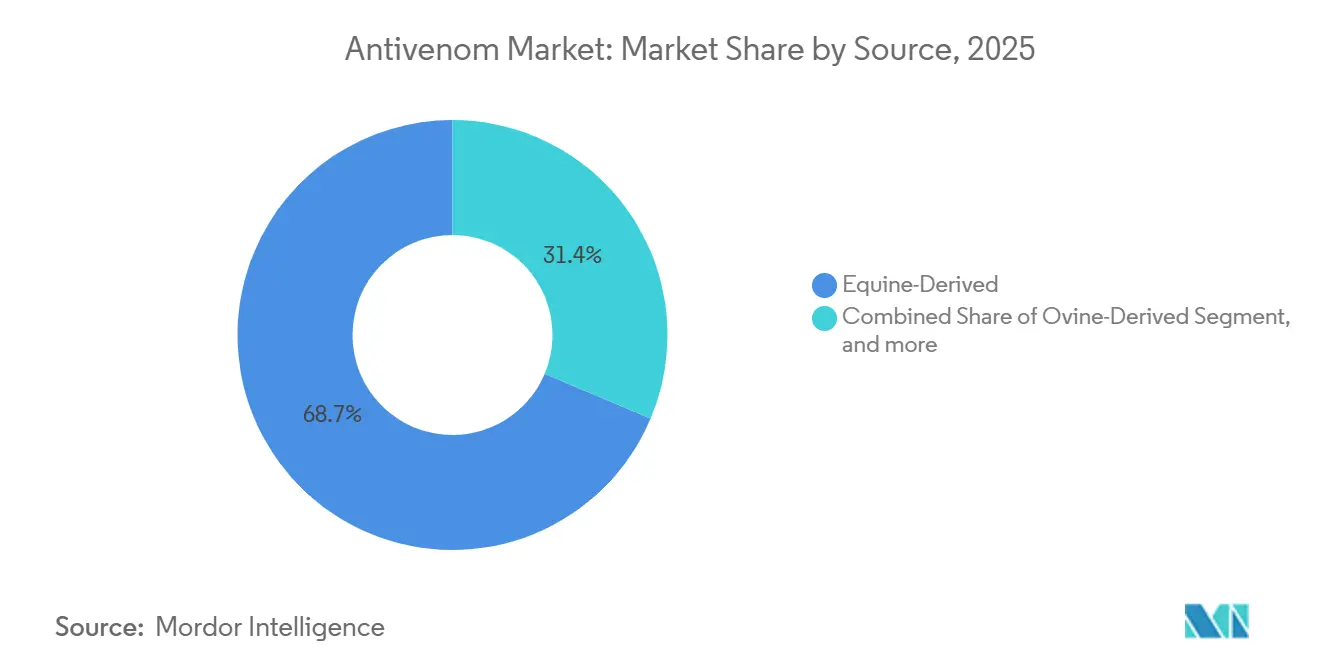
Equine Plasma Anchors Supply, Recombinant Platforms Gain TractionEquine plasma provided 68.65% of antivenom market size in 2025, reflecting a century of manufacturing know-how and relatively low variable cost. Ovine products remain niche but succeed where lower immunogenicity is valued, exemplified by BTG’s CroFab in the United States.
Recombinant monoclonal and nanobody candidates, though negligible in sales today, are slated to grow at 5.78% CAGR through 2031. They bypass horse husbandry constraints and offer scalable cell-culture production, but manufacturing costs are 3–5 times higher than for plasma-derived products. Europe and North America, where payers trade higher prices for safety, will likely host first launches. Equine plasma will remain the backbone of the antivenom market into the early 2030s, yet recombinant pipelines position leading firms for a gradual pivot.
By End-User:
Hospitals Anchor Demand, Trauma Centers Drive GrowthHospitals commanded 71.32% of antivenom market demand in 2025, as snakebite victims are routinely referred to tertiary facilities. Clinics and trauma centers are expected to post a 6.32% CAGR to 2031, reflecting policies that move stock closer to bite sites.
India requires antivenom at primary health centers, while Brazil deploys a mobile app to direct patients to stocked clinics. Smaller facilities need easy-to-administer formats and decision aids because staff may lack herpetology training. Bundling antivenom with smartphone algorithms that match species to product could reduce the 42.7% misuse rate reported in Thailand. Manufacturers that package dosing guides and offline decision tools can strengthen their value proposition in this fast-growing channel.
Geography Analysis
North America Antivenom Market
North America held 43.54% of the antivenom market revenue in 2025, supported by established hospital contracts and Defense Department procurement. Supply fragility persists; FDA extended Pfizer’s coral snake antivenin shelf life in 2025 because no alternative was available. Willingness to pay is high, enabling premium products like small-molecule varespladib-methyl to progress under Fast Track status.
APAC Antivenom Market
Asia-Pacific is projected to register the fastest regional CAGR at 4.54% through 2031. India records 46,000 snakebite deaths annually, prompting domestic firms such as the Serum Institute and Bharat Serums to scale up production. Rural trauma infrastructure and 11 home-grown mobile snakebite apps improve patient routing. China’s Healthy China 2030 blueprint places antivenom on essential lists for township clinics, although detailed volumes remain undisclosed.
EMEA and South America Antivenom Market
Europe, Middle East & Africa, and South America occupy the balance of demand. Sub-Saharan Africa now uses WHO’s eSURV platform in 46 countries, recording over 554,000 facility visits for snakebite since 2024. Public-private models, such as CSL’s Papua New Guinea donations, show how targeted programs can reach orphan geographies. Market expansion in these regions hinges on replacing substandard imports with WHO-approved options and securing donor finance.

Regulatory Landscape
Global procurement and quality requirements for antivenoms are increasingly anchored to World Health Organization (WHO) guidance, notably the WHO prequalification-linked risk-benefit assessment procedure conducted through TAG-SAIL, which relies on product dossiers, independent laboratory analysis, and GMP site inspections. In February 2026, WHO published new guidance for novel snakebite treatments, adding clearer performance and evidence expectations for engineered antibody biologics and small-molecule approaches as well as conventional antivenom immunoglobulins.
In the United States, antivenoms fall under the US FDA Center for Biologics Evaluation and Research (CBER). Marketing authorization requires a formal approval pathway demonstrating safety and effectiveness (e.g., NDA), while access to unapproved antivenoms can occur through the Investigational New Drug (IND) mechanism with IRB oversight and informed consent. Across endemic, resource-limited markets, the tightening linkage between public tenders and WHO-vetted products is raising documentation and quality-system thresholds, which in turn influences which manufacturers can compete in large government stockpiling programs.
Value Chain Analysis
The antivenom value chain starts with venom sourcing, often via specialized serpentariums and controlled milking programs, and then moves to animal hyperimmunization, commonly equine, followed by plasma collection and fractionation. Purification and formulation, whether liquid or lyophilized, are followed by fill-finish and cold-chain distribution to hospitals and peripheral facilities. WHO production and control guidance, along with the prequalification-oriented risk-benefit assessment framework, functions as a cross-border reference for quality control, batch release evidence, and GMP compliance, shaping manufacturing process design and supplier qualification.
Pressure points show up both upstream and in last-mile delivery. The market relies on a limited pool of producers in some high-burden areas, and high-quality plasma availability and consistency can constrain throughput. Cold-chain fragility is a recurring operational issue in rural settings where antivenoms must remain at 2-8 C. Demand forecasting and procurement discipline also affect stability, because irregular purchasing and weak registration or standardized quality oversight can drive low investment and eventual withdrawal. Programs tied to strategic stockpiling and WHO-vetted procurement specifications are being used to improve predictability and reduce the flow of clinically inappropriate or substandard imports.
Competitive Landscape
The moderate concentration of the antivenom market is defined by top players including CSL, Serum Institute of India, MicroPharm, Bharat Serums & Vaccines, and Instituto Butantan. WHO prequalification is tightening entry standards, disadvantaging low-cost suppliers that lack GMP credentials. MicroPharm’s 2024 purchase of Sanofi Pasteur’s equine portfolio signals consolidation aimed at scaling regulatory compliance costs.
Strategic patterns vary. Instituto Butantan controls venom extraction to final vial, giving Brazil supply security. CSL specializes in Australian and Papua New Guinean species, leveraging geographic expertise. Serum Institute provides broad polyvalent coverage across South Asia and holds long-term government tenders.
Emerging disruptors target white-space niches. Ophirex is developing varespladib-methyl, a small molecule that neutralizes phospholipase A2, while academic groups advance thermostable recombinant antibodies. Digital surveillance tools widen clinical insight but require offline functionality to reach rural Africa, a current gap in most apps. Incumbents with WHO-approved lines and robust distribution will likely preserve dominance through 2031, yet innovators that solve cold-chain or cross-neutralization challenges could capture premium segments.
Antivenom Industry Leaders
Pfizer Inc.
Merck KGaA (Sigma Aldrich)
Boehringer Ingelheim
CSL Limited
Bharat Serums and Vaccines Ltd
- *Disclaimer: Major Players sorted in no particular order

Antivenom Market Companies Covered in this Report
- Bharat Serums & Vaccines Ltd.
- BTG plc (Protherics UK Ltd.)
- CSL Behring
- Haffkine Bio-Pharmaceutical Corp.
- Incepta Pharmaceuticals Ltd.
- Instituto Butantan
- Instituto Clodomiro Picado
- Instituto Vital Brazil
- Merck
- Kamada Ltd.
- Laboratorios Bioclon S.A. de C.V.
- MicroPharm Ltd.
- Ophirex Inc.
- Pfizer
- Rare Disease Therapeutics
- Sanofi (Sanofi Pasteur)
- Serum Institute Of India
- South African Vaccine Producers (Pty) Ltd.
- Venomtech Ltd.
- Vins Bioproducts Ltd.

Market Opportunities and Future Outlook
Thermostable and simplified-use formats are a practical whitespace opportunity where cold-chain limitations restrict effective access, particularly in rural Africa, South Asia, and remote parts of Latin America. WHO guidance updates in February 2026 and work on WHO Target Product Profiles for novel snakebite treatments provide clearer development benchmarks, supporting differentiated products that prioritize stability, safety (including reduced immunogenicity), and evidence generation aligned with procurement requirements.
Regional supply decentralization is another opportunity where dependence on imports and species coverage mismatches have constrained treatment. Kenya’s Ministry of Health announced plans in May 2025 to establish an anti-snake venom processing plant at the Kenya Institute of Primate Research (Kipre) in Nairobi through technology transfer, indicating a shift toward domestic or regional manufacturing capability. On the supply side, capacity and resilience investments also broaden feasible sourcing and fill-finish options, illustrated by CSL Seqirus opening a new vaccine and antivenom manufacturing facility in Melbourne in December 2025, which strengthens onshore production and provides a platform for serving multiple antivenom types under high compliance standards.
Recent Industry Developments in Antivenom Market
- July 2026: Bharat Serums and Vaccines Ltd (BSV) rolled out a nationwide 4A strategy (Awareness, Access, Availability, Action) aimed at improving seasonal preparedness for monsoon-linked snakebite surges. The program focuses on accelerating patient routing to appropriate care and reinforcing availability at the point of use. This strengthens demand visibility and supports more structured stocking behavior in a market where timely access directly affects outcomes.
- December 2025: CSL Seqirus opened a new integrated vaccine and antivenom manufacturing facility in Tullamarine, Melbourne, designed to produce Australia’s antivenoms alongside other biologics. The investment expands high-quality domestic capacity and supports supply security for critical products. It also raises the bar for compliant manufacturing scale, influencing competitive dynamics for suppliers targeting premium, regulation-heavy markets.
- June 2024: MicroPharm Limited acquired Sanofi Pasteur’s equine immunoglobulin antivenom product range, including Viperfav, Bothrofav, Scorpifav, Fav-Afrique, and Favirept. The transaction transferred key intangible assets and selected tangible assets, consolidating established brands under a specialist antivenom manufacturer. Portfolio consolidation can improve continuity of supply and concentrate resources for documentation, GMP upgrades, and WHO-aligned quality expectations.


Antivenom Market Report Scope and Research Methodology
Market Definition and Coverage
The market is defined as the value of antivenom products used to treat venomous bites and stings across routine and emergency care settings, counted at manufacturer selling price in each covered geography.
Scope exclusions: We exclude supportive hospital services, bite wound care supplies, and diagnostic venom detection kits that do not neutralize venom.
Segments Covered in This Report
- By Product Type
- Polyvalent
- Monovalent
- Other Product Types
- By Source
- Equine-Derived
- Ovine-Derived
- Recombinant (DNA/Monoclonal)
- By End-User
- Hospitals
- Clinics & Trauma Centres
- Military & Special-Purpose
- Geography
- North America
- United States
- Canada
- Mexico
- Europe
- Germany
- United Kingdom
- France
- Italy
- Spain
- Rest of Europe
- Asia-Pacific
- China
- Japan
- India
- Australia
- South Korea
- Rest of Asia-Pacific
- Middle East & Africa
- GCC
- South Africa
- Rest of Middle East & Africa
- South America
- Brazil
- Argentina
- Rest of South America
- North America
Data Sources, Market Sizing, and Validation
Desk Research
Desk work starts with mapping incidence and treatment pathways so the demand pool is clear before any pricing is applied. We typically reference public health and epidemiology sources such as WHO snakebite envenoming materials, CDC health resources, and peer reviewed clinical journals to understand treatment rates, vial usage ranges, and care setting splits.
To keep the model grounded, trade and access signals are also reviewed through sources such as UN Comtrade import-export series, national health ministry procurement notes when available, and regulatory databases for product approvals and label updates. We then add context from public company filings, investor presentations, association websites, and reputable press coverage, and we selectively use paid subscriptions for company financials and a shipment-level trade database when it helps validate supply availability. These examples are not exhaustive, and many other sources were also used for data collection, validation, and clarification during the work.
Primary Interviews and Surveys
Primary interviews and surveys were used to test assumptions that desk sources rarely spell out, such as typical vial counts per case, tender pricing behavior, and how often products are substituted because of stockouts. We spoke with a mix of manufacturers, distributors, hospital pharmacy and emergency care stakeholders, and clinical specialists across major regions so gaps could be closed and the final inputs could be checked against real procurement and treatment patterns.
Distribution of primary research fieldwork respondents
| Company type | Respondent position | Region |
|---|---|---|
| Top tier: 27% | CXOs: 14% | APAC: 42% |
| Mid tier: 54% | Functional/Unit leaders: 34% | EMEA: 32% |
| Smaller Players: 19% | Managers: 52% | Americas: 26% |
Market-Sizing & Forecasting
Sizing is built using both top-down and bottom-up logic so totals stay explainable and can be checked against what the market typically does. On the top-down side, treated case pools are reconstructed by geography using public envenoming incidence ranges, estimated care seeking behavior, and the share of cases receiving antivenom, which is then converted to value using typical vials per case and country level price bands.
To corroborate the totals, we then run selective bottom-up approximations such as supplier and distributor revenue direction checks, channel feedback on tender volumes, and sampled ASP times volume cross-checks in higher visibility countries, and then the model is adjusted where the two views conflict. Inputs that tend to move the numbers the most include treatment coverage in rural areas, average vials per protocol by species mix, procurement cycles and tender timing, cold-chain and stockout frequency, and changes in approvals that expand or restrict usable indications.
For forecasting, scenario analysis is used because demand is sensitive to policy actions, funding for access programs, and supply constraints, and those shifts do not always follow smooth time series patterns. Where a stable history exists, exponential smoothing is used for price and volume sub-trends, followed by expert review to keep assumptions aligned with expected manufacturing capacity and access initiatives. When bottom-up signals are missing for a country, proxy ratios from similar bite burden settings are applied and then reviewed in primary calls before finalizing.
Data Validation & Update Cycle
Validation is done in steps, starting with unit consistency checks so incidence, treated cases, vials, and pricing convert cleanly into value. We then compare outputs against independent signals like import patterns, tender announcements, and observed pricing ranges, and outliers are reworked until the driver assumptions explain the difference.
Before sign-off, the model is reviewed by another analyst for logic and arithmetic, and re-contact is triggered when a variable moves materially, such as a large tender win, a major shortage, or a change in protocol that shifts vial usage. Reports are refreshed annually, with interim updates when meaningful events occur, and a final pre-delivery pass is completed so clients receive the most current view available.
Mordor Intelligence's Antivenoms Market Size Compared With Other Published Estimates
It is common to see different market values for antivenoms because studies do not always count the same products, pricing points, or years, and the market itself is affected by access and supply swings. Differences also show up when one source relies more on manufacturer revenues while another leans on treated patient demand assumptions.
The biggest gap drivers in this market are usually whether non-antivenom adjunct care is counted, whether pricing is measured at factory gate or at later points in the channel, and how vial usage per treatment is averaged across species and settings. Some estimates also apply aggressive growth based on unmet need, even when manufacturing constraints and procurement cycles keep near-term volumes from moving as fast, which is why careful variable selection and refresh cadence matter.
Benchmark comparison
| Source | Market Size | Gaps in Research Methodology |
|---|---|---|
| Mordor Intelligence | USD 1.28 B (2026) | |
| Global Consultancy A | USD 2.18 B (2026) | Uses a factory gate revenue view with a broader product roll-up and does not clearly separate antivenoms from adjacent antidote sales, which can lift the total versus a treated-case demand build. |
| Industry Publisher B | USD 1.40 B (2025) | Anchors on a different base year and applies a faster expansion path tied to unmet need, with limited visibility on vial-per-treatment and procurement timing assumptions that can slow realized uptake. |
The table shows that most of the spread comes from year alignment and what is counted as antivenom revenue versus adjacent categories, and then how access constraints are handled in the near term. By keeping the value build tied to treated cases, vial usage, and country price bands, and by refreshing these inputs around protocol and tender shifts, the estimate remains traceable to repeatable steps, which is the approach followed here by Mordor Intelligence.


Key Questions Answered in the Report
What CAGR is expected for the antivenom market through 2031?
The market is forecast to expand at a 3.13% CAGR between 2026 and 2031.
Which region is projected to grow the fastest?
Asia-Pacific is expected to post the highest growth at a 4.54% CAGR, led by India, Southeast Asia, and China.
Why do polyvalent antivenoms still dominate hospital purchases?
Hospitals prefer broad-spectrum coverage that reduces the risk of stocking the wrong product, even though it may include non-target antibodies.
How are regulatory changes influencing supply quality?
WHO prequalification and shared risk-benefit frameworks are raising quality standards, pushing low-evidence products out of public tenders.
What innovations could ease cold-chain constraints?
Lyophilized or thermostable formulations and nanobody constructs can tolerate higher temperatures, reducing reliance on refrigeration.
Which companies recently consolidated their portfolios?
MicroPharm acquired Sanofi Pasteur's equine antivenom line in 2024 to scale up compliance with WHO and GMP requirements.
Page last updated on:


 Your data is secure and never sold or shared.


