
Market Overview
| Study Period | 2020 - 2031 |
|---|---|
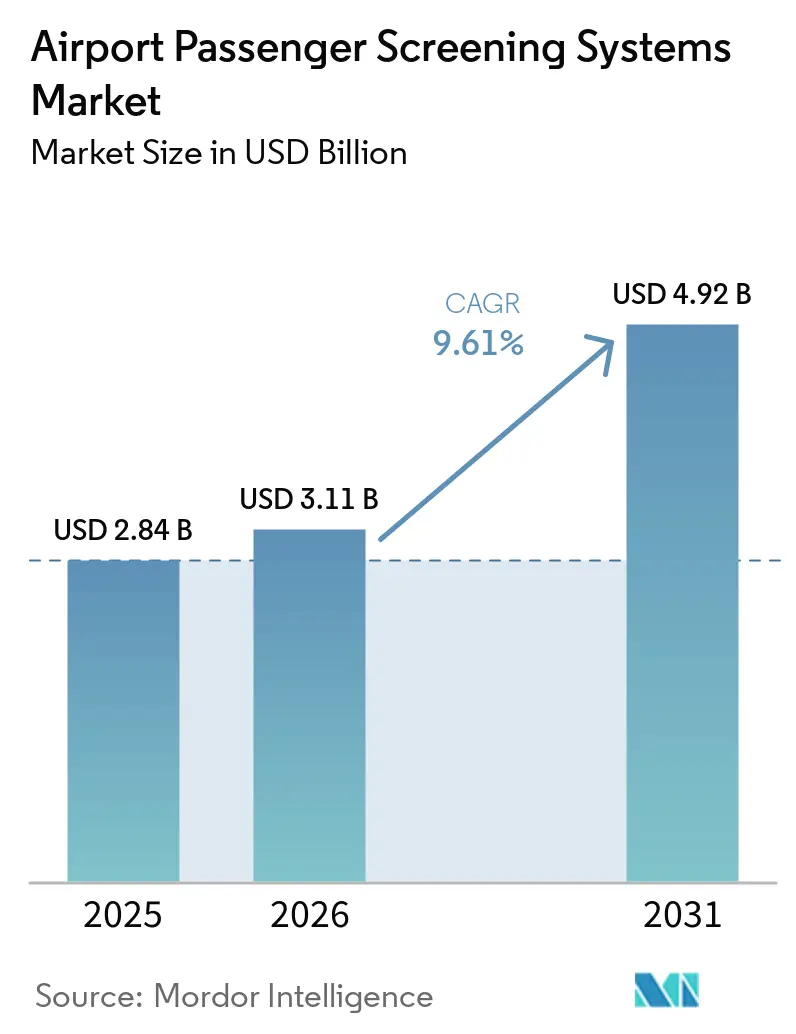
| Market Size (2026) | USD 3.11 Billion |
| Market Size (2031) | USD 4.92 Billion |
| Growth Rate (2026 - 2031) | 9.61 % |
| Fastest Growing Market | Asia-Pacific |
| Largest Market | North America |
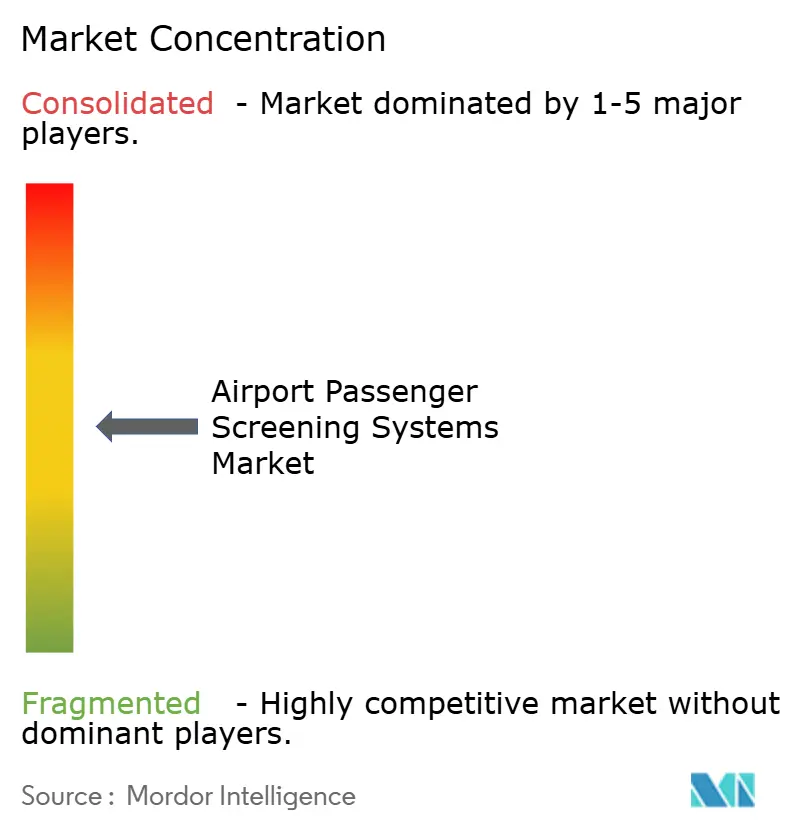
| Market Concentration | Medium |
Major Players *Disclaimer: Major Players sorted in no particular order Image © Mordor Intelligence. Reuse requires attribution under CC BY 4.0. | |
Airport Passenger Screening Systems Market Analysis by Mordor Intelligence
The airport passenger screening systems market size in 2026 is estimated at USD 3.11 billion, growing from 2025 value of USD 2.84 billion with 2031 projections showing USD 4.92 billion, growing at 9.61% CAGR over 2026-2031. Robust capital spending on computed-tomography (CT) checkpoints, rising passenger volumes approaching pre-2019 levels, and modernization mandates integrating biometric and artificial-intelligence (AI) functions propel this expansion. Regulatory programs such as the Transportation Security Administration’s (TSA) USD 10.7 billion capital plan for 2025-2029 and Europe’s C3 CT requirements are accelerating technology refresh cycles. Hardware continues to capture the bulk of outlays, yet software-driven analytics and predictive maintenance are growing fastest as airports seek real-time threat assessment and lower lifetime costs. Regionally, North America remains the largest buyer, while Asia-Pacific, backed by infrastructure build-outs that serve more than 3 billion annual travelers, is the fastest-growing arena. Competitive differentiation hinges on backlog strength and AI partnerships, with incumbents broadening portfolios as smaller specialists commercialize retrofit-friendly or employee-screening innovations.
Key Report Takeaways
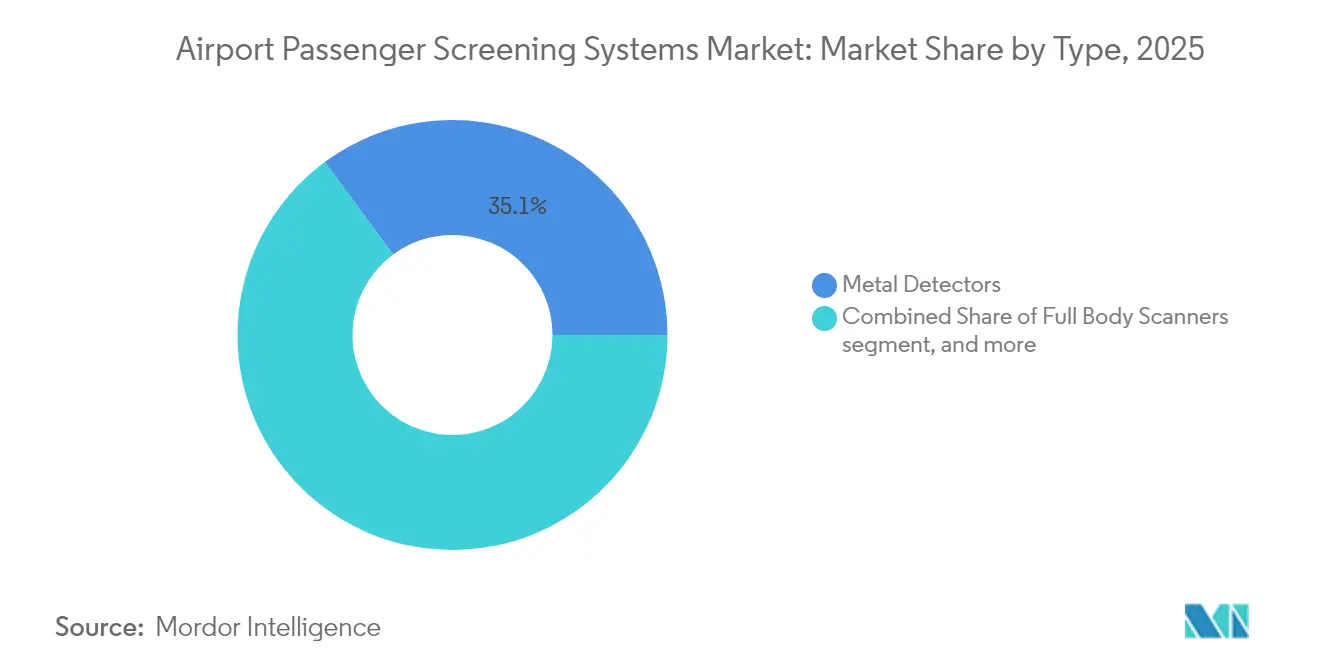
- By type, metal detectors led the airport passenger screening systems market with 35.12% of the share in 2025; advancing imaging technology is projected to expand at a 9.78% CAGR through 2031.
- By component, hardware accounted for 71.60% of the airport passenger screening systems market size in 2025, while software is set to grow at a 10.05% CAGR between 2026 and 2031.
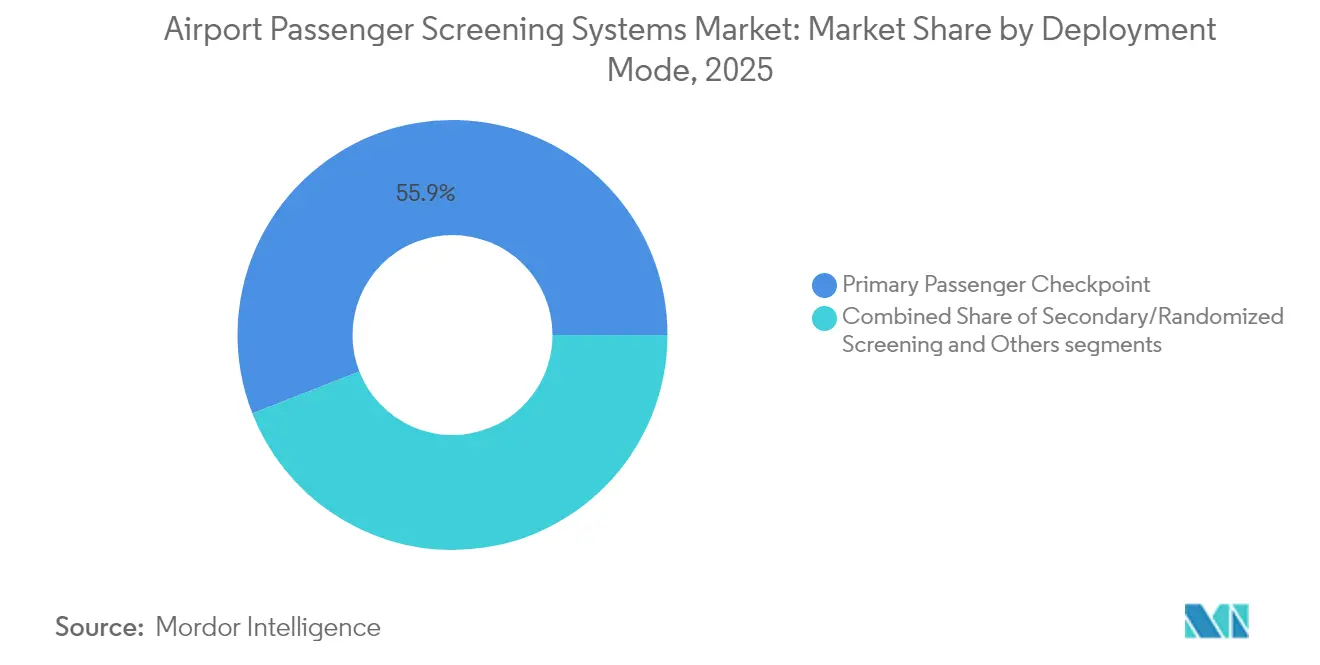
- By deployment mode, primary passenger checkpoints represented 55.94% revenue share in 2025; secondary and employee-screening applications are forecasted to advance at a 9.71% CAGR to 2031.
- By airport hub size, large hubs held 51.88% of the airport passenger screening systems market size in 2025; small airports are projected to expand at a 10.32% CAGR to 2031.
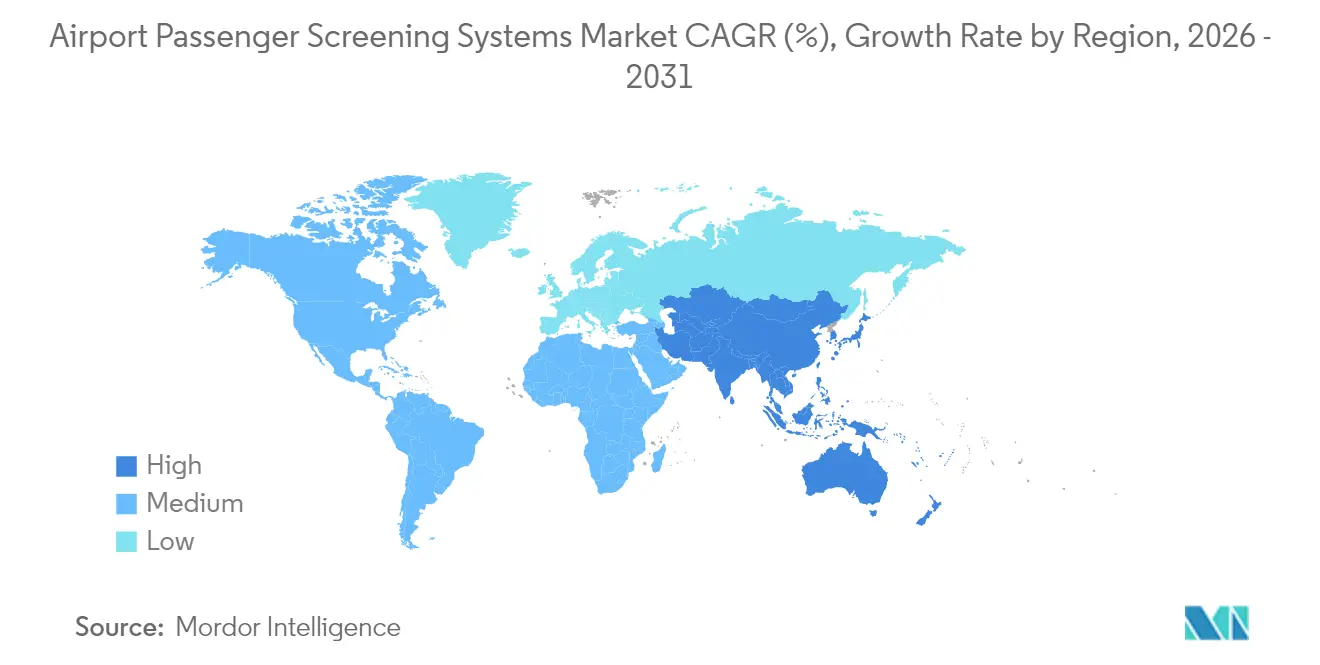
- By geography, North America captured 33.10% revenue share in 2025, whereas Asia-Pacific is expected to post the fastest 10.28% CAGR through 2031.
Note: Market size and forecast figures in this report are generated using Mordor Intelligence’s proprietary estimation framework, updated with the latest available data and insights as of 2026.
Market Trends and Insights
Drivers Impact Analysis of Airport Passenger Screening Systems Market*
| Driver | (~) % Impact on CAGR Forecast | Geographic Relevance | Impact Timeline |
|---|---|---|---|
| Growth in global air passenger traffic increasing demand for advanced screening technologies | +2.1% | Asia-Pacific, Middle East, Global | Medium term (2-4 years) |
| Implementation of regulatory mandates driving adoption of computed tomography (CT) systems | +1.8% | North America, Europe expanding to Asia-Pacific | Short term (≤ 2 years) |
| Modernization initiatives promoting deployment of advanced identity authentication solutions | +1.2% | North America, Europe, Global | Medium term (2-4 years) |
| Emergence of retrofit-friendly technologies reducing infrastructure upgrade costs | +0.9% | Global, smaller airports | Long term (≥ 4 years) |
| Integration of AI in millimeter-wave (mmWave) systems enhancing real-time threat detection capabilities | 0.8% | North America and Europe, with spillover to APAC | Medium term (2-4 years) |
| Expansion of airport security protocols to include employee screening operations | 0.7% | Global, with early adoption in North America | Long term (≥ 4 years) |
| Source: Mordor Intelligence | |||
Rising Passenger Traffic Pushing Demand for High-Throughput Systems
Asia-Pacific airports processed more than 3 billion passengers in 2024, surpassing 2019 throughput and intensifying the need for equipment that screens 300-plus travelers per hour while upholding stringent detection standards.[1] Middle-Eastern megaprojects valued near USD 1 trillion incorporate bright corridors that fuse biometrics with AI detection, illustrating how traffic growth directly converts into capital orders for advanced CT and mmWave scanners. Airports in emerging markets favor scalable, software-upgradable platforms to keep pace with double-digit passenger growth, whereas mature North American hubs concentrate on workflow optimization. The direct link between volume and security investment has strengthened since 2024 as operators measure checkpoint performance on risk mitigation and queue-time metrics. Consequently, the airport passenger screening systems market increasingly rewards vendors capable of proving throughput gains alongside compliance credentials.
Regulatory Mandates for CT Deployment
TSA requires Category X checkpoints to convert to CT by 2026 and has earmarked USD 2.8 billion solely for acquisition and installation, guaranteeing a multi-year procurement pipeline. The European Commission’s September 2024 re-imposition of liquid restrictions on airports lacking C3 CT accelerated EU rollouts. ICAO’s 2024 Global Aviation Security Plan endorses CT as the reference standard for its 193 member states. These mandates extend to employee screening under TSA’s Rap Back program, producing secondary demand beyond primary lanes. Noncompliance penalties compel rapid tenders, channeling share toward suppliers with certified solutions and global support. As a result, the airport passenger screening systems market sees forecastable surges just ahead of each regulatory deadline.
Modernization Programs Integrating Biometric Identity
TSA’s Credential Authentication Technology (CAT) spans more than 280 US airports and now completes over 3 million ID checks monthly. Dubai’s smart gates clear 95% of eligible passengers without manual verification, illustrating how contactless flows remain a post-pandemic priority. Biometric adoption brings data-privacy scrutiny; the Privacy and Civil Liberties Oversight Board underscores consent and retention compliance challenges in its 2024 review. Funding via airport-improvement grants offsets initial cost, yet deployment cadence depends on existing IT backbones. Airports value seamless identity-to-screen linkage, and vendors able to bundle CAT, facial recognition, and CT scanners position themselves for bundled awards within the airport passenger screening systems market.
Retrofit Friendly Technologies Lowering Upgrade Costs
Advanced imaging once demanded USD 146,000-159,000 in checkpoint remodeling per unit, deterring smaller airports. Modular CT now slides into legacy footprints, trimming civil-works budgets by up to 40% while retaining TSA certification. Portable or semi-portable units support temporary gates, disaster relief, and pop-up VIP lounges, broadening use cases. Software-defined platforms let operators add analytics without swapping out expensive hardware, extending service life and improving return on capital. These innovations democratize the airport passenger screening systems market, allowing facilities with under 5 million annual passengers to adopt technology once reserved for hubs.
Restraints Impact Analysis of Airport Passenger Screening Systems Market*
| Restraint | (~) % Impact on CAGR Forecast | Geographic Relevance | Impact Timeline |
|---|---|---|---|
| Physical and infrastructure limitations at airports hindering technology deployment | -0.6% | Older airports in Europe, North America, Global | Short term (≤ 2 years) |
| Rising cybersecurity and data compliance costs impacting biometric system integration | -0.4% | Europe, North America, Global | Medium term (2-4 years) |
| Public concerns regarding privacy and health risks associated with certain scanning technologies | -0.5% | North America and Europe, with spillover to developed APAC markets | Medium term (2-4 years) |
| Escalating component costs affecting affordability of next-generation screening systems | -0.4% | Global, with disproportionate impact on emerging markets and small airports | Long term (≥ 4 years) |
| Source: Mordor Intelligence | |||
Legacy Infrastructure Limiting Space, Power, Weight
Roughly 40% of leading international airports opened before 1980 and lack the floor space, electrical capacity, or structural strength to house CT gear that occupies 15-20% more area and draws triple the power of legacy X-ray units. Terminal modifications can exceed USD 500,000 per lane and cause daily disruption losses topping USD 100,000 at peak hubs. Weight limits on elevated checkpoints further complicate installs, especially in multi-level European and Asian terminals. These constraints delay rollouts and temper growth potential within the airport passenger screening systems market until retrofit budgets or greenfield projects catch up.
Rising Cybersecurity and Privacy Compliance Costs
Biometric deployments must satisfy GDPR, US federal cyber directives, and airline codeshare rules, adding USD 200,000-400,000 to each project for encryption, intrusion monitoring, and legal reviews.[2] Consent-withdrawal workflows, storage minimization, and breach notification demands extend timelines and favor vendors with secure cloud or on-prem solutions already vetted by regulators. Smaller airports struggle to finance these safeguards, slowing biometrics adoption even as passenger demand for contactless journeys rises. Persistent cyber risk, therefore, trims growth expectations for the airport passenger screening systems market.
*Our forecasts treat driver/restraint impacts as directional, not additive. The impact forecasts reflect baseline growth, mix effects, and variable interactions.
Airport Passenger Screening Systems Market Segment Analysis
By Type:
Computed Tomography Underpins the Detection LeapThe airport passenger screening systems market size for metal detectors reached a 35.12% share in 2025, yet CT-based advanced imaging technology is poised for the strongest 9.78% CAGR to 2031. Airport managers gravitate to CT for 3D imaging that clears liquids and electronics without unpacking, boosting lane throughput by up to 20%. Airport scanners, including full-body mmWave systems, have reached saturation at many hubs, but AI-assisted pattern recognition is lifting detection accuracy and lowering false alarms. ICAO’s endorsement of CT as best practice cements its role, while retrofittable units broaden access for mid-tier airports. Continuous software upgrades let operators refine threat libraries without swapping hardware, sustaining lifecycle value within the airport passenger screening systems market.
CT’s cost premium narrows as production scales and as regulators fund procurement. Meanwhile, traditional walk-through metal detectors preserve relevance for perimeter checks, employee entries, and budget-constrained terminals. Hybrid lane designs that pair metal detection with CT or mmWave equipment maximize capacity and flex to risk ratings. Therefore, vendors that package multi-technology portfolios capture broader wallet shares across airport growth stages.

By Component:
Software Intelligence Unlocks Latent Hardware PotentialHardware accounted for 71.60% revenue in 2025 because scanners, conveyors, and cabling require the bulk of capital outlay. Yet software revenues are expanding at a 10.05% CAGR as algorithms underpin predictive threat analysis, automatic image interpretation, and condition-based maintenance. The airport passenger screening systems market size attributed to analytics is further lifted by subscription licenses that deliver real-time upgrades and cybersecurity patches.
Edge processing removes reliance on cloud round-trips, meeting data sovereignty rules while shrinking latency to milliseconds—vital for 250-plus passenger-per-hour lanes. Algorithm performance depends on abundant operational data, giving incumbents with decades of scans a moat against new entrants. DHS Science & Technology grants of USD 27.55 million for quantum-sensing and AI research underscore the government's appetite for software-led detection breakthroughs. Hardware suppliers that open APIs to independent software vendors multiply innovation, yet must safeguard certification integrity to retain airport trust.
By Deployment Mode:
Secondary and Employee Applications Gain SpeedPrimary passenger lanes retained a 55.94% share in 2025 because every traveler must pass through them. Nonetheless, secondary checks, random screening, and employee verification are forecast to grow 9.71% annually through 2031. TSA’s Rap Back continuous monitoring and high-profile insider-threat incidents have pushed airports to install walk-through mmWave portals at staff entrances. Thruvision’s passive system evaluations in San Diego illustrate early success and lower throughput disruption.
Secondary inspection zones leverage mobile scanners and targeted analytics to resolve alarms without funneling passengers back to the main queue, preserving throughput. Cargo side-doors, VIP channels, and pop-up event gates widen the addressable base for adaptable solutions within the airport passenger screening systems market. Integrated command dashboards that aggregate passenger, baggage, and employee data deliver holistic situational awareness prized by security directors.
By Airport Hub Size:
Democratizing High-Grade SecurityLarge hubs commanded 51.88% of 2025 revenue, reflecting scale economics and regulatory scrutiny. Yet small airports are on track for the highest 10.32% CAGR as retrofit-ready CT, compact mmWave, and cloud-native analytics lower entry cost. The airport passenger screening systems market thus shifts from niche to mainstream among terminals handling under 2 million passengers.
Medium hubs bridge the transition, adopting modular lanes that can add capacity incrementally. Vendors increasingly market “checkpoint-as-a-service” bundles that bundle equipment, software, and multiyear maintenance in one fee, aligning with lean municipal budgets. As a result, security standardization advances across the aviation network, reducing weak-link vulnerability.
Geography Analysis
North America Airport Passenger Screening Systems Market
North America generated 33.10% of global revenue in 2025, owing to the TSA’s USD 10.7 billion modernization pipeline and mature infrastructure undergoing systematic refresh cycles. CAT identity technology now scans more than 3 million IDs monthly, and CT lanes are extending from flagship hubs to regional spokes. Canada and Mexico align rulesets with US standards, creating an integrated North American procurement theater that benefits suppliers certified by the TSA.
APAC Airport Passenger Screening Systems Market
Asia-Pacific delivers the fastest 10.28% CAGR, fueled by China and India’s airport-construction drives. By 2024, passenger totals will already be 103% of 2019 benchmarks. Greenfield terminals embed CT, biometrics, and AI from day one, bypassing legacy constraints. Government stimulus under smart-city plans adds funding for edge analytics and cloud dashboards, broadening the airport passenger screening systems market. Mature markets like Japan and Australia pursue upgrades that embed AI threat libraries and privacy safeguards.
EMEA Airport Passenger Screening Systems Market
Europe sustains mid-single-digit growth under harmonized ECAC rules and the 2024 liquid-restriction reinstatement for airports lacking C3 CT. GDPR shapes biometric rollouts, prompting on-prem solutions and explicit consent flows. Meanwhile, the Middle East and Africa leverage USD 1 trillion in planned capacity to showcase biometric-plus-AI smart gates that clear 95% of travelers hands-free. Diverse regulatory cadence demands flexible certification strategies from vendors looking to capture global share.
Regulatory Landscape
Airport passenger screening system requirements are anchored in national aviation security regulators and global standards led by ICAO. In the United States, the Transportation Security Administration (TSA) drives equipment eligibility and site-readiness through capability acceptance and planning guidance, and it has continued formalizing pathways for new technology via the Advanced Imaging Technology (AIT) Qualified Products List (QPL) qualification process (special notice issued in April 2026). This approach shapes which full-body and related systems can be deployed at federalized checkpoints.
In Europe, aviation security implementation is reinforced through EU regulations and ECAC-aligned evaluation practices that determine equipment acceptance and operating procedures. Commission Implementing Regulation (EU) 2026/449 (adopted February 2026) updated requirements affecting screening procedures for airport and in-flight supplies with a defined compliance window, adding operational changeovers alongside passenger checkpoint modernization. Parallel US policy actions, including the May 2026 introduction of the SAFEGUARDS Act in the U.S. House Committee on Homeland Security, kept funding and modernization of TSA technology programs in focus for airports and suppliers planning multi-year procurements.
Value Chain Analysis
The value chain covers component suppliers (detectors, X-ray/CT subsystems, computing, and cybersecurity hardware), OEMs that integrate certified checkpoint and imaging platforms, and software providers supplying automated detection algorithms, identity authentication, and fleet-health analytics. Downstream, systems integrators and airport contractors manage checkpoint layout, civil works, power and network upgrades, and commissioning, while third-party test bodies and government evaluation programs gate market access through performance and compliance validation. In the United States, TSA procurement and deployment programs for Credential Authentication Technology (CAT) show how identity and screening ecosystems co-evolve through staged upgrades (CAT-1 field upgrades via CAT-2 upgrade kits and new-production CAT-2 deployments beginning FY 2025).
Go-to-market is increasingly structured around government contract vehicles, service wrap, and public-private operating models, rather than one-off equipment sales. TSA initiatives to source private-sector solutions to improve checkpoint efficiency (July 2025) and the eGate public-private partnership with CLEAR (August 2025) highlight how identity capture, biometrics, and lane hardware are being bundled with operations and digital workflows. In Europe, harmonization efforts, including ECAC work in 2025 on a 3D image quality Standard Test Piece for security equipment testing, reduce duplicated regional validation burdens and push OEMs toward standardized, audit-ready configurations that can be deployed across multiple airports with less re-engineering.
Competitive Landscape
The airport passenger screening systems market remains moderately fragmented, though top suppliers deepen moats through AI alliances, service portfolios, and backlog scale. OSI Systems reported a USD 1.8 billion order book and 16% Security-division growth in FY 2025, underscoring its ability to fund continuous R&D and global support. Smiths Detection’s April 2025 pact with BigBear.ai targets a 25-30% drop in false positives, illustrating how machine learning is the new competitive frontier.
Integration capability is paramount; airports prefer single-throat contracts that bundle scanners, software, installation, and multiyear support. Retrofit specialists with portable or employee-oriented products turn fragmentation to advantage by partnering with prime contractors to fill white-space niches. Certification regime complexity shields incumbents, yet open-architecture trends invite startups focused on analytics overlays. Market consolidation via asset sales, spin-outs, and cooperative testing groups such as ECAC’s 2025 Security Testing Group further shapes rivalry dynamics.
Airport Passenger Screening Systems Industry Leaders
-
Analogic Corporation
-
Garrett Electronics Inc.
-
Smiths Group plc
-
Leidos, Inc.
-
OSI Systems, Inc.
- *Disclaimer: Major Players sorted in no particular order
Airport Passenger Screening Systems Market Companies Covered in this Report
- Smiths Group plc
- OSI Systems, Inc.
- Analogic Corporation
- Garrett Electronics Inc.
- CEIA S.p.A.
- Nuctech Technology Co., Ltd.
- Leidos, Inc.
- Rohde & Schwarz GmbH & Co. KG
- Liberty Defense Holdings Ltd.
- Astrophysics, Inc.
- Tek84, Inc.
- Vanderlande Industries B.V.
- Thales Group
- Autoclear LLC
- Kromek Group plc
Market Opportunities and Future Outlook
Modernization programs are creating whitespace for integrated checkpoints that link CT-based screening, automated image interpretation, and digital identity into a single operating workflow. TSA activity around biometric-enabled eGates, including the Innovation Office Industry Day in May 2026, points to procurement interest in automated identity verification layers that can be connected to primary and secondary screening. On the screening side, the installed-base shift toward CT continues to expand the addressable market for software, maintenance, and upgrade kits; TSA reported 1,162 CT scanner installations across 296 airports as of July 2026, supporting recurring demand for lifecycle services, cybersecurity hardening, and performance optimization.
Europe is also a second opportunity axis through approvals and airport-funded rollouts that accelerate adoption of higher-throughput CT and related analytics. The UK Department for Transport approval of Smiths Detection SDX 10080 SCT CT (June 2026) increases the range of deployable CT platforms across airport and cargo use cases, supporting procurement optionality for operators standardizing across passenger and logistics security. Airport-led capex shows near-term conversion as well, with Vienna Airport completing installation of new CT scanners across all terminals using a EUR 25 million investment (July 2026). These moves support opportunities for vendors that can deliver retrofit-friendly deployments, interoperable identity-to-screen integrations, and certified automation that reduces manual bag checks and false alarms.
Recent Industry Developments in Airport Passenger Screening Systems Market
- April 2026: Leidos Security Enterprise Solutions and Analogic announced a joint venture with Altaris to combine Leidos Security Enterprise Solutions with Analogic under the Analogic brand. The move consolidates product development and global delivery capabilities across passenger and baggage screening portfolios. It supports scale for airport modernization programs that favor integrated, multi-technology suppliers.
- May 2025: Smiths Detection was awarded a contract by Dubai Aviation Engineering Projects to provide checkpoint screening solutions for Dubai International Airport (DXB). The award reinforces large-hub demand for CT-enabled checkpoint upgrades. It also supports supplier positioning in the Middle East, where airports are linking security throughput improvements with passenger experience goals.
- November 2024: Fraport awarded Rohde & Schwarz a contract to install 100 security scanners at Frankfurt Airport, covering existing checkpoints and integration into future checkpoint facilities. The deployment points to sustained European investment in checkpoint refresh cycles. It also creates follow-on needs in integration, training, and multiyear service support across expanding terminal infrastructure.
Airport Passenger Screening Systems Market Report Scope and Research Methodology
Market Definition and Coverage
This market covers equipment installed at airport security checkpoints to screen passengers for concealed threats, measured as the value of systems sold and deployed for passenger inspection.
Scope exclusions: Baggage, cargo, and vehicle screening systems are excluded, even when they are procured in the same airport security upgrade program.
Segments Covered in This Report
- By Type
- Metal Detectors
- Full Body Scanners
- Advancing Imaging Technology
- By Component
- Hardware
- Software
- By Deployment Mode
- Primary Passenger Checkpoint
- Secondary/Randomized Screening
- Others
- By Airport Hub Size
- Large
- Medium
- Small
- By Geography
- North America
- United States
- Canada
- Mexico
- Europe
- United Kingdom
- France
- Germany
- Spain
- Rest of Europe
- Asia-Pacific
- China
- India
- Japan
- Australia
- Rest of Asia-Pacific
- South America
- Brazil
- Rest of South America
- Middle East and Africa
- Middle East
- United Arab Emirates
- Saudi Arabia
- Rest of Middle East
- Africa
- South Africa
- Rest of Africa
- Middle East
- North America
Data Sources, Market Sizing, and Validation
Desk Research
Desk work starts with building a fact base on aviation passenger traffic, security rules, and airport screening upgrade cycles, which later becomes the input layer for the model. For this, we refer to public sources such as ICAO and IATA aviation statistics, TSA and other national aviation security regulator guidance, airport operator annual reports, and budget documents.
To keep the numbers anchored to how procurement works, procurement and installed base signals are also reviewed through sources such as government tenders and contracts portals, customs and trade statistics for relevant screening equipment categories, and selected peer reviewed research that discusses screening performance and technology shifts. Company filings, investor presentations, and reputable press coverage help cross check shipment timing and program wins, and a paid subscription for company financials plus a separate paid patent database are used selectively to verify revenue exposure and technology direction. These examples are not exhaustive, and many other sources were also used to collect data, validate assumptions, and clarify open questions during research.
Primary Interviews and Surveys
Primary work is used to pressure test what desk sources cannot fully explain, especially replacement cycles, average selling price movement, and what is really counted as a passenger lane upgrade versus a broader checkpoint project. We speak with airport security and operations stakeholders, system integrators, distributors, and component side experts across major regions so that demand signals, adoption timing, and regulatory driven rollouts can be aligned with the model.
Distribution of primary research fieldwork respondents
| Company type | Respondent position | Region |
|---|---|---|
| Top tier: 38% | CXOs: 17% | APAC: 46% |
| Mid tier: 45% | Functional/Unit leaders: 24% | EMEA: 29% |
| Smaller Players: 17% | Managers: 59% | Americas: 25% |
Market-Sizing & Forecasting
Sizing is built using a top-down approach where passenger throughput and checkpoint lane requirements are reconstructed by region, then translated into system demand using upgrade and replacement rates discussed with industry participants. Once the demand pool is formed, it is converted into value by applying realistic average selling prices by system type and typical configuration, followed by installation and commissioning patterns where applicable.
To keep the totals grounded, the output is corroborated with selective bottom-up approximations, including sampled shipment timing from tenders, supplier revenue exposure checks, and channel feedback on unit volumes and pricing. Key inputs used in the model include air passenger traffic growth, airport capacity expansion pipelines, security regulation timelines for checkpoint upgrades, replacement cycles for metal detectors and body scanners, adoption of advanced imaging technologies, and pricing progression by system class, including maintenance and calibration assumptions when they are part of the system sale.
Forecasting is done using scenario analysis supported by variable level expectations gathered in interviews, because airport security programs can move faster or slower depending on policy enforcement and capex cycles. Where a bottom-up view is incomplete in smaller countries, gaps are handled by applying penetration and lane density ranges anchored to similar airport categories, then rechecked with regional experts.
Data Validation & Update Cycle
Results are triangulated by comparing the modeled market value with independent signals such as airport capex plans, tender award volumes, and the pace of checkpoint modernization programs in major hubs. Outliers are flagged, then reviewed by another analyst, and if the variance cannot be explained by timing or scope, follow-up calls are triggered to revalidate the assumption set.
Reports are refreshed annually, and material events such as major security mandates, program delays, or sudden traffic shifts are incorporated through interim checks. Before delivery, a final pass is performed so the market numbers reflect the latest public disclosures and the most recent primary feedback.
Mordor Intelligence's Airport Passenger Screening Systems Market Size Compared With Other Published Estimates
Published market values for airport passenger screening systems can vary a lot, even when they appear to refer to the same category. The main reasons usually come down to what is counted inside the market, what year is treated as the base, and how pricing and replacement timing are handled.
Baggage and cargo screening equipment sits outside Mordor Intelligence's scope here, which is one concrete reason this total can look lower than estimates that roll full checkpoint and hold baggage programs into one number. Differences also show up when some publishers include software heavy identity or biometric modules as a core part of screening spend, or when they assume faster ASP increases without cross checking them against tender outcomes and airport budget cycles. Currency conversion timing and how fast the model is refreshed can further widen the gap, especially when program awards shift between quarters.
Benchmark comparison
| Source | Market Size | Gaps in Research Methodology |
|---|---|---|
| Mordor Intelligence | USD 3.11 B (2026) | |
| Industry Research Publisher A | USD 2.59 B (2024) | Uses an earlier base year and also describes applications that include baggage and cargo screening, which can shift what is counted and how demand is timed across the cycle. |
| Global Consultancy B | USD 3.60 B (2024) | States a broader passenger screening total for 2024 with limited public detail on included system types and pricing build, which can lead to higher totals if adjacent checkpoint items are implicitly included. |
The spread in the table is mostly explained by scope stacking and base-year selection, then amplified by different assumptions on upgrade timing and pricing. By tying the model to passenger throughput, lane needs, and program-level procurement signals, the estimate stays traceable to repeatable steps that can be checked and updated as airport security spending plans change.
Key Questions Answered in the Report
How large is the airport passenger screening systems market in 2026?
The airport passenger screening systems market size reached USD 3.11 billion in 2026, with a forecasted CAGR of 9.61% to 2031.
Which technology segment is growing fastest?
Advancing imaging technology, primarily CT scanners, is projected to expand at a 9.78% CAGR through 2031 as regulators mandate 3D detection.
Why is Asia-Pacific considered the most attractive regional opportunity?
Passenger numbers in Asia-Pacific surpassed 3 billion in 2024, and substantial greenfield airport construction drives a 10.28% regional CAGR for new screening investments.
What role does software play in future checkpoint upgrades?
Software delivers AI-based threat recognition, predictive maintenance, and cybersecurity updates, supporting a 10.05% CAGR for this component through 2031.
How are employee-screening requirements changing demand patterns?
Revised TSA regulations and insider-threat mitigation strategies are fueling nearly 9.71% annual growth in secondary and workforce-screening deployments.