
Advanced Airport Technologies Market Size and Share
Market Overview
| Study Period | 2020 - 2031 |
|---|---|
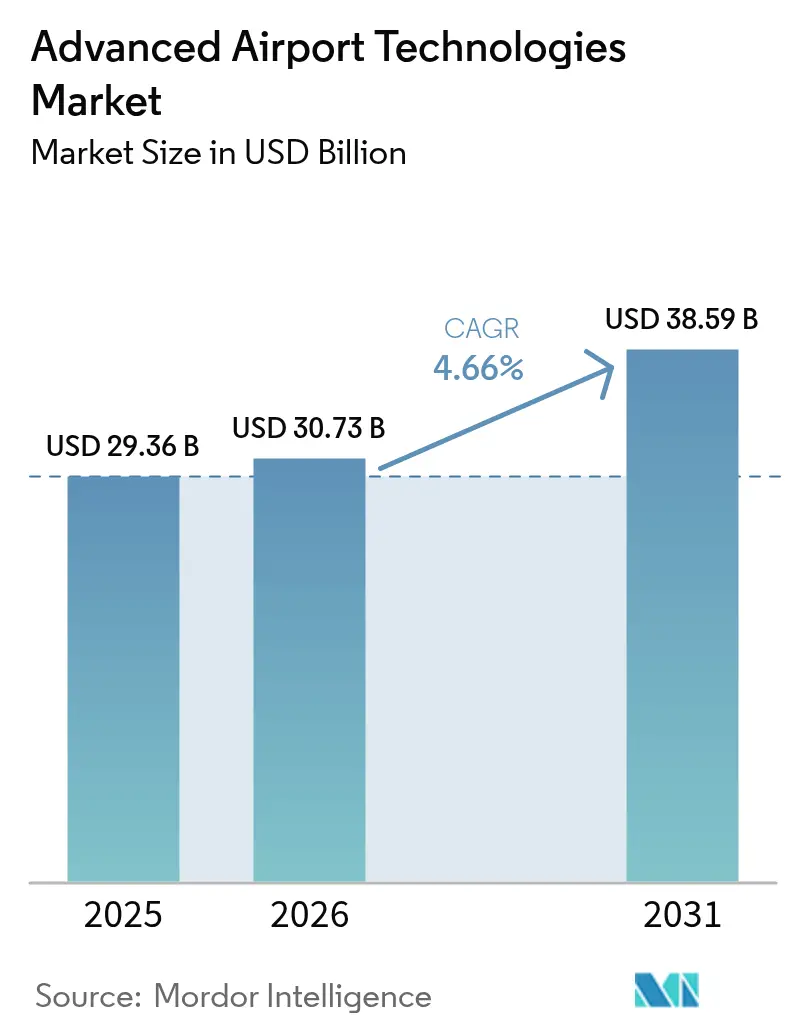
| Market Size (2026) | USD 30.73 Billion |
| Market Size (2031) | USD 38.59 Billion |
| Growth Rate (2026 - 2031) | 4.66 % |
| Fastest Growing Market | Asia Pacific |
| Largest Market | North America |
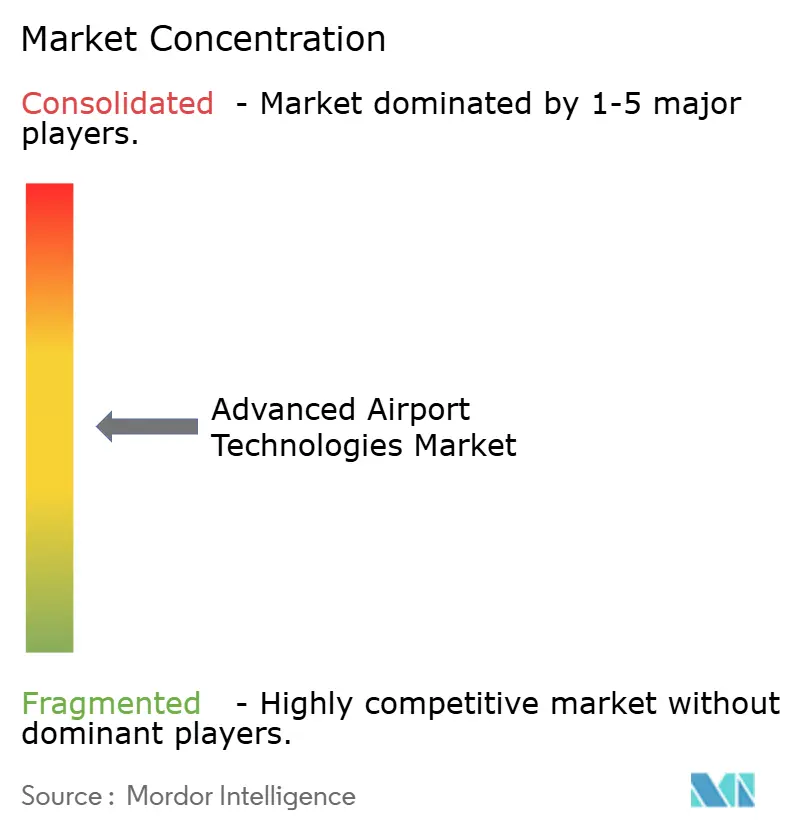
| Market Concentration | Medium |
Major Players *Disclaimer: Major Players sorted in no particular order Image © Mordor Intelligence. Reuse requires attribution under CC BY 4.0. | |
Advanced Airport Technologies Market Analysis by Mordor Intelligence
The advanced airport technologies market size was valued at USD 29.36 billion in 2025 and estimated to grow from USD 30.73 billion in 2026 to reach USD 38.59 billion by 2031, at a CAGR of 4.66% during the forecast period (2026-2031). Robust passenger-traffic recovery, mandatory security upgrades, and digital transformation spending continue to anchor purchasing decisions. Airports favor deployments that raise throughput and cut operating costs, giving security and screening platforms a stable revenue base, while cloud platforms and biometrics generate the steepest growth curves. Budget-constrained regional facilities lean on SaaS models and vendor financing, whereas hub airports refresh legacy systems to satisfy sustainability and resilience targets. Competitive dynamics remain moderate, with diversified conglomerates acquiring niche innovators to secure AI and automation expertise.
Key Report Takeaways
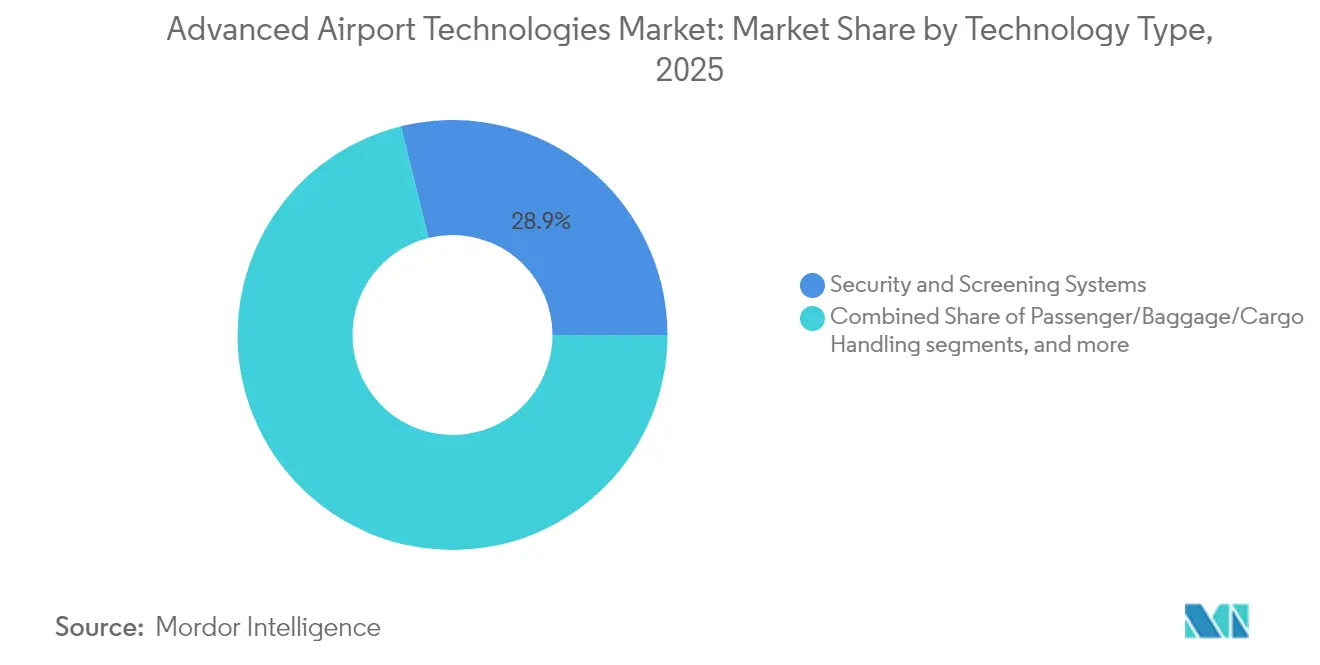
- By technology type, security and screening systems led with 28.86% of the advanced airport technologies market share in 2025; biometric passenger identification is projected to record a 6.14% CAGR through 2031.
- By operation area, terminal-side systems controlled 43.72% revenue in 2025, while air-side solutions are advancing at a 5.69% CAGR to 2031.
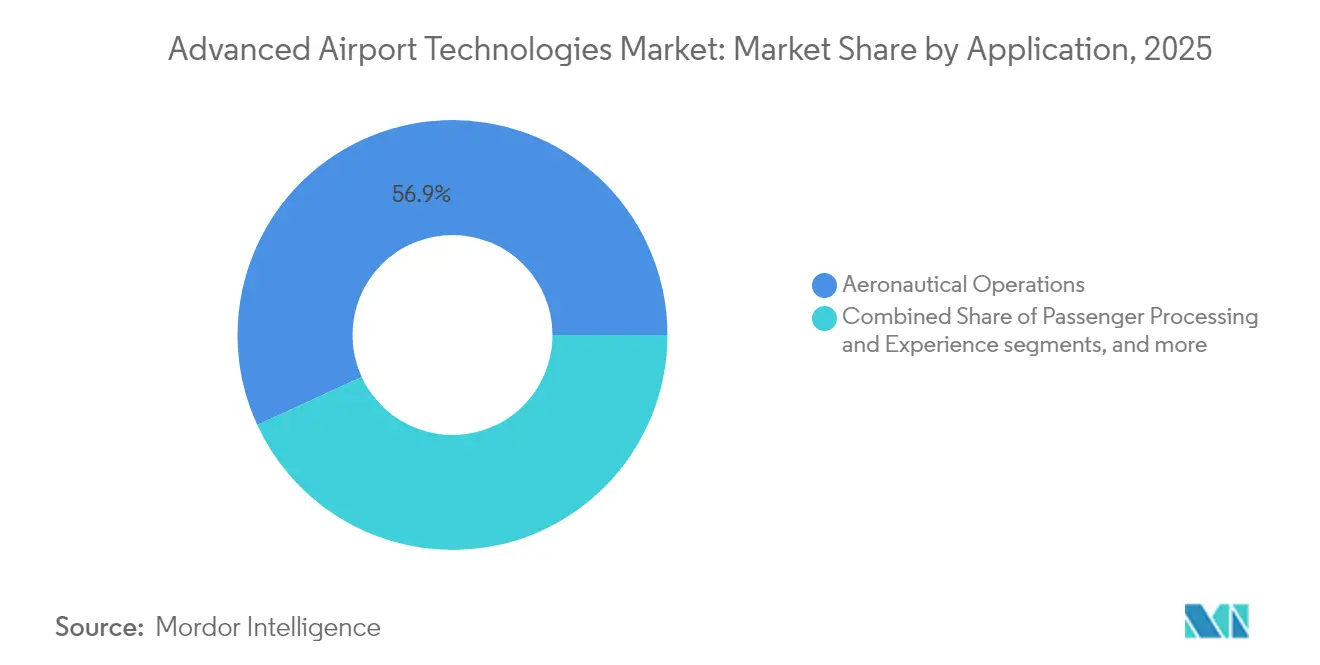
- By application, aeronautical operations held a 56.88% share of the advanced airport technologies market in 2025; smart retail and non-aeronautical platforms will accelerate at a 6.01% CAGR to 2031.
- By airport size, Class A hubs (greater than 25 million passengers per annum (mppa)) captured 35.22% of the advanced airport technologies market size in 2025; small and regional airports (less than 5 mppa) are expanding at a 6.23% CAGR through 2031.
- By deployment mode, on-premise systems retained 56.74% of spending in 2025, yet cloud and SaaS offerings are growing at a 5.76% CAGR to 2031.
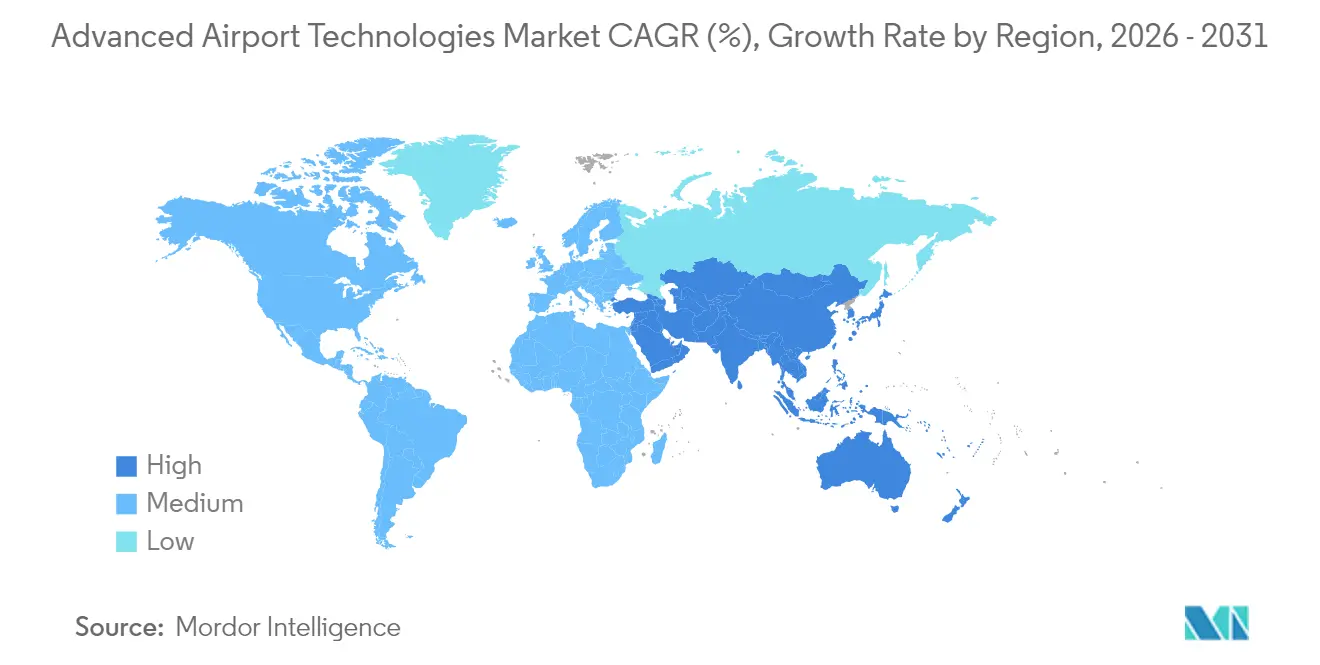
- By geography, North America commanded 34.12% market share in 2025, yet Asia-Pacific exhibits the fastest growth at 7.03% CAGR to 2031.
Note: Market size and forecast figures in this report are generated using Mordor Intelligence’s proprietary estimation framework, updated with the latest available data and insights as of 2026.
Market Trends and Insights
Drivers Impact Analysis of Advanced Airport Technologies Market*
| Driver | (~) % Impact on CAGR Forecast | Geographic Relevance | Impact Timeline |
|---|---|---|---|
| Growing air-passenger volumes and green-field airport projects | +1.2% | Global, strongest impact in Asia-Pacific and Middle East | Medium term (2-4 years) |
| Stringent global aviation-security mandates (ICAO, TSA, EASA) | +0.9% | Global, immediate impact in North America and Europe | Short term (≤ 2 years) |
| Rapid biometrics roll-outs for seamless passenger journey | +0.8% | North America and EU leading, Asia-Pacific accelerating | Medium term (2-4 years) |
| Demand for real-time data to cut turnaround-times | +0.6% | Global, early adoption in major hub airports | Short term (≤ 2 years) |
| Digital-twin adoption for remote ops and predictive maintenance | +0.4% | North America and EU core, spill-over to Asia-Pacific | Long term (≥ 4 years) |
| ESG-linked airport-financing favoring low-carbon tech | +0.3% | Europe leading, North America and Asia-Pacific following | Long term (≥ 4 years) |
| Source: Mordor Intelligence | |||
Growing Air-Passenger Volumes and Green-Field Airport Projects
According to ACI-World, global passenger traffic surpassed pre-pandemic levels in 2024 and reached 9.4 billion journeys, generating urgent capacity needs. Mega projects such as Singapore’s Changi Terminal 5, launched in May 2025, embed automated baggage flows, smart building controls, and solar power from day one.[1]Singapore Press Holdings, “Changi Terminal 5 Ground-breaking,” straitstimes.com This design-phase integration lets operators bypass costly retrofits and elevates baseline technology expectations for every subsequent expansion. Emerging-market governments fund similar builds, driving the advanced airport technologies market toward integrated, cloud-ready platforms that scale with traffic.
Stringent Global Aviation-Security Mandates (ICAO, TSA, EASA)
The European Union's (EU's) computed-tomography deadline and TSA's capital plan through 2029 lock in the procurement of advanced screening equipment. ICAO's 2024 Security Week endorsed AI-enhanced threat detection, creating a common playbook across jurisdictions. Harmonized rules lower customization costs, enlarge addressable volumes, and encourage bulk purchasing, lifting the advanced airport technologies market in every region. Smaller airports, however, face timetable pressure, accelerating partnerships with equipment vendors that offer pay-as-you-go models.
Rapid Biometrics Roll-Outs for Seamless Passenger Journey
Facial-recognition lanes operate at more than 400 US airports, and 79% of travelers endorse their use.[2]Phocuswire, “Traveler Attitudes Toward Biometric ID,” phocuswire.com Airports link biometric checkpoints to retail-loyalty platforms, converting shorter queues into incremental spend. BigBear.ai’s veriScan pilot at Denver and Delta’s digital-ID rollout in Salt Lake City demonstrate dwell-time drops and higher concession yields. With over 50% of airports planning deployments by 2026, the advanced airport technologies market anticipates biometrics shifting from pilot status to baseline requirement.
Demand for Real-Time Data to Cut Turnaround Times
Copenhagen Airports’ Total Airport Management suite trimmed average departure delays by 6.5 minutes, saving USD 540,582 in six months.[3]Regional Gateway, “Copenhagen Airport and Assaia Launch TAM Solution,” regionalgateway.netAI-driven ApronAI delivers predictive alerts that permit an extra aircraft turn per gate daily, translating to revenue and carbon reductions. Private 5G networks enhance spatial efficiency by up to 50%, while autonomous pushback vehicles lower taxi delays by 70%. Such quantifiable returns underpin capital cases, propelling the advanced airport technologies market toward data-centric investments.
Restraints Impact Analysis of Advanced Airport Technologies Market*
| Restraint | (~) % Impact on CAGR Forecast | Geographic Relevance | Impact Timeline |
|---|---|---|---|
| High CAPEX and long payback periods | -0.8% | Global, strongest impact on smaller airports | Medium term (2-4 years) |
| Escalating cybersecurity and data-privacy risks | -0.6% | Global, heightened concern in North America and Europe | Short term (≤ 2 years) |
| Legacy-IT integration complexity | -0.4% | North America and Europe primarily, limited impact in green-field markets | Medium term (2-4 years) |
| Passenger-consent bottlenecks for biometrics | -0.2% | Europe and privacy-conscious markets | Short term (≤ 2 years) |
| Source: Mordor Intelligence | |||
High CAPEX and Long Payback Periods
Revenues at many airports remain below 2019 peaks, tightening discretionary budgets. Class C facilities struggle to finance CT scanners that exceed USD 3 million per lane, slowing penetration. ESG-linked bonds and airport-as-a-service contracts soften upfront outlays, illustrated by Vienna Airport’s CO₂-neutral financing pathway. Nevertheless, extended payback horizons temper the advanced airport technologies market, especially where service fees cannot be raised.
Escalating Cybersecurity and Data-Privacy Risks
Airports ranked cybersecurity as the top IT focus for 73% of respondents in 2025, yet skill shortages stretch deployment timelines.[4]SITA, “SITA Acquires CCM to Integrate Technology with Design,” airport-technology.com Ransomware attacks on baggage-handling control systems highlight operational exposure. Privacy rules like the US Traveler Privacy Protection Act impose opt-in and deletion mandates, adding integration complexity. Compliance costs shave growth from the advanced airport technologies industry until standardized frameworks mature.
*Our forecasts treat driver/restraint impacts as directional, not additive. The impact forecasts reflect baseline growth, mix effects, and variable interactions.
Advanced Airport Technologies Market Segment Analysis
By Technology Type:
Security Dominance Amid Biometric DisruptionSecurity and screening systems accounted for 28.86% of the advanced airport technologies market share in 2025, underpinned by EU-wide CT mandates that guarantee equipment placement. This segment supplies reliable recurring service revenues and replacement cycles that stabilize vendor pipelines. The advanced airport technologies market size for security and screening reached USD 8.47 billion in 2025 and is forecast to post mid-single-digit gains through 2031.
Though smaller in 2025, biometric passenger identification platforms expanded at a 6.14% CAGR as airports link seamless ID to duty-free conversion rates. Hybrid solutions that fuse biometrics with threat-detection analytics attract bundled contracts, edging incumbent X-ray suppliers toward software partnerships. Baggage, cargo, and passenger-flow management software, embedding analytics into formerly hardware-only workflows, rides the same adoption wave. Ground-handling electrification also reshapes procurement; Shenzhen Airport’s 100% new-energy vehicle goal signals that environmental targets now influence specification sheets.



By Operation Area:
Terminal Efficiency Versus Airside InnovationTerminal-side systems represented 43.72% of the advanced airport technologies market size in 2025, reflecting concentrated passenger touchpoints. Checkpoint biometrics, digital signage, and smart retail software deliver throughput and ancillary revenue, making terminals the first investment priority.
Air-side applications, while smaller, recorded a 5.69% CAGR and increasingly integrate with terminal platforms via digital twins. Saab’s cloud-based runway-safety system at Nashville provides real-time alerts in line with FAA surface-awareness goals. Air-side gains are amplified by AI-driven gate allocation that trims taxi times, lowering Scope 1 emissions. Landside mobility systems, including smart parking PARCS installed at Charleston, unlock last-mile monetization and data capture, rounding out holistic airport-wide platforms.
By Application:
Aeronautical Operations Lead Smart Retail SurgeAeronautical operations and ATC/ATM commands a 56.88% share, reflecting mandatory safety spending and NextGen program rollouts. The advanced airport technologies market size for this application segment is projected to reach USD 23.59 billion by 2031, growing with the US FAA’s USD 16.5 billion budget for system modernization.
Smart retail and non-aeronautical platforms posted a 6.01% CAGR as airports pivot toward diversified income. Real-time location analytics allow concessionaires to tailor offerings, boosting per-passenger spend. Passenger-processing tools piggyback on biometric corridors, and asset-management software exploits IoT sensors to predict maintenance needs, aligning with lean staffing.
By Airport Size/Class:
Hub Spending Versus Regional GrowthClass A hubs (greater than 25 mppa) represented 35.22% of the advanced airport technologies market size in 2025, leveraging cash flows to adopt AI orchestration platforms. These airports act as proving grounds for biometrics and digital twins before scaling downstream.
Small and Regional airports (less than 5 mppa) deliver 6.23% CAGR through 2031, propelled by government grants and cloud subscriptions that bypass on-site IT investment. McGhee Tyson’s smart parking system, live within three days, typifies quick-turn projects that enhance service without extensive capital. Medium airports balance constraints by prioritizing single-pane dashboards over siloed point solutions.
By Deployment Mode:
Cloud Transformation AcceleratesOn-premise architectures held 56.74% of spending in 2025, driven by stringent control requirements. Yet cloud and SaaS solutions grow at 5.76% CAGR, aided by aviation-focused compliance frameworks. The advanced airport technologies market share for cloud models rises sharply in regions building green-field terminals free of legacy stacks.
Hybrid models will gain favor as airports shift analytics and passenger interfaces off-site while retaining critical command functions on-premise. SITA’s acquisition of CCM to blend design and cloud technology underscores vendor convergence toward “airport-in-a-box” offerings.
Geography Analysis
North America Advanced Airport Technologies Market
North America retained 34.12% of 2025 revenue, supported by TSA’s multiyear capital plan prioritizing biometrics and vetting systems. US hub airports pioneer frictionless ID pilots, and Vancouver’s digital-innovation push shows similar momentum. However, saturation tempers growth to low single digits. Canada’s airports leverage climate-resilience funds for energy-efficient retrofits, accelerating LED lighting and electrified ground fleets.
Europe Advanced Airport Technologies Market
Europe sustains sizable demand through harmonized regulation and ESG imperatives. The EU CT scanner mandate secures new installs, while Vienna Airport’s net-zero roadmap channels spending into photovoltaic and electric ground service equipment. Passenger traffic rose 9% year-on-year in the first half of 2024, yet 47% of airports remain below 2019 levels, highlighting uneven recovery. Sustainability-linked financing and Fit-for-55 infrastructure rules drive conversion to smart-grid-ready assets.
APAC Advanced Airport Technologies Market
Asia-Pacific is the fastest-growing theater at 7.03% CAGR, energized by India’s 174 million travelers in 2024 and a massive portfolio of new airports. Changi Terminal 5’s USD 3.5 billion build embeds robotics and AI, setting a regional benchmark. Incheon aims for 100% renewable electricity by 2040, boosting orders for smart-energy management systems. China’s multi-city expansions and South Korea’s RE100 commitments amplify opportunity, making the region the fulcrum of the advanced airport technologies market through 2031.

Regulatory Landscape
Regulation for advanced airport technologies is shaped by global safety and security standards and their regional transposition into enforceable rules. In Europe, EASA updated its Easy Access Rules for Aerodromes in March 2026, while NPA 2026-01 advances the incorporation of ICAO Annex 14 amendments into EU requirements. This reinforcement is driving compliance-driven upgrades across airside infrastructure, operational procedures, and supporting digital systems.
In the United States, the FAA Reauthorization Act of 2024 created a clearer pathway for airports to procure digital construction and modernization tooling, complementing ongoing NextGen-related modernization efforts. At the global level, ICAO continues to formalize the digitalization agenda through its March 2025 MET-SWIM implementation guidance and the April 2026 MID Region Implementation Plan for Digital Datasets, with target provision dates through 2031 for terrain, obstacle, and aerodrome mapping datasets. These initiatives support demand for interoperable data platforms, cybersecurity controls, and standards-aligned system integration.
Value Chain Analysis
The value chain covers (1) standards and governance bodies (ICAO, IATA, national regulators and security agencies), (2) OEMs and system integrators supplying screening, communications, lighting, and baggage/handling automation, (3) software and platform providers for airport operational databases, total airport management, analytics, and biometrics, and (4) airport operators, airlines, and ground handlers that procure, operate, and maintain these systems. Interoperability and operational fit are influenced by common-use and process standards such as IATA CUPPS for passenger processing and IATA Worldwide Airport Slot Guidelines (WASG), alongside ICAO Annex 14 requirements for aerodrome design and operations.
Implementation typically runs from concept and design, including eligibility and planning for public funding where applicable, to procurement, integration, cybersecurity hardening, commissioning, and long-tail maintenance and upgrades. Airports are increasingly using partnerships that bundle hardware, cloud platforms, and services into outcomes-based delivery, while supply-chain resiliency and workforce constraints affect lead times for critical components and field deployment capacity. This is reinforcing airport demand for standardized interfaces, remote monitoring, and predictive-maintenance toolchains across multi-vendor estates.
Competitive Landscape
Established multi-industry players such as Honeywell International, Inc., Cisco Systems, Inc., Thales Group, Amadeus IT Group SA, Siemens AG, and SITA command gateway relationships and broad portfolios, allowing cross-selling across security, communications, and building-automation layers. 2025 witnessed consolidation: Vanderlande moved to acquire Siemens Logistics to secure baggage-handling automation, and Toyota Industries invested USD 1.5 trillion (FY 2025-2027) in airport-linked logistics technologies, reflecting scale-driven competition.
Disruptors concentrate on narrow, high-value niches. Assaia captured visibility with ApronAI deployments, cutting delays by 6% and increasing turns by 4%. BigBear.ai leverages computer vision for biometric boarding that speeds gates without hardware overhauls. These firms win by proving ROI within six-month cycles, an attractive proposition for CFO-led procurement committees.
Cloud platform convergence reshapes vendor roles. SITA’s April 2025 acquisition of CCM integrates design, interiors, and IT into turnkey packages, signaling a shift from standalone software toward holistic delivery. Market barriers remain moderate; switching costs favor incumbents, yet airports demand open APIs, enabling specialists to interoperate. Competitive intensity focuses on AI capability, cybersecurity certifications, and sustainability credentials, factors that now differentiate bids as much as price.
Advanced Airport Technologies Industry Leaders
Thales Group
SITA
Siemens AG
Amadeus IT Group, S.A.
Honeywell International, Inc.
- *Disclaimer: Major Players sorted in no particular order
Advanced Airport Technologies Market Companies Covered in this Report
- Honeywell International, Inc.
- Cisco Systems, Inc.
- Thales Group
- Siemens AG
- SITA
- TAV Airports Holding
- ADB SAFEGATE
- NEC Corporation
- Smiths Detection (Smiths Group)
- Leidos Holdings, Inc.
- Analogic Corporation
- L3Harris Technologies, Inc.
- TK Elevator GmbH
- Rapiscan Systems, Inc.
- Amadeus IT Group, S.A.
- International Business Machines Corporation (IBM)
- Vanderlande Industries B.V.
- Indra Sistemas, S.A.
- Frequentis AG
- Collins Aerospace (RTX Corporation)
- Daifuku Co., Ltd.
- Oshkosh Corporation
- Johnson Controls International plc

Market Opportunities and Future Outlook
Opportunities center on replacing fragmented, legacy airport operational systems with unified data backbones that support real-time decisioning across terminal, airside, and landside operations. In March 2026, Heathrow selected the AIRHART platform as a new digital backbone to orchestrate operations, demonstrating active spending on platforms that connect AODB functions, disruption management, and resource planning into a single layer that can be extended with AI and automation.
Airspace and airport operations modernization also creates scope for AI-enabled flow management and trajectory services that raise capacity utilization without immediate physical expansion. In June 2026, the FAA awarded Air Space Intelligence a 12-year, USD 875 million contract for AI-powered flow management data and strategic routing platforms, supporting long-duration demand for scalable data services and integration capabilities that can extend into airport collaborative decision-making environments. Parallel runway and terminal expansion programs in the Middle East and Asia-Pacific, along with national initiatives supporting advanced air mobility integration (including the FAA eIPP selection involving the Port Authority of New York and New Jersey in March 2026), broaden the addressable set of deployments for surveillance, surface management, digital-twin, and secure identity technologies designed to operate as interoperable, standards-aligned systems.
Recent Industry Developments in Advanced Airport Technologies Market
- April 2026: Sun Group and SITA signed a strategic partnership to deploy self-service passenger processing, biometric-enabled boarding, and real-time data platforms at Phu Quoc and Van Don International Airports in Vietnam. The collaboration links airport digitization to a broader aviation and tourism ecosystem buildout, expanding the role of integrated platforms beyond checkpoint automation.
- April 2025: SITA acquired CCM to combine airport design and delivery capabilities with its technology and cloud platforms. This supports turnkey implementations where terminal design, passenger flows, and IT architecture are engineered together, shortening time-to-deploy for airport-wide programs.
- December 2024: GMR Airports launched an AI-powered digital twin at Rajiv Gandhi International Airport. This deployment reflects a shift toward data-driven operational planning and predictive maintenance workflows that connect assets and processes across the airport environment.


Advanced Airport Technologies Market Report Scope and Research Methodology
Market Definition and Coverage
This market covers technologies deployed by airports to improve passenger processing, security screening, baggage and cargo flow, and airside operations, including the related software and services that make these systems run in live airport environments.
Scope exclusions: Aircraft avionics and airline-only back office IT systems are excluded.
Segments Covered in This Report
- By Technology Type
- Airport Communications Systems
- Airport Management Software
- Passenger/Baggage/Cargo Handling
- Security and Screening Systems
- Ground and Airside Handling Equipment
- Landing Aids, Guidance and Lighting
- Airport Digital Signage Systems
- Smart Parking and Landside Mobility Solutions
- By Operation Area
- Terminal-side
- Air-side
- Land-side
- By Application
- Passenger Processing and Experience
- Aeronautical Operations and ATC/ATM
- Asset and Facility Management
- Smart Retail and Non-Aeronautical Revenue Solutions
- By Airport Size/Class
- Class A (Greater than 25 mppa) Large Hubs
- Class B (5 to 25 mppa) Medium Airports
- Class C (Less than 5 mppa) Small and Regional Airports
- By Deployment Mode
- On-premise/Proprietary
- Cloud and SaaS
- By Geography
- North America
- United States
- Canada
- Mexico
- Europe
- Germany
- United Kingdom
- France
- Italy
- Rest of Europe
- Asia-Pacific
- China
- Japan
- India
- South Korea
- Rest of Asia-Pacific
- South America
- Brazil
- Rest of South America
- Middle East and Africa
- Middle East
- United Arab Emirates
- Saudi Arabia
- Rest of Middle East
- Africa
- South Africa
- Egypt
- Rest of Africa
- Middle East
- North America
Data Sources, Market Sizing, and Validation
Desk Research
Desk research started with building a fact base on airport activity and technology adoption, so we could anchor demand to real airport throughput. Public sources, such as ICAO and IATA traffic statistics, FAA and EUROCONTROL operational updates, and ACI publications on airport investment priorities, were used to understand volumes, capacity additions, and the timing of upgrade programs.
We then added technology and regulatory context using sources such as government procurement portals, airport operator annual reports and investor presentations, and standards and guidance from bodies such as IATA and ICAO. We also reviewed peer reviewed papers on biometrics, screening, and airport operations. For cross checks, we used paid subscriptions for company financials and intelligence, news and financials, patent databases, and global contracts and tenders to validate which vendors win projects and which solution areas see repeat spend. The sources listed here are illustrative and not exhaustive, and many other public references were used for data collection, validation, and clarification.
Primary Interviews and Surveys
Primary inputs were collected through expert interviews and structured surveys with airport operators, technology integrators, system OEMs, and selected regulators and consultants across major aviation regions. These discussions were used to confirm what airports typically purchase as bundled initiatives, how projects are phased across years, and where pricing or adoption assumptions from desk work needed adjustment.
Distribution of primary research fieldwork respondents
| Company type | Respondent position | Region |
|---|---|---|
| Top tier: 35% | CXOs: 12% | APAC: 43% |
| Mid tier: 51% | Functional/Unit leaders: 28% | EMEA: 32% |
| Smaller Players: 14% | Managers: 60% | Americas: 25% |
Market-Sizing & Forecasting
Sizing was built using a top-down demand reconstruction, where airport passenger throughput and flight movements were translated into a realistic technology spend pool by applying adoption rates and upgrade cycles for key airport systems. The totals were then tested using selective bottom-up checks, such as sampling large program budgets, validating average system prices, and rolling up a limited set of supplier revenues where disclosures were available.
Key model inputs included passenger traffic growth, terminal expansion and modernization timing, and security and border control tightening, which affects screening and e-gate demand. We also modeled baggage system replacement cycles, plus the mix shift toward automation and software-enabled control layers. Where data was uneven across regions, gaps were handled through proxy indicators, such as capex intensity for airports by size band and the share of greenfield versus brownfield projects.
For forecasting, scenario analysis was used so the outlook could reflect different airport capex environments and implementation pacing. The scenarios were calibrated using primary feedback on procurement lead times, deployment durations, and expected pricing movement for integrated systems and software layers, then reconciled back to the core traffic and capacity outlook.
Data Validation & Update Cycle
Model outputs were triangulated against independent signals, including airport capex announcements, tender awards, and traffic recovery patterns, and then reviewed for outliers at the region and system level. When a variance was detected, assumptions were revisited and, if needed, follow up calls were triggered to confirm whether the shift came from delayed projects, scope changes, or pricing updates.
Before sign-off, the numbers pass through multi-step analyst checks so the logic, units, and currency handling stay consistent across years. Reports are refreshed annually, and interim updates are made when material events occur, such as large procurement cycles, regulatory changes, or major shifts in airport construction timelines. Right before delivery, a fresh review pass is completed so the final output reflects the latest available public data and validation inputs.
Mordor Intelligence's Global Advanced Airport Technologies Market Market Sizing Compared With Other Published Estimates
Published market sizes for advanced airport technologies often look different because each study draws the line around what counts as airport technology spend. Base years and forecasting windows also vary across providers. Differences can further arise when some estimates assume faster capex conversion, while others reflect slower procurement and commissioning cycles.
The table shows a wide spread across sources. In Mordor Intelligence's model, revenues are counted only for technologies installed within the airport perimeter that support passenger, baggage, cargo, airside operations, and centralized airport management. Aircraft avionics and airline-only IT are not included, which can shift totals materially when broader aviation electronics or airline systems get bundled in other scopes.
Benchmark comparison
| Source | Market Size | Gaps in Research Methodology |
|---|---|---|
| Mordor Intelligence | USD 30.73 B (2026) | |
| Industry Research Publisher A | USD 9.10 B (2023) | Uses an earlier base year and a narrower interpretation that appears to emphasize select digital and screening solutions, which can exclude large airside and airport-wide management system spends that lift the total. |
| Syndicated Report Publisher B | USD 9.48 B (2025) | Reports a smaller headline value that likely reflects a different boundary for what is treated as airport technology, and it can also be influenced by how multi-year programs are recognized across the base year. |
Taken together, the comparison mainly comes down to what is included in the spend pool and how timing is treated for multi-year airport programs. By tying the estimate to observable airport activity drivers and then checking it against project signals and expert feedback, the result stays traceable to clear inputs and can be repeated when assumptions change.


Key Questions Answered in the Report
What is the 2026 value of the advanced airport technologies market?
The market is valued at USD 30.73 billion in 2026 and is forecast to reach USD 38.59 billion by 2031, reflecting a 4.66% CAGR.
Which segment grows the fastest within the advanced airport technologies market?
Biometric Passenger Identification leads with a 6.14% CAGR through 2031 as airports pursue seamless passenger journeys.
Why are cloud deployments accelerating at airports?
Cloud platforms cut upfront costs, offer scalability, and meet new compliance frameworks, driving an 5.76% CAGR to 2031.
Which region offers the strongest growth prospects?
Asia-Pacific posts a 7.03% CAGR, supported by large-scale green-field construction and rapid passenger recovery.
How are cybersecurity concerns influencing technology buying?
With 73% of airports ranking cybersecurity as a priority, solutions that meet stringent data-protection rules gain procurement preference.
Page last updated on:


 Your data is secure and never sold or shared.


