
Market Overview
| Study Period | 2020 - 2031 |
|---|---|
| Forecast Data Period | 2026 - 2031 |
| Base Year Market Size (2025) | USD 338.90 Million |
| Market Size (2026) | USD 382.46 Million |
| Market Size (2031) | USD 700.16 Million |
| Growth Rate (2026 - 2031) | 12.86 % |
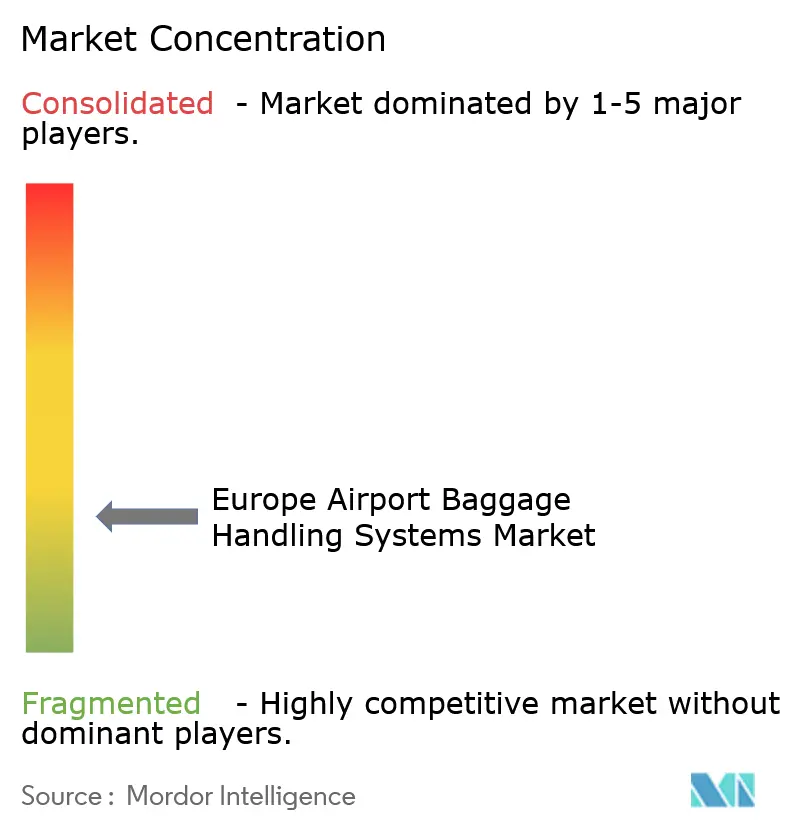
| Market Concentration | Low |
Major Players *Disclaimer: Major Players sorted in no particular order Image © Mordor Intelligence. Reuse requires attribution under CC BY 4.0. | |
Europe Airport Baggage Handling Systems Market Analysis by Mordor Intelligence
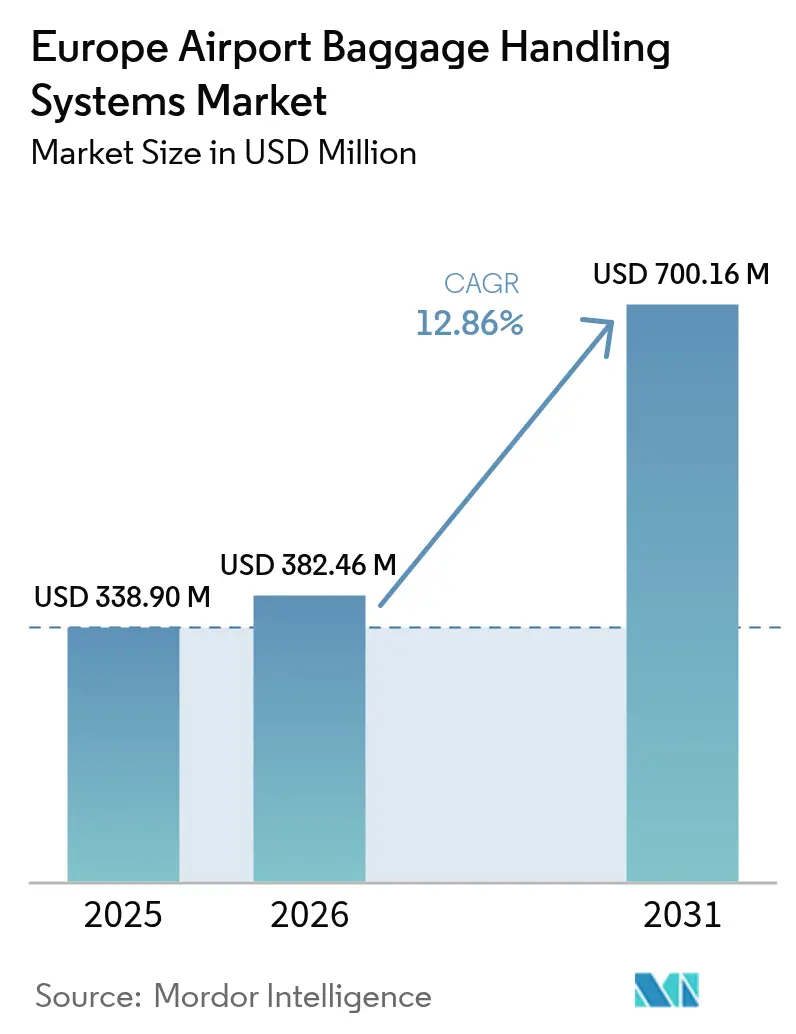
The Europe Airport Baggage Handling Systems Market size is expected to grow from USD 338.90 million in 2025 to USD 382.46 million in 2026 and is forecast to reach USD 700.16 million by 2031 at 12.86% CAGR over 2026-2031.
- The airport construction industry in Europe is booming, with significant ongoing airport infrastructure development projects, such as Berlin Brandenburg Airport (scheduled to open in October 2020) and an extension of Terminal 2 at Manchester Airport (Main building construction completed in March 2020). These factors are propelling the growth of airport baggage handling systems in the European region.
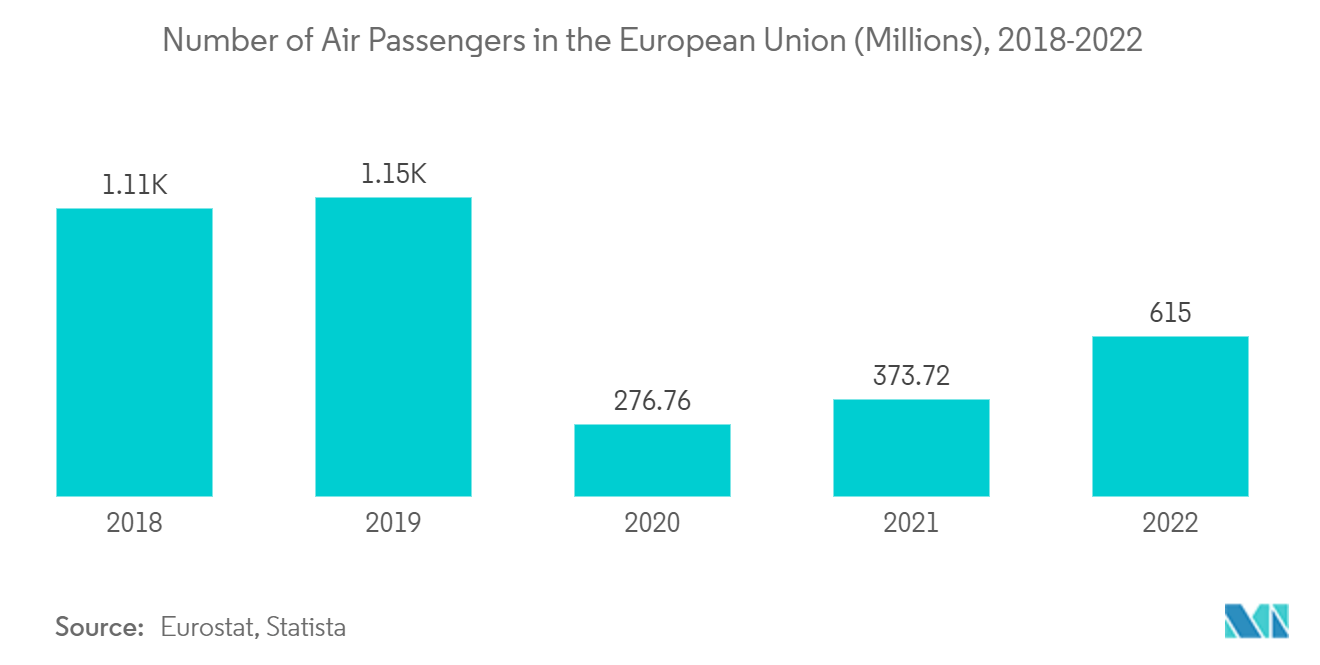
- Worldwide air travel has grown at a historically sharp pace over the past two decades. Europe experienced a 3.2% increase in air passenger traffic in 2019. Airports in Europe are replacing their existing baggage handling systems with new BHS to enhance their operations and to cater to the increasing air passenger traffic in the region.
- The integration of Information Technology in logistics and baggage management has increased the service quality and efficiency of airport operations. The implementation of technologies such as Artificial Intelligence and RFID will help further decrease the number of mishandled baggage.
Note: Market size and forecast figures in this report are generated using Mordor Intelligence’s proprietary estimation framework, updated with the latest available data and insights as of 2026.
Europe Airport Baggage Handling Systems Market Trends and Insights
Above 40 Million Segment is Anticipated to Show Significant Growth During the Forecast Period
- The above 40 million segment is expected to experience significant growth during the forecast period. In recent years, there has been a substantial increase in the number of airports entering the segment with passenger handling capacity above 40 million.
- An increasing number of air passengers and rising expenditure on airport modernization programs drive the market's growth. For instance, Frankfurt International Airport, Germany's central airport hub, is undergoing expansion by operator Fraport with a significant investment of USD 5.7 billion. In 2022, the airport handled 48.9 million passengers, making it the sixth busiest airport in Europe in terms of passenger traffic. The expansion project includes the construction of Terminal 3, which is projected to be operational by 2026.
- The addition of Terminal 3 is expected to enhance the airport's capacity and improve the overall passenger experience. Similar projects are ongoing in several other countries in different regions. Such airport expansion projects are anticipated to generate demand for new baggage handling systems that will efficiently process passengers and baggage in the airport.
- Eastern and Southern Europe are expected to experience high growth in airport development, with numerous significant projects currently under construction to meet the increasing demand for passenger traffic. Additionally, Poland plans to invest USD 10 billion in constructing the new Warsaw Solidarity Airport, which is scheduled to be operational by 2027.
- The Solidarity Transport Hub (STH) is a new greenfield airport being developed by the Polish government, with a passenger capacity of 40 million passengers annually in its first phase. The most important feature of the airport will be the integration of air, rail, and road transport. Such developments will create demand for new baggage handling systems, driving the market's growth.


France is Expected to Show Significant Growth During the Forecast Period
- France is expected to exhibit remarkable growth in the market during the forecast period. France recorded the highest rate of air passenger traffic in Europe, and this rate is continually increasing, primarily due to the development of other medium-sized and small airports, as well as opportunities for employment and education. Due to the aforementioned factors, the airport baggage handling systems market is expected to witness significant growth.
- Due to the growth in terrorism in the European region, France has invested in airport security solutions that can efficiently scan large amounts of baggage. Projects such as the terminal expansion of Marseille Provence International Airport, which is expected to be completed by 2023, will increase passenger handling capacity from 8 million to 12 million and total passenger handling capacity to 16 million passengers.
- Additionally, Charles de Gaulle Airport is expected to receive a new terminal by 2024, in preparation for the scheduled Paris Olympics in 2024. The terminal will serve more than 30 million passengers annually, increasing the airport's total annual passenger handling capacity to over 120 million passengers.
- Several baggage-handling system players are operating in France and investing in customer service enhancement and technological developments. The aforementioned factors are propelling the growth of the airport baggage handling systems market in France.
Competitive Landscape
The Europe Airport Baggage Handling Systems Market is moderately fragmented, with several global and local players catering to the needs of large, medium, and small airports in the region. A few major players, such as BEUMER Group, Vanderlande Industries B.V., SITA, Alstef Group SAS, and Siemens AG, dominate the market. The market is witnessing significant collaboration between technology companies and baggage handling system manufacturers in the development of innovative baggage management systems. Players also strive to win contracts with major airports to generate revenues.
For instance, in February 2023, Aena Group signed a contract with Siemens Logistics to operate and maintain the baggage handling systems at Adolfo Suárez Madrid-Barajas Airport in Spain (MAD). The service contract will run for five years and covers technical support for 140 kilometers of conveyor systems, as well as tray and belt technology.
Europe Airport Baggage Handling Systems Industry Leaders
BEUMER Group
SITA
Siemens AG
Alstef Group SAS
Vanderlande Industries B.V.
- *Disclaimer: Major Players sorted in no particular order

Market Opportunities and Future Outlook
Large-scale greenfield and brownfield airport programs across Europe continue to open multi-year tender pipelines for new baggage handling systems (BHS) and lifecycle services. Buyers are increasingly favoring modular, high-throughput architectures that can be delivered in phases without disrupting day-to-day operations. Poland's Centralny Port Komunikacyjny (CPK) Airport contract awarded to Vanderlande in October 2025 provides a clear anchor for demand that goes beyond equipment supply, including design-build and long-term operation and maintenance scope.
Spend is also shifting toward higher automation and digital baggage management aimed at reducing mishandling and improving traceability. That direction supports uptake of cross-belt sorting, Individual Carrier System (ICS) concepts, and AI-enabled identification. In 2026, Leonardo secured baggage system automation work at Malta International Airport and announced replacement and expansion activity at Hamburg Airport. Alstef Group was also selected by Bordeaux Merignac Airport for a centralized baggage solution with a cross-belt sorter. Alongside procurement, industry collaboration is moving proofs of concept for AI-driven bag identification and automated loading forward through initiatives such as the BOOST coalition, which includes Brussels Airport and Heathrow Airport, creating implementation pathways for software, sensors, and integration specialists alongside traditional BHS OEMs.
Recent Industry Developments
- May 2026: Frankfurt Airport inaugurated Terminal 3, with BEUMER Group delivering a baggage handling system that includes more than 14 km of conveyor technology. The commissioning underscores continued replacement and expansion activity at major European hubs and reinforces demand for large-scale integration, controls, and maintenance capabilities alongside mechanical conveyance.
- October 2025: Centralny Port Komunikacyjny (CPK) awarded Vanderlande a contract for the design, supply, installation, operation, and maintenance of the baggage handling system at Poland's new CPK Airport in Warsaw. The scope combines delivery with a long-term O&M element, highlighting airports preference for performance-backed availability and lifecycle support beyond initial system installation.
- December 2024: SITA expanded its partnership with IDEMIA to integrate ALIX computer-vision technology into SITA baggage management solutions. The update advances AI-assisted identification and tracking within baggage operations, adding software and analytics layers that complement physical baggage handling infrastructure.


Research Methodology Framework and Report Scope
Market Definition and Coverage
For this methodology, the market covers revenues earned from baggage handling systems installed at airports across Europe, including the main equipment, controls, and supporting integration needed to move, sort, screen, and deliver checked bags.
Scope exclusions: We exclude airport cargo handling equipment and non-airport logistics systems that do not touch passenger baggage flows.
Segmentation Overview
- Airport Capacity
- Up to 15 million
- 15 - 25 million
- 25 - 40 million
- Above 40 Million
- Geography
- Europe
- United Kingdom
- Germany
- France
- Italy
- Rest of Europe
- Europe
Data Sources, Market Sizing, and Validation
Desk Research
Desk research was used to set the foundation on airport activity and capital spending signals that influence baggage system demand. We referred to open aviation traffic and airport statistics, such as EUROCONTROL traffic data, ACI Europe airport traffic reporting, and Eurostat transport series, to understand passenger recovery, peak season patterns, and airport growth plans.
For the supply and technology side, we also used public procurement and project cues, such as TED (Tenders Electronic Daily) notices, national civil aviation authority publications, and peer reviewed papers on baggage screening and sortation performance. Company annual reports, investor presentations, and reputable aviation press were then used to map typical project scope, replacement cycles, and pricing movement for major subsystems. For some checks, paid subscriptions for company financials and patent databases were used to confirm timelines and product positioning. The desk sources listed here are illustrative, and many other references were also used for data collection, validation, and clarification.
Primary Interviews and Surveys
Primary work focused on validating what airports are actually buying, and when, across large hubs and mid sized airports in Europe. We spoke with airport operations and engineering teams, system integrators, and component suppliers to confirm project sizing drivers, typical upgrade triggers, and how screening regulations shape system design.
Feedback from these discussions was used to cross check the assumptions taken from desk research, and to tighten ranges on pricing, project cadence, and the split between new terminal builds and retrofit programs.
Distribution of primary research fieldwork respondents
| Company type | Respondent position |
|---|---|
| Top tier: 38% | CXOs: 15% |
| Mid tier: 44% | Functional/Unit leaders: 31% |
| Smaller Players: 18% | Managers: 54% |
Market-Sizing & Forecasting
The core model starts with a top-down reconstruction of the addressable airport demand pool in Europe, where passenger throughput and terminal capacity plans are translated into likely baggage system projects and upgrade intensity. Once that structure was built, it was corroborated through selective bottom-up checks using sampled project values, typical subsystem mixes (conveyors, sorters, screening interfaces, and controls), and realistic price bands shared by industry participants.
Key inputs used in the model include airport passenger traffic levels and recovery pace, known terminal expansion and modernization programs, baggage screening and security compliance requirements, average project replacement cycles for older systems, and observed shifts toward automation and tracking features that change installed cost. When gaps appeared (for example, when a project value was disclosed without a clear scope), we applied conservative scope rules and then tested the outputs against comparable airport classes before finalizing.
For forecasting, scenario analysis was used because project pipelines can move based on funding approvals, construction delays, and policy changes. Growth cases were set by how fast airport capacity adds, retrofit activity, and pricing progression, and then tuned using expert consensus from interviews so the forward view stays practical.
Data Validation & Update Cycle
Outputs are checked through triangulation across independent signals, such as passenger traffic, publicly visible airport capex plans, and the timing of large tender awards, and then the spread is reviewed before sign-off. If a country level result looks off, the assumptions are revisited and respondents may be re-contacted to confirm what changed.
Reports are refreshed annually, and interim updates are made when there is a material event, such as a major airport expansion announcement or a policy shift that impacts screening requirements. Before delivery, an analyst performs a fresh pass across key inputs and recent news so clients receive the latest updated view.
Mordor Intelligence's Europe Airport Baggage Handling Systems Market Size Versus Other Published Estimates
Published market values can differ because analysts may not use the same definition of a baggage handling system, and they may also vary on whether they count only airport-side system value or include broader passenger processing equipment. Differences also come from how project timing is treated, since a single large hub upgrade can shift the yearly value if it is booked on award date versus installation milestones.
Tender award records and airport capex announcements are the evidence used to keep Mordor Intelligence's estimate anchored to Europe-only system spend that is visible through real projects and delivery timelines. In other publications, the number often moves because wider geographies are bundled in, or because screening and passenger processing items are counted beyond baggage flow equipment.
Benchmark comparison
| Source | Market Size | Gaps in Research Methodology |
|---|---|---|
| Mordor Intelligence | USD 338.90 M (2025) | |
| Trade Journal A | USD 299.54 M (2025) | Often relies on a narrower captured project list and may undercount retrofit scope when contract values are not fully disclosed, which can pull down the stated current-year total. |
| Industry Report B | USD 1.20 B (2023) | Commonly groups Europe with a broader airport equipment basket and may include passenger processing and adjacent security systems, which inflates the value versus a baggage-system-only boundary. |
The spread in values is mainly explained by scope boundaries and how project value is recognized across time. When airport-only baggage system revenue is separated from adjacent equipment and checked against observable airport investment signals, the market total becomes easier to trace and to repeat in future updates.


Key Questions Answered in the Report
How big is the Europe Airport Baggage Handling Systems Market?
The Europe Airport Baggage Handling Systems Market size is expected to reach USD 382.46 million in 2026 and grow at a CAGR of 12.86% to reach USD 700.16 million by 2031.
What is the current Europe Airport Baggage Handling Systems Market size?
In 2026, the Europe Airport Baggage Handling Systems Market size is expected to reach USD 382.46 million.
Who are the key players in Europe Airport Baggage Handling Systems Market?
BEUMER Group, SITA, Siemens AG, Alstef Group SAS and Vanderlande Industries B.V. are the major companies operating in the Europe Airport Baggage Handling Systems Market.
What years does this Europe Airport Baggage Handling Systems Market cover, and what was the market size in 2024?
In 2024, the Europe Airport Baggage Handling Systems Market size was estimated at USD 294.37 million. The report covers the Europe Airport Baggage Handling Systems Market historical market size for years: 2019, 2020, 2021, 2022, 2023 and 2024. The report also forecasts the Europe Airport Baggage Handling Systems Market size for years: 2026, 2027, 2028, 2029, 2030 and 2031.
Page last updated on:


 Your data is secure and never sold or shared.


