
Market Overview
| Study Period | 2019 - 2031 |
|---|---|
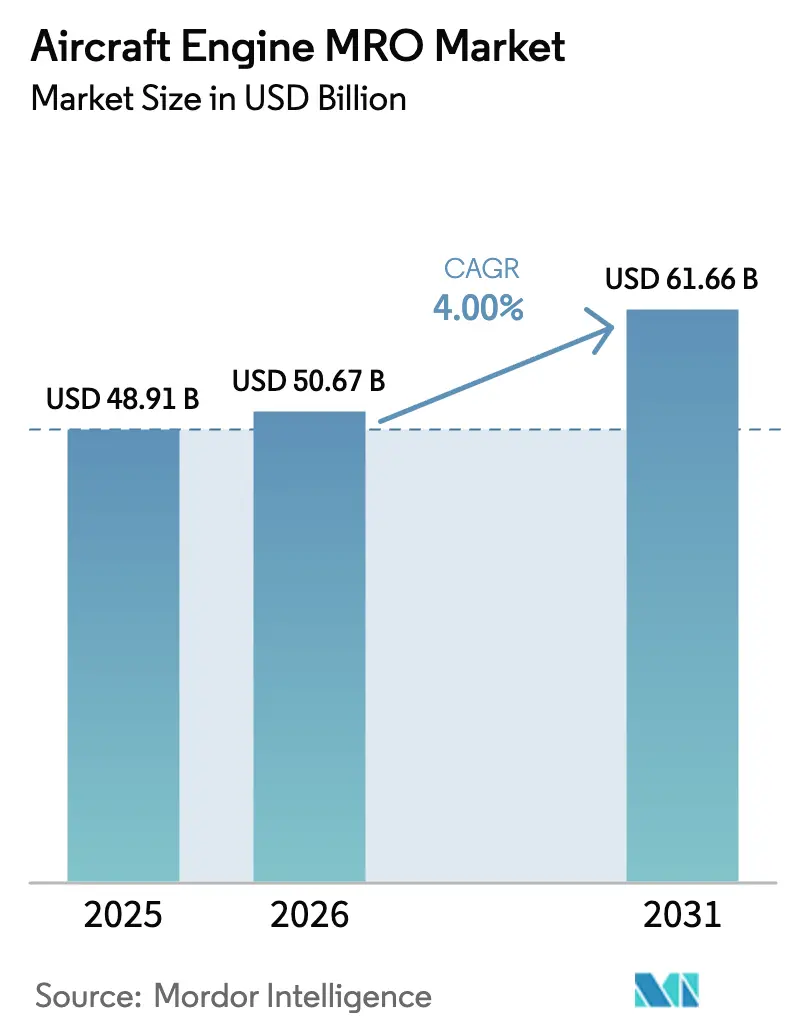
| Market Size (2026) | USD 50.67 Billion |
| Market Size (2031) | USD 61.66 Billion |
| Growth Rate (2026 - 2031) | 4.00 % |
| Fastest Growing Market | Asia Pacific |
| Largest Market | North America |
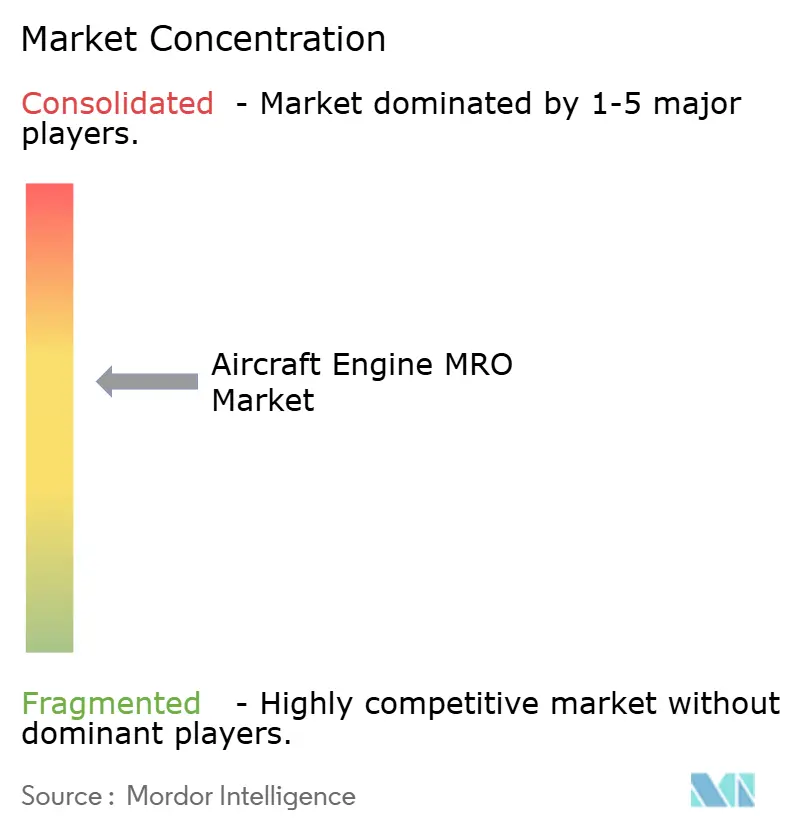
| Market Concentration | Medium |
Major Players *Disclaimer: Major Players sorted in no particular order Image © Mordor Intelligence. Reuse requires attribution under CC BY 4.0. | |
Aircraft Engine MRO Market Analysis by Mordor Intelligence
The aircraft engine mro market size is expected to grow from USD 48.91 billion in 2025 to USD 50.67 billion in 2026 and is forecasted to reach USD 61.66 billion by 2031 at a 4.00% CAGR over 2026-2031. This growth unfolds while operators struggle with powder-metal contamination in Pratt & Whitney GTF disks that lengthens shop visits to 250-300 days. Dust-related turbine-blade erosion on LEAP engines in desert environments has prompted CFM International to develop retrofit durability kits. Spare-engine lease rates have climbed to USD 200,000-350,000 per month, signaling tight capacity and lifting margins for lessors. OEMs defend high aftermarket profitability by restricting access to technical data and tooling, while additive manufacturing can shorten lead times by up to 90% for selected hot-section parts. Digital-twin analytics, led by Rolls-Royce and Airbus, now extend time-on-wing by nearly 50%, cutting unscheduled removals and reshaping competitive dynamics.
Key Report Takeaways
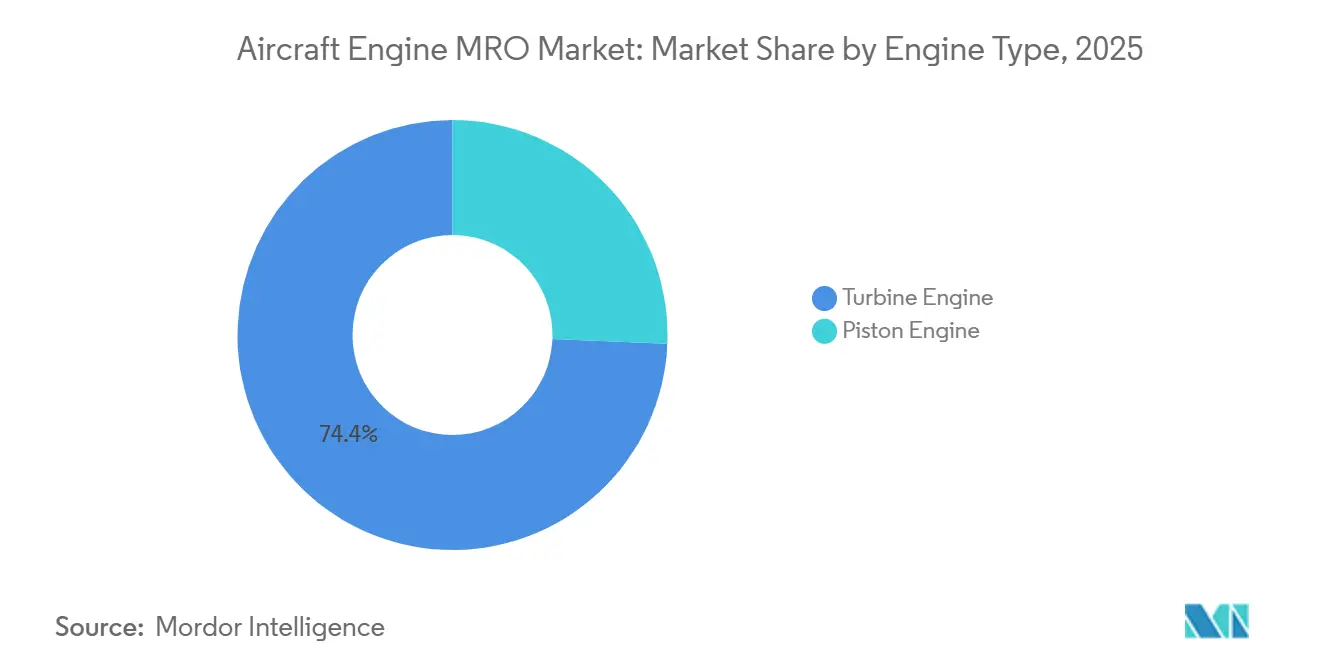
- By engine type, turbine engines accounted for 74.36% of the aircraft engine MRO market share in 2025 and are forecasted to expand at a 5.32% CAGR through 2031.
- By aviation, commercial aviation accounted for 62.67% of spending in 2025, whereas unmanned aerial vehicles are projected to grow at a 7.38% CAGR through 2031.
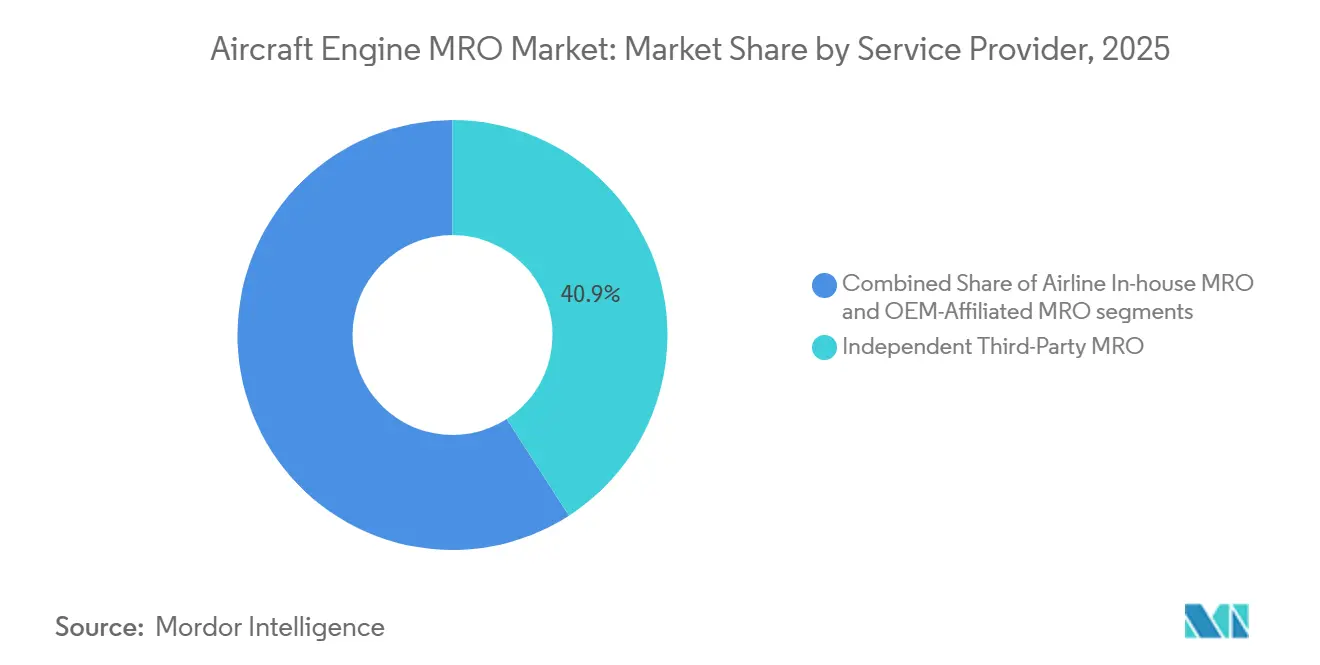
- By service providers, independent MROs accounted for 40.89% of shop visits in 2025; however, OEM-affiliated networks are projected to show the highest CAGR at 5.12% through 2031.
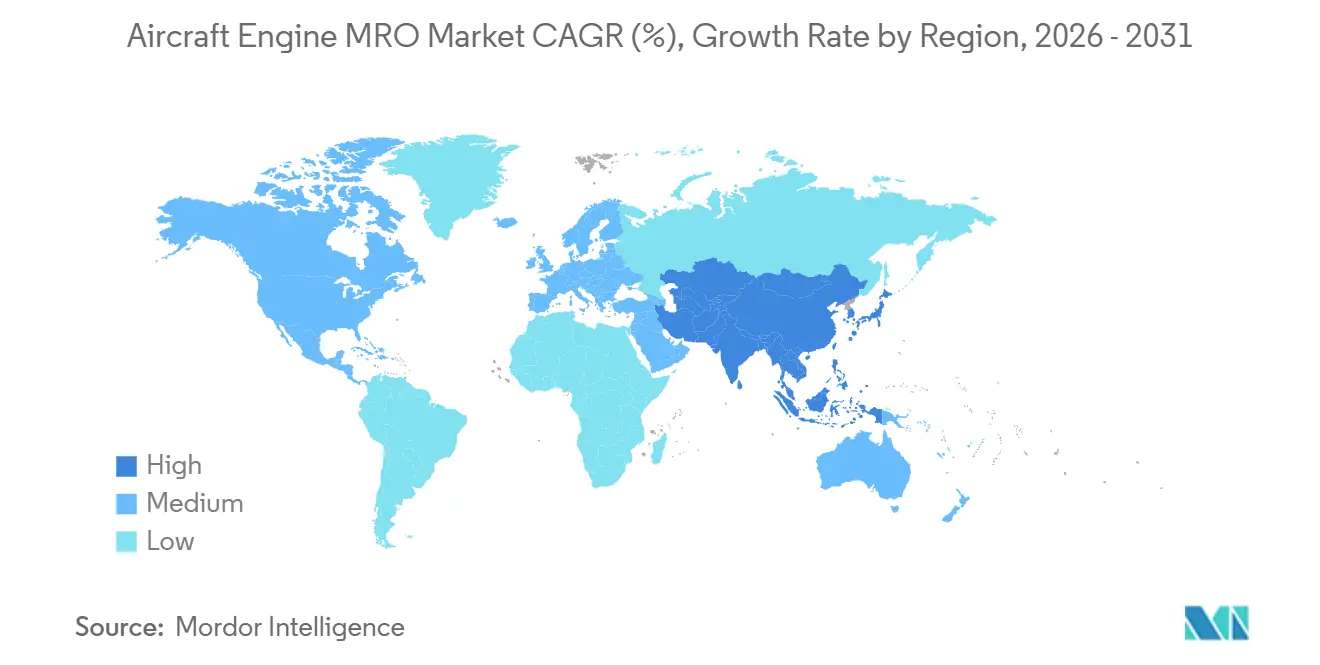
- By geography, the Asia-Pacific region is expected to deliver the fastest regional growth at a 6.65% CAGR, driven by more than USD 600 million in new capacity additions in 2024.
Note: Market size and forecast figures in this report are generated using Mordor Intelligence’s proprietary estimation framework, updated with the latest available data and insights as of January 2026.
Market Trends and Insights
Drivers Impact Analysis of Aircraft Engine MRO Market*
| Driver | (~) % Impact on CAGR Forecast | Geographic Relevance | Impact Timeline |
|---|---|---|---|
| Surging narrow-body fleet growth and high flight-cycle utilization | +1.2% | Global, with concentration in Asia-Pacific and North America | Medium term (2-4 years) |
| OEM-mandated teardowns for LEAP and GTF durability fixes | +0.9% | Global, acute in Middle East, South Asia, North America | Short term (≤ 2 years) |
| Used-serviceable-material scarcity inflating shop-visit pricing | +0.6% | Global, particularly North America and Europe | Medium term (2-4 years) |
| Digital-twin-based predictive maintenance adoption cuts unscheduled removals | +0.5% | North America, Europe, Asia-Pacific hubs | Long term (≥ 4 years) |
| Green-time leasing boom amid engine capacity bottlenecks | +0.4% | Global, led by North America and Europe lessors | Short term (≤ 2 years) |
| 3D-printed hot-section parts slash turnaround time | +0.3% | North America, Europe, select Asia-Pacific facilities | Long term (≥ 4 years) |
| Source: Mordor Intelligence | |||
Surging Narrow-Body Fleet Growth and High Flight-Cycle Utilization
Airbus reported 19,233 A320-family orders, with 7,262 units still undelivered. Notably, 72% of this backlog consists of A321neo variants, which accumulate 3,000-3,500 flight hours per year. Boeing 737 MAX operators in Asia-Pacific and Latin America routinely fly 11-12 block hours daily, shortening first shop-visit intervals on LEAP-1A and -1B engines to 8,000-9,000 cycles. This compression forces MROs to invest in modular tooling and flexible bays that absorb unpredictable surges, as demonstrated by Lufthansa Technik and ST Engineering facilities commissioned in 2024. Certification under FAA and EASA Part 145 remains essential to scale these high-cycle workloads. Consequently, the aircraft engine MRO market increasingly rewards providers that can synchronize manpower, tooling, and parts logistics without extending turnaround times.
OEM-Mandated Teardowns for LEAP and GTF Durability Fixes
Pratt & Whitney’s powder-metal contamination has sidelined more than 1,200 GTF engines, stretching shop visits to 250-300 days and grounding up to 12% of the active fleet. CFM International is simultaneously rolling out ceramic-matrix-composite shrouds and advanced coatings to fight blade erosion in dusty regions, compelling airline budgets to include inspections every 4,000-5,000 cycles.[1] Delta TechOps increased GTF throughput by 30% to 450 annual shop visits after investing USD 50 million in tooling and additional staff. Pratt & Whitney has earmarked USD 3 billion for accelerating parts production and establishing regional repair hubs in Singapore and Poland. This mandatory work injects near-term volume but also heightens dependency on OEM-owned technical data, intensifying competition inside the aircraft engine MRO market.
Used-Serviceable-Material Scarcity Inflating Shop-Visit Pricing
AerFin logged a 50% increase in demand for rotable modules, as aircraft retirements decreased to 400 units in 2024, limiting the feedstock for teardown. Discounts on USM parts narrowed to 70-85% of new-part prices, resulting in reduced savings for airlines. PMA suppliers such as Heico and AAR responded by expanding FAA-approved parts that undercut OEM pricing by up to 40%. OEMs countered by bundling warranty coverage only with genuine parts, locking independents into higher material costs. The outcome is a 15-20% rise in average shop-visit invoices across the aircraft engine MRO market since 2023.
Digital-Twin Predictive Maintenance Adoption Cuts Unscheduled Removals
Rolls-Royce digital-twin algorithms have lengthened time-on-wing by 48% and cut unscheduled downtime by 30% on Trent and Pearl engines.[2] Airbus Skywise aggregates operational data on more than 12,000 aircraft, enabling airlines to benchmark engine health in real-time. A study in the Journal of Air Transport Management found that digital twins reduce unplanned events by 7 hours per 1,000 flight hours, resulting in an annual savings of USD 210,000 per aircraft. OEM-affiliated MROs enjoy privileged access to telemetry that independents lack, creating data asymmetry within the aircraft engine MRO market. Independent providers are responding by recruiting data scientists and entering into direct feed agreements with airline operations centers, although progress remains gradual.
Restraints Impact Analysis of Aircraft Engine MRO Market*
| Restraint | (~) % Impact on CAGR Forecast | Geographic Relevance | Impact Timeline |
|---|---|---|---|
| Chronic global shortage of licensed engine technicians | -0.7% | Global, acute in North America and Europe | Long term (≥ 4 years) |
| Long-lead forgings and castings create prolonged TATs | -0.5% | Global, supply concentrated in North America | Medium term (2-4 years) |
| OEM aftermarket lock-ins squeeze independent MRO margins | -0.4% | Global, particularly impacting independent third-party MROs | Long term (≥ 4 years) |
| Escalating ESG compliance costs for chemical processing | -0.2% | Europe, North America, expanding to Asia-Pacific | Medium term (2-4 years) |
| Source: Mordor Intelligence | |||
Chronic Global Shortage of Licensed Engine Technicians
Boeing forecasts a need for 132,000 new maintenance personnel by 2043, while US retirements reach 14,500 annually against 6,000-8,000 graduates from FAA-approved schools.[3] European data indicate that 20% of mechanics are over 55, with limited cross-border mobility due to EASA Part 66 regulations. Starting salaries of USD 45,000-55,000 trail those of the technology sector, fueling attrition. MROs are automating borescope inspections and AI-assisted defect detection, but regulators still require human sign-offs, capping productivity gains. Labor scarcity, therefore, hinders the growth trajectory of the aircraft engine MRO market.
Long-Lead Forgings and Castings Prolong Turnaround
Titanium compressor disks now require 18-24 months to procure, up from 12-15 months before the pandemic. Nickel-superalloy single-crystal blades need 9-12 months, delaying engine re-delivery. Pratt & Whitney disclosed that forging bottlenecks slow GTF spare-engine deliveries by up to 90 days, and CFM faces similar delays on LEAP parts. GE Aerospace acquired additional forging capacity through a partnership with Arconic, while Rolls-Royce invested £90 million in its Rotherham plant to gain machining headroom. Independents, lacking capital for vertical integration, rely on consignment inventory, which erodes their pricing power within the aircraft engine MRO market.
*Our forecasts treat driver/restraint impacts as directional, not additive. The impact forecasts reflect baseline growth, mix effects, and variable interactions.
Aircraft Engine MRO Market Segment Analysis
By Engine Type:
Turbine Engines Lead a Diverse FleetTurbine engines captured 74.36% of the aircraft engine MRO market share in 2025, with a projected annual growth rate of 5.32% during the forecast period, driven by their widespread use across commercial, military, and business jet fleets. Turbofan families, such as the CFM56, LEAP, Trent, and GEnx, generate the majority of shop visits, supported by high cycle counts on the A320 and 737 fleets. Turboprop demand follows regional aviation use of Pratt & Whitney Canada PT6 powerplants that exceed 400 million flight hours, turboshaft engines power over 20,000 UH-60 and AH-64 helicopters with GE T700 variants, keeping rotorcraft MRO steady.
Piston engines are projected to rise at a moderate CAGR as general aviation and UAV fleets expand; overhauls occur every 500-1,000 hours on delivery drones, bringing new revenue streams. Standardization under ASTM F3201 is expected to streamline the approval process for UAV maintenance. This trend positions niche providers to anchor specialization within the aircraft engine MRO market size for smaller propulsion categories.

By Aviation:
Commercial Dominates While UAVs AccelerateCommercial aviation accounted for 62.67% of 2025 spending, driven by narrow-body engines that face first-run overhauls at 8,000-10,000 cycles. Wide-body overhauls, although less frequent, are more expensive due to the replacement of fan blades and high-pressure turbine modules on GE90, Trent XWB, and GEnx engines.[4] Regional jets comply with updated ICAO Annex 16 noise and emissions limits, sustaining moderate MRO volume.
Military budgets contribute USD 8-9 billion yearly, with the F135 depot network supporting 6,000-hour overhauls on the expanding F-35 fleet. Transport aircraft, such as the C-130J and C-17, operate under performance-based logistics that guarantee availability. UAVs remain the fastest-growing slice of the aircraft engine MRO market, advancing at a 7.38% CAGR through 2031 as defense ministries and logistics firms expand their drone fleets.
By Service Provider:
OEM Networks Extend ControlIndependent MROs accounted for 40.89% of shop visits in 2025 by pricing 10-15% below OEM rates, utilizing PMA parts and DER repairs. Yet OEM-affiliated networks from GE, Rolls-Royce, Pratt & Whitney, and Safran grow at a 5.12% CAGR by leveraging embedded telemetry and warranty bundling. Airline in-house arms such as Delta TechOps and Lufthansa Technik absorb excess capacity, selectively serving third-party customers for margin diversification.
Tooling outlays of USD 5-10 million per engine type, plus annual data fees of USD 50,000-200,000, restrict independent entry into next-generation platforms. Niche expertise in directed-energy deposition blade repairs at AAR or legacy CFM56 overhauls at Magnetic MRO exemplifies the survival strategies employed by independent companies in the aircraft engine MRO market.
Geography Analysis
North America Aircraft Engine MRO Market
North America accounted for 29.91% of 2025 revenues, with mature commercial and military fleets serviced by Delta TechOps, StandardAero, and AAR facilities that manage over 1,000 annual shop visits. Technician shortages, however, push wages higher and limit expansion pace, while proximity to GE, Pratt & Whitney, and Honeywell sustains rapid parts logistics.
APAC Aircraft Engine MRO Market
Asia-Pacific, advancing at a 6.65% CAGR, recorded more than USD 600 million of investment in 2024 alone, including GAMECO’s USD 500 million LEAP and Trent project in China and Pratt & Whitney’s USD 200 million joint venture with Air India.[5] ST Engineering has committed USD 100 million to developing wide-body capability in Singapore, while Rolls-Royce operates a Trent hub there. The regional fleet is forecast to exceed 17,000 aircraft by 2043, reinforcing long-term workload within the aircraft engine MRO market.
EMEA and South America Aircraft Engine MRO Market
Europe’s established players, Lufthansa Technik, Air France-KLM, and SR Technics, continue to expand; Lufthansa Technik has invested USD 150 million in Poland for Trent XWB and GEnx work. Safran doubled LEAP capacity in Morocco, illustrating a southward shift toward cost-competitive labor. The Middle East leverages state backing at Sanad and Turkish Technic to capture regional workloads. South America and Africa remain under-served, forcing operators to ferry engines abroad and inflating logistics costs, an imbalance that signals future white-space within the aircraft engine MRO market.
Regulatory Landscape
Aircraft engine MRO activity is governed by continuing airworthiness and maintenance-organization approvals, with FAA Part 145 and EASA Part 145 as key reference points for certifying shops, tooling, quality systems, and human-factors controls. In 2026, regulators continued to drive shop-visit content and timing through mandated inspections and maintenance program updates, including the FAA Airworthiness Directive 2026-07-06 (effective May 29, 2026) for specified Pratt & Whitney PW100/PW2000 family models requiring angled ultrasonic inspections of critical rotating parts.
In Europe, EASA Airworthiness Directive 2026-0113 (effective June 25, 2026) updated time limits for Rolls-Royce Trent XWB engines and required maintenance programme revisions within a defined compliance window, shaping operator maintenance planning and MRO slot demand. Separately, EASA adopted a modernization package on January 15, 2026, amending Regulations (EU) 748/2012 and (EU) 1321/2014 to update elements of the airworthiness review process, supporting broader digitalization of records and oversight expectations for approved maintenance organizations.
Value Chain Analysis
The aircraft engine MRO value chain starts with OEM design authority and technical data, then moves through operator planning (workscopes, removals, leasing decisions), engine and module logistics, teardown and inspection, parts procurement (new OEM parts, USM, PMA where permitted), repair and reassembly, test-cell runs, certification release, and redelivery. New-generation platforms have tightened upstream dependencies, with OEM-controlled tooling and data, long-lead forgings and castings, and limited material availability constraining turnaround time and capacity utilization. Shop inputs increasingly include digital diagnostics (engine health monitoring and digital twins) that influence induction timing and scope definition.
Parts and labor are the two dominant constraint nodes. USM and alternative repairs (PMA/DER) remain critical for mature engines, and providers have moved closer to the parts channel to protect throughput. For example, Lufthansa Technik expanding direct USM sales to airlines in April 2025 was positioned to mitigate supply constraints. Downstream, test capacity, regulatory release, and lease-engine availability determine how quickly operators can return aircraft to service, with tight spare-engine leasing conditions reinforcing the need for integrated logistics and supply-chain resilience across the MRO value chain.
Competitive Landscape
OEM-affiliated networks collectively manage 35-40% of global shop visits and earn 25-30% operating margins through data exclusivity and proprietary tooling. GE Aerospace expanded MRO sites in Poland and India, Rolls-Royce invested GBP 90 million (USD 120.69 million) in Rotherham machining, and Pratt & Whitney formed a USD 200 million Indian joint venture, strengthening footholds in growth regions.
Independent providers counter with specialization. StandardAero guarantees 120-day turnarounds under performance-based contracts, AAR offers rapid blade repairs, and ST Engineering integrates predictive analytics to offset data gaps. PMA suppliers, such as Heico, penetrate the market at price points 30-40% below OEM parts, exerting downward pressure on material margins. Additive manufacturing reshapes competitive edges; GE has already cut lead times by 90% on selected components, and MTU won EASA approval for 3D-printed blade repairs.
Regulatory compliance under FAA and EASA Part 145 ensures that quality systems scale with volume, serving as a barrier to new entrants. The aircraft engine MRO market, therefore, balances between capital-intensive OEM franchises and agile independents that exploit niche technologies or legacy platforms to sustain their share.
Aircraft Engine MRO Industry Leaders
-
General Electric Company
-
Safran SA
-
Lufthansa Technik AG
-
Rolls-Royce Holdings plc
-
RTX Corporation
- *Disclaimer: Major Players sorted in no particular order
Aircraft Engine MRO Market Companies Covered in this Report
- Lufthansa Technik AG
- General Electric Company
- Rolls-Royce Holdings plc
- RTX Corporation
- Safran SA
- MTU Aero Engines AG
- Delta TechOps (Delta Air Lines, Inc.)
- Air France-KLM Group
- Singapore Technologies Engineering Ltd.
- Hong Kong Aircraft Engineering Company Limited
- StandardAero
- AAR CORP.
- SIA Engineering Company
- Honeywell International Inc.
- Israel Aerospace Industries Ltd.
- Magnetic Group
- Sanad
- SR Technics Switzerland Ltd.
- S7 Technics
- GMF AeroAsia
Market Opportunities and Future Outlook
Capacity build-out for next-generation narrowbody engines is a clear whitespace area as operators manage extended shop visits and constrained slots, particularly for LEAP and Pratt & Whitney GTF workscopes. Recent facility investments indicate where incremental capability is being added. Safran Aircraft Engines inaugurated a new engine maintenance shop in Queretaro, Mexico in July 2026 (USD 140 million), adding LEAP-focused infrastructure that broadens overhaul options in the Americas. Investments in North American LEAP capacity, including MTU Maintenance’s Fort Worth hub expansion, also point to geographically distributed induction points that reduce logistics time for airlines operating high-utilization 737 MAX and A320neo fleets.
An additional opportunity is improving parts access and repair-information flow for third-party providers, which affects turnaround time and pricing in a supply-constrained environment. IATA’s June 24, 2026 call for urgent action on engine MRO bottlenecks, citing durability issues and aftermarket access constraints, highlights the value of programs that accelerate repair approvals, expand pools of serviceable material, and improve data-sharing mechanisms. Providers that combine certified capability (FAA/EASA Part 145), stronger USM channels, and digital inspection and analytics workflows have room to differentiate on cycle time and availability outcomes rather than competing mainly on labor-rate discounts.
Recent Industry Developments in Aircraft Engine MRO Market
- July 2026: Safran opened a new engine maintenance shop in Queretaro, Mexico, strengthening its MRO hub in the Americas with infrastructure spanning CFM56 and CFM LEAP work, including test capabilities and a repair center. The investment expands in-region overhaul capacity for high-cycle narrowbody fleets and supports a more distributed servicing footprint aligned with airline operations and parts logistics.
- March 2026: MTU Aero Engines detailed network actions to ready its MRO footprint for higher-volume next-generation work, including preparations tied to introducing LEAP-1B inductions at its Fort Worth site in mid-2026. The move advances independent capacity for LEAP overhauls and positions the facility to absorb workload as operators contend with constrained slots and extended shop-visit times.
- July 2025: Rolls-Royce and Turkish Technic announced plans to establish an aero-engine maintenance facility, expanding long-term shop capacity for large commercial engines through a new partnership structure. The planned capability build increases regional options for operators and adds competitive pressure on incumbent widebody engine MRO networks by widening the pool of approved service providers.
Aircraft Engine MRO Market Report Scope and Research Methodology
Market Definition and Coverage
This market covers the value of services used to keep aircraft engines airworthy, including scheduled maintenance, repairs, and full overhauls that restore performance and safety for operators.
Scope exclusions: It does not count new engine sales, airframe MRO work, or routine non-engine line tasks that are priced and contracted separately.
Segments Covered in This Report
- By Engine Type
- Turbine Engine
- Turbofan Engine
- Turboprop Engine
- Turboshaft Engine
- Turbojet Engine
- Piston Engine
- Turbine Engine
- By Aviation
- Commercial Aviation
- Narrowbody
- Widebody
- Regional Jets
- Military Aviation
- Combat
- Transport
- Special Mission
- Helicopters
- General Aviation
- Business Jets
- Commercial Helicopters
- Unmanned Aerial Vehicles (UAVs)
- Commercial Aviation
- By Service Providers
- Airline In-house MRO
- Independent Third-Party MRO
- OEM-Affiliated MRO
- By Geography
- North America
- United States
- Canada
- Mexico
- South America
- Brazil
- Rest of South America
- Europe
- United Kingdom
- Germany
- France
- Russia
- Rest of Europe
- Asia-Pacific
- China
- India
- Japan
- South Korea
- Rest of Asia-Pacific
- Middle East and Africa
- Middle East
- United Arab Emirates
- Saudi Arabia
- Rest of Middle East
- Africa
- Egypt
- Rest of Africa
- Middle East
- North America
Data Sources, Market Sizing, and Validation
Desk Research
Desk work starts with public datasets that show fleet size, utilization, and maintenance drivers, which we then translate into service demand for engine shop visits. We typically reference sources such as FAA and EASA airworthiness and safety publications, ICAO traffic statistics, IATA operational indicators, and national civil aviation authority fleet and registration data.
To ground the pricing and event assumptions, we also review materials such as airline annual reports and investor decks, OEM technical notes released publicly, reputable aviation press coverage of shop capacity and turnaround times, and peer reviewed papers on engine reliability and life limited parts. Where needed, we use paid subscriptions for company financials and intelligence, aerospace and aviation databases with aircraft and engine details, and patent databases to cross check platform activity and shop visit intensity. These sources are illustrative only, and many other references are used during collection, validation, and clarification.
Primary Interviews and Surveys
Primary checks are used to confirm shop visit cycles, typical workscopes, and how pricing is moving across engine families, before assumptions are finalized. We spoke with airline and lessor maintenance teams, MRO providers, parts and module specialists, and industry advisors across APAC, EMEA, and the Americas, so the model reflects how contracts and capacity are actually set for engine maintenance.
Distribution of primary research fieldwork respondents
| Company type | Respondent position | Region |
|---|---|---|
| Top tier: 27% | CXOs: 17% | APAC: 46% |
| Mid tier: 54% | Functional/Unit leaders: 32% | EMEA: 33% |
| Smaller Players: 19% | Managers: 51% | Americas: 21% |
Market-Sizing & Forecasting
Sizing is built using a top-down demand pool. We reconstruct global and regional engine populations and utilization trends from fleet and traffic indicators, then translate those into expected shop visits and on-wing events. Once the demand pool is set, we apply blended pricing using observed overhaul rates and parts intensity, keeping the output tied to how MRO is billed across engine shop visits.
The inputs that matter most include active fleet by engine type, average flight hours and cycles, expected time on wing, share of engines entering heavy shop visits in a year, and how LLP replacement and material availability are affecting workscope and turnaround time. When the data is patchy for smaller aircraft categories, gaps are handled with conservative proxy assumptions from similar engine classes, followed by expert checks. We then corroborate the totals with selective bottom-up approximations such as sampled shop visit counts, capacity and bay disclosures, and sampled average revenue per visit, which helps us adjust totals when the first pass looks too high or too low.
For forecasting, we mainly use scenario analysis linked to traffic growth and fleet plans, then refine the curve with a light multivariate regression on utilization and shop capacity signals, since those two factors tend to move MRO demand the most. Assumptions are reviewed with interview feedback, so the forecast stays realistic when supply constraints, not demand, become the limiting factor.
Data Validation & Update Cycle
Validation is done through repeated cross checks against independent signals, including fleet growth, engine delivery trends, and publicly visible maintenance capacity additions. We compare output at global and regional levels, then re-check drivers if a region shows a sudden jump that is not supported by utilization or shop capacity.
Before sign-off, the model and narrative go through multiple analyst reviews, and follow-up calls are triggered when respondents disagree on pricing, workscope mix, or visit intervals. The report is refreshed annually, and interim updates are added when major changes affect utilization, parts availability, or maintenance policy. Right before delivery, a final pass is completed so clients receive the most current view available.
Mordor Intelligence's Aircraft Engine MRO Market Size Measured Against Other Published Estimates
Published market values for aircraft engine MRO do not always match, and the gaps are usually tied to what is counted as an engine MRO event and how pricing is applied across different engine families and operator types.
The table points to a visible spread, and in Mordor Intelligence's model the value is counted only for contracted engine maintenance, repair, and overhaul services. This avoids adding adjacent airframe work or new engine deliveries that can inflate the total. Differences also come from base year choices, how fast material and labor inflation is passed through into shop visit pricing, and whether supply constraints are treated as a cap on near-term throughput. Currency conversion timing and refresh cadence matter too, since MRO pricing and turnaround times can change quickly when parts shortages ease or when capacity expands.
Benchmark comparison
| Source | Market Size | Gaps in Research Methodology |
|---|---|---|
| Mordor Intelligence | USD 50.67 B (2026) | |
| Global Consultancy A | USD 49.12 B (2026) | Uses a different base build and pricing ladder across engine types, and may apply a more conservative assumption on shop visit workscope intensity and billable material content in 2026. |
| Industry Publisher B | USD 46.92 B (2025) | Anchors the estimate on a 2025 base year, and the scope can vary by including fewer provider types or using slower pass-through of labor and parts inflation, which reduces the measured value. |
Reading the three figures together, the key message is that scope boundaries and the shop visit pricing logic drive most of the gap, not just the CAGR. By keeping the demand pool tied to fleet utilization and visit intervals, and then stress-testing it with capacity and pricing checks, we end up with a balanced number that is easy to trace back to clear drivers and to update when conditions change.
Key Questions Answered in the Report
How large will the aircraft engine MRO market be by 2031?
It is expected to reach USD 61.66 billion by 2031 on a 4.00% CAGR trajectory.
Which engine type draws the most maintenance spending?
Turbine engines hold 74.36% of 2025 value, reflecting their use across commercial, military, and business-jet fleets.
Why are spare-engine lease rates so high in 2026?
Extended shop-visit times for GTF and LEAP engines have driven monthly lease prices to USD 200,000-350,000 as operators secure additional coverage.
Which region is expanding maintenance capacity fastest?
Asia-Pacific leads with a 6.65% CAGR and more than USD 600 million invested in new facilities during 2024.
How is additive manufacturing changing overhaul economics?
How is additive manufacturing changing overhaul economics?