
Africa Bitumen Market Size and Share
Market Overview
| Study Period | 2021 - 2031 |
|---|---|
| Forecast Data Period | 2026 - 2031 |
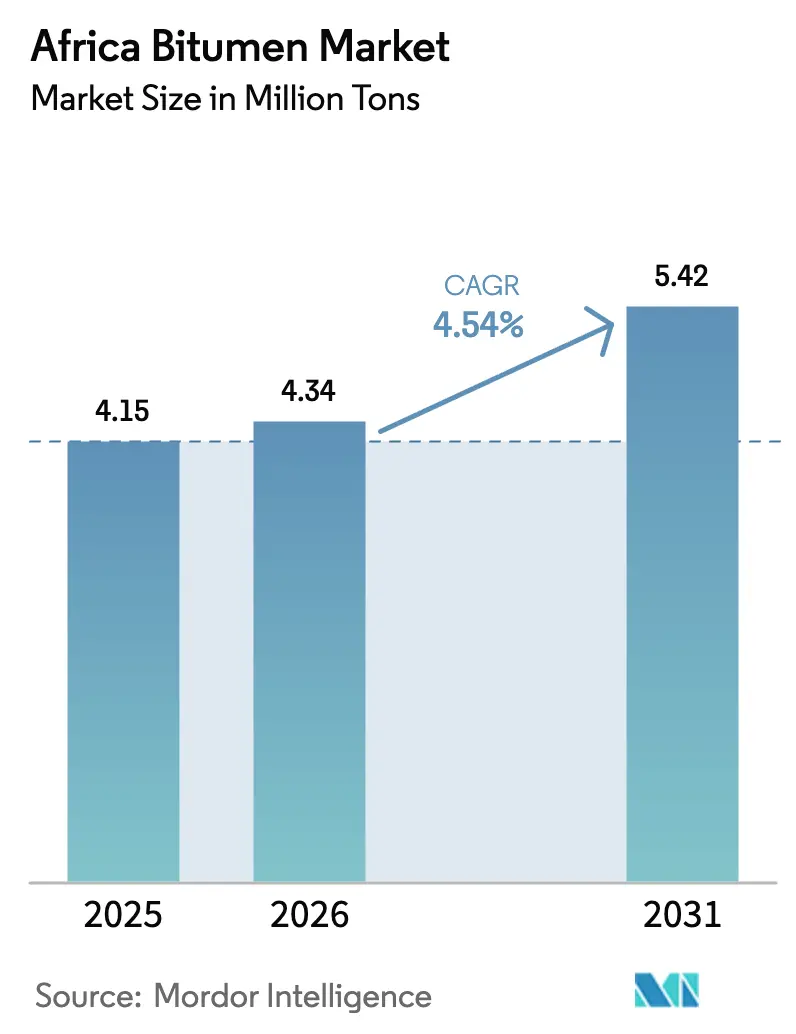
| Base Year Market Size (2025) | 4.15 Million tons |
| Market Volume (2026) | 4.34 Million tons |
| Market Volume (2031) | 5.42 Million tons |
| Growth Rate (2026 - 2031) | 4.54 % |
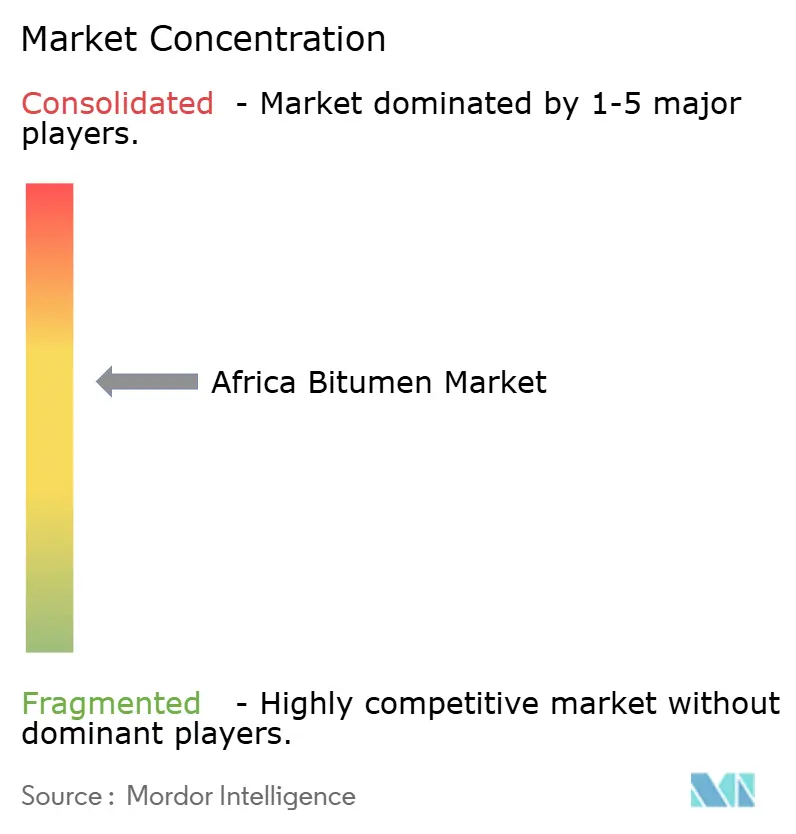
| Market Concentration | Medium |
Major Players *Disclaimer: Major Players sorted in no particular order Image © Mordor Intelligence. Reuse requires attribution under CC BY 4.0. | |
Africa Bitumen Market Analysis by Mordor Intelligence
The Africa Bitumen Market size is expected to grow from 4.15 Million tons in 2025 to 4.34 Million tons in 2026 and is forecast to reach 5.42 Million tons by 2031 at 4.54% CAGR over 2026-2031.The combination of rapid urban population growth, record public-sector spending on roads, and a gradual pivot toward specialty binders positions the Africa bitumen market for lengthy expansion even as sovereign balance sheets tighten. Polymer-modified and emulsified grades are capturing procurement share because performance-based specifications now dominate large contracts, while cost-inflating carbon rules force refiners to innovate their feedstock slates. Strategic opportunities arise where governments require longer-lasting pavements, where private developers standardize waterproofing membranes, and where indigenous ore-grade bitumen deposits promise import substitution. Competitive intensity is fragmenting as international oil majors sell refining stakes, inviting local blenders to integrate storage terminals with on-site modification units to shorten lead times and lift margins. Downside risk remains tethered to crude-oil price spikes, tighter greenhouse-gas caps, and concrete or block-paver substitution on high-visibility urban arterials.
Key Report Takeaways
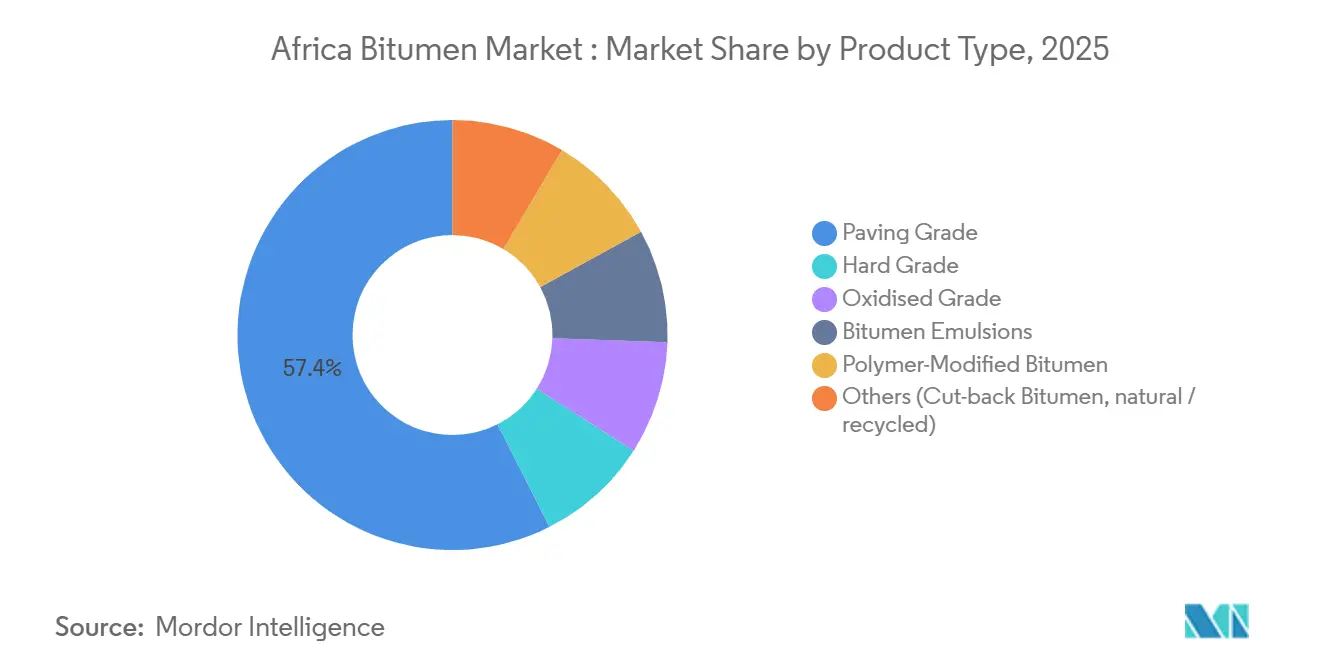
- By product type, paving-grade captured 57.45% of Africa bitumen market share in 2025 and polymer-modified grades are advancing at a 7.12% CAGR, the fastest rate through 2031.
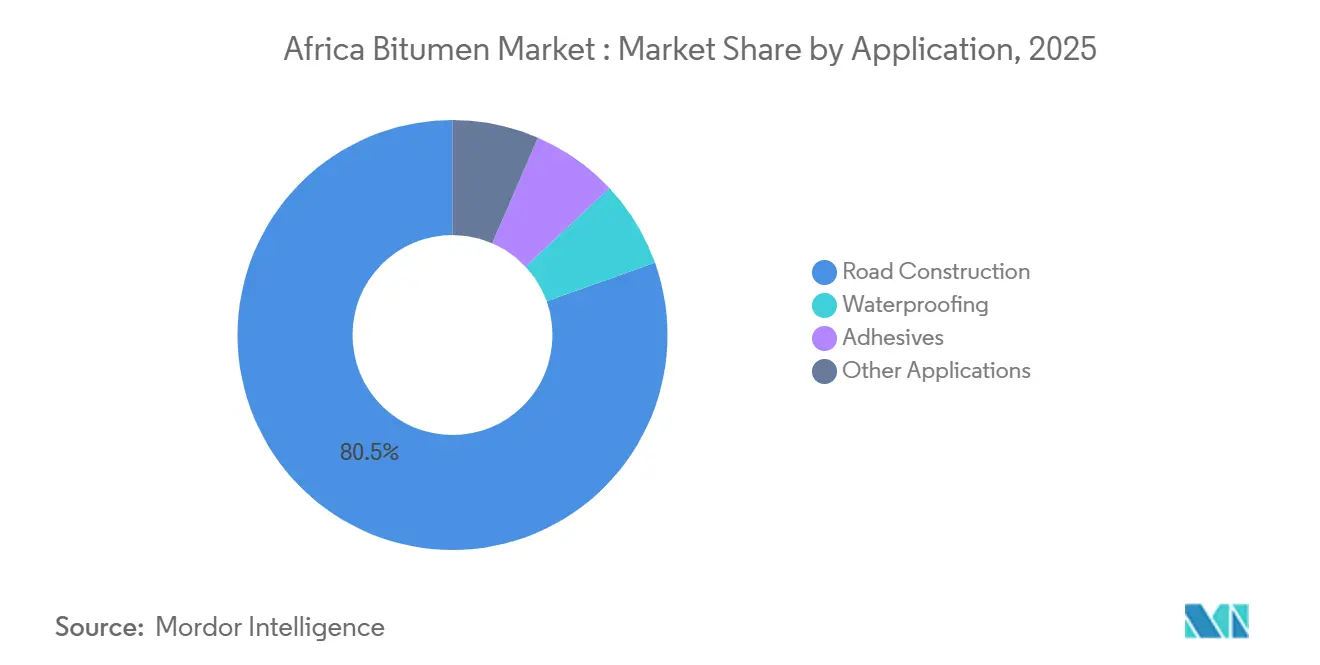
- By application, road construction held 80.47% of Africa bitumen market size in 2025, while other applications are poised for a 6.83% CAGR to 2031.
- By geography, South Africa led with 25.29% of 2025 volume, while Nigeria is poised for a 6.36% CAGR to 2031.
Note: Market size and forecast figures in this report are generated using Mordor Intelligence’s proprietary estimation framework, updated with the latest available data and insights as of January 2026.
Africa contributes to a system defined not by any single geography but by the interaction of many. The global bitumen market data by Mordor Intelligence represents that combined structure.
Market Trends and Insights
Drivers Impact Analysis of Africa Bitumen Market *
| Driver | (~) % Impact on CAGR Forecast | Geographic Relevance | Impact Timeline |
|---|---|---|---|
| Growing Government-Funded Road-Network Expansion | +1.8% | Nigeria, Kenya, Egypt, Algeria, Morocco | Medium term (2-4 years) |
| Accelerating Demand for Waterproofing and Roofing Membranes | +0.6% | South Africa, Nigeria, Egypt, Kenya | Long term (≥ 4 years) |
| Rapid Adoption of Polymer-Modified and Emulsified Bitumen | +1.2% | South Africa, Kenya, Ghana, Ethiopia | Medium term (2-4 years) |
| Urbanization-Led Road Maintenance and Rehabilitation Spend | +0.7% | Global, with early gains in Lagos, Nairobi, Johannesburg | Long term (≥ 4 years) |
| Commercialization of Nigeria's Native Bitumen Reserves | +0.3% | National, concentrated in Ondo, Ogun, Edo States | Long term (≥ 4 years) |
| Source: Mordor Intelligence | |||
Growing Government-Funded Road-Network Expansion
Between 2024 and 2026, African sovereigns earmarked more than USD 25 billion for strategic highway corridors, a fiscal commitment that elevates the addressable volume for the Africa bitumen market. Nigeria’s Lagos–Calabar coastal highway alone is budgeted at USD 2 billion and will consume roughly 180,000 tons of polymer-modified binder annually before commissioning in 2029. Kenya secured USD 3.6 billion in blended finance for the 440-kilometer Usahihi Expressway, unlocking a 2026 ground-breaking that embeds warm-mix-asphalt clauses into bid documents. Algeria’s Chiffa–Berrouaghia stretch of the North-South highway, opened in July 2025, demonstrated how Belt and Road Initiative capital prefers asphalt over concrete in hot, arid micro-climates. Morocco’s Guercif–Nador link received a EUR 246 million African Development Bank loan, ensuring freight traffic from the Nador West Med port will ride on performance-graded asphalt by 2028. Because multilateral lenders now require lifecycle-cost models, most engineering contracts justify premium polymer-modified overlays that double pavement life, adding structural demand even where headline budgets stay flat.
Accelerating Demand for Waterproofing and Roofing Membranes
Sub-Saharan cities are adding residents at 3.5% per year, propelling a surge in mid-rise concrete structures that specify atactic-polypropylene (APP) or styrene-butadiene-styrene (SBS) membranes over outdated tar-paper. The South African Council for Scientific and Industrial Research reported in 2024 that nano-modified emulsions lower rooftop surface temperatures by up to 18%, prompting Johannesburg developers to standardize reflective coatings that extend roof life from 10 to 25 years. Nigeria’s real-estate sector grew 6.2% in 2024, and builders in Lagos now specify self-adhesive membranes capable of resisting saline groundwater, a chronic problem on reclaimed land. Kenya’s 2025 building code mandates waterproofing for any structure exceeding three stories, automatically granting bitumen membrane suppliers a captive urban client base. Because waterproofing revenue is relatively immune to public-budget cycles, refiners that diversify into membranes cushion volatility when highway allocations are delayed.
Rapid Adoption of Polymer-Modified and Emulsified Bitumen
Polymer-modified grades are expanding at a 7.12% CAGR, outpacing the broad Africa bitumen market by 258 basis points. South Africa’s Sabita Manual 35, revised in 2024, requires SBS or EVA modification for routes exceeding 3 million equivalent standard axles, automatically reserving 40% of national-route tonnage for high-value binders. Ghana’s GOIL-SMB venture brought a USD 40 million plant online in September 2024, giving West Africa a 7,500-ton storage hub with in-line dosing that cuts regional trucking costs 15%. Ethiopia tendered 12 performance-based contracts that specify polymer-modified binders for high-altitude frost zones, a specification shift that alone adds 22,000 tons of incremental demand by 2028. Sasol’s SASOBIT additive enables warm-mix asphalt at 120-140 °C, lowering carbon output 30% and keeping paving crews active during Highveld winter nights, a productivity bonus that most agencies price into bid assessments.
Urbanization-Led Road Maintenance and Rehabilitation Spend
African megacities spend an increasing share of transport budgets on resurfacing and rehabilitation rather than new alignments, a pivot that boosts emulsified and polymer-modified grades. Lagos, Nairobi, and Johannesburg each recorded more than 4,000 pothole complaints in 2025, forcing municipal engineers to adopt micro-surfacing treatments that extend service life 5–7 years at one-third the overlay cost. Cold-in-place recycling with cationic emulsions now dominates Johannesburg’s winter maintenance schedule, lifting demand for rapid-setting products that were niche five years earlier. In Nairobi, Bus Rapid Transit lanes receive SBS chip seals to prevent rutting under articulated buses, further expanding the specialty-binder footprint. The maintenance-led model reinjects steady volume into the Africa bitumen market even when macro headwinds curb capital budgets for greenfield expressways.
Restraints Impact Analysis of Africa Bitumen Market *
| Restraint | (~) % Impact on CAGR Forecast | Geographic Relevance | Impact Timeline |
|---|---|---|---|
| Tightening VOC / GHG Emission Regulations | -0.5% | South Africa, Kenya, Egypt | Short term (≤ 2 years) |
| Concrete and Block-Paving Substitution in Urban Arterials | -0.3% | Ghana, Kenya, Nigeria (urban centers) | Medium term (2-4 years) |
| Crude Oil Price Volatility Inflating Feedstock Costs | -0.4% | Global, acute in import-dependent markets (Ghana, Kenya, Tanzania) | Short term (≤ 2 years) |
| Source: Mordor Intelligence | |||
Tightening VOC / GHG Emission Regulations
South Africa’s Climate Change Act imposes a carbon-budget system that forces asphalt producers to trim plant-level emissions 2–3% annually until 2030, a rule that directly inflates production costs for penetration-grade bitumen[1]South African Department of Forestry, Fisheries and the Environment, “Climate Change Act 2024,” dffe.gov.za . The Carbon Tax Act further levies ZAR 190 per ton CO₂e, calculated at 3.15 tons CO₂e per ton of bitumen, and the rate escalates at inflation plus 2% every April. Kenya’s National Environment Management Authority capped stack VOCs at 50 mg/m³ in 2025, triggering retrofit bills topping USD 500,000 for every plant in Nairobi’s industrial belt. Egypt’s environment ministry now requires continuous emissions monitors on every distillation column producing bitumen, effectively sidelining small private refiners that cannot justify USD 1 million of compliance gear. The resulting compliance arbitrage encourages blenders to relocate to Mozambique and Tanzania, then back-haul finished product into regulated markets, fragmenting supply chains and undermining in-country investment.
Concrete and Block-Paving Substitution in Urban Arterials
Ghanaian engineers documented in 2024 that interlocking concrete pavers cut lifecycle costs by up to 20% on steep city arteries where asphalt rutting accelerates during monsoon seasons. Kenya’s cost manual pegs installed concrete blocks at KES 1,200 per m² versus KES 1,350 for warm-mix asphalt adjusted for recent bitumen spikes, a saving that has already converted 12 roundabouts in Nairobi’s CBD. Lagos State Public Works piloted permeable pavers on 8 km of secondary roads, slashing storm-runoff 40% and eliminating repetitive crack sealing - a result that garners political favor in flood-prone suburbs. While rural corridors favor bitumen’s rapid construction speed, urban show-case projects shape engineer preferences, risking erosion of bitumen’s brand equity where public scrutiny is highest.
*Our forecasts treat driver/restraint impacts as directional, not additive. The impact forecasts reflect baseline growth, mix effects, and variable interactions.
Africa Bitumen Market Segment Analysis
By Product Type:
Specialty Grades Capture Margin PremiumPaving-grade binder retained 57.45% Africa bitumen market share in 2025, satisfying lowest-cost bids on long-haul highways across Algeria, Egypt, and Tanzania. Yet polymer-modified grades are registering a 7.12% CAGR, redefining specifications for corridors in South Africa and Kenya. Emulsions are climbing steadily because cationic surface dressing extends pavement life five years for one-third of overlay cost. Oxidized-grade demand tracks roofing cycles in Nigeria and Egypt, while hard-grade remains a niche used in pipe coating. Sasol’s lignin-enhanced bio-binder trial, swapping 15% of bitumen for bagasse derivatives, hints at future blends that satisfy carbon levies without sacrificing rut resistance.
Price realization differs markedly: paving-grade trades at vacuum-residue parity; polymer-modified grades fetch premiums of USD 140–180 per ton; emulsions deliver USD 110 margins when sold with turnkey micro-surfacing service contracts. Because carbon taxes apply per ton of binder, specialty grades amortize levies over longer pavement cycles, giving polymer-modified suppliers pricing power even when crude swings. Investors gauge project returns not only on throughput but also on additive-line optionality; Tema’s new 7,500-ton storage hub illustrates how in-line dosing can pivot between SBS and EVA modifiers in under an hour, maximizing asset utilization.


By Application:
Maintenance Spend Diversifies RevenueRoad construction absorbed 80.47% of 2025 demand, buoyed by the 1.2 million-ton combined requirement of Nigeria’s coastal highway, Kenya’s Usahihi Expressway, and Algeria’s trans-Atlas segments. Yet other applications collectively clock a 6.83% CAGR, outpacing greenfield alignments. Surface-dressing programs in Ghana, Sierra Leone, and Côte d’Ivoire prefer emulsified binders because they can heal cracked pavements in dry seasons when hot-mix plants sit idle. Automotive hot-melt adhesives remain niche but lucrative: tier-one suppliers to South Africa’s BMW and Ford plants buy stabilized oxidized bitumen at twice paving-grade margins.
Fiscal austerity elevates maintenance budgets because low-traffic rural roads can be rejuvenated for USD 35,000 per km using slurry seals versus USD 140,000 for full-depth reconstruction, making emulsified products politically attractive during election cycles. As a result, specialty blenders hedge volatility by courting both highway-agency tenders and property-developer orders, an operational model that smooths revenue cycles and encourages investment in dual-purpose storage tanks and small-batch reactors.
Geography Analysis
South Africa and Nigeria Bitumen Market
South Africa contributed 25.29% of overall 2025 volume, anchored by SANRAL’s predictable tender calendar and by Sasol-operated Natref’s on-spec output despite a January 2025 distillation-unit fire that squeezed short-term supply. Imports filled the gap, climbing to 200,000 tons in 2024 and eroding coastal price discounts. Nigeria’s 6.36% CAGR positions it as the growth engine of the Africa bitumen market; the Lagos–Calabar highway alone demands 180,000 tons annually, while planned mining of native deposits promises to displace 50% of imports by 2030.
North Africa Bitumen Market
Egypt’s National Road Project, bankrolled at EGP 175 billion, already added 7,000 km of lanes and continues to specify 50/70 penetration grade except on Cairo ring-road ramps where polymer-modified dictates dowel-bar retrofits. Algeria’s July 2025 opening of the 53-km Chiffa–Berrouaghia section consumed a large amount of paving-grade, confirming Belt and Road contractors’ preference for bitumen in arid corridors. Morocco’s Guercif–Nador link will finalize the trans-Maghreb corridor, cementing an asphalt route from Tunis to Casablanca by 2028.
East Africa Bitumen Market
East Africa commands a smaller but accelerating share. Kenya’s USD 3.6 billion Usahihi Expressway, financed in May 2025, aligns moderate polymer-modified demand with a 36-month build window. Ethiopia’s ETB 3 trillion transport plan intends to boost the paved network from 144,000 km to 246,000 km, of which at least 25% requires polymer-modified binder for high-altitude freeze-thaw cycles. Tanzania’s infrastructure diversification, showcased by the Standard Gauge Railway and the Julius Nyerere hydro project, siphons budget share away from roads, explaining subdued bitumen imports relative to peers.
West and Central Africa Bitumen Market
West Africa’s supply chain is redrawing itself around new coastal terminals. Ghana’s Tema plant exports emulsions and PMB across ECOWAS in ISO tanks, trimming voyage times to Abidjan to under 16 hours. Cameroon’s All Bitumen refinery, under construction in Kribi, will add 250,000 tons of annual capacity, reducing landed costs in landlocked Chad by an expected 30% once trucking corridors are synchronized with rail extensions.
The bitumen market is analyzed by Mordor Intelligence across multiple other geographies, with in-depth regional assessments available for Asia and Europe.
Regulatory Landscape
Regulation is tightening around both product quality and emissions, shifting procurement toward higher-spec binders and more formal oversight of import and distribution. In South Africa, the 2024 Climate Change Act and the Carbon Tax Act add recurring compliance and cost pressure on bitumen production, which supports procurement of warm-mix and other lower-temperature paving solutions. Kenya also capped stack VOCs at 50 mg/m3 in 2025, lifting the compliance bar for plants concentrated around major urban and industrial belts.
In 2026, Ghana moved toward more structured downstream governance when the National Petroleum Authority (NPA) inaugurated a 16-member Bitumen Technical Committee to develop a dedicated framework covering importation, storage, distribution, and quality assurance. The committee includes participation from bodies such as the Ghana Standards Authority and Ghana Highways Authority. In parallel, industrial policy is being used to stimulate local supply, exemplified by Cameroons 2026 Finance Law measures that provide customs and VAT exemptions (and a reduced 5% customs duty on certain inputs) to support domestic bitumen production linked to the Kribi project. This complements the regions continued reliance on international standards such as ASTM and AASHTO, where local specifications remain unevenly enforced.
Value Chain Analysis
Africas bitumen value chain typically starts with vacuum residue production at local refineries and imported cargoes, often sourced from the Middle East and Mediterranean supply basins. The material then moves through bulk storage at coastal terminals and inland hauling before being converted downstream into paving binders, emulsions, and polymer-modified grades through blending and in-line dosing units. Contractors and road agencies drive demand through tender cycles, and performance-based specifications increasingly pull forward higher-value binders. Specialty additives for PMB and warm-mix asphalt add a higher-margin input layer and can be bundled with paving services.
Logistics and compliance are decisive cost drivers. Shipping disruptions on key supply routes have raised delivered-cost volatility for import-dependent markets and extend lead times for ports such as Mombasa and Dar es Salaam. At the same time, tighter VOC and emissions-monitoring rules increase operating complexity for producers and blenders in regulated hubs. The chain is also moving toward localized production and regional hubs to reduce import exposure, with initiatives such as All Bitumen Cameroons Kribi project (backed by a refining license in April 2026) and West Africas storage and modification build-out anchored by the Tema hub, which shortens order-to-dispatch cycles for ECOWAS cross-border supply.
Competitive Landscape
Africa hosts a moderately fragmented supplier matrix. TotalEnergies, Shell, and BP managed 32% of 2025 refining throughput, but repeated divestments are shrinking their footprint. TotalEnergies sold its 50% Natref stake and exited Côte d’Ivoire’s SIR in 2024, yet expanded its branded-station network to 4,520 outlets across 30 countries to monetize non-fuel retail and lubricants[2]TotalEnergies SE, “Annual Report 2024,” totalenergies.com . Shell exited onshore SPDC assets in Nigeria in March 2025, freeing capital for LNG and lubricants, leaving local terminals to import finished binder.
Regional challengers exploit the vacuum. GOIL-SMB’s USD 40 million Tema hub co-locates import jetty, polymer-mod lines, and ISO-tank loading, slicing logistics costs 15% and granting West African contractors 48-hour order-to-dispatch cycles. All Bitumen Cameroon’s CFA 161 billion Kribi refinery will supply 250,000 tons per year, coupling a 10,000-bpd mini-refinery with PMB reactors to feed Central and landlocked Sahel demand. Sasol controls the warm-mix niche via SASOBIT additive, bundling chemical supply with design-build paving contracts that lock in downstream binder volume.
Innovation hotspots center on bio-binders and rubber-crumb. South Africa’s CSIR tests showed 15% lignin substitution cut carbon intensity 22% without rutting degradation, aligning with pending Scope 3 reporting rules. Kenyan startups blend tire-derived rubber into 70/100 penetration binder, achieving 25% lifecycle-cost gains on Nairobi’s freight corridors. These novel blends fit under carbon-tax exemptions for recycled content, hinting at competitive upside for first-movers.
Africa Bitumen Industry Leaders
Exxon Mobil Corporation
Shell plc
TotalEnergies
BP p.l.c.
THE Bouygues group
- *Disclaimer: Major Players sorted in no particular order
Africa Bitumen Market Companies Covered in this Report
- All bitumen Cameroon
- Asphalt and Bitumen West Co.
- BP p.l.c.
- Exxon Mobil Corporation
- GOIL Plc
- HOLCIM
- Indian Oil Corporation Ltd
- Kraton Corporation
- Marathon Petroleum Corporation
- Nynas AB
- RAHA Bitumen, Inc.
- Richmond Group (Nigeria)
- Rubis Asphalt
- Sasol
- Shell plc
- Suncor Energy Inc.
- Tekfalt Binders (Pty) Ltd
- THE Bouygues group
- Tiger Bitumen
- TotalEnergies
- Wabeco Petroleum Ltd

Market Opportunities and Future Outlook
Opportunities center on reducing reliance on volatile long-haul imports by regionalizing supply, and on expanding specialty binders tied to performance-based procurement. Cameroons import-substitution push around the Kribi bitumen plant highlights a whitespace for domestic production and integrated terminal-plus-modification models, supported by policy measures in 2026 through customs and VAT incentives and a refining license granted to progress the project. In West Africa, the operationalization of the GOIL-SMB Tema hub, including storage, lab testing, emulsions, and multiple grades, highlights the commercial value of fast-turnaround supply, ISO-tank exports, and on-site dosing for SBS and EVA modification.
A second opportunity set is linked to specification upgrades and non-road applications that diversify demand beyond capital-budget road programs. South Africas Sabita Manual 35 revision in 2024 and Kenyas building-code waterproofing requirement for structures above three stories in 2025 support higher-value polymer-modified binders and membrane-grade bitumen, while municipal maintenance practices such as micro-surfacing and cold-in-place recycling increase emulsions consumption in large cities. Finally, tightening carbon and VOC requirements create demand pull for warm-mix asphalt and recycled-content solutions, including rubber-crumb and partial bio-binder substitution, where agencies and contractors can document lifecycle and emissions benefits alongside pavement durability.
Recent Industry Developments in Africa Bitumen Market
- April 2026: All Bitumen Cameroon Plc receives a Cameroon government grant of refining license and customs exemptions to support Kribi bitumen plant project. The move expands regional supply capacity for bitumen and supports local production. It helps de-risk regional road-construction supply chains by substituting imports.
- February 2026: Good News Africa Sarl signs a public-private partnership contract with Office des routes to pave 258 km of National Road No. 27 under a 25-year BOT model in DR Congo. The contract creates new regional bitumen demand and a PPP-led project pipeline. It strengthens regional asphalt market exposure and potential for on-site supply integration.
- January 2026: Shengli Engineering Construction (Group) Company Limited is awarded Sh4.06 billion contract by Kenya National Highways Authority to upgrade Uplands Githunguri Ruiru road with bitumen surfacing. The award signals active bitumen infrastructure expansion in East Africa. It creates opportunities for local modification capacity.


Africa Bitumen Market Report Scope and Research Methodology
Market Definition and Coverage
For this study, the market covers bitumen supplied and consumed across Africa for paving and other industrial uses, measured in tons. It includes conventional and modified grades that are produced locally or imported and then sold into end-use demand.
Scope exclusions: We exclude crude oil, refinery feedstocks, and finished downstream products where bitumen is only a minor input (for example, pre-made waterproofing membranes).
Segments Covered in This Report
- By Product Type
- Paving Grade
- Hard Grade
- Oxidised Grade
- Bitumen Emulsions
- Polymer-Modified Bitumen
- Others (Cut-back Bitumen, natural / recycled)
- By Application
- Road Construction
- Waterproofing
- Adhesives
- Other Applications (Road Maintenance and Rehabilitation, Industrial Coatings, etc.)
- By Geography
- South Africa
- Nigeria
- Egypt
- Algeria
- Morocco
- Kenya
- Ghana
- Ethiopia
- Tanzania
- Côte d’Ivoire
- Rest of Africa
Data Sources, Market Sizing, and Validation
Desk Research
Desk work starts with building a clean view of supply, trade, and road construction activity that can be checked country by country. We relied on public sources such as national statistics offices, customs and trade releases, energy or petroleum regulator publications, and road agency budget documents, which help anchor demand drivers to the actual infrastructure plans.
We then cross-checked directionally using sources such as World Bank and IMF macro series, UN Comtrade-style trade statistics, and technical publications from standards bodies and journals that discuss paving mixes and binder usage. For company context, we reviewed annual reports, investor presentations, and credible press coverage. We also used paid subscriptions for company financials and intelligence, shipment-level import and export visibility, and patent databases to confirm product positioning. This list is illustrative only, and we used many other references to collect data, validate assumptions, and clarify gaps.
Primary Interviews and Surveys
Primary work focused on validating what drives tonnage in each major market, and why volumes can swing due to project timing and import logistics. We spoke with a mix of producers, importers, distributors, contractors, and procurement stakeholders, and we used their input to test binder consumption norms, seasonal delivery constraints, and realistic price and grade mix assumptions across Africa.
Distribution of primary research fieldwork respondents
| Company type | Respondent position |
|---|---|
| Top tier: 31% | CXOs: 13% |
| Mid tier: 54% | Functional/Unit leaders: 41% |
| Smaller Players: 15% | Managers: 46% |
Market-Sizing & Forecasting
The sizing logic was built by reconstructing demand from road building and maintenance activity and then mapping that to binder needs, which is the top-down view used for this market. We converted road program signals into bitumen tonnage using practical consumption factors, then adjusted results using import patterns and local refinery supply where it is relevant.
To keep outputs realistic, we corroborated totals with selective bottom-up checks, such as sampled supplier volumes in key corridors, distributor channel checks, and simple ASP times volume tests where pricing references were available. The model uses inputs like paved road additions and rehabilitation spend, asphalt mix intensity in major projects, import arrivals and storage constraints at ports, refinery throughput and product slate changes, and the share of polymer-modified or emulsion usage in priority climates. For forecasting, we used scenario analysis because project pipelines, public budgets, and currency conditions can shift quickly. We refined scenarios based on what interviewees expect for tender flow and execution pace. Where bottom-up visibility was thin in smaller countries, we filled gaps with proxy indicators tied to road budgets and import dependency, then normalized the result to avoid unrealistic jumps year to year.
Data Validation & Update Cycle
Validation is done through multiple checks so the final tonnage aligns with independent signals. We compare outputs with trade flows, known refinery supply capacity, and the direction of public road spending, then we investigate outliers such as abrupt growth that is not supported by pipeline or import constraints.
Before sign-off, assumptions are reviewed in steps, and follow-up calls are triggered when a country result conflicts with what suppliers or contractors report. Reports are refreshed annually, and interim updates are made when material events occur, such as major tender delays, refinery shutdowns, or policy-driven shifts in import duties. Prior to delivery, an analyst performs a final pass to ensure the newest available data is reflected in the narrative and model.
Mordor Intelligence's Africa Bitumen Market Size Measured Against Other Published Estimates
Published market sizes for Africa bitumen often look different because the scope and the unit of measurement are not always aligned across sources, and the assumed price progression can also vary. Differences also come from how each study treats imports versus local production, and whether it ties demand to actual road execution or to announced plans.
The biggest gap driver is unit choice and scope overlap. Mordor Intelligence reports the market in tons and keeps the count to bitumen binders supplied into Africa, while some other figures shift into revenue terms and may blend Middle East and Africa into one total, or apply broad price assumptions that are not checked against trade reality.
Benchmark comparison
| Source | Market Size | Gaps in Research Methodology |
|---|---|---|
| Mordor Intelligence | USD 4.15 M (2025) | |
| Trade Journal A | USD 0.75 B (2028) | Reported in revenue, not tons, and the estimate depends heavily on implied pricing and grade mix, which can drift if import costs, currency timing, or project delays are not refreshed. |
| Global Consultancy B | USD 6.12 B (2024) | Uses a combined Middle East and Africa scope, so the total is not directly comparable to Africa-only demand, and the value-based framing can inflate differences when regional ASP assumptions are generalized. |
Taken together, the spread mainly reflects how studies set geography, whether they size in volume or value, and how carefully prices and demand signals are kept in sync with imports, refinery supply, and road execution. Our approach stays traceable because each country total can be walked back to clear demand drivers and cross-checks, which makes updates easier when budgets or project timing shift.


Key Questions Answered in the Report
What is the projected size of the Africa bitumen market in 2031?
Volume is forecast to reach 5.42 million tons by 2031, up from 4.34 million tons in 2026.
Which product type is expanding the quickest across the region?
Polymer-modified grades are advancing at a 7.12% CAGR, the fastest rate among all binders through 2031.
How much share did paving-grade bitumen command in 2025?
Paving-grade held 57.45% of total volume in 2025.
Why is Nigeria seen as the fastest-growing geography for bitumen demand?
The Lagos–Calabar coastal highway and planned mining of 42 billion tons of native reserves are driving a 6.36% CAGR through 2031.
Page last updated on:


 Your data is secure and never sold or shared.


