
Europe Bitumen Market Size and Share
Market Overview
| Study Period | 2020 - 2031 |
|---|---|
| Forecast Data Period | 2026 - 2031 |
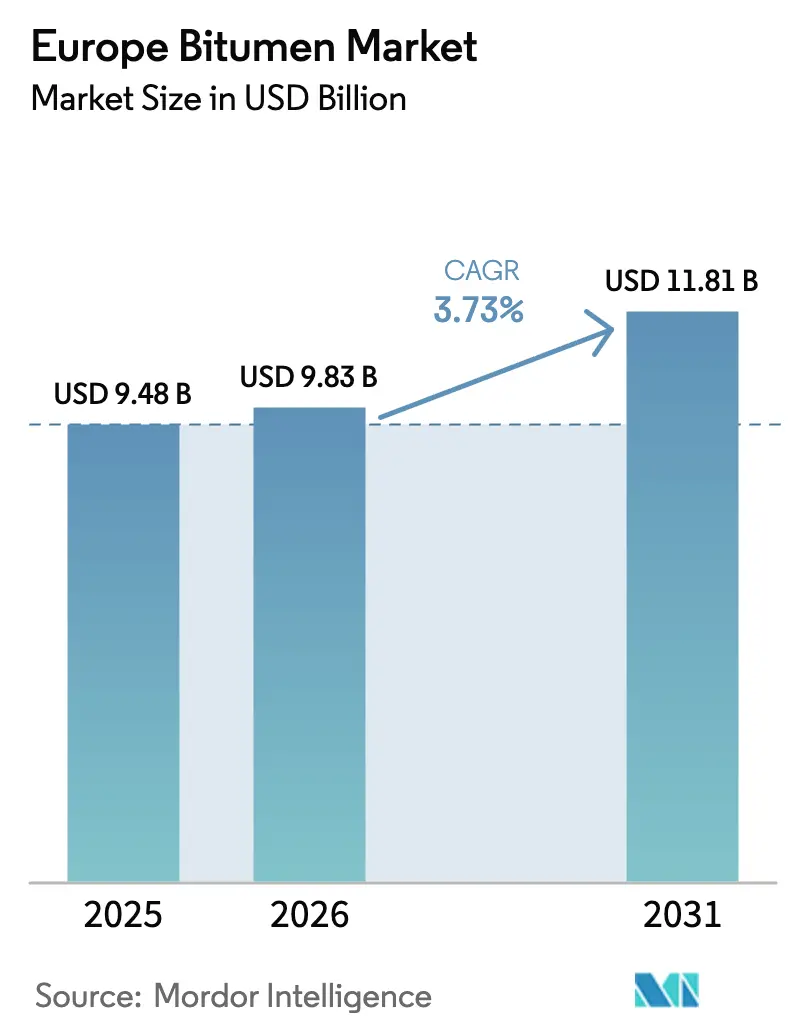
| Base Year Market Size (2025) | USD 9.48 Billion |
| Market Size (2026) | USD 9.83 Billion |
| Market Size (2031) | USD 11.81 Billion |
| Growth Rate (2026 - 2031) | 3.73 % |
| Market Concentration | Medium |
Major Players *Disclaimer: Major Players sorted in no particular order Image © Mordor Intelligence. Reuse requires attribution under CC BY 4.0. | |
Europe Bitumen Market Analysis by Mordor Intelligence
Europe Bitumen Market size in 2026 is estimated at USD 9.83 billion, growing from 2025 value of USD 9.48 billion with 2031 projections showing USD 11.81 billion, growing at 3.73% CAGR over 2026-2031. This steady expansion is anchored in record public‐works allocations, accelerating polymer-modified binder adoption, and supply-chain realignment that channels Mediterranean refinery surpluses into Northwest Europe at lower freight cost. Warm-mix asphalt technologies are scaling quickly, helping plant operators curb energy use and comply with Fit-for-55 carbon limits. Builders of zero-energy commercial facilities are specifying premium SBS-modified membranes, while freight growth drives heavier truck loads that favor high-performance pavements. The Europe bitumen market also benefits from cohesive EN-series standards that harmonize product quality, yet it must navigate tightening emission caps and the encroachment of concrete alternatives in long-life motorway projects.
Key Report Takeaways
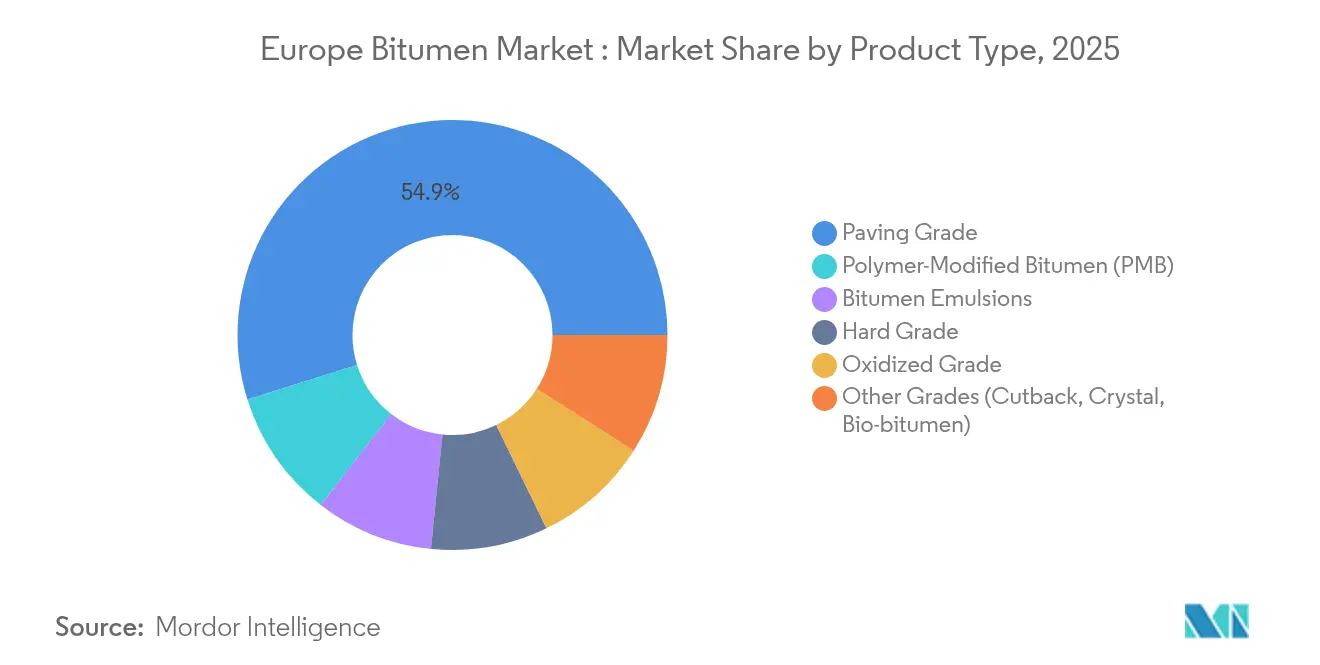
- By product type, paving grade held 54.85% of the Europe bitumen market share in 2025, while polymer-modified bitumen is projected to grow at a 4.27% CAGR through 2031.
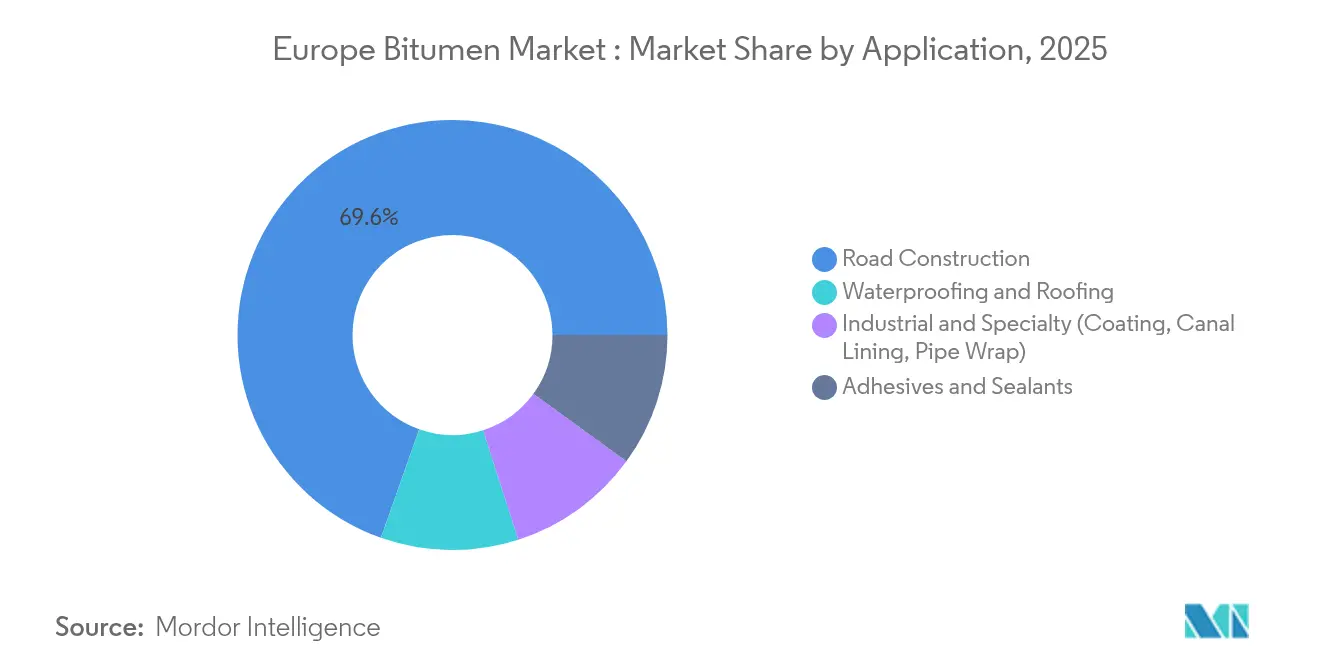
- By application, road construction accounted for 69.60% of the Europe bitumen market size in 2025, while waterproofing and roofing is advancing at a 4.05% CAGR.
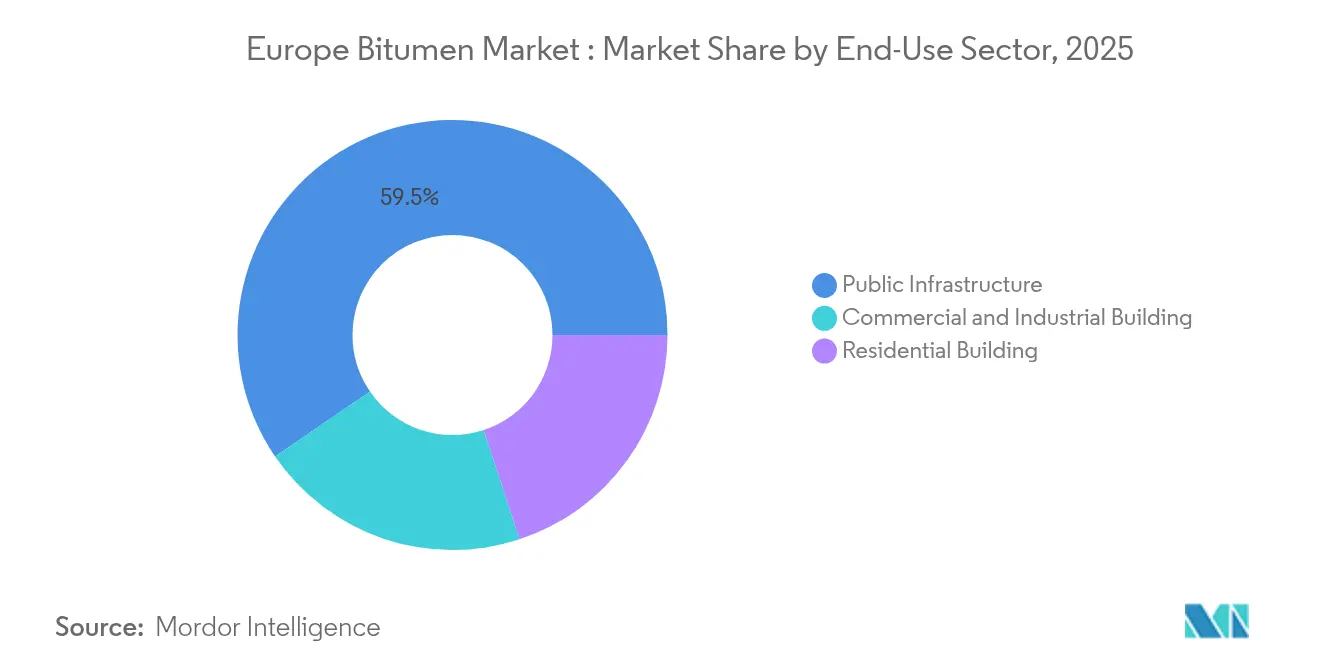
- By end-use sector, public infrastructure commanded 59.55% of 2025 demand; commercial and industrial building is forecast to expand at a 3.88% CAGR.
- By geography, Germany led with an 18.05% Europe bitumen market share in 2025, whereas Central and Eastern Europe is set to post a 3.95% CAGR to 2031.
Note: Market size and forecast figures in this report are generated using Mordor Intelligence’s proprietary estimation framework, updated with the latest available data and insights as of 2026.
Global valuation is built by aggregating outputs from multiple regions, with Europe forming one of the important contributors. Mordor Intelligence's global bitumen market size report represents that cumulative total.
Market Trends and Insights
Drivers Impact Analysis of Europe Bitumen Market *
| Driver | (~) % Impact on CAGR Forecast | Geographic Relevance | Impact Timeline |
|---|---|---|---|
| Growing Road-Rehabilitation and Greenfield Highway Spending Across EU-27 | +1.2% | EU-27 wide, concentrated in Germany, France, Italy | Medium term (2-4 years) |
| Accelerating Adoption of Polymer-Modified Binders for Heavier Truck Loads | +0.8% | Western Europe, expanding to Central Europe | Short term (≤ 2 years) |
| Surging Demand for Premium Waterproofing Membranes in Zero-Energy Buildings | +0.6% | Nordic countries, Germany, Netherlands | Long term (≥ 4 years) |
| Mediterranean Surplus Filling Supply Gap After Russia Ban, Lowering NW Europe Costs | +0.7% | Northwestern Europe, Mediterranean basin | Short term (≤ 2 years) |
| Rapid Shift Toward Warm-Mix Asphalt (WMA) to Meet Fit-For-55 Decarbonisation Targets | +0.5% | EU-27 wide, early adoption in Scandinavia | Medium term (2-4 years) |
| Source: Mordor Intelligence | |||
Growing Road-Rehabilitation and Greenfield Highway Spending Across EU-27
EU transport authorities earmarked EUR 7 billion (USD 7.7 billion) in 2024 for road modernization, with Germany alone spending EUR 2.8 billion (USD 3.08 billion) each year on motorway upgrades[1]. Mandates embedded in the revised TEN-T regulation stretch demand visibility to 2050. Tender specifications increasingly call for polymer-modified binders that lengthen maintenance cycles, reinforcing premiumization trends across the Europe bitumen market. Contractors benefit from certainty in multi-year spending plans that lock in baseline tonnage requirements and tilt procurement toward suppliers with robust logistics footprints.
Accelerating Adoption of Polymer-Modified Binders for Heavier Truck Loads
Freight tonnage jumped 23% since 2019 and axle weights now approach the 44-ton limit along major corridors, prompting road agencies to specify SBS-modified binders known to raise rutting resistance by 30-40%. Field trials confirm service‐life gains of up to 80% relative to conventional paving grade, validating price premiums that average 15–20%. EN 14023 provides a harmonized performance benchmark, while Germany and France codify mandatory PMB use on motorways exceeding 10,000 vehicles daily. This structural shift underpins the fastest expansion track for polymer-modified products within the Europe bitumen market.
Surging Demand for Premium Waterproofing Membranes in Zero-Energy Buildings
Nearly zero-energy building rules under the Energy Performance of Buildings Directive elevate moisture-barrier specifications. Kingspan’s roofing and waterproofing revenue reached EUR 568.5 million (USD 625.35 million) in 2024 and rose 15% year-on-year, while its EUR 1.2 billion (USD 1.32 billion) purchase of Nordic Waterproofing amplifies supply scale. SBS-modified sheets offer superior flexibility in sub-zero Nordic climates, pushing premium membranes deeper into the specification stack. The Europe bitumen market therefore tilts toward high-margin downstream systems where quality assurance and integrated insulation packages command pricing power.
Mediterranean Surplus Filling Supply Gap After Russia Ban, Lowering NW Europe Costs
Sanctions erased roughly 2 million tonnes of Russian imports, but Italian and Spanish refineries backfilled volumes while trimming haulage distances into Germany, the Netherlands, and Belgium. Freight savings of 25–30% now underpin more stable delivered pricing, decreasing volatility that previously plagued the Europe bitumen market. TotalEnergies aligned its European refining slate around regional logistics, and Shell redirected its Wesseling site toward higher-value base oils, collectively tightening supply yet refining cost curves in favor of Mediterranean output.
Restraints Impact Analysis of Europe Bitumen Market *
| Restraint | (~) % Impact on CAGR Forecast | Geographic Relevance | Impact Timeline |
|---|---|---|---|
| Heightened CO₂ / PAH Emission Regulations on Asphalt Plants | -0.4% | EU-27 wide, strictest in Nordic countries | Medium term (2-4 years) |
| Concrete and Composite Pavements Winning Share in Long-Life Motorway Projects | -0.3% | Germany, Austria, Netherlands | Long term (≥ 4 years) |
| Antitrust Fines on Regional Emulsion Cartels Inflating Compliance Costs | -0.2% | Germany, Italy, Austria | Short term (≤ 2 years) |
| Source: Mordor Intelligence | |||
Heightened CO₂ / PAH Emission Regulations on Asphalt Plants
The revised Industrial Emissions Directive ratcheted PAH limits down 40% and expanded CO₂ reporting duties. Operators estimate EUR 2-5 million (USD 2.2-5.5 million) per facility for oxidation and filtration retrofits[2]. Smaller batch plants may struggle to fund upgrades, trimming available capacity and pushing some producers out of the Europe bitumen market. Early movers with best-available-technology status leverage compliance as a competitive moat and capture carbon-conscious tender lots.
Concrete and Composite Pavements Winning Share in Long-Life Motorway Projects
Lifecycle studies indicate 5–35% cost savings over 40 years for concrete surfaces, particularly on steep Alpine grades that punish flexible pavements. Austria now lays concrete on two-thirds of new motorways, while Germany pushes the material to 25% share. Composite solutions that marry concrete bases with asphalt toppers stretch service intervals beyond 30 years, diverting part of the Europe bitumen market toward alternative materials where durability trumps up-front cost.
*Our forecasts treat driver/restraint impacts as directional, not additive. The impact forecasts reflect baseline growth, mix effects, and variable interactions.
Europe Bitumen Market Segment Analysis
By Product Type:
PMB Commands Premium Growth Despite Paving Grade DominancePolymer-modified bitumen underpins the fastest trajectory, charting a 4.27% CAGR through 2031, although conventional paving grade still accounts for 54.85% of the Europe bitumen market share in 2025. Premiumization accelerates because freight corridors demand binders that postpone rutting and fatigue, while EN 14023 assures buyers of cross-border consistency. The Europe bitumen market size tied to PMB climbed in tandem with logistics efficiencies that shorten lead times from Mediterranean hubs. Suppliers with integrated SBS and crumb-rubber modification capacity therefore record superior order backlogs.
Bio-bitumen innovations ride on the warm-mix wave. Lignin substitution rates near 5% in half-warm mixes, and used-cooking-oil epoxidation trials produce binders that hit durability targets. Hard and oxidized grades remain niche yet critical for industrial coatings and waterproofing mats. Bitumen emulsions find relevance in cold recycling and spray seals, especially where road agencies lift reclaimed asphalt pavement (RAP) thresholds to 50%. The Europe bitumen industry thus stretches its product ladder to capture both sustainability and performance premiums.

By Application:
Waterproofing Gains Momentum Beyond Road Construction DominanceRoad construction still consumes 69.60% of demand, yet waterproofing and roofing is projected to grow at 4.05% CAGR as zero-energy codes shift value downstream. Rising warehouse construction injects volume into adhesive flashings and SBS cap sheets. Kingspan’s membrane revenues illustrate the commercial pull of high-spec roofs, signaling an addressable sub-sector that outpaces the broader Europe bitumen market.
Industrial coatings and pipe wraps cling to their niche but stable slot. Adhesives and sealants gain from modular building systems that favor bitumen‐based sound attenuation mats. Public subsidy programs for building envelopes amplify retrofit activity, keeping waterproofing lines fully booked. As a result, the Europe bitumen market size dedicated to building solutions is widening relative to its historical baseline, balancing infrastructure cyclicality.
By End-Use Sector:
Commercial Building Segment Accelerates Despite Public Infrastructure LeadershipPublic infrastructure remains the anchor at 59.55% for 2025, buoyed by an EU road budget that hit USD 7.7 billion. Still, warehousing and logistics hubs in Poland, Czechia, and Hungary are propelling commercial consumption at a 3.88% CAGR. Investors racing to serve same-day e-commerce delivery fit large roofs with reflective waterproofing membranes, intensifying private-sector pull on the Europe bitumen market.
Residential construction faces higher mortgage rates, yet roof retrofit subsidies keep shingles and torch-on sheets moving through distribution. Industrial facilities reshape floor layouts to accommodate robotics, raising requirements for chemical-resistant bituminous screeds. This differential growth pattern forces producers to calibrate batch runs toward smaller-lot specialty grades alongside bulk road binders, adding flexibility to the Europe bitumen industry production mix.
Geography Analysis
Germany Bitumen Market
Germany anchors the Europe bitumen market with an 18.05% share in 2025, driven by USD 3.08 billion annual motorway allocations and stringent PMB norms for high-traffic lanes. Concrete accounts for a quarter of German motorways, yet bitumen maintains leadership through lifecycle optimized overlay strategies. Antitrust fines totaling USD 11.55 million underscore regulatory vigilance and raise compliance thresholds for local contractors.
Central and Eastern Europe Bitumen Market
Central and Eastern Europe advances at a 3.95% CAGR, powered by cohesion funds funneled into Polish expressways, Czech ring roads, and Hungarian industrial parks. Warehouse clusters around Łódź and Katowice translate directly into waterproofing demand, while newly upgraded asphalt plants in Slovakia adopt warm-mix equipment to comply with EU emission ceilings. This region captures increasing slices of the Europe bitumen market size as infrastructure parity with Western Europe tightens.
Broader European Markets
Italy leverages Mediterranean surplus to offset lost Russian cargoes, lowering delivered costs into Lombardy projects. France maintains steady growth on the back of its USD 16.5 billion five-year infrastructure plan. The United Kingdom adjusts supply chains post-Brexit but preserves volumes through motorway asset management contracts. Spain benefits from EU recovery grants, and Nordic states pioneer lignin-modified binders that dovetail with their bioeconomy strategies. Collectively, these dynamics reinforce diversified demand pillars that stabilize the Europe bitumen market against single-country shocks.
Coverage of the bitumen market by Mordor Intelligence spans a wide geographic footprint, with regional analysis available for Asia and Africa.
Regulatory Landscape
Bitumen binders placed on the European market fall under the Construction Products Regulation (EU) No 305/2011 framework, which drives CE marking and a Declaration of Performance for harmonized construction products. Product and performance definitions are largely standardized through the EN-series for bitumen and modified binders, including EN 12591 for paving grade and EN 14023 for polymer-modified bitumen, which supports cross-border procurement on major corridors and TEN-T-related tenders.
Compliance is also shaped by chemical and product-safety obligations that affect production and downstream placing-on-the-market. Bitumen-related substance registrations fall under REACH, and evolving EU standardization continues to influence documentation duties: Commission Implementing Decision (EU) 2026/901, published in April 2026, lists European standards referenced in support of Regulation (EU) 2023/988, reinforcing the role of formalized standards and conformity information flows across the sector.
Value Chain Analysis
The Europe bitumen value chain starts with crude refining and vacuum distillation to produce bitumen streams, followed by blending and modification (notably SBS-based and other polymer modification for PMB) and, for certain use cases, emulsion production. Dedicated and integrated producers supply bulk binder to asphalt plants and roofing membrane manufacturers, while trade bodies such as Eurobitume (producer representation) and the European Asphalt Pavement Association (EAPA, asphalt value chain representation) act as coordination nodes for technical guidance and industry-wide best practices.
Logistics is a key cost and risk lever because bitumen typically requires heated handling and transport (commonly around 150-180 C) across terminals, barges, rail, and insulated road tankers. Distribution platforms and terminals connect refinery output and import parcels to inland asphalt plants, while downstream converters, including membrane and waterproofing manufacturers, pull higher-spec grades and PMB into branded systems; Nynas operates as a dedicated bitumen producer, and Eurobitume member rosters include majors and traders such as Shell, TotalEnergies, Repsol, OMV, Vitol, and Nynas. This mix of integrated supply and merchant distribution supports regional availability.
Competitive Landscape
The producer roster is headlined by integrated majors—TotalEnergies, Shell, and BP—flanked by specialists such as Nynas AB and Bitumina Group. Combined, the top five suppliers control roughly 45% of regional volume, positioning the Europe bitumen market in the moderately concentrated tier. BP is divesting its 12 million-tonne Gelsenkirchen refinery, and Shell transitioned Wesseling into a 300 000-tonne base-oils hub, shifts that squeeze commodity output while lifting margins on upgraded products.
Kingspan’s EUR 1.32 billion Nordic Waterproofing deal crystallizes downstream consolidation where branded membranes out-earn generic binders. Specialty polymer houses such as Kraton and Sika use proprietary SBS and reactive elastomer chemistries to lock in sticky supply agreements with toll blenders. Warm-mix additives and bio-bitumen modifiers emerge as battlegrounds for intellectual property, evidenced by a surge in EU patent filings throughout 2025.
Compliance capability is increasingly a differentiator. Plants fitted with regenerative thermal oxidizers meet PAH rules ahead of schedule, winning procurement bonuses from Scandinavian agencies. Producers failing to retrofit face curtailed operating permits, effectively ceding share to compliant rivals. These strategic pivots collectively re-shape competition and raise the overall sophistication of the Europe bitumen industry.
Europe Bitumen Industry Leaders
-
Exxon Mobil Corporation
-
Nynas AB
-
Shell plc
-
TotalEnergies
-
BP Plc
- *Disclaimer: Major Players sorted in no particular order

Europe Bitumen Market Companies Covered in this Report
- Bitumina Group
- BP Plc
- Colas Group (Bouygues)
- Eurovia (Vinci Group)
- Exxon Mobil Corporation
- Gazprom Neft
- Icopal / BMI Group
- KRATON CORPORATION
- Nynas AB
- Orlen Lietuva
- Puma Energy
- Shell Plc
- Sika AG
- STRABAG SE
- Suncor Energy Inc.
- TotalEnergies
Market Opportunities and Future Outlook
A major area of opportunity is decarbonization and compliance-ready paving solutions, where warm-mix asphalt adoption and tightened plant emission obligations push asphalt producers to look for binder-additive packages and PMB designs that reduce laying temperatures while maintaining rutting resistance for heavier axle loads. Eurobitume and EAPA technical workstreams also provide a channel for specification harmonization and safety practices, and Eurobitume released an updated PMB life cycle assessment in 2026, which supplies comparative environmental data that can be used in public procurement dossiers and EPD-style documentation.
Supply-chain realignment also creates room for logistics-led players and refiners that can secure dependable terminal access and feedstock flexibility. Rubis brought 60,000 tonnes of bitumen storage capacity into operation at the ATPC terminal in Antwerp in February 2026, strengthening distribution optionality into Belgium, the Netherlands, France, and Germany. On the production side, Nynas disclosed 2025 capital spending of 213 MSEK to increase vacuum distillation capacity at Nynashamn, targeting improved yields and feedstock flexibility, which supports higher-value product slates (including PMB and specialty binders) as refinery configurations shift across Europe.
Recent Industry Developments in Europe Bitumen Market
- July 2026: Eurobitume releases the Life Cycle Assessment Report 2026 for polymer-modified bitumen PMB. The launch provides environmental impact data for PMB in EU and UK markets, informing sustainability benchmarks and procurement considerations. The release supports PMB demand shift and higher-performance binders while guiding product development decisions.
- February 2026: Rubis Group begins operation of 60,000 tonnes of bitumen storage capacity at the ATPC terminal in Antwerp. The new storage site creates a strategic distribution platform for Belgium, the Netherlands, France, and Germany. It strengthens regional logistics and reduces transport risk from refinery downsizing, affecting distribution dynamics.
- January 2026: Eurobitume publishes multi-language guidance for ground-based operations to enhance safety in the bitumen supply chain. The guidance improves safety standards across the supply chain and supports operational consistency for compliant suppliers. The initiative improves procurement advantages by reducing safety risks and related disruptions.
Europe Bitumen Market Report Scope and Research Methodology
Market Definition and Coverage
For this study, the market includes revenues generated from sales of petroleum bitumen used as a binder and waterproofing material across Europe, counted at the first point of sale into paving, roofing, and other industrial uses.
Scope exclusions: Excluded from sizing are asphalt mix production revenues, installation and road-laying services, and non-bituminous substitute binders.
Segments Covered in This Report
- By Product Type
- Paving Grade
- Hard Grade
- Oxidized Grade
- Bitumen Emulsions
- Polymer-Modified Bitumen (PMB)
- Other Grades (Cutback, Crystal, Bio-bitumen)
- By Application
- Road Construction
- Waterproofing and Roofing
- Adhesives and Sealants
- Industrial and Specialty (Coating, Canal Lining, Pipe Wrap)
- By End-Use Sector
- Public Infrastructure
- Residential Building
- Commercial and Industrial Building
- By Geography
- Germany
- United Kingdom
- Italy
- France
- Spain
- NORDIC Countries
- Central and Eastern Europe
- Rest of Europe
Data Sources, Market Sizing, and Validation
Desk Research
Desk work started by mapping the demand pool using public infrastructure and construction indicators, then aligning it with bitumen supply and trade signals. We relied on open, verifiable sources such as Eurostat construction output and trade statistics, European Commission transport and infrastructure programs, and International Energy Agency refinery and oil-product context to sanity-check the supply side.
To keep the product and use-case boundary clear, we also referred to industry and technical bodies such as Eurobitume publications, and used asphalt production statistics from the European Asphalt Pavement Association to explain how binder demand shifts with paving activity. In parallel, company annual reports, investor presentations, and reputable press were used to track capacity changes, refinery conversion trends, and pricing commentary. Paid subscriptions were applied selectively for company financials and patent searches when public disclosures were limited. The sources listed here are illustrative only, and additional references were used across data collection, validation, and clarification.
Primary Interviews and Surveys
Primary work focused on confirming how demand and pricing are behaving by country, and how product mix is shifting between paving grades and modified grades. We engaged participants across the value chain, including refiners and blenders, distributors and importers, asphalt producers, and large contractors, then cross-checked those inputs with engineering consultants and association contacts across major European sub-regions.
Distribution of primary research fieldwork respondents
| Company type | Respondent position |
|---|---|
| Top tier: 25% | CXOs: 15% |
| Mid tier: 60% | Functional/Unit leaders: 26% |
| Smaller Players: 15% | Managers: 59% |
Market-Sizing & Forecasting
Sizing was built using a top-down approach where road and construction activity proxies are converted into binder demand, then translated into value using observed price bands and product mix. We started with country-level signals such as road maintenance intensity, new road kilometers, and roofing activity, and then applied penetration assumptions for bitumen use in these applications, as clarified through interviews.
To keep the model practical, we tracked a small set of market fingerprints that tend to move the Europe value line, including import dependency by country, refinery output shifts and turnaround schedules, seasonal paving windows, typical grade split between paving and modified binders, and the spread between crude and bitumen pricing during tight supply periods. Forecasting relied mainly on scenario analysis, because infrastructure budgets, refinery rationalization, and energy costs can shift the near-term balance, and those scenarios were stress-tested with expert views on demand resilience and substitution risk.
After forming the top-down totals, we corroborated results with selective bottom-up approximations such as sampled supplier volumes, distributor channel checks, and ASP times volume sanity checks in larger countries, followed by adjustments where gaps were visible. For smaller markets where direct volume data could not be validated, we used proxy scaling from asphalt output and construction indices, then normalized it with trade flow direction to avoid overstating local consumption.
Data Validation & Update Cycle
Checks were run at multiple levels so the final numbers are consistent with how the market behaves in practice. We compared outputs against independent signals such as asphalt production trends, published consumption tonnage discussions in association materials, and visible changes in trade balances, then investigated outliers before sign-off.
A second analyst review is used to challenge assumptions with large impacts, such as grade mix shifts and price progression, and any large variance triggers follow-up outreach to re-check the logic. Reports are refreshed annually, with interim updates when material events occur, such as major refinery closures, sharp feedstock swings, or policy changes affecting road spending. Before delivery, an analyst performs a fresh pass across key inputs so clients receive the latest updated view.
Mordor Intelligence's Europe Bitumen Market Size Compared With Other Published Estimates
Market size estimates for Europe bitumen can look far apart because publishers do not always count the same boundary, and they may also use different price points, base years, and conversion choices. In this study, we kept the definition tight to bitumen sales value and then tested the result against practical supply and demand signals.
Key gap drivers usually come from whether asphalt mix revenues are mistakenly combined with binder revenues, whether the geography includes peripheral markets with limited disclosure, and how price is handled during volatile crude periods. By tracking country-level binder demand proxies and refreshing the price deck using Europe-specific trade and supply checks, Mordor Intelligence keeps the total tied to bitumen-only value instead of mixing it with downstream paving activity.
Benchmark comparison
| Source | Market Size | Gaps in Research Methodology |
|---|---|---|
| Mordor Intelligence | USD 9.48 B (2025) | |
| Trade Journal A | USD 7.90 B (2024) | Uses a narrower country set that overweights EU-27 production reporting, and applies a conservative spot-price snapshot rather than a blended annual realized pricing view. |
| Regional Consultancy B | USD 19.58 B (2024) | Appears to include downstream asphalt mix and paving-related revenues in addition to binder sales, which inflates value when construction activity is high. |
The spread across the table is largely explained by what is counted as part of the market and how pricing is averaged across a year. When the scope is held to bitumen revenues and checked against demand indicators and trade realities, the output becomes easier to trace back to clear steps that can be repeated each year.
Key Questions Answered in the Report
How large is Europe’s bitumen demand today and where is it heading by 2031?
Value reached USD 9.83 billion in 2026 and is projected to climb to USD 11.81 billion by 2031, implying a 3.73% CAGR.
Which bitumen product type is expanding fastest across Europe?
Polymer-modified bitumen leads with a 4.27% CAGR, driven by heavier truck loads and stricter pavement durability standards.
What role do Mediterranean refineries play in supplying Northwest European bitumen?
Additional output from Italian and Spanish plants replaces lost Russian volumes and cuts freight costs into Germany, the Netherlands, and Belgium by up to 30%.
Why are European highway agencies switching to polymer-modified binders?
SBS-modified mixes boost rutting resistance and can extend pavement life 60–80%, offsetting their 15–20% price premium.