
Market Overview
| Study Period | 2020 - 2031 |
|---|---|
| Forecast Data Period | 2026 - 2031 |
| Base Year Market Size (2025) | USD 15.45 Billion |
| Market Size (2026) | USD 15.86 Billion |
| Market Size (2031) | USD 18.08 Billion |
| Growth Rate (2026 - 2031) | 2.66 % |
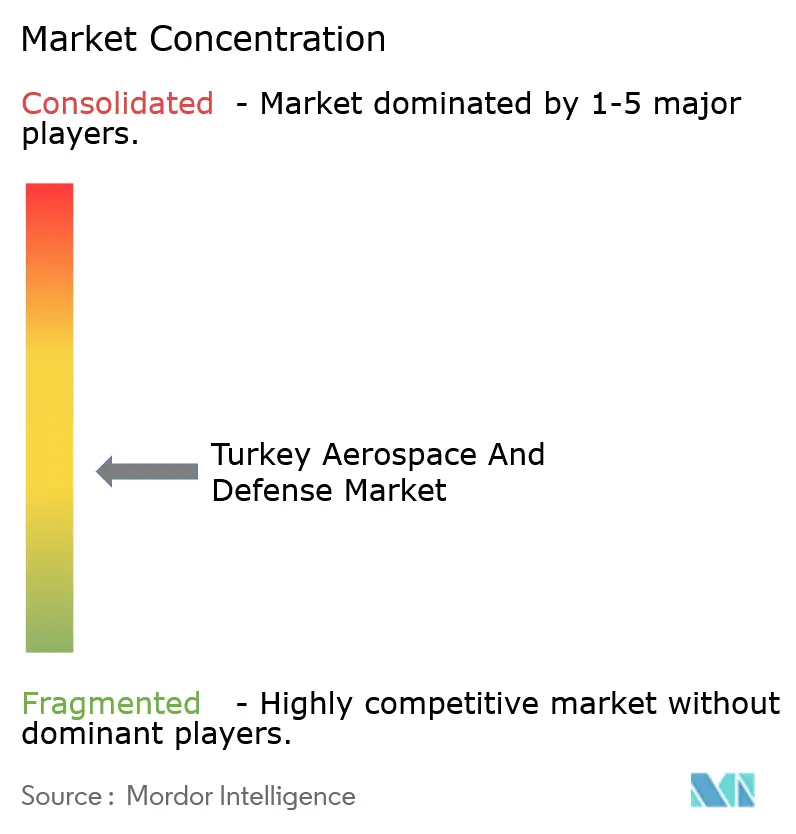
| Market Concentration | Medium |
Major Players *Disclaimer: Major Players sorted in no particular order Image © Mordor Intelligence. Reuse requires attribution under CC BY 4.0. | |
Turkey Aerospace And Defense Market Analysis by Mordor Intelligence
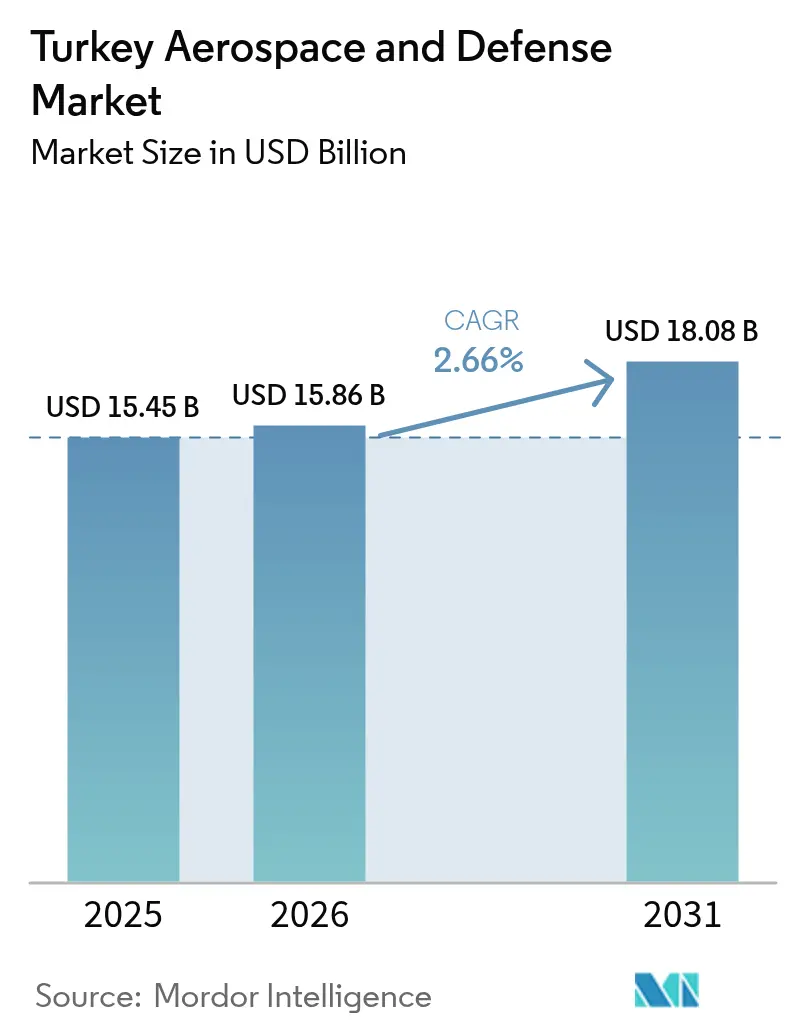
The Turkey aerospace and defense market size is expected to grow from USD 15.45 billion in 2025 to USD 15.86 billion in 2026 and is forecast to reach USD 18.08 billion by 2031 at 2.66% CAGR over 2026-2031. This trajectory stems from the nation’s pivot toward indigenous platform development, resilient export demand, and a supportive defense budget framework that climbed to USD 47 billion in 2025.[1]Source: Middle East Eye, “Turkey’s 2025 Defense Budget Reaches USD 47 Billion,” middleeasteye.net Rising drone, missile, and space-system deliveries reinforce Turkey’s status as a reliable alternative to traditional suppliers. At the same time, the government’s commitment to 80% local content shields the sector from supply-chain shocks. Competitive dynamics emphasize technology sovereignty, demonstrated by the KAAN fifth-generation fighter, Hisar-O air-defense missile, and TB3 naval drone programs, which anchor an ecosystem capable of end-to-end design, prototyping, and serial production.
Key Report Takeaways
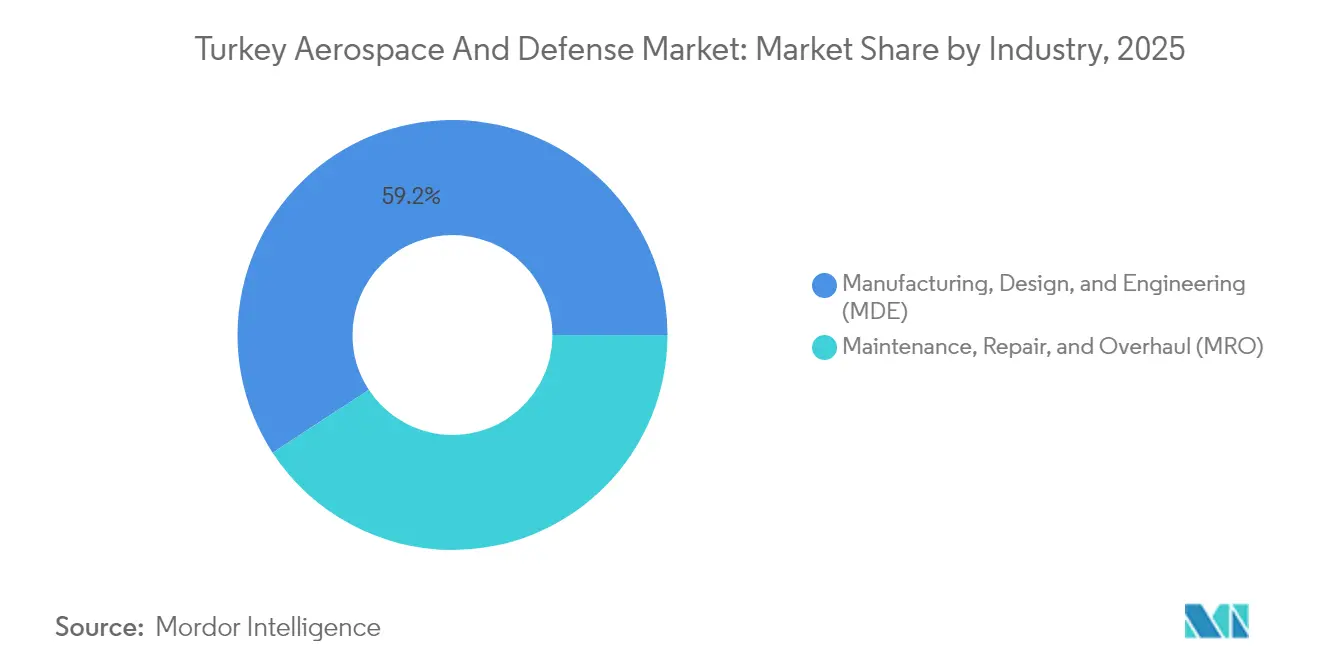
- By industry, manufacturing, design, and engineering (MDE) led with 59.22% of Turkey's aerospace and defense market share in 2025 and is projected to expand at a 2.98% CAGR through 2031.
- By type, defense platforms held a 67.90% share of the Turkish aerospace and defense market size in 2025, while the aerospace segment is forecasted to grow at a 3.24% CAGR to 2031.
- By end user, the military segment accounted for 71.60% share of the Turkish aerospace and defense market size in 2025, with government non-military applications advancing at a 3.62% CAGR through 2031.
- By platform, unmanned aerial vehicles (UAVs) captured 26.27% of the Turkish aerospace and defense market share in 2025 and are projected to grow at a 4.32% CAGR through 2031.
Note: Market size and forecast figures in this report are generated using Mordor Intelligence’s proprietary estimation framework, updated with the latest available data and insights as of 2026.
Turkey Aerospace And Defense Market Trends and Insights
Drivers Impact Analysis*
| Driver | (~) % Impact on CAGR Forecast | Geographic Relevance | Impact Timeline |
|---|---|---|---|
| Rising defense-budget allocations | +0.8% | National, with spillover to regional partners | Medium term (2-4 years) |
| Surge in UAV and guided-munition exports | +0.6% | Global, with strong penetration in MENA, Eastern Europe | Short term (≤ 2 years) |
| National self-reliance and indigenous-platform targets | +0.5% | National, with technology transfer to allied nations | Long term (≥ 4 years) |
| Commercial-aviation fleet and airport capacity expansion | +0.4% | National, with regional connectivity benefits | Medium term (2-4 years) |
| NATO-interoperability upgrade programs | +0.3% | NATO member states, with focus on Eastern flank | Medium term (2-4 years) |
| Additive-manufacturing and advanced-composites adoption | +0.2% | National, with export potential to emerging markets | Long term (≥ 4 years) |
| Source: Mordor Intelligence | |||
Rising Defense-Budget Allocations
The 2025 defense budget of USD 47 billion allocates 165 billion Turkish lira to the Defense Industry Support Fund, guaranteeing near-term demand for indigenous air and missile programs and underwriting USD 4.5 billion in domestic R&D. Elevated outlays have already accelerated serial production of the Hisar-O air-defense missile and enabled new engine test stands for the TF35000 turbofan, thereby deepening vertical integration across propulsion, guidance and C4ISR subsystems. Predictable funding streams also entice SMEs into advanced composites, sensors, and additive-manufacturing niches, expanding the supplier base that feeds the Turkish aerospace and defense market. Taken together, these investments reinforce Turkey’s quest for strategic autonomy and broaden its export appeal to partners eager for technology transfer.
Surge in UAV and Guided-Munition Exports
Baykar’s USD 1.76 billion 2024 revenues highlight how performance in Ukraine, Libya, and Nagorno-Karabakh translated into contracts across 34 countries, with locally staffed facilities inaugurated in Ukraine and Indonesia. The TB3’s deck-based sorties from TCG Anadolu illustrate maritime force-multiplication at price points light-carrier navies can afford. Accompanying precision munitions packages and sustainment services create stable annuity revenues, helping firms weather exchange-rate swings while enlarging the Turkish aerospace and defense market footprint.
National Self-Reliance and Indigenous-Platform Targets
The KAAN fighter’s USD 10 billion export contract with Indonesia for over 48 aircraft—with licensed production lines in Bandung—confirms that home-grown designs can win on global tenders even against established Western jets. Turkey reduced foreign dependency from 80% to 20% in two decades, building supply-chain depth in avionics, warheads, and composite structures. Indigenous-content mandates channel procurement toward local suppliers, locking in scale economies that lower unit costs and make Turkish bids more competitive abroad. Once perceived as risks, technology-transfer clauses now function as selling points for governments seeking industrial upskilling, enlarging the Turkish aerospace and defense market.
Commercial-Aviation Fleet and Airport Capacity Expansion
Turkish Airlines operates 458 aircraft and targets 813 by 2033, a plan that requires expanded MRO capacity, domestic interiors, and composite components.[2]Source: Turkish Airlines, “Board Activity Report 2Q 2024,” investor.turkishairlines.com Istanbul Airport’s 120 million-passenger layout cements Turkey’s role as an intercontinental hub, sparking demand for radar, baggage handling, and ground-support systems. Dual-use technologies migrate from military programs into cost-sensitive commercial lines—such as additive-manufactured cabin brackets—shortening development cycles. Thus, the Turkish aerospace and defense market benefits from civil-military technology convergence that diversifies revenue streams.
Restraints Impact Analysis*
| Restraint | (~) % Impact on CAGR Forecast | Geographic Relevance | Impact Timeline |
|---|---|---|---|
| Currency volatility and high input-cost inflation | -0.4% | National, with export competitiveness implications | Short term (≤ 2 years) |
| Export-license/sanctions exposure | -0.3% | Global, particularly affecting Western technology access | Medium term (2-4 years) |
| Skilled-labor shortages in critical disciplines | -0.2% | National, with regional talent competition | Medium term (2-4 years) |
| ESG/geopolitical-risk driven financing constraints | -0.1% | European markets, with limited emerging market impact | Long term (≥ 4 years) |
| Source: Mordor Intelligence | |||
Currency Volatility and High Input-Cost Inflation
Sharp Turkish-lira swings widen cost baselines for imported engines and aerospace-grade titanium, complicating pricing for long-cycle export contracts. Although 80% of a finished system is now locally sourced, the 20% foreign-supplied share often embodies propulsion or sensor packages that carry disproportionate value. Hard-currency billing and natural-hedge export portfolios provide partial relief, yet material inflation still pressures margins across the Turkish aerospace and defense market.
Export-License/Sanctions Exposure
Western sanctions following the S-400 acquisition evicted Turkey from the F-35 program, blocking planned workshare returns on a USD 1.4 billion sunk cost. License denials for US-origin components complicate subsystem sourcing and restrict sales into NATO markets. Turkish response strategies range from indigenous engine development to supply-chain diversification toward Asian and Middle-Eastern vendors, a pathway that expands design freedom but requires additional qualification testing. Short-term friction thus trims growth in the Turkish aerospace and defense market, even as self-reliance programs lay foundations for long-term resilience.
*Our forecasts treat driver/restraint impacts as directional, not additive. The impact forecasts reflect baseline growth, mix effects, and variable interactions.
Segment Analysis
By Industry: Manufacturing Drives Indigenous Platform Development
Manufacturing, design, and engineering (MDE) generated 59.22% of 2025 revenue and is on track for a 2.98% CAGR, underscoring how production autonomy underpins the Turkish aerospace and defense market. TUSAŞ’s 4 million m² Kahramankazan campus covers design, assembly, and flight-test operations, enabling simultaneous production of the KAAN fighter, GÖKBEY helicopter, and ANKA-3 UAV on contiguous lines. Serial-production capacity gives Turkish primes negotiating clout on joint-venture bids, while SMEs supply harnesses, 3D-printed ducts, and high-temperature resins, elevating domestic value capture to 80% across major platforms.
The segment’s forward momentum benefits from additive manufacturing breakthroughs that shorten tooling cycles by 40%, allowing for quick pivoting from prototype to low-rate initial production. Integrated digital twins reduce rework costs and align well with export partners’ offset packages, enhancing the appeal of the Turkish aerospace and defense market. Sustained investment in hybrid composite-metallic structures for the TF35000 engine nacelle highlights how Turkey converts R&D budgets into proprietary IP that commands premium margins.



By Type: Defense Platforms Lead While Aerospace Accelerates
Defense platforms accounted for 67.90% of 2025 revenue as the Turkish Armed Forces recapitalized its armored vehicles, air-defense battalions, and naval assets. Combat-tested systems enhance credibility abroad, driving 30% year-over-year export growth that expands the Turkish aerospace and defense market. Yet the Aerospace segment’s 3.24% CAGR is closing the gap, powered by Turkish Airlines’ fleet-doubling plan and the domestic space program’s demand for launch structures and satellite buses.
Turksat 6A, designed in Ankara, extends coverage to 5 billion people and unlocks telecom royalties from emerging Asian markets. Civil-military spillovers, such as space-qualified solar arrays now repurposed for HALE UAVs, illustrate technology cross-pollination that enriches the Turkish aerospace and defense industry while reducing dependence on volatile defense cycles.
By End User: Military Dominance With Government Growth Emerging
Military agencies purchased 71.60% of the 2025 output, absorbing large volumes of precision munitions, tactical UAVs, and naval corvettes under multi-year procurement plans. National forces act as launch customers, validating systems for foreign buyers and cementing robust baseline demand for the Turkish aerospace and defense market. Nonetheless, Government (non-military) applications show a 3.62% CAGR, driven by border security towers, wildfire-monitoring drones, and satellite-enabled e-government connectivity.
Civil-authority adoption of dual-use radars and encrypted radio networks helps amortize R&D across broader volumes, lowering unit costs and improving export competitiveness. Such diversification shields revenue streams against potential slowdowns in defense allocation without diluting core competencies that define the Turkish aerospace and defense market.

By Platform: UAVs Lead Innovation and Export Success
UAVs accounted for 26.27% revenue and paced the field with 4.32% CAGR, reflecting Baykar’s prominent share of global UAV exports and TB2’s milestone of 1 million flight hours. Indigenous EO/IR turrets, SATCOM data links, and smart munitions replace once-imported payloads, keeping value in-country and expanding the Turkish aerospace and defense market. Fixed-wing manned projects such as the KAAN fighter diversify the portfolio, while ATAK-II heavy helicopter programs address regional rotor-craft demand.
Missile and precision-munition lines leverage composite airframes from drone production, cutting cycle times and offering turnkey packages attractive to medium-income nations. Space platforms, catalyzed by Fergani Space’s private-satellite launch, present long-tail upside by positioning Turkey as a regional provider of earth-observation and PNT services. Platform diversity, therefore, undergirds the sustained expansion of the Turkish aerospace and defense market.
Geography Analysis
The Marmara region houses SAHA Istanbul, a 1,300-member cluster that tallied USD 12.59 billion turnover and USD 6.08 billion exports in 2024. Its concentration of system integrators, port logistics, and the new Istanbul Airport places it at the epicenter of the Turkish aerospace and defense market. Collaborative R&D parks link primes with prototyping boutiques, accelerating the transition from concept to series production and enabling quick iterations responding to export customer feedback.
Central Anatolia, anchored by Ankara, centers on Turkish Aerospace’s Kahramankazan plant and the TF35000 engine integration line, reinforcing propulsion self-reliance. Proximity to defense-procurement agencies fosters agile decision-making and rapid contract execution, factors that cultivate new entrants and sustain SME pipelines feeding the Turkish aerospace and defense market.
The Aegean region leverages Izmir’s industrial zones and deep-water ports to support naval-air integration projects, while Mediterranean shipyards diversify into UAV-capable corvette decks. Black Sea hubs focus on radar and EW subsystems, capitalizing on offshore gas security needs. Southeastern and Eastern Anatolia offer cost-competitive facilities and tax incentives, attracting additive-manufacturing startups and broadening geographic risk dispersion for the Turkish aerospace and defense market.
Regulatory Landscape
Turkey’s aerospace and defense procurement and industrialization are centrally governed by the Secretariat of Defence Industries (SSB) under the Presidency, with major program approvals and strategic decisions overseen by the Defence Industry Executive Committee (SSIK), chaired by the President. Entry into defense programs is shaped by SSB contracting practices and Industrial Participation and Offset rules that embed localization and technology-transfer requirements into large procurements, reinforcing the sector’s high local-content orientation.
Production, trade, and security compliance are split across authorities and laws: Law No. 5201 regulates production, import, and export of war materials and requires permits from the Ministry of National Defence (MSB), while Law No. 5202 imposes defense-industry security requirements for facilities involved in classified projects, including certification and periodic audits. Controlled items are governed via the MSB’s Kontrole Tabi Liste (KTL), and trade controls for dual-use and controlled goods use TAREKS as the mandatory digital risk-based authorization and tracking platform. As a result, permitting, facility security, and export-control compliance operate as gatekeeping steps for both local suppliers and foreign primes.
Value Chain Analysis
Turkey’s aerospace and defense value chain is anchored by SSB-directed program portfolios and a dense domestic industrial base, with primes and key subsystem houses coordinating tiered suppliers across metals, composites, electronics, software, and energetics. Turkish Aerospace Industries covers airframes and aerospace integration, ASELSAN supports sensors, C4ISR, and electronic warfare, Roketsan provides missiles and propulsion, BMC/FNSS supplies land systems, and MKE supports ordnance. The structure also relies on clustering and capability-development mechanisms to expand qualified local sourcing, including SSB capability mapping (such as YETEN 2.0) and SME-competency schemes.
Upstream dependencies concentrate around propulsion, high-end sensors, and selected aerospace materials where sanctions or licensing constraints can disrupt supply. This reinforces the emphasis on vertical integration, including indigenous engines and domestic electronics. Midstream value creation focuses on design-to-serial production at large campuses, for example Turkish Aerospace Industries’ Kahramankazan complex, and on integrated production hubs that consolidate air-defense and electronics manufacturing. Downstream revenues increasingly come from packaged exports that combine platforms, munitions, training, and sustainment. On the services side, MRO and lifecycle support are scaling around Istanbul Airport and Turkish Technic, linking civil aviation demand with defense-grade maintenance and parts manufacturing capabilities.
Competitive Landscape
Seven Turkish firms rank in the global defense top-100; ASELSAN leads domestically at USD 2.172 billion revenue and holds heavy positions in radar, EW, and electro-optics. TUSAŞ follows with USD 1.858 billion, integrating airframes and satellites, while Baykar dominates UAVs with a 90% export-revenue ratio. Competitive advantage stems from vertical integration and speed—the time between TB2 baseline certification and first export was three years, far shorter than legacy OEM cycles.
Additive-manufacturing adoption reduces tooling costs by 35% and compresses prototype lead times, giving SMEs leverage to bid for subsystems on next-generation aircraft. Strategic moves in 2025 include Leonardo and Baykar’s joint venture targeting Europe’s unmanned-fighter segment and TUSAŞ’s Airbus partnership on Spain’s trainer program. Disruptors like Fergani Space push satellite-bus prices below USD 4 million, expanding addressable markets beyond state budgets. Collaboration inside SAHA Istanbul allows rapid scaling when export contracts, such as Indonesia’s KAAN order, demand local content. All told, synergistic competition propels global reach for the Turkish aerospace and defense market.
Turkey Aerospace And Defense Industry Leaders
Turkish Aerospace Industries, Inc.
ASELSAN A.Ş.
BMC Otomotiv Sanayi ve Ticaret A.Ş.
BAYKAR MAKİNA SANAYİ VE TİCARET A.Ş.
Roketsan A.Ş.
- *Disclaimer: Major Players sorted in no particular order

Market Opportunities and Future Outlook
Air and missile defense industrialization stands out as a whitespace for component suppliers and systems integrators as Turkey shifts from development to higher-rate manufacturing under the Steel Dome architecture. The ramp-up is supported by large-scale industrial investments, including ASELSAN’s Oğulbey Technology Base, and by continuing serial-production contracting for layered air-defense systems. This pulls through demand for radars, electronic warfare, command-and-control software, interceptors, and test infrastructure, with exportable configurations that package sensors and effectors as an integrated architecture rather than standalone products.
High-technology sovereignty programs are also opening development and supplier-entry lanes beyond traditional platforms, especially for network-centric warfare, AI-enabled autonomy, and quantum technologies. In 2026, SSB launched a Quantum Program and published a roadmap with projects including superconducting quantum processor development and quantum magnetometers. That expands the addressable market for defense-grade components, cryogenics, secure electronics, and specialized software. Alongside this, near-term production and delivery plans for indigenous platforms, including Turkish Aerospace’s 2026 HURKUS and HURJET deliveries, and civil aviation expansion that is driving new MRO capacity at Istanbul Airport, support opportunities in avionics, engine support, training systems, and certified maintenance and parts manufacturing within Turkey.
Recent Industry Developments
- May 2026: GE Aerospace and Turkish Aerospace announced an agreement covering the supply of F404 engines for the HURJET program. Securing a defined engine path supports HURJET production planning and export readiness, while also tightening integration between platform and propulsion supply chains in Turkey.
- February 2026: ASELSAN and CSG Group announced strategic cooperation to establish an EU-based joint venture and to integrate the Korkut air defense system on the Tatra Force 6x6 platform. The move strengthens ASELSAN’s European industrial footprint and broadens addressable demand by pairing Turkish air defense capabilities with an established European vehicle OEM and distribution base.
- October 2024: ASELSAN announced multiple contracts including guidance-kit procurement for the Turkish Armed Forces and payload sales with exports to Asian and African markets. These awards expand ASELSAN’s production backlog in precision and payload subsystems and reinforce Turkey’s pattern of bundling domestic electronics and munitions-related capabilities into both domestic programs and exports.


Research Methodology Framework and Report Scope
Market Definition and Coverage
For this study, the market covers the value of aerospace and defense activities in Turkey across design, production, integration, and maintenance support that deliver usable aerospace and defense platforms and systems to civil and government end users.
Scope exclusions: We exclude pure upstream raw materials and general construction works that are not directly tied to aerospace and defense platform or system delivery.
Segmentation Overview
- By Industry
- Manufacturing, Design, and Engineering (MDE)
- Maintenance, Repair, and Overhaul (MRO)
- By Type
- Aerospace
- Aviation
- Space
- Defense
- Aerospace
- By End User
- Commercial Aviation
- Military
- Government (Non-military)
- Private and Business Aviation
- By Platform
- Fixed-Wing Aircraft
- Rotary-Wing Aircraft
- Unmanned Aerial Vehicles (UAVs)
- Land Systems
- Naval Systems
- Missiles and Precision Munitions
- Space Platforms and Launchers
Data Sources, Market Sizing, and Validation
Desk Research
We start by mapping what is produced, acquired, and sustained inside Turkey, then we anchor it with public signals that can be checked year over year. For defense demand direction, we lean on official budget and capability statements, public procurement releases, and program level updates that indicate timing of deliveries and upgrades.
To keep the model grounded, we use non paywalled sources such as SIPRI trend indicators, NATO public defense expenditure series, Turkish government releases tied to defense industry programs, and Turkish export statistics and customs trade tables. We also incorporate civil aviation fleet and traffic statistics published by official aviation bodies. Annual reports, investor presentations, and credible press interviews help interpret what part of revenue relates to Turkey based production, MRO work, and exports. We additionally use paid subscriptions for company financials and news intelligence, plus aerospace and aviation databases that include aircraft level and engine level details to validate platform activity. The sources mentioned above are illustrative only, and many other public and paid references were also used for data collection, cross checks, and clarification.
Primary Interviews and Surveys
Our primary work focuses on confirming scope and pricing logic, since defense and aerospace programs can shift timing and mix quickly. We speak with program and procurement stakeholders, component and subsystem suppliers, MRO providers, and experienced industry observers across Turkey. We use these inputs to validate delivery assumptions, export weighting, and service intensity by platform type.
Distribution of primary research fieldwork respondents
| Company type | Respondent position |
|---|---|
| Top tier: 33% | CXOs: 13% |
| Mid tier: 53% | Functional/Unit leaders: 29% |
| Smaller Players: 14% | Managers: 58% |
Market-Sizing & Forecasting
Sizing starts with a top-down build that reconstructs Turkey demand and supply from defense budget intent, major program schedules, and observable platform activity, then it is translated into market value using category specific spending and service intensity assumptions. To make sure the totals stay realistic, we corroborate the result with selective bottom up approximations, such as sampled platform counts times typical upgrade and sustainment values, plus supplier and channel checks on subsystems where pricing is clearer.
The model uses a small set of practical inputs that can be refreshed each year, including defense budget and procurement direction, export momentum and reported order wins, delivery timing for aircraft, UAV, naval, and land programs, MRO workload indicators, and currency timing for USD conversion. Where local content is rising, we reflect it through mix shifts between imports, domestic integration, and services rather than forcing a full supplier roll up. Forecasting is completed through scenario analysis supported by expert consensus. The base case adjusts for program phasing, export pipeline quality, and sustainment needs that typically lag new platform deliveries.
Data Validation & Update Cycle
We validate results by checking the model against independent signals such as defense export totals, public delivery milestones, and visible fleet and platform activity. We also test whether implied spend per platform looks consistent with interview feedback. Outliers are reviewed in more than one step, including variance checks across years and a second analyst review before sign-off.
Reports are refreshed annually, and we trigger interim updates when material events occur, such as major contract announcements, budget changes, or program delays that affect near term deliveries. Before delivery, we do a fresh pass on the latest public releases so clients receive the latest updated view with the same assumptions applied consistently.
Mordor Intelligence's Aerospace and Defense Industry of Turkey Market Size Measured Against Other Published Estimates
Published market sizes for Turkey aerospace and defense can vary more than expected because each publisher draws the line differently between domestic turnover, exports, and defense spending, and then applies its own pricing and currency timing. We have also seen that some estimates blend civil aviation value pools into the same headline number, which changes the total even if growth direction is similar.
Key gaps usually come from what is counted as the market value, and from how program timing is handled across the base year and forecast years. Some external figures lean on industry turnover or export led reporting that can include adjacent activities or broader product groupings. Those methods can cover broader value pools like sector turnover or exports, then the count shifts to delivered platforms, systems, and related MRO and integration work inside Turkey, a scope filter applied in Mordor Intelligence.
Benchmark comparison
| Source | Market Size | Gaps in Research Methodology |
|---|---|---|
| Mordor Intelligence | USD 15.45 B (2025) | |
| Government Investment Agency A | USD 15.10 B (2023) | Uses reported sector turnover for Turquie, which can combine defense and aerospace with adjacent civil aviation linked activity, and it is not aligned to a delivered program schedule in a common base year. |
| Trade Journal B | USD 10.05 B (2025) | Uses exports (goods plus services) as the headline, which can undercount in country integration and sustainment work that does not directly show up in export totals. |
The spread mainly comes from whether the headline is built from exports, from overall turnover, or from a platform and service value model tied to observable delivery and sustainment needs. When the scope is kept consistent and checked against export and program signals, the final market value becomes easier to trace back to clear variables and repeatable steps.


Key Questions Answered in the Report
What is the current size of the Turkey aerospace and defense market?
The market stands at USD 15.86 billion in 2026 and is projected to reach USD 18.08 billion by 2031, reflecting a 2.66% CAGR.
Which segment holds the largest Turkey aerospace and defense market share?
Manufacturing, Design & Engineering leads with 59.22% share as of 2025, thanks to sustained investment in indigenous platform production.
Why are Turkish UAVs so competitive internationally?
Combat validation, high indigenous content and bundled sustainment services have enabled Baykar to secure contracts in 34 countries and capture 65% of global UAV exports.
How significant is Turkey’s defense budget for industry growth?
The USD 47 billion 2025 defense budget, including substantial R&D allocations, underwrites domestic demand and accelerates technology self-reliance programs.
What regions within Turkey drive aerospace and defense production?
The Marmara region hosts the SAHA Istanbul cluster, Central Anatolia houses major assembly and engine-test facilities, and the Aegean leverages port infrastructure for maritime-air projects.
Which restraints could slow Turkey aerospace and defense market growth?
Currency volatility, export-license hurdles and skilled-labor shortages pose near-term risks, although indigenous development initiatives aim to mitigate these challenges.
Page last updated on:





