
Acetaldehyde Market Size and Share
Market Overview
| Study Period | 2020 - 2031 |
|---|---|
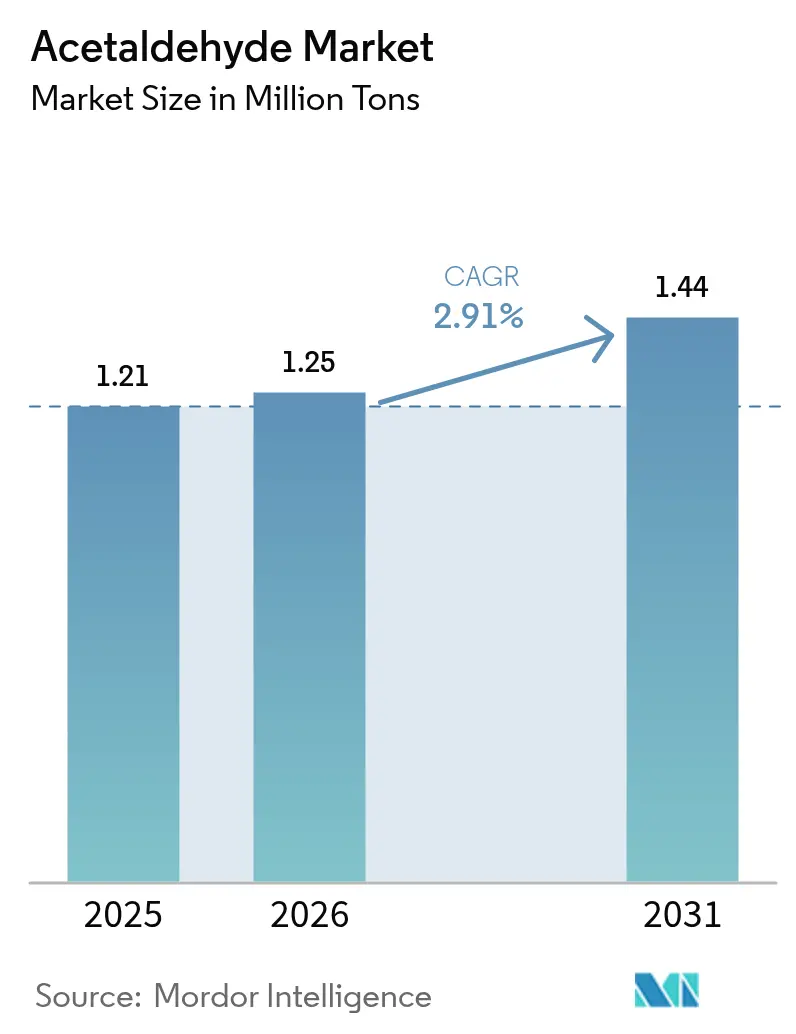
| Market Volume (2026) | 1.25 Million tons |
| Market Volume (2031) | 1.44 Million tons |
| Growth Rate (2026 - 2031) | 2.91 % |
| Fastest Growing Market | North America |
| Largest Market | Asia Pacific |
| Market Concentration | Medium |
Major Players *Disclaimer: Major Players sorted in no particular order Image © Mordor Intelligence. Reuse requires attribution under CC BY 4.0. | |
Acetaldehyde Market Analysis by Mordor Intelligence
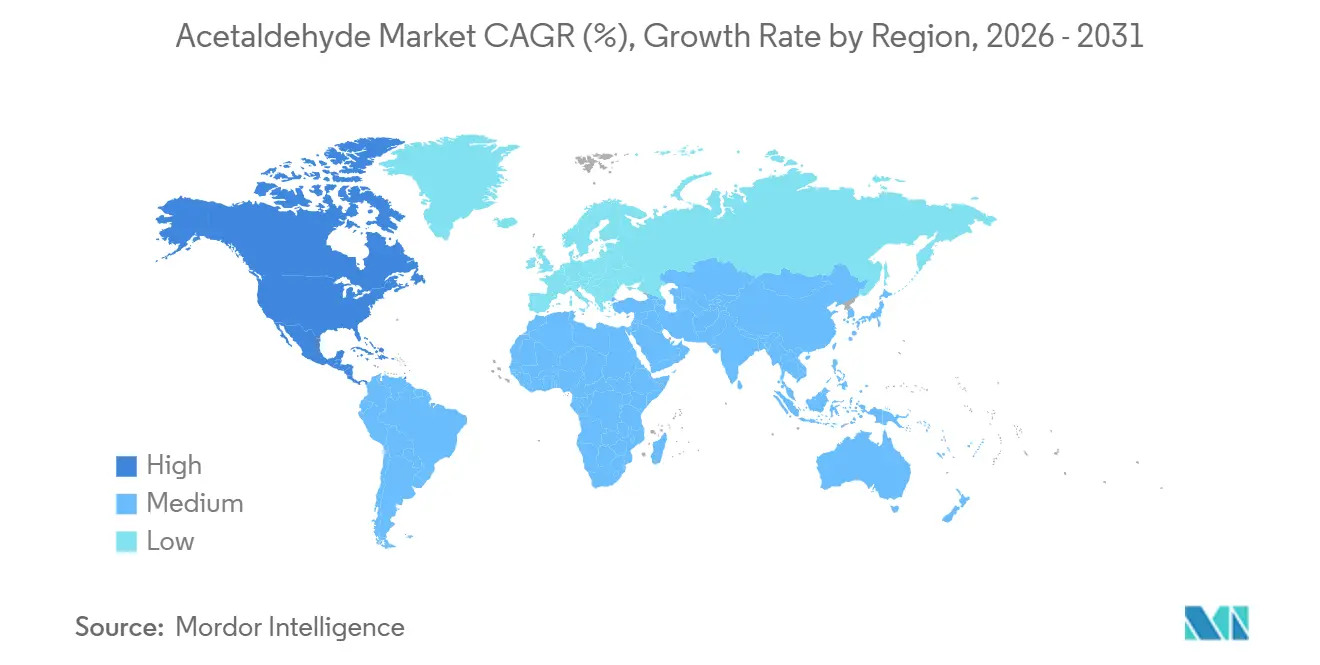
The Acetaldehyde Market size is projected to expand from 1.21 million tons in 2025 and 1.25 million tons in 2026 to 1.44 million tons by 2031, registering a CAGR of 2.91% between 2026 to 2031. Bio-ethanol routes are scaling as producers seek lifecycle emissions near 0.75 kg CO₂ per kg, far below the 5.7 kg intensity of fossil pathways. Traditional Wacker-process units face margin pressure because ethylene prices swing with crude and gas liquids, while palladium oxide catalysis for direct ethane oxidation offers a future low-capex alternative. Downstream, acetate esters and pentaerythritol gain traction as low-VOC regulations tighten in coatings and adhesives. Regional cost curves are fragmenting: Asia-Pacific keeps scale leadership, yet North America captures fastest growth thanks to abundant ethane and policy incentives such as the Inflation Reduction Act.
Key Report Takeaways
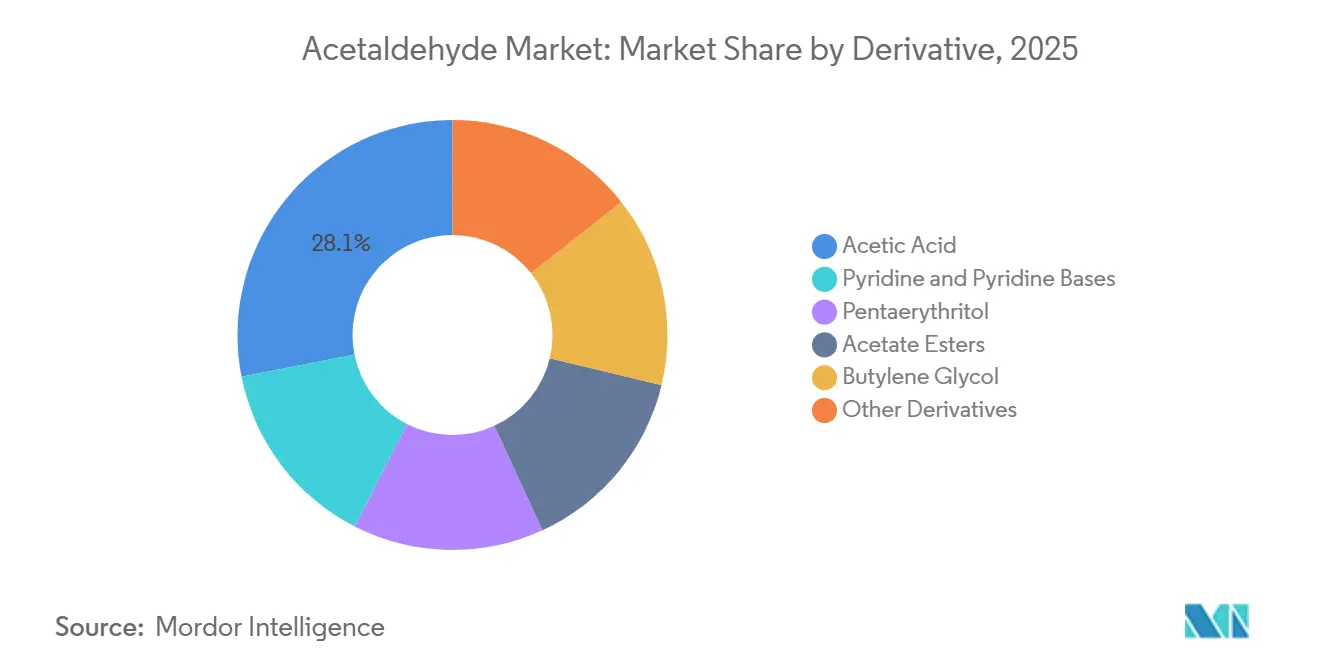
- By derivative, acetic acid led with 28.12% of the acetaldehyde market share in 2025, while pyridine and pyridine bases are projected to expand at a 3.78% CAGR through 2031.
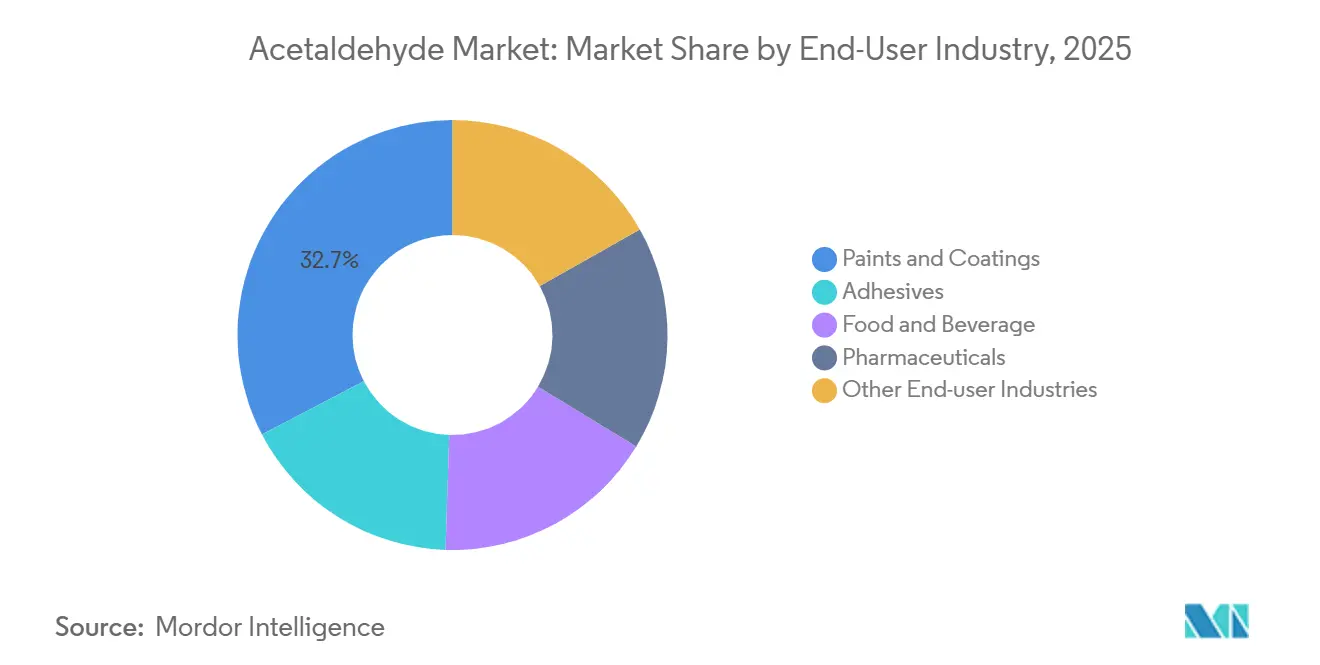
- By end-user industry, paints and coatings held 32.66% share of the acetaldehyde market size in 2025 and are advancing at a 3.22% CAGR through 2031.
- By geography, Asia-Pacific accounted for 57.25% of the 2025 volume, whereas North America is set to grow at a 3.13% CAGR between 2026-2031.
Note: Market size and forecast figures in this report are generated using Mordor Intelligence’s proprietary estimation framework, updated with the latest available data and insights as of 2026.
Market Trends and Insights
Drivers Impact Analysis of Acetaldehyde Market*
| Drivers | (~) % Impact on CAGR Forecast | Geographic Relevance | Impact Timeline |
|---|---|---|---|
| Expanding pentaerythritol use in alkyd and UV-curable resins | +0.8% | Global, with concentration in Asia-Pacific and Europe | Medium term (2-4 years) |
| Growing acetate-ester demand in low-VOC solvent blends | +0.7% | North America, Europe, Asia-Pacific | Short term (≤ 2 years) |
| Breakthrough ethane-to-acetaldehyde PdO catalysis | +0.5% | North America, Middle East (ethane-rich regions) | Long term (≥ 4 years) |
| Circular PET de-aldehyde upgrades raising bottle-grade quality bar | +0.4% | Global, led by Europe and North America | Medium term (2-4 years) |
| Bio-ethanol derived acetaldehyde for low-carbon supply chains | +0.6% | Europe, North America, Brazil | Medium term (2-4 years) |
| Source: Mordor Intelligence | |||
Expanding Pentaerythritol Use in Alkyd and UV-Curable Resins
Coatings makers are shifting toward alkyd and UV-curable systems that rely on pentaerythritol produced from acetaldehyde. These resins meet volatile-organic-compound limits below 50 g per liter in the European Union[1]European Commission, “Directive 2010/75/EU on Industrial Emissions,” europa.eu. UV-curable finishes cure without solvent loss, so demand rises in automotive and electronics. Bio-based pentaerythritol can cut lifecycle emissions by up to 30% and earns pricing premiums in sustainability-focused brands[2]Royal Society of Chemistry, “Life-Cycle Metrics of Bio-Pentaerythritol,” rsc.org . Asia-Pacific leads consumption because of ongoing construction activity, while Europe’s REACH rules encourage lower-emission feedstocks. As a result, pentaerythritol growth secures additional pull for the acetaldehyde market.
Growing Acetate-Ester Demand in Low-VOC Solvent Blends
Ethyl, butyl, and propyl acetates come from acetaldehyde via acetic acid and serve as safer solvents in paints, inks, and adhesives. Regulatory frameworks such as the EU Solvent Emissions Directive and California Rule 1113 push formulators to replace aromatics with acetate esters. Flexographic printers are adopting ethyl acetate because it evaporates cleanly and has low toxicity. China keeps adding acetic-acid capacity earmarked for esterification, supporting intra-regional supply. North American demand rebounded in 2025 despite higher ethanol feed costs, showing the resilience of downstream value. Forward-integrated producers capture higher margins than merchants who only sell commodity acetaldehyde.
Breakthrough Ethane-to-Acetaldehyde PdO Catalysis
Laboratory work published in 2024 proved that palladium oxide can convert ethane directly into acetaldehyde with more than 90% selectivity. Omitting the ethylene step promises lower capital spend for new plants, particularly in shale-rich North America and gas-rich Middle East. Commercial scaling usually needs five to seven years, so first deployments will likely be greenfield builds rather than retrofits. Operators with sunk investment in Wacker units may delay adoption to avoid stranded assets. Even so, the technology adds a disruptive option that could reshape cost leadership in the acetaldehyde market.
Circular PET De-Aldehyde Upgrades Raising Bottle-Grade Quality Bar
Recycled PET must have minimal acetaldehyde to suit food-contact bottles. Solid-state polymerization under vacuum volatilizes acetaldehyde, but new scavengers such as anthranilamide chemically bind the molecule, saving energy. Tighter European circular-economy rules that require 30% recycled content by 2030 intensify quality needs. High-purity acetaldehyde, favored for catalyst control, commands price premiums and supports differentiation. Producers segmenting between commodity and specialty grades can capture this emerging value pocket.
Restraints Impact Analysis of Acetaldehyde Market*
| Restraints | (~) % Impact on CAGR Forecast | Geographic Relevance | Impact Timeline |
|---|---|---|---|
| Carcinogenic re-classification and tighter workplace exposure limits | -0.6% | Global, with stricter enforcement in North America and Europe | Short term (≤ 2 years) |
| Ethylene price volatility squeezing Wacker-process margins | -0.5% | Europe, Asia-Pacific (naphtha-based regions) | Short term (≤ 2 years) |
| On-site formaldehyde generation replacing acetaldehyde in disinfectants | -0.3% | North America, Europe | Medium term (2-4 years) |
| Source: Mordor Intelligence | |||
Carcinogenic Re-Classification and Tighter Workplace Exposure Limits
The International Agency for Research on Cancer lists acetaldehyde as Group 2B, prompting regulators to lower exposure limits. ACGIH set a ceiling value of 25 ppm in 2024, and several U.S. states consider stricter thresholds. Formulators in flavors and preservatives are reformulating or substituting to avoid compliance costs. Industrial users invest in closed-loop systems and vapor recovery, increasing fixed costs and pressuring smaller firms.
Ethylene Price Volatility Squeezing Wacker-Process Margins
Wacker oxidation depends on ethylene, whose cost tracks oil and natural-gas liquids. A 2025 academic study placed the levelized ethylene cost near USD 746 per ton under mid-range fuel assumptions. When ethylene spikes, acetaldehyde prices cannot fully adjust because acetic acid prices are capped by cheaper methanol carbonylation. Integrated players with captive ethylene or ethanol are better placed than merchant producers, who may rationalize capacity.
*Our forecasts treat driver/restraint impacts as directional, not additive. The impact forecasts reflect baseline growth, mix effects, and variable interactions.
Acetaldehyde Market Segment Analysis
By Derivative:
Acetic Acid Dominates, Pyridine Bases AccelerateAcetic acid captured 28.12% of the 2025 volume, confirming its position as the largest single outlet within the acetaldehyde market share. The acetaldehyde market size linked to pyridine and pyridine bases is projected to widen at a 3.78% CAGR through 2031 as agrochemical and pharmaceutical producers scale demand for acetaldehyde-ammonia trimer intermediates.
Pentaerythritol ranks second and mirrors coatings growth, while acetate esters rise on the pull from low-VOC solvents. Butylene glycol stays niche, serving cosmetics where bio-based fermentation routes compete. Peracetic acid grows in food sanitation, benefiting from a favorable regulatory status relative to chlorine.



By End-User Industry:
Coatings Lead, Pharmaceuticals Offer MarginPaints and coatings held 32.66% of 2025 demand and will advance at a 3.22% CAGR during 2026-2031, the quickest among end-uses. This trajectory roots in waterborne and UV-curable systems that contain lower solvent loads, reinforcing structural demand for downstream acetaldehyde derivatives.
Pharmaceutical applications, although smaller, deliver higher margins because they require high-purity input; bio-based acetaldehyde fetches premiums of up to 20% in this segment. Food and beverage uses face uncertainty as safety review bodies reassess acetaldehyde’s GRAS status. Adhesives and rubber additives round out the mix, providing diversification against single-segment shocks.
Geography Analysis
APAC and India Acetaldehyde Market
Asia-Pacific accounted for 57.25% of global volume in 2025, anchored by China’s 10.81 million-ton annual acetic-acid capacity. New units scheduled for 2026 indicate continuing scale additions despite thinner margins. India’s acetaldehyde demand is rising due to pharmaceutical and agrochemical investments, and mergers such as Laxmi Organic with Yellowstone Fine Chemicals highlight consolidation aimed at feedstock security.
North America Acetaldehyde Market
North America is forecast to register the fastest regional pace at 3.13% CAGR from 2026-2031. Ethane-rich feedstock and policy support, including clean-energy tax credits, underpin several expansion projects. Celanese started a 1.3 million-ton acetic acid addition in March 2024 and positions it as the lowest-carbon unit globally, courtesy of co-located ethylene crackers.
Europe, South America and Middle East Acetaldehyde Market
Europe remains challenged by high naphtha-based ethylene costs but pursues competitiveness through renewable routes. Sekab’s wood-cellulose acetaldehyde line, certified in 2024, exemplifies the pivot. South America leverages sugarcane ethanol yet continues to export raw feedstock rather than investing heavily in downstream acetaldehyde capacity. Middle East producers monitor PdO catalysis because abundant ethane could unlock a cost advantage once the technology scales.

Value Chain Analysis
Acetaldehyde supply draws on two main feedstock pools, petrochemical ethylene (supporting Wacker oxidation) and bio-ethanol (supporting dehydrogenation or catalytic oxidation routes), with smaller legacy reliance on acetylene hydration in limited locations. Most producers handle acetaldehyde as a captive intermediate within integrated acetyls and derivative chains, converting it into acetic acid and further into acetate esters, while also supplying pentaerythritol and pyridine intermediates; this setup reduces exposure to ethylene or ethanol cost swings that can compress standalone acetaldehyde margins.
Downstream distribution splits between bulk shipments to large derivative plants and smaller, higher-purity streams for pharmaceutical and specialty applications where aldehyde control carries additional value. Key bottlenecks and cost adders increasingly cluster around safety and compliance, including flammable vapor handling, VOC management, and worker exposure controls. These requirements favor closed-loop loading, vapor recovery, and stronger traceability, which tend to benefit larger integrated operators and specialist logistics built for reactive, volatile organics.
Competitive Landscape
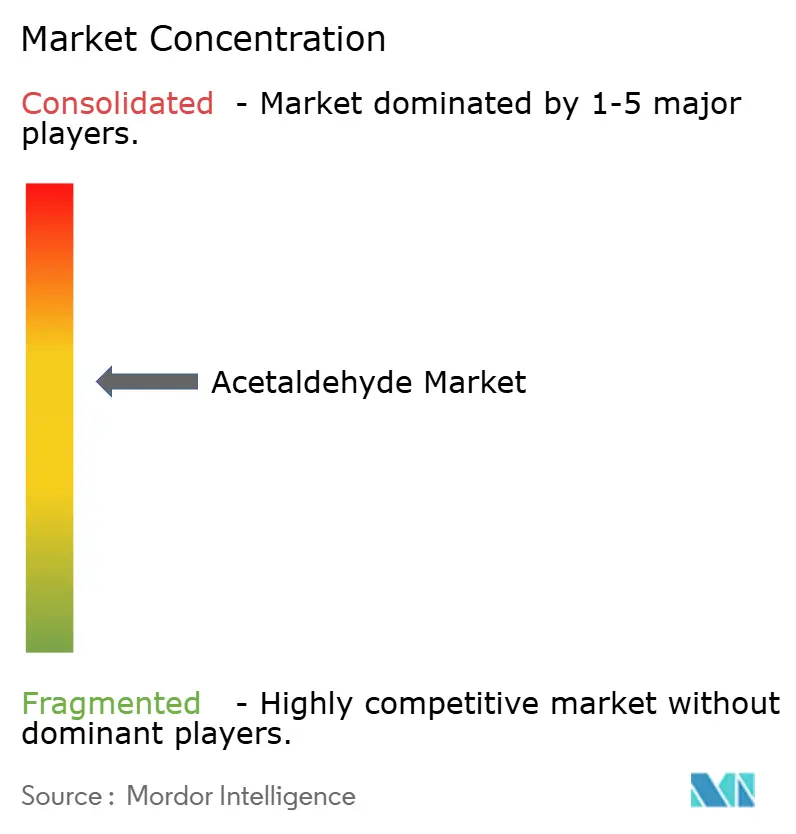
The acetaldehyde market is moderately consolidated. Celanese, Eastman Chemical, and Wacker Chemie anchor the leadership tier because they combine upstream feedstock control with downstream derivative integration. Celanese’s Clear Lake complex in Texas, which started a 1.3 million-ton acetic-acid train in March 2024, is tied to an onsite ethylene cracker and gives the company one of the lowest cost positions in the acetaldehyde market. Eastman continues to leverage proprietary oxo-technology that channels internally produced acetaldehyde into acetate esters used in coatings and specialty polymers, thereby lowering exposure to spot-market volatility. Wacker Chemie still licenses the canonical ethylene-oxidation route but is retooling European units with energy-efficiency upgrades to withstand high naphtha-based feedstock costs.
Acetaldehyde Industry Leaders
Celanese Corporation
Eastman Chemical Company
Sumitomo Chemical Co., Ltd.
Jubilant Ingrevia Limited
Wacker Chemie AG
- *Disclaimer: Major Players sorted in no particular order
Acetaldehyde Market Companies Covered in this Report
- Arkema S.A
- Celanese Corporation
- Daicel Corporation
- Eastman Chemical Company
- INEOS Group Ltd.
- Jubilant Ingrevia Limited
- Laxmi Organic Industries Ltd.
- LCY
- Lonza
- Merck KGaA
- Resonac Corporation
- Sekab
- Sumitomo Chemical Co., Ltd.
- Wacker Chemie AG

Market Opportunities and Future Outlook
A white-space pocket is emerging around lower-carbon acetaldehyde supply for customers needing traceable footprints in coatings solvents and other downstream chemicals, consistent with the broader push for bio-ethanol routes that can reach lifecycle emissions around 0.75 kg CO2 per kg compared with fossil pathways. Technology progress in catalytic bioethanol-to-acetaldehyde conversion reinforces this direction: in December 2025, researchers at the Dalian Institute of Chemical Physics reported a perovskite-supported gold catalyst delivering about a 95% acetaldehyde yield at 225 C, supporting more energy-efficient process modules and debottlenecking options beyond legacy Wacker economics.
A second opportunity sits at the intersection of circular plastics and aldehyde management in recycled PET, where lower residual acetaldehyde requirements raise demand for tighter high-purity control and scavenger-enabled process windows. In July 2026, Nature Communications reported an atmospheric CO2-to-acetaldehyde route using metallo hydrogen-bonded organic frameworks in an artificial photosynthesis context, adding longer-horizon optionality for alternative carbon feedstocks. While it is not yet commercial, the work expands the innovation pipeline that could influence where and how acetaldehyde is produced in regions prioritizing decarbonization and renewable power integration.
Recent Industry Developments in Acetaldehyde Market
- March 2026: Celanese announced immediate global price increases across its acetyls chain, including acetic acid, VAM, and other derivatives, with changes varying by region. The move signaled active price management across integrated acetyls platforms that sit upstream and downstream of acetaldehyde, affecting contract negotiations and spot availability for derivative producers.
- January 2026: Laxmi Organic raised domestic acetaldehyde prices in India, citing higher ethanol and ethylene costs alongside firm coatings demand. The increase underscored how merchant and semi-integrated producers track feedstock swings and how feedstock flexibility matters for supplying coatings-linked derivative demand.
- December 2024: Sekab obtained ISCC PLUS certification for wood-cellulose-based acetaldehyde, validating a lifecycle emissions footprint cited at 0.75 kg CO2 per kg. The certification improved commercial readiness of renewable acetaldehyde for buyers seeking auditable mass-balance claims and lower-carbon inputs across downstream acetaldehyde derivatives.


Acetaldehyde Market Report Scope and Research Methodology
Market Definition and Coverage
For this study, the acetaldehyde market is defined as the global demand for acetaldehyde produced and consumed as a chemical intermediate, measured at the level of bulk merchant supply and captive internal use, and expressed in volume terms.
Scope exclusions: This sizing excludes downstream derivative market values and any double counting of acetaldehyde embedded inside finished products.
Segments Covered in This Report
- By Derivative
- Pyridine and Pyridine Bases
- Pentaerythritol
- Acetic Acid
- Acetate Esters
- Butylene Glycol
- Other Derivatives (Chloral, Peracetic Acid, etc.)
- By End-User Industry
- Adhesives
- Food and Beverage
- Paints and Coatings
- Pharmaceuticals
- Other End-user Industries (Water Treatment, Plastics, Rubber, Fuel Additives, etc.)
- By Geography
- Asia-Pacific
- China
- India
- Japan
- South Korea
- Rest of Asia-Pacific
- North America
- United States
- Canada
- Mexico
- Europe
- Germany
- United Kingdom
- France
- Italy
- Spain
- Russia
- NORDIC
- Turkey
- Rest of Europe
- South America
- Brazil
- Argentina
- Rest of South America
- Middle-East and Africa
- Saudi Arabia
- South Africa
- Rest of Middle-East and Africa
- Asia-Pacific
Data Sources, Market Sizing, and Validation
Desk Research
Desk research was used to build a grounded starting point on acetaldehyde production routes, end-use linkages, and trade patterns, before the assumptions were tested in the market model. We typically reference public datasets such as UN Comtrade trade statistics, USGS mineral and chemicals summaries where applicable, and U.S. EPA and ECHA regulatory disclosures. Peer reviewed chemistry and process-engineering journals were also used to sanity check use rates and yield ranges.
On top of official sources, we relied on company annual reports, investor presentations, press releases, and association websites to track capacity changes, plant restarts, and regional supply tightness. Limited paid subscriptions were used mainly for company financials and intelligence, patent lookups, and import-export shipment level checks so the model inputs could be cross-verified. The sources named here are illustrative only, and many other public and paid references were reviewed during data collection, validation, and clarification.
Primary Interviews and Surveys
Primary work focused on interviews and short surveys with producers, distributors, derivative manufacturers, and procurement and operations roles in end-use industries across APAC, EMEA, and the Americas. These discussions were used to confirm typical operating rates, the share of captive versus merchant volumes, and how pricing resets and feedstock pass-through show up in contracts. When gaps were found in public data, we went back to domain experts to stress test the assumptions until the final totals and regional splits stayed internally consistent.
Distribution of primary research fieldwork respondents
| Company type | Respondent position | Region |
|---|---|---|
| Top tier: 36% | CXOs: 16% | APAC: 40% |
| Mid tier: 47% | Functional/Unit leaders: 25% | EMEA: 37% |
| Smaller Players: 17% | Managers: 59% | Americas: 23% |
Market-Sizing & Forecasting
Sizing is built using a top-down approach that reconstructs regional demand pools from derivative output indicators and process consumption factors, and then adjusts for trade flows and the level of captive production. The totals are corroborated with selective bottom-up checks, such as sampling supplier capacities and operating rates, along with channel feedback on merchant availability, before the final numbers are locked.
Key inputs used in the model include acetaldehyde plant capacities and utilization bands, regional import-export movements, derivative production trends that consume acetaldehyde (such as for pyridine bases and pentaerythritol), and observed shifts in ethanol and ethylene based route economics that can change supply behavior. Price is handled as a supporting check rather than the main driver since this report sizes the market in volume. Even so, the model tracks typical contract reset frequency and feedstock pass-through patterns to validate whether the implied tonnage is realistic.
Forecasting is run using scenario analysis, where macro demand signals from major end-use industries and expected capacity actions are combined with expert-agreed utilization and trade assumptions. Where bottom-up inputs are incomplete for smaller plants or captive lines, the missing portion is filled using region-level utilization benchmarks and then rechecked through interviews so the gap does not distort the global total.
Data Validation & Update Cycle
Outputs are validated through triangulation across independent signals, including capacity and operating rate logic, trade balances, and derivative demand consistency, and then outliers are investigated one by one. A second analyst review is done to recheck calculations, confirm units, and challenge any assumption that moves the market materially.
The report is refreshed annually, and interim updates are triggered when major capacity additions, shutdowns, or trade disruptions occur that can move regional availability. Before delivery, a final pass is completed to capture the latest public releases, and to re-contact experts if a recent event creates a noticeable variance versus the prior model run.
Mordor Intelligence's Acetaldehyde Market Estimate Compared With Other Published Estimates
Published acetaldehyde market sizes often do not match because some studies report revenue while others report volume. In those cases, the pricing and currency choices behind value estimates can shift the result quickly. Another common reason is that the boundary between acetaldehyde and its derivatives gets blurred, which can lead to double counting when totals are summed.
In a refresh-led read, the spread is usually explained by how frequently prices are updated, which FX date is used for currency conversion, and whether implied price per ton lines up with known feedstock movements and contract reset timing. In our work, those checks are re-run close to publication so the volume baseline stays stable while price signals remain consistent, a step handled explicitly in Mordor Intelligence's model before the benchmark totals are finalized.
Benchmark comparison
| Source | Market Size | Gaps in Research Methodology |
|---|---|---|
| Mordor Intelligence | USD 0.00 B (2025) | |
| Global Consultancy A | USD 2.35 B (2025) | Uses a revenue view for 2025, where the implied price per ton can vary by contract timing and spot exposure, and the value can shift if FX conversion is anchored to a different month than physical volumes. |
| Industry Research House B | USD 1.73 B (2025) | Also reports value, and the lower 2025 total can reflect conservative ASP progression and a narrower set of transactions captured, which can understate regions with higher merchant pricing despite similar tonnage. |
The table mainly shows a unit mismatch, where the report baseline is volume-led, while the other figures convert to USD using their own price and FX choices. By keeping the sizing tied to capacity, trade balance, and derivative consumption checks, and only then using price as a reasonableness filter, the final output stays easier to reproduce and explain on a simple set of variables.


Key Questions Answered in the Report
What is the current market size for acetaldehyde?
The acetaldehyde market is estimated to grow from 1.21 million tons in 2025 to 1.25 million tons in 2026.
What growth rate is expected for the acetaldehyde market through 2031?
Volume is projected to rise at a 2.91% CAGR between 2026-2031 as bio-routes offset slower fossil growth.
Which derivative will expand fastest over the next five years?
Pyridine and pyridine bases are forecast to post the highest CAGR at 3.78% because of agrochemical and pharmaceutical demand.
Why is North America the quickest-growing region?
Abundant shale-based ethane, clean-energy tax credits, and reshoring of chemical chains lift regional CAGR to 3.13%.
How are new technologies reshaping supply economics?
Palladium-oxide catalysis that converts ethane directly into acetaldehyde could cut capital costs for greenfield plants in gas-rich regions.
What regulatory headwinds affect acetaldehyde use?
Group 2B carcinogen status and lower occupational exposure limits are pushing formulators to re-engineer or substitute in consumer-facing products.
Where does bio-based acetaldehyde create the most value?
Low-carbon supply chains for high-purity pharmaceuticals, coatings, and recycled-PET scavengers command 15-20% price premiums.
Page last updated on:


 Your data is secure and never sold or shared.


