

Market Overview
| Study Period | 2017 - 2030 |
|---|---|
| Market Size (2025) | USD 37.88 Billion |
| Market Size (2030) | USD 48.05 Billion |
| Growth Rate (2025 - 2030) | 4.87% CAGR |
| Fastest Growing Market | Africa |
| Largest Market | Asia Pacific |
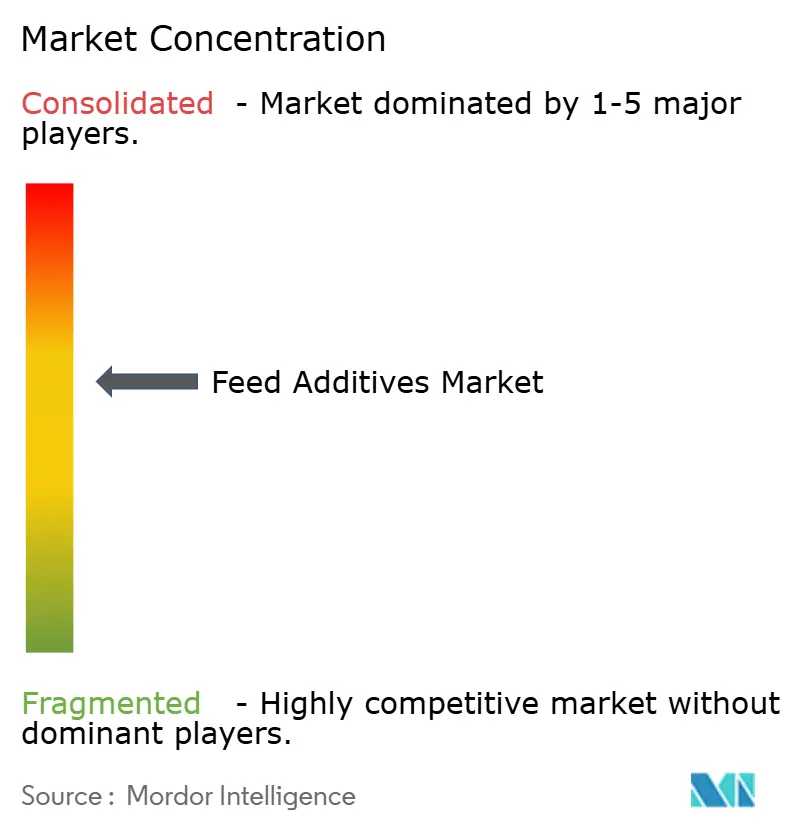
| Market Concentration | Medium |
Major Players
*Disclaimer: Major Players sorted in no particular order Image © Mordor Intelligence. Reuse requires attribution under CC BY 4.0. |
|

Feed Additives Market Analysis by Mordor Intelligence
The feed additives market size reached USD 37.88 billion in 2025 and is forecast to climb to USD 48.05 billion by 2030, reflecting a 4.87% CAGR. Demand pivots around functional alternatives as universal antibiotic-growth-promoter bans take hold, while precision-fermentation streams transform waste proteins into peptide-rich inputs that lower formulation costs and appeal to clean-label buyers. Companies that align with evolving approval frameworks in China, the European Union, and the United States expand faster, as harmonized dossiers shorten time to market and widen geographic reach. Strategic partnerships between ingredient specialists and integrated meat producers accelerate data-driven product development, tightening the link between in-barn performance metrics and additive choice. Environmental declarations now influence purchasing decisions, pushing methane-reducing and low-phosphorus solutions into mainstream rations and reinforcing a premium pricing tier across all regions.
Key Report Takeaways
- By additive type, amino acids held the largest 22.1% share of the feed additives market in 2024, while antioxidants registered the fastest 4.4% CAGR to 2030.
- By animal, poultry led with a 43.5% of the feed additives market share in 2024, whereas aquaculture is projected to expand at a 3.9% CAGR through 2030.
- By geography, Asia-Pacific accounted for 31.4% of the feed additives market share in 2024, and Africa is set to record the highest 3.2% CAGR through 2030.
Global Feed Additives Market Trends and Insights
Drivers Impact Analysis
| Driver | (~) % Impact on CAGR Forecast | Geographic Relevance | Impact Timeline |
|---|---|---|---|
| Ban on Antibiotic Growth Promoters | +1.8% | Global, with strongest impact in Europe and Asia-Pacific | Medium term (2-4 years) |
| Rising Meat Consumption Per Capita | +1.2% | Asia-Pacific, Africa, and South America | Long term (≥ 4 years) |
| Industrialization of Livestock Production | +1.0% | Asia-Pacific core, spill-over to Africa and South America | Medium term (2-4 years) |
| Increasing Focus on Gut Health and Feed Efficiency | +0.8% | Global, with early adoption in North America and Europe | Short term (≤ 2 years) |
| Precision-Fermentation By-Products as Functional Additives | +0.6% | North America and Europe, expanding to Asia-Pacific | Long term (≥ 4 years) |
| Carbon-Footprint Labeling Spurring Methane-Reducing Additives | +0.4% | Europe and North America, with regulatory influence spreading globally | Medium term (2-4 years) |
| Source: Mordor Intelligence | |||
Ban on Antibiotic Growth Promoters
Regulatory restrictions on antibiotic growth promoters have accelerated beyond traditional markets, with China implementing comprehensive bans in 2024 that mirror European Union standards established under Regulation (EU) 2019/6. The Food and Drug Administration's (FDA's) termination of its Memorandum of Understanding with the Association of American Feed Control Officials (AAFCO) in October 2024 signals a shift toward more stringent oversight, launching the Animal Food Ingredient Consultation process to expedite approval of novel alternatives [1]Source: Food and Drug Administration, “Animal Food Ingredient Consultation Process,” fda.gov. This regulatory evolution creates immediate demand for functional replacements, particularly organic acids, essential oils, and probiotic blends that can maintain growth performance without antimicrobial resistance concerns. The transition has proven most challenging in swine production, where producers report a 5-8% feed conversion ratio deterioration during the initial adaptation period, driving premium pricing for proven alternatives.
Rising Meat Consumption Per Capita
Global per capita meat consumption continues its upward trajectory, reaching 43.2 kg annually in 2024, with developing economies driving the most significant increases. India's meat consumption has grown 12% year-over-year, while African markets show even more dramatic shifts as urbanization accelerates dietary transitions. This consumption growth translates directly into feed additive demand, as producers seek efficiency-enhancing solutions to meet protein requirements cost-effectively. The trend particularly benefits amino acid and enzyme segments, where optimization can improve feed conversion ratios by 8-12%, crucial for maintaining profitability amid rising grain costs that have increased 15% globally since early 2024 [2]Source: World Bank, “Commodity Markets Outlook 2024,” worldbank.org.
Industrialization of Livestock Production
Large-scale livestock operations increasingly dominate global protein production, with integrated producers controlling 68% of poultry output and 52% of swine production in major markets. These industrial systems demand consistent, measurable performance from feed additives, creating opportunities for precision nutrition solutions that can optimize production across thousands of animals simultaneously. The industrialization trend has accelerated the adoption of data-driven feed formulation, where additives are selected based on real-time performance metrics rather than traditional rule-of-thumb approaches. This shift favors suppliers who can provide technical support and performance guarantees, explaining the premium pricing power maintained by market leaders despite commodity-like base products.
Increasing Focus on Gut Health and Feed Efficiency
Livestock producers have shifted from growth-focused to efficiency-focused additive strategies, recognizing that gut health optimization delivers more sustainable performance improvements than simple growth promotion. This paradigm change has elevated probiotics, prebiotics, and postbiotics from niche applications to mainstream solutions, with the combined market for these products growing 18% annually. Advanced microbiome research has identified specific bacterial strains that can improve nutrient absorption by 15-20%, creating competitive advantages for companies investing in strain development and characterization. The trend has also driven demand for combination products that deliver synergistic effects, such as enzyme-probiotic blends that can simultaneously improve protein digestibility and establish beneficial gut flora.
Restraints Impact Analysis
| Restraint | (~) % Impact on CAGR Forecast | Geographic Relevance | Impact Timeline |
|---|---|---|---|
| Stringent Approval Regulations | -0.9% | Global, with the highest impact in Europe and North America | Medium term (2-4 years) |
| Volatile Raw-Material Prices | -0.7% | Global, with particular stress in the Asia-Pacific supply chains | Short term (≤ 2 years) |
| Consumer Skepticism Toward Synthetic Additives | -0.4% | North America and Europe, spreading to urban Asia-Pacific | Long term (≥ 4 years) |
| Biotech-Enzyme Capacity Bottlenecks | -0.3% | Global, with acute shortages in specialized enzyme categories | Medium term (2-4 years) |
| Source: Mordor Intelligence | |||
Stringent Approval Regulations
Regulatory approval timelines for novel feed additives have extended significantly, with the European Food Safety Authority requiring an average of 36 months for a comprehensive dossier review, compared to 24 months in 2019. The Food and Drug Administration's (FDA's) new Animal Food Ingredient Consultation process, while streamlining some procedures, has introduced additional data requirements for safety assessment that can add 6-12 months to approval timelines. These delays particularly impact innovative products like precision fermentation derivatives and novel enzyme formulations, where regulatory precedents remain limited. Companies report spending USD 2-5 million on regulatory compliance for each new additive, with no guarantee of approval, creating barriers for smaller innovators and slowing market dynamism.
Volatile Raw-Material Prices
Feed additive manufacturers face unprecedented raw material cost volatility, with vitamin premix prices fluctuating 40-60% quarterly due to supply chain disruptions and geopolitical tensions. A fire at a major German vitamin production facility in early 2024 triggered Force Majeure declarations across the industry, highlighting supply chain fragility. The United States' dependence on Chinese suppliers for 78% of vitamin requirements and 62% of amino acid inputs creates additional vulnerability to trade policy changes and currency fluctuations. These cost pressures force manufacturers to implement frequent price adjustments, complicating customer relationships and reducing predictability in feed formulation economics [3]Source: USDA Economic Research Service, “Feed Ingredient Import Dependence 2024,” ers.usda.gov.
Segment Analysis
By Additive: Amino Acids Lead While Probiotics Surge
The precision nutrition revolution has elevated amino acids to their dominant 22.1% market share in 2024, as producers optimize protein utilization to combat feed cost inflation that has increased ingredient expenses by 18% year-over-year. Methionine and lysine command premium pricing due to supply concentration, with only three global suppliers controlling 70% of methionine production capacity. Regulatory frameworks under the Association of American Feed Control Officials (AAFCO) and the European Food Safety Authority (EFSA) guidelines increasingly favor products with demonstrated mode-of-action data, creating competitive advantages for science-backed formulations over traditional empirical approaches.
Antioxidants emerge as the fastest-growing segment with a 4.4% CAGR through 2030. The market is witnessing a notable shift towards natural and clean-label antioxidants, reflecting broader consumer preferences for natural ingredients throughout the food chain. Enzymes maintain steady growth through phytase innovations that unlock phosphorus from plant-based feeds, while vitamins face margin pressure from Chinese supply disruptions that have created 45% price volatility in key compounds like vitamin E and biotin.

Note: Segment shares of all individual segments available upon report purchase
Get Detailed Market Forecasts at the Most Granular Levels
Download PDF
By Animal: Poultry Dominance Meets Aquaculture Innovation
Poultry maintains its commanding 43.5% market share in 2024, supported by the sector's rapid adoption of precision nutrition technologies that optimize additive combinations for specific production phases. The integration of artificial intelligence in feed formulation has enabled dynamic additive dosing based on real-time performance metrics, improving feed conversion ratios by 8-12% in commercial operations. Ruminant applications focus increasingly on methane reduction solutions, with 3-nitrooxypropanol achieving the Food and Drug Administration (FDA) approval for dairy cattle in late 2024, validating commercial pathways for emission-reducing additives.
Aquaculture emerges as the fastest-growing segment with a 3.9% CAGR through 2030, driven by functional feed innovations that address species-specific digestive physiology and disease prevention requirements in intensive farming systems. Shrimp farming particularly benefits from specialized enzyme blends that improve protein digestibility in high-density production environments where water quality management is critical. The segment dynamics reflect species-specific regulatory requirements, with aquaculture additives subject to environmental impact assessments that consider aquatic ecosystem effects, while terrestrial animal products focus primarily on food safety and residue concerns under the Food and Drug Administration (FDA) and the United States Department of Agriculture (USDA) oversight.

Note: Segment shares of all individual segments available upon report purchase
Get Detailed Market Forecasts at the Most Granular Levels
Download PDF
Geography Analysis
Asia-Pacific's 31.4% market share in 2024 reflects the region's industrial-scale livestock operations and sophisticated regulatory frameworks that increasingly mirror European Union standards for additive approval and usage. China's implementation of new feed additive registration requirements has created market consolidation opportunities, as smaller suppliers lack resources for the comprehensive dossier preparation required under the updated regulatory framework.
Africa demonstrates the highest growth potential with 3.2% CAGR through 2030, supported by urbanization trends that are shifting protein consumption patterns and government initiatives to modernize livestock production systems across Kenya, Nigeria, and Egypt. The continent's growth trajectory reflects infrastructure development that enables cold chain distribution of premium feed additives, previously limited by logistics constraints. Egypt's new DSM-Firmenich premix facility, with 10,000 metric tons annual capacity, demonstrates multinational confidence in regional market potential and provides local production capabilities that reduce import dependency.
North American producers benefit from streamlined regulatory processes under the Food and Drug Administration's (FDA's) new Animal Food Ingredient Consultation framework, which has reduced approval timelines for novel additives by 15-20% compared to previous procedures. South American markets, led by Brazil and Argentina, capitalize on export-oriented production systems that demand consistent quality standards, creating opportunities for premium additive solutions that ensure product traceability and compliance with international food safety requirements.

Get Analysis on Important Geographic Markets
Download PDF
Competitive Landscape
The feed additives market exhibits moderate consolidated with a concentration of players, including DSM-Firmenich AG, Evonik Industries AG, SHV (Nutreco NV), Archer-Daniels-Midland Co., and Adisseo. Creating substantial white-space opportunities for specialized competitors and regional players. This fragmentation reflects the industry's technical complexity, where different additive categories require distinct production capabilities, regulatory expertise, and customer relationships that prevent easy market consolidation. The competitive dynamics favor companies with broad product portfolios and technical service capabilities, as customers increasingly seek integrated solutions rather than single-ingredient suppliers.
Strategic patterns emphasize innovation partnerships and capacity expansion, with market leaders pursuing collaborative R&D to accelerate product development while maintaining competitive differentiation. DSM-Firmenich's merger created synergies in enzyme and vitamin production, enabling cross-selling opportunities and operational efficiencies that smaller competitors cannot replicate.
Emerging disruptors focus on precision fermentation and biotechnology applications, where novel production methods can create cost advantages and performance differentiation that challenge traditional manufacturing approaches. Patent activity in methane-reducing compounds and microbiome-based solutions indicates technology-driven competition that rewards R&D investment and regulatory expertise over traditional scale advantages, suggesting continued market fragmentation as innovation creates new competitive segments.
Feed Additives Industry Leaders
-
Evonik Industries AG
-
SHV (Nutreco NV)
-
Archer Daniel Midland Co.
-
Adisseo
-
DSM-Firmenich AG
- *Disclaimer: Major Players sorted in no particular order
Need More Details on Market Players and Competitors?
Download PDF
Recent Industry Developments
- July 2025: ADM (Archer Daniels Midland) plans to construct a premix manufacturing facility in Apucarana, Paraná. The facility will produce mixtures of minerals, amino acids, vitamins, and additives, increasing the company's production capacity by 40%. ADM, currently ranked among Brazil's top 10 animal nutrition manufacturers, aims to secure a position among the top three producers in the country.
- October 2024: DSM-Firmenich began operations at its new premix and feed additive manufacturing plant in Sadat City, Egypt, to meet the growing demand in the North African feed market. The 10,000-square-meter production facility serves customers across Egypt, the Middle East, Southern Europe, and Africa. The plant features modern infrastructure and Bühler Technologies' advanced systems, including an integrated control system with barcoding capabilities.
- May 2024: Innovad Group acquired Oligo Basics, a Brazilian manufacturer of prebiotic and organic acid solutions, for an undisclosed amount exceeding USD 15 million. The acquisition complements Innovad's existing feed additive offerings with Oligo Basics' prebiotic and organic acid solutions for livestock.
Global Feed Additives Market Report Scope
By Additive
| Acidifiers | By Sub Additive | Fumaric Acid |
| Lactic Acid | ||
| Propionic Acid | ||
| Other Acidifiers | ||
| Amino Acids | By Sub Additive | Lysine |
| Methionine | ||
| Threonine | ||
| Tryptophan | ||
| Other Amino Acids | ||
| Antibiotics | By Sub Additive | Bacitracin |
| Penicillins | ||
| Tetracyclines | ||
| Tylosin | ||
| Other Antibiotics | ||
| Antioxidants | By Sub Additive | Butylated Hydroxyanisole (BHA) |
| Butylated Hydroxytoluene (BHT) | ||
| Citric Acid | ||
| Ethoxyquin | ||
| Propyl Gallate | ||
| Tocopherols | ||
| Other Antioxidants | ||
| Binders | By Sub Additive | Natural Binders |
| Synthetic Binders | ||
| Enzymes | By Sub Additive | Carbohydrases |
| Phytases | ||
| Other Enzymes | ||
| Flavors & Sweeteners | By Sub Additive | Flavors |
| Sweeteners | ||
| Minerals | By Sub Additive | Macrominerals |
| Microminerals | ||
| Mycotoxin Detoxifiers | By Sub Additive | Binders |
| Biotransformers | ||
| Phytogenics | By Sub Additive | Essential Oil |
| Herbs & Spices | ||
| Other Phytogenics | ||
| Pigments | By Sub Additive | Carotenoids |
| Curcumin & Spirulina | ||
| Prebiotics | By Sub Additive | Fructo Oligosaccharides |
| Galacto Oligosaccharides | ||
| Inulin | ||
| Lactulose | ||
| Mannan Oligosaccharides | ||
| Xylo Oligosaccharides | ||
| Other Prebiotics | ||
| Probiotics | By Sub Additive | Bifidobacteria |
| Enterococcus | ||
| Lactobacilli | ||
| Pediococcus | ||
| Streptococcus | ||
| Other Probiotics | ||
| Vitamins | By Sub Additive | Vitamin A |
| Vitamin B | ||
| Vitamin C | ||
| Vitamin E | ||
| Other Vitamins | ||
| Yeast | By Sub Additive | Live Yeast |
| Selenium Yeast | ||
| Spent Yeast | ||
| Torula Dried Yeast | ||
| Whey Yeast | ||
| Yeast Derivatives |
By Animal
| Aquaculture | By Sub Animal | Fish |
| Shrimp | ||
| Other Aquaculture Species | ||
| Poultry | By Sub Animal | Broiler |
| Layer | ||
| Other Poultry Birds | ||
| Ruminants | By Sub Animal | Beef Cattle |
| Dairy Cattle | ||
| Other Ruminants | ||
| Swine | ||
| Other Animals |
By Geography
| Africa | By Country | Egypt |
| Kenya | ||
| South Africa | ||
| Rest of Africa | ||
| Asia-Pacific | By Country | Australia |
| China | ||
| India | ||
| Indonesia | ||
| Japan | ||
| Philippines | ||
| South Korea | ||
| Thailand | ||
| Vietnam | ||
| Rest of Asia-Pacific | ||
| Europe | By Country | France |
| Germany | ||
| Italy | ||
| Netherlands | ||
| Russia | ||
| Spain | ||
| Turkey | ||
| United Kingdom | ||
| Rest of Europe | ||
| Middle East | By Country | Iran |
| Saudi Arabia | ||
| Rest of Middle East | ||
| North America | By Country | Canada |
| Mexico | ||
| United States | ||
| Rest of North America | ||
| South America | By Country | Argentina |
| Brazil | ||
| Chile | ||
| Rest of South America |
| By Additive | Acidifiers | By Sub Additive | Fumaric Acid |
| Lactic Acid | |||
| Propionic Acid | |||
| Other Acidifiers | |||
| Amino Acids | By Sub Additive | Lysine | |
| Methionine | |||
| Threonine | |||
| Tryptophan | |||
| Other Amino Acids | |||
| Antibiotics | By Sub Additive | Bacitracin | |
| Penicillins | |||
| Tetracyclines | |||
| Tylosin | |||
| Other Antibiotics | |||
| Antioxidants | By Sub Additive | Butylated Hydroxyanisole (BHA) | |
| Butylated Hydroxytoluene (BHT) | |||
| Citric Acid | |||
| Ethoxyquin | |||
| Propyl Gallate | |||
| Tocopherols | |||
| Other Antioxidants | |||
| Binders | By Sub Additive | Natural Binders | |
| Synthetic Binders | |||
| Enzymes | By Sub Additive | Carbohydrases | |
| Phytases | |||
| Other Enzymes | |||
| Flavors & Sweeteners | By Sub Additive | Flavors | |
| Sweeteners | |||
| Minerals | By Sub Additive | Macrominerals | |
| Microminerals | |||
| Mycotoxin Detoxifiers | By Sub Additive | Binders | |
| Biotransformers | |||
| Phytogenics | By Sub Additive | Essential Oil | |
| Herbs & Spices | |||
| Other Phytogenics | |||
| Pigments | By Sub Additive | Carotenoids | |
| Curcumin & Spirulina | |||
| Prebiotics | By Sub Additive | Fructo Oligosaccharides | |
| Galacto Oligosaccharides | |||
| Inulin | |||
| Lactulose | |||
| Mannan Oligosaccharides | |||
| Xylo Oligosaccharides | |||
| Other Prebiotics | |||
| Probiotics | By Sub Additive | Bifidobacteria | |
| Enterococcus | |||
| Lactobacilli | |||
| Pediococcus | |||
| Streptococcus | |||
| Other Probiotics | |||
| Vitamins | By Sub Additive | Vitamin A | |
| Vitamin B | |||
| Vitamin C | |||
| Vitamin E | |||
| Other Vitamins | |||
| Yeast | By Sub Additive | Live Yeast | |
| Selenium Yeast | |||
| Spent Yeast | |||
| Torula Dried Yeast | |||
| Whey Yeast | |||
| Yeast Derivatives | |||
| By Animal | Aquaculture | By Sub Animal | Fish |
| Shrimp | |||
| Other Aquaculture Species | |||
| Poultry | By Sub Animal | Broiler | |
| Layer | |||
| Other Poultry Birds | |||
| Ruminants | By Sub Animal | Beef Cattle | |
| Dairy Cattle | |||
| Other Ruminants | |||
| Swine | |||
| Other Animals | |||
| By Geography | Africa | By Country | Egypt |
| Kenya | |||
| South Africa | |||
| Rest of Africa | |||
| Asia-Pacific | By Country | Australia | |
| China | |||
| India | |||
| Indonesia | |||
| Japan | |||
| Philippines | |||
| South Korea | |||
| Thailand | |||
| Vietnam | |||
| Rest of Asia-Pacific | |||
| Europe | By Country | France | |
| Germany | |||
| Italy | |||
| Netherlands | |||
| Russia | |||
| Spain | |||
| Turkey | |||
| United Kingdom | |||
| Rest of Europe | |||
| Middle East | By Country | Iran | |
| Saudi Arabia | |||
| Rest of Middle East | |||
| North America | By Country | Canada | |
| Mexico | |||
| United States | |||
| Rest of North America | |||
| South America | By Country | Argentina | |
| Brazil | |||
| Chile | |||
| Rest of South America | |||
Need A Different Region or Segment?
Customize Now
Market Definition
- FUNCTIONS - For the study, feed additives are considered to be commercially manufactured products that are used to enhance characteristics such as weight gain, feed conversion ratio, and feed intake when fed in appropriate proportions.
- RESELLERS - Companies engaged in reselling feed additives without value addition have been excluded from the market scope, to avoid double counting.
- END CONSUMERS - Compound feed manufacturers are considered to be end-consumers in the market studied. The scope excludes farmers buying feed additives to be used directly as supplements or premixes.
- INTERNAL COMPANY CONSUMPTION - Companies engaged in the production of compound feed as well as the manufacturing of feed additives are part of the study. However, while estimating the market sizes, the internal consumption of feed additives by such companies has been excluded.
| Keyword | Definition |
|---|---|
| Feed additives | Feed additives are products used in animal nutrition for purposes of improving the quality of feed and the quality of food from animal origin, or to improve the animals’ performance and health. |
| Probiotics | Probiotics are microorganisms introduced into the body for their beneficial qualities. (It maintains or restores beneficial bacteria to the gut). |
| Antibiotics | Antibiotic is a drug that is specifically used to inhibit the growth of bacteria. |
| Prebiotics | A non-digestible food ingredient that promotes the growth of beneficial microorganisms in the intestines. |
| Antioxidants | Antioxidants are compounds that inhibit oxidation, a chemical reaction that produces free radicals. |
| Phytogenics | Phytogenics are a group of natural and non-antibiotic growth promoters derived from herbs, spices, essential oils, and oleoresins. |
| Vitamins | Vitamins are organic compounds, which are required for normal growth and maintenance of the body. |
| Metabolism | A chemical process that occurs within a living organism in order to maintain life. |
| Amino acids | Amino acids are the building blocks of proteins and play an important role in metabolic pathways. |
| Enzymes | Enzyme is a substance that acts as a catalyst to bring about a specific biochemical reaction. |
| Anti-microbial resistance | The ability of a microorganism to resist the effects of an antimicrobial agent. |
| Anti-microbial | Destroying or inhibiting the growth of microorganisms. |
| Osmotic balance | It is a process of maintaining salt and water balance across membranes within the body's fluids. |
| Bacteriocin | Bacteriocins are the toxins produced by bacteria to inhibit the growth of similar or closely related bacterial strains. |
| Biohydrogenation | It is a process that occurs in the rumen of an animal in which bacteria convert unsaturated fatty acids (USFA) to saturated fatty acids (SFA). |
| Oxidative rancidity | It is a reaction of fatty acids with oxygen, which generally causes unpleasant odors in animals. To prevent these, antioxidants were added. |
| Mycotoxicosis | Any condition or disease caused by fungal toxins, mainly due to contamination of animal feed with mycotoxins. |
| Mycotoxins | Mycotoxins are toxin compounds that are naturally produced by certain types of molds (fungi). |
| Feed Probiotics | Microbial feed supplements positively affect gastrointestinal microbial balance. |
| Probiotic yeast | Feed yeast (single-cell fungi) and other fungi used as probiotics. |
| Feed enzymes | They are used to supplement digestive enzymes in an animal’s stomach to break down food. Enzymes also ensure that meat and egg production is improved. |
| Mycotoxin detoxifiers | They are used to prevent fungal growth and to stop any harmful mold from being absorbed in the gut and blood. |
| Feed antibiotics | They are used both for the prevention and treatment of diseases but also for rapid growth and development. |
| Feed antioxidants | They are used to protect the deterioration of other feed nutrients in the feed such as fats, vitamins, pigments, and flavoring agents, thus providing nutrient security to the animals. |
| Feed phytogenics | Phytogenics are natural substances, added to livestock feed to promote growth, aid in digestion, and act as anti-microbial agents. |
| Feed vitamins | They are used to maintain the normal physiological function and normal growth and development of animals. |
| Feed flavors and sweetners | These flavors and sweeteners help to mask tastes and odors during changes in additives or medications and make them ideal for animal diets undergoing transition. |
| Feed acidifiers | Animal feed acidifiers are organic acids incorporated into the feed for nutritional or preservative purposes. Acidifiers enhance congestion and microbiological balance in the alimentary and digestive tracts of livestock. |
| Feed minerals | Feed minerals play an important role in the regular dietary requirements of animal feed. |
| Feed binders | Feed binders are the binding agents used in the manufacture of safe animal feed products. It enhances the taste of food and prolongs the storage period of the feed. |
| Key Terms | Abbreviation |
| LSDV | Lumpy Skin Disease Virus |
| ASF | African Swine Fever |
| GPA | Growth Promoter Antibiotics |
| NSP | Non-Starch Polysaccharides |
| PUFA | Polyunsaturated Fatty Acid |
| Afs | Aflatoxins |
| AGP | Antibiotic Growth Promoters |
| FAO | The Food And Agriculture Organization of the United Nations |
| USDA | The United States Department of Agriculture |
Need More Details on Market Definition?
Ask a Question
Research Methodology
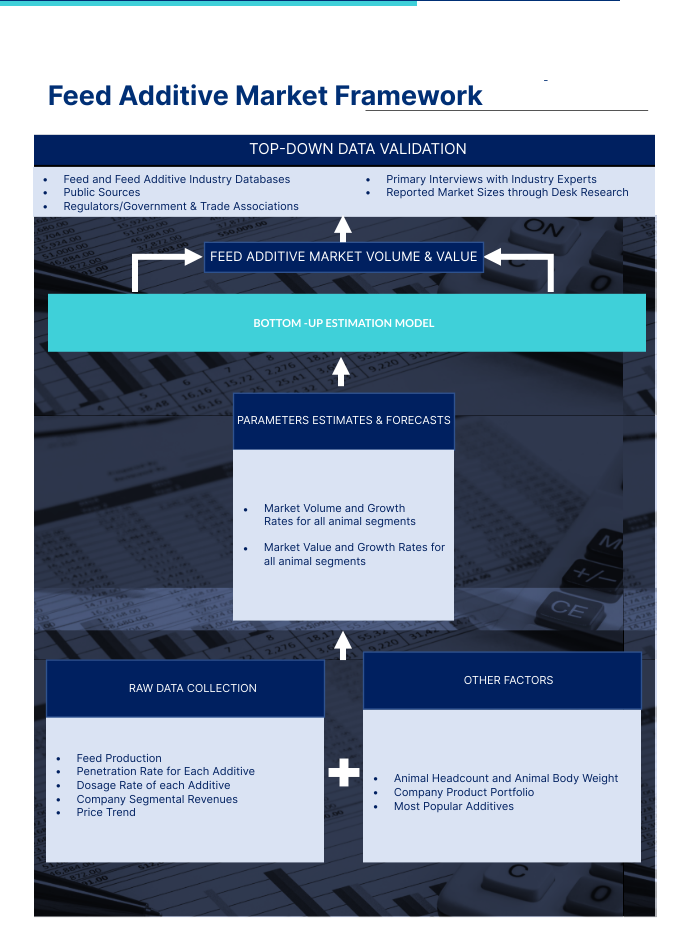
Mordor Intelligence follows a four-step methodology in all our reports.
- Step-1: IDENTIFY KEY VARIABLES: In order to build a robust forecasting methodology, the variables and factors identified in Step-1 are tested against available historical market numbers. Through an iterative process, the variables required for market forecast are set and the model is built on the basis of these variables.
- Step-2: Build a Market Model: Market-size estimations for the forecast years are in nominal terms. Inflation is not a part of the pricing, and the average selling price (ASP) is kept constant throughout the forecast period.
- Step-3: Validate and Finalize: In this important step, all market numbers, variables and analyst calls are validated through an extensive network of primary research experts from the market studied. The respondents are selected across levels and functions to generate a holistic picture of the market studied.
- Step-4: Research Outputs: Syndicated Reports, Custom Consulting Assignments, Databases & Subscription Platforms
Get More Details On Research Methodology
Download PDF




