
Online Gambling Market Analysis by Mordor Intelligence
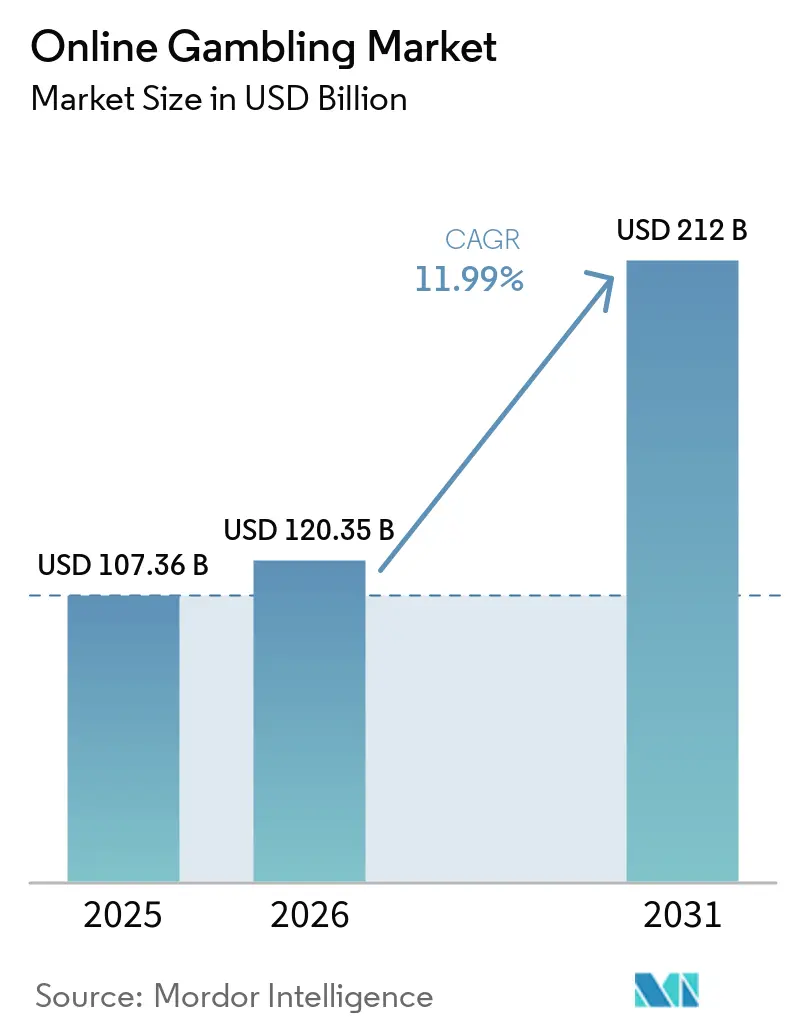
The online gambling market size is projected to expand from USD 120.4 billion in 2026 and USD 134.8 billion in 2027 to USD 231.4 billion by 2032, registering a CAGR of 11.42% between 2027 and 2032.
Mobile access, integrated live viewing and wagering, and faster bank transfers make casino and sportsbook services easier to reach and use. Operators can respond with differentiated content, shared technology and local operating businesses. The United Kingdom's Remote Gaming Duty increase from April 2026 narrows retained earnings and raises the return hurdle for expansion. Brazil's nationwide fixed-odds betting lottery prohibition under a provisional measure from September 2026 also restricts legal commercial access. Growth consequently favors offerings that combine usable digital services with a viable local operating model.
Key Report Takeaways
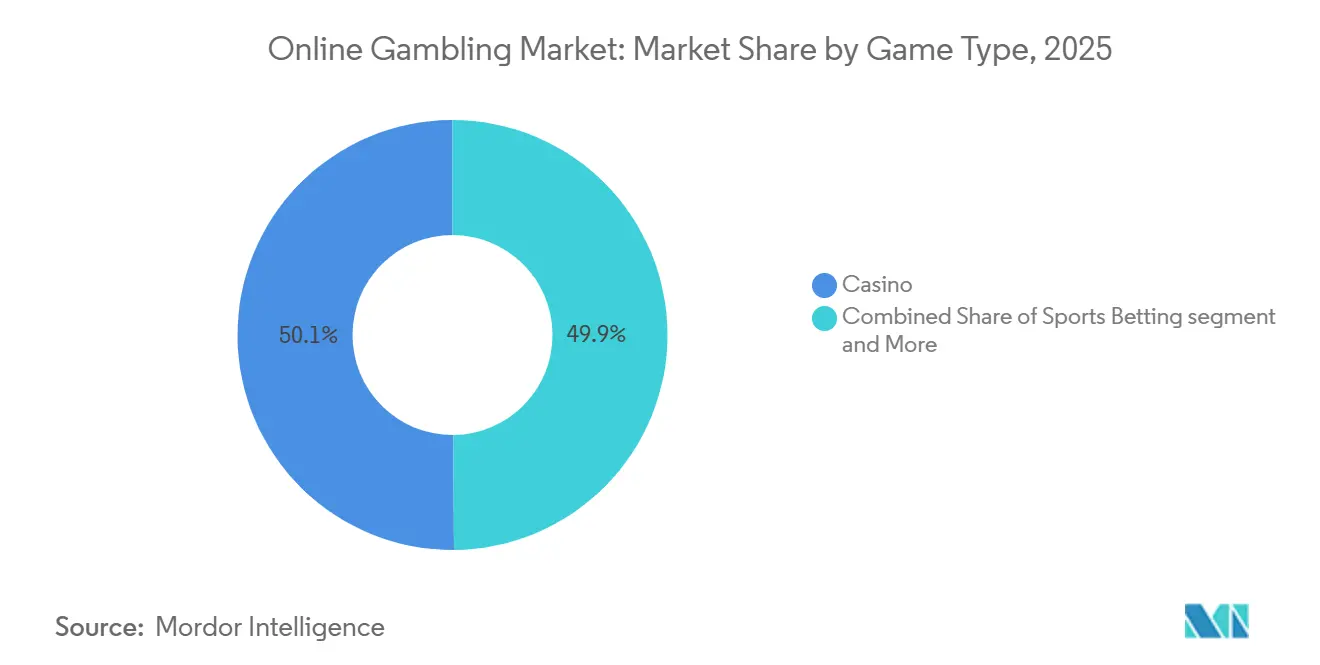
- By game type, casino accounted for 50.44% of the online gambling market size in 2026 and is the fastest-growing segment, with a projected CAGR of 12.15% between 2027 and 2032.
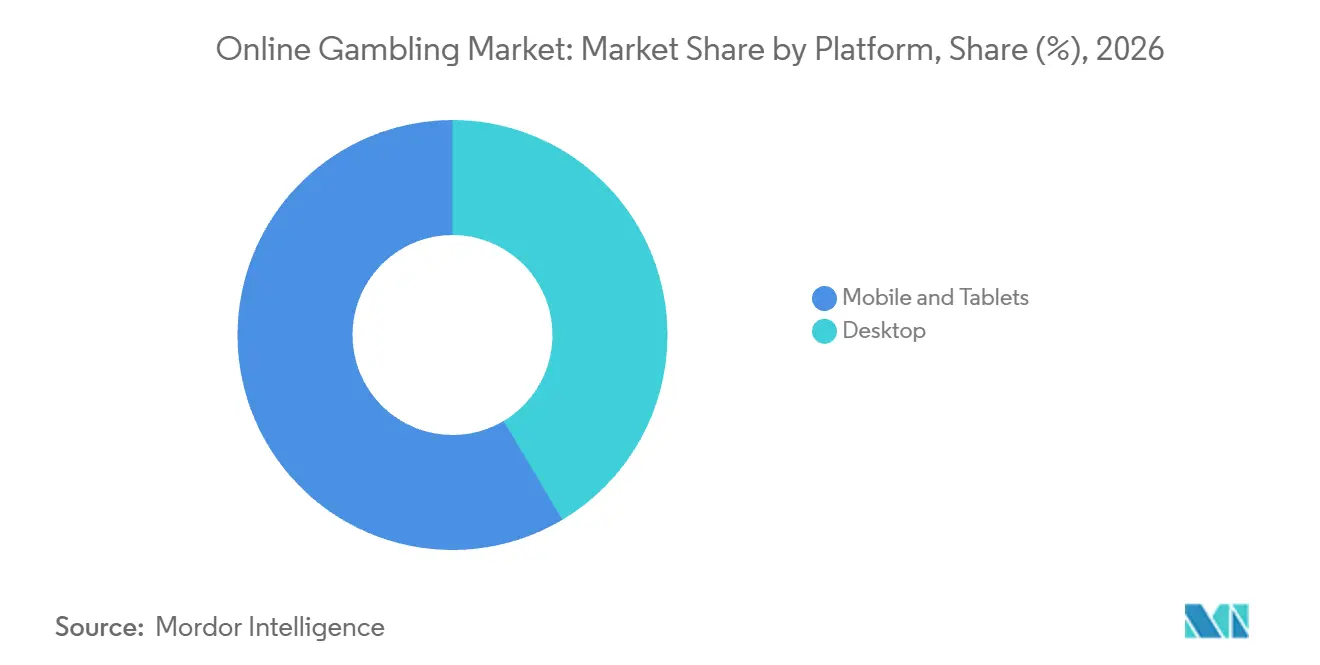
- Across platforms, mobile and tablets held a 58.54% online gambling market share in 2026 and are forecast to expand fastest, at a CAGR of 14.15% between 2027 and 2032.
- Among age groups, adults aged 35 to 44 led with a 30.12% market share in 2026, while adults aged 25 to 34 are forecast to grow fastest at a CAGR of 14.09% between 2027 and 2032.
- By betting type, pre-match/fixed-odds betting led with a 55.52% market share in 2026, whereas live/in-play is forecast to grow fastest at a CAGR of 13.3% between 2027 and 2032.
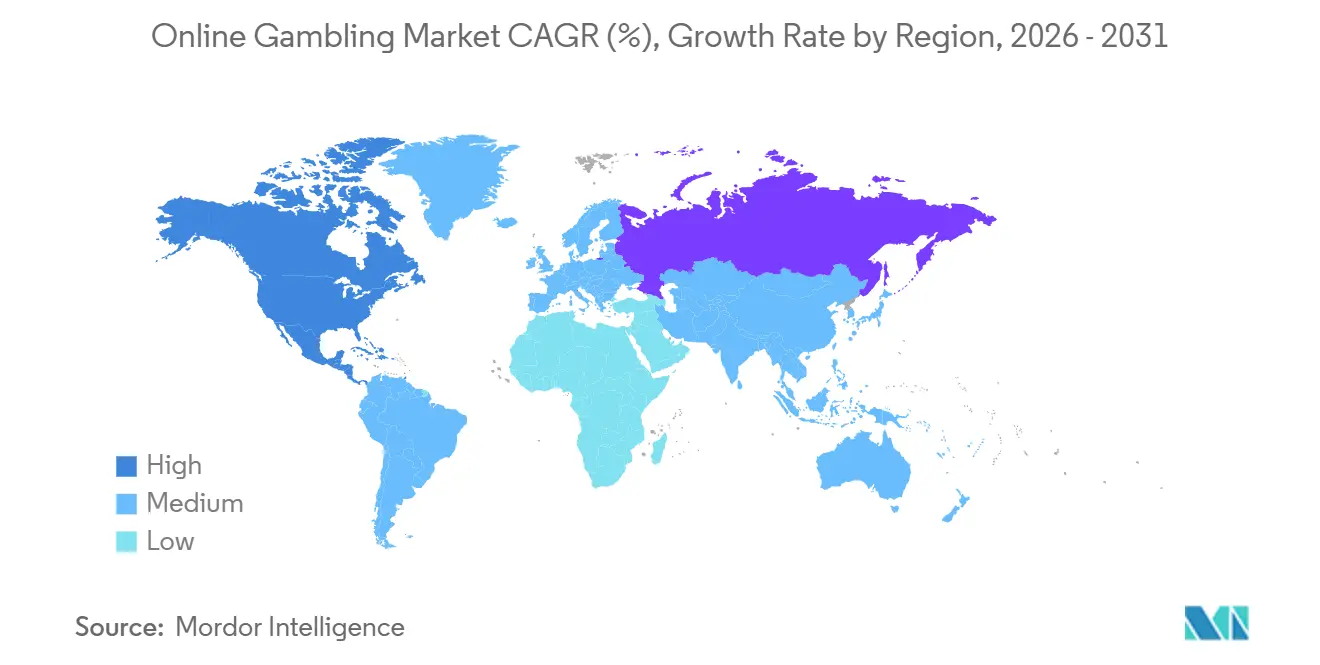
- Geographically, Europe led with 47.73% of the market in 2026, while North America is forecast to grow fastest at a CAGR of 16.05% between 2027 and 2032.
Note: Market numbers in this report are based on Mordor Intelligence's proprietary estimation framework, which combines nine months of actuals with Q4 projections for base year 2026.
Market Trends and Insights
Drivers Impact Analysis of Online Gambling Market*
| Driver | (~) % Impact on CAGR Forecast | Geographic Relevance | Impact Timeline |
|---|---|---|---|
| Advancement of Digital Technologies | +3% | North America (Mexico) | Medium term (2-4 years) |
| Legalization and Regulatory Liberalization | +4.3% | Ireland and Finland | Medium term (2-4 years) |
| Live Betting and Real-Time Streaming | +4% | North America (Arkansas) | Medium term (2-4 years) |
| Improved Payment Solutions | +2.5% | United Kingdom and Germany | Short term (≤ 2 years) |
| Blockchain Technology | +0.3% | Anjouan (licensing jurisdiction) | Long term (≥ 4 years) |
| Personalized User Experience | +0.9% | North America (United States) | Medium term (2-4 years) |
| Source: Mordor Intelligence | |||
Advancement of Digital Technologies
SkillOnNet launched GAIA Roulette, an AI-powered random number generator roulette game with an interactive digital dealer, on PlayUZU Mexico on December 2, 2025. The developer described it as the first AI-driven roulette host in commercial use. The game blends randomly generated gameplay with the 3D realism of a live dealer. A casino lobby can therefore offer a dealer presence inside an automated-outcome format. Because the host is a digital dealer and the outcome is generated randomly, the format carries a dealer-style presentation without requiring a live-dealer table.
Legalization and Regulatory Liberalization
Licensing reform creates a route to legally serviceable demand, with commercial benefits depending on when operators may begin taking wagers. Ireland's Gambling Regulatory Authority opened applications for remote betting and remote betting intermediary licenses on February 9, 2026.[1] Finland's Gambling Act 10/2026 established an electronic casino games license category, with licensing provisions effective March 1, 2026. Licensed operations may begin under the Finnish act's general commencement on July 1, 2027. These separate milestones make licensing preparation an earlier opportunity than customer revenue, particularly for operators evaluating entry into newly accessible jurisdictions. Entry spending therefore needs to follow the permission timetable, so application access can translate into a launch the license permits.
Live Betting and Real-Time Streaming
Integrating wagering with the live picture can make a sportsbook useful throughout a match, extending demand beyond the initial bet. In May 2025, Genius Sports launched BetVision for Soccer, described as the sport's first interactive in-game wagering product, across more than 120 competitions for its global sportsbook-partner network. At launch, Genius described a Touch-to-Bet feature intended to give viewers access to a player's betting markets by touching that player in the video. That design connects the event attracting a viewer's attention directly to the available wager, reducing separation between viewing and selection. For sportsbook operators, competition coverage makes this interaction a repeatable service proposition across a schedule of matches.
Improved Payment Solutions
Payment improvements can support gambling demand by making both entry into a service and the return of winnings easier. In January 2026, bet365 deployed TrueLayer Pay by Bank across its UK and German operations, offering instant bank deposits and withdrawals. The operator made Pay by Bank the recommended option in its checkout, giving bank transfers a prominent position within the payment offer. The deployment paired instant withdrawals with biometric bank authentication and real-time confirmation, which TrueLayer described as enhancing security. Because winnings return straight to the player's own bank account, funding and payout run through the same bank-authenticated channel.
Restraints Impact Analysis of Online Gambling Market*
| Restraint | (~) % Impact on CAGR Forecast | Geographic Relevance | Impact Timeline |
|---|---|---|---|
| High Taxation and Licensing Costs | -1.6% | Europe (United Kingdom) | Short term (≤ 2 years) |
| Cybersecurity and Fraud Risks | -1% | North America (United States) | Short term (≤ 2 years) |
| Payment Processing Limitations | -0.6% | Australia and United States | Medium term (2-4 years) |
| Negative Public Perception and Social Stigma | -0.4% | North America (Hawaiʻi) | Long term (≥ 4 years) |
| Source: Mordor Intelligence | |||
High Taxation and Licensing Costs
Higher gaming duties constrain expansion by reducing the profit pool that operators can retain from serving a jurisdiction. From April 1, 2026, UK remote gaming providers pay Remote Gaming Duty at 40% of profits from remote gaming with UK persons, up from 21%.[2] The higher statutory claim on those profits reduces the room available for customer offers, product development and other operating commitments. At the 40% duty rate, a provider retains 60% of relevant gaming profit before other taxes, compared with 79% under the former 21% rate. Maintaining the same post-duty return consequently requires more pre-duty profit, increasing the earnings that an additional UK-facing product must generate.
Cybersecurity and Fraud Risks
Cybersecurity exposure can constrain gambling demand through service interruptions as well as the expense of protecting customer relationships. In its February 2026 filing, DraftKings warned that cyber-related third-party failures causing user-data loss or service interruptions could disrupt online offerings. Potential consequences included anticipated revenue losses, significant response costs and reduced user confidence, although prior incidents had not materially affected operations or financial results. That combination makes supplier security a commercial dependency, since restoring a technical service alone may not restore a customer's willingness to use it. In July 2026, content and technology supplier Bragg Gaming Group reported that its certified operating entities in Slovenia and Malta had completed an ISO/IEC 27001:2022 recertification audit. A supplier's recertification does not move that exposure, because the legal, remediation and notification costs DraftKings described would fall on the operator when a third party fails.
*Our forecasts treat driver/restraint impacts as directional, not additive. The impact forecasts reflect baseline growth, mix effects, and variable interactions.
Online Gambling Market Segment Analysis
By Game Type:
Casino Earnings Favor Focused Content InvestmentCasino accounted for a 50.44% share of the online gambling market size in 2026 and is the fastest-growing segment, with a forecast CAGR of 12.15% between 2027 and 2032. Online casino games generated GBP 5.7 billion (USD 7.7 billion) in gross gambling yield in Great Britain from April 2025 to March 2026.[3] That earnings pool makes casino content a material commercial decision for operators serving the jurisdiction. Slots supplied GBP 4.8 billion (USD 6.48 billion) of that yield, concentrating British online casino earnings in a single product category.
That concentration makes slot portfolio breadth and management a development priority for operators serving Great Britain. Sports betting had a separate demand pattern, with football and horse racing leading Great Britain's remote betting yield from April 2025 to March 2026. For operators serving Great Britain, slot content and trading depth in football and horse racing target the leading earnings pools within their respective products.

By Platform:
Mobile Commerce Supports Digital Gambling AccessMobile and tablets represented a 58.54% online gambling market share in 2026, forming the largest segment and the fastest-growing segment with a forecast CAGR of 14.15% between 2027 and 2032. In Denmark, mobile devices accounted for 73% of gross gaming revenue from online betting and online casinos in 2025. This places a substantial portion of the country's measured digital gambling earnings within the mobile service experience. A mobile platform serving both products can spread delivery investment across betting and casino activity, giving channel engineering a role in portfolio economics.
Denmark's regulator placed the long-term shift toward mobile gambling in the context of wider technological development that is making mobile commerce easier. EGBA's 2025 report, citing H2 Gambling Capital data, projected desktop's share of online gambling revenue in the EU-27 and UK to decline from a provisional 42% in 2024 to 33% by 2029. The projection measures the distribution of gross gaming revenue across channels, giving operators a basis for assessing the earnings exposure of their platform-development choices. Building the desktop experience first would prioritize the channel projected to lose revenue share in those markets, increasing the commercial importance of mobile delivery.
By Age Group:
Established Participation Meets Age-Specific ControlsAdults aged 35 to 44 were the largest age group, accounting for 30.12% of the market in 2026. In Australia's January 2025 survey, 38.6% of adults aged 35 to 44 reported gambling online at least half the time over the preceding 12 months. That was the highest online-participation rate among the age groups reported in the survey. The survey counts only people who gambled online at least half the time for each activity, so the measured cohort already conducts a substantial portion of its gambling online. For operators serving Australian adults, this cohort is reachable through online products without first moving customers away from venue play.
Adults aged 25 to 34 are the fastest-growing segment, with a projected CAGR of 14.09% between 2027 and 2032. This age group accounted for 33.8% of players in online games offered by Malta Gaming Authority licensees in 2025. Adults aged 18 to 24 face a different online-slot constraint in Great Britain, where total stakes per game cycle were capped at GBP 2 (USD 2.67) from May 21, 2025. The corresponding limit for adults aged 25 or older is GBP 5 (USD 6.68) per game cycle. Adults aged 25 to 34 consequently face a game-cycle limit 2.5 times the youngest legal-age tier, leaving this cohort less constrained by age-specific slot stake rules.
By Betting Type:
Pre-Event Scale Coexists With In-Play GrowthPre-match/fixed-odds betting was the largest segment, accounting for 55.52% of the market in 2026. Pre-match betting also generated the greater part of European Gaming and Betting Association (EGBA) members' European online sports betting gross gaming revenue in 2025. The pre-event decision window gives operators a commercial opportunity to organize selection before the sporting action begins, serving an established pool of betting activity. For those sportsbooks, improving pre-event odds and market coverage addresses the larger part of the measured revenue base.
Live/in-play is the fastest-growing segment, with a projected CAGR of 13.3% between 2027 and 2032. In-play betting generated 37% of EGBA members' European online sports betting gross gaming revenue in 2025, unchanged from 2024. On March 12, 2026, the Professional Fighters League announced an exclusive global agreement with Sportradar covering betting data and streaming rights, including in-play markets and its first official real-time betting product for fights. For sportsbooks, that combination offers a way to expand the range of bets available within a fight, with league-authorized data and streaming supplying the inputs for a sport-specific in-play service.
Geography Analysis
Europe Online Gambling Market
Europe accounted for 47.73% of the online gambling market size in 2026, making it the largest regional market. EGBA's member operators were active across 22 European countries in 2025, illustrating the breadth of established online gambling businesses in the region. Multi-country reach can spread content and technology investment across several regulated businesses, giving operators a larger commercial base over which to use those capabilities. Great Britain's Gambling Commission and the Danish Gambling Authority report gambling activity nationally, so the 22-country reach of EGBA's licensed and regulated members combines shared capabilities with country-level regulatory relationships.
North America Online Gambling Market
North America is the fastest-growing region, with a projected CAGR of 16.05% between 2027 and 2032. Ontario had 49 regulated operators contracted with iGaming Ontario on September 1, 2026, excluding OLG.ca. Its unaudited August 2026 data recorded 1.21 million active player accounts with cash or promotional wagering, subject to adjustment, excluding OLG and pari-mutuel horse racing. In July 2026, Flutter's FanDuel made casino and sportsbook apps available to adults aged 18 and older in Alberta. Ontario's operator base and account activity, together with FanDuel's Alberta debut, show an established provincial market alongside a new provincial entry, so growth in Canada is added province by province.
In Asia-Pacific, Australian sports bettors predominantly used online channels in 2025, with survey participants classified as online when they gambled that way at least half the time. In the rest of the world, online betting generated a material portion of South Africa's all-mode gross gambling revenue in FY2024/25 across the provinces covered by the online series. Brazil's Provisional Measure No. 1,394 of September 25, 2026, prohibited operating, offering and advertising fixed-odds betting lotteries nationwide. These different operating conditions make product category and country-level legal access decisive when evaluating regional expansion, particularly where an established activity faces a new prohibition. A positive regional forecast can therefore coexist with the closure of a specific national product channel, so regional growth alone is an incomplete entry signal.
Regulatory Framework and Outlook
Selected jurisdictions are compared from the perspective of a licensed online gambling operator assessing entry conditions and ongoing compliance. Canada is represented by Ontario, where registration and an operating agreement are both required before games can be offered. The commercial distinction is between permission to enter and the obligations attached to serving customers after entry, since an accessible licensing route can still carry demanding operating requirements.
Regulatory Table of Online Gambling Market
| Decision factor | Germany | Canada |
|---|---|---|
| Primary authority | Gemeinsame Glücksspielbehörde der Länder, or GGL | Alcohol and Gaming Commission of Ontario, or AGCO; iGaming Ontario for operating agreements |
| Key instruments or direction | GlüStV 2021 permits and advertising conditions | AGCO registration; operating agreement; Registrar's Standards 2.10 and 2.11 in Ontario |
| Commercial effect | Authorization requirements and product-specific advertising restrictions | Registration and agreement before offering games; player-harm monitoring and risk-based intervention |
| Current policy attractiveness | Medium | Medium |
| Future direction of policy attractiveness | No change | No change |
| Source: Mordor Intelligence | ||
Germany's Medium rating balances permitted access against advertising restrictions, with state supervisory authorities evaluating specified treaty provisions alongside the GGL and Advisory Board and reporting by December 31, 2026. The GGL's September 2026 call for more adaptable regulation and greater discretion within the law is unadopted, while its July 2026 report described 2027 authorization-cycle preparations, leaving No change tied to operative access conditions. Canada's rating reflects Ontario's dual entry requirements and duties to monitor player harm and intervene proportionately to risk. The No change view for Ontario weighs those standards alongside the operating-agreement mandate in iGaming Ontario's 2026-2029 business plan.
Value Chain Stages
The value chain compares technology supply, audience acquisition and player-facing gambling operations through the different earnings relationships they create. Playtech's content software-as-a-service (SaaS) model serves operators with their own platforms, showing how content access can be separated from ownership of the underlying platform. The resulting structure lets suppliers participate in gambling activity through service revenues while operators retain the customer-facing gaming relationship and its associated earnings exposure.
Value Chain Analysis Table of Online Gambling Market
| Primary activity | Key participants | Value capture | Bottleneck | Resilience response |
|---|---|---|---|---|
| Supply gambling content and sportsbook technology | Content suppliers such as Playtech; sportsbook-service suppliers such as Kambi | Playtech content SaaS fees linked to operator net gaming revenue | Integrating external content with an operator-owned platform | Separate content interfaces from platform ownership decisions |
| Build audiences and refer players | Affiliate and sports-media publishers such as Better Collective | Publishing cost-per-acquisition revenue in Q2 2026 | Exposure to operator-side tax changes | Diversify jurisdiction and operator relationships |
| Operate player-facing gambling services | Online gambling operators such as DraftKings Inc. and bet365 | Casino hold from house-banked play | Managing earnings exposure from house-banked games | Align wagering exposure with the capacity to support play |
| Source: Mordor Intelligence | ||||
Better Collective reported a negative Q2 2026 revenue impact from the UK Remote Gaming Duty increase. That supplier outcome shows how an operator-facing fiscal change can affect earnings elsewhere in the chain. Playtech charges a percentage of operator net gaming revenue for its content, while Better Collective reported cost-per-acquisition revenue in its Publishing segment in Q2 2026. For publishers, diversifying operator and jurisdiction relationships can therefore address fiscal exposure that the presence of acquisition-based revenue alone does not remove.
Competitive Landscape
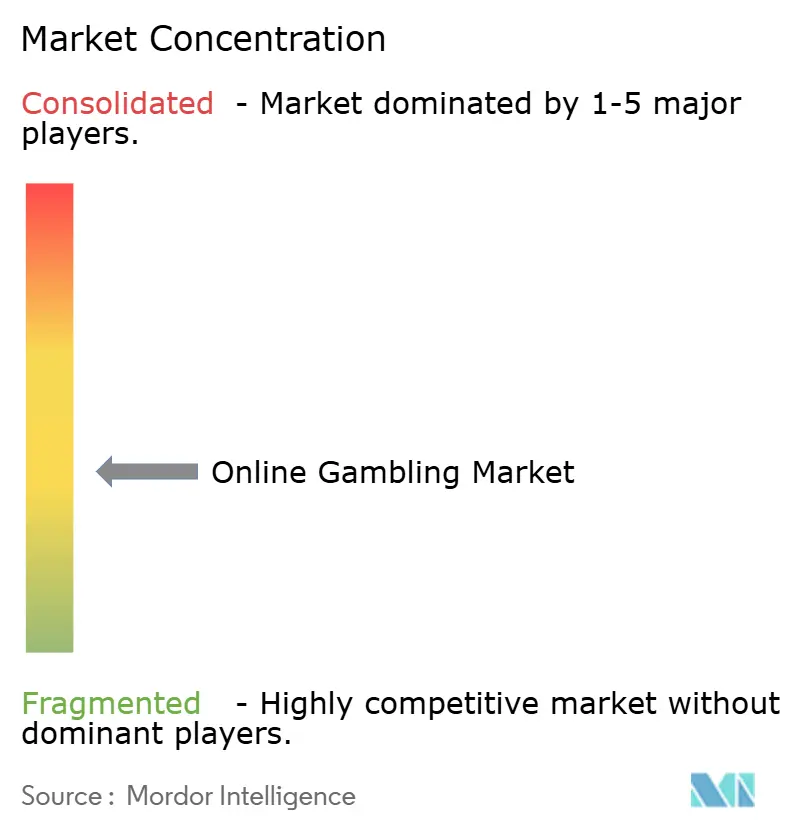
The industry combines large operator groups with jurisdiction-specific competition, with Flutter Entertainment PLC, Entain PLC, Bet365 Group Ltd, DraftKings Inc. and Betsson AB among its major participants. Bet365's gaming revenue increased 25% in the financial year to March 2025, demonstrating the commercial importance of its gaming offering alongside sports betting. DraftKings combines online and retail sportsbook activity with iGaming, while Entain operates online sports betting and gaming across multiple jurisdictions. These different product and geographic mixes make competitive strength dependent on the permissions and customers served, leaving room for focused operators alongside groups able to support broader portfolios.
Flutter completed its acquisition of Snai, an Italian omnichannel sports betting and iGaming operator, on April 30, 2025. The deal gave Flutter an Italian business spanning retail and online activity, placing its expansion within an existing local operating footprint. Betsson completed its acquisition of Rhino Entertainment Group's consumer-facing business licensed in Canada in August 2026, including activities in Ontario and the rest of Canada. Betsson also offers sportsbook directly through its brands and as a business-to-business service for other operators. That supplier route can give challenger brands sportsbook capabilities without developing the full service internally, alongside the acquisition route to a licensed consumer business.
Regulatory positioning also shapes the products through which operators can compete and the legal entities authorized to offer them. Betsson subsidiary Azzurri Limited obtained 2 Italian online gambling concessions in 2025. France's ANJ lists HILLSIDE (New Media Malta) PLC as the operator of bet365.fr for sports betting, horse-race betting and online poker. These product-specific permissions make a broad commercial brand an incomplete guide to the activities a customer can legally access in a particular country. For challengers, a focused offer aligned with an available authorization route can be easier to bring to market than attempting to reproduce a large group's full international portfolio.
Online Gambling Industry Leaders
-
Flutter Entertainment PLC
-
Entain PLC
-
Bet365 Group Ltd
-
DraftKings Inc.
-
Betsson AB
- *Disclaimer: Major Players sorted in no particular order
Online Gambling Market Companies Covered in this Report
- Betsson AB
- Evoke Plc
- Entain PLC
- Flutter Entertainment PLC
- DraftKings Inc.
- Kindred Group PLC
- Bet365 Group Ltd
- 1XBET
- 22BET
- SportPesa
- MGM Resorts International
- Super Group (SGHC) Limited
- Golden Nugget Online Gaming
- El Royale Casino
- Logrand Entertainment Group
- Codere Online Luxembourg
- Grupo Caliente
- Playdoit
- Rush Street Interactive Inc.
- LeoVegas AB
Key Opportunities for Market Participants
The opportunities compare conditional online casino entry in New Zealand with the customer controls and enforcement capabilities needed to support compliant operations. An auction that concluded October 12, 2026, gave 11 entities the right to apply for licenses, subject to detailed application and assessment. The commercial opening therefore concerns preparing a service that meets the standards and a suitability case before permission to operate is determined, with distinct work for operator leadership, customer-interface teams and compliance specialists.
Market Opportunities Table of Online Gambling Market
| Opportunity | Why now | Buyer / lead segment | Recommended play | Main barrier | Likely beneficiaries |
|---|---|---|---|---|---|
| Conditional casino-entry preparation | Post-auction applications require a business plan and suitability assessment | Successful bidders seeking online casino licenses | Build the operating case and complete the required application | Auction-determined payment and demonstration of suitability | Successful bidders that meet licensing requirements |
| Accessible player-control interfaces | Minimum standards effective July 8, 2026, require accessible time, deposit and spend limits with free-text entry | Applicants implementing online casino platforms | Put limit-setting functions within account and deposit journeys | Usability across account and deposit screens | Operators and potential platform providers such as Playtech |
| Concurrent-limit enforcement | Standards require the lowest limit to apply when customers set simultaneous periods | Operators' platform and compliance teams | Validate limit precedence across overlapping daily and weekly periods | Correct enforcement across simultaneous limits | Operators and potential platform-service providers such as Playtech |
| Source: Mordor Intelligence | |||||
The central opening is a casino service that can demonstrate compliance through its actual customer controls. Applicants must pay the auction-determined amount and submit a business plan plus detailed advertising, consumer-protection, harm-minimization and compliance strategies for suitability assessment. Connecting accessible controls with correct limit enforcement turns that preparation into an operational capability, giving applicants a concrete basis for their suitability case before licensed play begins.
Recent Industry Developments in Online Gambling Market
- Oct 2026: New Zealand's online casino auction concluded October 12, with 11 entities winning the right to apply for licenses, subject to detailed application and assessment.
- Sep 2026: Brazil's Provisional Measure No. 1,394 of September 25 prohibited operating, offering and advertising fixed-odds betting lotteries nationwide.
- Aug 2026: Betsson completed its acquisition of Rhino Entertainment Group's consumer-facing business licensed in Canada, including activities in Ontario and the rest of Canada.
Online Gambling Market Report Scope and Research Methodology
Market Definition and Coverage
The global online gambling market measures annual gross gaming revenue from gambling and betting conducted through internet services worldwide. Operator revenue is classified by game, access device, bettor age, bet timing, and geography.
Scope exclusions: Land-based gambling revenue, wager turnover, gambling software and platform supplier sales, and standalone payment processing, affiliate, and advertising fees are excluded.
Segments Covered in This Report
- By Game Type
- Sports Betting
- Football
- Horse Racing
- Tennis
- Other Sports
- Casino
- Live Casino
- Baccarat
- Blackjack
- Poker
- Slots
- Other Casino Games
- Lottery
- Bingo
- Sports Betting
- By Platform
- Desktop
- Mobile and Tablets
- By Age Group
- 18–24 Years
- 25–34 Years
- 35–44 Years
- 45–54 Years
- 55+ Years
- By Betting Type
- Pre-Match/Fixed-Odds
- Live/In-Play
- By Geography
- North America
- United States
- Canada
- Mexico
- Rest of North America
- Europe
- United Kingdom
- Germany
- France
- Italy
- Spain
- Sweden
- Rest of Europe
- Asia-Pacific
- Oceanic Countries
- Rest of Asia-Pacific
- Rest Of The World
- South America
- Middle East and Africa
- North America
Data Sources, Market Sizing, and Validation
Desk Research
Public and official sources such as the World Bank's World Development Indicators, drawing on ITU data, help track internet access that supports online participation. EGBA and H2 Gambling Capital's European market tables provide regional online gross gaming revenue and product mix, and the UK Gambling Commission's industry statistics give reported online gross gambling yield by sector. HM Treasury's remote gambling consultation explains the gross gambling yield measure and supplies a regulatory and tax context for interpreting operator revenue.
Company filings, annual reports, investor presentations, regulatory returns, and reputable business press can supplement public market data by clarifying geographic exposure, online product mix, and changes in operator activity, and such information can also cross-check country and company trends. These illustrative sources are not exhaustive, and further sources inform collection, validation and clarification.
Primary Interviews and Surveys
Interviews and structured surveys with online gambling operators, platform and content providers, trade and regulatory specialists, and payments or compliance professionals can test secondary findings on revenue recognition, product mix, channel use, and jurisdiction changes. Where public reporting omits market detail, respondents can clarify gaps and explain differences between licensed and grey-market activity. Analysts can compare those explanations with regulatory returns, operator disclosures, and independent market indicators, and revisit respondents when evidence conflicts or a material change affects an estimate.
Distribution of primary research fieldwork respondents
| Company type | Respondent position | Region |
|---|---|---|
| Top tier: 25% | CXOs: 20% | APAC: 40% |
| Mid tier: 55% | Functional/Unit leaders: 35% | EMEA: 35% |
| Smaller Players: 20% | Managers: 45% | Americas: 25% |
Market-Sizing & Forecasting
The estimate starts with a top-down view of annual online operator gross gaming revenue by country and region, then checks selected totals through country-level regulatory or association GGR and disclosed operator revenue roll-ups. Analysts track online GGR by game and geography, mobile and internet access, operator disclosures, player participation where available, and jurisdiction licensing or tax changes. These indicators help explain market level, product and regional shares, and changes in growth. Public product and device splits, country reporting, and operator mix inform segment shares, which are checked against the global total and against one another.
For 2027-2032, multivariate regression can extend comparable revenue and access series where relationships are stable, while scenario analysis captures discrete licensing, tax, or market-entry changes. Analysts compare projected country and segment contributions with the top-down path and use selective operator roll-ups or reported gross gaming revenue as a bottom-up check, adjusting for differences in reporting period and coverage. Where a country or product lacks a comparable series, the analyst uses the nearest supported indicator, tests its effect against adjacent markets and primary respondent explanations, and records the remaining gap for review.
Data Validation & Update Cycle
Analysts triangulate operator filings, regulator and association totals, and independent digital access or participation signals, checking that periods, currencies, revenue measures, and geographic coverage align. They investigate outliers and material variances against prior periods and related markets, resolve anomalies through source checks, calculation review, and targeted respondent re-contact, then complete a second analyst review before sign-off. The model is refreshed annually, revisited between cycles when legislation, market entry, or operator events could materially change revenue, and checked again against the latest available evidence before delivery.
Mordor Intelligence's Online Gambling Market Size Measured Against Other Published Estimates
Published estimates can differ in the transactions and products they count and the inputs used to model demand. The global online gambling market measures annual gross gaming revenue from gambling and betting conducted through internet services worldwide.
Key Gap Drivers include the study's defined coverage and market-specific modeling choices. Analysts track online GGR by game and geography, mobile and internet access, operator disclosures, player participation where available, and jurisdiction licensing or tax changes.
Benchmark comparison
| Source | Market Size | Gaps in Research Methodology |
|---|---|---|
| Mordor Intelligence | USD 134.8 B (2027) | |
| Industry Data Provider A | USD 115 B (2026) | At its 2026 base, this estimate is 14.7% below this report's 2027 value of USD 134.8 B, 1 year later. Its 2026 measurement year precedes the comparison year, while its explicit inclusion of grey-market GGR broadens coverage and can raise the total. |
| Consultancy B | USD 102 B (2025) | At its 2025 base, this estimate is 24.3% below this report's 2027 value of USD 134.8 B, 2 years later. Its 2025 global GGR base and stated rising forecast place the estimate earlier in the market's growth path. |
Mordor Intelligence's analysts triangulate operator filings, regulator and association totals, and independent digital access or participation signals, checking that periods, currencies, revenue measures, and geographic coverage align.
Key Questions Answered in the Report
What is the online gambling market size and growth outlook?
The size is projected to expand from USD 120.4 billion in 2026 and USD 134.8 billion in 2027 to USD 231.4 billion by 2032, at a CAGR of 11.42% between 2027 and 2032.
What drives demand for online gambling services?
Digital interfaces, live betting and improved payments support demand. In January 2026, bet365 deployed TrueLayer Pay by Bank across its UK and German operations.
Which game type leads online gambling revenue?
Casino led with a 50.44% market share in 2026.
Which companies are prominent online gambling operators?
Major participants include Flutter Entertainment PLC, Entain PLC, Bet365 Group Ltd, DraftKings Inc. and Betsson AB.
What is a major constraint on remote gaming operators?
The UK's Remote Gaming Duty rose from 21% to 40% of providers' profits from remote gaming with UK persons on April 1, 2026, reducing retained earnings.
Which region leads online gambling, and which is growing fastest?
Europe led with 47.73% of the market in 2026. North America is forecast to grow fastest at a CAGR of 16.05% between 2027 and 2032.