
Market Overview
| Study Period | 2018 - 2031 |
|---|---|
| Forecast Data Period | 2026 - 2031 |
| Base Year Market Size (2025) | USD 5.38 Billion |
| Market Size (2026) | USD 5.67 Billion |
| Market Size (2031) | USD 7.41 Billion |
| Growth Rate (2026 - 2031) | 5.47% CAGR |
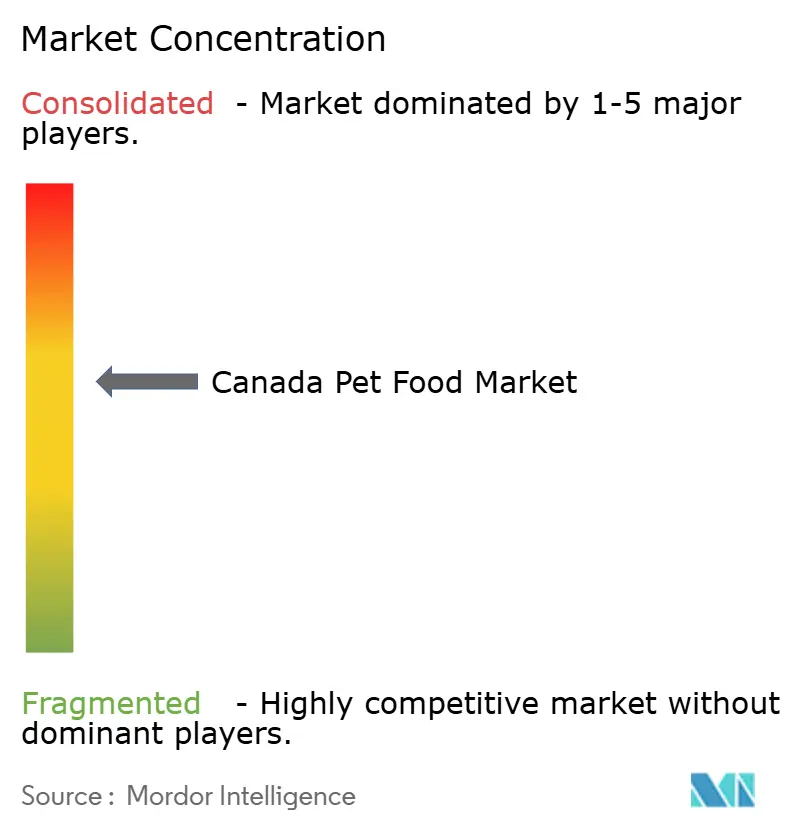
| Market Concentration | Medium |
Major Players *Disclaimer: Major Players sorted in no particular order Image © Mordor Intelligence. Reuse requires attribution under CC BY 4.0. | |
Canada Pet Food Market Analysis by Mordor Intelligence
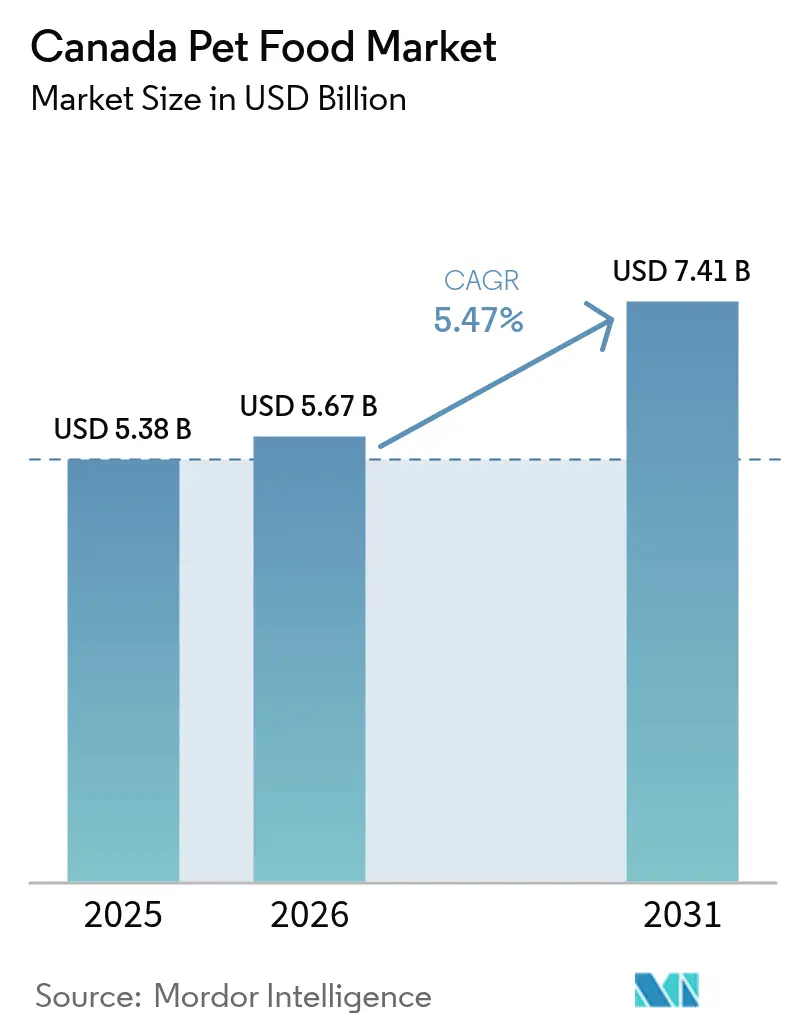
The Canada pet food market size is expected to grow from USD 5.38 billion in 2025 to USD 5.67 billion in 2026 and is forecast to reach USD 7.41 billion by 2031 at 5.47% CAGR over 2026-2031. Premium kibble reformulations, functional nutrition, and omnichannel retail models are the primary catalysts behind this steady escalation. Premium price elasticity has widened as owners align pet diets with their own health goals, elevating the role of regionally sourced proteins, probiotics, and nutrient-dense inclusions. Specialty retail consolidation and direct-to-consumer models enable manufacturers to showcase differentiated propositions while defending margins in the face of volatile raw-material inputs. At the same time, the 2025 overhaul of the Canadian Feeds Regulations is forcing every label holder to strengthen traceability and preventive controls, effectively weeding out under-capitalized competitors and reinforcing trust in established brands. Altogether, these factors underpin a structural shift from volume to value that should continue to redefine competitive advantage within the Canada pet food market.
Key Report Takeaways
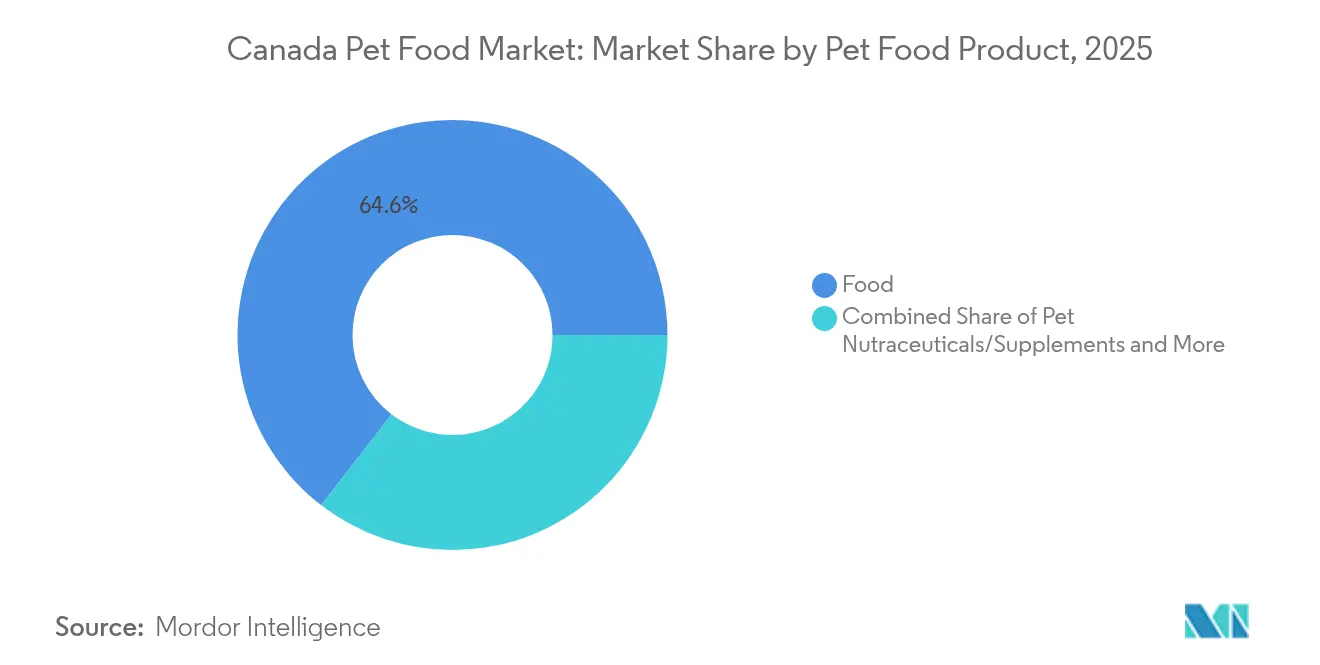
- By pet food product category, food segment retained 64.55% of Canada's pet food market share in 2025, while pet nutraceuticals and supplements are projected to log the fastest 9.05% CAGR through 2031.
- By pets, dogs accounted for 37.25% of the Canada pet food market size in 2025 and are forecast to grow at a 6.66% CAGR to 2031.
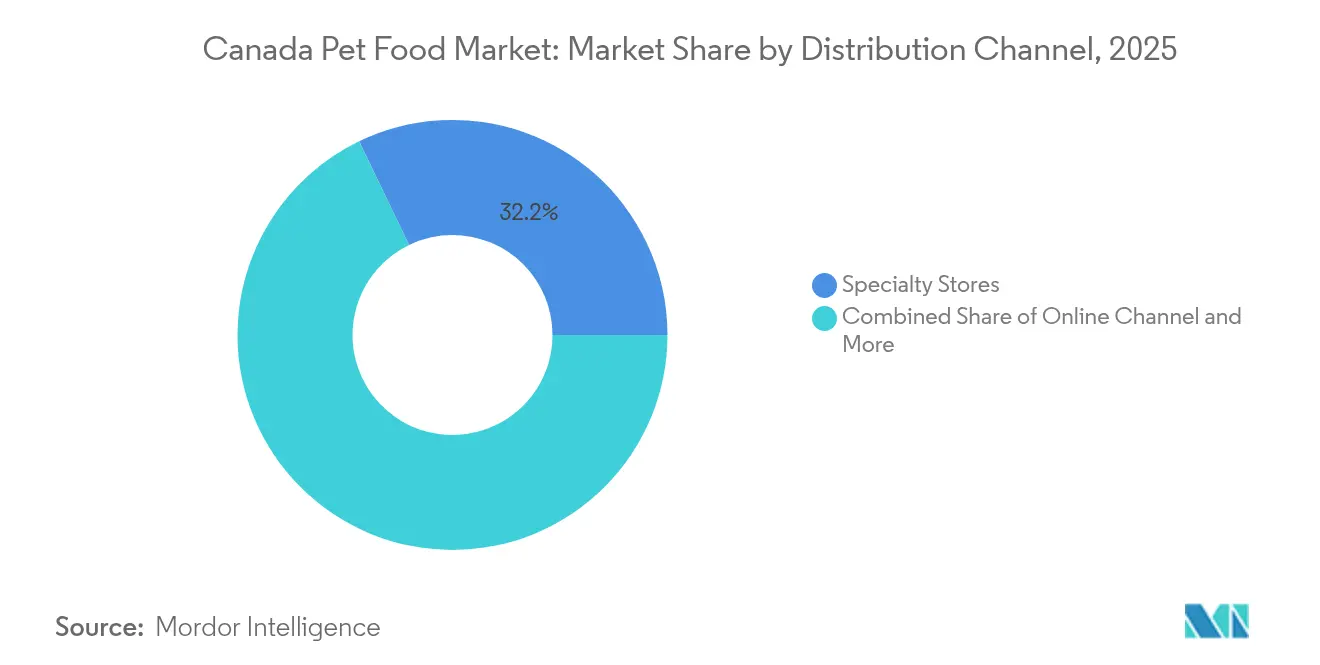
- By distribution channel, specialty stores accounted for 32.15% of the Canada pet food revenue in 2025, whereas online platforms are projected to grow at a 7.18% CAGR through 2031.
- The Canadian pet food market exhibits a moderate consolidated structure dominated by global multinational corporations with diverse product portfolios spanning multiple pet care categories. Mars, Incorporated, Nestle (Purina), Colgate-Palmolive Company (Hill's Pet Nutrition, Inc.), General Mills Inc., and Schell & Kampeter, Inc. (Diamond Pet Foods) are major players, accounting for a 53.10% share in 2025.
Note: Market size and forecast figures in this report are generated using Mordor Intelligence’s proprietary estimation framework, updated with the latest available data and insights as of 2026.
Canada Pet Food Market Trends and Insights
Drivers Impact Analysis*
| Driver | (~) % Impact on CAGR Forecast | Geographic Relevance | Impact Timeline |
|---|---|---|---|
| Rising premiumization of kibble formats | +1.2% | National, with a concentration in urban centers | Medium term (2-4 years) |
| Humanization trend fueling functional ingredients | +0.9% | National, led by Ontario and British Columbia | Long term (≥4 years) |
| Growth of specialty retail chains across urban Canada | +0.7% | Urban centers, expanding to mid-tier cities | Short term (≤2 years) |
| Surge in direct-to-consumer fresh-frozen meal startups | +0.5% | Urban markets with cold-chain infrastructure | Medium term (2-4 years) |
| Provincial incentives for novel protein processing plants | +0.3% | Ontario and Quebec primarily | Long term (≥4 years) |
| Veterinary telehealth upselling prescription diets | +0.4% | National, with urban concentration | Short term (≤2 years) |
| Source: Mordor Intelligence | |||
Understand The Key Trends Shaping This Market
Download PDF
Rising Premiumization of Kibble Formats
Champion Petfoods' Orijen and Acana product lines combine freeze-dried raw ingredients with single-origin meats, with prices ranging from CAD 80-120 (USD 59-89) for 11.4 kg bags, positioning them 15-25% above standard kibble prices in January 2025. This pricing reflects consumers' willingness to pay premium prices for products perceived as having superior nutritional value. Mars's USD 1.2 billion acquisition of Champion in 2022 demonstrates the value of premium positioning over volume-based growth strategies, especially as rising ingredient costs affect traditional profit margins. Regulatory compliance factors under the Canadian Food Inspection Agency (CFIA) modernized Feeds Regulations support premium manufacturers with established quality systems while creating barriers for cost-focused competitors.
Humanization Trend Fueling Functional Ingredients
Functional ingredient integration mirrors human nutraceutical trends, with joint health, cognitive support, and digestive wellness commanding 40-60 premiums over baseline formulations. Pet Wellbeing Canada's product portfolio spans probiotics, omega-3 complexes, and targeted supplements priced at CAD 40-90 (USD 30-67) per unit in 2024. Healthybud's CAD 2.0 million (USD 1.5 million) funding round in 2024 for freeze-dried raw products with prebiotic and postbiotic inclusions demonstrates investor confidence in functional positioning. The trend extends beyond supplements into therapeutic diets, where Hill's Pet Nutrition leverages veterinary channel relationships to drive prescription diet adoption through telehealth consultations.
Growth of Specialty Retail Chains Across Urban Canada
Specialty retail consolidation accelerates through strategic acquisitions that expand geographic footprints and customer touchpoints. In 2023, Legault Group's acquisition of Ren's Pets and partnership with Homes Alive Pets created a 200-plus location network spanning Ontario, Quebec, and Western Canada. This consolidation enables premium brand positioning and educational merchandising that mass retailers cannot replicate. Mondou's expansion strategy targets mid-tier urban markets with 15-20% higher margins than big-box competitors through curated product selection and specialized staff training. The channel shift benefits premium manufacturers while pressuring commodity brands dependent on supermarket distribution.
Surge in Direct-to-Consumer Fresh-Frozen Meal Startups
Fresh-frozen meal delivery exploits cold-chain logistics improvements and subscription commerce adoption among urban pet owners. Pet Valu's 2024 launched of Performatrin Culinary frozen raw and gently-cooked lines validates retailer interest in premium fresh formats [1]Source: Pet Valu, “Performatrin Culinary,” petvalu.com. Startups like Tom&Sawyer and Dog Child leverage human-grade facility certifications and Association of American Feed Control Officials (AAFCO) compliance to differentiate from raw food safety concerns. The model bypasses traditional retail margins while building direct customer relationships that support higher lifetime values. However, distribution economics limit expansion beyond urban centers with established cold-chain infrastructure.
Restraints Impact Analysis*
| Restraint | (~) % Impact on CAGR Forecast | Geographic Relevance | Impact Timeline |
|---|---|---|---|
| Volatile meat and grain input costs | -0.8% | National, with regional variations | Short term (≤2 years) |
| Stringent Canadian Food Inspection Agency (CFIA) labeling revisions | -0.6% | National regulatory impact | Short term (≤2 years) |
| Consumer confusion on raw vs. fresh-frozen safety | -0.4% | Urban markets primarily | Medium term (2-4 years) |
| Competition from homemade diet TikTok communities | -0.3% | National, youth demographics | Medium term (2-4 years) |
| Source: Mordor Intelligence | |||
Volatile Meat and Grain Input Costs
Input cost volatility compressed manufacturer margins as beef prices increased 12% year-over-year in Q3 2024, while wheat and corn prices fluctuated 8-15% according to Statistics Canada commodity data [2]Source: Statistics Canada, “Commodity Price Index,” statcan.gc.ca. Canadian dollar weakness against the USD amplifies imported ingredient costs, particularly for specialty proteins and vitamin premixes sourced from international suppliers. Premium manufacturers partially offset cost pressures through price increases, but mass-market brands face margin compression that limits innovative investment. Supply chain resilience initiatives, including local sourcing partnerships, require 18–24-month implementation timelines that delay cost mitigation benefits.
Stringent Canadian Food Inspection Agency (CFIA) Labeling Revisions
The Canadian Food Inspection Agency (CFIA) modernized the Feeds Regulations, introducing preventive control plans, enhanced traceability requirements, and expanded licensing obligations that increase compliance costs for manufacturers. New labeling standards require reformulation of existing products and delay new product launches by 6-12 months while companies adapt quality systems and documentation processes[3]Source: Canadian Food Inspection Agency, “Pet Food Recalls,” recalls-rappels.canada.ca. Smaller manufacturers face disproportionate compliance burdens that favor established players with existing regulatory infrastructure. The regulations create competitive advantages for compliant manufacturers by raising barriers to entry and supporting premium positioning through enhanced safety credentials.
*Our updated forecasts treat driver/restraint impacts as directional, not additive. The revised impact forecasts reflect baseline growth, mix effects, and variable interactions.
Segment Analysis
By Pet Food Product: Nutraceuticals Drive Premium Shift
The food segment dominates the Canadian pet food market, accounting for approximately 64.55% of the total market value in 2025. This substantial market share can be attributed to the segment's role as a staple purchase for pet owners, regardless of their pets' breed, size, or age. The segment encompasses both dry and wet pet food products, with dry pet food being particularly popular due to its affordability and longer shelf life. The segment's dominance is further strengthened by the increasing consumer demand for high-quality pet foods that support their pets' health and wellness, along with the growing trend of premium and specialized food products that cater to specific dietary requirements and preferences of different pets.
Pet Nutraceuticals and Supplements capture the fastest growth at 9.05% CAGR through 2031, this impressive growth rate is driven by increasing awareness among pet owners about the benefits of vitamins and minerals, probiotics, and omega-3 fatty acids in supporting their pets' overall health. The segment's expansion is further fueled by the growing focus on preventive healthcare and the rising demand for specialized nutritional supplements that address specific health concerns in pets. The trend towards pet humanization has also contributed significantly to this growth, as pet owners increasingly seek products that can enhance their pets' immunity, digestive health, and overall well-being.
Note: Segment shares of all individual segments available upon report purchase
Get Detailed Market Forecasts at the Most Granular Levels
Download PDF
By Pets: Dogs Dominate Across Categories
Dogs command 37.25% market share in 2025 while maintaining the fastest 2026-2031 growth at 6.66% CAGR, reflecting both population growth and increased spending per animal. This dual advantage positions dog-focused brands for sustained expansion across all product categories. Cats represent a stable but slower-growing segment where specialized nutrition requirements create opportunities for targeted formulations.
Despite having a lower population compared to cats, dogs generate higher revenue due to their larger food consumption and the availability of a wider variety of dog food options from various brands. The segment's strong performance is supported by the rising trend of pet humanization, where owners increasingly treat their dogs as family members and are willing to invest in high-quality nutrition. The segment has also benefited from the expansion of specialized product offerings, including grain-free options, breed-specific formulations, and veterinary diets.
By Distribution Channel: Online Gains Despite Specialty Strength
Specialty Stores maintain a 32.15% market share in 2025 through educational merchandising and premium brand curation that mass retailers cannot replicate. These stores have gained significant traction among pet owners due to their extensive product selection and specialized expertise in pet nutrition. The success of specialty stores can be attributed to their ability to offer premium and specialized pet food products, along with knowledgeable staff who can provide personalized recommendations based on specific pet needs. These stores particularly excel in the distribution of veterinary diets and premium pet food products, making them a preferred choice for pet owners seeking high-quality nutrition for their pets.
Online channels accelerate fastest growing at 7.18% CAGR through 2031, this growth is being driven by the increasing preference for convenient shopping options and the wide variety of products available through digital platforms. E-commerce platforms are revolutionizing the dog food industry retail landscape by offering subscription services and personalized pet food options delivered directly to customers' doorsteps. Major online retailers are enhancing their service offerings with features such as auto-replenishment programs, detailed product information, and customer reviews, making it easier for pet owners to make informed purchasing decisions. The segment's growth is further supported by the rising adoption of mobile shopping apps and the integration of artificial intelligence to provide personalized product recommendations based on pet profiles and previous purchase history.
Note: Segment shares of all individual segments available upon report purchase
Get Detailed Market Forecasts at the Most Granular Levels
Download PDF
Geography Analysis
Canada's pet food market demonstrates regional concentration patterns that reflect urban demographics, disposable income distribution, and retail infrastructure development. Ontario and Quebec are one of the major states for pet food, driven by population density and higher per-capita pet ownership rates in urban centers like Toronto, Montreal, and Vancouver. These markets lead premium product adoption and functional ingredient acceptance, creating test markets for innovation before national rollouts. Western provinces, including Alberta and British Columbia, show strong growth in specialty retail penetration, supported by Champion Petfoods' Alberta manufacturing presence and regional brand loyalty. Atlantic provinces represent smaller but stable markets where traditional retail channels maintain stronger positions due to limited specialty store penetration.
Provincial regulatory variations create compliance complexities for national manufacturers while supporting local producers with specialized knowledge of regional requirements. Quebec's French-language labeling requirements and cultural preferences for local sourcing benefit regional manufacturers like Canino and other Montreal-based startups. Regional income disparities influence product mix preferences, with premium and super-premium categories concentrated in urban centers while rural markets maintain stronger demand for value-oriented formulations.
This geographic segmentation enables manufacturers to optimize product portfolios and pricing strategies based on regional purchasing power and competitive dynamics. The concentration of veterinary services in urban areas supports prescription diet growth through telehealth platforms that extend specialist access to rural pet owners, creating new distribution models that bypass traditional geographic limitations.
Competitive Landscape
The Canadian pet food market exhibits a moderate consolidated structure dominated by global multinational corporations with diverse product portfolios spanning multiple pet care categories. Mars, Incorporated, Nestle (Purina), Colgate-Palmolive Company (Hill's Pet Nutrition, Inc.), General Mills Inc., and Schell & Kampeter, Inc. (Diamond Pet Foods) are major players accounting for a share of 53.6% in 2024 that leverage their extensive research and development capabilities, established distribution networks, and strong brand recognition to maintain their market positions. The market has seen active participation from both conglomerates with diversified business interests and specialist Canadian pet food manufacturers, though the former hold significantly larger market shares due to their superior resources and broader reach.
These pet food companies in Canada have consistently focused on product innovation, launching new pet food varieties that cater to the specific dietary needs and preferences of different pets. The market has witnessed significant operational agility, with companies adapting their distribution networks to include both traditional retail channels and emerging e-commerce platforms. Strategic moves have primarily centered around acquisitions and partnerships to expand product portfolios and strengthen market positions. Companies have also invested in manufacturing facility expansions to meet the growing demand and ensure efficient supply chain operations across the country.
The market has experienced considerable merger and acquisition activity, with larger companies acquiring smaller, specialized pet food manufacturers to expand their product offerings and capture emerging market segments. This consolidation trend has been particularly evident in the premium and natural pet food segments, where established players have sought to strengthen their presence through strategic acquisitions. Local players, while present in the market, face intense competition from global giants but maintain their relevance through specialized offerings and strong regional distribution networks.
Canada Pet Food Industry Leaders
Mars, Incorporated
Nestle (Purina)
Colgate-Palmolive Company (Hill's Pet Nutrition, Inc.)
General Mills Inc.
Schell & Kampeter, Inc. (Diamond Pet Foods)
- *Disclaimer: Major Players sorted in no particular order
Need More Details on Market Players and Competitors?
Download PDF
Recent Industry Developments
- February 2025: In Canada, Calysta and Marsapet have launched the first complete dog food featuring FeedKind Pet protein, a cultured protein fermented without using any arable land or animal ingredients. Produced under its Marsavet line and targeted at animal health, MicroBell dry kibble is a vegan, grain-free, and gluten-free pet food with all the necessary amino acids to keep dogs healthy
- July 2023: Hill's Pet Nutrition introduced its new MSC (Marine Stewardship Council) certified pollock and insect protein products for pets with sensitive stomachs and skin lines. They contain vitamins, omega-3 fatty acids, and antioxidants.
- May 2023: Nestle Purina launched new cat treats under the Friskies "Friskies Playfuls - treats" brand. These treats are round in shape and are available in chicken and liver and salmon and shrimp flavors for adult cats.
Canada Pet Food Market Report Scope
Food, Pet Nutraceuticals/Supplements, Pet Treats, Pet Veterinary Diets are covered as segments by Pet Food Product. Cats, Dogs are covered as segments by Pets. Convenience Stores, Online Channel, Specialty Stores, Supermarkets/Hypermarkets are covered as segments by Distribution Channel.
Pet Food Product
| Food | By Sub Product | Dry Pet Food | By Sub Dry Pet Food | Kibbles |
| Other Dry Pet Food | ||||
| Wet Pet Food | ||||
| Pet Nutraceuticals/Supplements | By Sub Product | Milk Bioactives | ||
| Omega-3 Fatty Acids | ||||
| Milk Bioactives | ||||
| Probiotics | ||||
| Proteins and Peptides | ||||
| Vitamins and Minerals | ||||
| Other Nutraceuticals | ||||
| Pet Treats | By Sub Product | Crunchy Treats | ||
| Dental Treats | ||||
| Freeze-dried and Jerky Treats | ||||
| Soft & Chewy Treats | ||||
| Other Treats | ||||
| Pet Veterinary Diets | By Sub Product | Diabetes | ||
| Digestive Sensitivity | ||||
| Oral Care Diets | ||||
| Renal | ||||
| Urinary tract disease | ||||
| Obesity Diets | ||||
| Derma Diets | ||||
| Other Veterinary Diets |
Pets
| Cats |
| Dogs |
| Other Pets |
Distribution Channel
| Convenience Stores |
| Online Channel |
| Specialty Stores |
| Supermarkets/Hypermarkets |
| Other Channels |
| Pet Food Product | Food | By Sub Product | Dry Pet Food | By Sub Dry Pet Food | Kibbles |
| Other Dry Pet Food | |||||
| Wet Pet Food | |||||
| Pet Nutraceuticals/Supplements | By Sub Product | Milk Bioactives | |||
| Omega-3 Fatty Acids | |||||
| Milk Bioactives | |||||
| Probiotics | |||||
| Proteins and Peptides | |||||
| Vitamins and Minerals | |||||
| Other Nutraceuticals | |||||
| Pet Treats | By Sub Product | Crunchy Treats | |||
| Dental Treats | |||||
| Freeze-dried and Jerky Treats | |||||
| Soft & Chewy Treats | |||||
| Other Treats | |||||
| Pet Veterinary Diets | By Sub Product | Diabetes | |||
| Digestive Sensitivity | |||||
| Oral Care Diets | |||||
| Renal | |||||
| Urinary tract disease | |||||
| Obesity Diets | |||||
| Derma Diets | |||||
| Other Veterinary Diets | |||||
| Pets | Cats | ||||
| Dogs | |||||
| Other Pets | |||||
| Distribution Channel | Convenience Stores | ||||
| Online Channel | |||||
| Specialty Stores | |||||
| Supermarkets/Hypermarkets | |||||
| Other Channels | |||||
Need A Different Region or Segment?
Customize Now
Market Definition
- FUNCTIONS - Pet foods are usually intended to provide complete and balanced nutrition to the pet but are primarily used as functional products. The scope includes the food and supplements consumed by pets including veterinary diets. Supplements/nutraceuticals that are directly supplied to pets are considered within the scope.
- RESELLERS - Companies engaged in reselling of pet food without value addition have been excluded from the market scope, in order to avoid double counting.
- END CONSUMERS - Pet owners are considered to be the end-consumers in the market studied.
- DISTRIBUTION CHANNELS - Supermarkets/hypermarkets, specialty stores, convenience stores, online channels and other channels are considered within the scope. The stores which are exclusively providing pet related basic and custom products are considered within the scope of specialty stores.
| Keyword | Definition |
|---|---|
| Pet Food | The scope of pet food includes the food that is eatable by pets including food, treats, veterinary diets, and nutraceuticals/supplements. |
| Food | Food is animal feed intended for consumption by pets. It is formulated to provide essential nutrients and meet the dietary needs of various types of pets, including dogs, cats, and other animals. These are generally segmented into dry and wet pet foods. |
| Dry Pet Food | Dry pet foods may be extruded/baked (kibbles) or flaked. They have a lower moisture content, typically around 12-20%. |
| Wet Pet Food | Wet pet food, also known as canned pet food or moist pet food, generally has a higher moisture content compared to dry pet food, often ranging from 70-80%. |
| Kibbles | Kibbles are dry, processed pet food in small, bite-sized pieces or pellets. They are specifically formulated to provide balanced nutrition for various domestic animals, such as dogs, cats, and other animals. |
| Treats | Pet Treats are special food items or rewards given to pets, to show affection, and encourage good behavior. They are especially used during training. Pet treats are made from various combinations of meat or meat-derived materials with other ingredients. |
| Dental Treats | Pet dental treats are specialized treats that are formulated to promote good oral hygiene in pets. |
| Crunchy Treats | It is a type of pet treat that has a firm and crispy texture which can be a good source of nutrition for pets. |
| Soft and chewy treats | Soft and Chewy pet treats are a type of pet food product that is formulated to be easy to chewy and digest. They are usually made from soft and pliable ingredients, such as meat, poultry, or vegetables, that have been blended and formed into bite-sized pieces or strips. |
| Freeze-dried & Jerky Treats | Freeze-dried and jerky treats are snacks given to pets, that are prepared through a special preservation process, without damaging the nutritional content, resulting in long-lasting, nutrient-rich treats. |
| Urinary Tract Disease Diets | These are commercial diets that are specifically formulated to promote urinary health and reduce the risk of urinary tract infections and other urinary problems. |
| Renal Diets | These are specialized pet foods formulated to support the health of pets with kidney disease or renal insufficiency. |
| Digestive Sensitivity Diets | Digestive-sensitive diets are specially formulated to meet the nutritional needs of pets with digestive issues such as food intolerances, allergies, and sensitivities. These diets are designed to be easily digestible and to reduce the symptoms of digestive problems in pets. |
| Oral Care Diets | Oral care diets for pets are specially formulated diets produced to promote oral health and hygiene in pets. |
| Grain-Free Pet Food | Pet food that does not contain common grains like wheat, corn, or soy. Grain-free diets are often preferred by pet owners seeking alternative options or if their pets have specific dietary sensitivities. |
| Premium Pet Food | High-quality pet food formulated with superior ingredients often offers additional nutritional benefits compared to standard pet food. |
| Natural Pet Food | Pet food made from natural ingredients, with minimal processing and without artificial preservatives. |
| Organic Pet Food | Pet food is produced using organic ingredients, free from synthetic pesticides, hormones, and genetically modified organisms (GMOs). |
| Extrusion | A manufacturing process used to produce dry pet food, where ingredients are cooked, mixed, and shaped under high pressure and temperature. |
| Other Pets | Other pets include birds, fish, rabbits, hamsters, ferrets, and reptiles. |
| Palatability | The taste, texture, and aroma of pet food influence its appeal and acceptance by pets. |
| Complete and Balanced Pet Food | Pet food that provides all essential nutrients in appropriate proportions to meet the nutritional needs of pets without additional supplementation. |
| Preservatives | These are the substances that are added to pet food to extend its shelf life and prevent spoilage. |
| Nutraceuticals | Food products that offer health benefits beyond basic nutrition, often contain bioactive compounds with potential therapeutic effects. |
| Probiotics | Live beneficial bacteria that promote a healthy balance of gut flora, supporting digestive health and immune function in pets. |
| Antioxidants | Compounds that help neutralize harmful free radicals in the body, promoting cellular health and supporting the immune system in pets. |
| Shelf-Life | The duration of which pet food remains safe and nutritionally viable for consumption after its production date. |
| Prescription diet | Specialized pet food formulated to address specific medical conditions under veterinary supervision. |
| Allergen | A substance that can cause allergic reactions in some pets, leading to food allergies or sensitivities. |
| Canned food | Wet pet food that is packed in cans and contains higher moisture content than dry food. |
| Limited ingredient diet (LID) | Pet food formulated with a reduced number of ingredients to minimize potential allergens. |
| Guaranteed Analysis | The minimum or maximum levels of certain nutrients present in pet food. |
| Weight management | Pet food designed to help pets maintain a healthy weight or support weight loss efforts. |
| Other Nutraceuticals | It includes prebiotics, antioxidants, digestive fiber, enzymes, essential oils and herbs. |
| Other Veterinary Diets | It includes weight management diets, skin and coat health, cardiac care, and joint care. |
| Other Treats | It includes rawhides, mineral blocks, lickables, and catnips. |
| Other Dry Foods | It includes cereal flakes, mixers, meal toppers, freeze-dried foods, and air-dried foods. |
| Other Animals | It includes birds, fish, reptiles, and small animals (rabbits, ferrets, hamsters). |
| Other Distribution Channels | It includes veterinary clinics, local unregulated stores, and feed and farm stores. |
| Proteins and Peptides | Proteins are large molecules composed of basic units called amino acids which help in the growth and development of pets. Peptides are the short string of 2 to 50 amino acids. |
| Omega-3 fatty acids | Omega-3 fatty acids are essential polyunsaturated fats that play a crucial role in the overall health and well-being of Pets |
| Vitamins | Vitamins are the essential organic compounds that are essential for vital physiological functioning. |
| Minerals | Minerals are naturally occurring inorganic substances that are essential for various physiological functions in pets. |
| CKD | Chronic Kidney Disease |
| DHA | Docosahexaenoic Acid |
| EPA | Eicosapentaenoic Acid |
| ALA | Alpha-linolenic Acid |
| BHA | Butylated Hydroxyanisol |
| BHT | Butylated Hydroxytoluene |
| FLUTD | Feline Lower Urinary Tract Disease |
Need More Details on Market Definition?
Ask a Question
Research Methodology
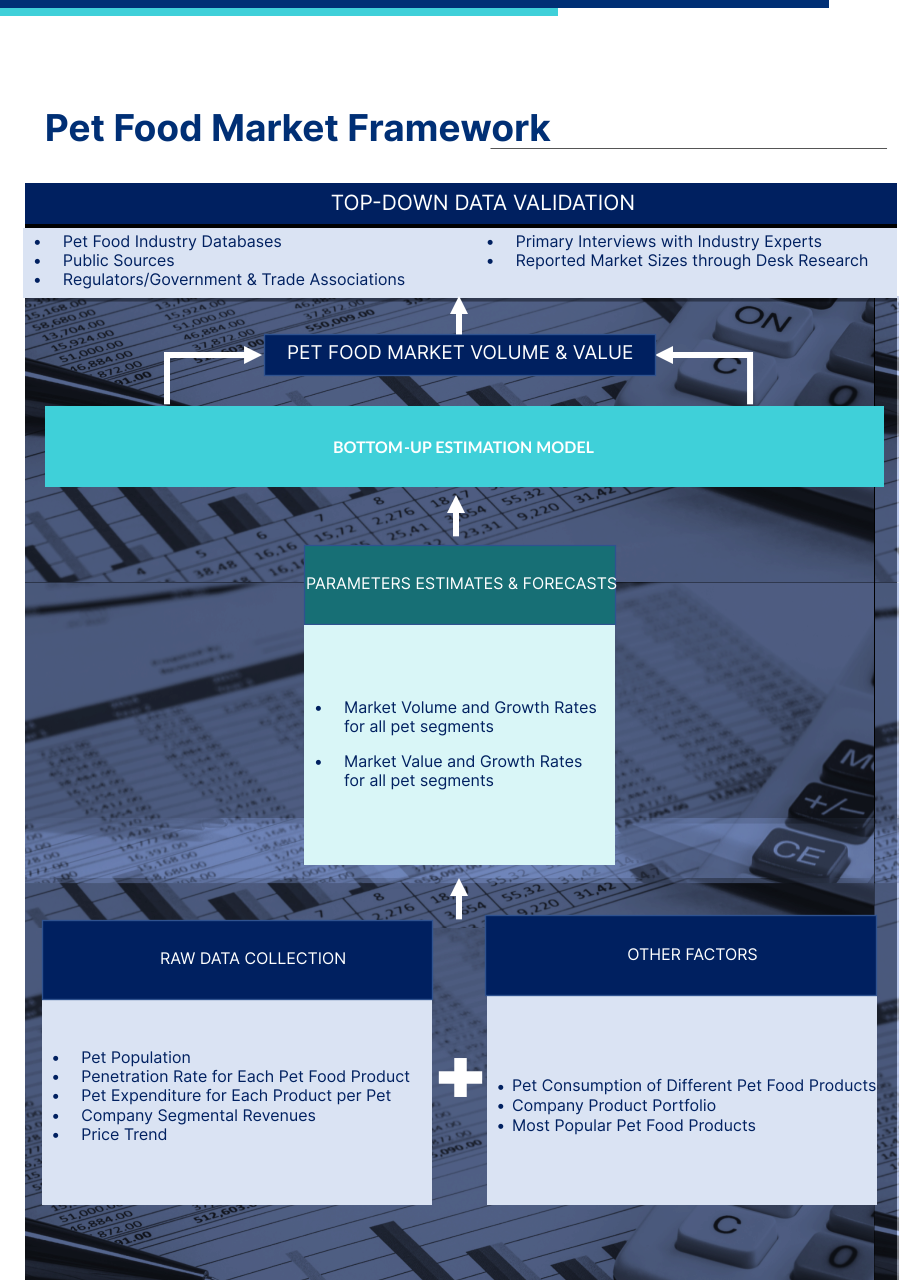
Mordor Intelligence follows a four-step methodology in all our reports.
- Step-1: IDENTIFY KEY VARIABLES: In order to build a robust forecasting methodology, the variables and factors identified in Step-1 are tested against available historical market numbers. Through an iterative process, the variables required for market forecast are set and the model is built on the basis of these variables.
- Step-2: Build a Market Model: Market-size estimations for the forecast years are in nominal terms. Inflation is not a part of the pricing, and the average selling price (ASP) is kept constant throughout the forecast period.
- Step-3: Validate and Finalize: In this important step, all market numbers, variables and analyst calls are validated through an extensive network of primary research experts from the market studied. The respondents are selected across levels and functions to generate a holistic picture of the market studied.
- Step-4: Research Outputs: Syndicated Reports, Custom Consulting Assignments, Databases & Subscription Platforms
Get More Details On Research Methodology
Download PDF




