
Fresh Durian Market Size and Share
Fresh Durian Market Analysis by Mordor Intelligence
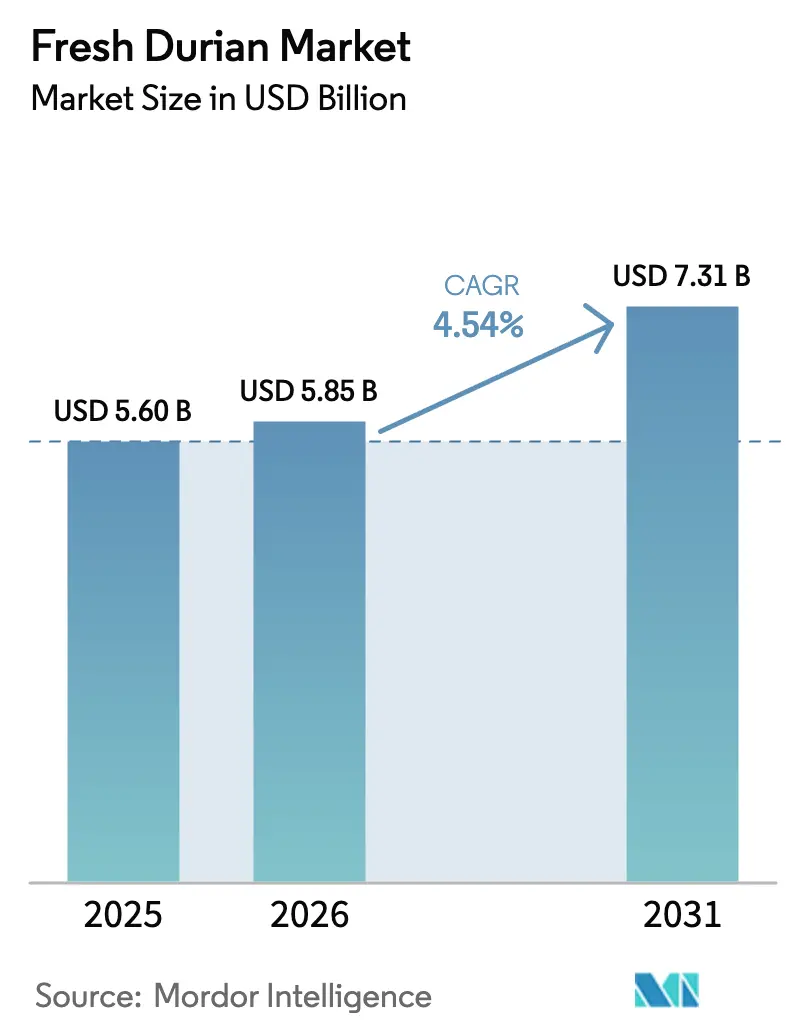
The fresh durian market size is anticipated to grow from USD 5.6 billion in 2025 to USD 5.85 billion in 2026 and is forecast to reach USD 7.31 billion by 2031 at 4.54% CAGR over 2026-2031. Robust Chinese import demand, backed by 1.56 million metric tons of arrivals in 2024, continues to upend Southeast Asian orchard economics as growers race to secure export certification and controlled-atmosphere logistics. Since early 2025, China has implemented stricter import regulations on Vietnamese durians due to the detection of excessive levels of alkaline yellow and cadmium, creating a premium window for compliant producers. Integrated cold chains that cut spoilage and blockchain-verified provenance that lifts auction prices are accelerating investment in on-farm technologies across Malaysia, Thailand, and Vietnam. At the same time, El Niño-linked heat stress and residue-limit crackdowns in China, the European Union, and the United States expose growers to regulatory and climate shocks that may temper short-term volume gains.
Key Report Takeaways
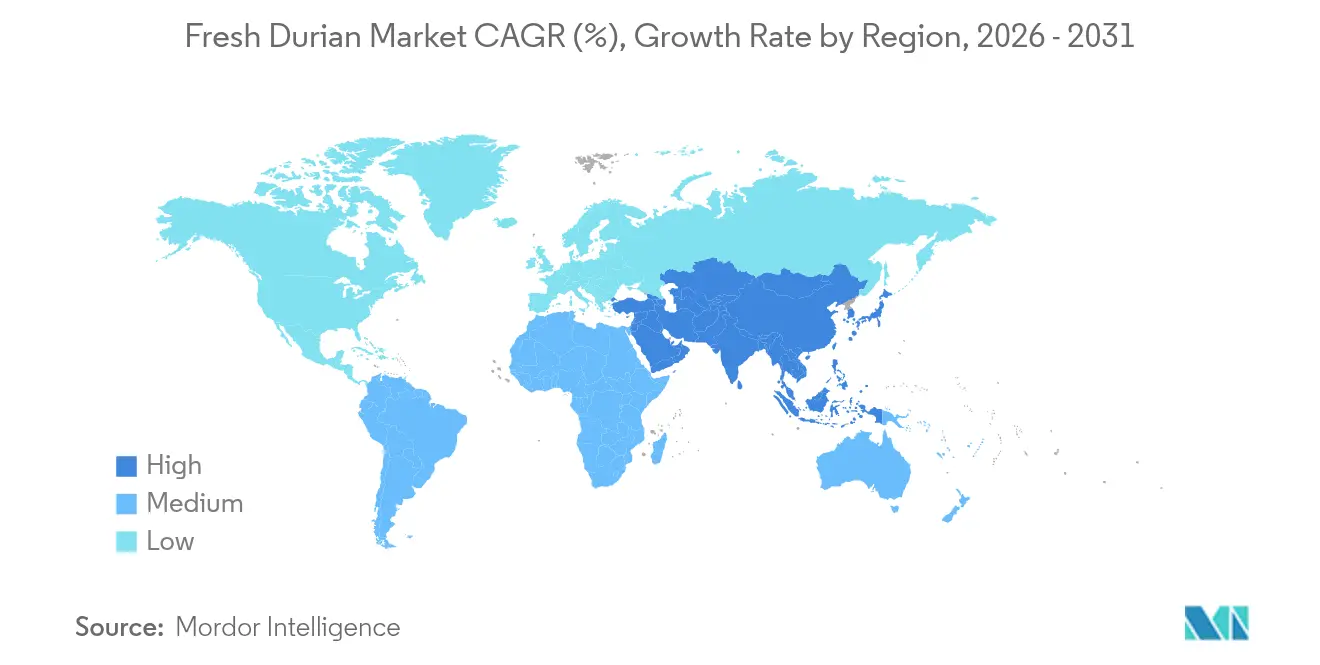
- By geography, Asia-Pacific commanded the largest market share of 79.6% of the fresh durian market in 2025, while the Middle East region is forecast to expand at the fastest-growing CAGR of 6.5% from 2026 to 2031.
Note: Market size and forecast figures in this report are generated using Mordor Intelligence’s proprietary estimation framework, updated with the latest available data and insights as of January 2026.
Global Fresh Durian Market Trends and Insights
Drivers Impact Analysis
| Driver | (~) % Impact on CAGR Forecast | Geographic Relevance | Impact Timeline |
|---|---|---|---|
| Demand surge for premium-grade fruit in China and Singapore | +2.8% | Asia-Pacific core, spillover to Middle East luxury retail | Medium term (2-4 years) |
| Expansion of controlled-atmosphere shipping corridors | +1.9% | Southeast Asia to China and Middle East lanes | Short term (≤ 2 years) |
| Subsidized re-planting programs in Thailand, Malaysia, and Vietnam | +1.4% | Thailand, Malaysia, Vietnam | Long term (≥ 4 years) |
| Roll-out of cold-resistant cultivars for subtropical latitudes | +1.2% | Southern China, northern Vietnam, Taiwan trials | Long term (≥ 4 years) |
| Orchard-backed tokenized investment funds crowd-funding acreage | +0.9% | Malaysia, Thailand, Vietnam | Medium term (2-4 years) |
| Blockchain-enabled provenance premiums in luxury retail | +1.3% | China tier-1 cities, Singapore, United Arab Emirates | Short term (≤ 2 years) |
| Source: Mordor Intelligence | |||
Demand Surge for Premium-Grade Fruit in China and Singapore
High-income consumers in Shanghai and Shenzhen paid above USD 15 per kilogram for Musang King during 2025, encouraging Malaysian orchards to secure geographical indication tags and post-harvest quality controls[1]Source: Department of Agriculture Malaysia, “Musang King Export Note 2025,” doa.gov.my. Singapore’s role as a re-export hub magnifies this pull, routing certified fruit to Hong Kong and Japan at stable premiums. Aroma profiling research links specific sulfur compounds to perceived quality, giving exporters scientific tools for consistent grading. The resulting willingness to pay premium prices reduces the market’s exposure to bulk-commodity swings, opens niche digital channels, and allows small orchards to monetize meticulous cultivation practices. In turn, local government programs begin subsidizing post-harvest cold-chain upgrades, further supporting premium segments. As a result, premiumization continues to elevate average unit values within the fresh durian market.
Expansion of Controlled-Atmosphere Shipping Corridors
Maersk introduced low-oxygen, high-carbon-dioxide reefers in 2024 that slashed spoilage on Thailand-China routes by 30% and extended shelf life by roughly one-third. Cryogenic liquid-nitrogen freezing at minus 80 to minus 110 degrees Celsius now preserves whole-fruit texture, letting exporters capture up to 80% of fresh-fruit value during off-season months. These logistics advances boost the adoption of durian commodity market innovations in West Asia and Europe. These infrastructure leaps flatten seasonal gluts and spread supply more evenly across the calendar, creating smoother revenue curves for exporters in the fresh durian market.
Subsidized Re-Planting Programs in Thailand, Malaysia, and Vietnam
Southeast Asian governments recognize durian as a significant cash crop. Vietnam's Directive 71 requires adherence to good agricultural practice (GAP) audits and provides low-interest loans for drip irrigation, aiming to achieve yields of 7 metric tons per hectare by 2030. This policy addresses quality inconsistencies, ensuring the export of compliant, high-quality fruit to markets such as China. Vietnam overshot its 2030 durian acreage target five years early, reaching 150,000 hectares in 2025 and triggering price swings that dropped Grade A fruit from VND 200,000 to VND 30,000 per kilogram (USD 7.70 to USD 1.15) within weeks. Subsidies invite a three-to-five-year lag before new trees bear fruit, rewarding first movers and pressuring late entrants as supply floods in 2028 and beyond.
Orchard-Backed Tokenized Investment Funds Crowd-Funding Acreage
Harvest Ville fractionalizes orchard ownership through blockchain tokens that represent land parcels and harvest rights, bringing urban capital to smallholders who lack bank credit. Tokens offer exposure to a commodity that generated 15-20% yearly returns between 2020 and 2024, yet secondary markets remain thin, limiting liquidity. Regulatory agencies in Malaysia and Thailand have not clarified whether these tokens are securities, leaving investors with disclosure risk. Concentrating portfolios in a single cultivar could amplify downside if Musang King premiums erode once Vietnam’s plantings mature.
Restraints Impact Analysis
| Restraint | (~) % Impact on CAGR Forecast | Geographic Relevance | Impact Timeline |
|---|---|---|---|
| Stricter maximum residue limits in China, European Union, and United States | -1.6% | Thailand, Vietnam, Malaysia exports | Short term (≤ 2 years) |
| Climate-driven pollination failures and yield swings | -1.3% | Equatorial Southeast Asia | Medium term (2-4 years) |
| High farm-gate price volatility discouraging long-term contracts | -0.9% | Vietnam, Thailand, Malaysia | Short term (≤ 2 years) |
| Structural labor shortage and rising orchard wages | -0.7% | Malaysia, Thailand, Vietnam | Long term (≥ 4 years) |
| Source: Mordor Intelligence | |||
Stricter Maximum Residue Limits in China, European Union, and United States
Since Vietnam began officially exporting durians in September 2022, China has rejected 30 shipments due to cadmium contamination. These rejections account for only 0.01% of the total durian exports to China. China’s customs authority now mandates cadmium and Auramine O tests on every shipment after carcinogenic dye was detected in Thai fruit. The rule immediately reduced Vietnamese exports by 80% in February 2025, exposing smallholders who could not fund certified labs. The European Union has announced that it will no longer allow the sale of the commonly used insecticide active ingredients, chlorpyrifos and chlorpyrifos-methyl. Singapore’s Food Agency imposes similar thresholds, triggering costly recall risks for non-compliant lots. Compliance investment lifts entry barriers and favors large integrated estates, but it also cuts contamination incidents and preserves consumer trust in the fresh durian market.
Climate-Driven Pollination Failures and Yield Swings
The 2024 El Niño heatwave cracked skins and dried fibers across Thailand, trimming export volume substantially and forcing emergency imports of Vietnamese fruit to meet domestic tourist demand. Malaysia experienced 10-30% tree losses from canker outbreaks and humidity-linked flower abortion, reducing farmer revenue by as much as 80% in affected blocks. Studies submitted to the Food and Agriculture Organization show night temperatures above 24 degrees Celsius cut fruit set by 25% and are now occurring 40-plus nights a year compared with 15 historically. Saltwater intrusion in Vietnam’s Mekong Delta threatens 20,000 hectares within three years as upstream dams shrink freshwater flows, elevating soil salinity and curbing yields by up to 40%.
Geography Analysis
Asia-Pacific accounted for 79.6% of the fresh durian market size in 2025 as both the dominant production hub and the largest consumer block. Vietnam's significant share of China's arrivals highlights the effectiveness of two-day land-sea corridors in maintaining product quality, outperforming Thailand's longer shipments and reducing Bangkok suppliers' market share. Thailand's market presence faced challenges due to stricter entry conditions following contamination incidents. Malaysia leveraged premium products and efficient cross-border road connections to southern China to strengthen its position.
The Middle East is the fastest-growing region with 6.5% CAGR from 2026 to 2031, driven by rising consumption in the United Arab Emirates due to the growing expatriate Asian population and the availability of halal-certified products in premium grocery chains[2]Source: Dubai Customs, “Agri-Import Statistics 2026,” dubaicustoms.gov.ae. Saudi Arabia's food-security agenda has increased import permits, supporting significant annual growth. Dedicated freighters facilitate weekly shipments of Musang King durians during peak Ramadan gift seasons. Additionally, smaller Gulf states re-export products through Dubai’s Jebel Ali port to regions such as East Africa and Central Asia.
North America is experiencing growth due to demand from diaspora communities and the increasing availability of freeze-dried snacks in mainstream retail stores. Europe is also growing, although new residue-limit regulations may restrict supply unless exporters adopt biological control measures. South America and Africa are nearing double-digit growth rates, supported by investments from stakeholders in countries such as Brazil, Ecuador, South Africa, and Kenya, which are creating niche distribution channels.


Competitive Landscape
The durian market remains fragmented, with the top companies holding significant shares in 2025. Charoen Pokphand Foods leads the market, supported by integrated cold storage facilities ensuring a consistent supply to buyers[3]Source: Charoen Pokphand Foods, “Company Overview,” cpfworldwide.com . Sunshine International follows, driven by its strong presence in wholesale clusters and its strategy of repackaging durians to meet size preferences in various cities. Malaysia-based companies, Top Fruits and Benum Hill Fruits, specialize in Musang King durians with complete orchard-to-market control.
Competition in the durian market increasingly revolves around traceability. Serialized identifiers have significantly reduced tracking time and provided price advantages for compliant suppliers. Advanced QR code technology enables consumers to verify product origins, pushing suppliers to upgrade their digital infrastructure. Tokenized acreage concepts are lowering entry barriers for smallholders and attracting fresh capital into mechanization. Tech-ready orchards are also exploring integration with carbon-credit revenue, hinting at future growth opportunities.
The approval of new origins for fresh durian exports is anticipated to impact the market by diluting volume shares and intensifying price competition. Rising demand in alternative regions offers new opportunities, though regulatory harmonization may limit access to premium markets. Cryogenic freezing infrastructure is becoming a critical factor, enabling access to distant markets without reliance on costly airfreight. As margins tighten for commodity-grade fruit, cultivar innovation and direct-to-consumer e-commerce are likely to shape the future of the market.
Recent Industry Developments
- December 2025: Laos has received approval to export fresh durians to China, positioning itself as a significant supplier to the expanding Chinese market. Leveraging the China–Laos railway for efficient logistics, Laos plans to export 400 metric tons in 2026, with a goal to increase production to 24,300 metric tons by 2029, competing with Thailand, Vietnam, Malaysia, Cambodia, and the Philippines.
- July 2025: The Malaysian Agricultural Research and Development Institute (MARDI) plans to introduce three new durian varieties in the next two years. The institute is currently evaluating several hybrid varieties to determine their planting suitability across different regions. Additionally, MARDI is rebranding its Super 88 (MS88) hybrid, with 13,000 trees currently under cultivation. The MS88 variety is anticipated to be available for commercial distribution within five to six years.
- April 2025: China implemented mandatory testing for Auramine O and cadmium in all durian imports from Thailand and Vietnam, disrupting trade flows and forcing exporters to establish certified testing capabilities.
- February 2025: China rejected more than 100 containers of Thai durian after detecting Basic Yellow 2, a carcinogenic dye, resulting in several Thai exporters being blacklisted. This development presents an opportunity for Indonesia to increase its durian exports to China, particularly from Central Sulawesi, despite existing logistical constraints.


Global Fresh Durian Market Report Scope
| North America | United States | Production Analysis (Production Volume) |
| Consumption Analysis (Consumption Value and Volume) | ||
| Import Market Analysis (Import Value, Volume, and Key Supplying Markets) | ||
| Export Market Analysis (Export Value, Volume, and Key Destination Markets) | ||
| Wholesale Price Trend Analysis and Forecast | ||
| Regulatory Framework | ||
| List of Key Players | ||
| Logistics and Infrastructure | ||
| Seasonality Analysis | ||
| Canada | Production Analysis (Production Volume) | |
| Consumption Analysis (Consumption Value and Volume) | ||
| Import Market Analysis (Import Value, Volume, and Key Supplying Markets) | ||
| Export Market Analysis (Export Value, Volume, and Key Destination Markets) | ||
| Wholesale Price Trend Analysis and Forecast | ||
| Regulatory Framework | ||
| List of Key Players | ||
| Logistics and Infrastructure | ||
| Seasonality Analysis | ||
| South America | Brazil | Production Analysis (Production Volume) |
| Consumption Analysis (Consumption Value and Volume) | ||
| Import Market Analysis (Import Value, Volume, and Key Supplying Markets) | ||
| Export Market Analysis (Export Value, Volume, and Key Destination Markets) | ||
| Wholesale Price Trend Analysis and Forecast | ||
| Regulatory Framework | ||
| List of Key Players | ||
| Logistics and Infrastructure | ||
| Seasonality Analysis | ||
| Colombia | Production Analysis (Production Volume) | |
| Consumption Analysis (Consumption Value and Volume) | ||
| Import Market Analysis (Import Value, Volume, and Key Supplying Markets) | ||
| Export Market Analysis (Export Value, Volume, and Key Destination Markets) | ||
| Wholesale Price Trend Analysis and Forecast | ||
| Regulatory Framework | ||
| List of Key Players | ||
| Logistics and Infrastructure | ||
| Seasonality Analysis | ||
| Europe | Netherlands | Production Analysis (Production Volume) |
| Consumption Analysis (Consumption Value and Volume) | ||
| Import Market Analysis (Import Value, Volume, and Key Supplying Markets) | ||
| Export Market Analysis (Export Value, Volume, and Key Destination Markets) | ||
| Wholesale Price Trend Analysis and Forecast | ||
| Regulatory Framework | ||
| List of Key Players | ||
| Logistics and Infrastructure | ||
| Seasonality Analysis | ||
| France | Production Analysis (Production Volume) | |
| Consumption Analysis (Consumption Value and Volume) | ||
| Import Market Analysis (Import Value, Volume, and Key Supplying Markets) | ||
| Export Market Analysis (Export Value, Volume, and Key Destination Markets) | ||
| Wholesale Price Trend Analysis and Forecast | ||
| Regulatory Framework | ||
| List of Key Players | ||
| Logistics and Infrastructure | ||
| Seasonality Analysis | ||
| United Kingdom | Production Analysis (Production Volume) | |
| Consumption Analysis (Consumption Value and Volume) | ||
| Import Market Analysis (Import Value, Volume, and Key Supplying Markets) | ||
| Export Market Analysis (Export Value, Volume, and Key Destination Markets) | ||
| Wholesale Price Trend Analysis and Forecast | ||
| Regulatory Framework | ||
| List of Key Players | ||
| Logistics and Infrastructure | ||
| Seasonality Analysis | ||
| Germany | Production Analysis (Production Volume) | |
| Consumption Analysis (Consumption Value and Volume) | ||
| Import Market Analysis (Import Value, Volume, and Key Supplying Markets) | ||
| Export Market Analysis (Export Value, Volume, and Key Destination Markets) | ||
| Wholesale Price Trend Analysis and Forecast | ||
| Regulatory Framework | ||
| List of Key Players | ||
| Logistics and Infrastructure | ||
| Seasonality Analysis | ||
| Asia-Pacific | China | Production Analysis (Production Volume) |
| Consumption Analysis (Consumption Value and Volume) | ||
| Import Market Analysis (Import Value, Volume, and Key Supplying Markets) | ||
| Export Market Analysis (Export Value, Volume, and Key Destination Markets) | ||
| Wholesale Price Trend Analysis and Forecast | ||
| Regulatory Framework | ||
| List of Key Players | ||
| Logistics and Infrastructure | ||
| Seasonality Analysis | ||
| Australia | Production Analysis (Production Volume) | |
| Consumption Analysis (Consumption Value and Volume) | ||
| Import Market Analysis (Import Value, Volume, and Key Supplying Markets) | ||
| Export Market Analysis (Export Value, Volume, and Key Destination Markets) | ||
| Wholesale Price Trend Analysis and Forecast | ||
| Regulatory Framework | ||
| List of Key Players | ||
| Logistics and Infrastructure | ||
| Seasonality Analysis | ||
| Vietnam | Production Analysis (Production Volume) | |
| Consumption Analysis (Consumption Value and Volume) | ||
| Import Market Analysis (Import Value, Volume, and Key Supplying Markets) | ||
| Export Market Analysis (Export Value, Volume, and Key Destination Markets) | ||
| Wholesale Price Trend Analysis and Forecast | ||
| Regulatory Framework | ||
| List of Key Players | ||
| Logistics and Infrastructure | ||
| Seasonality Analysis | ||
| Japan | Production Analysis (Production Volume) | |
| Consumption Analysis (Consumption Value and Volume) | ||
| Import Market Analysis (Import Value, Volume, and Key Supplying Markets) | ||
| Export Market Analysis (Export Value, Volume, and Key Destination Markets) | ||
| Wholesale Price Trend Analysis and Forecast | ||
| Regulatory Framework | ||
| List of Key Players | ||
| Logistics and Infrastructure | ||
| Seasonality Analysis | ||
| Middle East | Saudi Arabia | Production Analysis (Production Volume) |
| Consumption Analysis (Consumption Value and Volume) | ||
| Import Market Analysis (Import Value, Volume, and Key Supplying Markets) | ||
| Export Market Analysis (Export Value, Volume, and Key Destination Markets) | ||
| Wholesale Price Trend Analysis and Forecast | ||
| Regulatory Framework | ||
| List of Key Players | ||
| Logistics and Infrastructure | ||
| Seasonality Analysis | ||
| Africa | South Africa | Production Analysis (Production Volume) |
| Consumption Analysis (Consumption Value and Volume) | ||
| Import Market Analysis (Import Value, Volume, and Key Supplying Markets) | ||
| Export Market Analysis (Export Value, Volume, and Key Destination Markets) | ||
| Wholesale Price Trend Analysis and Forecast | ||
| Regulatory Framework | ||
| List of Key Players | ||
| Logistics and Infrastructure | ||
| Seasonality Analysis | ||
| Kenya | Production Analysis (Production Volume) | |
| Consumption Analysis (Consumption Value and Volume) | ||
| Import Market Analysis (Import Value, Volume, and Key Supplying Markets) | ||
| Export Market Analysis (Export Value, Volume, and Key Destination Markets) | ||
| Wholesale Price Trend Analysis and Forecast | ||
| Regulatory Framework | ||
| List of Key Players | ||
| Logistics and Infrastructure | ||
| Seasonality Analysis | ||
| By Geography | North America | United States | Production Analysis (Production Volume) |
| Consumption Analysis (Consumption Value and Volume) | |||
| Import Market Analysis (Import Value, Volume, and Key Supplying Markets) | |||
| Export Market Analysis (Export Value, Volume, and Key Destination Markets) | |||
| Wholesale Price Trend Analysis and Forecast | |||
| Regulatory Framework | |||
| List of Key Players | |||
| Logistics and Infrastructure | |||
| Seasonality Analysis | |||
| Canada | Production Analysis (Production Volume) | ||
| Consumption Analysis (Consumption Value and Volume) | |||
| Import Market Analysis (Import Value, Volume, and Key Supplying Markets) | |||
| Export Market Analysis (Export Value, Volume, and Key Destination Markets) | |||
| Wholesale Price Trend Analysis and Forecast | |||
| Regulatory Framework | |||
| List of Key Players | |||
| Logistics and Infrastructure | |||
| Seasonality Analysis | |||
| South America | Brazil | Production Analysis (Production Volume) | |
| Consumption Analysis (Consumption Value and Volume) | |||
| Import Market Analysis (Import Value, Volume, and Key Supplying Markets) | |||
| Export Market Analysis (Export Value, Volume, and Key Destination Markets) | |||
| Wholesale Price Trend Analysis and Forecast | |||
| Regulatory Framework | |||
| List of Key Players | |||
| Logistics and Infrastructure | |||
| Seasonality Analysis | |||
| Colombia | Production Analysis (Production Volume) | ||
| Consumption Analysis (Consumption Value and Volume) | |||
| Import Market Analysis (Import Value, Volume, and Key Supplying Markets) | |||
| Export Market Analysis (Export Value, Volume, and Key Destination Markets) | |||
| Wholesale Price Trend Analysis and Forecast | |||
| Regulatory Framework | |||
| List of Key Players | |||
| Logistics and Infrastructure | |||
| Seasonality Analysis | |||
| Europe | Netherlands | Production Analysis (Production Volume) | |
| Consumption Analysis (Consumption Value and Volume) | |||
| Import Market Analysis (Import Value, Volume, and Key Supplying Markets) | |||
| Export Market Analysis (Export Value, Volume, and Key Destination Markets) | |||
| Wholesale Price Trend Analysis and Forecast | |||
| Regulatory Framework | |||
| List of Key Players | |||
| Logistics and Infrastructure | |||
| Seasonality Analysis | |||
| France | Production Analysis (Production Volume) | ||
| Consumption Analysis (Consumption Value and Volume) | |||
| Import Market Analysis (Import Value, Volume, and Key Supplying Markets) | |||
| Export Market Analysis (Export Value, Volume, and Key Destination Markets) | |||
| Wholesale Price Trend Analysis and Forecast | |||
| Regulatory Framework | |||
| List of Key Players | |||
| Logistics and Infrastructure | |||
| Seasonality Analysis | |||
| United Kingdom | Production Analysis (Production Volume) | ||
| Consumption Analysis (Consumption Value and Volume) | |||
| Import Market Analysis (Import Value, Volume, and Key Supplying Markets) | |||
| Export Market Analysis (Export Value, Volume, and Key Destination Markets) | |||
| Wholesale Price Trend Analysis and Forecast | |||
| Regulatory Framework | |||
| List of Key Players | |||
| Logistics and Infrastructure | |||
| Seasonality Analysis | |||
| Germany | Production Analysis (Production Volume) | ||
| Consumption Analysis (Consumption Value and Volume) | |||
| Import Market Analysis (Import Value, Volume, and Key Supplying Markets) | |||
| Export Market Analysis (Export Value, Volume, and Key Destination Markets) | |||
| Wholesale Price Trend Analysis and Forecast | |||
| Regulatory Framework | |||
| List of Key Players | |||
| Logistics and Infrastructure | |||
| Seasonality Analysis | |||
| Asia-Pacific | China | Production Analysis (Production Volume) | |
| Consumption Analysis (Consumption Value and Volume) | |||
| Import Market Analysis (Import Value, Volume, and Key Supplying Markets) | |||
| Export Market Analysis (Export Value, Volume, and Key Destination Markets) | |||
| Wholesale Price Trend Analysis and Forecast | |||
| Regulatory Framework | |||
| List of Key Players | |||
| Logistics and Infrastructure | |||
| Seasonality Analysis | |||
| Australia | Production Analysis (Production Volume) | ||
| Consumption Analysis (Consumption Value and Volume) | |||
| Import Market Analysis (Import Value, Volume, and Key Supplying Markets) | |||
| Export Market Analysis (Export Value, Volume, and Key Destination Markets) | |||
| Wholesale Price Trend Analysis and Forecast | |||
| Regulatory Framework | |||
| List of Key Players | |||
| Logistics and Infrastructure | |||
| Seasonality Analysis | |||
| Vietnam | Production Analysis (Production Volume) | ||
| Consumption Analysis (Consumption Value and Volume) | |||
| Import Market Analysis (Import Value, Volume, and Key Supplying Markets) | |||
| Export Market Analysis (Export Value, Volume, and Key Destination Markets) | |||
| Wholesale Price Trend Analysis and Forecast | |||
| Regulatory Framework | |||
| List of Key Players | |||
| Logistics and Infrastructure | |||
| Seasonality Analysis | |||
| Japan | Production Analysis (Production Volume) | ||
| Consumption Analysis (Consumption Value and Volume) | |||
| Import Market Analysis (Import Value, Volume, and Key Supplying Markets) | |||
| Export Market Analysis (Export Value, Volume, and Key Destination Markets) | |||
| Wholesale Price Trend Analysis and Forecast | |||
| Regulatory Framework | |||
| List of Key Players | |||
| Logistics and Infrastructure | |||
| Seasonality Analysis | |||
| Middle East | Saudi Arabia | Production Analysis (Production Volume) | |
| Consumption Analysis (Consumption Value and Volume) | |||
| Import Market Analysis (Import Value, Volume, and Key Supplying Markets) | |||
| Export Market Analysis (Export Value, Volume, and Key Destination Markets) | |||
| Wholesale Price Trend Analysis and Forecast | |||
| Regulatory Framework | |||
| List of Key Players | |||
| Logistics and Infrastructure | |||
| Seasonality Analysis | |||
| Africa | South Africa | Production Analysis (Production Volume) | |
| Consumption Analysis (Consumption Value and Volume) | |||
| Import Market Analysis (Import Value, Volume, and Key Supplying Markets) | |||
| Export Market Analysis (Export Value, Volume, and Key Destination Markets) | |||
| Wholesale Price Trend Analysis and Forecast | |||
| Regulatory Framework | |||
| List of Key Players | |||
| Logistics and Infrastructure | |||
| Seasonality Analysis | |||
| Kenya | Production Analysis (Production Volume) | ||
| Consumption Analysis (Consumption Value and Volume) | |||
| Import Market Analysis (Import Value, Volume, and Key Supplying Markets) | |||
| Export Market Analysis (Export Value, Volume, and Key Destination Markets) | |||
| Wholesale Price Trend Analysis and Forecast | |||
| Regulatory Framework | |||
| List of Key Players | |||
| Logistics and Infrastructure | |||
| Seasonality Analysis | |||


Key Questions Answered in the Report
How large is the durian market in 2026?
The fresh durian market size is USD 5.85 billion in 2026 and is forecast to reach USD 7.31 billion by 2031.
Which region accounts for the biggest share of the fresh durian market?
Asia-Pacific controls 79.6% of the fresh durian market demand, driven by China's deep appetite for fresh fruit imports.
Why is Musang King priced higher than other cultivars?
Musang King benefits from Malaysian geographical indication tags and blockchain traceability that lift Guangzhou wholesale prices by about 12% over uncertified fruit.
How are stricter pesticide rules affecting exporters?
China's and Singapore's tighter residue tests increase compliance costs, favoring large integrated estates with certified labs.
Which new supplier entered China in 2025?
Laos received approval in December 2025, adding competitive pressure for Thai, Vietnamese, and Malaysian exporters.
Page last updated on:





