

Market Overview
| Study Period | 2020 - 2031 |
|---|---|
| Base Year For Estimation | 2025 |
| Forecast Data Period | 2026 - 2031 |
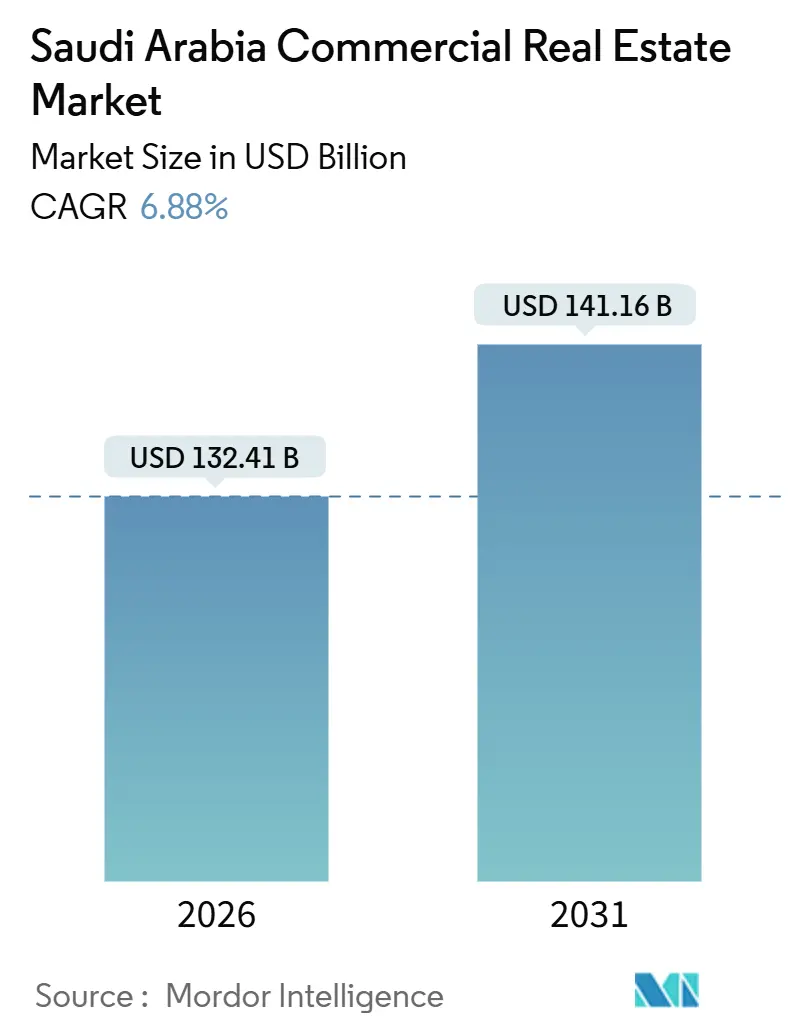
| Market Size (2026) | USD 132.41 Billion |
| Market Size (2031) | USD 141.16 Billion |
| Growth Rate (2026 - 2031) | 6.88% CAGR |
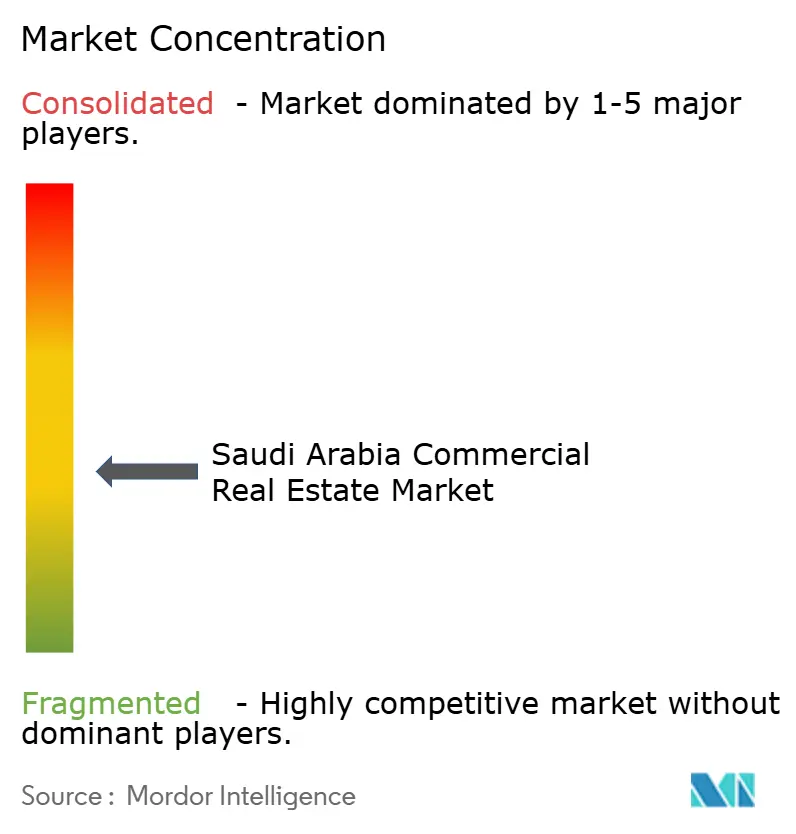
| Market Concentration | Medium |
Major Players *Disclaimer: Major Players sorted in no particular order Image © Mordor Intelligence. Reuse requires attribution under CC BY 4.0. | |
Saudi Arabia Commercial Real Estate Market Analysis by Mordor Intelligence
The Saudi Arabia commercial real estate market size is USD 132.41 billion in 2026 and is projected to reach USD 141.16 billion by 2031, reflecting a 6.88% CAGR over the forecast period. Growth is reinforced by ongoing giga-project execution, active public-sector developers, and policy initiatives that continue to unlock demand for prime office, retail, and logistics assets. Office fundamentals remain strong in the capital due to the Regional Headquarters policy and sustained leasing from multinational corporations. Logistics demand benefits from rapid e-commerce adoption, a growing network of logistics centers, and new large-scale warehousing investments. Hospitality and mixed-use districts aligned to tourism and entertainment programs add to the pipeline of commercial spaces as real estate becomes a key channel for diversification.
Key Report Takeaways
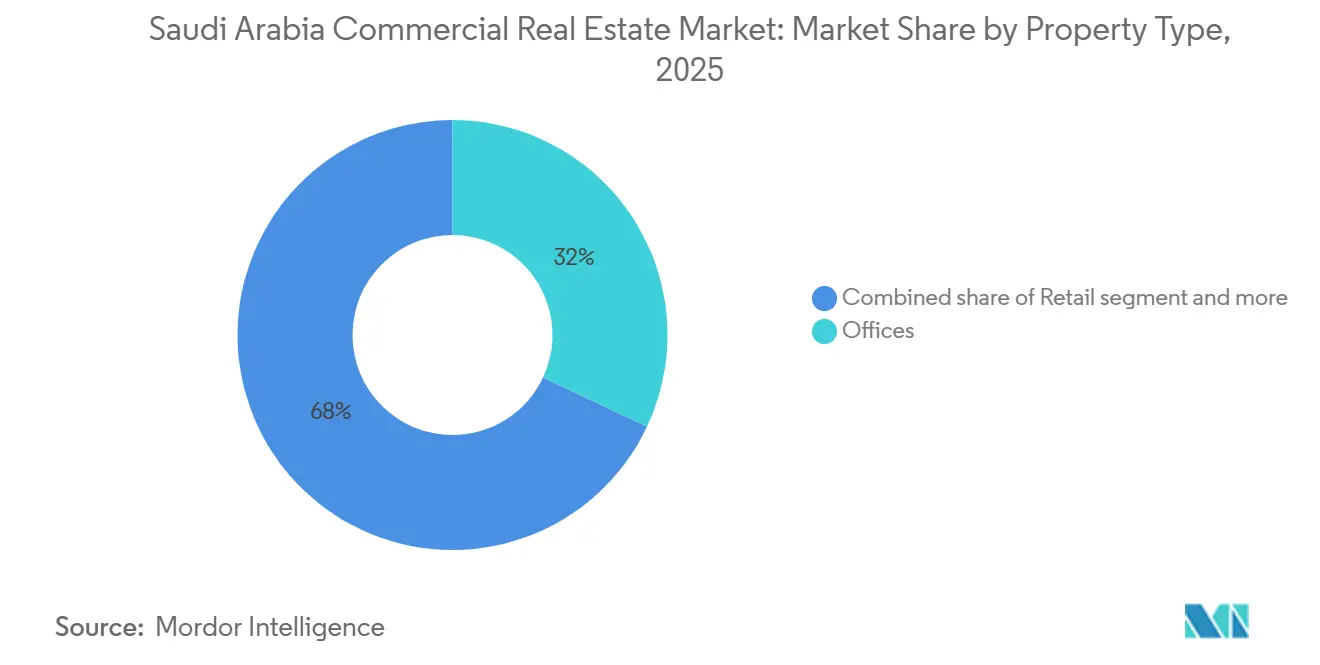
- By property type, Offices accounted for a 32% share of the Saudi Arabia commercial real estate market size in 2025, while Logistics posted the fastest growth at a 7.88% CAGR through 2031.
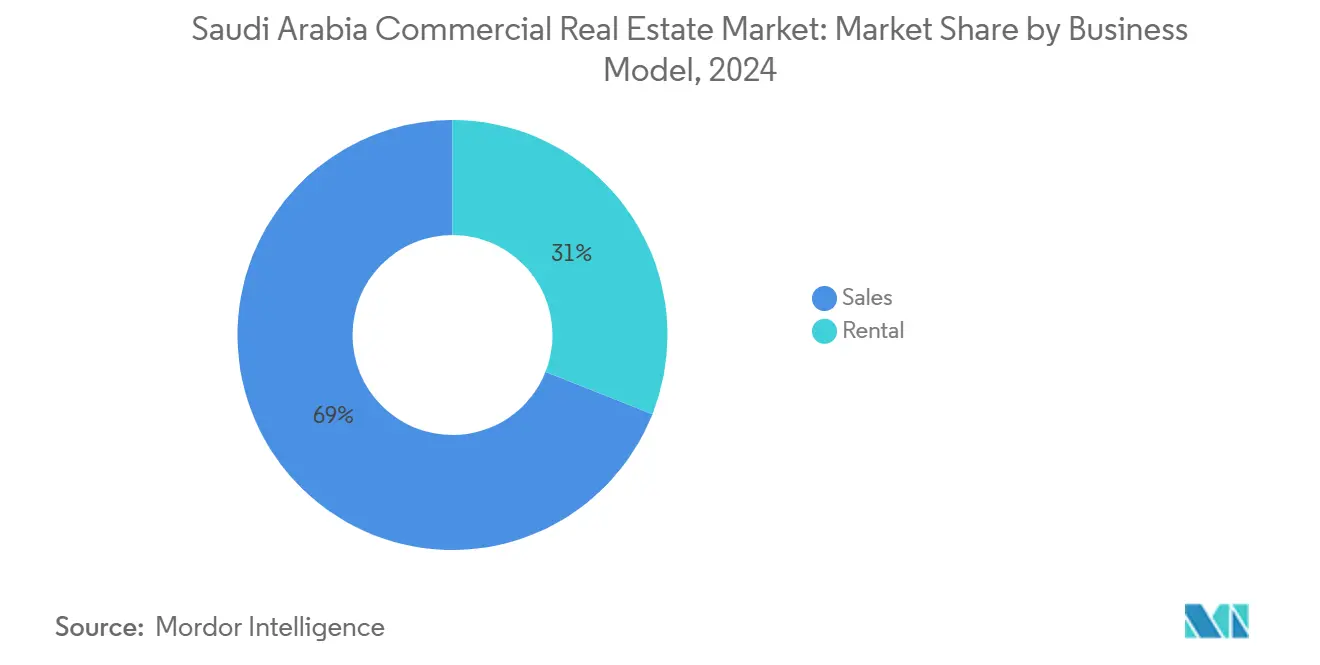
- By business model, Sales held 71% in 2025, while Rental recorded the highest projected growth with a 7.33% CAGR to 2031.
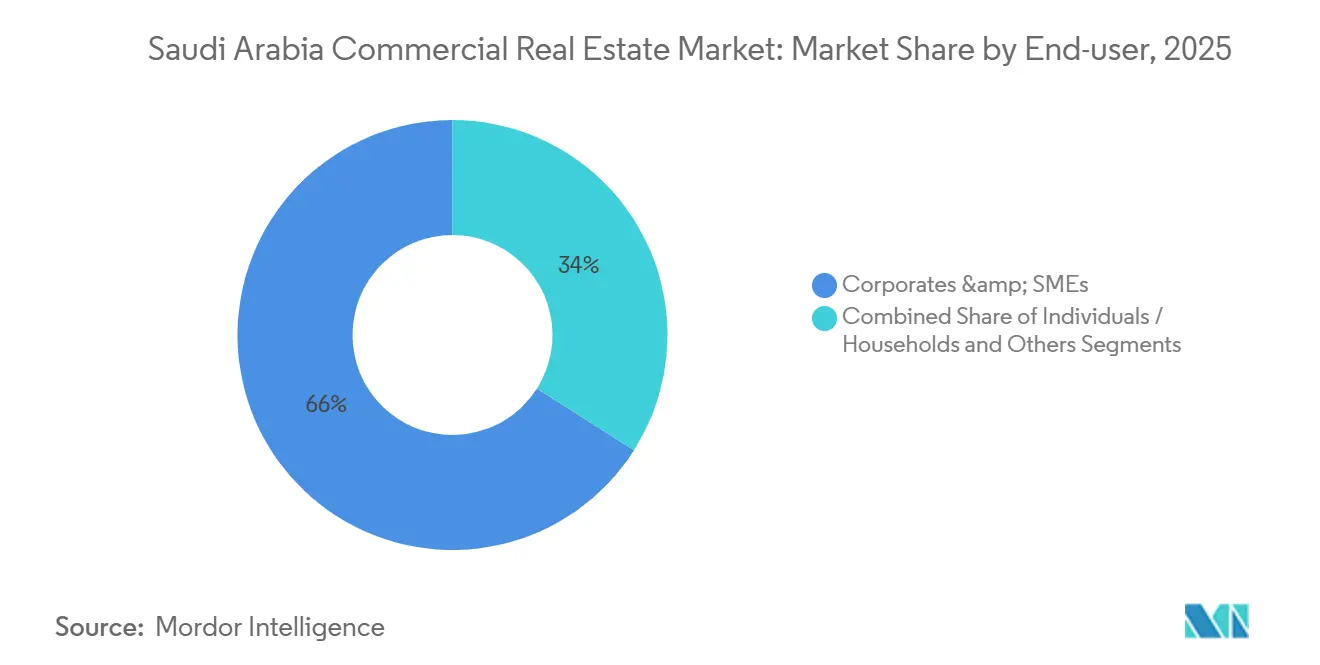
- By end-user, Corporates and SMEs led with 66% in 2025, while Individuals and Households are projected to expand at a 7.10% CAGR through 2031.
- By geography, Riyadh accounted for 49% in 2025, while Makkah is projected to expand at a 7.33% CAGR through 2031.
Note: Market size and forecast figures in this report are generated using Mordor Intelligence’s proprietary estimation framework, updated with the latest available data and insights as of January 2026.
Saudi Arabia Commercial Real Estate Market Trends and Insights
Drivers Impact Analysis
| Drivers | (~) % Impact on CAGR Forecast | Geographic Relevance | Impact Timeline |
|---|---|---|---|
| Accelerated demand for prime industrial and logistics space driven by e-commerce | +1.8% | Riyadh, Jeddah, NEOM | Short term (≤ 2 years) |
| Government-backed infrastructure pipeline lifting commercial land values | +1.5% | Global | Long term (≥ 4 years) |
| Surge in institutional capital allocation to core office assets | +1.2% | Riyadh (King Abdullah Financial District), Jeddah | Medium term (2-4 years) |
| Re-rating of ESG-compliant green buildings unlocking premium rents | +0.9% | Riyadh, Jeddah, Eastern Province | Medium term (2-4 years) |
| Rebound in international tourism revitalising CBD hotel RevPAR | +0.7% | Makkah, Madinah, Red Sea, NEOM | Short term (≤ 2 years) |
| Data-localisation mandates fueling edge data-centre development | +0.6% | Riyadh, NEOM, Jeddah | Medium term (2-4 years) |
| Source: Mordor Intelligence | |||
Accelerated Demand for Prime Industrial and Logistics Space Driven by E-Commerce
E-commerce order fulfillment rose to 290 million transactions in 2024, illustrating a step-change in distribution intensity and the need for modern, well-located warehouse space. Class A logistics sites near major airports and arterial highways are attracting multi-user developments from global operators, with one leading provider committing EUR 130 million (USD 140.4 million) for a large facility at Riyadh’s Special Integrated Logistics Zone, supported by bonded corridors and long-term land arrangements. Near-airport nodes and special zones have emerged as strategic anchors for automotive, technology, and retail supply chains, supporting temperature-controlled storage, value-added services, and compliance. Across the network, 23 activated logistics centers now cover 34.6 million square meters, with the Makkah region accounting for 20.4 million square meters, reinforcing regional fulfillment reach. As build quality improves and operating standards converge to global benchmarks, the Saudi Arabia commercial real estate market is positioned to see further consolidation of logistics footprints by multinational tenants.[1]https://www.stats.gov.sa/
Government-backed Infrastructure Pipeline Lifting Commercial Land Values
Large-scale urban programs, cultural assets, and mixed-use districts are redefining commercial corridors and elevating demand for surrounding plots. In Riyadh, New Murabba’s planned downtown redevelopment anchors prime offices, R&D spaces, and innovation hubs across 14 million square meters, with associated infrastructure catalyzing new corporate locations and retail-led experiences. Diriyah has rapidly executed awards across mixed-use clusters, including a major arena superblock with office towers and commercial amenities that broaden the occupier base and community services. Along the western coast, Red Sea Global’s phased resorts and mixed-use offerings are tying hospitality to retail and experiential spaces that require high standards for building performance and operations. These programmatic investments signal long-cycle demand creation and underpin the land value uplift that feeds into the Saudi Arabia commercial real estate market.[2]https://www.diriyahcompany.sa/en
Surge in Institutional Capital Allocation to Core Office Assets
Multinational corporations continue to scale their presence in Riyadh to align with the Regional Headquarters framework, reinforcing demand for Grade A offices in locations that concentrate policymaking and corporate decision centers. The requirement for substantive local operations has steered occupiers toward integrated districts with institutional property management and modern specs. King Abdullah Financial District has captured key tenants, including recent signings by global financial services firms, demonstrating sustained momentum for prime stock. The district’s extensive certified inventory and amenities support larger floorplates and higher space efficiency, improving occupier economics over long leases. As anchor tenants commit, institutional capital follows through acquisitions and development funding, deepening the liquidity profile of the Saudi Arabia commercial real estate market.[3]https://www.kafd.sa/
Re-rating of ESG-Compliant Green Buildings Unlocking Premium Rents
The Mostadam program has scaled local green building certifications, creating a clear pathway for projects to achieve recognized environmental and performance standards. International validation has strengthened the program’s credibility, allowing investors and tenants to benchmark outcomes against frameworks such as GRESB and LEED. KAFD’s concentration of LEED-certified assets and its smart neighborhood credential illustrate the leasing advantage of high-performing buildings, especially for multinationals with corporate sustainability commitments. Government-led schemes increasingly embed green standards from the outset, nudging private developers to adopt efficient MEP systems, smart energy management, and water-saving features to remain competitive. As operational savings accumulate and tenant preferences shift, ESG enhancements support stronger pricing and occupancy in the Saudi Arabia commercial real estate market.
Restraints Impact Analysis
| Restraints | (~) % Impact on CAGR Forecast | Geographic Relevance | Impact Timeline |
|---|---|---|---|
| Elevated construction costs and labour shortages delaying project delivery | -1.1% | Global | Short term (≤ 2 years) |
| Persistent work-from-home adoption softening CBD office net absorption | -0.8% | Riyadh, Jeddah | Medium term (2-4 years) |
| Monetary tightening and rising cap rates compressing transactions | -0.6% | Global | Short term (≤ 2 years) |
| Heightened climate-risk exposure raising insurance premiums for coastal assets | -0.4% | Jeddah, Red Sea Coast, NEOM | Long term (≥ 4 years) |
| Source: Mordor Intelligence | |||
Elevated Construction Costs and Labour Shortages Delaying Project Delivery
Input cost inflation and tight contractor capacity are pressuring delivery schedules for complex mixed-use and hospitality projects. Official construction cost indices showed persistent year-on-year increases through late 2025, driven by non-residential categories and high materials demand. Project owners are adopting modular construction and BIM-enabled coordination to improve productivity and protect timelines. Labor-market policies that promote localization are also reshaping workforce planning and wage structures across project ecosystems. These dynamics raise near-term execution risk and may stagger supply additions in the Saudi Arabia commercial real estate market.
Persistent Work-from-Home Adoption Softening CBD Office Net Absorption
As hybrid work practices mature, some occupiers are recalibrating space needs, adjusting layouts, and consolidating non-core locations. CBD Grade A remains supported by mandates that require senior executives to be present and by large organizations that prioritize proximity to government stakeholders. However, secondary submarkets with older buildings may experience slower leasing velocity as tenants seek flexible agreements and higher fit-out standards. Flexible workspace providers are expanding tailored solutions that blur the line between serviced offices and traditional leases. Over the medium term, selective softness in peripheral nodes may persist, even as prime CBD assets in the Saudi Arabia commercial real estate market maintain tight conditions.
Segment Analysis
By Property Type: Core Office Strength Contrasts with Logistics Surge
Offices held the largest share at 32% in 2025, supported by policy-driven corporate relocation and the clustering benefits of integrated business districts. Prime office districts with LEED-certified assets and smart infrastructure have attracted leading financial and professional services firms that value proximity to regulators and clients. At King Abdullah Financial District, global tenants have expanded footprints and deepened long-term commitments, creating a base of stable demand. Complementing office momentum, retail and hospitality components within mixed-use districts are being calibrated to new lifestyle and experiential formats. Select large projects in Riyadh, including New Murabba and Diriyah, continue to expand the corporate and retail ecosystem that supports the Saudi Arabia commercial real estate market.
Logistics is the fastest-growing segment with a 7.88% CAGR, reflecting e-commerce fulfillment scaling to 290 million transactions in 2024 and continued investment in modern warehousing. International operators are committing capital to near-airport multi-user facilities, such as EUR 130 million (USD 140.4 million) allocated for a 53,000-square-meter site in Riyadh’s Special Integrated Logistics Zone. Nationwide, 23 activated logistics centers now cover 34.6 million square meters, with the Makkah region alone at 20.4 million square meters, extending last-mile reach for merchants. Riyadh’s prime office rents have also increased in recent years, with benchmark Grade A locations commanding premium annual rates around SAR 2,700 per square meter (USD 720), supported by constrained vacancy in the most sought-after assets. In parallel, evolving retail formats are aligning with mixed-use strategies that integrate F&B, entertainment, and hospitality to enhance dwell times and capture broader consumer spend within the Saudi Arabia commercial real estate market.
Note: Segment shares of all individual segments available upon report purchase
Get Detailed Market Forecasts at the Most Granular Levels
Download PDF
By Business Model: Sales Dominance Yields to Rental Momentum
Sales led with 71% in 2025, reflecting strong activity across master-planned communities, corporate plots, and pre-sales in integrated neighborhoods. Public-sector developers and partners continue to execute large residential and mixed-use agreements that expand community footprints and critical services. In the capital, flagship districts catalyze surrounding land sales as infrastructure deployment unlocks new corridors. Premium inventory tied to major nodes has seen consistent buyer interest from both local and expatriate households. These transactions reinforce construction pipelines that feed into the Saudi Arabia commercial real estate market.
The Rental segment is the fastest-growing model at a 7.33% CAGR as investors seek predictable income and as institutional-quality assets enter the market. Regulatory enhancements by the Capital Market Authority have expanded flexibility for real estate funds and REITs, including development participation in select markets and structured distribution policies. Large districts are exploring capital recycling through income funds, with assets that meet modern ESG and digital infrastructure standards gaining attention from long-horizon investors. Rental performance benefits from tightening in prime nodes and from operational improvements that reduce opex and enhance occupier experience. As balance sheets adjust to the rate environment, income assets remain central to capital deployment in the Saudi Arabia commercial real estate market.
Note: Segment shares of all individual segments available upon report purchase
Get Detailed Market Forecasts at the Most Granular Levels
Download PDF
By End-user: Corporate Giants Meet Rising Household Demand
Corporates and SMEs accounted for 66% in 2025, supported by the Regional Headquarters program that concentrates executive teams, consolidates decision-making, and increases demand for Grade A space. High-spec business districts that offer LEED-certified environments and resilient digital infrastructure continue to attract multinational businesses. KAFD’s tenant roster illustrates the appeal of integrated, amenitized hubs where financial services, advisory, and technology firms can co-locate. Corporate distribution footprints are also expanding due to e-commerce growth, with national logistics center coverage enabling faster deliveries across major routes. These occupier behaviors reinforce a broad base of demand and leasing depth within the Saudi Arabia commercial real estate market.
Individuals and Households are the fastest-growing cohort at 7.10% CAGR as policy reforms and master-planned communities enhance accessibility and lifestyle amenities. Large-scale communities continue to add apartments and townhomes that broaden the product mix beyond detached villas. Residential anchors connect residents to retail, education, and healthcare within short distances, improving live-work convenience. As new phases launch, integrated neighborhoods are attracting first-time buyers and long-stay tenants who value community services and modern building standards. This consumer-led momentum complements corporate demand, supporting mixed-use vitality in the Saudi Arabia commercial real estate market.
Note: Segment shares of all individual segments available upon report purchase
Get Detailed Market Forecasts at the Most Granular Levels
Download PDF
Geography Analysis
Riyadh captured 49% of 2025 turnover, reflecting its central role in headquarters consolidation and public investment activity. Flagship districts such as KAFD anchor blue-chip tenants, supported by LEED-certified buildings and sophisticated digital infrastructure. New Murabba advances plans for a 14-million-square-meter downtown with a signature mixed-use landmark and significant commercial and R&D space, while the broader corridor benefits from transit and amenities. Major logistics commitments include a EUR 130 million (USD 140.4 million) multi-user facility at the Special Integrated Logistics Zone near King Khalid International Airport, strengthening air cargo-led distribution. The pipeline of Grade A offices and logistics infrastructure reinforces Riyadh’s appeal to corporates and long-horizon capital in the Saudi Arabia commercial real estate market.
Jeddah’s coastal economy supports diversified commercial assets, including offices, logistics, and retail formats serving a large resident and visitor base. Grade A offices continue to attract professional services, with annual rent benchmarks in prime buildings around SAR 1,393 per square meter (USD 371.5) and healthy occupancy at the top end. Large retail destinations are being aligned with experiential concepts and stronger entertainment offerings to lengthen dwell times. Port-led logistics expansion and related industrial growth add to warehouse demand near key corridors. These features position Jeddah for steady leasing in high-quality assets within the Saudi Arabia commercial real estate market.
Makkah is projected as the fastest-growing region with a 7.33% CAGR, driven by religious tourism and accompanying mixed-use development. Jabal Omar’s multi-phase destination adjacent to the Holy Mosque integrates hotels, retail, and residences that elevate capacity and visitor services. Continued progress on adjoining transport and urban upgrades supports better circulation and expands commerce. Growth in hotel keys and retail adjacencies feeds into spillover demand for back-of-house logistics and workforce housing solutions. As the region scales, balanced planning around access, services, and environmental performance will be central to sustaining momentum in the Saudi Arabia commercial real estate market.
Competitive Landscape
Public-sector developers and affiliates play a defining role, with giga-project sponsors influencing land assembly, infrastructure sequencing, and urban design at the national scale. ROSHN Group is building multi-asset communities that integrate retail, education, and health services, with SEDRA in Riyadh and MARAFY in Jeddah representing deep pipelines. Diriyah Company continues to award contracts across mixed-use nodes, expanding office clusters and residential districts that reinforce the capital’s growth corridors. Red Sea Global advances destinations with sustainability embedded, elevating standards for hospitality and retail integration. This platform-led approach enables consistent delivery and standard-setting in the Saudi Arabia commercial real estate market.
Private developers are pivoting toward asset operation and recurring income, complementing sales-led strategies. Mixed-use placemaking emphasizes walkability, convenience, and curated retail that lifts tenant performance and asset values. District-scale owners are exploring income vehicles and potential public listings to recycle capital while holding stabilized assets. Grade A office districts leverage certifications and smart infrastructure to attract global tenants and enhance rent resilience through cycle turns. This rebalancing underscores how operational capability is becoming a competitive differentiator in the Saudi Arabia commercial real estate market.
Global brands and operators continue to enter strategic partnerships that raise service standards and brand equity. Retail groups are aligning with international mall platforms to strengthen events, merchandising, and customer loyalty programs. Logistics operators are committing capital to multi-user sites in special zones to support growth in technology, retail, and automotive verticals. Hospitality partners are expanding luxury and lifestyle concepts in flagship destinations, adding high-end F&B and experiential elements that benefit adjacent commercial assets. These moves accelerate capability transfer and broaden investor participation in the Saudi Arabia commercial real estate market.
Saudi Arabia Commercial Real Estate Industry Leaders
Cenomi Centers
Hamat Holding
Unified Real Estate Development
KINAN International Real Estate
Alandalus Property
- *Disclaimer: Major Players sorted in no particular order
Need More Details on Market Players and Competitors?
Download PDF
Recent Industry Developments
- December 2025: Diriyah Company signed a 70-year lease agreement with King Saud University’s Riyadh Valley Company to develop a 552,000-square-meter plot within the Diriyah Project masterplan, supporting knowledge-economy integration within a major mixed-use district.
- November 2025: DHL Supply Chain announced a EUR 130 million (USD 140.4 million) investment to establish a 53,000-square-meter multi-user warehouse at Riyadh’s Special Integrated Logistics Zone near King Khalid International Airport, with construction scheduled to begin in Q1 2026 and completion expected by Q2 2027.
- November 2025: ROSHN Group launched SEDRA Residence, the fourth phase of the SEDRA community in North Riyadh, adding more than 700 premium apartments within the 20-million-square-meter development.
- November 2025: Diriyah Company awarded SAR 5.7 billion (USD 1.52 billion) in major construction contracts and launched 239 premium homes in the Manazel AlHadawi residential area within the Media and Innovation District.
Research Methodology Framework and Report Scope
Market Definitions and Key Coverage
Our study defines Saudi Arabia's commercial real estate market as the annual income potential, both sale and rental, of completed, income-generating non-residential property located within the kingdom, including offices, retail centers, logistics and industrial sheds, hotels, and mixed-use assets. According to Mordor Intelligence, developments enter the model only after official completion certificates are issued.
Vacant land, purely residential units, and standalone property-management services are excluded.
Segmentation Overview
- By Property Type
- Offices
- Retail
- Logistics
- Others (Industrial estate, Hospitality, etc.)
- By End-user
- Individuals / Households
- Corporates & SMEs
- Others
- By Region
- Riyadh
- Jeddah
- Makkah
- Rest of Saudi Arabia
Detailed Research Methodology and Data Validation
Primary Research
Mordor analysts interviewed brokers in Riyadh and Jeddah, logistics-park operators, hotel asset managers, and policy officials across the kingdom. Their feedback validated vacancy spreads, effective rent levels, pipeline timing, and foreign-capital sentiment, closing gaps left by desk research.
Desk Research
We compiled macro and sector inputs from tier-1 public sources such as the General Authority for Statistics, Saudi Central Bank, the Real Estate General Authority, and Ministry of Tourism, supported by association releases, developer filings, and reliable press. Paid platforms, D&B Hoovers for company financials and Dow Jones Factiva for deal tracking, supplied granular cross-checks. These illustrate our desk sources; many other references were consulted for confirmation.
Market-Sizing & Forecasting
We reconstructed the 2024 market using a top-down build of construction completions and REGA transaction registers, followed by selective bottom-up roll-ups of sampled asset sales to refine anomalies. Variables such as building-permit issuances, Grade A office vacancy, foreign direct investment inflows, e-commerce parcel volumes, and pilgrim arrivals feed the model. An ARIMA forecast, scenario-tested with interviewees, extends results to 2030.
Data Validation & Update Cycle
Outputs undergo dual analyst review, variance checks against independent indicators, and, before publication, a fresh pass to reflect any material events. Models refresh annually, with interim updates triggered by policy shifts or mega-project announcements.
Why Our Saudi Arabia Commercial Real Estate Baseline Stands Out for Decision Makers
Published estimates frequently diverge because firms adopt different asset baskets, pricing bases, and refresh cadences.
The comparison below illustrates how those choices alter the headline number.
Benchmark comparison
| Market Size | Anonymized source | Primary gap driver |
|---|---|---|
| USD 132.41 B (2025) | Mordor Intelligence | - |
| USD 67.50 B (2024) | Regional Consultancy A | Omits hospitality and logistics assets; sale data only |
| USD 34.90 B (2024) | Global Consultancy B | Focuses on Grade A offices in three cities; ignores rental flows |
| USD 45.20 B (2024) | Industry Journal C | Applies conservative price-per-sqm, excludes pipeline deliveries |
Mordor Intelligence captures a broader asset mix, aligns prices with verified closings, and applies a disciplined update cadence, giving stakeholders a balanced, transparent baseline rooted in traceable variables and repeatable steps.
Need A Different Region or Segment?
Customize Now
Key Questions Answered in the Report
What is the current size and 5-year outlook for the Saudi Arabia commercial real estate market?
The Saudi Arabia commercial real estate market size is USD 132.41 billion in 2026 and is projected to reach USD 141.16 billion by 2031 at a 6.88% CAGR.
Which property type leads and which is growing fastest in Saudi Arabia commercial real estate?
Offices led with 32% of the Saudi Arabia commercial real estate market share in 2025, while Logistics is the fastest-growing at a 7.88% CAGR through 2031.
What is driving logistics demand in the Saudi Arabia commercial real estate market?
E-commerce fulfilment reached 290 million transactions in 2024 and major operators committed new capital to multi-user facilities near airports and special logistics zones.
Which business model is expanding quickest in Saudi Arabia commercial real estate?
Rental is the fastest-growing model at a 7.33% CAGR due to investor appetite for income assets and supportive fund regulations.
Which region is growing fastest and why in Saudi Arabia commercial real estate?
Makkah is projected at a 7.33% CAGR, supported by religious tourism and mixed-use projects expanding hotel and retail capacity.
How are ESG and green building policies influencing the Saudi Arabia commercial real estate market?
Mostadam certifications and LEED-aligned assets like KAFD are attracting tenants and investors, supporting premiums and operational savings.


